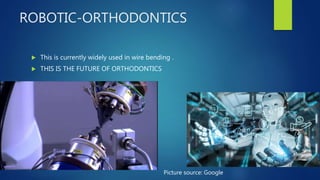
The document outlines the advancements in digital orthodontics, including patient data digitization, virtual treatment planning, and the use of intraoral scanners for accurate impressions. It discusses various technological aids for diagnosis, imaging, and aligner fabrication, emphasizing the benefits of digital methods over traditional practices. Additionally, it explores the role of artificial intelligence, tele-orthodontics, and robotics in enhancing orthodontic treatments and improving patient outcomes.

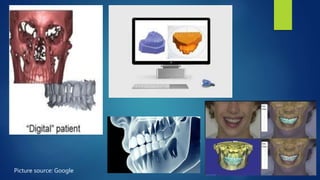
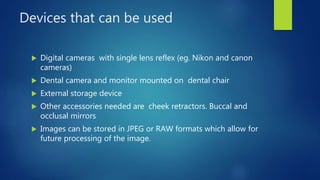
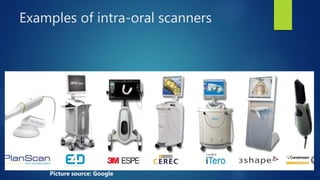
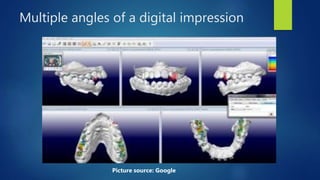
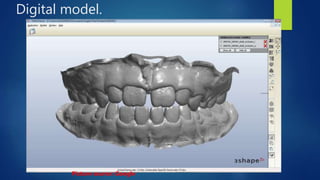
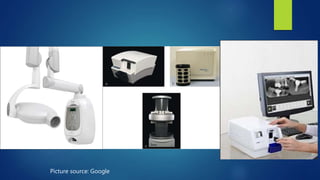
![ The CAD software converts the clinical tooth misalignments into a 3D
digital image in the most common file format (i.e., Standard Tessellation
Language [STL]).
Subsequently, the graphic representation of the dental models can be
manipulated by human hands using FEM software to simulate how the
teeth will move throughout the treatment according to the orthodontist’s
plan.
On the virtual planning software, the dentist dictates how and when each
tooth movement should occur, plans if any tooth should remain stationary,
decides on incisor proclination or anterior dental arch constriction, dictates
the amount of dental distalization, extrusion or intrusion, and anything else
necessary for achieving the orthodontic treatment goals.](https://image.slidesharecdn.com/digitalorthodonticsbydrolarinmoye-201202075445/85/Digital-orthodontics-41-320.jpg)
![Classification of rapid prototyping
Broadly rapid prototyping may be categorized into:
1) Additive method – which is widely used
2) Subtractive – less effective.
The frequent technologies that are adopted in dental practice are:
1. Stereolithography is an additive manufacturing process which uses UV-Photopolymer
curable resin and a UV laser to build layer by layer. It is the most widely used.
2. Selective laser sintering (SLS)
3. Inkjet-based system (3D printers [3DP])
4. Fused deposition modeling (FDM).](https://image.slidesharecdn.com/digitalorthodonticsbydrolarinmoye-201202075445/85/Digital-orthodontics-47-320.jpg)