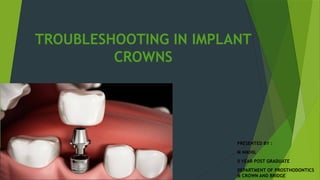
TROUBLESHOOTING IN IMPLANT
CROWNS
PRESENTED BY :
M NIKHIL
II YEAR POST GRADUATE
DEPARTMENT OF PROSTHODONTICS
& CROWN AND BRIDGE
INTRODUCTION
 Implant-supported fixed dental prostheses (FDP) represent a well-established
treatment option that has evolved to become a standard of care in dental
practice.
 A successful implant crown restoration is crucial for multiple reasons. It
ensures the functionality of the dentition (chewing and speaking), maintains
oral and systemic health, and provides aesthetic satisfaction to patients.
Unsuccessful restorations can lead to complications like occlusal problems,
peri-implant disease, and patient dissatisfaction.
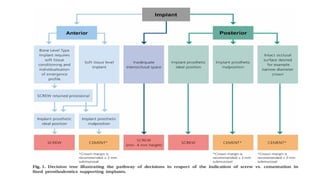
 Implant supported restorations can be attached to implants with screws or
can be cemented to abutments which are secured to implants with screws.
 Both retention types have been applied for single, multiple and cross-arch
fixed dental prostheses. Long-span prostheses should preferably be screw
retained for easier maintenance.
 However, if the implant is not placed in a prosthetically ideal position– with
the future access hole of the planned crown below the planned incisal edge
position– cement retention is often the only treatment option.
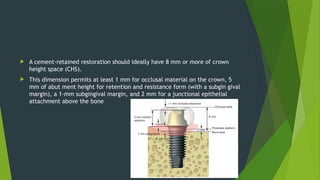
 A cement-retained restoration should ideally have 8 mm or more of crown
height space (CHS).
 This dimension permits at least 1 mm for occlusal material on the crown, 5
mm of abut ment height for retention and resistance form (with a subgin gival
margin), a 1-mm subgingival margin, and 2 mm for a junctional epithelial
attachment above the bone
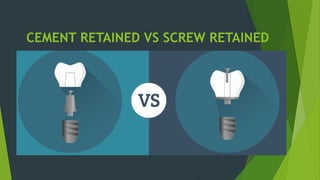
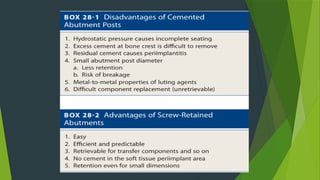
CEMENT RETAINED VS SCREW RETAINED
RETRIEVABILITY
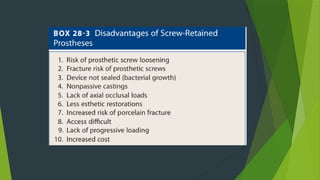
 Implant prostheses have more complications
1. Abutment screw loosening,
2. Porcelain fracture,
3. Crestal bone loss, and
4. Implant failure during the first year of loading.
Axial Load
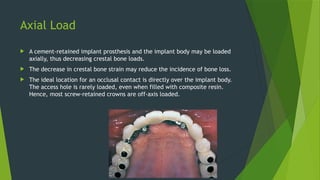
 A cement-retained implant prosthesis and the implant body may be loaded
axially, thus decreasing crestal bone loads.
 The decrease in crestal bone strain may reduce the incidence of bone loss.
 The ideal location for an occlusal contact is directly over the implant body.
The access hole is rarely loaded, even when filled with composite resin.
Hence, most screw-retained crowns are off-axis loaded.
Hygiene of the Implant Sulcus
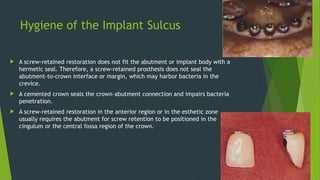
 A screw-retained restoration does not fit the abutment or implant body with a
hermetic seal. Therefore, a screw-retained prosthesis does not seal the
abutment-to-crown interface or margin, which may harbor bacteria in the
crevice.
 A cemented crown seals the crown–abutment connection and impairs bacteria
penetration.
 A screw-retained restoration in the anterior region or in the esthetic zone
usually requires the abutment for screw retention to be positioned in the
cingulum or the central fossa region of the crown.
Occlusal Material Fracture
 Occlusal material fracture is more common with implants than natural teeth
because of the lack of periodontal stress relief with implants and a resultant
higher impact force to the occlusal material.
 A decreased incidence of porcelain or acrylic fracture of the prosthesis has
been observed with cement-retained restorations compared with screw-
retained prostheses.
 The screw hole may increase stress concentration to the restoring material
and more often leads to unsupported porcelain.
Access
 Access is more challenging in the posterior regions of the mouth for insertion
of screw-retained restorations, especially in patients with limited jaw
opening.
 The screwdrivers to place and torque the prosthetic screws are usually
greater than 15 mm in height.
Component Fracture
 A long-term complication of screw-retained prostheses is fatigue failure of the
screw components.
 The narrow diameter of the prosthesis screw reduces its long-term strength.
 The bending fracture resistance for a solid object is low. Because the
diameter of the occlusal screw is the smallest of any implant component, the
screw is most at risk for breakage
Cost and Time
 The laboratory costs for a screw-retained restoration are greater than those
for a cemented prosthesis.
 Screw-retained restorations require additional laboratory components such as
impression transfers, analogs, copings, and screws.
 Fewer and shorter prosthetic appointments are required to restore a patient
with a cemented prosthesis than with a screw-retained restoration.
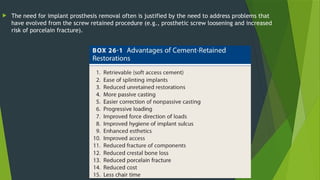
 The need for implant prosthesis removal often is justified by the need to address problems that
have evolved from the screw retained procedure (e.g., prosthetic screw loosening and increased
risk of porcelain fracture).
Low-Profile Retention
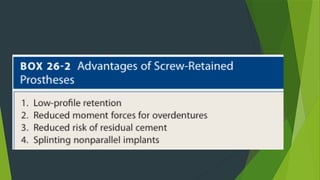
 The primary advantage of a screw-retained superstructure is the lower profile retention of the
abutment system.
 Cemented prostheses require a vertical component of at least 5 mm to provide retention and
resistance form.
 A crown height reduction of 2 mm may decrease the retention as much as 40% when the implant
abutment is only 4 mm in diameter.
 The screw retained system is more resistant to removal forces than the cement abutment when the
abutment height is less than 5 mm.
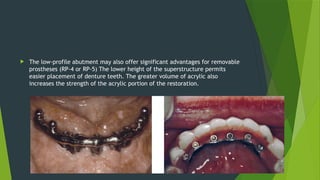
 The low-profile abutment may also offer significant advantages for removable
prostheses (RP-4 or RP-5) The lower height of the superstructure permits
easier placement of denture teeth. The greater volume of acrylic also
increases the strength of the acrylic portion of the restoration.
Reduced Moments of Force
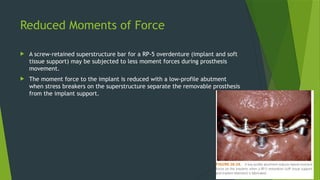
 A screw-retained superstructure bar for a RP-5 overdenture (implant and soft
tissue support) may be subjected to less moment forces during prosthesis
movement.
 The moment force to the implant is reduced with a low-profile abutment
when stress breakers on the superstructure separate the removable prosthesis
from the implant support.
Risk of residual cement in the sulcus
 Another advantage of screw-retained crowns is the absence of residual
cement in the gingival crevice, which may cause irritation to the surrounding
tissues and lead to increased plaque retention and inflammation, similar to an
excess cement condition with crowns on natural teeth.
 Subgingival margins increase the incidence of incomplete cement removal on
teeth or implant abutments.
Nonparallel Implants
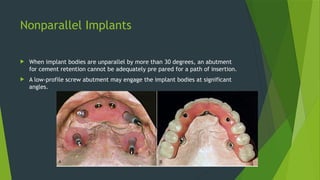
 When implant bodies are unparallel by more than 30 degrees, an abutment
for cement retention cannot be adequately pre pared for a path of insertion.
 A low-profile screw abutment may engage the implant bodies at significant
angles.
Complications in cement retained prosthesis
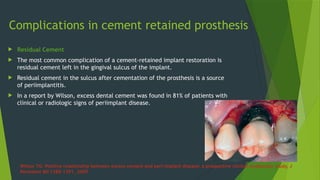
 Residual Cement
 The most common complication of a cement-retained implant restoration is
residual cement left in the gingival sulcus of the implant.
 Residual cement in the sulcus after cementation of the prosthesis is a source
of periimplantitis.
 In a report by Wilson, excess dental cement was found in 81% of patients with
clinical or radiologic signs of periimplant disease.
Wilson TG: Positive relationship between excess cement and peri-implant disease: a prospective clinical endoscopic study, J
Periodont 80:1388–1391, 2009.
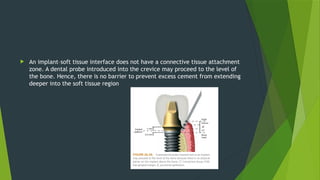
 An implant–soft tissue interface does not have a connective tissue attachment
zone. A dental probe introduced into the crevice may proceed to the level of
the bone. Hence, there is no barrier to prevent excess cement from extending
deeper into the soft tissue region
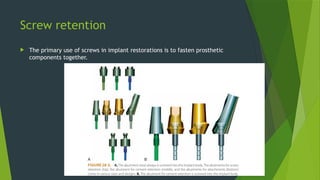
Screw retention
 The primary use of screws in implant restorations is to fasten prosthetic
components together.
Screw Loosening of Abutment and
Prosthetic Screws
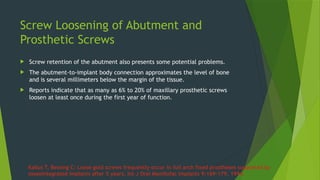
 Screw retention of the abutment also presents some potential problems.
 The abutment-to-implant body connection approximates the level of bone
and is several millimeters below the margin of the tissue.
 Reports indicate that as many as 6% to 20% of maxillary prosthetic screws
loosen at least once during the first year of function.
Kallus T, Bessing C: Loose gold screws frequently occur in full arch fixed prostheses supported by
osseointegrated implants after 5 years, Int J Oral Maxillofac Implants 9:169–179, 1994.
Causes of screw loosening and fracture
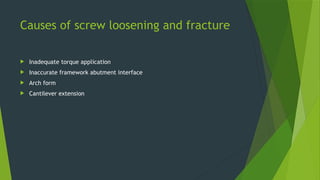
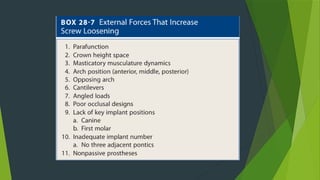
 Inadequate torque application
 Inaccurate framework abutment interface
 Arch form
 Cantilever extension
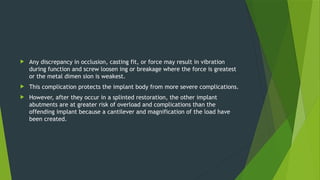
 Any discrepancy in occlusion, casting fit, or force may result in vibration
during function and screw loosen ing or breakage where the force is greatest
or the metal dimen sion is weakest.
 This complication protects the implant body from more severe complications.
 However, after they occur in a splinted restoration, the other implant
abutments are at greater risk of overload and complications than the
offending implant because a cantilever and magnification of the load have
been created.
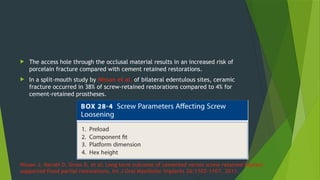
 The access hole through the occlusal material results in an increased risk of
porcelain fracture compared with cement retained restorations.
 In a split-mouth study by Nissan et al. of bilateral edentulous sites, ceramic
fracture occurred in 38% of screw-retained restorations compared to 4% for
cement-retained prostheses.
Nissan J, Narobi D, Gross D, et al: Long term outcome of cemented verses screw retained implant
supported fixed partial restorations, Int J Oral Maxillofac Implants 26:1102–1107, 2011.
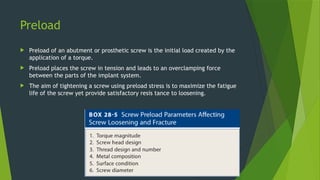
Preload
 Preload of an abutment or prosthetic screw is the initial load created by the
application of a torque.
 Preload places the screw in tension and leads to an overclamping force
between the parts of the implant system.
 The aim of tightening a screw using preload stress is to maximize the fatigue
life of the screw yet provide satisfactory resis tance to loosening.
Torque magnitude
 The amount of force applied to tighten a screw joint is related to the success
of the components staying connected.
 Too small a torque leads to low clamping forces, which increase the risk of
loosening.
 The clamping forces on a metal-to-metal screw component are one of the
more important considerations for long-term screw fixation.
 The clamp force is directly proportional to the force used to tighten the
screw.
 The magnitude of the preload is related directly to the clamping force.
Screw head design
 The head of the screw is wider than the outer thread diameter and for an
implant abutment or prosthetic screw may be tapered or flat.
 The tapered head prosthetic screw design reduces the clamping effect and
reduces the tensile force in the threads of the screw. Most of the force within
the tapered screw head is distributed to the head rather than to the fixation
screw component.

Screw fracture
 The most common causes of screw fracture are a partially unretained
restoration or fatigue related to the amount of force or the number of cycles.
 Prosthetic screw fracture occurs approximately 4% of the time and abutment
screw fracture 2% of the time. The difference is related to the diameter of
the component.
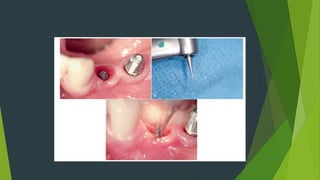
 There are five options to remove a fractured screw, and the method proceeds
in a particular order.
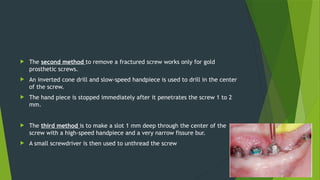
 The second method to remove a fractured screw works only for gold
prosthetic screws.
 An inverted cone drill and slow-speed handpiece is used to drill in the center
of the screw.
 The hand piece is stopped immediately after it penetrates the screw 1 to 2
mm.
 The third method is to make a slot 1 mm deep through the center of the
screw with a high-speed handpiece and a very narrow fissure bur.
 A small screwdriver is then used to unthread the screw
 The fourth method to remove a fractured screw is used when the prosthetic screw
fractures in an abutment for screw reten tion.
 The abutment is removed and replaced with a new abut ment and prosthetic screw of the
same design and size.
 The last option to retrieve an abutment screw is to grind out the fractured abutment with
a high-speed handpiece and fissure bur.
 The heat generated during this process is high enough to cause bone necrosis and implant
failure. The patient is instructed to notify the dentist when the generated heat is
noticeable, which is often less than 5 to 10 seconds after the initial drilling.
Framework fracture
 A cross sectional dimension of atleast 4x6mm is needed.
 Common areas of fracture are
 Solder joints and distal to distal most implant.
 Zarb et al reported an increased incidence of framework breakage if
extensions in mandible exceed 20mm
Prosthetic complications and failures of implant-supported fixed partial dentures: A scoping review
da Silva Bezerra, Aliane et al. Journal of Prosthetic Dentistry, Volume 0, Issue 0,.2023
 Aliane et al conducted a study on prosthetic complications and failures of
implant supported FPDs.
 The search yielded 5695 studies. Fourteen articles were included in this
review for data extraction. Veneering porcelain fracture, screw fracture, and
implant loss were the most common failures reported. Technical
complications mainly involved screw loosening, loss of retention, and wear of
the screw-access restoration.
Review of literature
Goodacre, Brian J et al. “Prosthetic complications with implant prostheses (2001-
2017).” European journal of oral implantology vol. 11 Suppl 1 (2018): S27-S36.
 In a study conducted by brian j et al on prosthetic complications with implant
prosthetics he concluded that Implant overdentures are associated with more
complications than implant fixed complete dentures, implant fixed partial
dentures, and implant single crowns.
 The lowest incidence of complications was reported with implant single
crowns. The most common complication reported with implant fixed
complete dentures was denture tooth fracture.
 Sailer et al. Conducted a systematic review on 59 studies with minimum of 1
year follow up. He concluded that :
 Cemented single crowns: 5-year reconstruction survival was 96.5% .Screw
retained single crowns :89.3%(P=0.091)
 Cemented partial fixed dental prostheses (FDPs):5-year survival rate:96.9%.
Screw retained partial : 98%(P=0.47)
 Cemented full-arch FDPs:5-year survival: 100%; Screw retained :95.8%(P=0.54)
 Estimated 5-year cumulative incidence of technical complications:
 cemented single crowns11.9%; screw retained crowns:24.4%.
 Partial and full-arch FDPs cemented 24.5%, screw retained 22.1%; full-arch
FDPs,cemen ted 62.9%, screw retained 54.1%
 Biological complications such as marginal boneloss >2 mm occurred more
frequently at cemented crowns(5-year incidence:2.8%) than at screw retained
crowns (5-year incidence:0%)
Conclusion
 Successful implant crown restorations require careful planning, accurate
execution, and diligent maintenance.
 Awareness of potential complications and proactive troubleshooting ensures
long-term success and patient satisfaction.
 Implant crown restorations benefit significantly from collaboration among
prosthodontists, periodontists, and dental technicians.
 Each plays a critical role in ensuring success through accurate diagnosis,
precision in fabrication, and management of complications.
References
 Dental Implants Prosthetics, Carl E Misch, 2nd
Edition
 Pietrabissa R, Gionso L, Quaglini V, et al: An in vivo study on compensation
mismatch of screwed vs cement-retained implant supported fixed prostheses,
Clin Oral Implants Res 11:448–457, 2000.
 Nissan J, Narobi D, Gross D, et al: Long term outcome of cemented verses
screw retained implant supported fixed partial restorations, Int J Oral
Maxillofac Implants 26:1102–1107, 2011.
 Kallus T, Bessing C: Loose gold screws frequently occur in full arch fixed
prostheses supported by osseointegrated implants after 5 years, Int J Oral
Maxillofac Implants 9:169–179, 1994.
 Millen C, Bragger U, Wittneben JG. Influence of prosthesis type and retention
mechanism on complications with fixed implant-supported prostheses: a
systematic review apply ing multivariate analyses. Int J Oral Maxillofac
Implants 2015: 30: 110–124.
 Goodacre, Brian J et al. “Prosthetic complications with implant prostheses
(2001-2017).” European journal of oral implantology vol. 11 Suppl 1 (2018):
S27-S36.
 Prosthetic complications and failures of implant-supported fixed partial
dentures: A scoping review da Silva Bezerra, Aliane et al.
Journal of Prosthetic Dentistry, Volume 0, Issue 0,.2023
TROUBLESHOOTING IN IMPLANT CROWNS.pptx ppt