0
AN INFORMATIONAL
BOOKLET
ON
BASIC LIFE SUPPORT
This informational booklet explains about Basic Life Support. BLS is the foundation for saving lives after
cardiac arrest. You will learn the skills of high-quality cardiopulmonary resuscitation (CPR) for victims of
adult both as a single rescuer and as a member of a multirescuer team. The knowledge you learn in this
booklet will enable you to recognize cardiac arrest, activate the emergency response system early and
respond quickly and confidently.
GENERAL CONCEPT
An Informational Booklet content:
 Basic Life Support
 Introduction of heart………..
 Location and surface projection, Layers of heart wall, Chambers of heart, Valves of
heart, Normal heart sound, Coronary circulation, Cardiac conduction system
 Cardiac Arrest………….
 Definition, Cause, Symptom, Diagnosis, Management
 Basic life support………..
 Definition, American Heart Association 2020 guideline, Basic Steps Assessment , High
quality CPR components for BLS providers, BLS Algorithm, Choking relief for adult
Life is a celebration of life. A simple yet powerful answer to the question of
why we should all be healthy in heart and mind.
I encourage you to discover your Why and share it with others. Ask yourself;
what are the moments, people and experiences I live for? What makes me joy,
wonder, and happiness? Why am I saves lives? Why is cardiovascular care
important to me? The answer to these questions is your Why.
Through informational Booklet you will find information that correlates with
the importance of cardiovascular care.
Why do we do what we do?
Life is why.
BASIC LIFE SUPPORT
INTRODUCTION OF HEART
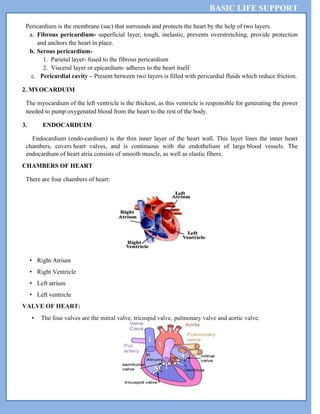
Heart is the vital organ in the circulatory system, primarily responsible for delivering the circulation of
blood and transportation of oxygen and nutrients, as well as assisting in the removal of metabolic wastes in
all parts of the body. The heart is usually beating about 60 to 100 times per minute.
LOCATION AND SURFACE PROJECTION
• The heart is the hollow, cone shaped about the size of closed fist
• The heart is specifically located in thoracic cavity. It lies in the mediastinum between the lungs and
rests upon the diaphragm.
• The heart lies within a fluid filled cavity called pericardial cavity.
• The heart weighs about 250- 350 gms.
LAYERS OF HEART WALLS
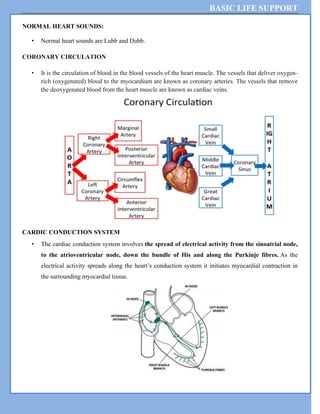
 There are mainly 3 layers of heart: Epicardium, myocardium, endocardium.
1. PERICARDUIM/ EPICARDUIM:
It is the layer immediately outside of the heart muscle proper (the myocardium). The epicardium is
largely made of connective tissue and functions as a protective layer.
BASIC LIFE SUPPORT
Pericardium is the membrane (sac) that surrounds and protects the heart by the help of two layers.
a. Fibrous pericardium- superficial layer, tough, inelastic, prevents overstretching, provide protection
and anchors the heart in place.
b. Serous pericardium-
1. Parietal layer- fused to the fibrous pericardium
2. Visceral layer or epicardium- adheres to the heart itself
c. Pericardial cavity – Present between two layers is filled with pericardial fluids which reduce friction.
2. MYOCARDUIM
The myocardium of the left ventricle is the thickest, as this ventricle is responsible for generating the power
needed to pump oxygenated blood from the heart to the rest of the body.
3. ENDOCARDUIM
Endocardium (endo-cardium) is the thin inner layer of the heart wall. This layer lines the inner heart
chambers, covers heart valves, and is continuous with the endothelium of large blood vessels. The
endocardium of heart atria consists of smooth muscle, as well as elastic fibers.
CHAMBERS OF HEART
There are four chambers of heart:
• Right Atrium
• Right Ventricle
• Left atrium
• Left ventricle
VALVE OF HEART:
• The four valves are the mitral valve, tricuspid valve, pulmonary valve and aortic valve.
BASIC LIFE SUPPORT
NORMAL HEART SOUNDS:
• Normal heart sounds are Lubb and Dubb.
CORONARY CIRCULATION
• It is the circulation of blood in the blood vessels of the heart muscle. The vessels that deliver oxygen-
rich (oxygenated) blood to the myocardium are known as coronary arteries. The vessels that remove
the deoxygenated blood from the heart muscle are known as cardiac veins.
CARDIC CONDUCTION SYSTEM
• The cardiac conduction system involves the spread of electrical activity from the sinoatrial node,
to the atrioventricular node, down the bundle of His and along the Purkinje fibres. As the
electrical activity spreads along the heart’s conduction system it initiates myocardial contraction in
the surrounding myocardial tissue.
BASIC LIFE SUPPORT
• The sinoatrial (SA) node or sinus node is the heart's natural pacemaker. The AV node serves as an
electrical relay station, slowing the electrical current sent by the sinoatrial (SA) node before the signal
is permitted to pass down through to the ventricles. The bundle of His is an important part of the
electrical conduction system of the heart, as it transmits impulses from the atrioventricular node,
located at the anterior-inferior end of the interatrial septum, to the ventricles of the heart. The left
bundle branch further divides into the left anterior and the left posterior fascicles. These bundles and
fascicles give rise to thin filaments known as Purkinje fibers.
CARDIAC ARREST
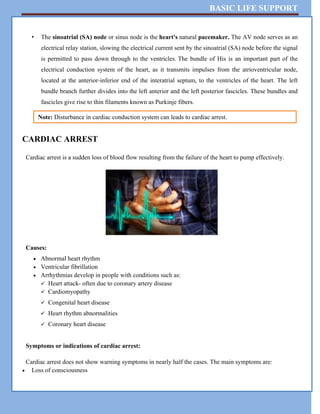
Cardiac arrest is a sudden loss of blood flow resulting from the failure of the heart to pump effectively.
Causes:
 Abnormal heart rhythm
 Ventricular fibrillation
 Arrhythmias develop in people with conditions such as:
 Heart attack- often due to coronary artery disease
 Cardiomyopathy
 Congenital heart disease
 Heart rhythm abnormalities
 Coronary heart disease
Symptoms or indications of cardiac arrest:
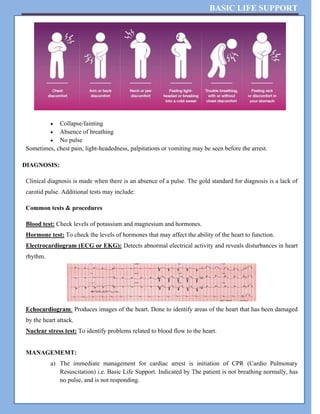
Cardiac arrest does not show warning symptoms in nearly half the cases. The main symptoms are:
 Loss of consciousness
Note: Disturbance in cardiac conduction system can leads to cardiac arrest.
BASIC LIFE SUPPORT
 Collapse/fainting
 Absence of breathing
 No pulse
Sometimes, chest pain, light-headedness, palpitations or vomiting may be seen before the arrest.
DIAGNOSIS:
Clinical diagnosis is made when there is an absence of a pulse. The gold standard for diagnosis is a lack of
carotid pulse. Additional tests may include:
Common tests & procedures
Blood test: Check levels of potassium and magnesium and hormones.
Hormone test: To check the levels of hormones that may affect the ability of the heart to function.
Electrocardiogram (ECG or EKG): Detects abnormal electrical activity and reveals disturbances in heart
rhythm.
Echocardiogram: Produces images of the heart. Done to identify areas of the heart that has been damaged
by the heart attack.
Nuclear stress test: To identify problems related to blood flow to the heart.
MANAGEMEMT:
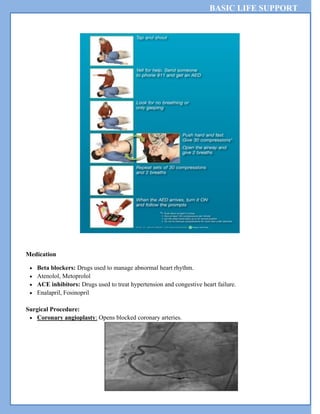
a) The immediate management for cardiac arrest is initiation of CPR (Cardio Pulmonary
Resuscitation) i.e. Basic Life Support. Indicated by The patient is not breathing normally, has
no pulse, and is not responding.
BASIC LIFE SUPPORT
Medication
 Beta blockers: Drugs used to manage abnormal heart rhythm.
 Atenolol, Metoprolol
 ACE inhibitors: Drugs used to treat hypertension and congestive heart failure.
 Enalapril, Fosinopril
Surgical Procedure:
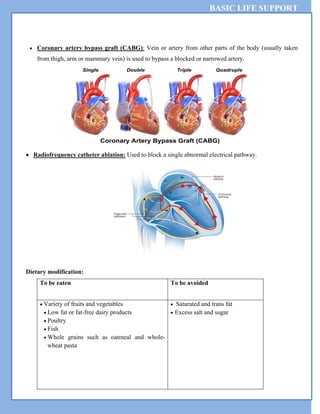
 Coronary angioplasty: Opens blocked coronary arteries.
BASIC LIFE SUPPORT
 Coronary artery bypass graft (CABG): Vein or artery from other parts of the body (usually taken
from thigh, arm or mammary vein) is used to bypass a blocked or narrowed artery.
 Radiofrequency catheter ablation: Used to block a single abnormal electrical pathway.
Dietary modification:
To be eaten To be avoided
 Variety of fruits and vegetables
 Low fat or fat-free dairy products
 Poultry
 Fish
 Whole grains such as oatmeal and whole-
wheat pasta
 Saturated and trans fat
 Excess salt and sugar
BASIC LIFE SUPPORT
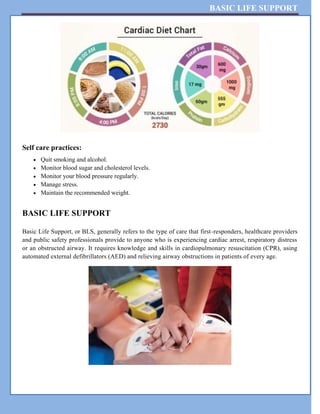
Self care practices:
 Quit smoking and alcohol.
 Monitor blood sugar and cholesterol levels.
 Monitor your blood pressure regularly.
 Manage stress.
 Maintain the recommended weight.
BASIC LIFE SUPPORT
Basic Life Support, or BLS, generally refers to the type of care that first-responders, healthcare providers
and public safety professionals provide to anyone who is experiencing cardiac arrest, respiratory distress
or an obstructed airway. It requires knowledge and skills in cardiopulmonary resuscitation (CPR), using
automated external defibrillators (AED) and relieving airway obstructions in patients of every age.
BASIC LIFE SUPPORT
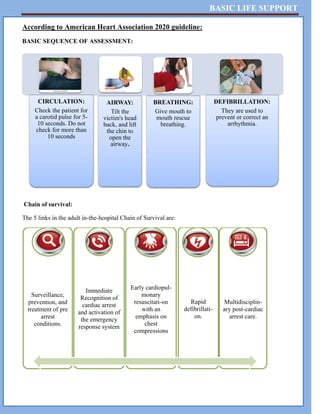
According to American Heart Association 2020 guideline:
BASIC SEQUENCE OF ASSESSMENT:
Chain of survival:
The 5 links in the adult in-the-hospital Chain of Survival are:
CIRCULATION:
Check the patient for
a carotid pulse for 5-
10 seconds. Do not
check for more than
10 seconds
AIRWAY:
Tilt the
victim's head
back, and lift
the chin to
open the
airway.
BREATHING:
Give mouth to
mouth rescue
breathing.
DEFIBRILLATION:
They are used to
prevent or correct an
arrhythmia.
Surveillance,
prevention, and
treatment of pre
arrest
conditions.
Immediate
Recognition of
cardiac arrest
and activation of
the emergency
response system
Early cardiopul-
monary
resuscitati-on
with an
emphasis on
chest
compressions
Rapid
defibrillati-
on.
Multidisciplin-
ary post-cardiac
arrest care.
BASIC LIFE SUPPORT
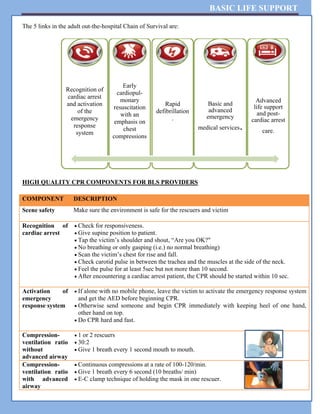
The 5 links in the adult out-the-hospital Chain of Survival are:
HIGH QUALITY CPR COMPONENTS FOR BLS PROVIDERS
COMPONENT DESCRIPTION
Scene safety Make sure the environment is safe for the rescuers and victim
Recognition of
cardiac arrest
 Check for responsiveness.
 Give supine position to patient.
 Tap the victim’s shoulder and shout, “Are you OK?"
 No breathing or only gasping (i.e.) no normal breathing)
 Scan the victim’s chest for rise and fall.
 Check carotid pulse in between the trachea and the muscles at the side of the neck.
 Feel the pulse for at least 5sec but not more than 10 second.
 After encountering a cardiac arrest patient, the CPR should be started within 10 sec.
Activation of
emergency
response system
 If alone with no mobile phone, leave the victim to activate the emergency response system
and get the AED before beginning CPR.
 Otherwise send someone and begin CPR immediately with keeping heel of one hand,
other hand on top.
 Do CPR hard and fast.
Compression-
ventilation ratio
without
advanced airway
 1 or 2 rescuers
 30:2
 Give 1 breath every 1 second mouth to mouth.
Compression-
ventilation ratio
with advanced
airway
 Continuous compressions at a rate of 100-120/min.
 Give 1 breath every 6 second (10 breaths/ min)
 E-C clamp technique of holding the mask in one rescuer.
Recognition of
cardiac arrest
and activation
of the
emergency
response
system
Early
cardiopul-
monary
resuscitation
with an
emphasis on
chest
compressions
Rapid
defibrillation
.
Basic and
advanced
emergency
medical services.
Advanced
life support
and post-
cardiac arrest
care.
BASIC LIFE SUPPORT
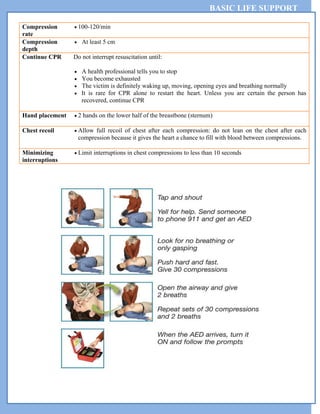
Compression
rate
 100-120/min
Compression
depth
 At least 5 cm
Continue CPR Do not interrupt resuscitation until:
 A health professional tells you to stop
 You become exhausted
 The victim is definitely waking up, moving, opening eyes and breathing normally
 It is rare for CPR alone to restart the heart. Unless you are certain the person has
recovered, continue CPR
Hand placement  2 hands on the lower half of the breastbone (sternum)
Chest recoil  Allow full recoil of chest after each compression: do not lean on the chest after each
compression because it gives the heart a chance to fill with blood between compressions.
Minimizing
interruptions
 Limit interruptions in chest compressions to less than 10 seconds
BASIC LIFE SUPPORT
Automated External Defibrillator (AED)
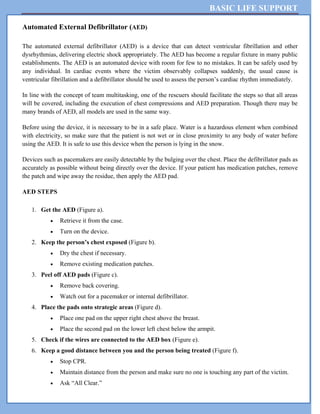
The automated external defibrillator (AED) is a device that can detect ventricular fibrillation and other
dysrhythmias, delivering electric shock appropriately. The AED has become a regular fixture in many public
establishments. The AED is an automated device with room for few to no mistakes. It can be safely used by
any individual. In cardiac events where the victim observably collapses suddenly, the usual cause is
ventricular fibrillation and a defibrillator should be used to assess the person’s cardiac rhythm immediately.
In line with the concept of team multitasking, one of the rescuers should facilitate the steps so that all areas
will be covered, including the execution of chest compressions and AED preparation. Though there may be
many brands of AED, all models are used in the same way.
Before using the device, it is necessary to be in a safe place. Water is a hazardous element when combined
with electricity, so make sure that the patient is not wet or in close proximity to any body of water before
using the AED. It is safe to use this device when the person is lying in the snow.
Devices such as pacemakers are easily detectable by the bulging over the chest. Place the defibrillator pads as
accurately as possible without being directly over the device. If your patient has medication patches, remove
the patch and wipe away the residue, then apply the AED pad.
AED STEPS
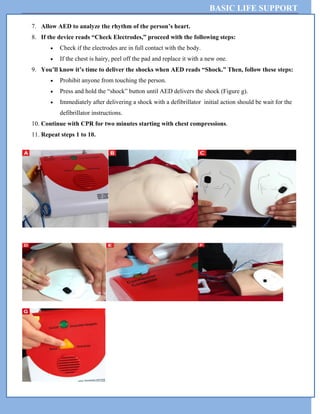
1. Get the AED (Figure a).
 Retrieve it from the case.
 Turn on the device.
2. Keep the person’s chest exposed (Figure b).
 Dry the chest if necessary.
 Remove existing medication patches.
3. Peel off AED pads (Figure c).
 Remove back covering.
 Watch out for a pacemaker or internal defibrillator.
4. Place the pads onto strategic areas (Figure d).
 Place one pad on the upper right chest above the breast.
 Place the second pad on the lower left chest below the armpit.
5. Check if the wires are connected to the AED box (Figure e).
6. Keep a good distance between you and the person being treated (Figure f).
 Stop CPR.
 Maintain distance from the person and make sure no one is touching any part of the victim.
 Ask “All Clear.”
BASIC LIFE SUPPORT
7. Allow AED to analyze the rhythm of the person’s heart.
8. If the device reads “Check Electrodes,” proceed with the following steps:
 Check if the electrodes are in full contact with the body.
 If the chest is hairy, peel off the pad and replace it with a new one.
9. You’ll know it’s time to deliver the shocks when AED reads “Shock.” Then, follow these steps:
 Prohibit anyone from touching the person.
 Press and hold the “shock” button until AED delivers the shock (Figure g).
 Immediately after delivering a shock with a defibrillator initial action should be wait for the
defibrillator instructions.
10. Continue with CPR for two minutes starting with chest compressions.
11. Repeat steps 1 to 10.
BASIC LIFE SUPPORT
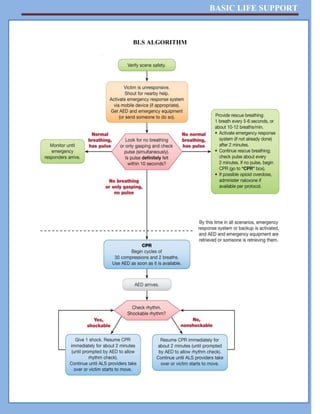
BLS ALGORITHM
BASIC LIFE SUPPORT
CHOKING RELIEF FOR ADULT
Early recognition of foreign-body airway obstruction is the key to successful outcome. It is important to
distinguish this emergency from fainting, stroke, heart attack, seizure, drug overdose, or other conditions that
may cause sudden respiratory distress but require different treatment.
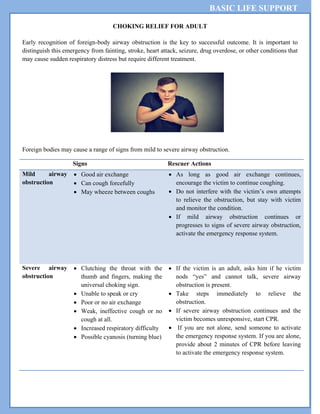
Foreign bodies may cause a range of signs from mild to severe airway obstruction.
Signs Rescuer Actions
Mild airway
obstruction
 Good air exchange
 Can cough forcefully
 May wheeze between coughs
 As long as good air exchange continues,
encourage the victim to continue coughing.
 Do not interfere with the victim’s own attempts
to relieve the obstruction, but stay with victim
and monitor the condition.
 If mild airway obstruction continues or
progresses to signs of severe airway obstruction,
activate the emergency response system.
Severe airway
obstruction
 Clutching the throat with the
thumb and fingers, making the
universal choking sign.
 Unable to speak or cry
 Poor or no air exchange
 Weak, ineffective cough or no
cough at all.
 Increased respiratory difficulty
 Possible cyanosis (turning blue)
 If the victim is an adult, asks him if he victim
nods “yes” and cannot talk, severe airway
obstruction is present.
 Take steps immediately to relieve the
obstruction.
 If severe airway obstruction continues and the
victim becomes unresponsive, start CPR.
 If you are not alone, send someone to activate
the emergency response system. If you are alone,
provide about 2 minutes of CPR before leaving
to activate the emergency response system.
BASIC LIFE SUPPORT
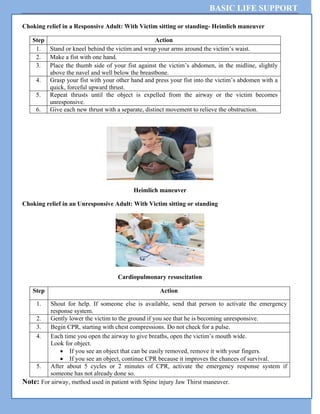
Choking relief in a Responsive Adult: With Victim sitting or standing- Heimlich maneuver
Step Action
1. Stand or kneel behind the victim and wrap your arms around the victim’s waist.
2. Make a fist with one hand.
3. Place the thumb side of your fist against the victim’s abdomen, in the midline, slightly
above the navel and well below the breastbone.
4. Grasp your fist with your other hand and press your fist into the victim’s abdomen with a
quick, forceful upward thrust.
5. Repeat thrusts until the object is expelled from the airway or the victim becomes
unresponsive.
6. Give each new thrust with a separate, distinct movement to relieve the obstruction.
Heimlich maneuver
Choking relief in an Unresponsive Adult: With Victim sitting or standing
Cardiopulmonary resuscitation
Step Action
1. Shout for help. If someone else is available, send that person to activate the emergency
response system.
2. Gently lower the victim to the ground if you see that he is becoming unresponsive.
3. Begin CPR, starting with chest compressions. Do not check for a pulse.
4. Each time you open the airway to give breaths, open the victim’s mouth wide.
Look for object.
 If you see an object that can be easily removed, remove it with your fingers.
 If you see an object, continue CPR because it improves the chances of survival.
5. After about 5 cycles or 2 minutes of CPR, activate the emergency response system if
someone has not already done so.
Note: For airway, method used in patient with Spine injury Jaw Thirst maneuver.
BASIC LIFE SUPPORT
Nurses Responsibility
 Immediate management (Basic Life Support)
 Administer medications Such as (Anti- anginals)
 Administer supplemental Oxygen by nasal prongs or face mask as indicated
 Monitor Vital sign(pulse, blood pressure)
 Note heart sounds
 Monitor laboratory Status e.g BUN, Creatinine
 Measure cardiac output and other functional parameters
 Monitor closely ECG and Chest x-ray changes and electrolyte and nutrition
 Administer IV solution as prescribed
 Encourage rest, semi recumbent in bed or chair, Assist with physical care as indicated.
 Emotional Support Patient/client and family
Nursing officers being the heart and pillars of hospital
helps in catering all emergency cases. Nursing officers
encompasses an art, a humanistic orientation, a feeling
of value towards the individuals, and an intuitive sense
of ethics. Hence BLS booklet enables them to perform
crucial life-saving techniques for clients suffering from a
stroke, cardiac arrest or other potentially life-threatening
condition. Nursing officers can initiate BLS response
anywhere, not just in a hospital setting.
BASIC LIFE SUPPORT
Where to go for more information?
If you need more information, please go to
www.heart.org
www.international.heart.org
www.en.wikipedia.org/wiki/IndianHeartAssociation
For contacts:
+1 (800) 242-8721
Mobile ambulance for BLS +91 44 4202 6644
info@theproject.com
Initial of researcher:
Priyanka Thakur

An informational booklet on Basic Life Support

  • 1.
  • 2.
    This informational bookletexplains about Basic Life Support. BLS is the foundation for saving lives after cardiac arrest. You will learn the skills of high-quality cardiopulmonary resuscitation (CPR) for victims of adult both as a single rescuer and as a member of a multirescuer team. The knowledge you learn in this booklet will enable you to recognize cardiac arrest, activate the emergency response system early and respond quickly and confidently. GENERAL CONCEPT An Informational Booklet content:  Basic Life Support  Introduction of heart………..  Location and surface projection, Layers of heart wall, Chambers of heart, Valves of heart, Normal heart sound, Coronary circulation, Cardiac conduction system  Cardiac Arrest………….  Definition, Cause, Symptom, Diagnosis, Management  Basic life support………..  Definition, American Heart Association 2020 guideline, Basic Steps Assessment , High quality CPR components for BLS providers, BLS Algorithm, Choking relief for adult Life is a celebration of life. A simple yet powerful answer to the question of why we should all be healthy in heart and mind. I encourage you to discover your Why and share it with others. Ask yourself; what are the moments, people and experiences I live for? What makes me joy, wonder, and happiness? Why am I saves lives? Why is cardiovascular care important to me? The answer to these questions is your Why. Through informational Booklet you will find information that correlates with the importance of cardiovascular care. Why do we do what we do? Life is why.
  • 3.
    BASIC LIFE SUPPORT INTRODUCTIONOF HEART Heart is the vital organ in the circulatory system, primarily responsible for delivering the circulation of blood and transportation of oxygen and nutrients, as well as assisting in the removal of metabolic wastes in all parts of the body. The heart is usually beating about 60 to 100 times per minute. LOCATION AND SURFACE PROJECTION • The heart is the hollow, cone shaped about the size of closed fist • The heart is specifically located in thoracic cavity. It lies in the mediastinum between the lungs and rests upon the diaphragm. • The heart lies within a fluid filled cavity called pericardial cavity. • The heart weighs about 250- 350 gms. LAYERS OF HEART WALLS  There are mainly 3 layers of heart: Epicardium, myocardium, endocardium. 1. PERICARDUIM/ EPICARDUIM: It is the layer immediately outside of the heart muscle proper (the myocardium). The epicardium is largely made of connective tissue and functions as a protective layer.
  • 4.
    BASIC LIFE SUPPORT Pericardiumis the membrane (sac) that surrounds and protects the heart by the help of two layers. a. Fibrous pericardium- superficial layer, tough, inelastic, prevents overstretching, provide protection and anchors the heart in place. b. Serous pericardium- 1. Parietal layer- fused to the fibrous pericardium 2. Visceral layer or epicardium- adheres to the heart itself c. Pericardial cavity – Present between two layers is filled with pericardial fluids which reduce friction. 2. MYOCARDUIM The myocardium of the left ventricle is the thickest, as this ventricle is responsible for generating the power needed to pump oxygenated blood from the heart to the rest of the body. 3. ENDOCARDUIM Endocardium (endo-cardium) is the thin inner layer of the heart wall. This layer lines the inner heart chambers, covers heart valves, and is continuous with the endothelium of large blood vessels. The endocardium of heart atria consists of smooth muscle, as well as elastic fibers. CHAMBERS OF HEART There are four chambers of heart: • Right Atrium • Right Ventricle • Left atrium • Left ventricle VALVE OF HEART: • The four valves are the mitral valve, tricuspid valve, pulmonary valve and aortic valve.
  • 5.
    BASIC LIFE SUPPORT NORMALHEART SOUNDS: • Normal heart sounds are Lubb and Dubb. CORONARY CIRCULATION • It is the circulation of blood in the blood vessels of the heart muscle. The vessels that deliver oxygen- rich (oxygenated) blood to the myocardium are known as coronary arteries. The vessels that remove the deoxygenated blood from the heart muscle are known as cardiac veins. CARDIC CONDUCTION SYSTEM • The cardiac conduction system involves the spread of electrical activity from the sinoatrial node, to the atrioventricular node, down the bundle of His and along the Purkinje fibres. As the electrical activity spreads along the heart’s conduction system it initiates myocardial contraction in the surrounding myocardial tissue.
  • 6.
    BASIC LIFE SUPPORT •The sinoatrial (SA) node or sinus node is the heart's natural pacemaker. The AV node serves as an electrical relay station, slowing the electrical current sent by the sinoatrial (SA) node before the signal is permitted to pass down through to the ventricles. The bundle of His is an important part of the electrical conduction system of the heart, as it transmits impulses from the atrioventricular node, located at the anterior-inferior end of the interatrial septum, to the ventricles of the heart. The left bundle branch further divides into the left anterior and the left posterior fascicles. These bundles and fascicles give rise to thin filaments known as Purkinje fibers. CARDIAC ARREST Cardiac arrest is a sudden loss of blood flow resulting from the failure of the heart to pump effectively. Causes:  Abnormal heart rhythm  Ventricular fibrillation  Arrhythmias develop in people with conditions such as:  Heart attack- often due to coronary artery disease  Cardiomyopathy  Congenital heart disease  Heart rhythm abnormalities  Coronary heart disease Symptoms or indications of cardiac arrest: Cardiac arrest does not show warning symptoms in nearly half the cases. The main symptoms are:  Loss of consciousness Note: Disturbance in cardiac conduction system can leads to cardiac arrest.
  • 7.
    BASIC LIFE SUPPORT Collapse/fainting  Absence of breathing  No pulse Sometimes, chest pain, light-headedness, palpitations or vomiting may be seen before the arrest. DIAGNOSIS: Clinical diagnosis is made when there is an absence of a pulse. The gold standard for diagnosis is a lack of carotid pulse. Additional tests may include: Common tests & procedures Blood test: Check levels of potassium and magnesium and hormones. Hormone test: To check the levels of hormones that may affect the ability of the heart to function. Electrocardiogram (ECG or EKG): Detects abnormal electrical activity and reveals disturbances in heart rhythm. Echocardiogram: Produces images of the heart. Done to identify areas of the heart that has been damaged by the heart attack. Nuclear stress test: To identify problems related to blood flow to the heart. MANAGEMEMT: a) The immediate management for cardiac arrest is initiation of CPR (Cardio Pulmonary Resuscitation) i.e. Basic Life Support. Indicated by The patient is not breathing normally, has no pulse, and is not responding.
  • 8.
    BASIC LIFE SUPPORT Medication Beta blockers: Drugs used to manage abnormal heart rhythm.  Atenolol, Metoprolol  ACE inhibitors: Drugs used to treat hypertension and congestive heart failure.  Enalapril, Fosinopril Surgical Procedure:  Coronary angioplasty: Opens blocked coronary arteries.
  • 9.
    BASIC LIFE SUPPORT Coronary artery bypass graft (CABG): Vein or artery from other parts of the body (usually taken from thigh, arm or mammary vein) is used to bypass a blocked or narrowed artery.  Radiofrequency catheter ablation: Used to block a single abnormal electrical pathway. Dietary modification: To be eaten To be avoided  Variety of fruits and vegetables  Low fat or fat-free dairy products  Poultry  Fish  Whole grains such as oatmeal and whole- wheat pasta  Saturated and trans fat  Excess salt and sugar
  • 10.
    BASIC LIFE SUPPORT Selfcare practices:  Quit smoking and alcohol.  Monitor blood sugar and cholesterol levels.  Monitor your blood pressure regularly.  Manage stress.  Maintain the recommended weight. BASIC LIFE SUPPORT Basic Life Support, or BLS, generally refers to the type of care that first-responders, healthcare providers and public safety professionals provide to anyone who is experiencing cardiac arrest, respiratory distress or an obstructed airway. It requires knowledge and skills in cardiopulmonary resuscitation (CPR), using automated external defibrillators (AED) and relieving airway obstructions in patients of every age.
  • 11.
    BASIC LIFE SUPPORT Accordingto American Heart Association 2020 guideline: BASIC SEQUENCE OF ASSESSMENT: Chain of survival: The 5 links in the adult in-the-hospital Chain of Survival are: CIRCULATION: Check the patient for a carotid pulse for 5- 10 seconds. Do not check for more than 10 seconds AIRWAY: Tilt the victim's head back, and lift the chin to open the airway. BREATHING: Give mouth to mouth rescue breathing. DEFIBRILLATION: They are used to prevent or correct an arrhythmia. Surveillance, prevention, and treatment of pre arrest conditions. Immediate Recognition of cardiac arrest and activation of the emergency response system Early cardiopul- monary resuscitati-on with an emphasis on chest compressions Rapid defibrillati- on. Multidisciplin- ary post-cardiac arrest care.
  • 12.
    BASIC LIFE SUPPORT The5 links in the adult out-the-hospital Chain of Survival are: HIGH QUALITY CPR COMPONENTS FOR BLS PROVIDERS COMPONENT DESCRIPTION Scene safety Make sure the environment is safe for the rescuers and victim Recognition of cardiac arrest  Check for responsiveness.  Give supine position to patient.  Tap the victim’s shoulder and shout, “Are you OK?"  No breathing or only gasping (i.e.) no normal breathing)  Scan the victim’s chest for rise and fall.  Check carotid pulse in between the trachea and the muscles at the side of the neck.  Feel the pulse for at least 5sec but not more than 10 second.  After encountering a cardiac arrest patient, the CPR should be started within 10 sec. Activation of emergency response system  If alone with no mobile phone, leave the victim to activate the emergency response system and get the AED before beginning CPR.  Otherwise send someone and begin CPR immediately with keeping heel of one hand, other hand on top.  Do CPR hard and fast. Compression- ventilation ratio without advanced airway  1 or 2 rescuers  30:2  Give 1 breath every 1 second mouth to mouth. Compression- ventilation ratio with advanced airway  Continuous compressions at a rate of 100-120/min.  Give 1 breath every 6 second (10 breaths/ min)  E-C clamp technique of holding the mask in one rescuer. Recognition of cardiac arrest and activation of the emergency response system Early cardiopul- monary resuscitation with an emphasis on chest compressions Rapid defibrillation . Basic and advanced emergency medical services. Advanced life support and post- cardiac arrest care.
  • 13.
    BASIC LIFE SUPPORT Compression rate 100-120/min Compression depth  At least 5 cm Continue CPR Do not interrupt resuscitation until:  A health professional tells you to stop  You become exhausted  The victim is definitely waking up, moving, opening eyes and breathing normally  It is rare for CPR alone to restart the heart. Unless you are certain the person has recovered, continue CPR Hand placement  2 hands on the lower half of the breastbone (sternum) Chest recoil  Allow full recoil of chest after each compression: do not lean on the chest after each compression because it gives the heart a chance to fill with blood between compressions. Minimizing interruptions  Limit interruptions in chest compressions to less than 10 seconds
  • 14.
    BASIC LIFE SUPPORT AutomatedExternal Defibrillator (AED) The automated external defibrillator (AED) is a device that can detect ventricular fibrillation and other dysrhythmias, delivering electric shock appropriately. The AED has become a regular fixture in many public establishments. The AED is an automated device with room for few to no mistakes. It can be safely used by any individual. In cardiac events where the victim observably collapses suddenly, the usual cause is ventricular fibrillation and a defibrillator should be used to assess the person’s cardiac rhythm immediately. In line with the concept of team multitasking, one of the rescuers should facilitate the steps so that all areas will be covered, including the execution of chest compressions and AED preparation. Though there may be many brands of AED, all models are used in the same way. Before using the device, it is necessary to be in a safe place. Water is a hazardous element when combined with electricity, so make sure that the patient is not wet or in close proximity to any body of water before using the AED. It is safe to use this device when the person is lying in the snow. Devices such as pacemakers are easily detectable by the bulging over the chest. Place the defibrillator pads as accurately as possible without being directly over the device. If your patient has medication patches, remove the patch and wipe away the residue, then apply the AED pad. AED STEPS 1. Get the AED (Figure a).  Retrieve it from the case.  Turn on the device. 2. Keep the person’s chest exposed (Figure b).  Dry the chest if necessary.  Remove existing medication patches. 3. Peel off AED pads (Figure c).  Remove back covering.  Watch out for a pacemaker or internal defibrillator. 4. Place the pads onto strategic areas (Figure d).  Place one pad on the upper right chest above the breast.  Place the second pad on the lower left chest below the armpit. 5. Check if the wires are connected to the AED box (Figure e). 6. Keep a good distance between you and the person being treated (Figure f).  Stop CPR.  Maintain distance from the person and make sure no one is touching any part of the victim.  Ask “All Clear.”
  • 15.
    BASIC LIFE SUPPORT 7.Allow AED to analyze the rhythm of the person’s heart. 8. If the device reads “Check Electrodes,” proceed with the following steps:  Check if the electrodes are in full contact with the body.  If the chest is hairy, peel off the pad and replace it with a new one. 9. You’ll know it’s time to deliver the shocks when AED reads “Shock.” Then, follow these steps:  Prohibit anyone from touching the person.  Press and hold the “shock” button until AED delivers the shock (Figure g).  Immediately after delivering a shock with a defibrillator initial action should be wait for the defibrillator instructions. 10. Continue with CPR for two minutes starting with chest compressions. 11. Repeat steps 1 to 10.
  • 16.
  • 17.
    BASIC LIFE SUPPORT CHOKINGRELIEF FOR ADULT Early recognition of foreign-body airway obstruction is the key to successful outcome. It is important to distinguish this emergency from fainting, stroke, heart attack, seizure, drug overdose, or other conditions that may cause sudden respiratory distress but require different treatment. Foreign bodies may cause a range of signs from mild to severe airway obstruction. Signs Rescuer Actions Mild airway obstruction  Good air exchange  Can cough forcefully  May wheeze between coughs  As long as good air exchange continues, encourage the victim to continue coughing.  Do not interfere with the victim’s own attempts to relieve the obstruction, but stay with victim and monitor the condition.  If mild airway obstruction continues or progresses to signs of severe airway obstruction, activate the emergency response system. Severe airway obstruction  Clutching the throat with the thumb and fingers, making the universal choking sign.  Unable to speak or cry  Poor or no air exchange  Weak, ineffective cough or no cough at all.  Increased respiratory difficulty  Possible cyanosis (turning blue)  If the victim is an adult, asks him if he victim nods “yes” and cannot talk, severe airway obstruction is present.  Take steps immediately to relieve the obstruction.  If severe airway obstruction continues and the victim becomes unresponsive, start CPR.  If you are not alone, send someone to activate the emergency response system. If you are alone, provide about 2 minutes of CPR before leaving to activate the emergency response system.
  • 18.
    BASIC LIFE SUPPORT Chokingrelief in a Responsive Adult: With Victim sitting or standing- Heimlich maneuver Step Action 1. Stand or kneel behind the victim and wrap your arms around the victim’s waist. 2. Make a fist with one hand. 3. Place the thumb side of your fist against the victim’s abdomen, in the midline, slightly above the navel and well below the breastbone. 4. Grasp your fist with your other hand and press your fist into the victim’s abdomen with a quick, forceful upward thrust. 5. Repeat thrusts until the object is expelled from the airway or the victim becomes unresponsive. 6. Give each new thrust with a separate, distinct movement to relieve the obstruction. Heimlich maneuver Choking relief in an Unresponsive Adult: With Victim sitting or standing Cardiopulmonary resuscitation Step Action 1. Shout for help. If someone else is available, send that person to activate the emergency response system. 2. Gently lower the victim to the ground if you see that he is becoming unresponsive. 3. Begin CPR, starting with chest compressions. Do not check for a pulse. 4. Each time you open the airway to give breaths, open the victim’s mouth wide. Look for object.  If you see an object that can be easily removed, remove it with your fingers.  If you see an object, continue CPR because it improves the chances of survival. 5. After about 5 cycles or 2 minutes of CPR, activate the emergency response system if someone has not already done so. Note: For airway, method used in patient with Spine injury Jaw Thirst maneuver.
  • 19.
    BASIC LIFE SUPPORT NursesResponsibility  Immediate management (Basic Life Support)  Administer medications Such as (Anti- anginals)  Administer supplemental Oxygen by nasal prongs or face mask as indicated  Monitor Vital sign(pulse, blood pressure)  Note heart sounds  Monitor laboratory Status e.g BUN, Creatinine  Measure cardiac output and other functional parameters  Monitor closely ECG and Chest x-ray changes and electrolyte and nutrition  Administer IV solution as prescribed  Encourage rest, semi recumbent in bed or chair, Assist with physical care as indicated.  Emotional Support Patient/client and family Nursing officers being the heart and pillars of hospital helps in catering all emergency cases. Nursing officers encompasses an art, a humanistic orientation, a feeling of value towards the individuals, and an intuitive sense of ethics. Hence BLS booklet enables them to perform crucial life-saving techniques for clients suffering from a stroke, cardiac arrest or other potentially life-threatening condition. Nursing officers can initiate BLS response anywhere, not just in a hospital setting.
  • 20.
    BASIC LIFE SUPPORT Whereto go for more information? If you need more information, please go to www.heart.org www.international.heart.org www.en.wikipedia.org/wiki/IndianHeartAssociation For contacts: +1 (800) 242-8721 Mobile ambulance for BLS +91 44 4202 6644 info@theproject.com Initial of researcher: Priyanka Thakur