Thais Borges Lessa, PhD
An improved method for
studying mouse diaphragm
function
Duan Lab
University of Missouri
This virtual poster has been produced in conjunction with Aurora Scientific under the following Creative
Commons license:
Attribution-NonCommercial-NoDerivatives 4.0 International (CC BY-NC-ND 4.0)
The diaphragm is a sheet-like muscle that separates the thoracic cavity from the abdominal
cavity. It is the primary muscle of inspiration. Dysfunctions in the diaphragm muscle is a cause of
morbidity and mortality in many neuromuscular and respiratory diseases. The mouse model is
the most common animal used to investigate these diseases. Numerous strains of mouse model
have been generated to suppress the need in different pathologies. Therefore, an accurate
evaluation of the diaphragm force is essential to best utilize these models in preclinical studies.
Methods to evaluate the diaphragm muscle:
- Stainless steel hooks
- Clamps – few information
- Suture – (www.treat-nmd.eu/downloads/file/ sops/dmd/MDX/DMD_M.1.2.002.pdf)
Overview
Suture method
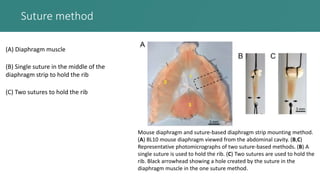
(A) Diaphragm muscle
(B) Single suture in the middle of the
diaphragm strip to hold the rib
(C) Two sutures to hold the rib
Mouse diaphragm and suture-based diaphragm strip mounting method.
(A) BL10 mouse diaphragm viewed from the abdominal cavity. (B,C)
Representative photomicrographs of two suture-based methods. (B) A
single suture is used to hold the rib. (C) Two sutures are used to hold the
rib. Black arrowhead showing a hole created by the suture in the
diaphragm muscle in the one suture method.
1. To provide detailed information on the clamp design and muscle preparation
for muscle function assay
2. To perform side by side comparison between suture and clamp method
3. To test the utility of the new clamp for preclinical study: comparison between
BL10 and mdx mice
Aims
Clamp design
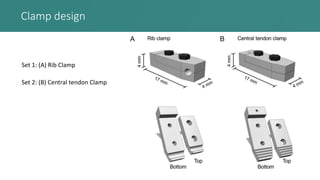
Set 1: (A) Rib Clamp
Set 2: (B) Central tendon Clamp
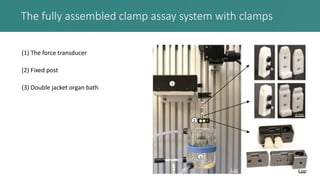
The fully assembled clamp assay system with clamps
(1) The force transducer
(2) Fixed post
(3) Double jacket organ bath
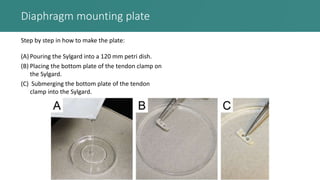
Diaphragm mounting plate
Step by step in how to make the plate:
(A) Pouring the Sylgard into a 120 mm petri dish.
(B) Placing the bottom plate of the tendon clamp on
the Sylgard.
(C) Submerging the bottom plate of the tendon
clamp into the Sylgard.
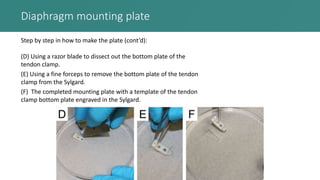
Diaphragm mounting plate
Step by step in how to make the plate (cont’d):
(D) Using a razor blade to dissect out the bottom plate of the
tendon clamp.
(E) Using a fine forceps to remove the bottom plate of the tendon
clamp from the Sylgard.
(F) The completed mounting plate with a template of the tendon
clamp bottom plate engraved in the Sylgard.
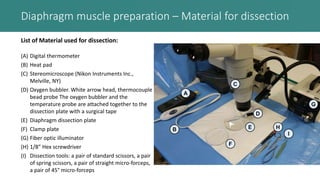
Diaphragm muscle preparation – Material for dissection
List of Material used for dissection:
(A) Digital thermometer
(B) Heat pad
(C) Stereomicroscope (Nikon Instruments Inc.,
Melville, NY)
(D) Oxygen bubbler. White arrow head, thermocouple
bead probe The oxygen bubbler and the
temperature probe are attached together to the
dissection plate with a surgical tape
(E) Diaphragm dissection plate
(F) Clamp plate
(G) Fiber optic illuminator
(H) 1/8” Hex screwdriver
(I) Dissection tools: a pair of standard scissors, a pair
of spring scissors, a pair of straight micro-forceps,
a pair of 45° micro-forceps
Diaphragm muscle preparation
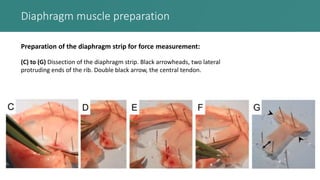
Preparation of the diaphragm strip for force measurement:
(A) The diaphragm was dissected from the mouse and pinned in the dissection plate.
Red arrow, temperature probe. Dark blue arrow, oxygenated bubbler
(B) Identification of the 4 mm diaphragm strip to be dissected using 4 pins. White
arrowheads, pins used for marking the 4 mm diaphragm strip.
Diaphragm muscle preparation
Preparation of the diaphragm strip for force measurement:
(C) to (G) Dissection of the diaphragm strip. Black arrowheads, two lateral
protruding ends of the rib. Double black arrow, the central tendon.
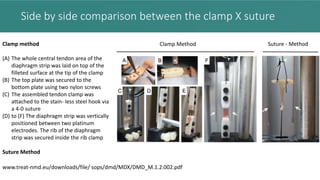
Side by side comparison between the clamp X suture
Clamp Method Suture - MethodClamp method
(A) The whole central tendon area of the
diaphragm strip was laid on top of the
filleted surface at the tip of the clamp
(B) The top plate was secured to the
bottom plate using two nylon screws
(C) The assembled tendon clamp was
attached to the stain- less steel hook via
a 4-0 suture
(D) to (F) The diaphragm strip was vertically
positioned between two platinum
electrodes. The rib of the diaphragm
strip was secured inside the rib clamp
Suture Method
www.treat-nmd.eu/downloads/file/ sops/dmd/MDX/DMD_M.1.2.002.pdf
Clamp & Suture method -
muscle force assay
Strain: BL10 mice
Gender: Male
Age: 8 months-old
Image caption
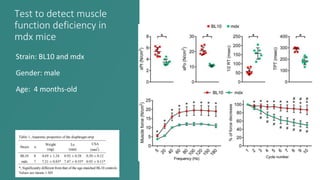
Test to detect muscle
function deficiency in
mdx mice
Strain: BL10 and mdx
Gender: male
Age: 4 months-old
Image caption
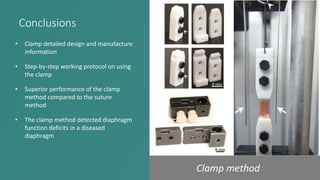
Conclusions
• Clamp detailed design and manufacture
information
• Step-by-step working protocol on using
the clamp
• Superior performance of the clamp
method compared to the suture
method
• The clamp method detected diaphragm
function deficits in a diseased
diaphragm
Clamp method
Acknowledgements:
• National Institutes of Health (NIH) NS-90634
(DD)
• National Institutes of Health (NIH) AR-70517
(DD)
• Jackson Freel DMD Research Fund (DD)
• Duchenne UK (DD)
• Michael’s Cause (DD)
• Ryan’s Quest (DD)
• Ryan’s Rally (DD)
• Intramural Research Program of the NIH
National Center for Advancing Translational
Sciences (CHH and NNY)
• São Paulo Research Foundation FAPESP
(Process numbers: 12/04506-3 and 13/06753-
0) (CEA and TBL)
• Mr. Brian Jenkins for the excellent technical
assistance
• All authors of this work: Chady H. Hakim,
Gregory Jenkins, Nora N. Yang, Carlos Eduardo
Ambrosio and Dongsheng Duan
Thais Borges Lessa, PhD
To learn more about this poster and the
research being done please connect
with the speaker directly:
lessat@health.missouri.e
du
This virtual poster has been produced in conjunction with Aurora Scientific under the following Creative
Commons license:
Attribution-NonCommercial-NoDerivatives 4.0 International (CC BY-NC-ND 4.0)
An improved method for studying mouse diaphragm function

An improved method for studying mouse diaphragm function

  • 1.
    Thais Borges Lessa,PhD An improved method for studying mouse diaphragm function Duan Lab University of Missouri This virtual poster has been produced in conjunction with Aurora Scientific under the following Creative Commons license: Attribution-NonCommercial-NoDerivatives 4.0 International (CC BY-NC-ND 4.0)
  • 2.
    The diaphragm isa sheet-like muscle that separates the thoracic cavity from the abdominal cavity. It is the primary muscle of inspiration. Dysfunctions in the diaphragm muscle is a cause of morbidity and mortality in many neuromuscular and respiratory diseases. The mouse model is the most common animal used to investigate these diseases. Numerous strains of mouse model have been generated to suppress the need in different pathologies. Therefore, an accurate evaluation of the diaphragm force is essential to best utilize these models in preclinical studies. Methods to evaluate the diaphragm muscle: - Stainless steel hooks - Clamps – few information - Suture – (www.treat-nmd.eu/downloads/file/ sops/dmd/MDX/DMD_M.1.2.002.pdf) Overview
  • 3.
    Suture method (A) Diaphragmmuscle (B) Single suture in the middle of the diaphragm strip to hold the rib (C) Two sutures to hold the rib Mouse diaphragm and suture-based diaphragm strip mounting method. (A) BL10 mouse diaphragm viewed from the abdominal cavity. (B,C) Representative photomicrographs of two suture-based methods. (B) A single suture is used to hold the rib. (C) Two sutures are used to hold the rib. Black arrowhead showing a hole created by the suture in the diaphragm muscle in the one suture method.
  • 4.
    1. To providedetailed information on the clamp design and muscle preparation for muscle function assay 2. To perform side by side comparison between suture and clamp method 3. To test the utility of the new clamp for preclinical study: comparison between BL10 and mdx mice Aims
  • 5.
    Clamp design Set 1:(A) Rib Clamp Set 2: (B) Central tendon Clamp
  • 6.
    The fully assembledclamp assay system with clamps (1) The force transducer (2) Fixed post (3) Double jacket organ bath
  • 7.
    Diaphragm mounting plate Stepby step in how to make the plate: (A) Pouring the Sylgard into a 120 mm petri dish. (B) Placing the bottom plate of the tendon clamp on the Sylgard. (C) Submerging the bottom plate of the tendon clamp into the Sylgard.
  • 8.
    Diaphragm mounting plate Stepby step in how to make the plate (cont’d): (D) Using a razor blade to dissect out the bottom plate of the tendon clamp. (E) Using a fine forceps to remove the bottom plate of the tendon clamp from the Sylgard. (F) The completed mounting plate with a template of the tendon clamp bottom plate engraved in the Sylgard.
  • 9.
    Diaphragm muscle preparation– Material for dissection List of Material used for dissection: (A) Digital thermometer (B) Heat pad (C) Stereomicroscope (Nikon Instruments Inc., Melville, NY) (D) Oxygen bubbler. White arrow head, thermocouple bead probe The oxygen bubbler and the temperature probe are attached together to the dissection plate with a surgical tape (E) Diaphragm dissection plate (F) Clamp plate (G) Fiber optic illuminator (H) 1/8” Hex screwdriver (I) Dissection tools: a pair of standard scissors, a pair of spring scissors, a pair of straight micro-forceps, a pair of 45° micro-forceps
  • 10.
    Diaphragm muscle preparation Preparationof the diaphragm strip for force measurement: (A) The diaphragm was dissected from the mouse and pinned in the dissection plate. Red arrow, temperature probe. Dark blue arrow, oxygenated bubbler (B) Identification of the 4 mm diaphragm strip to be dissected using 4 pins. White arrowheads, pins used for marking the 4 mm diaphragm strip.
  • 11.
    Diaphragm muscle preparation Preparationof the diaphragm strip for force measurement: (C) to (G) Dissection of the diaphragm strip. Black arrowheads, two lateral protruding ends of the rib. Double black arrow, the central tendon.
  • 12.
    Side by sidecomparison between the clamp X suture Clamp Method Suture - MethodClamp method (A) The whole central tendon area of the diaphragm strip was laid on top of the filleted surface at the tip of the clamp (B) The top plate was secured to the bottom plate using two nylon screws (C) The assembled tendon clamp was attached to the stain- less steel hook via a 4-0 suture (D) to (F) The diaphragm strip was vertically positioned between two platinum electrodes. The rib of the diaphragm strip was secured inside the rib clamp Suture Method www.treat-nmd.eu/downloads/file/ sops/dmd/MDX/DMD_M.1.2.002.pdf
  • 13.
    Clamp & Suturemethod - muscle force assay Strain: BL10 mice Gender: Male Age: 8 months-old Image caption
  • 14.
    Test to detectmuscle function deficiency in mdx mice Strain: BL10 and mdx Gender: male Age: 4 months-old Image caption
  • 15.
    Conclusions • Clamp detaileddesign and manufacture information • Step-by-step working protocol on using the clamp • Superior performance of the clamp method compared to the suture method • The clamp method detected diaphragm function deficits in a diseased diaphragm Clamp method
  • 16.
    Acknowledgements: • National Institutesof Health (NIH) NS-90634 (DD) • National Institutes of Health (NIH) AR-70517 (DD) • Jackson Freel DMD Research Fund (DD) • Duchenne UK (DD) • Michael’s Cause (DD) • Ryan’s Quest (DD) • Ryan’s Rally (DD) • Intramural Research Program of the NIH National Center for Advancing Translational Sciences (CHH and NNY) • São Paulo Research Foundation FAPESP (Process numbers: 12/04506-3 and 13/06753- 0) (CEA and TBL) • Mr. Brian Jenkins for the excellent technical assistance • All authors of this work: Chady H. Hakim, Gregory Jenkins, Nora N. Yang, Carlos Eduardo Ambrosio and Dongsheng Duan
  • 17.
    Thais Borges Lessa,PhD To learn more about this poster and the research being done please connect with the speaker directly: lessat@health.missouri.e du This virtual poster has been produced in conjunction with Aurora Scientific under the following Creative Commons license: Attribution-NonCommercial-NoDerivatives 4.0 International (CC BY-NC-ND 4.0)