Tahirou DJARA, Marc Kokou ASSOGBA & Antoine VIANOU
International Journal of Image Processing (IJIP), Volume (11) : Issue (2) : 2017 25
An Approach for Benin Automatic Licence Plate Recognition
Tahirou DJARA csm.djara@gmail.com
Laboratory of Electronic Engineering,
Telecommunications and Applied data ProcessingTechnology.
Ecole Polytechnique of Abomey Calavi (EPAC).
University of Abomey-Calavi. 01 BP 2009 Cotonou, BENIN.
Marc Kokou ASSOGBA mkokouassogba@yahoo.fr
Laboratory of Electronic Engineering,
Telecommunications and Applied data Processing Technology.
Ecole Polytechnique of Abomey Calavi (EPAC).
University of Abomey-Calavi. 01 BP 2009 Cotonou, BENIN.
Antoine VIANOU avianou@yahoo.fr
Laboratory of Electronic Engineering,
Telecommunications and Applied data Processing Technology.
Ecole Polytechnique of Abomey Calavi (EPAC).
University of Abomey-Calavi. 01 BP 2009 Cotonou, BENIN.
Abstract
In this work, we read licence plates using Optical Character Recognition. Our algorithm relies on
the detection of plates on the basis of contours and text that they contain. Thank to the
combinaison of these two detection mode, our algorithm remains effective even when the plate is
slightly obstructed. For the separation of false positive from real images of license plates, we use
filters based on text and registration plates general characteristics. This gives our algorithm a
great ability to adapt to different contexts. Following our experimental test on license plates in
Benin, we obtained a recall rate of 86% and an accuracy rate of 60%.
Keywords: Image Processing, License Plates, Segmentation, LAPI, ROC.
1. INTRODUCTION
In order to associate each vehicule his owner number plates are used. Today there are used
again theft and traffic violation. The public and private services need autonomous tools to face
the challenge of the increase of vehicule number. The Information and Communication
Technologies (ICTS) are this day the only means to answer this need. One way to do this is to set
up ANPR systems. A such system can be modified and adapted to the Benin. The general
objective of this work is to define and design a method of analysis, extraction and reading of the
information contained on number plates. This method must be usefull for both one line and two
line plates, and not sensitive to the variation of plates’ foreground and background colors. This
document present our work. It will be structured in four parts. :
2. STATE OF ART
The are globally three ways to do ANPR. The first is based on the fact that the zones of plates
present hight rates of contrast in the image. So, thanks to the edge map, it is possible to obtain
the position of the plate, by looking for the peaks of the horizontal and vertical projections [4, 9, 6,
1]. The second way consider that the sought number plates will present correct bounded borders.
Generally, they attempt to highlight these borders, thanks to the detection of outlines. Then using
an algorithms of forms detection, such as Hought transform or the filling of closed bounding,
these forms are then processed and those, which are similar to a licence plates, are kept. The
main purpose of the third way is to mask in the image the zone of the plate. It is possible thanks
Tahirou DJARA, Marc Kokou ASSOGBA & Antoine VIANOU
International Journal of Image Processing (IJIP), Volume (11) : Issue (2) : 2017 26
to the closeness of the characters of the plate. A series of dilatation, will for example allow to stick
all the characters between them in the horizontal direction and to obtain a zone of masked plate
address and phone number which coordinates will be easy to determine [11, 3, 15, 7, 10, 5, 12].
This approach is structured in four stages : the detection and the extraction of the candidate
regions, the identification of the zones of plates, the correction and the post-treatment of the
images, the optical character recognition.
3. DETECTION AND EXTRACTION OF THE CANDIDATE REGIONS
We choose to mixt two methods for this stage. The first one’s objective is to detect the plate
based on its characters, whereas the second, detects the plate from its shape.
3.1. Detection based on Plate Characters
The analysis of our study case led us to the following conclusions: too big images require more
processing time; the characters on licence plates are usually designed to be easily located and
readable at long distances. Then they are zones with hight occurrence and hight density of lines;
In the environnement of the plate, there is often elements with hight contrast, such as the car’s
edge or rear lights etc.
These observations, led us to the following conclusions : It is more convenient to try to locate the
plate than its characters; The chosen structuring element has to be not too big neither too small.
Too small, it couldn’t interconnect the characters of the plate. Too big it could interconnect
regions with hight contrast nearby the plate. To solve the issues presented above we made a set
of choices.
The first one is a stage of pre-processing. We limit the size of the image, so that its longest side
will not exceed 440 pixels, while keeping its aspect ratio.
On this image, we shall make every time : Histogram equalization; property reinforcement; tophat
operation. The new image will be clearer with a highter contrast level. For the localization or the
detection of the regions of text, we followed the same procedure as Xiaoqing Liu and Jagath
Samarabandu [7], but we made the following changes.
We know that the plate have rectangular shape and doesn’t occupy a significant area of the
image. The labeling principle of Xiaoqing Liu and Jagath Samarabandu attributes label of
proportional value to their surfaces to the various connected components. We noticed that the
way the plates are readable is affected by this stage of the algorithm. We tried to solve this issue
by choosing a different criteria to eliminate false positives. A number plate have generally a
longer width. So instead of choosing the surface, we favored the criteria of the height of the
rectangular block surrounding the elements. So in our approach, connected elements which have
the longest heights such as the outlines of doors and windows, trees etc are attenuated whereas
those who do not present a long height, in particular the plate, are kept intact.
For the characters grouping, we also used square structuring elements, but with different sizes.
Indeed, after several tests, we noticed that the size of the structuring element should evolve
according to the size of the plate in the image. This size can vary according to the distance from
the car to the objective of the camera, or the zoom coefficient of the capture tool. We determined
three structuring elements of different sizes, according to the distance between the plate and the
capture tool. Then :
 For an image taken at a distance lower than a meter, we recommend to choose a
structuring element of size twelve (12).
 For an image captured at a distance lower than six meters, a square structuring element
of size eight (8).
Tahirou DJARA, Marc Kokou ASSOGBA & Antoine VIANOU
International Journal of Image Processing (IJIP), Volume (11) : Issue (2) : 2017 27
 For an image taken at a distance lower than 15 meters, a structuring element of size six
(6).
For the extraction of the previously detected regions, we based our approach on the bounding
box calculated in the previous stage.
The size chosen for the input image does not always allow to obtain a quality image for the plate
reading. So we used the reduced image to locate the plate and a seven (7) time bigger image to
read its characters.
To separate the characters from the background, we make a threshold with the method of Otsu
[16]. Its advantage is to determine automatically the optimal value, so that the realized threshold,
separates the various classes of components in the image. Therefore it is possible to separate
characters from their background.
FIGURE 1: Outcome of the detection and the extraction of plates zones.
3.2. Detection based on Plate Outline
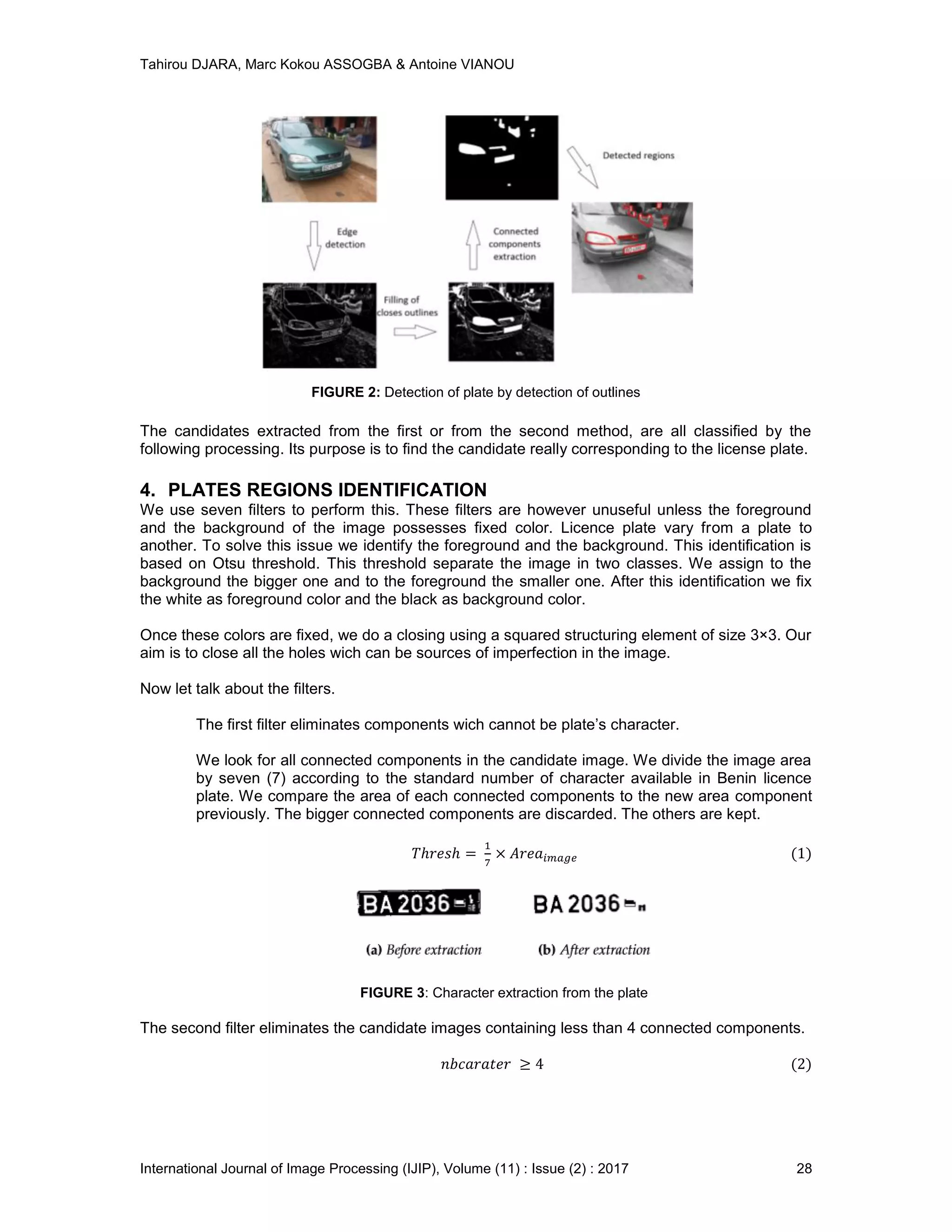
The second method used, is based on the detection of the closed outlines. To detect the plate,
we make in the chain the following treatments:
 Detection of outlines using Sobel operators
 Binarisation of the image by means of Otsu threshold
 Filling hole
 Morphological opening to separate too close elements
The candidate zones are the ones which will be filled during the process. They are extracted from
the image by means of an algorithm of connected components’ labeling.
Tahirou DJARA, Marc Kokou ASSOGBA & Antoine VIANOU
International Journal of Image Processing (IJIP), Volume (11) : Issue (2) : 2017 28
FIGURE 2: Detection of plate by detection of outlines
The candidates extracted from the first or from the second method, are all classified by the
following processing. Its purpose is to find the candidate really corresponding to the license plate.
4. PLATES REGIONS IDENTIFICATION
We use seven filters to perform this. These filters are however unuseful unless the foreground
and the background of the image possesses fixed color. Licence plate vary from a plate to
another. To solve this issue we identify the foreground and the background. This identification is
based on Otsu threshold. This threshold separate the image in two classes. We assign to the
background the bigger one and to the foreground the smaller one. After this identification we fix
the white as foreground color and the black as background color.
Once these colors are fixed, we do a closing using a squared structuring element of size 3×3. Our
aim is to close all the holes wich can be sources of imperfection in the image.
Now let talk about the filters.
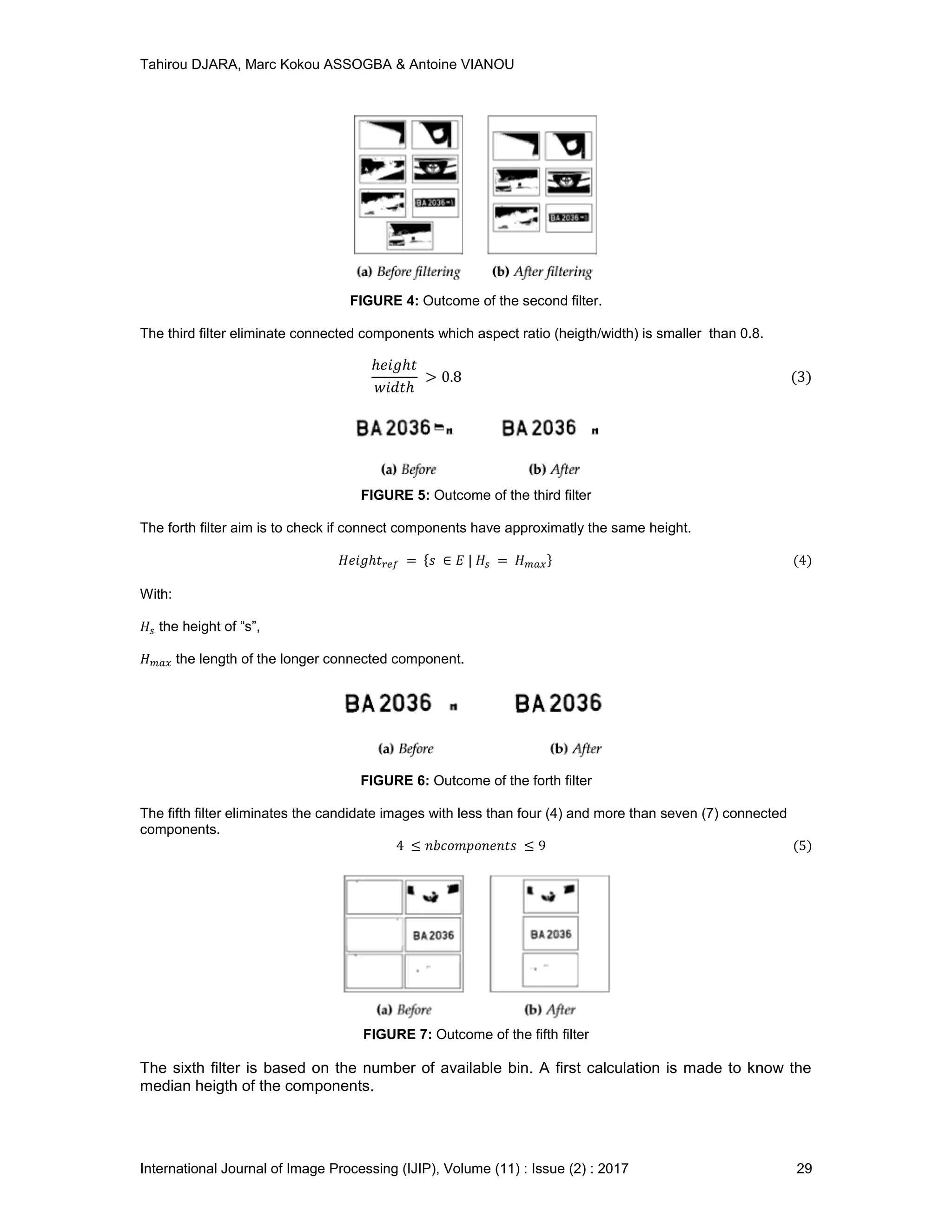
The first filter eliminates components wich cannot be plate’s character.
We look for all connected components in the candidate image. We divide the image area
by seven (7) according to the standard number of character available in Benin licence
plate. We compare the area of each connected components to the new area component
previously. The bigger connected components are discarded. The others are kept.
FIGURE 3: Character extraction from the plate
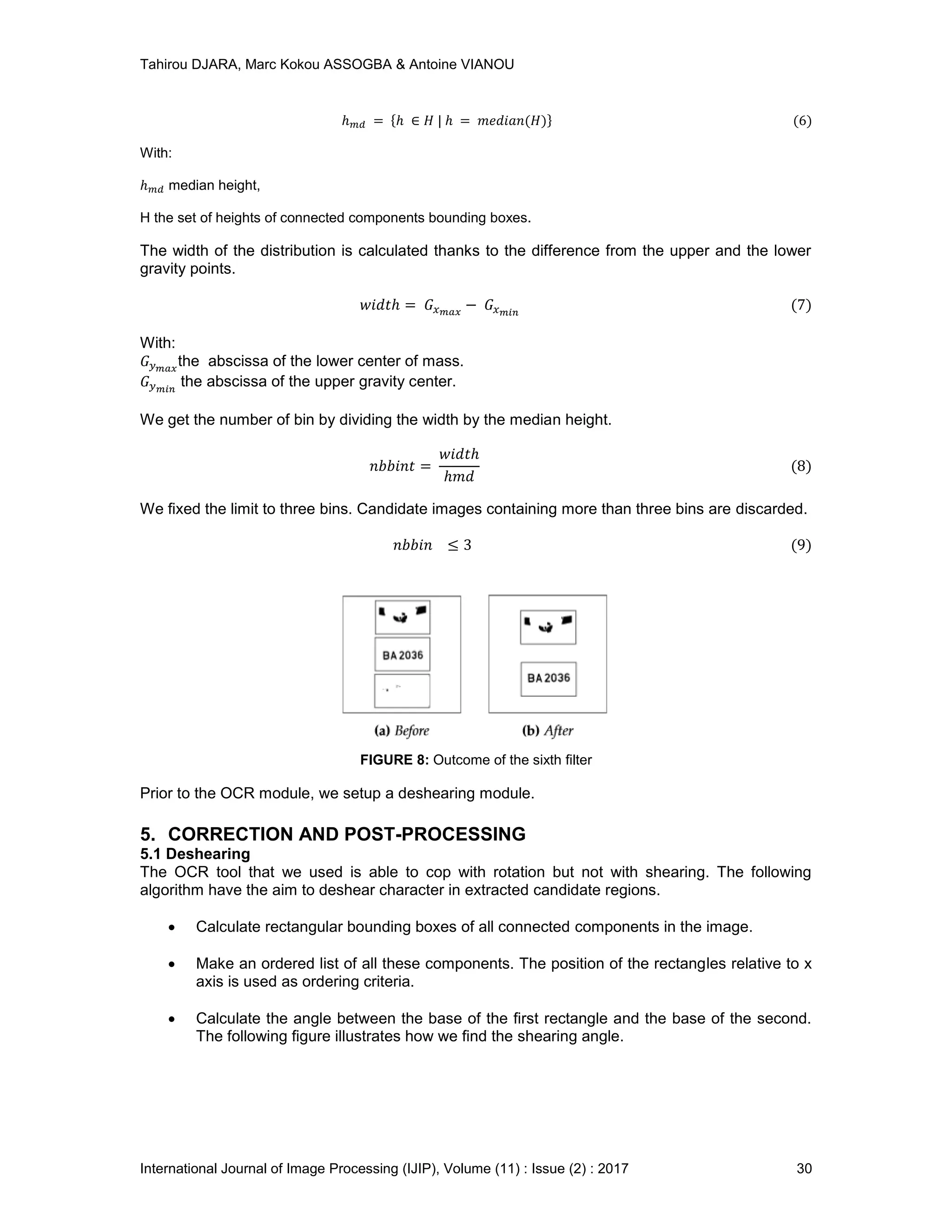
The second filter eliminates the candidate images containing less than 4 connected components.
Tahirou DJARA, Marc Kokou ASSOGBA & Antoine VIANOU
International Journal of Image Processing (IJIP), Volume (11) : Issue (2) : 2017 29
FIGURE 4: Outcome of the second filter.
The third filter eliminate connected components which aspect ratio (heigth/width) is smaller than 0.8.
FIGURE 5: Outcome of the third filter
The forth filter aim is to check if connect components have approximatly the same height.
With:
the height of “s”,
the length of the longer connected component.
FIGURE 6: Outcome of the forth filter
The fifth filter eliminates the candidate images with less than four (4) and more than seven (7) connected
components.
FIGURE 7: Outcome of the fifth filter
The sixth filter is based on the number of available bin. A first calculation is made to know the
median heigth of the components.
Tahirou DJARA, Marc Kokou ASSOGBA & Antoine VIANOU
International Journal of Image Processing (IJIP), Volume (11) : Issue (2) : 2017 30
With:
median height,
H the set of heights of connected components bounding boxes.
The width of the distribution is calculated thanks to the difference from the upper and the lower
gravity points.
With:
the abscissa of the lower center of mass.
the abscissa of the upper gravity center.
We get the number of bin by dividing the width by the median height.
We fixed the limit to three bins. Candidate images containing more than three bins are discarded.
FIGURE 8: Outcome of the sixth filter
Prior to the OCR module, we setup a deshearing module.
5. CORRECTION AND POST-PROCESSING
5.1 Deshearing
The OCR tool that we used is able to cop with rotation but not with shearing. The following
algorithm have the aim to deshear character in extracted candidate regions.
 Calculate rectangular bounding boxes of all connected components in the image.
 Make an ordered list of all these components. The position of the rectangles relative to x
axis is used as ordering criteria.
 Calculate the angle between the base of the first rectangle and the base of the second.
The following figure illustrates how we find the shearing angle.
Tahirou DJARA, Marc Kokou ASSOGBA & Antoine VIANOU
International Journal of Image Processing (IJIP), Volume (11) : Issue (2) : 2017 31
FIGURE 9: Shearing angle between two characters
 We deshear the image by doing a shearing using the opposite of the angle we found
previously.
FIGURE 10: Illustration of the deshearing of an license plate image.
5.2 Images post-processing
The deshearing, sometimes lead to the loss of informations in the desheared image. So to correct
it we do a closing on the image using a 3×3 squared structuring element.
The last preprocessing stage aim is to eliminate non-character elements from the number plate
image.
6. OPTICAL CHARACTER RECOGNITION
For the Optical Character Recognition, we used the free and open tool TesseractOCR. It is an
OCR engine developed in c++ by HP laboratories between 1985 and 1995. Nowadays it is
maintained by Google [13]. It has many advantages:
 It is cross-platform
 It read rotated texts.
 It do recognition in many languages such as Chinese and French [14]
 It can be trained.
7. RESULTS
7.1 Plate Localization
We used 100 images of various kind of cars and in various conditions. Result for the detection
based on the mixed method.
Precision Recall F-measure
60% 87% 73.5
TABLE 1: Result for the plate detection.
Tahirou DJARA, Marc Kokou ASSOGBA & Antoine VIANOU
International Journal of Image Processing (IJIP), Volume (11) : Issue (2) : 2017 32
The precision-recall draw is as follow:
FIGURE 11: Results: precision-recall.
7.2 Optical Character Recognition
For the reading of the detected plates, we used 87 correctly identified regions. The obtained
results are as follow:
Number of images Read Success rate
87 57 65.5%
TABLE 2: Results of plates reading by OCR.
8. DISCUSSION
8.1 Analysis of Failure Cases
The analysis of the 13 detection missed for our dataset, shows several causes of failure. Among
them were presence of shadows on part of the plate, and bad or uneven illumination of the
image.
8.2 Our Approach Regarding The Literature
The following table presents the recall rate of some works done in ANPR field. Our method is also
listed.
Author Country Recall
A. Daramola et al [1] Nigeria 98%
S. Hamidreza et al [5] Iran 97.3%
Radha et al [10] India 93%
Khalifa et al [6] Malaysia 92%
Our method Benin 87%
Kaushik Deb et al [2] Korea 82.5%
Fernando et al [8] Spain 80.39%
TABLE 3: Works done in ANPR in the world.
This table shows that our method follows the tendency and is satisfactory.
9. CONCLUSION AND PERSPECTIVES
In summary, the general difficulties of ANPR are:
 Plate detection
 Detection and correction of distortions
 Character segmentation
Tahirou DJARA, Marc Kokou ASSOGBA & Antoine VIANOU
International Journal of Image Processing (IJIP), Volume (11) : Issue (2) : 2017 33
In our study case besides, these difficulties we had to work with plates of variable forms and
colors. Furthermore the borders of our number plates are not always visible.
To solve these issues, we made a set of choices.
 We mixed an approach based on the detection of the characters and an approach based
on the detection of the closed outlines. So, we can detect from a plate now even if its
edges are not visible.
 We corrected the distortions by basing us on angles between every character.
 We made up a module for detection of foreground and background whatever their colors.
For our approach, we have got 87% recall rate, 60% of precision and 65.5% for the F-measure.
For future works, we want make a module to solve bad and uneven illumination issues, improve
the segmentation stage and make our own OCR system.
Furthermore, works have to be done in order to build up a system controlling parking areas, as
we project to do.
10. REFERENCES
[1] S Adebayo Daramola, E Adetiba, AU Adoghe, JA Badejo, IA Samuel, and T Fagorusi.
Automaticvehicle identification system using license plate. International Journal of
Engineering Science and Technology, 3(2):1712–1719, 2011.
[2] Kaushik Deb, Hyun-Uk Chae, and Kang-Hyun Jo. Vehicle license plate detection method
based on sliding concentric windows and histogram. Journal of computers, 4(8):771–777,
2009.
[3] Jonathan Fabrizio, Beatriz Marcotegui, and Matthieu Cord. Text detection in street level
images. Pattern Analysis and Applications, 16(4):519–533, 2013.
[4] Balázs Fazekas and Enyedi-Lajos Konyha-Kálmán. Real time number plate localization
algorithms. Journal of electrical engineering, 57(2):69–77, 2006.
[5] SHamidrezaKasaei, SMohammadrezaKasaei, andSAlirezaKasaei. Newmorphology-based
method for robust iranian car plate detection and recognition. International Journal of
Computer Theory and Engineering, 2(2):264–268, 2010.
[6] Othman Khalifa, Sheroz Khan, Rafiqul Islam, Ahmad Suleiman, et al. Malaysian vehicle
license plate recognition. Int. Arab J. Inf. Technol., 4(4):359–364, 2007.
[7] Xiaoqing Liu and Jagath Samarabandu. An edge-based text region extraction algorithm for
indoor mobile robot navigation. In Mechatronics and Automation, 2005 IEEE International
Conference, volume 2, pages 701–706. IEEE, 2005.
[8] Fernando Martin, Maite Garcia, and José Luis Alba. New methods for automatic reading of
vlp’s (vehicle license plates). In Proc. IASTED Int. Conf. SPPRA, pages 126–131, 2002.
[9] Martinsk`y Ondrej, V Zboril Frantisek, and Drahansk`y Martin. Algorithmic and mathematical
principles of automatic number plate recognition systems. BRNO University of technology,
page 10, 2007.
Tahirou DJARA, Marc Kokou ASSOGBA & Antoine VIANOU
International Journal of Image Processing (IJIP), Volume (11) : Issue (2) : 2017 34
[10] R Radha and CP Sumathi. A novel approach to extract text from license plate vehicles.
Signal & Image Processing: An International Journal (SIPIJ) Vol, 3, 2012.
[11] Sophie Schüpp, Youssef Chahir, Abderrahim Elmoataz, and L Chen. Détection etextraction
automatique de texte dans une vidéo: une approche par morphologie mathématique.
Available on : <http://www.cipprs.org/papers/VI/VI2003/papers/S2/S2_sophie_102.pdf>
(visited the 12.14.2015), 2002. [online].
[12] Chetan Sharma and Amandeep Kaur. Indian vehicle license plate extraction and
segmentation. International Journal of Computer Science and Communication, 2(2):593–
599, 2011.
[13] Ray Smith. An overview of the tesseract ocr engine. In icdar, pages 629–633. IEEE, 2007.
[14] Ray Smith, Daria Antonova, and Dar-Shyang Lee. Adapting the tesseract open source ocr
engine for multilingual ocr. In Proceedings of the International Workshop on Multilingual
OCR, page 1. ACM, 2009.
[15] Sharma Sneha. Extraction of text regions in natural images. Available on : <http:
//scholarworks.rit.edu/cgi/viewcontent.cgi?article=1165&context=theses> (visited the
12.14.2015), Juillet 2007. PhD Thesis, [online].
[16] Xiangyang Xu, Shengzhou Xu, Lianghai Jin, and Enmin Song. Characteristic analysis of
otsu threshold and its applications. Pattern recognition letters, 32(7):956–961, 2011.

An Approach for Benin Automatic Licence Plate Recognition

  • 1.
    Tahirou DJARA, MarcKokou ASSOGBA & Antoine VIANOU International Journal of Image Processing (IJIP), Volume (11) : Issue (2) : 2017 25 An Approach for Benin Automatic Licence Plate Recognition Tahirou DJARA csm.djara@gmail.com Laboratory of Electronic Engineering, Telecommunications and Applied data ProcessingTechnology. Ecole Polytechnique of Abomey Calavi (EPAC). University of Abomey-Calavi. 01 BP 2009 Cotonou, BENIN. Marc Kokou ASSOGBA mkokouassogba@yahoo.fr Laboratory of Electronic Engineering, Telecommunications and Applied data Processing Technology. Ecole Polytechnique of Abomey Calavi (EPAC). University of Abomey-Calavi. 01 BP 2009 Cotonou, BENIN. Antoine VIANOU avianou@yahoo.fr Laboratory of Electronic Engineering, Telecommunications and Applied data Processing Technology. Ecole Polytechnique of Abomey Calavi (EPAC). University of Abomey-Calavi. 01 BP 2009 Cotonou, BENIN. Abstract In this work, we read licence plates using Optical Character Recognition. Our algorithm relies on the detection of plates on the basis of contours and text that they contain. Thank to the combinaison of these two detection mode, our algorithm remains effective even when the plate is slightly obstructed. For the separation of false positive from real images of license plates, we use filters based on text and registration plates general characteristics. This gives our algorithm a great ability to adapt to different contexts. Following our experimental test on license plates in Benin, we obtained a recall rate of 86% and an accuracy rate of 60%. Keywords: Image Processing, License Plates, Segmentation, LAPI, ROC. 1. INTRODUCTION In order to associate each vehicule his owner number plates are used. Today there are used again theft and traffic violation. The public and private services need autonomous tools to face the challenge of the increase of vehicule number. The Information and Communication Technologies (ICTS) are this day the only means to answer this need. One way to do this is to set up ANPR systems. A such system can be modified and adapted to the Benin. The general objective of this work is to define and design a method of analysis, extraction and reading of the information contained on number plates. This method must be usefull for both one line and two line plates, and not sensitive to the variation of plates’ foreground and background colors. This document present our work. It will be structured in four parts. : 2. STATE OF ART The are globally three ways to do ANPR. The first is based on the fact that the zones of plates present hight rates of contrast in the image. So, thanks to the edge map, it is possible to obtain the position of the plate, by looking for the peaks of the horizontal and vertical projections [4, 9, 6, 1]. The second way consider that the sought number plates will present correct bounded borders. Generally, they attempt to highlight these borders, thanks to the detection of outlines. Then using an algorithms of forms detection, such as Hought transform or the filling of closed bounding, these forms are then processed and those, which are similar to a licence plates, are kept. The main purpose of the third way is to mask in the image the zone of the plate. It is possible thanks
  • 2.
    Tahirou DJARA, MarcKokou ASSOGBA & Antoine VIANOU International Journal of Image Processing (IJIP), Volume (11) : Issue (2) : 2017 26 to the closeness of the characters of the plate. A series of dilatation, will for example allow to stick all the characters between them in the horizontal direction and to obtain a zone of masked plate address and phone number which coordinates will be easy to determine [11, 3, 15, 7, 10, 5, 12]. This approach is structured in four stages : the detection and the extraction of the candidate regions, the identification of the zones of plates, the correction and the post-treatment of the images, the optical character recognition. 3. DETECTION AND EXTRACTION OF THE CANDIDATE REGIONS We choose to mixt two methods for this stage. The first one’s objective is to detect the plate based on its characters, whereas the second, detects the plate from its shape. 3.1. Detection based on Plate Characters The analysis of our study case led us to the following conclusions: too big images require more processing time; the characters on licence plates are usually designed to be easily located and readable at long distances. Then they are zones with hight occurrence and hight density of lines; In the environnement of the plate, there is often elements with hight contrast, such as the car’s edge or rear lights etc. These observations, led us to the following conclusions : It is more convenient to try to locate the plate than its characters; The chosen structuring element has to be not too big neither too small. Too small, it couldn’t interconnect the characters of the plate. Too big it could interconnect regions with hight contrast nearby the plate. To solve the issues presented above we made a set of choices. The first one is a stage of pre-processing. We limit the size of the image, so that its longest side will not exceed 440 pixels, while keeping its aspect ratio. On this image, we shall make every time : Histogram equalization; property reinforcement; tophat operation. The new image will be clearer with a highter contrast level. For the localization or the detection of the regions of text, we followed the same procedure as Xiaoqing Liu and Jagath Samarabandu [7], but we made the following changes. We know that the plate have rectangular shape and doesn’t occupy a significant area of the image. The labeling principle of Xiaoqing Liu and Jagath Samarabandu attributes label of proportional value to their surfaces to the various connected components. We noticed that the way the plates are readable is affected by this stage of the algorithm. We tried to solve this issue by choosing a different criteria to eliminate false positives. A number plate have generally a longer width. So instead of choosing the surface, we favored the criteria of the height of the rectangular block surrounding the elements. So in our approach, connected elements which have the longest heights such as the outlines of doors and windows, trees etc are attenuated whereas those who do not present a long height, in particular the plate, are kept intact. For the characters grouping, we also used square structuring elements, but with different sizes. Indeed, after several tests, we noticed that the size of the structuring element should evolve according to the size of the plate in the image. This size can vary according to the distance from the car to the objective of the camera, or the zoom coefficient of the capture tool. We determined three structuring elements of different sizes, according to the distance between the plate and the capture tool. Then :  For an image taken at a distance lower than a meter, we recommend to choose a structuring element of size twelve (12).  For an image captured at a distance lower than six meters, a square structuring element of size eight (8).
  • 3.
    Tahirou DJARA, MarcKokou ASSOGBA & Antoine VIANOU International Journal of Image Processing (IJIP), Volume (11) : Issue (2) : 2017 27  For an image taken at a distance lower than 15 meters, a structuring element of size six (6). For the extraction of the previously detected regions, we based our approach on the bounding box calculated in the previous stage. The size chosen for the input image does not always allow to obtain a quality image for the plate reading. So we used the reduced image to locate the plate and a seven (7) time bigger image to read its characters. To separate the characters from the background, we make a threshold with the method of Otsu [16]. Its advantage is to determine automatically the optimal value, so that the realized threshold, separates the various classes of components in the image. Therefore it is possible to separate characters from their background. FIGURE 1: Outcome of the detection and the extraction of plates zones. 3.2. Detection based on Plate Outline The second method used, is based on the detection of the closed outlines. To detect the plate, we make in the chain the following treatments:  Detection of outlines using Sobel operators  Binarisation of the image by means of Otsu threshold  Filling hole  Morphological opening to separate too close elements The candidate zones are the ones which will be filled during the process. They are extracted from the image by means of an algorithm of connected components’ labeling.
  • 4.
    Tahirou DJARA, MarcKokou ASSOGBA & Antoine VIANOU International Journal of Image Processing (IJIP), Volume (11) : Issue (2) : 2017 28 FIGURE 2: Detection of plate by detection of outlines The candidates extracted from the first or from the second method, are all classified by the following processing. Its purpose is to find the candidate really corresponding to the license plate. 4. PLATES REGIONS IDENTIFICATION We use seven filters to perform this. These filters are however unuseful unless the foreground and the background of the image possesses fixed color. Licence plate vary from a plate to another. To solve this issue we identify the foreground and the background. This identification is based on Otsu threshold. This threshold separate the image in two classes. We assign to the background the bigger one and to the foreground the smaller one. After this identification we fix the white as foreground color and the black as background color. Once these colors are fixed, we do a closing using a squared structuring element of size 3×3. Our aim is to close all the holes wich can be sources of imperfection in the image. Now let talk about the filters. The first filter eliminates components wich cannot be plate’s character. We look for all connected components in the candidate image. We divide the image area by seven (7) according to the standard number of character available in Benin licence plate. We compare the area of each connected components to the new area component previously. The bigger connected components are discarded. The others are kept. FIGURE 3: Character extraction from the plate The second filter eliminates the candidate images containing less than 4 connected components.
  • 5.
    Tahirou DJARA, MarcKokou ASSOGBA & Antoine VIANOU International Journal of Image Processing (IJIP), Volume (11) : Issue (2) : 2017 29 FIGURE 4: Outcome of the second filter. The third filter eliminate connected components which aspect ratio (heigth/width) is smaller than 0.8. FIGURE 5: Outcome of the third filter The forth filter aim is to check if connect components have approximatly the same height. With: the height of “s”, the length of the longer connected component. FIGURE 6: Outcome of the forth filter The fifth filter eliminates the candidate images with less than four (4) and more than seven (7) connected components. FIGURE 7: Outcome of the fifth filter The sixth filter is based on the number of available bin. A first calculation is made to know the median heigth of the components.
  • 6.
    Tahirou DJARA, MarcKokou ASSOGBA & Antoine VIANOU International Journal of Image Processing (IJIP), Volume (11) : Issue (2) : 2017 30 With: median height, H the set of heights of connected components bounding boxes. The width of the distribution is calculated thanks to the difference from the upper and the lower gravity points. With: the abscissa of the lower center of mass. the abscissa of the upper gravity center. We get the number of bin by dividing the width by the median height. We fixed the limit to three bins. Candidate images containing more than three bins are discarded. FIGURE 8: Outcome of the sixth filter Prior to the OCR module, we setup a deshearing module. 5. CORRECTION AND POST-PROCESSING 5.1 Deshearing The OCR tool that we used is able to cop with rotation but not with shearing. The following algorithm have the aim to deshear character in extracted candidate regions.  Calculate rectangular bounding boxes of all connected components in the image.  Make an ordered list of all these components. The position of the rectangles relative to x axis is used as ordering criteria.  Calculate the angle between the base of the first rectangle and the base of the second. The following figure illustrates how we find the shearing angle.
  • 7.
    Tahirou DJARA, MarcKokou ASSOGBA & Antoine VIANOU International Journal of Image Processing (IJIP), Volume (11) : Issue (2) : 2017 31 FIGURE 9: Shearing angle between two characters  We deshear the image by doing a shearing using the opposite of the angle we found previously. FIGURE 10: Illustration of the deshearing of an license plate image. 5.2 Images post-processing The deshearing, sometimes lead to the loss of informations in the desheared image. So to correct it we do a closing on the image using a 3×3 squared structuring element. The last preprocessing stage aim is to eliminate non-character elements from the number plate image. 6. OPTICAL CHARACTER RECOGNITION For the Optical Character Recognition, we used the free and open tool TesseractOCR. It is an OCR engine developed in c++ by HP laboratories between 1985 and 1995. Nowadays it is maintained by Google [13]. It has many advantages:  It is cross-platform  It read rotated texts.  It do recognition in many languages such as Chinese and French [14]  It can be trained. 7. RESULTS 7.1 Plate Localization We used 100 images of various kind of cars and in various conditions. Result for the detection based on the mixed method. Precision Recall F-measure 60% 87% 73.5 TABLE 1: Result for the plate detection.
  • 8.
    Tahirou DJARA, MarcKokou ASSOGBA & Antoine VIANOU International Journal of Image Processing (IJIP), Volume (11) : Issue (2) : 2017 32 The precision-recall draw is as follow: FIGURE 11: Results: precision-recall. 7.2 Optical Character Recognition For the reading of the detected plates, we used 87 correctly identified regions. The obtained results are as follow: Number of images Read Success rate 87 57 65.5% TABLE 2: Results of plates reading by OCR. 8. DISCUSSION 8.1 Analysis of Failure Cases The analysis of the 13 detection missed for our dataset, shows several causes of failure. Among them were presence of shadows on part of the plate, and bad or uneven illumination of the image. 8.2 Our Approach Regarding The Literature The following table presents the recall rate of some works done in ANPR field. Our method is also listed. Author Country Recall A. Daramola et al [1] Nigeria 98% S. Hamidreza et al [5] Iran 97.3% Radha et al [10] India 93% Khalifa et al [6] Malaysia 92% Our method Benin 87% Kaushik Deb et al [2] Korea 82.5% Fernando et al [8] Spain 80.39% TABLE 3: Works done in ANPR in the world. This table shows that our method follows the tendency and is satisfactory. 9. CONCLUSION AND PERSPECTIVES In summary, the general difficulties of ANPR are:  Plate detection  Detection and correction of distortions  Character segmentation
  • 9.
    Tahirou DJARA, MarcKokou ASSOGBA & Antoine VIANOU International Journal of Image Processing (IJIP), Volume (11) : Issue (2) : 2017 33 In our study case besides, these difficulties we had to work with plates of variable forms and colors. Furthermore the borders of our number plates are not always visible. To solve these issues, we made a set of choices.  We mixed an approach based on the detection of the characters and an approach based on the detection of the closed outlines. So, we can detect from a plate now even if its edges are not visible.  We corrected the distortions by basing us on angles between every character.  We made up a module for detection of foreground and background whatever their colors. For our approach, we have got 87% recall rate, 60% of precision and 65.5% for the F-measure. For future works, we want make a module to solve bad and uneven illumination issues, improve the segmentation stage and make our own OCR system. Furthermore, works have to be done in order to build up a system controlling parking areas, as we project to do. 10. REFERENCES [1] S Adebayo Daramola, E Adetiba, AU Adoghe, JA Badejo, IA Samuel, and T Fagorusi. Automaticvehicle identification system using license plate. International Journal of Engineering Science and Technology, 3(2):1712–1719, 2011. [2] Kaushik Deb, Hyun-Uk Chae, and Kang-Hyun Jo. Vehicle license plate detection method based on sliding concentric windows and histogram. Journal of computers, 4(8):771–777, 2009. [3] Jonathan Fabrizio, Beatriz Marcotegui, and Matthieu Cord. Text detection in street level images. Pattern Analysis and Applications, 16(4):519–533, 2013. [4] Balázs Fazekas and Enyedi-Lajos Konyha-Kálmán. Real time number plate localization algorithms. Journal of electrical engineering, 57(2):69–77, 2006. [5] SHamidrezaKasaei, SMohammadrezaKasaei, andSAlirezaKasaei. Newmorphology-based method for robust iranian car plate detection and recognition. International Journal of Computer Theory and Engineering, 2(2):264–268, 2010. [6] Othman Khalifa, Sheroz Khan, Rafiqul Islam, Ahmad Suleiman, et al. Malaysian vehicle license plate recognition. Int. Arab J. Inf. Technol., 4(4):359–364, 2007. [7] Xiaoqing Liu and Jagath Samarabandu. An edge-based text region extraction algorithm for indoor mobile robot navigation. In Mechatronics and Automation, 2005 IEEE International Conference, volume 2, pages 701–706. IEEE, 2005. [8] Fernando Martin, Maite Garcia, and José Luis Alba. New methods for automatic reading of vlp’s (vehicle license plates). In Proc. IASTED Int. Conf. SPPRA, pages 126–131, 2002. [9] Martinsk`y Ondrej, V Zboril Frantisek, and Drahansk`y Martin. Algorithmic and mathematical principles of automatic number plate recognition systems. BRNO University of technology, page 10, 2007.
  • 10.
    Tahirou DJARA, MarcKokou ASSOGBA & Antoine VIANOU International Journal of Image Processing (IJIP), Volume (11) : Issue (2) : 2017 34 [10] R Radha and CP Sumathi. A novel approach to extract text from license plate vehicles. Signal & Image Processing: An International Journal (SIPIJ) Vol, 3, 2012. [11] Sophie Schüpp, Youssef Chahir, Abderrahim Elmoataz, and L Chen. Détection etextraction automatique de texte dans une vidéo: une approche par morphologie mathématique. Available on : <http://www.cipprs.org/papers/VI/VI2003/papers/S2/S2_sophie_102.pdf> (visited the 12.14.2015), 2002. [online]. [12] Chetan Sharma and Amandeep Kaur. Indian vehicle license plate extraction and segmentation. International Journal of Computer Science and Communication, 2(2):593– 599, 2011. [13] Ray Smith. An overview of the tesseract ocr engine. In icdar, pages 629–633. IEEE, 2007. [14] Ray Smith, Daria Antonova, and Dar-Shyang Lee. Adapting the tesseract open source ocr engine for multilingual ocr. In Proceedings of the International Workshop on Multilingual OCR, page 1. ACM, 2009. [15] Sharma Sneha. Extraction of text regions in natural images. Available on : <http: //scholarworks.rit.edu/cgi/viewcontent.cgi?article=1165&context=theses> (visited the 12.14.2015), Juillet 2007. PhD Thesis, [online]. [16] Xiangyang Xu, Shengzhou Xu, Lianghai Jin, and Enmin Song. Characteristic analysis of otsu threshold and its applications. Pattern recognition letters, 32(7):956–961, 2011.