Developing an ERM System
based on Linked Data
ERM Workshop @ ELAG 2014
Lydia Unterdörfel, Björn Muschall, Leipzig University Library
Challenges
➔ variety of information
serials, databases, e-books, packages, contacts, statistics,
contracts, license terms, terms of use, vendors,
consortias...
➔ heterogenious formats & sources
COUNTER XML, EXCEL (title lists from vendors), MS-
WORD (contracts, invoices), PDF(contracts, invoices), RDF
(ZDB title information), ONIX-PL (licenses)
➔ changing business models and publication formats
Mandatory Features
1. WORKFLOW MANAGEMENT: Support across e-resource life cycle
(resource tracking, reminders, status assignments, communication)
2. LICENSE MANAGEMENT: Manage license details, provide storage for
agreements, display license terms for internal and external users
3. STATISTICS MANAGEMENT: Obtain, gather and organize usage statistics.
auto-download statistics using -SUSHI standard. Provide historical statistics
4. ADMINISTRATIVE INFORMATION STORAGE: Store and access
administrative information (usernames, passwords)
5. RESOURCE AND PACKAGE MANAGEMENT: representation of local
holdings, titel-package matching, linking of title - package - license (terms)
Application Qualities
➔ integration of heterogeneous data formats
in a flexible, uniform data model
➔ linking all relevant information
➔ interoperability across systems
➔ adjustments done by systems librarians
➔ generic ‘toolkit’
Regarding the ERMI report
➔ Electronic Resource Management Initiative
➔ created 2004 by Digital Library Federation
➔ very detailed considerations and dictionary
➔ http://old.diglib.org/pubs/dlf102/
Linked Data
➔ a method to publish and interlink structured data
➔ applied by using the Resource Description Framework (RDF)
specifications
➔ four principles:
1. Use URIs to identify things
2. Use HTTP URIs so that these things can be referred to
3. Provide useful information about the thing when its URI is
dereferenced, using standards such as RDF, SPARQL.
4. Include links to other related things (using their URIs)
A new ontology
➔ to publish linked data you can use classes
and properties of established ontologies,
which exist for a variety of purposes
➔ if they do not meet your needs, it is time for
your own ontology!
AMSL ONTOLOGY
➔ reuse existing ontologies:
bibo, dc, umbel, aiiso, owl, foaf, vcard...
➔ create new ones:
favor using ERMI dictionary
COUNTER launched soon
http://vocab.ub.uni-leipzig.de/bibrm
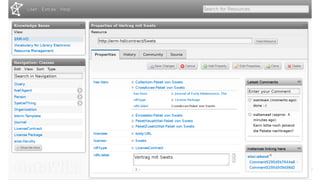
Linked Data Tool: OntoWiki
➔ facilitates the visual presentation of RDF
➔ create, edit and link RDF content with a GUI
➔ build appropriate forms based on your ontology
easily with form builder
➔ developed by the Research Group Agile Knowledge
Engineering and Semantic Web (AKSW) hosted by
the Univerity of Leipzig
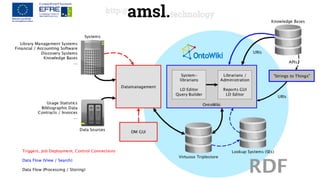
Data Integration
➔ Importing RDF Data is a core feature of
OntoWiki
➔ Format migration will be done by middleware
(by SLUB Dresden)
More information
http://amsl.technology
English information coming soon!
http://vocab.ub.uni-leipzig.de/bibrm
OntoWiki Application Framework
●
strictly open source
● based on OntoWiki (GPL)
● all software-development takes place in the
official OntoWiki source code repository
site: http://ontowiki.net/
repo: https://github.com/AKSW/OntoWiki
partners
OntoWiki Development and Linked Data Technology :
AKSW - Agile Knowledge management and Semantic Web
/ Institute for applied informatics InfAI e.V.
http://infai.org
Data integration and versatile data conversion:
SLUB - Saxon State and University Library Dresden
http://www.slub-dresden.de

Developing an ERM System based on Linked Data (AMSL project presentation @ ERM Workshop, ELAG 2014)

  • 1.
    Developing an ERMSystem based on Linked Data ERM Workshop @ ELAG 2014 Lydia Unterdörfel, Björn Muschall, Leipzig University Library
  • 2.
    Challenges ➔ variety ofinformation serials, databases, e-books, packages, contacts, statistics, contracts, license terms, terms of use, vendors, consortias... ➔ heterogenious formats & sources COUNTER XML, EXCEL (title lists from vendors), MS- WORD (contracts, invoices), PDF(contracts, invoices), RDF (ZDB title information), ONIX-PL (licenses) ➔ changing business models and publication formats
  • 3.
    Mandatory Features 1. WORKFLOWMANAGEMENT: Support across e-resource life cycle (resource tracking, reminders, status assignments, communication) 2. LICENSE MANAGEMENT: Manage license details, provide storage for agreements, display license terms for internal and external users 3. STATISTICS MANAGEMENT: Obtain, gather and organize usage statistics. auto-download statistics using -SUSHI standard. Provide historical statistics 4. ADMINISTRATIVE INFORMATION STORAGE: Store and access administrative information (usernames, passwords) 5. RESOURCE AND PACKAGE MANAGEMENT: representation of local holdings, titel-package matching, linking of title - package - license (terms)
  • 4.
    Application Qualities ➔ integrationof heterogeneous data formats in a flexible, uniform data model ➔ linking all relevant information ➔ interoperability across systems ➔ adjustments done by systems librarians ➔ generic ‘toolkit’
  • 5.
    Regarding the ERMIreport ➔ Electronic Resource Management Initiative ➔ created 2004 by Digital Library Federation ➔ very detailed considerations and dictionary ➔ http://old.diglib.org/pubs/dlf102/
  • 6.
    Linked Data ➔ amethod to publish and interlink structured data ➔ applied by using the Resource Description Framework (RDF) specifications ➔ four principles: 1. Use URIs to identify things 2. Use HTTP URIs so that these things can be referred to 3. Provide useful information about the thing when its URI is dereferenced, using standards such as RDF, SPARQL. 4. Include links to other related things (using their URIs)
  • 7.
    A new ontology ➔to publish linked data you can use classes and properties of established ontologies, which exist for a variety of purposes ➔ if they do not meet your needs, it is time for your own ontology!
  • 8.
    AMSL ONTOLOGY ➔ reuseexisting ontologies: bibo, dc, umbel, aiiso, owl, foaf, vcard... ➔ create new ones: favor using ERMI dictionary COUNTER launched soon http://vocab.ub.uni-leipzig.de/bibrm
  • 9.
    Linked Data Tool:OntoWiki ➔ facilitates the visual presentation of RDF ➔ create, edit and link RDF content with a GUI ➔ build appropriate forms based on your ontology easily with form builder ➔ developed by the Research Group Agile Knowledge Engineering and Semantic Web (AKSW) hosted by the Univerity of Leipzig
  • 10.
    Data Integration ➔ ImportingRDF Data is a core feature of OntoWiki ➔ Format migration will be done by middleware (by SLUB Dresden)
  • 11.
    More information http://amsl.technology English informationcoming soon! http://vocab.ub.uni-leipzig.de/bibrm
  • 13.
  • 14.
    strictly open source ●based on OntoWiki (GPL) ● all software-development takes place in the official OntoWiki source code repository site: http://ontowiki.net/ repo: https://github.com/AKSW/OntoWiki
  • 15.
    partners OntoWiki Development andLinked Data Technology : AKSW - Agile Knowledge management and Semantic Web / Institute for applied informatics InfAI e.V. http://infai.org Data integration and versatile data conversion: SLUB - Saxon State and University Library Dresden http://www.slub-dresden.de