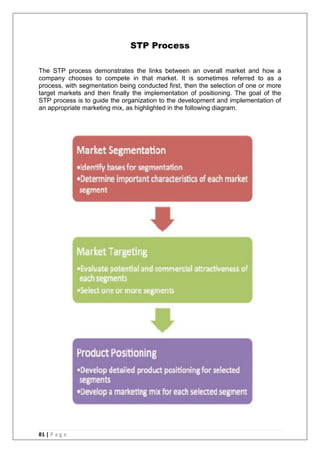
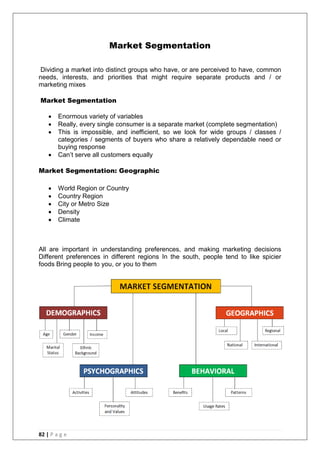
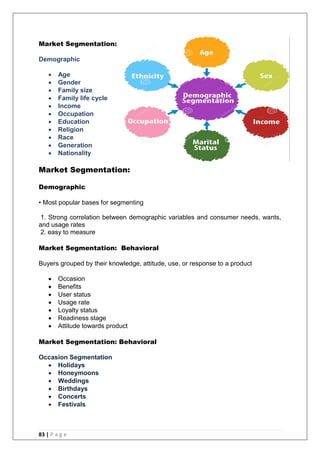
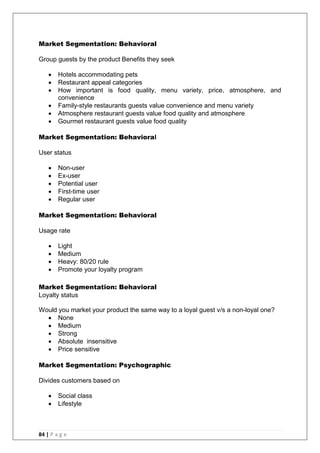




1 | P a g e
A
Project Report on
Consumer Behaviour and Customer
Engagement
Field of management
At
Dezyne E‟Cole College Ajmer
By
Amrita Srivastava
Towards The Partial Fulfillment of 3rd Year in Bachelor‘s
of Business Administrative
Dezyne E‘cole College
106/10 civil lines, Ajmer
0145-2624679
www.dezyneecole.com
2016-2017
2 | P a g e
Amrita Srivastava,
Bachelor of Business Administration
Dezyne E’ Cole College
www.dezynecole.com
3 | P a g e
Grade Sheet
Dezyne E‘ Cole College
106/10 civil lines, Ajmer
0145-2624679
www.dezyneecole.com
2016-2017
This project report of Miss Amrita Srivastava of Bachelor of business
Administration (3rd
) Year Program of BBA has been graduate
as…………………..
Thinking You
Principal
4 | P a g e
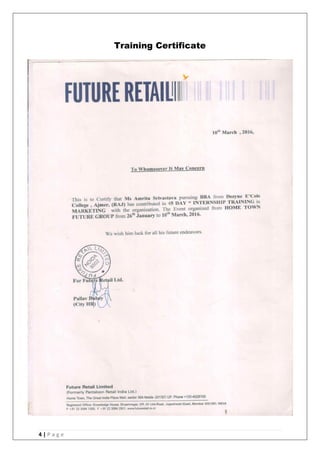
Training Certificate
5 | P a g e
Acknowledgment
I would like to express my gratitude towards Future Group for giving me
an opportunity to work as a summer intern for the duration of one and
half month as a part of training of our course. I express my gratitude to
all those who initialed and help me in a successful completion of this
project.
I express my sincere gratitude to Mr. Tarun sir (Training head, Noida)
and our faculty guide Miss. Neha Bagga for supporting us during the
project work.
I also take this opportunity to express my indebtedness to Mrs. Vinita
Mathur principal “Dezyne E‟ Cole Ajmer‖ for her corporation and
affectionate encouragement. I also thanks to my all faculty member for
their suggestion and advices.
Also I am thankful to my parents and family member who are my
constant source of inspiration in every field of life and due to them I am
whatever I am today.
Thanking you
With regards
Amrita Srivastava
6 | P a g e
Synopsis
This Project was undertaken as my summer internship at future Retail (HOME
TOWN) during the internship period of 45 days I work on the topic consumer
behaviour and customer engagement.
Currently I‘m completing a Bachelor‘s degree at the Dezyne E‘ Cole College in the
Ajmer. I‘m in my 3rd year and therefore I have to conduct a one and half month
internship. The reason I choose to do my internship Delhi is because I wanted to
benefit from the experience. I wanted a new challenge. I wanted to do my internship
Delhi to experience the business world and to learning, improve and develop new
sets of skills.
One of my main goals is to improve my English. Another goal is to Improve
Knowledge about Market. This is why I choose to follow my internship Delhi to learn
and develop new sets of skills and to experience working Delhi.
In this internship report I will describe my experiences during my internship period.
The internship report contains an overview of the internship company and the
activities, tasks and projects that I have worked on during my internship. Writing this
report, I also will describe and reflect my learning objects and personal goals that I
have set during my internship period.
7 | P a g e
Amrita Srivastava
Management student
Profile
To be a successful Manger we need to focus on
the way of communication and all the aspect of
human bahvaiour. I thank Dezyne E Cole to
make me an skilled person and make me ready
for the industry.
Skill
 Computer Knowledge
 Website Maker
 Basie knowledge of Accounts
 Basic knowledge of business management
Intrest
 Music
 Dance
 Like to Learning different country language
 Gaining knowledge about new technology
Language
 Hindi
 English
Experience
 Internship at home Town for One and Half
month
 Doing Project regarding Management
 Make a Website regarding Rajasthan
tourism
Email id :
Dezyneecole@gmai.com
Website :
www.dezyneecole.com
Phone :
0145-2624679
Education
Bachelor’s Of Business
Administrative (BBA)
Dezyne E’ Cole College,
Ajmer
(2014-2017)
12th
National Institute of
Open Schooling Jaipur.
(2013-2014)
10th
Rajasthan board
(2011-2012)
8 | P a g e
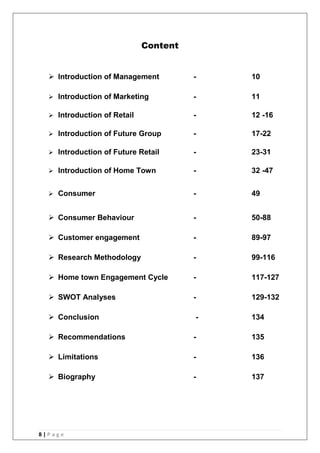
Content
 Introduction of Management - 10
 Introduction of Marketing - 11
 Introduction of Retail - 12 -16
 Introduction of Future Group - 17-22
 Introduction of Future Retail - 23-31
 Introduction of Home Town - 32 -47
 Consumer - 49
 Consumer Behaviour - 50-88
 Customer engagement - 89-97
 Research Methodology - 99-116
 Home town Engagement Cycle - 117-127
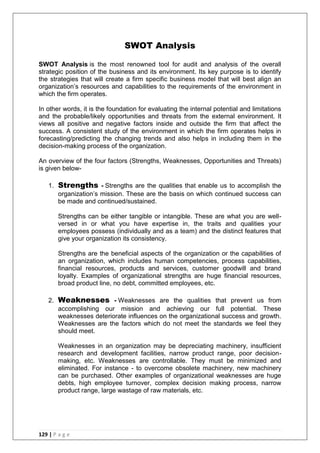
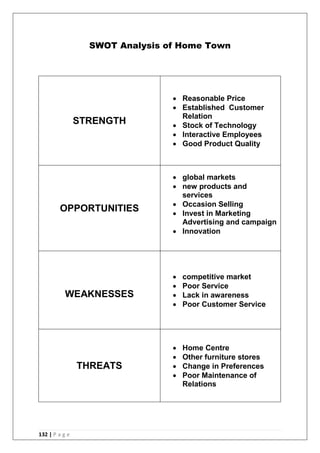
 SWOT Analyses - 129-132
 Conclusion - 134
 Recommendations - 135
 Limitations - 136
 Biography - 137
9 | P a g e
Introduction of Management field and its
content
Introduction of Marketing
Introduction of Retail
Introduction of Future Group
 Brands
Introduction of Future Retail
 Outlets
Introduction of Home Town
 Department
 Need of Study
Objectives of Study
Limitation of Study
10 | P a g e
Introduction of Management
As per the studying criteria of three years of bachelor‘s degree of management field
every student has to undergo a practical training of 45 days. According to the interest
of the student the training is a vocational training in the organization to learn more
about the working scenario of an organization and a project by the person whom one
is posted during the training period. I had undergo a practical from Future Group,
Hometown.
In the present scenario the practical training is an essential part of management
stream. It helps an individual to visualize the management practices in the theoretical
aspects in which we have learnt Business Communication, Purchase
Management, Business Research, Quality Management, Orgainsation
Behaviour, Sales and Salesmanship, etc.
After the completion of training period every student have to make a training report to
showcase my work, which I had done in an organization in my training period. The
project report contain the chapters likewise, Company profile, Consumer
Behaviour, Customer Engagement, etc.
This project work is based on the above subjects whom we learn in our three year
degree program.
A project report is divided into two major parts the first is Primary parts which gives
a brief study about Company profile, Product Classification etc.
The second part is Secondary Part which gives a brief study about Research
Tools, Market Study, Objectives of Study, and Introduction of management etc.
These are the aspects which I have discussed in my internship project work at
Future Group, Hometown in Noida for 45 days.
This is the annual report which presents the aspects of the practical training taken by
me. The criteria on which I had undertaken my training and present my project work
is “Consumer Behaviour and Customer Engagement” for understanding the
efficient and better functioning of the organizations and for taking an practical
knowledge about the effective working of the organization to enhance and boost up
my skill set.
11 | P a g e
“Marketing is Strategic Communication and promotion
delivered in a mix of from, such as advertising public
relation and direct marketing through multiple online and
offline channels to acquire customer retain customer,
increase share of wallet and shorten the sales cycle”.
Marketing is the moving and exciting activity in everybody activities. The
sellers, distributors, advertising agencies, consultants, transporters,
financers, store agencies and every one as a counter are part of the
marketing system. Any exchange process be it consumer, goods,
intermediary goods, services of ideas, comes under the preview of
marketing. It is very often regarded that the development of markets and
marketing is synonymous with the economic development of account.
Through marketing is an action discipline. In the ever-growing corporate
world, marketing is being regarded as a crucial element for the success
of an Enterprise. The marketing discipline is undergoing fresh re
appraisal in the light of the vast global, technological, economic and
social challenges facing today‘s companies and countries. Marketing at
its best is about value creation and raising the world‘s living standards.
Today swinging companies are those who succeed most in satisfying,
indeed delighting their target customers.
Marketing is so basic that it cannot be considered a separate function. It
is whole business seen from the point of view of its final result, that is,
from the customer‘s point of view. Business success is not determined
by the producer but by the customer´.
P.P.Drucker
Defined marketing as it is a social and managerial process by which
individuals and groups obtain what they need and want through creating,
offering and exchanging products of values with others´. Many Indian
companies espouse a satisfied customer philosophy and describe
marketing as customer-satisfaction engineering. Since the economy in
this country has changed from a primary condition of scarcity to gradual
and steady stage of affluence, largely giving consumers the opportunity
to choose among many varied alternatives, satisfaction has become a
major concern of business.
Philip Kotler
12 | P a g e
Retail
The word ‗retail‘ is derived from the French word ‗retailer‘ meaning ‗to cut a piece off‘
or ‗to break bulk‘. In simple terms it involves activities whereby product or services
are sold to final consumers in small quantities. Although retailing in its various
formats has been around our country for many decades it has been confined for a
long time to family owned corner shops.
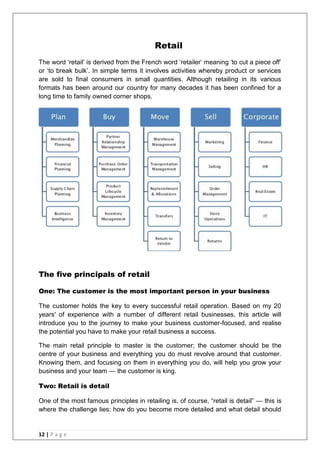
The five principals of retail
One: The customer is the most important person in your business
The customer holds the key to every successful retail operation. Based on my 20
years' of experience with a number of different retail businesses, this article will
introduce you to the journey to make your business customer-focused, and realise
the potential you have to make your retail business a success.
The main retail principle to master is the customer; the customer should be the
centre of your business and everything you do must revolve around that customer.
Knowing them, and focusing on them in everything you do, will help you grow your
business and your team — the customer is king.
Two: Retail is detail
One of the most famous principles in retailing is, of course, ―retail is detail‖ — this is
where the challenge lies: how do you become more detailed and what detail should
13 | P a g e
you focus on? You need to address and improve your understanding of your
customer. To do this, every retailer must focus on the detail and get the detail right
the majority of the time. Mistakes are OK, but you must learn from them and do not
repeat your mistakes. Customers will allow you some mistakes, but too many will
turn them away; understanding the detail is a key skill to master in retail.
Three: Understand the four Ps
This is a very old principle but still has validity. This retail principle will help you
understand the overall foundations of a retail business; the 4 Ps: Product, Price,
Place, and Promotion. These are the basic foundations of a successful retail
business.
Product: You need products that your customers want to buy and a product range
that will satisfy your customers‘ needs and desires. The products must also deliver a
profit for you to have a successful business;
Price: Price must be consistent across the marketing mix and meet all requirements
for your business. You need to price your product range at the correct level for the
customers to be able to buy your products, and for them to gain value from your
products. This could mean pricing high or low — this very much depends upon your
customer offering;
Place: You must provide somewhere for your customers to purchase your product,
be that a physical store, a catalogue or an e-commerce website;
Promotion: Once you have a product — at the right price, in a place where the
customer can access it — you need to tell them about this and promote your
business and your products; make sure your customers know that you and your
products exist and are available for them to enjoy.
Four: Go the extra mile for your customer
Providing great customer service starts with understanding and knowing your
customer; however, knowing them is the start of the journey and you will need to
deliver more than just customer service. To be successful you must deliver world-
class customer service; you must ―go the extra mile for the customer‖. You and your
team must continually go the extra mile for the customer, each time delivering just a
little more than they expect. Doing this each time you and your team interact with
your customers will win them over and make them loyal over a long period of time.
Five: Location, location, location
The final retail principle is: Location, location, location. History has dictated that this
is one of the most important factors in the success of a physical store, and still to this
day it will have a major impact on your success. The best location of your store will
be dictated by your brand and product strategies. For example, a supermarket
14 | P a g e
operation needs a car park and a high fashion store needs to be in a high fashion
area that attracts the right customers for the store. I would argue, however, that
location has less effect now than previously, due to two main factors: the first being
the flexibility of the customers; now we often travel more, and the second being the
internet. The internet has changed our shopping habits and will continue to do so. E-
commerce websites have opened up the world of ―non-geographic‖ retail — a retail
world without the need to visit the physical store. The emergence of ―retail‖ from
retail has been the biggest change over the past 20 years. The journey from retail to
retail has been quick, and we need to embrace the world of retail and ensure we
understand its effects on our customers. The retail world is growing significantly and
with new technologies, such as iPods and mobile commerce, it will continue to
change the opportunities in the world of retail. Retail marketing is the range of
activities undertaken by a retailer to promote awareness and sales of the company‘s
products. This is different from other types of marketing because of the components
of the retail trade, such as selling finished goods in small quantities to the consumer
or end user, usually from a fixed location.
Retail marketing makes use of the common principles of the marketing mix, such as
product, price, place and promotion. A study of retail marketing at university level
includes effective merchandising strategies, shopping and consumer behavior,
branding and advertising. Retail marketing is especially important to small retailers
trying to compete against large chain stores.
(As India‘s leading multi format retailer future group inspire)
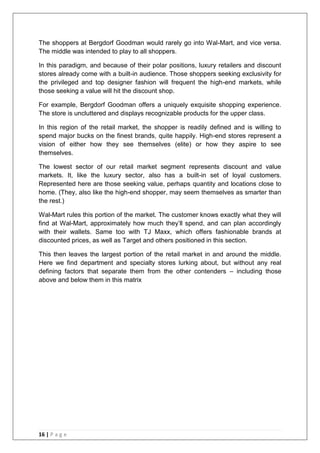
What is a retail outlet?
A store that sells smaller
quantities of products or
services to the general public. A
business that operates as a
retail outlet will typically buy
goods directly from
manufacturers or wholesale
suppliers at a volume discount
and will then mark them up in
price for sale to end consumers.
Need For Study of Retail
The retail sector development has been based on the democratization of
consumption thanks to a low price economic model. This model relies on a low price-
oriented value offer. To be efficiently implemented, this model needs to work on the
control of distribution costs
15 | P a g e
Today‘s retail market is in the midst of great changes. The current competitive set is
under fierce competition from new and emerging venues this dynamic of change is
not a new occurrence in retail. Populations were centered within metropolitan areas.
People did not live in the suburbs and rural residents made their way to nearby cities
when they needed to make a purchase. Back then, required clothing was either
unable to be made and/or unavailable in the general store.
Those residents of cities and metropolitan areas shopped in retail districts, often
defined by the type of product that was available. There were streets and avenues
that were known colloquially as the shoe district, milliner district, haberdashers and
others.
Like the advent of supermarkets in food retailing, where grocers brought the various
store fronts together under one roof (i.e. green grocer and butcher shop),
convenience drove the birth of the department store. These eponymous mega-stores
brought the shingles of merchants together in one place. Suddenly, it was possible to
shop for hats, shoes, dresses, and outerwear all in one place. The lucky city shopper
was able to save time as well as sample all the finest and utilitarian goods available.
This retail market was a global phenomenon. In Britain, Kendals, Harrods, Selfridge,
Baimbridge and others took hold. As the space moved towards this powerful market
economy, department stores arrived all over the European continent. Le Bon
Marché, Karstadt, Magasin and countless others — each was representing the
needs of the local population.
In the US, retail giants took root and Gimbels, Macy‘s, John Wanamaker, Lit
Brothers, Strawbridge and Clothier, Lord & Taylor, Marshal Fields, Frederick and
Nelson began. Many never morphed into chain stores. Marble Palace, in New York,
was one of the first department stores.
As the population shifted to the suburbs from the 1940s and 50s, these large
department stores opened chain stores in larger markets today, in the retail market
world, new pressures have arrived. Specialty stores are on the rise again because
shoppers are looking for the unique and unusual. Population centers have expanded
and almost every community can support a mall (that is, a centralized design
predicated upon the idea that a city shopping experience could be brought to any
community) and a discount retailer like Wal-Mart, Kmart, and Target. But margins
have eroded, discounting has become the norm, shoppers are savvier and the
availability of online purchasing can fulfill the needs of the shopper. The thrill of the
hunt can reside on your tablet or phone and when the shopper visits the department
store they are aware of pricing and compare it to an online venue or a competitor‘s
web site live — even while in the store itself
As a result, cities all over the globe saw more and more independent specialty stores
shutter their windows and close. The department store appeared to be an irresistible
source.
16 | P a g e
The shoppers at Bergdorf Goodman would rarely go into Wal-Mart, and vice versa.
The middle was intended to play to all shoppers.
In this paradigm, and because of their polar positions, luxury retailers and discount
stores already come with a built-in audience. Those shoppers seeking exclusivity for
the privileged and top designer fashion will frequent the high-end markets, while
those seeking a value will hit the discount shop.
For example, Bergdorf Goodman offers a uniquely exquisite shopping experience.
The store is uncluttered and displays recognizable products for the upper class.
In this region of the retail market, the shopper is readily defined and is willing to
spend major bucks on the finest brands, quite happily. High-end stores represent a
vision of either how they see themselves (elite) or how they aspire to see
themselves.
The lowest sector of our retail market segment represents discount and value
markets. It, like the luxury sector, also has a built-in set of loyal customers.
Represented here are those seeking value, perhaps quantity and locations close to
home. (They, also like the high-end shopper, may seem themselves as smarter than
the rest.)
Wal-Mart rules this portion of the market. The customer knows exactly what they will
find at Wal-Mart, approximately how much they‘ll spend, and can plan accordingly
with their wallets. Same too with TJ Maxx, which offers fashionable brands at
discounted prices, as well as Target and others positioned in this section.
This then leaves the largest portion of the retail market in and around the middle.
Here we find department and specialty stores lurking about, but without any real
defining factors that separate them from the other contenders – including those
above and below them in this matrix
17 | P a g e
Kishore Biyani (born on August
9, 1961) is the Founder and
Group Chief Executive Officer
India‘s leading Retail Company,
Future Group. Future Group
mainly deals in retail chains
spread over the space of 20
million square feet in more than
240 cities in India and attracts
over 370 million customer visits
annually. As the Group CEO of
Future Group, Kishore leads a
strong leadership team that delivers on Future Group‘s vision of making India a
‗Sone Ki Chidiya‘ once again. Biyani is married to Sangita Biyani and they have two
daughters, Ashni Biyani and Avni Biyani. His elder daughter Ashni is a director of
Future Ideas, Group's innovation and incubation cell and younger daughter Avni
Biyani is Concept Head of a premium food destination, Foodhall.
Career
Though hailing from a business family, Kishore Biyani‘s first venture happened
almost by chance. During the early ‘80s he noticed the trend of ‗stonewashed‘ fabric
being used for trousers. Riding on this demand, Biyani began the business of
supplying stonewashed fabric to local shops in South Mumbai. This small business
gave him the first taste of entrepreneurial success. The initial success encouraged
Biyani to launch his own brand of fabric for men‘s trousers called WBB - White
Brown and Blue. In 1987, Biyani started a new company called Manz Wear Private
Limited, which was dedicated to manufacturing garments. These brands were sold
under in the retail stores of Pantaloons Shoppe. Manz Wear Private Limited initially
supplied garments to few apparel outlets, but Biyani quickly expanded its scope and
established a network of franchise stores that sold Pantaloon trousers only. In 1991,
Manz Wear was converted into a public limited company and the name was changed
to Pantaloon Fashions (India) Limited. By 1994, the Pantaloons franchise chain had
achieved a turnover of Rs 9,000,000. The company also launched shirt brand ‗John
Miller‘. In 1996, when Biyani was contemplating making Pantaloons a large format
retail store, he stumbled upon a 8,000 square foot property at Gariahat in Kolkata .
At that time, the biggest stores in the city were no more than 4,000 sq ft. This led to
18 | P a g e
the launch of the first departmental store of Pantaloons in 1997. In 2001, Kishore led
the creation of Big Bazaar, a uniquely Indian hypermarket network that connects
thousands of small and large manufacturers to millions of customers. Big Bazaar
today is counted among the five most trusted brands in the services sector in India.
(refer Brand Equity Nielsen Study) Since then, a number of retail chains have
become part of Future Group. Some of these include, Central, Brand Factory,
HomeTown, eZoneonline.in . He has led the acquisition of a number of chains
including Nilgiris, EasyDay,Aadhaar and fabfurnish.com.
Collectively, these are spread over almost 20 million square feet of retail space in
over 240 cities and towns in India and on various digital platforms. Future Group
stores attract over 370 million customers annually and are served by over 45,000
customer associates directly employed by the Group and almost million people who
are directly or indirectly associated with the Group‘s businesses. The group has also
developed an extensively portfolio of brands in the fashion, food and beauty space
that are retailed through its own outlets as well as through other competing chains. In
the fashion space, some of Future Group brands include, Scullers, Indigo Nation,
Jealous, Lee Cooper, Converse, John
Miller, Bare, UMM, Knighthood etc. In
the FMCG space, Future Group brands
include, Tasty Treat, Sunkist, Veg Affair,
Golden Harvest, Nilgiris, Kosh, Sangi‘s
Kitchen, among others. Valuing and
nurturing relationships is a key value
championed by Kishore and reflects in
the strong partnerships the group has
developed with entrepreneurs,
developers, investors, service providers
and domestic and foreign organizations
across various industries. Some of the
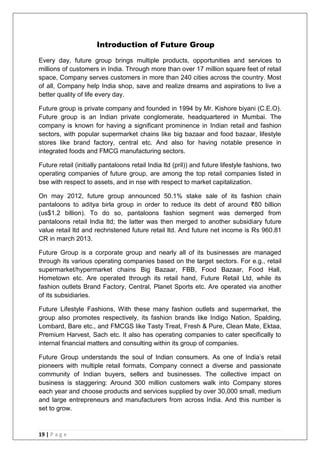
key joint venture partners of the group
include, British footwear market, Clarks,
Europe‘s leading insurer, Generali
Group and British consumer analytics
firm, dunnhumby and the group has
invested in businesses started by over a
dozen of its supply partners and
entrepreneurs. Kishore is a firm believer
in the maxim of ‗Rewrite Rules, Retain
Values.‘ He was born in Mumbai in
1961. In 2007, he authored the book, ‗It
Happened in India.‘ Kishore and his
wife, Sangita have two daughters, Ashni
and Avni Biyani
19 | P a g e
Introduction of Future Group
Every day, future group brings multiple products, opportunities and services to
millions of customers in India. Through more than over 17 million square feet of retail
space, Company serves customers in more than 240 cities across the country. Most
of all, Company help India shop, save and realize dreams and aspirations to live a
better quality of life every day.
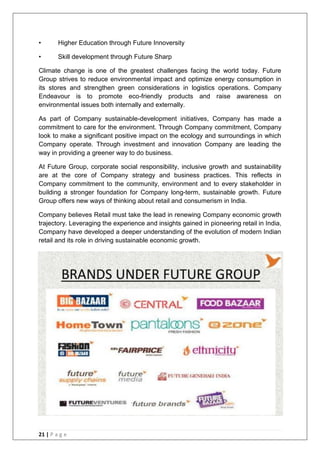
Future group is private company and founded in 1994 by Mr. Kishore biyani (C.E.O).
Future group is an Indian private conglomerate, headquartered in Mumbai. The
company is known for having a significant prominence in Indian retail and fashion
sectors, with popular supermarket chains like big bazaar and food bazaar, lifestyle
stores like brand factory, central etc. And also for having notable presence in
integrated foods and FMCG manufacturing sectors.
Future retail (initially pantaloons retail India ltd (pril)) and future lifestyle fashions, two
operating companies of future group, are among the top retail companies listed in
bse with respect to assets, and in nse with respect to market capitalization.
On may 2012, future group announced 50.1% stake sale of its fashion chain
pantaloons to aditya birla group in order to reduce its debt of around ₹80 billion
(us$1.2 billion). To do so, pantaloons fashion segment was demerged from
pantaloons retail India ltd; the latter was then merged to another subsidiary future
value retail ltd and rechristened future retail ltd. And future net income is Rs 960.81
CR in march 2013.
Future Group is a corporate group and nearly all of its businesses are managed
through its various operating companies based on the target sectors. For e.g., retail
supermarket/hypermarket chains Big Bazaar, FBB, Food Bazaar, Food Hall,
Hometown etc. Are operated through its retail hand, Future Retail Ltd, while its
fashion outlets Brand Factory, Central, Planet Sports etc. Are operated via another
of its subsidiaries.
Future Lifestyle Fashions, With these many fashion outlets and supermarket, the
group also promotes respectively, its fashion brands like Indigo Nation, Spalding,
Lombard, Bare etc., and FMCGS like Tasty Treat, Fresh & Pure, Clean Mate, Ektaa,
Premium Harvest, Sach etc. It also has operating companies to cater specifically to
internal financial matters and consulting within its group of companies.
Future Group understands the soul of Indian consumers. As one of India‘s retail
pioneers with multiple retail formats, Company connect a diverse and passionate
community of Indian buyers, sellers and businesses. The collective impact on
business is staggering: Around 300 million customers walk into Company stores
each year and choose products and services supplied by over 30,000 small, medium
and large entrepreneurs and manufacturers from across India. And this number is
set to grow.
20 | P a g e
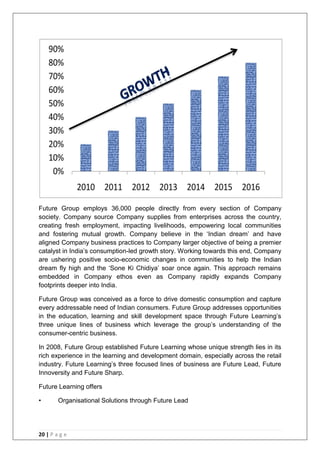
Future Group employs 36,000 people directly from every section of Company
society. Company source Company supplies from enterprises across the country,
creating fresh employment, impacting livelihoods, empowering local communities
and fostering mutual growth. Company believe in the ‗Indian dream‘ and have
aligned Company business practices to Company larger objective of being a premier
catalyst in India‘s consumption-led growth story. Working towards this end, Company
are ushering positive socio-economic changes in communities to help the Indian
dream fly high and the ‗Sone Ki Chidiya‘ soar once again. This approach remains
embedded in Company ethos even as Company rapidly expands Company
footprints deeper into India.
Future Group was conceived as a force to drive domestic consumption and capture
every addressable need of Indian consumers. Future Group addresses opportunities
in the education, learning and skill development space through Future Learning‘s
three unique lines of business which leverage the group‘s understanding of the
consumer-centric business.
In 2008, Future Group established Future Learning whose unique strength lies in its
rich experience in the learning and development domain, especially across the retail
industry. Future Learning‘s three focused lines of business are Future Lead, Future
Innoversity and Future Sharp.
Future Learning offers
• Organisational Solutions through Future Lead
21 | P a g e
• Higher Education through Future Innoversity
• Skill development through Future Sharp
Climate change is one of the greatest challenges facing the world today. Future
Group strives to reduce environmental impact and optimize energy consumption in
its stores and strengthen green considerations in logistics operations. Company
Endeavour is to promote eco-friendly products and raise awareness on
environmental issues both internally and externally.
As part of Company sustainable-development initiatives, Company has made a
commitment to care for the environment. Through Company commitment, Company
look to make a significant positive impact on the ecology and surroundings in which
Company operate. Through investment and innovation Company are leading the
way in providing a greener way to do business.
At Future Group, corporate social responsibility, inclusive growth and sustainability
are at the core of Company strategy and business practices. This reflects in
Company commitment to the community, environment and to every stakeholder in
building a stronger foundation for Company long-term, sustainable growth. Future
Group offers new ways of thinking about retail and consumerism in India.
Company believes Retail must take the lead in renewing Company economic growth
trajectory. Leveraging the experience and insights gained in pioneering retail in India,
Company have developed a deeper understanding of the evolution of modern Indian
retail and its role in driving sustainable economic growth.
22 | P a g e
Future supply chains:
FSC (Future Supply Chain Solutions Ltd.) is India's first fully integrated and IT
enabled end- to- end Supply Chain and Logistics service provider in India. It provides
services to large corporate in Food & FMCG; Apparels, Footwear & Accessories;
Consumer Electronics & Hi- Tech; Automotive; Pharma and Light Engineering
domain.
Promoted by Future Group and Fung Capital, FSC has been a pioneer in
modernizing supply chain and logistics by implementing global best practices in the
Indian context. This has enabled FSC to provide customized Supply Chain Solutions
& Services which reduce Time- to- Market™ and Cost- to- Market™ of customers
Future Supply Chains Offerings:-
FSC Supply Chain Solutions
FSC Supply Chain Solutions team studies the business imperatives of customers
and designs customized supply chain solutions in collaboration with the customers
like:
 Supply chain consulting to define business needs and logistics opportunities.
 Distribution and Transportation network analysis and design
 Warehouse and Facility modeling and layout, including evaluation of
Infrastructure and mechanization needs
 Evaluation and implementation of Technology.
 Labor management opportunity assessment.
 Operational analysis and improvement
 3PL capabilities of high-end Warehousing, Express and Customized
Movement Solutions.
FSC Supply Chain Services
FSC’s Service offerings include:
 FSC Contract Logistics (Warehousing and Distribution)
 GST Ready Network across all High Growth Consumption Clusters of India
 Facilities are Built-to-Suit, Multi-user and Scalable
 Deploying global best practices in Technology & Automation; Indian sing and
Indigenizing to suit Indian conditions
 Robust Distribution & Last Mile Fulfillment Network, providing end- to- end
solutions
 FSC Express Logistics (Express transportation services)
 Safe, secure & all-weather movement through a dedicated fleet of
containerized vehicles.
23 | P a g e
 Online, Real time consignment tracking through GPS enabled Vehicle
Tracking System
 24/7, Online Customer Portal which gives end- to- end visibility from pick- up
to delivery
Future Group was founded on a simple idea: Rewrite rules, retain values. This
fundamental belief created a new kind of marketplace, forever transforming Indian
retail. Today Company core values continue to guide how Company do business and
improve the quality of life of the people Company serve. Company're growing in
dynamic ways and are looking for people w
ho will enable us to continue Company success. Company are looking for people
who are passionate, adaptable, self-motivated, team players and who reflect
Company ideology - "Rewrite rules. Retain values". Future Group is an equal-
opportunity employer. Company encourages people to join us from all walks of life.
To this end, Company implemented numerous training programs that provide
Company employees avenues for advancement. Company unflagging efforts have
ensured that over 80 percent of Company people have been positively impacted.
This has helped us identify and nurture Future leaders and bringing fresh energy and
perspective to the business.
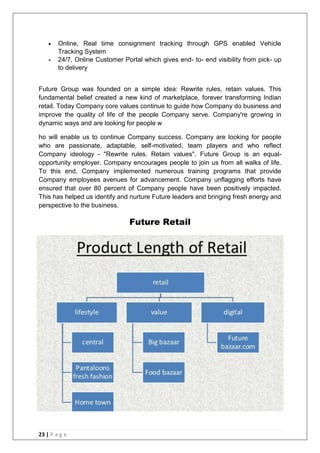
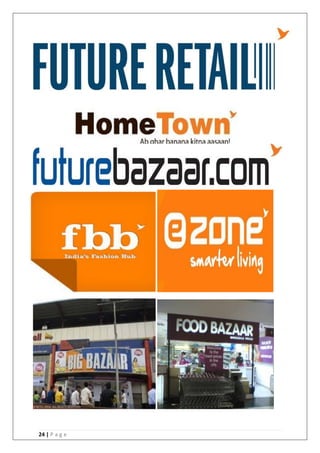
Future Retail
24 | P a g e
25 | P a g e
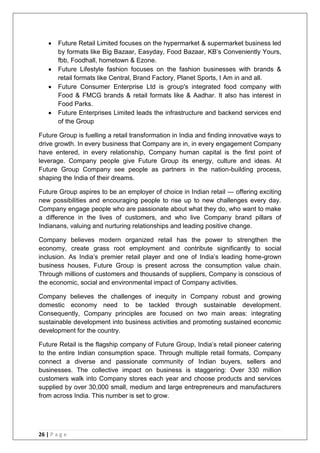
Future Group was conceived as a force to drive domestic consumption and capture
every addressable need of Indian consumers. Future Group makes every effort to
delight its customers, tailoring store formats to changing Indian lifestyles and
adapting products and services to their desires.
The group is credited with creating some of India‘s most popular retail chains. The
hypermarket chain, Big Bazaar is ranked amongst the top 3 service brands in the
country by The Nielsen Company. Other retail chains include, department store
chain, Central, outlet stores chain, Brand Factory, sportswear chain, Planet Sports,
home improvement and consumer durables chain, hometown and Ezone,
supermarket chain, Food Bazaar, convenience stores chain, KB‘s Conveniently
Yours and a growing rural distribution network through Aadhaar.
As modern retail drives fresh demand and consumption in new categories, Company
strategy is based on a deep understanding of Indian consumers, the products they
want, and making these products available in every city, in every store format. Future
Group offers innovative offerings at affordable prices tailored to the needs of every
Indian household
 Pioneers in the India‘s retail space, or formats are household names in more
than 240 cities across the country.
 Company stores cover around 17 million square feet of retail space and
attract around 300 million customers each year
26 | P a g e
 Future Retail Limited focuses on the hypermarket & supermarket business led
by formats like Big Bazaar, Easyday, Food Bazaar, KB‘s Conveniently Yours,
fbb, Foodhall, hometown & Ezone.
 Future Lifestyle fashion focuses on the fashion businesses with brands &
retail formats like Central, Brand Factory, Planet Sports, I Am in and all.
 Future Consumer Enterprise Ltd is group's integrated food company with
Food & FMCG brands & retail formats like & Aadhar. It also has interest in
Food Parks.
 Future Enterprises Limited leads the infrastructure and backend services end
of the Group
Future Group is fuelling a retail transformation in India and finding innovative ways to
drive growth. In every business that Company are in, in every engagement Company
have entered, in every relationship, Company human capital is the first point of
leverage. Company people give Future Group its energy, culture and ideas. At
Future Group Company see people as partners in the nation-building process,
shaping the India of their dreams.
Future Group aspires to be an employer of choice in Indian retail — offering exciting
new possibilities and encouraging people to rise up to new challenges every day.
Company engage people who are passionate about what they do, who want to make
a difference in the lives of customers, and who live Company brand pillars of
Indianans, valuing and nurturing relationships and leading positive change.
Company believes modern organized retail has the power to strengthen the
economy, create grass root employment and contribute significantly to social
inclusion. As India‘s premier retail player and one of India‘s leading home-grown
business houses, Future Group is present across the consumption value chain.
Through millions of customers and thousands of suppliers, Company is conscious of
the economic, social and environmental impact of Company activities.
Company believes the challenges of inequity in Company robust and growing
domestic economy need to be tackled through sustainable development.
Consequently, Company principles are focused on two main areas: integrating
sustainable development into business activities and promoting sustained economic
development for the country.
Future Retail is the flagship company of Future Group, India‘s retail pioneer catering
to the entire Indian consumption space. Through multiple retail formats, Company
connect a diverse and passionate community of Indian buyers, sellers and
businesses. The collective impact on business is staggering: Over 330 million
customers walk into Company stores each year and choose products and services
supplied by over 30,000 small, medium and large entrepreneurs and manufacturers
from across India. This number is set to grow.
27 | P a g e
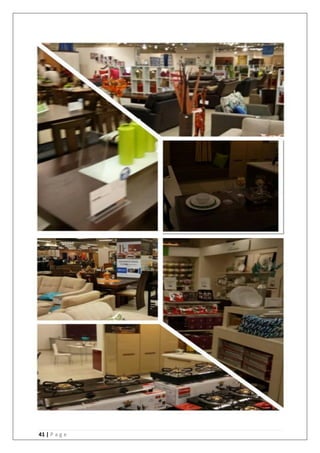
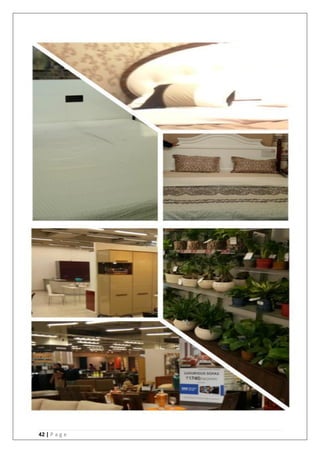
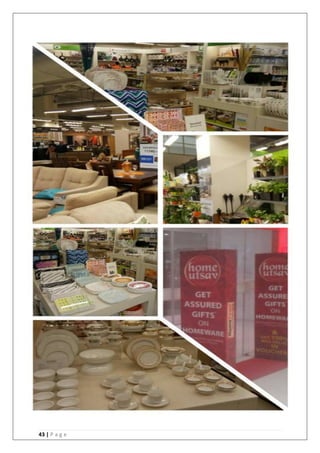
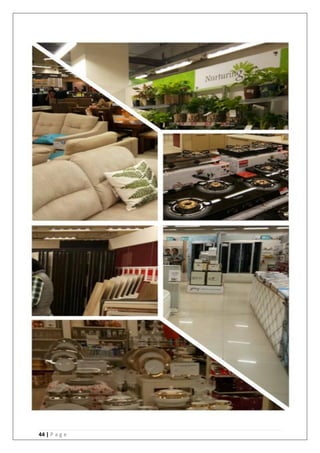
The home solutions segment include hometown and Ezone. Hometown is a unique
one-stop destination for complete home-making solutions. Company promise to
make homemaking an enjoyable and hassle-free experience with Company wide
array of products and services. Company offerings include a slew of living room
furniture, dining, bedroom furniture and furniture essentials, mattresses, modular
kitchens, home furnishing, décor, households and bath luxury.
Future Ventures:
Future Ventures, seeks to promote and participate in innovative and emerging
business ventures in India. The company intends to play a role in powering
entrepreneurship, by promoting or participating in diverse business activities,
primarily in ³consumption-led´ sectors in the country, which it defines as sectors
whose growth and development will be determined primarily by the growing
purchasing power of Indian consumers and their changing tastes, lifestyle and
spending habits. The company will also participate in businesses where it exercises
control or influence, and can add value as active shareholders, by utilizing the
experience and knowledge of the Future Group, and specifically its parent, pantaloon
Retailed
Future Consumer Enterprise Ltd is group's integrated food company with Food &
FMCG brands & retail formats like KB‘s conveniently yours & Aadhar. It also has
Interest in Food Parks.
FSC Supply Chain Solutions:
Means: - Future Supply Chain
It help full to do Retail services. Uses of FSC is
FSC Supply Chain Solutions team studies the business imperatives of customers
and designs customized supply chain solutions in collaboration with the customers
like:
• Supply chain consulting to define business needs and logistics opportunities.
• Distribution and Transportation network analysis and design
• Warehouse and Facility modeling and layout, including evaluation of
Infrastructure and mechanization needs
• Evaluation and implementation of Technology.
• Labor management opportunity assessment.
• Operational analysis and improvement
28 | P a g e
What Is Future Supply Chain?
FSC (Future Supply Chain Solutions Ltd.) is India's first fully integrated and IT
enabled end- to- end Supply Chain and Logistics service provider in India. It provides
services to large corporate in Food & FMCG; Apparels, Footwear & Accessories;
Consumer Electronics & Hi- Tech; Automotive; Pharma and Light Engineering
domain.
Promoted by Future Group and Fung Capital, FSC has been a pioneer in
modernizing supply chain and logistics by implementing global best practices in the
Indian context. This has enabled FSC to provide customized Supply Chain Solutions
& Services which reduce Time- to- Market™ and Cost- to- Market™ of customers
These are Future Group Technology‘s. That‘s why the Group getting good profits
and running successfully.
Business Technology’s Services
Business Technology Services (BTS) is an IT Service provider focused on retail and
allied consumption sectors. This IT service provider arm of Future Group was
established in 2007 with a mandate to develop and deliver end to end technology
solutions to Group's retail, logistics and other businesses. Over the years BTS has
built strong solutions and delivery capabilities with significant traction across all key
retail formats of Future Group.
Currently operating from Mumbai and Ahmadabad we also have support personnel
across major cities like, Gurgaon, Kolkata and Bangalore. Through a robust vendor
partnership the team enables IT operations across the country. BTS has a state of
art centre with 400 seats in Ahmadabad – this is the primary delivery centre to
provide services. Business Technology Services has a unique network of service
model that innovatively integrates consulting, application development, infrastructure
and project management.
Future Group Brands
Our company maintains huge number of Brands in stores
Future Group has built an attractive portfolio of some of the fastest growing
consumer brands in India. This activity is led through Future Brands India Limited, a
specialized subsidiary company set up to create and build powerful brands that
address the aspirations of the new Indian consumer.
Fashion Brands
JOHN MILLER, RTG, BARE, DJ&C, SCULLERS, UMM, BUFFALO, INDIGO,
NATION.
29 | P a g e
LEARNING AND DEVELOPMENT
Future Group addresses opportunities in the education, learning and skill
development space through Future Learning‘s three unique lines of business which
leverage the group‘s understanding of the consumer-centric business.
Future Ideas Of 2016
A New Year brings with it many new hopes, ideas and perspectives at the cusp of
2016
Mainly the Future group focuses on some of occasions
1. Festive feasts on Saturdays
(Weekends clubbed with festivals and a late festival schedule)
2. Lower Prices Guaranteed
(Achhe din a head?)
3. Wedding & no Mahurats
(The longest period of no mahurats)
4. Kitchen as assembly lines
5. Technology on Arms
(Wearable Devices)
6. Another Kumbh
(Godavari Kumbh mala gets nation‘s attention)
7. Cricket worlds cup 2015
(Watch it on your mobile)
8. Tirthas on Ganges
(Allahabad, Ujjain, Nasik, Haridwar)
The Future group sees this traditional time for conducting marketing. These are the
Future group‗s 2016 ideas.
Example
The Godavari Kumbh will celebrate on this year July month that‘s why the future
group wants to do market on rural areas in India. They want to sale some sort of
shampoos, soap‘s, like that this is the new kind of pre planed strategy.
30 | P a g e
Empowering for women‗s
By promoting work and self – sufficiency for women, future group is advancing the
cause of women is society and collectively strengthen the fabric of communities.
Competitors of the Company
In Indian Retail market sector the Future Group is one of Top Company. The Future
group also have competition from some of National Retail company‘s .now find some
of companies.
• Reliance Retail
• ITC Retails
• Spencer‟s
• More Stores
These four companies are top most competitors for FUTURE GROUP.
Competitors for Future Group Retail
1. Reliance Retail
2. Birla Group Retail
3. K .Raheja Group
4. Wal-Mart.
Latest News & Events
Katrina kaif & Varun Dhawan are the new faces of fbb
BIG BAZAAR‘S The Great Indian Kitchen festival‘s back.
Company‘s Purpose:
Future Group was founded on a simple idea. Re write rules, retail values. This
fundamental belief created a new kind of market place forever transforming Indian
retail.
Need For the Study
In the understanding of various forms of business organisations and their operations,
practical and internship approach play an important role in addition to the regular
learning from the course delivery. In this connection it is felt that there is a need to
undertake an organisational study which enables the scholar to be familiar with the
profile of retail industry and profile and functioning of HOME TOWN , NOIDA and
31 | P a g e
keeping the main purpose of the study as to know the application of the theoretical
aspects in the course in the corporate environment and to gain first-hand experience
and expose to policies of the company.
Objectives of the Study
• To study the profile of retail industry.
• To know the profile of Home Town in general and of HOME TOWN , NOIDA
in particular.
• To understand the organisational structure of the company.
• To understand the working of the various departments of the company.
• To perform SWOT analysis for HOME TOWN .
• To offer suggestions and recommendations based on the study carried out.
Limitations of the Study
• Time is limited.
• As per the company rules many information was not disclosed.
• As the managers are busy in their daily schedules it is not possible for us to
spend more time in interaction and discussion with them.
• Sometimes respondents don‘t provide accurate information which may
influence the survey result.
32 | P a g e
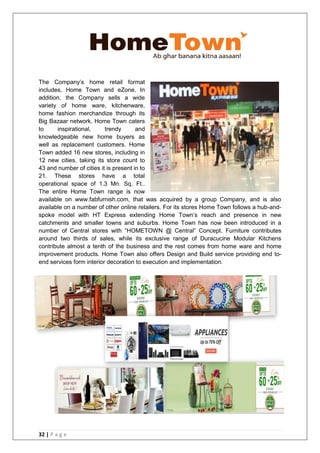
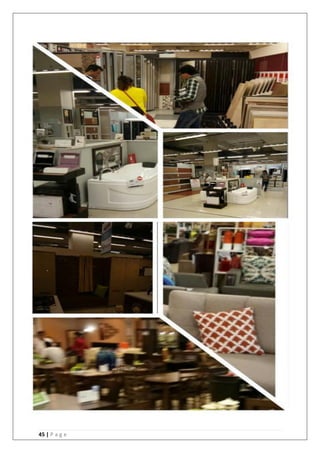
The Company‘s home retail format
includes, Home Town and eZone. In
addition, the Company sells a wide
variety of home ware, kitchenware,
home fashion merchandize through its
Big Bazaar network. Home Town caters
to inspirational, trendy and
knowledgeable new home buyers as
well as replacement customers. Home
Town added 16 new stores, including in
12 new cities, taking its store count to
43 and number of cities it is present in to
21. These stores have a total
operational space of 1.3 Mn. Sq. Ft..
The entire Home Town range is now
available on www.fabfurnish.com, that was acquired by a group Company, and is also
available on a number of other online retailers. For its stores Home Town follows a hub-and-
spoke model with HT Express extending Home Town‘s reach and presence in new
catchments and smaller towns and suburbs. Home Town has now been introduced in a
number of Central stores with ―HOMETOWN @ Central‖ Concept. Furniture contributes
around two thirds of sales, while its exclusive range of Duracucine Modular Kitchens
contribute almost a tenth of the business and the rest comes from home ware and home
improvement products. Home Town also offers Design and Build service providing end to-
end services form interior decoration to execution and implementation.
33 | P a g e
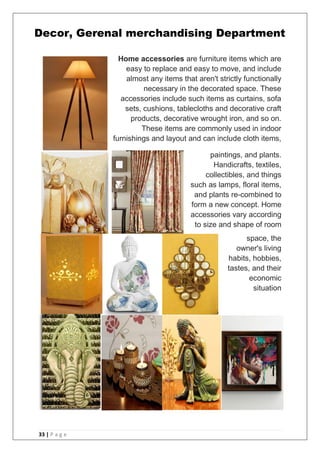
Home accessories are furniture items which are
easy to replace and easy to move, and include
almost any items that aren't strictly functionally
necessary in the decorated space. These
accessories include such items as curtains, sofa
sets, cushions, tablecloths and decorative craft
products, decorative wrought iron, and so on.
These items are commonly used in indoor
furnishings and layout and can include cloth items,
paintings, and plants.
Handicrafts, textiles,
collectibles, and things
such as lamps, floral items,
and plants re-combined to
form a new concept. Home
accessories vary according
to size and shape of room
space, the
owner's living
habits, hobbies,
tastes, and their
economic
situation
Decor, Gerenal merchandising Department
34 | P a g e
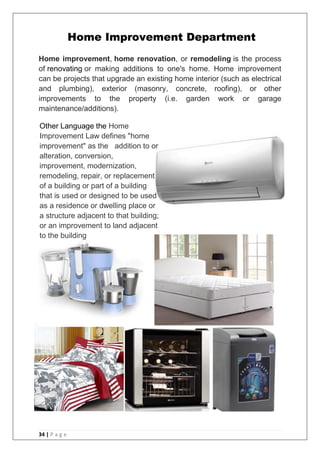
Home improvement, home renovation, or remodeling is the process
of renovating or making additions to one's home. Home improvement
can be projects that upgrade an existing home interior (such as electrical
and plumbing), exterior (masonry, concrete, roofing), or other
improvements to the property (i.e. garden work or garage
maintenance/additions).
Home Improvement Department
Other Language the Home
Improvement Law defines "home
improvement" as the addition to or
alteration, conversion,
improvement, modernization,
remodeling, repair, or replacement
of a building or part of a building
that is used or designed to be used
as a residence or dwelling place or
a structure adjacent to that building;
or an improvement to land adjacent
to the building
35 | P a g e
Furniture Department
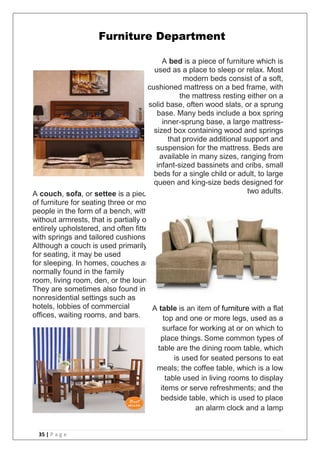
A couch, sofa, or settee is a piece
of furniture for seating three or more
people in the form of a bench, with or
without armrests, that is partially or
entirely upholstered, and often fitted
with springs and tailored cushions.
Although a couch is used primarily
for seating, it may be used
for sleeping. In homes, couches are
normally found in the family
room, living room, den, or the lounge.
They are sometimes also found in
nonresidential settings such as
hotels, lobbies of commercial
offices, waiting rooms, and bars.
A bed is a piece of furniture which is
used as a place to sleep or relax. Most
modern beds consist of a soft,
cushioned mattress on a bed frame, with
the mattress resting either on a
solid base, often wood slats, or a sprung
base. Many beds include a box spring
inner-sprung base, a large mattress-
sized box containing wood and springs
that provide additional support and
suspension for the mattress. Beds are
available in many sizes, ranging from
infant-sized bassinets and cribs, small
beds for a single child or adult, to large
queen and king-size beds designed for
two adults.
A table is an item of furniture with a flat
top and one or more legs, used as a
surface for working at or on which to
place things. Some common types of
table are the dining room table, which
is used for seated persons to eat
meals; the coffee table, which is a low
table used in living rooms to display
items or serve refreshments; and the
bedside table, which is used to place
an alarm clock and a lamp
36 | P a g e
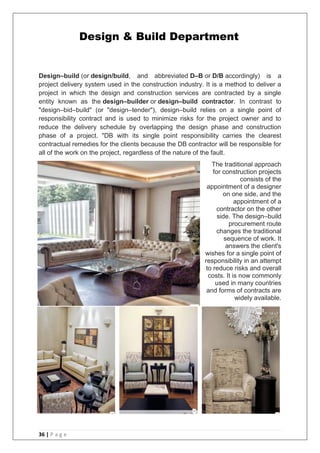
Design–build (or design/build, and abbreviated D–B or D/B accordingly) is a
project delivery system used in the construction industry. It is a method to deliver a
project in which the design and construction services are contracted by a single
entity known as the design–builder or design–build contractor. In contrast to
"design–bid–build" (or "design–tender"), design–build relies on a single point of
responsibility contract and is used to minimize risks for the project owner and to
reduce the delivery schedule by overlapping the design phase and construction
phase of a project. "DB with its single point responsibility carries the clearest
contractual remedies for the clients because the DB contractor will be responsible for
all of the work on the project, regardless of the nature of the fault.
The traditional approach
for construction projects
consists of the
appointment of a designer
on one side, and the
appointment of a
contractor on the other
side. The design–build
procurement route
changes the traditional
sequence of work. It
answers the client's
wishes for a single point of
responsibility in an attempt
to reduce risks and overall
costs. It is now commonly
used in many countries
and forms of contracts are
widely available.
Design & Build Department
37 | P a g e
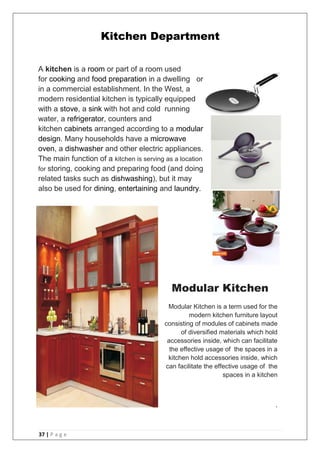
A kitchen is a room or part of a room used
for cooking and food preparation in a dwelling or
in a commercial establishment. In the West, a
modern residential kitchen is typically equipped
with a stove, a sink with hot and cold running
water, a refrigerator, counters and
kitchen cabinets arranged according to a modular
design. Many households have a microwave
oven, a dishwasher and other electric appliances.
The main function of a kitchen is serving as a location
for storing, cooking and preparing food (and doing
related tasks such as dishwashing), but it may
also be used for dining, entertaining and laundry.
Modular Kitchen
Modular Kitchen is a term used for the
modern kitchen furniture layout
consisting of modules of cabinets made
of diversified materials which hold
accessories inside, which can facilitate
the effective usage of the spaces in a
kitchen hold accessories inside, which
can facilitate the effective usage of the
spaces in a kitchen
.
Kitchen Department
38 | P a g e
39 | P a g e
40 | P a g e
41 | P a g e
42 | P a g e
43 | P a g e
44 | P a g e
45 | P a g e
46 | P a g e
What is new at this Hometown?
Solid wood collection: This is a collection of select hand-crafted solid wood
furniture and accessories using materials like solid sheesham wood and rubber-
wood and the like. The line includes sofa sets, bed-sets, dinning sets, bar units,
occasional seating, stools and more. There is history, experience and love going
into each of these pieces. Each piece of furniture is Kiln-dried and termite treated,
so it ensures a lasting life. This Hometown will also have a Food Bazaar, which is
spread across 4000 sq.ft. Said, Mahesh Shah, CEO, Hometown, ―We believe
Hometown will revolutionize the way Kolkata‘s, and those from the neighboring
cities, shop for their homes. Hometown‘s promise to customers is a convenient
shopping experience, where they can get value as well as lifestyle products, across
a wide range of categories, all under one roof. The store has a good mix of products
for budget-buyers, aspiration buyers and lifestyle buyers, with an underlying
principle of keeping traditions alive in a contemporary world.‖
He added, ―Hometown will provide consumers in Kolkata, a single point destination
for all their home needs and a great mix of products with traditional as well as
modern designs, suitable to varied tastes and preferences. We are confident that
Kolkata‘s will find products, unlike what they have seen so far. Moreover, the
services like Design & Build that Hometown offers will surely enhance the value
proposition to our customers. ‖Hometown offers customers a unique, personalized
shopping experience. Every customer walking into the store is escorted around the
store by informative and helpful hosts and hostesses, who guide them about their
requirements. The look and feel of the store is casual and strikes a delicate balance
between aesthetics and functionality. Hometown will display products from all major
manufacturers from India and abroad. Customers will be given price, service and
product guarantees. If customers find any products that they have purchased,
cheaper elsewhere, they will be given a gift voucher of double the difference,
provided they bring an original receipt within two days of purchase of the product.
Hometown will also guarantee workmanship of the jobs that it undertakes, for one
year from the time the job is completed. Every product or service provided is backed
by the reliable manufacturers and service providers. In case of any manufacturing
defect, consumers will get the option to exchange or refund the product. Hometown
will also facilitate fast and easy consumer loans through „Future Money‟, for
purchases at Hometown.
Joint Ventures
Home Solutions Retail (I) Limited has also entered into two equal joint ventures
with India‘s market leader in the retail industry lighting segment and the fastest
growing lighting solutions provider for the retail consumer, Asian Electronics.
Asian
47 | P a g e
Electronics, with a market share of over 60% in the segment brings to the table its
vast technical and manufacturing expertise.
Asian Retail Lighting Limited, provides efficient and energy conserving lighting
solutions to the retail sector. Apart from Pantaloon Retail, some of the customers
serviced by the venture include Spencer‘s Retail, Infinity Retail, Home Care Retail,
Provogue, Welspun, Metro Cash & Carry and Food World.
Home Lighting India Limited provides lighting solutions for the retail consumers‘
home needs. Banking on a strong distribution model, the front-end includes retailing
of all lighting products at the company‘s formats, specialized lighting stores, electrical
distributors and major sanitary and hardware distributors.
48 | P a g e
Who is Consumer?
Introducation of Consumer Behaviour
Characteristic of Consumer Behaviour
Five Thinking Sense
Purchasing Processs
STP Process
Introducation of Customer Engagement
Ways of Customer Engagement
Customer Engagement Process
Need of study
Ojectes of Study
Limitation of Study
49 | P a g e
Consumer
An individual who purchases products and services from
the market for his/her own personal consumption is
called as consumer
Consumer is a KING
50 | P a g e
Consumer Behaviour
Real world consumer behaviour
Introduction
As the need for new patterns of
consumption increases, so do efforts to
understand consumer behaviour, with a
more nuanced understanding beginning to
emerge based on shared insights from a
huge number of disciplines – including
psychology, economics, sociology,
marketing, neuroscience, evolutionary
biology to name but a few. Over time, as
this more sophisticated level of
understanding has developed, evidence
has emerged that calls to account some of the most pervasive and important models
previously used to explain behaviour. A wealth of evidence suggests that ‗real world‘
behaviour (a term used in this report to refer to the actual, observed behaviour of
individuals in day-to-day life) differs dramatically from that predicted by these
models. The evidence presented in this review draws largely on two disciplines –
marketing and behavioural economics – and calls into question perhaps one of the
most pervasive, if not important, assumptions in standard economics: that of ‗rational
man‘. Presented below are the results of this review. Evidence from both behavioural
economics and marketing, as well as other relevant disciplines like psychology and
sociology, is integrated under headings that set out some of the main factors that
drive consumer behaviour. The review is set out with reference to a series of key
texts, which readers are advised to read alongside this report.
The aim of this review is not to reproduce the comprehensive arguments and
evidence set out in these texts but to build upon these, setting out new evidence
where appropriate.
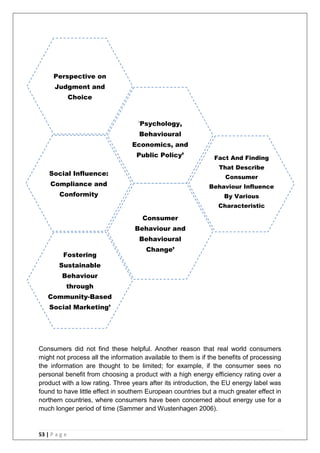
1. Kahneman, D. (2003) A Perspective on Judgment and Choice: Mapping
Bounded Rationality. American Psychologist. 58 (9), 697 – 720. Daniel Kahneman‘s
paper (2003) presents over three decades‘ Nobel-prize winning research exploring
the concept of ‗bounded rationality‘ - the ways in which decisions diverge from those
predicted by rational choice theory. It focuses largely on ‗cognitive economics‘ (it
does not, for example, consider the impact of social norms on decision-making), but
provides a comprehensive summary of many of behavioural economics‘ most well-
researched phenomena.
51 | P a g e
2. Jackson, T. (2005) „Motivating sustainable consumption: a review of
evidence on consumer behaviour and behavioural change’. A report to
the Sustainable Development Research Network. January 2005. Several more
recent reviews of behaviour change and behavioural models exist but Prof. Tim
Jackson‘s 2005 review of consumer behaviour remains perhaps the most
comprehensive and accessible, and the foundation on which the majority of more
recent reviews have largely been based. The report sets out in an accessible way
the main drivers of behaviour and theoretical models that attempt to explain it, and
does so with consistent critiques of rational choice.
3. Cialdini, R. B. and Goldstein, N. J. (2004) Social influence: compliance
and conformity. Annual Review of Psychology. 55, 591 – 621. A wide-ranging
summary of evidence relating to the ways in which people seek to comply with
requests and demands, and to conform to social norms. The article summarizes
recent research (1997 – 2002) and considers the ways in which three goals –
accuracy; affiliation and maintenance of a positive self-concept – drive individuals to
comply with requests and conform. Findings related to marketing are largely implicit
but the articles serve as a valuable summary of many of the principles that underlie
advertising and consumer-focused persuasion.
4. McKenzie-Mohr, D. (2000) ‗Fostering Sustainable Behaviour through
Community-Based Social Marketing’. American Psychologist. 55 (5), 531 –
537.2 The findings that have emerged from the literature reviewed to date point
towards the need for more nuanced policy-making that can take into account the
different barriers to and drivers of behaviour in any given situation. Doug McKenzie-
Mohr‘s article sets out a clear, step-by-step guide on how to adopt a community-
based social marketing approach when planning interventions (McKenzie-Mohr
2000). Social marketing is already informing SCP policy-making within Europe (e.g.
Defra 2008) and is likely to continue to do so. Discussions in the literature review of
policy implications will update McKenzie-Mohr‘s article with reference to recent
research and also policy interventions referenced in behavioural economics. Or, for
even more information, the book: McKenzie-Mohr, D. (2000) ‗Fostering Sustainable
Behaviour Through Community-Based Social Marketing.
5. Amir, O. et al. ‗Psychology, Behavioural Economics, and Public
Policy’. Marketing Letters. 16 (3/4), 443 – 454. Co-authored by a number of leading
behavioural economists, this paper sets out a number of ways in which learning from
behavioural science can inform policy. It considers three examples from existing
policy, before discussing some of the challenges that face policy informed by
psychology. Finally, the paper advocates attempting to change policy through the
utilisation of emerging findings from behavioural economics and highlights the
importance of trialing policies through local level pilots. How do consumers really
make decisions? Standard economic thought often contends that consumer
52 | P a g e
behaviour is most cost effectively influenced by policy through the provision of
information and choice; provide enough information and a wide array of products
with which consumers can satisfy their preferences and markets will do the rest. In
reality, as this section of the report begins to discuss, consumer decision-making is
subject to a host of internal and external factors that bias decisions and over-turn
preferences. The repeated buying of products leads to shopping habits, leading to
certain products (particularly, for example, food products) being bought almost
automatically. Consumers tend to avoid losses and eagerly take advantage of
promotions and product trials, making the offer of something for ‗free‘ irresistible.
Even the method of payment used to buy a product can have a fundamental impact
on the amount someone is willing to pay for it. What follows is a discussion of some
of the evidence that highlights the often surprising nature of consumer behaviour.
The chapter then considers in greater detail some of the internal and external factors
which drive this behaviour. Information provision, reliability and sources A common
feature of standard economic thought is the belief that when individuals make poor
choices it is the result of misinformation or a lack of information. As such, the
information-deficit model of behaviour change (or ‗knowledge-deficit‘ model)
contends that poor decisions are made because people lack the information that
would enable them to make a better choice. Across many areas of consumer policy,
information provision is favored as a policy tool because of its marginal cost
(compared to other options) and because it is assumed that too much information
can never be harmful (BRE and NCC 2007). However, both marketing and the
behavioural sciences have proven the information-deficit model to be deeply flawed.
16 In part, this stems from the fact that consumers rarely search out, read or properly
digest all of the information that is available to them when making a decision. The
type, complexity and amount of information provided, and the way in which it is
presented, all have a significant impact on the likelihood of people reading and
understanding it. In the UK, research has found that consumers are unwilling to
spend time reading a lot of available information (especially ‗small print‘) and that the
formal, legal language of much information is confusing. Often, people think that
information is being provided because the provider of the information is legally
obliged to do so, rather than because it is beneficial to the consumer (BRE and NCC
2007). For example, consumers might assume that detailed information about the
specification of a new television is provided because the manufacturer has an
obligation to provide it. Rather than actually helping consumers make informed
choices, the sheer volume of information now found on products and packaging can
make understanding information harder rather than easier.
‗200Hz clear LCD‘ ‗4 HDMI‘, ‗DVB-T‘, ‗Motionflow 220Hz‘ ‗Xross media bar‘ ‘24P true
cinema‘…Needless to say, we know from research that there is hardly any consumer
understanding of the meaning of these features, nor of their consumer benefit‘ (van
Veen 2009). To highlight two extreme cases, the UK‘s Better Regulation Executive
identify a toaster sold with 52 different safety warnings and a consumer credit
agreement that took people 55 minutes to read in full (BRE and NCC 2007).
53 | P a g e
Consumers did not find these helpful. Another reason that real world consumers
might not process all the information available to them is if the benefits of processing
the information are thought to be limited; for example, if the consumer sees no
personal benefit from choosing a product with a high energy efficiency rating over a
product with a low rating. Three years after its introduction, the EU energy label was
found to have little effect in southern European countries but a much greater effect in
northern countries, where consumers have been concerned about energy use for a
much longer period of time (Sammer and Wustenhagen 2006).
Fostering
Sustainable
Behaviour
through
Community-Based
Social Marketing’
Perspective on
Judgment and
Choice
‗Psychology,
Behavioural
Economics, and
Public Policy’
Consumer
Behaviour and
Behavioural
Change’
Social Influence:
Compliance and
Conformity
Fact And Finding
That Describe
Consumer
Behaviour Influence
By Various
Characteristic
54 | P a g e
Although energy efficiency labels might appeal to consumers concerned about their
environmental impact, consumers are more likely to process the information if they
see a benefit from doing so. For consumers who are concerned about protecting the
environment, knowing they are purchasing an energy efficient product may be
enough to motivate their purchase; for other consumers, the personal benefits – in
terms of reduced running costs or total lifetime savings – may prove more
motivating. Similarly, a year-long study into the impact of front-of-pack nutritional
labeling of food on consumer behaviour in the UK found a marked difference
between self reported levels of label use when shopping and actual observed
consumer behaviour. While many people claimed that they were influenced by
nutritional 17 labels, in reality it was largely those concerned with healthy-eating – or
following some kind of special diet – who used the labels. In most cases, other
external factors (for example price, special offers, brand loyalty and the type of
product) all played an influential role in purchasing decisions (FSA 2009). It has been
suggested that information provision as a policy option will therefore be most
effective when it makes it easier for consumers to process information about
expensive products (i.e. it lowers the costs associated with processing the
information) (OFT 2008). The other reason the information-deficit model proves to be
ineffective at motivating behaviour change is because of the wealth of other factors –
in addition to information – that motivate individual action. Policies that fail to
accommodate these other factors, for example by considering the impact of the
behaviour of other peoples – are less likely to prove effective. For example, in the
summer of 2000, California experienced an energy crisis with demand outstripping
supply; prices rocketed and power outages were widespread. Within this context,
Schultz et al. (2007) tested a series of different interventions that encouraged people
to conserve energy in their homes. Across several approaches, the least effective
method was providing information. Yet this remained the method most frequently
employed by policy (Schultz and Estrada-Hollenbeck 2008). Other considerations
are related to the way in which information is communicated. From as early ago as
the 1940s, research has shown that mass media is very rarely able to directly
influence more than only a small part its audience. In fact, it is face-to-face contact
with others that influences most people (Weenig and Midden (1991), and see Fell et
al. (2009) for a current review of literature on influence via social networks). 3.2.2
The ‗paradox of choice‘ Consumer autonomy, or the right of consumers to make their
own choices, is one of the most fundamental features of classic free market
economics, something psychology would initially appear to support as beneficial.
The provision of a right– to-choose has been found to positively link to increases in
perceived control, intrinsic motivations and life satisfaction, as well as proving
beneficial even when the choice itself is trivial (Iyengar and Lepper 2000). However,
when faced with too much choice, people have difficulty managing their decisions
and both satisfaction and the ability to easily make preferential decisions are
reduced. Schwartz (2004) has called this ‗the tyranny (or ‗paradox‘) of choice‘.
Research shows that as choice increases, consumers consider fewer choices,
55 | P a g e
process less overall information and evaluate information differently. 18 ‗Choice
overload‘ hypothesis (Iyengar and Lepper 2000) proposes that while the provision of
extensive choices can initially be seen as desirable, it ultimately proves
demotivating. In a series of studies exploring the way in which people buy jam they
found that people proved much more likely to purchase a product when offered a
small selection of options (6) than a much more extensive set of options (24 – 30).
Their findings support those from cognitive psychology which contend that our short-
term memory can generally handle 7 (+/- 2) options when making choices
(Productivity Commission 2008). Consumers may also be less happy with a decision
when they closely consider their options than when they do not. If I am presented
with one good option, I will be happy. But if I am presented with two good options, I
am more likely to critically evaluate both and to notice their disadvantages.
Whichever option I ultimately choose, I will be aware of its disadvantages –
something that might not be the case if I only had one option to choose from (Hsee
and Tsai 2007). Linked to loss aversion, the opportunity costs (the opportunities
presented by the options that we choose to reject when making a choice) can gain
excessive prominence in decision-making. Given that opportunity costs tend to
reduce the desirability of the most preferred choice, it can be the case that the more
choice there is, the more opportunities we will feel have been lost and the less happy
we will be with our choice (Schwartz 2004). Hsee and Tsai (2007) attribute this to the
emotional attachment that can result from deliberation; close consideration of a suite
of options can lead consumers to form an emotional attachment to all options,
including those that have to be foregone. Choosing one option feels like losing the
others. Similarly, when faced with multiple undesirable options, consumers are
happier if someone else makes the choice for them than if they have to make the
choice themselves. For example, if someone is on a diet and has to choose between
a selection of meals that
do not appeal to them,
they will be happier if
someone else chooses
the meal for them (Hsee
and Tsai 2007). As the
complexity of making a
choice increases,
people simplify their
decision making
processes and are more
likely to rely on mental
rules of thumb, or
‗heuristics‘, to speed up
decision-making. Such
heuristics – or mental
‗rules of thumb‘ – are
56 | P a g e
often helpful and indeed rational; they allow us to reduce the effort (or 'transaction
costs') associated with decision-making and provide ‗rough and ready‘ preference
assessments. When heuristics become more problematic, from an economic point of
view, is when responses based on heuristics are biased and when these biases are
systematically repeated. Related to choice and information provision, product
branding and recognition provide one example of when such a heuristic may
influence consumers. Branding and the recognition heuristic As the complexity of
making a choice increases, people simplify their decision making processes and are
more likely to rely on heuristics. Related to information provision, product branding
and the judgment heuristics discussed earlier (Kahneman 2003), recent evidence
suggests the existence of a ‗recognition heuristic‘ (Goldstein and Gigerenzer 2002).
When forced to make a decision quickly, consumers often make decisions based
purely on product recognition, even if the consumer knows nothing about the product
(Ariely 2008; Richter and Spath 2006). The importance of recognition, and the extent
to which consumers are able to access information about products and brands even
when attention levels are low, is knowledge of increasing importance to marketing. In
the past, marketing relied heavily on ‗product recall‘ (the extent to which a consumer
remembered having seen or heard about a product) as indicative of successful
marketing. If lots of people recalled having seen an advert, the ‗recall rate‘ was taken
as a marker of success. More recently, influenced by advocates of the ‗primacy of
affect‘ (Zajonc 1984), marketing is realising that brand recognition, rather than an
individual‘s ability to necessarily recall seeing an advert or brand, is actually a better
predictor of brand favorability. When brand information is subject to what Heath
(2001) has termed ‗Low Attention Processing‘ – i.e. the automatic cognitive
processing that Camerer et al. (2005) identified this can trigger an automatic
emotional response, which can in turn lead to an intuitive choice (Penn 2005). If I am
shopping in a rush and my thoughts are distracted, I might prove more likely to grab
a product or brand that I recognise, regardless of whether I can actually recall seeing
an advert about it and without even noticing what other information is on the label
(for example, about the fat content or production methods). Market research has
used CCTV to monitor the way in which people buy beverages in convenience stores
and found the vast majority made a decision within two minutes, going straight to a
familiar brand. One conclusion of this is that manufacturers are better advertising out
of store than attempting to do so in-store (The Economist, 2008). The impact of
brand loyalty is not confined to point of purchase. A frequently cited example in both
behavioural economics and marketing literature comes from Princeton University,
where a research team explored brain activity in participants while they drank
branded cola. While some participants drank blind, others were made aware of what
brand they were drinking and were shown the product packaging. The study found
that brand awareness had a dramatic influence on expressed behavioural
preferences; people said they liked exactly the same product much more if they
thought that it was produced by a known brand. What was particularly important in
the study was that FMRI brain scans were used to monitor brain activity 20 during
the tests. These found that activity in the part of the brain associated with emotion
57 | P a g e
and affect were greater when participants knew they were drinking the branded
product – not only do people report enjoying consuming a branded product more, but
their brains exhibit responses commensurate
The term "consumer behavior" refers to actions and decisions that factor into a
customer's purchase. Researchers, businesses and marketers study consumer
behavior to understand what influences a consumer's shopping preferences and
selection of products and services. Multiple factors affect consumer behavior, among
them economic status, beliefs and values, culture, personality, age and education
(Kotler, 2004). Findings on consumer behavior are used to develop methods and
products that will boost company performance and sales. Customers are becoming
more powerful, more knowledgeable and more sophisticated, and research into
modern consumer behaviour is increasingly important for businesses according.
Advertising to attract consumers, providing better environment, product, services and
policies is important in improving today‘s consumer experience to support
businesses in retaining customers. This study seeks to determine and explain the
effectiveness of internet advertising in stimulating consumer response.
According to Warner,
consumer behaviour is the
study of individuals, groups,
or organizations and the
processes they use to
select, secure, and dispose
of products, services,
experiences, or ideas to
satisfy needs and the
impacts that these
processes have on the
consumer and society
(Malcolm). Warner
emphasized the
consumption related
behaviours are often undertaken collectively. For example, some activities performed
by individuals but consumed by a family or group of people, similar as 14
organization purchasing activities usually followed by group decisions. Beside this
point, the consumer behaviour is not just purchasing, but has usage and disposal the
goods, this type of information always be useful for company to make marketing
decisions (Malcolm). It blends elements from psychology, sociology, social
anthropology and economics, and attempts to understand the decision-making
processes of buyers, both individually and in groups. It studies characteristics of
individual consumers such as demographics and behavioural variables in an attempt
to understand people's wants, and also tries to assess influences on the consumer
from groups such as family, friends, reference groups, and society in general. This
58 | P a g e
definition clearly brings out that it is not just the buying of goods/services that
receives attention in consumer behaviour but, the process starts much before the
goods have been acquired or bought. A process of buying starts in the minds of the
consumer, which leads to the finding of alternatives between products that can be
acquired with their relative advantages and disadvantages. This leads to internal and
external research. Then follows a process of decision-making for purchase and using
the goods, and then the post purchase behaviour which is also very important,
because it gives a clue to the marketers whether his product has been a success or
not (Malcom). The black box model shows the interaction of stimuli, consumer
characteristics, decision process and consumer responses.
It can be distinguished between interpersonal stimuli (between people) or
intrapersonal stimuli (within people). The black box model is related to the black box
theory of behaviourism, where the focus is not set on the processes inside a
consumer, but the relation between the stimuli and the response of the consumer.
The marketing stimuli are planned and processed by the companies, whereas the
environmental stimulus is given by social factors, based on the economical, political
and cultural circumstances of a society. The buyer‘s black box contains the buyer
characteristics and the decision process, which determines the buyer‘s response.
Measuring customer behaviour is a crucial part of any business. Knowing what the
consumer wants and how he acts is vital in terms of product design, and marketing
(Todd, 1997). Assessment of consumer behavior in specific situations, using
observational and physiological methods, is becoming increasingly important in
understanding conscious and unconscious consumer behavior. An increased
understanding of consumer behavior may result in the development of improved
consumer products and in more healthy dietary patterns. A growing number of
techniques is available to assist researchers in measuring various aspects of
consumer behavior such as walking patterns, product selection, meal composition,
and eating/drinking. Due to advances in digital video, sensor technology and
computer speed, complex measurements of behavior and physiology are now
possible. Integration of these techniques allows multimodal measurements. With the
growing number of techniques, the challenge for the researcher to choose the right
solution becomes larger. There are different ways of measuring consumer
behaviour, depending on the interest. Regularly conducting market research allows
businesses to know their customers, and take them into account when making
business decisions. This greatly improves business performance, and profits.
Common measurements includes, conducting a survey to determine consumer
behaviour. There are two main types of consumer survey: qualitative or quantitative.
Qualitative studies involve asking a few consumers a lot of in-depth questions.
Quantitative studies involve asking lots of consumers a few questions. The latter
would be better for determining the market for a totally new product, since you only
need to find out if people would buy it. If you are amending a product, or making one
similar, a qualitative study would allow you to gain more detailed information.
Similarly, consumer behaviour would be measured by observing consumers going
59 | P a g e
about their business within permitted stores or shopping malls. By watching
consumers, it is possible to discern a great deal of information about their behaviour.
Information such as optimum height and location of a product and store layout is all
gleaned from observational consumer behaviour measures. Other techniques
involve using raw data to provide a measurement tool. For example, releasing a
new product to the market, and observing if it is bought regularly in conjunction with
another 16 product. If so, then an assumption can be made that it has a similar
demographic to the second product. Using the raw data to determine what time of
day, or weather, or time of year people buy a product gives information on consumer
behaviour. Using separate objective and subjective data obtained from an interview
or survey. The primary data from respondents is used to make objective judgements,
which are free from bias.
Consumer behaviour in the real world often differs from that predicted by economics
and policy. Drawing together evidence from behavioural economics and marketing,
this project sought to explore consumer behaviour relating to the purchasing of
environmentally-preferable products. The project‘s research findings are based on
the results of a review of behavioural economics and marketing literature, and
additional research with marketing professionals. Contrary to the belief of many
economists, consumers very rarely weigh-up the full costs and benefits of their
purchasing decisions. Instead, they are strongly influenced by emotional factors, the
behaviour of other people, by habits, and by the use of mental short-cuts, which all
help to speed up decision-making. Rather than being consistent, consumer
preferences have also been shown to be inconsistent, changing over time and
according to the situation and the way in which information is presented. In turn,
while information provision and choice are important, neither necessarily leads to
improved consumer decision-making or changes in consumer behaviour. A common
feature of standard economic thought is the belief that when individuals make poor
60 | P a g e
choices it is the result of misinformation or a lack of information. Both marketing and
the behavioural sciences have proven this ‗information-deficit‘ model to be deeply
flawed. In part, this stems from the fact that consumers rarely search out, read or
properly digest all of the information that is available to them when making a
decision. More fundamentally, the model neglects the wealth of other factors that
determine individuals‘ behaviour. The most obvious finding to emerge from the
research is that policy must take into account all of these different factors if it is to
effectively influence consumer choice. An improved understanding of consumer
behaviour gives policy-makers a wider range of policy instruments with which to
achieve policy objectives. Used in the right circumstances, these instruments are
likely to be more cost-effective than more traditional policy instruments. Policy should
also remember consumer behaviour is both context- and product specific. While the
existing evidence on consumer behaviour contained in this report provides guidance
on how people make choices, policy-makers need to remember that consumer
responses will vary across product groups and policy areas. The six short 'policy
briefs' produced to accompany this report provide the key pieces of policy-relevant
information and advice on consumer behaviour in relation to 5 purchasing (and
sometimes use) of: private vehicles, white goods, consumer electronics, food
and drink, utility contracts.
Key findings: what do we know about consumer behaviour?
Consumers rarely weigh up all the costs and benefits of choices. Instead, purchasing
decisions may be made automatically, habitually, or be heavily influenced by an
individual‘s emotions or the behaviour of others. This also means that consumers
tend not to use all of the information available to them when shopping. Instead,
people are more likely to read information when they perceive a benefit from doing
so.
 Consumers use mental short-cuts to help speed up decision-making. These
short-cuts can distort consumers‘ decisions. Short-cuts can include relying on
labels or brand names that are recognized, and being influenced by the way
in which information is presented and the context in which a decision is made.
 Consumers respond more to losses than gains. This means people are more
reluctant to give something up or suffer loss than they are motivated by
benefits of equal value. This aversion to loss has a significant impact on the
way in which people interpret information and can lead to consumers avoiding
making choices altogether.
 Consumers value products much more once they own them. In addition, the
value placed on a product is inconsistent. It can vary over time, and can be
61 | P a g e
affected by the previous cost of the product and the emotional attachment
someone places on a product. This makes people reluctant to trade in old
products, even when it would be cost-effective to replace them.
 Consumers place a greater value on the immediate future and heavily
discount future savings. This impacts on the way in which consumers value
the efficiency and lifetime costs of appliances.
 Too much choice can be overwhelming to consumers, making decision-
making difficult. As choice increases, consumers may consider fewer choices,
process less overall information and evaluate information differently. When
choice is particularly excessive, consumers may actually avoid making a
choice altogether.
 Consumers are heavily influenced by other people. This might take the form
of an indirect influence, for example from seeing neighbours or friends buying
a product, or a more direct, explicit influence, for example when a salesperson
persuades someone to buy a certain product. Nearly all consumption choices
are subject to some kind of social influence.
 Consumers use products to make a statement about themselves. Products
meet far more than just a functional need; they make a statement about a
person‘s identity and about the type of person they are and would like to be.
One of the most important lessons from marketing is that people buy products
for very 6 different reasons; for example, while some people may be
motivated by concern for the environment, many others will not. Key findings:
implications for product policy In light of these findings, the project identified a
number of opportunities and implications for the design of more effective
product policy:
 Reconsider the impact of price. The impact that price has on consumer
behaviour can be influenced by in-store marketing, such as special offers, by
the prices of similar products and by consumer perceptions of changes in
price. Policy should work with retailers to encourage price promotions on
environmentally-preferable products. Although price incentives may initially
cause consumers to react to price changes, consumer valuations of prices
tend to change over time. This means that as consumers adapt to higher
prices, initial changes to consumer behaviour may not be maintained.
Financial levers that increase over time can overcome this problem.
62 | P a g e
 Help consumers consider long-term costs. Consumers have a tendency to
overvalue the short-term and undervalue the future so tend not to consider the
long-term running costs associated with products. Policy could work with
retailers to ensure that the long-term costs of products, rather than just the
purchasing price, are highlighted to consumers.
 Recognise the importance of recognition. Consumer choice is often driven by
recognition of products, brands or labels. Labels need to be consistent and
easily recognisable, something which the current colour-coding system used
within the European energy label will aid. Future labeling schemes should
take advantage of the fact that consumers may already recognise ‗A‘ rated
products as the most energy efficient. A ‗frontrunner‘ approach, whereby
classes are updated periodically so that the most energy efficient products are
always awarded an A label, would help to maintain this existing recognition.
 Reconsider information provision. The way in which messages are framed
plays an enormous part in the way in which consumers interpret that
information. Information is also much more likely to be taken notice of by a
consumer if perceived as beneficial. Present information in ways that appeal
to consumers, recognising that this may differ according to consumers and
products. Policymakers need to also recognise that product information
reaches consumers through numerous routes: consider the role of
intermediaries (like salespersons) and new Internet-based information
sources on consumer behaviour.
 Make it easier to make choices. This may mean making it easier for
consumers to research their purchases, for example by improving Internet-
based price comparison sites. It could also mean greater ‗editing‘ of the
choices that consumers face, for example by removing the unhealthiest or the
most environmentally damaging products from the market.
 Fines may be more effective but incentives are preferred. People feel the loss
from a visible fine (or surcharge on a price) more than they value gains from
an incentive. The difficulty is that, because individuals are loss averse, they
are equally averse to policies that suggest future losses. Policies that fine
people are likely to be less publicly acceptable for precisely the same reason
that they are likely to prove more effective.
.
63 | P a g e
Changes in Trolley from Traditional to
modern
64 | P a g e
 Allow consumers to change their minds. Often consumers make poor
decisions because they are under pressure to make a decision. ‗Cooling off
periods‘ provide consumers with the space to calmly consider the costs and
benefits of a purchase, away from the pressure of a sales environment. This
is especially useful for high value purchases, like cars or expensive
electronics, where the influence of salespersons in-store is known to be
powerful.
 Remember that all consumers are different. Gender and income levels impact
on product choice, as do attitudes, values and beliefs. While some people
may carry out extensive information searches before shopping, others may be
content to decide in-store or to listen to the advice of a sales person. No
single policy intervention is likely to change the behaviour of all consumers.
Instead, a mix of policies will be the most effective way of influencing different
consumers. Key findings: implications for consumer policy and research In
addition, the project identified a number of key findings related to consumer
policy and research more broadly:
 Learn from the world of marketing. Much can be learnt from marketing about
consumer behaviour. One important lesson is that consumers are
heterogeneous, which means that a targeted approach to policy design,
based on audience segmentation, can capitalise on this heterogeneity.
Another potentially effective 8 policy tool would be interventions that alter the
ways in which products are marketed. At one extreme, this could include
restrictions on marketing practices. Perhaps more effectively, it could mean
working with retailers in ways that encourage them to market certain products
or services in order to promote uptake.
 Pilot policies in the ‗real world‘. Accurate, reliable information about how
consumers will react to different policies is difficult to collect, particularly prior
to the implementation of policies. Policy-makers will need to be smart in how
they obtain this information. Policy pilots and trials provide an opportunity to
observe consumer behaviour in a real world setting.
 Improve policy evaluation. Building knowledge of consumer behaviour in
response to policy instruments will require better evaluation of applied policy
instruments. To be useful, that evaluation will need to examine the impacts of
instruments on the drivers of consumers‘ behaviour, not only the outcomes.
New ‗real world‘ approaches to evaluation are required.
65 | P a g e
 Develop an international evidence base. Effective design of consumer policy
in this area would be supported by exchange of information on drivers of
consumer behaviour and evaluations of policy instruments across the EU and
other countries. Ways to promote this sharing should be put in place within
Member States, or at EU level.
 Remember that all consumer policy attempts to change behaviour. Critiques
of policy-making based on insight from behaviour economics sometimes
accuses such policies of being overly paternalistic, leading to accusations of
the ‗nannystate‘. Policy-makers should not be put off by such accusations.
Policy instruments that are uninformed by research from behavioural science
are not necessarily less paternalistic, ‗they are simply less likely to be
effective‘.
66 | P a g e
Consumer Characteristics
Consumer characteristics affect how consumers perceive and react to the stimuli.
Consumers are shaped to some extent by the environment in which consumers live
and consumers influence environments through consumer behaviors in turn.
Consumer purchasing decisions are strongly swayed by culture, social, personal,
and psychological characteristic, Marketing and Other Stimuli
•Marketing: Product, Price, Place, Promotion
•Other: Economic, Technological, Political, Cultural Consumer's black box
•Consumer Characteristics: Culture, Social, Personal, Psychological
•Consumer Decision Process Consumer's Responses
•Product choice
•Brand choice
•Dealer choice
•Purchase amount
•Purchase Timing
•Purchase timing
67 | P a g e
Characteristics Influencing
Consumer Behavior Source: Kotler and Armstrong16 Cultural Characteristics
Cultural factors that exert intensely influence on consumer behavior consist of
culture, subculture, and social class factor. Culture According to Assael, culture is
the values, norms, and customs that a person learns from society and results in
common patterns of behavior within the society. Schiffman and Kanuk also defined
culture as ―the sum total of learned beliefs, values, and customs that serve to direct
the consumer behavior of members of a particular society‖. Members of culture
share beliefs, values, norms, and customs which form members‘ attitudes and
behavior as consumers. Cultural beliefs and values interpose in economic decisions
made by consumers. Culture is learned unlike inborn biological characteristics.
Members of culture acquire a set of beliefs, values, norms, and customs from social
environment which make up culture at an early age. Families outline the culture
values of children. The values then passed on to be reflected in children‘s attitudes
and behavior. Cultural influences on purchasing behavior may greatly differ from
country to country since every society has its own culture. Therefore, change in
culture or culture shift affects change in consumer purchasing behavior. Subculture
Smaller subcultures exist in each culture. Specific subculture members hold beliefs,
values, norms, and customs that set the members aside from other members in the
same society. Moreover,
•Culture
•Subculture
•Social class Social
•Reference groups
•Family
•Roles and status Personal
•Age
•Occupation
•Economic situation
68 | P a g e
•Lifestyle
•Personality Psychological
•Motivation
•Perception
•Learning
Beliefs and attitudes 15 the members stick to most of the major cultural beliefs,
values, and behavioral patterns of a larger society.
 Subculture can be defined as ―a distinct cultural group that exists as an
identifiable segment within a larger, more complex society‖. Subcultures
include nationalities, religions, geographic regions, racial groups, ages, and
genders. All consumers are concurrently members of more than one sub
cultural group. Thus, understanding preferences and behaviors of subcultures
are vital for prediction of the members‘ consumption behavior. Social Class
Social class refers to the separation of society members into a hierarchy. The
members of each class share relatively similar values, interests, and
behaviors.
 Social class is determined by various factors, combination of occupation,
income, education, wealth, and other factors. Differences in these variables
impact social status and authority within the societies. Members in the class
are likely to show similar purchasing behavior. Thus, social class is taken into
consideration when companies set their marketing strategies.
 Social Characteristics Social factors such as reference groups, family, and
social roles and status also impact consumer behavior. Reference Groups
Reference group can be defined as any person or group of people who
significantly influences an individual‘s behavior. The beliefs, values, attitudes,
behaviors, and norms of the group are perceived to have relevance upon the
evaluations, behaviors, and aspirations of another individual. Individuals may
be involved in many different types of groups. Reference groups and can be
of any size and may be tangible or intangible. Reference group‘s member
may be from the same or different social classes, subcultures, and even
cultures. Opinion leaders of each group exert influence on people within a
reference group because of special skills, knowledge, personality, or other
characteristics. Therefore, manufacturers and retailers of any products or
brands seek to identify opinion leaders among group members and figure out
how to reach opinion leaders so as to have direct marketing resources toward
them. For each products and brands, the significant of group influence
diverges. Group influence tends have the most effect when the product is
perceptible to people whom the purchaser respects. On the other hand,
privately purchased and used products are not much affected by group
influences, since either the product or the brand will not be noticed by others .
Family The most vital consumer group in society is family. Family can be
defined as a group of two or more persons related by blood, marriage, or
adoption that reside together Family members are considered to be able to
significantly impact buyer behavior and decision-making depending on the
condition and product . The roles and influence of the husband, wife, and
69 | P a g e
children on the purchase of different products and services are greatly
interested by manufacturers and retailer.
Family decision-making includes five roles:
a. Initiator – Family members who propose the idea of buying and gather
information regarding a product or service;
b. Influencer – Family members who set the evaluative criteria when
purchasing products for the family
c. Decider – Family members who have financial authority to choose how
the family‘s money will be spent and on which products or
brands
d. Purchaser – Family members who make the actual purchase of a
specific product or service
e. User – Family members who use the product. Roles and Status
Individual person in a society belongs to many groups such as
family, clubs, and organizations.
The behavior of consumers while shopping or making other marketing decisions
Limitations in consumer knowledge or information processing abilities influence
decisions and marketing outcome How consumer motivation and decision strategies
differ between products that differ in their level of importance or interest that they
entail for the consumer and How marketers can adapt and improve their marketing
campaigns and marketing strategies to more effectively reach the consumer.
Understanding these issues helps us adapt our strategies by taking the consumer
into consideration. For example, by understanding that a number of different
messages compete for our potential customer‘s attention, we learn that to be
effective, advertisements must usually be repeated extensively. We also learn that
consumers will sometimes be persuaded more by logical arguments, but at other
times will be persuaded more by emotional or symbolic appeals.
 By understanding the consumer, we will be able to make a more informed
decision as to which strategy to employ.
 Behavior occurs either for the individual, or in the context of a group (e.g.
friend‘s influence what kinds of clothes a person wears) or an organization
(people on the job make decisions as to which products the firm should use).
Consumer behavior involves the use and disposal of products as well as the study of
how they are purchased. Product use is often of great interest to the marketer,
because this may influence how a product is best positioned or how we can
encourage increased consumption. Since many environmental problems result from
product disposal (e.g., motor oil being sent into sewage systems to save the
recycling fee, or garbage piling up at landfills) this is also an area of interest.
 Consumer behavior involves services and ideas as well as tangible products.
 The impact of consumer behavior on society is also of relevance
70 | P a g e
The importance of the five senses in Buying
Behaviour
Touching, tasting, hearing, smelling
and seeing a product plays an
important role in our understanding.
Perception of these roles has a
valuable advantage in the market
today. These senses are image of our
daily lives, and by using them we
satisfy our needs and desires.
Recently, behavioral economists have
started addressing these needs
through sensory marketing which is
usually associated with a favorable
emotional response to make a change
in the shopping behavior (Yoon and
Park, 2011). Sensory Marketing, as a
marketing -oriented experience, is one
of the innovative solutions that give the
consumer opportunities to percept and experience the product and services (Heitzler
et al. 2008). The color and shape of a product or atmosphere released odor, efficient
song, being free in touching and tasting the delicious food products, with different
effects, motivate the consumer behavior. Various environmental stimuli in the store,
by stimulating the senses of sight (color, shape, and size), sound (music), smell
(odor) and touch (softness, temperature) will affect consumer behavior (Farias et al.
2014). Also sensory cues such as color, light, music and smell in the store
atmosphere has a positive effect on customer reactions (Spangenberg et al. 1996).
Tourly and Milliman (2000) in their study concluded that the five sensory stimuli in
the environment of the store has positive effect on shopping intention, time
understanding, going back , mood, time , satisfaction, spent money, product
involvement, enjoyment and arousal. Sensory marketing is trying to create the
perfect sensory stimuli and achieve the greatest impact on buying behavior of
consumer.
 Based on the above discussion, the main hypothesis proposes that the five
senses can affect consumer behavior.
Sight in Sensory Marketing
Sight is dominant sensory system and the strongest sense used in marketing. More
than 80% of the commercial and shopping communications are done through the
sight sense Therefore it is a long time that creative managers try to make a visually
appealing images and messages understandable by the consumer. Logos, colors,
packaging and designing product are examples of visual stimuli that can be part of
any brand strategy (Hulten, 2013). Color produces different reactions (biological,
psychological, and draw attention to an object) in people (Farias et al. 2014) and has
71 | P a g e
certain mental impact on customers. Significant factors such as logos, packaging,
color, design and attractive shape can be a strategic approach to strengthen and
make the desired image of a product in consumers' minds (Hulten et al. 2012). Sight
stimuli may also have an emotional response besides drawing attention (Hulten,
2013). Based on the above discussion, the first hypothesis proposes that stimulating
sight perception influence consumer behavior. It is also significant to note that
consumers, without access to other information, positively or negatively, are affected
by the sight stimuli and in addition to being attracted by them, they show emotional
response.
 Based on the above discussion, the first hypothesis proposes that visual
perception stimulate influence consumer behavior
Smell in Sensory Marketing
You can close your eyes, cover your ears, do not call and refuse to taste, but the
smell is part of an air that you breathe (Lindstrom, 2005). The sense of smell
involves 45% communication with the brand (Kotler and Lindstrom, 2005). The
sense of smell is very close to our emotions and behavior and it has great influence
on our behavior (Mahmoudi et al. 2012). It is clear that many retailers believe that
the odor and smell can have a positive impact on customer behavior (Bone and
Ellen, 1999). Stores, which use conditioning smells, can be better assessed by the
consumers. Good smell triggers memory and is effective in justifying the added value
of goods. In a research conducted by Krishna et al (2010), they come to this result
that in long-term effect of smell causes more fragrant memory and an aromatic
object is much attractive than non- aromatic one. In another study by Chebat and
Michon (2003) conducted in a shopping center, they concluded that the odor directly
affects the impression of buyers and has a considerable influence on consumers‘
behaviors. Also, smell and odor significantly impact on perceptions of product quality
and environment. Increasing attention to using the odor allows the sellers to look at
using odor strategically in the competitive environment (Bone and Ellen‚ 1999).
 Based on the above discussion, the second hypothesis proposes that
stimulating the smell sense affects the consumer behavior.
Hearing in Sensory Marketing
Sound has long been recognized as an important driver of positive effects on mood,
preferences and consumer behavior (Alpert et al. 2005). Hearing share in relating to
brand building is 41% (Kotler and Lindstorm, 2005). The sound can be used as an
efficient tool for communicating with the unconscious needs of the consumer. It
affects on our shopping habits (Lindstrom, 2005). In addition, Hui and Dube (1997) in
their study of music in a retail environment showed that music in store leads to
positive emotions in consumer and understanding of music causes a positive
approach to the store. Other studies show that store music can be effective in
increasing sales (Matilla and Wirtz, 2001) and influence on purchase intentions
(Baker et al. 2002). In a study by Vida (2008) on consumer irritation hearing, they
determined that the perception of music has positive results in the consumer
72 | P a g e
experience and after the evaluation of store, the goods seems desirable and finally
much more time and money are spend in the store. The findings confirmed that the
right music can affect the behavior of buyers.
 Based on the above discussion, the third hypothesis proposes that stimulating
the sense of hearing can affect consumer behavior.
Sight
TasteTouch
Hear
Smell
73 | P a g e
Touching in Sensory Marketing
Touch is the largest sensory organ of the body and it is symbol of physical contact
through the skin. Touch sense associated with brand building has 25% share (Kotler
and Lindstrom, 2005). By touching the products, customer behavior and shopping
attitude is positively affected (Peck and Wiggens, 2006). Reading Peck and Wiggins
(2006) suggests that the touching the touch-screen electronic products encourages
shoppers to interact with the products. One reason could be the fact that the eye
alone is not enough to judge products like computers or mobile phones (Hulten,
2013). Material, temperature, weight and shape impact positively on touch
experience and enhance customer loyalty (Rodrigues et al. 2011). Hulten (2013) in
his study concluded that using visual and auditory sensory cues influences
customer‗s attention and makes customer buying behavior to have a positive
correlation with touching the products. This means that if sensory stimuli make
customer closer to products, he/she will probably touch it.
 Based on the above discussion, the fourth hypothesis proposes that
stimulating the touch sense affects on consumer behavior.
Taste in Sensory Marketing
Flavors associated with brand building has 31 % share (Kotler and Lindstrom, 2005).
In situations where there is fierce competition among the marketers of food products,
using an intuitive expression of good taste is an effective way to influence consumer
behavior. It should be significant for companies that using marketing through the
palate, the can be persuasive for the consumer. In this regard, Coca-Cola is one of
the brands that has had a unique identity for itself using the taste (Jayakrishnan,
2013). Providing and the way of serving the food and beverages as intuitive
expression are important for taste experience (Klosse et al. 2004). Restaurant
owners and marketing experts can attract more customers through describing a food
or meal with vivid names. According to the researches, this strategic process has
increased 27 % of restaurants sale (Wansink et al. 2004). Costa et al (2012) in their
study on restaurant industry concluded that sensory marketing, as an experience in
marketing, is a strategy that aims to achieve customer‘s loyalty. This is done through
differentiation of service and it is beyond things like color to attract the attention,
smell and odor to provide calm, sound to stimulate staying in a place and taste for
surprising the taste. This issue leads the customer to understand the unique value
and makes him/ her a memorable experience that stimulate the replication and
extension of this experience, regardless of the price.
 Based on the above discussion, the fifth hypothesis proposes that stimulating
the taste sense affects the consumer behavior.
The aim of this study is saying that using sensory marketing that takes advantage of
human senses; we can definitely have a good affect on the customer behavior and
show strategic Stimulation of consumer senses in marketing process can be applied
by the companies and retailers to attract the customers and increase their loyalty.
74 | P a g e
Consumer Attitudes and Buying Behavior for Home
Furniture
Many changes have occurred in U.S. society over the past decade that either directly
or indirectly impacts the home furniture industry. Technological changes, the rise of
social media, evolving demographics, and the increasing purchasing power of
women are just a few factors that furniture manufacturers and retailers must consider
in their marketing efforts (York 2013). As the economy continues to show signs of
modest recovery (Miller and Matthews 2013; Coy 2012), furniture makers are trying
to determine the best ways to adjust to these changing consumer demands. In order
to implement a successful marketing strategy, a keen understanding of consumers is
needed, particularly with respect to how they shop for and purchase home furniture.
According to Dewey (1910), consumers move through five stages as they
contemplate an impending purchase decision: (1) problem or need recognition, (2)
information search, (3) alternative evaluation, (4) outlet selection and purchase, and
(5) post purchase evaluation. For routine products that are purchased often (i.e.,
grocery or toiletry items), the entire decision process is quite short, and often there is
little or no consideration of the different options that are available. This is not the
case, however, for home furniture. Furniture is a product that requires extensive
problem solving, as it is expensive, durable, and not purchased with great frequency.
Further, many consumers view their homes and the furniture in them as an extension
of themselves, so it can be considered an emotional purchase (Perry 2007). Thus,
as consumers do not necessarily have a lot of furniture buying experience to rely on,
they typically move through these stages of the decision process to slowly,
methodologically, and purposefully, to try to ensure that the right piece(s) of furniture
will be purchased. Problem Identification The goal of the current research is to gain a
better understanding of the factors involved in consumer decision making for home
furniture. A similar study of consumers‘ attitudes towards home furniture was
conducted five years ago with a survey of 2,012 U.S. consumers (Ponder 2008), so
the current research will allow for comparisons to determine to extent to which
attitudes and behaviors towards home furniture have changed over the five year
period. Specifically, the current study uses both primary and secondary data to
assess:
 When consumers recognize their need for new furniture, and who acts as
influencers of this purchase decision The extent to which consumers view furniture
as an important part of their self-identity
 Lifestyle Attitudes and preferences toward furniture made with environmentally-
friendly
 Materials as well as furniture made in the U.S.A. How consumers search for
information before making a furniture purchase, including
75 | P a g e
 The use of traditional media, the internet, and social media Factors that may
influence consumers to spend more money for their furniture
 Specific attitudes and behaviors concerning purchasing furniture, including brand.
 Loyalty, store loyalty, and online purchasing The level of confidence consumers
have in their ability to select and purchase
 Furniture, and any feelings of cognitive dissonance (or ―buyer‘s remorse‖) that
consumers may experience after a furniture purchase Of particular interest to
furniture manufacturers and retailers are the attitudes and opinions of people across
different generations.
 The Baby Boomers, currently between the ages of 48 and 66, represent 42% of all
furniture buyers and 45% of the total dollars spent on furniture (French 2013a).
While this generation currently accounts for a large portion of 3 furniture sales,
manufacturers and retailers should also consider the attitudes of younger adults –
specifically Generation Y (hereafter Gen Y) or the Millenial generation. Members of
this generation, currently between the ages of 18 and 34, experience life changes
that precipitate the need for home furniture, such as getting married, having a first
child, and buying a first home (French 2011; Evans 2008). While many members of
Gen Y chose to move back with their parents after graduating college, there is
evidence that they are finally moving away from the nest (Hudson 2013).
Additionally, this group represents an attractive market segment because they are
large in number. At approximately 71 million people, this generation is second in size
only to the 80 million Baby Boomers. Throughout this report, comparisons in
attitudes and behaviors will be made across generational groups, comparing
attitudes and
behaviors of four
generational groups
This study introduces
the furniture
purchasing behaviour
model. The study
describes the
behaviour model and
characteristics of
decision making and
the environmental
factors affecting the
individuals besides
emphasising the
family character of
76 | P a g e
furniture purchase. We introduce a chapter from the primary research verifying the
model that analyses the validity of customer behaviour trends defined as elements of
the impersonal environment on the furniture market. We touch on our lifestyle based
segmentation model which is elaborated in our work in detail. The method of primary
research is quantitative, personal interview. While working out our research model
we applied a method that enables multi-level cross-section and cohort analyses. Our
work has verified the need for trend researches on the furniture market so we
suggest the construction and the near-future launch of a trend research system
consisting of several modules that reveals the specific factors on the furniture market
besides verifying the validity of general behaviour trends.
The furniture industry encompasses the creation and sale of furniture for offices,
hotels, homes, schools and businesses. The industry also includes accompaniments
for those pieces of furniture, for instance, upholstery, mattresses, and furnishings.
Skilled workers in the industry use various machines, tools and CAD/CAM to
contribute to the design and manufacture of the furniture. A wide array of materials
are used to create the furniture, including metal, plastic, rattan, wood, and even
silver. Wood furniture is often the most preferred in both production and exportation.
An ever-evolving industry, the furniture market continually strives to evolve and
present pieces that will appeal to a variety of individuals and lifestyles on a global
market. Many factors need to be considered by those in the industry, including:
consumer income, additional economic factors, shifting lifestyles, and changing
urban landscapes. Consumer expectations and consumption habits in different
regions are also important pieces of data to consider. Workers in the furniture
industry often act as their own negotiators in debates between the manufacturers
and retailers. Wholesalers often purchase from manufacturers and retail products to
department stores or specialty shops that specialize in furniture.
On the global market, there are countries that have roots in furniture production and
have for many years been dominate on the global market. They have been able to
produce furniture and progress in technology and science at the same pace. These
countries also have solid financial standing and a history of successful management
practices which would contribute to their continued success in the furniture markets.
77 | P a g e
Consumer Decision- Making Process
The consumer decision-making process is the stages that consumers is involved in
when buying. shows that the consumer decision-making process contains five
stages:
 Need Recognition,
 Information Search,
 Evaluation Of Alternatives,
 Purchase Decision
 Post-Purchase Evaluation.
The purchasing process starts before actual purchase and continues after the
purchase. Consumer Decision-Making Process Source: Adapted from Kotler and
Armstrong16 and Blackwell, Miniard, and Engel5 In consumer decision-making
process, consumers pass through all five stages with every purchase. But
consumers often reverse or skip some of these stages in more routine purchases. By
understanding the stages in the consumer decision-making process, companies can
learn why individuals are or are not buying products or services. Companies can also
learn what can be done to get people to buy more or buy specific product or service.
Need Recognition
Need recognition is the initial point of any purchase decision. Need recognition
occurs when people sense a difference between actual state and desired state. The
need can be activated by both internal stimuli such as motive, attitudes, and
personality and external stimuli such as culture, social, and family. The product is
bought when customers believe a product‘s ability to resolve a problem is worth
more than the cost of buying that product. Therefore, the first step in the sale of a
product is looking for an unmet need. At this stage, companies find out from
consumers what kinds of needs or problems arise, what brought them about, and
how they led the consumers to this particular product. Moreover, companies must
78 | P a g e
monitor consumer trends since, as consumer change, their problems and needs also
change. Need Recognition Information Search Evaluation of Alternatives Purchase
Decision Post-purchase Evaluation.
79 | P a g e
Information Search
Once need recognition happens, consumers begin searching for information and
solutions to satisfy their unmet needs. Search may be internal, retrieving knowledge
from memory, or external, collecting information from peers, family, and the
marketplace. Consumers also search passively by becoming more receptive to
information around them. On the other hand, consumers engage in active search
behavior such as researching consumer. The length and depth of search is decided
by factors such as personality, social class, income, past experience, prior brand
perception, and customer satisfaction. Several sources of information can be
obtained by consumers. Types of source include personal sources and public
source. Personal sources consist of family friends, colleagues, and neighbors,
commercial sources, advertising, salesperson, packaging, and display. Public
sources are mass media and consumer-rating organization, and experiential
sources, handling, examining, and using the product. The influence of these
information sources varies with the product and the buyer. Usually, the consumers
receive the most information about a product from commercial sources which
controller by companies‘ marketer. However, the most effective sources incline to be
personal sources. Commercial sources normally inform the buyer, but personal
sources evaluate products for the buyer. People often ask other people for
recommendation concerning a product or service. Consequently, companies have a
high interest in building word-of-mouth sources of information since these sources
are low cost and convincing. As more information obtained, the consumers‘
awareness and knowledge of the available brands and features increases.
Companies must design their marketing mix to make prospective customer aware of
their brands. In addition, companies should carefully recognize consumers‘ sources
of information and the importance of each source in order to use them effectively.
Evaluation of Alternatives
The stage consumers use information to evaluate alternative options is called
evaluation of alternatives. Consumers compare products and brands with what they
consider most important. Then consumers narrow the field of alternatives before they
decide to buy one of them. Consumers use new or existing evaluations stored in
memory to select products, services, brands, and stores that will most likely satisfy
their purchase and consumption. Different consumers occupy different evaluative
criteria. Individuals‘ choice evaluation is influenced by both individual influences such
as motivation, knowledge, attitudes, values, and personality and environmental
influences such as culture, social class, and family. Attributes that are used in
alternatives evaluation are both salient and determinant. However, both attributes
affect marketing and advertising strategy. Consumers think of salient attributes such
as price, reliability, and factors as potentially the most important. How alternatives
vary on determinant attributes usually determine which brand or store consumers
choose to make a purchase, particularly when consumers consider the salient
attributes to be equivalent. Consumers often monitor attributes such as quantity,
size, quality, and price. Fluctuations in these attributes can affect their brand and
product choices. Companies should study buyers to find out how buyers actually
80 | P a g e
evaluate brand alternatives. Therefore, companies can take steps to influence the
consumers‘ decision.
Purchase Decision
Consumers rank brands and form purchase intentions, in evaluation stage.
Generally, the consumers‘ will purchase the most preferred brand, but two factors
can intervene between the purchase intention and the purchase decision. The first
factor is the attitudes of other people such as family, friends, and relatives. The
second factor is unexpected situation factors; such event may change the purchase
intention. Consequently, preferences and purchase intentions do not always result in
actual purchase.
Post-purchase
Evaluation After purchasing the product, with satisfaction or dissatisfaction,
consumers will participate in post-purchase behavior. Satisfaction occurs when
consumers‘ expectations are matched by perceived performance. On the other hand,
when experiences and performances do not meet the expectations, dissatisfaction
occurs. The outcomes are important since consumers store their evaluations in their
memory and refer to them in the future. After the purchase, consumers are satisfied
with the benefits of the chosen brand and are glad to avoid the drawbacks of the
brands not bought. However, every purchase involves compromise. Satisfy
customers are vital because companies‘ sales come from two basic groups of new
customers and retained customers. Generally, attracting new customers cost higher
than retaining current customers. And the best way to retain current customers is to
keep them satisfied. Satisfied consumers buy a product again, say good things to
others about the product, pay less attention to competing brands and advertising,
and buy other products from the companies.
81 | P a g e
STP Process
The STP process demonstrates the links between an overall market and how a
company chooses to compete in that market. It is sometimes referred to as a
process, with segmentation being conducted first, then the selection of one or more
target markets and then finally the implementation of positioning. The goal of the
STP process is to guide the organization to the development and implementation of
an appropriate marketing mix, as highlighted in the following diagram.
82 | P a g e
Market Segmentation
Dividing a market into distinct groups who have, or are perceived to have, common
needs, interests, and priorities that might require separate products and / or
marketing mixes
Market Segmentation
 Enormous variety of variables
 Really, every single consumer is a separate market (complete segmentation)
 This is impossible, and inefficient, so we look for wide groups / classes /
categories / segments of buyers who share a relatively dependable need or
buying response
 Can‘t serve all customers equally
Market Segmentation: Geographic
 World Region or Country
 Country Region
 City or Metro Size
 Density
 Climate
All are important in understanding preferences, and making marketing decisions
Different preferences in different regions In the south, people tend to like spicier
foods Bring people to you, or you to them
83 | P a g e
Market Segmentation:
Demographic
 Age
 Gender
 Family size
 Family life cycle
 Income
 Occupation
 Education
 Religion
 Race
 Generation
 Nationality
Market Segmentation:
Demographic
• Most popular bases for segmenting
1. Strong correlation between demographic variables and consumer needs, wants,
and usage rates
2. easy to measure
Market Segmentation: Behavioral
Buyers grouped by their knowledge, attitude, use, or response to a product
 Occasion
 Benefits
 User status
 Usage rate
 Loyalty status
 Readiness stage
 Attitude towards product
Market Segmentation: Behavioral
Occasion Segmentation
 Holidays
 Honeymoons
 Weddings
 Birthdays
 Concerts
 Festivals
84 | P a g e
Market Segmentation: Behavioral
Group guests by the product Benefits they seek
 Hotels accommodating pets
 Restaurant appeal categories
 How important is food quality, menu variety, price, atmosphere, and
convenience
 Family-style restaurants guests value convenience and menu variety
 Atmosphere restaurant guests value food quality and atmosphere
 Gourmet restaurant guests value food quality
Market Segmentation: Behavioral
User status
 Non-user
 Ex-user
 Potential user
 First-time user
 Regular user
Market Segmentation: Behavioral
Usage rate
 Light
 Medium
 Heavy: 80/20 rule
 Promote your loyalty program
Market Segmentation: Behavioral
Loyalty status
Would you market your product the same way to a loyal guest v/s a non-loyal one?
 None
 Medium
 Strong
 Absolute insensitive
 Price sensitive
Market Segmentation: Psychographic
Divides customers based on
 Social class
 Lifestyle
85 | P a g e
 Personality
Requirements for Effective Segmentation
 Is every variable important?
 Can group people by hair color, but is that helpful?
 Measurability: can you determine segment size and purchasing power
 Accessibility: can you reach the segment
 20% of a restaurant‘s guests near a university were frequent users, but they
had no common characteristics
 Students, faculty, staff, part-time, full-time, 1st -4 the year…how can you
assess and serve this frequent-user segment
Requirements For Effective Segmentation
 Substantiality: is the segment large enough or profitable enough to serve as a
market for your business
 You have a great concept for an Ethiopian food restaurant, but you put it in a
small town with low population and density, not a good fit for a niche
 Action ability: degree to which effective programs can be designed for
attracting and serving segments
 Is it going to cost to much to create a marketing program
Market Targeting
This is the evaluation of the various segments identified during segmentation and
deciding how many and which ones to serve.
Evaluating The Market Segments
In evaluating different market segments, the firm must look at the following factors
1) Segment size and growth
 Marketing segment has to be ‗right size‘. Size can be measured in terms of
sales volume.
 Companies should not only concentrate on sales volume but also on the
growth potential of the segment.
2) Segments structural attractiveness – Using Porter‘s Five Forces
Analysis.
A segment might have desirable size and growth characteristics and still not
profitable. The company should evaluate the long-run profitability of the market
segment.
86 | P a g e
Michael Porter has identified five forces that determine the intensive long-run
attractiveness of the whole market or any other segment within it. These five forces
are:-
Threat of intense segment rivalry -A segment is unattractive if it already contains
strong or aggressive competitors.
Threat of new entrants -A segment is unattractive if it is likely to attract new
competitors who will bring in new capacity, substantial resources and a drive for
market share growth.
Threats of substitute products -A segment is unattractive if there exists actual or
potential substitutes for the product.
Threats of growing bargaining powers of buyers -A segment is unattractive if the
buyer‘s posses strong or increasing bargaining power. Interested in low prices but
high quality.
Threat of growing bargaining power and suppliers -A segment is unattractive if the
suppliers posses a strong or increasing bargaining power. They can raise prices or
reduce the quality and quantity of products and services offered.
 Even if the segment has positive size and growth and it is attractive, the
company has to consider its own objectives and resources.
 The segment can be dismissed because it does not fit in the company‘s long-
run objectives.
 Even if segments fit the company‘s objectives, it must consider whether it has
the required skills and resources to succeed in that segment.
3) Segment interrelationships
Segments selected should be inter-related in terms of costs, performance and
technology for effectiveness
Target Market Strategies
There are several different target-market strategies that may be followed. Targeting
strategies usually can be categorized as one of the following:
Single-segment strategy - also known as a concentrated strategy. One market
segment (not the entire market) is served with one marketing mix. A single-segment
approach often is the strategy of choice for smaller companies with limited
resources.
Selective specialization- this is a multiple-segment strategy, also known as a
differentiated strategy. Different marketing mixes are offered to different segments.
87 | P a g e
The product itself may or may not be different - in many cases only the promotional
message or distribution channels vary.
Product specialization- the firm specializes in a particular product and tailors it to
different market segments.
Market specialization- the firm specializes in serving a particular market segment
and offers that segment an array of different products.
Full market coverage - the firm attempts to serve the entire market. This coverage
can be achieved by means of either a mass market strategy in which a single
undifferentiated marketing mix is offered to the entire market, or by a differentiated
strategy in which a separate marketing mix is
With differentiated or multi-segment approach, the marketer targets a variety of
different segments with a series of differentiated products. This is typical in the motor
industry which has a variety of products such as diesel, four-wheel-drive, sports
saloons, and so on.
A firm that is seeking to enter a market and grow should first target the most
attractive segment that matches its capabilities. Once it gains a foothold, it can
expand by pursuing a product specialization strategy, tailoring the product for
different segments, or by pursuing a market specialization strategy and offering new
products to its existing market segment.
Another strategy whose use is increasing is individual marketing, in which the
marketing mix is tailored on an individual consumer basis. While in the past
impractical, individual marketing is becoming more viable thanks to advances in
technology.
Market Positioning
This is the act of designing a company‘s offering and image to occupy a distinctive
place in the target market‘s mind. I.e. The act of creating a difference between a
company‘s offer from those of competitors.
Positioning is the process of establishing and maintaining a distinctive place in the
market for the organizations‘ product or brands. Positioning starts with the product,
but positioning is not what you do to a product. Positioning is what you do to the
mind of the customer. You should concentrate on the perception of the customer and
not the reality of the product. Positioning then is how the product is perceived and
evaluated by the target market, relative to competing products. To the consumer
perception is reality. That is why it is said that a marketing battle is fought in the
minds of consumers. Marketers who attain a superior position in customers‘ minds
have won the marketing battle.
A difference is worth establishing to the extent that it satisfies the following criteria.
88 | P a g e
1. Important - The difference delivers a highly valued benefit to a sufficient
number of buyers.
2. Distinctive - The difference is delivered in a distinctive way
3. Superior - The difference is superior to other ways of obtaining the benefit.
4. Pre-emptive - The difference cannot be easily copied by competitors.
5. Affordable - The buyer can afford to pay for the difference.
6. Profitable - The Company will find in profitable to introduce the difference.
Positioning strategies:-
 Attribute positioning -A company positions itself on an attribute e.g. size,
number of years in existence.
 Benefit positioning -The product is positioned as the leader in a certain
benefit.
 Use or application positioning -Positioning a product as the best for some
use or application.
 User positioning -Positioning a product the best for some user group e.g.
Bic pen, food for consumption.
 Competitor positioning -The product claims to be better in some way then a
named competitor.
 Product category positioning -The product is positioned as the leader in a
certain product category
 Quality or price positioning. -The product is positioned as offering the best
value
89 | P a g e
Customer Engagement
No matter what your company‘s services are, the need to engage customers
effectively is paramount. Here are some key ways to adapt and develop your
company, taking into account the needs of customers and the best ways to interact
with them. In today‘s highly dynamic and interactive business environment, the role
of ―customer engagement‖ (CE) in co creating customer experience and value is
receiving increasing attention from business practitioners and academics alike.
Despite this interest, systematic scholarly inquiry into the concept and its conceptual
distinctiveness from other, associated relational concepts has been limited to date.
This article explores the theoretical foundations of CE by drawing on relationship
marketing theory and the service-dominant (S-D) logic. The analysis also examines
the use of the term ―engagement‖ in the social science, management, and marketing
academic literatures, as well as in specific business practice applications. Five
fundamental propositions (FPs) derived from this analysis are used to develop a
general definition of CE, and distinguish the concept from other relational concepts,
including ―participation‖ and ―involvement.‖ The five propositions are used in the
development of a framework for future research, the undertaking of which would
facilitate the subsequent refinement of the conceptual domain of CE. Overall, CE,
based on its relational foundations of interactive experience and the co creation of
value, is shown to represent an important concept for research in marketing and
service management.
Customer engagement is a business communication connection between an
external stakeholder (consumer) and an organization (company or brand) through
various channels of correspondence. This connection can be a reaction, interaction,
effect or overall customer experience, which takes place online and offline. The term
can also be used to define customer-to-customer correspondence regarding a
communication, product, service or brand. However, the latter dissemination
originates from a business-to-consumer interaction resonated at a subconscious
level.
Online customer engagement is qualitatively different from offline engagement as the
nature of the customer‘s interactions with a brand, company and other customers
90 | P a g e
differ on the internet. Discussion forums or blogs, for example, are spaces where
people can communicate and socialise in ways that cannot be replicated by any
offline interactive medium. Online customer engagement is a social phenomenon
that became mainstream with the wide adoption of the internet in the late 1990s,
which has expanded the technical developments in broadband speed, connectivity
and social media. These factors enable customer behaviour to regularly engage in
online communities revolving, directly or indirectly, around product categories and
other consumption topics. This process leads to a customer‘s positive engagement
with the company or offering, as well as the behaviours associated with different
degrees of customer engagement.
Marketing practices aim to create, stimulate or influence customer behaviour, which
places conversions into a more strategic context and is premised on the
understanding that a focus on maximising conversions can, in some circumstances,
decrease the likelihood of repeat conversions. Although customer advocacy has
always been a goal for marketers, the rise of online user generated content has
directly influenced levels of advocacy. Customer engagement targets long-term
interactions, encouraging customer loyalty and advocacy through word-of-mouth.
Although customer engagement marketing is consistent both online and offline, the
internet is the basis for marketing efforts.
Leveraging customer contributions is an important source of competitive advantage
– whether through advertising, user generated product reviews, customer
service FAQs, forums where consumers can socialise with one another or contribute
to product development. In store, or offline customer engagement is best leveraged
by associates‘ extensive brand and product knowledge, and the digital access that
supports it. Equipped with a tablet that also delivers store and sales training,
educated on-floor associates become brand ambassadors who can show consumers
high-definition product imagery and video to help cross-sell, up-sell, grow
relationships and foster loyalty.
How-To for Engagement
1. Functional first: Consumers priorities hard benefits such as convenience,
quality, deals and good service and data driven strategies can help marketers
constantly improve how they deliver on consumers‘ core wants.
 The top reasons why brands are favorites are quality (72%), service
(64%), offers/deals (62%) and being the most convenient/easy (57%)
 72% are interested in receiving a delivery alert status after purchasing
a product
2. Creatures of habit but with savvy shopping goals: Brands need to
constantly reprove their value in consumers‘ eyes. Habitual purchasing is
common but price sensitivity and comparison continues to be aspirational and
ever easier to achieve.
 40% of consumers fall into the ―Active Loyal‖ consumer type
 76% agree that they are willing to spend time researching
items/products in order to get the best value
91 | P a g e
3. Relevancy rules: Brands that can create genuinely relevant interactions will
stand out. Consumers favour heightened forms of personalisation over
content.
• 63% are interested in receiving offers tailored to what they had bought after
a purchase
• 27% are interested in receiving interesting content about a brand/shop/site‘s
history tailored to what they like after a purchase
4. Feedback please: Brands can empower and engage consumers through
greater reciprocity. Consumers are craving a more open dialogue and more
feedback from brands they like.
• 40% of consumers are willing to be rated as a customer by brands
• Just under half believe brands should respond to comments people
make about them on social networks – rising to 61% of Gen Y
5. Reward : Brands need to show consumers more appreciation. Many have
high expectations of rewards they should receive.
• Half believe they should be rewarded if they recommend products to
friends and family
• Just 11% receive surprises/free gifts from their favourite retailer, but
in fact almost half of the sample like/ would want this
92 | P a g e
6. Make it special: Brands are currently not meeting consumers‘ expectations in
terms of surprise and exclusivity. Brands can heighten the impact of these
forms of engagement through personalization.
• 62% of consumers agree that they would like it if loyalty offers they
receive from brands/shops or sites related more closely to what they
like
7. Data incentives: Brands must get much better at communicating to
customers the hard benefits of using their data. While they remain cautious
about sharing detailed personal information with brands, consumers are more
willing to share this when benefits are clearly presented.
• In order to get lower prices, 54% would be willing to share their email
address; 17% would be willing to share their past purchasing history
with the brand
8. Digital gets emotional: Brands need to find ways to better engage with
consumers more intuitively in the digital space. Chat messenger/chat bots
and virtual reality are creating more personalised yet human service
experiences online.
• 48% of consumers are interested in at least one virtual customer
service innovation
93 | P a g e
Customer Engagement Cycle
It all starts from a AWARENESS. Where can you find your clients and how do
you present yourself to them? How do you get them to listen to you and win their
undivided attention? Of course, there are many ways to establish connections,
including networking, cold calling, emails, social media channels, online forums,
word-of-mouth/ referrals, and also volunteering, among many others. Though this
can still come in handy for many business starters and aspiring entrepreneurs
beware of the traps of rejections. Rejections are normal and they shouldn‘t be a
reason to give up no doubt one‘s self worth. Establishing connections is a great way
to test your business ideas and concept out there. To survive this stage, you have to
keep a strong sense of self-esteem, courage and your authentic self.
You‘re through to the next level, ACQUISITION, if your initial contact leads you
to your first meeting (be it online or in person) or even just a simple, positive reply of
interest via email. When this happens, take this opportunity to get to know your
customers better. Instead of diving straight into your sales talk (which many
customers find irritating), first listen to what your target customers are looking for,
what their needs are and how you can best help them through your product or
service offerings. And yes, it‘s possible that after your first consultation or talk, you
figured out that what you‘re offering is not what they‘re looking for at the moment. In
this case, don‘t feel that your time and efforts are wasted because such genuine
interaction (showing that you truly care) also leads to referrals. But the best case
scenario at this stage is, of course, sealing a deal.
94 | P a g e
After sealing a deal, SATISFACTION is key to surviving this next level
of customer engagement. To avoid customer dissatisfaction, don‘t over promise.
Always give an allowance for yourself when you set expectations and timelines. For
instance, if you know you can finish a job in a week, inform your customer that
expected delivery date is in 2 weeks. In that case, if you happen to deliver earlier,
that‘s plus points for you! And just because you‘re gaining more customers doesn‘t
mean you have to lower the quality of your offerings. In every next step, the question
should always be, ‘how can I make this product or service better for my customers?’
So you‘ve won some customers at this point. The challenge this time
is RETENTION. How do you keep repeat clients? How can you turn your buyers into
loyal customers and eventually your ambassadors? Best practices include having
incentives like bonuses for loyal customers, VIP treatment, or being an ambassador
of them as well (especially if you‘re a B2B company). The key point at this level is to
create and maintain highly positive emotions with customers so you can keep them
talking about you with friends (referrals) or wanting for more (repeat clients).
The next level in customer engagement cycle is CONVERSION, which
according to Sashi has 2 major dimensions. One is calculative commitment, which
means having that long-term relationships with customers and maintaining highly
positive emotions as a result from a lack of choice or switching costs,
further resulting to customer loyalty. The other dimension is affective commitment or
the highly positive emotions that leads to a higher level of customer loyalty and
enduring relationships with sellers, resulting to customer delight.
If delighted and/or loyal customers interact with others in their social network and
share their positive experiences with your product, brand or company, then you‘ve
reached the next level called ADVOCACY. As a product or service provider, you
can also reciprocate your customers‘ advocacy by acting in the customer‘s best
interest as well as you can see in many communication channels (e.g. slogans like
‗customer care‘).
95 | P a g e
As your targeted customers become your advocates and you to them, the
relationship is much deeper that you can actually get them involved in the value
adding process. This is the level of ENGAGEMENT. You make them co-
creators of value by asking them their thoughts, inputs, suggestions or
recommendations with regards to your business in general, your brand, and the
products or services that you provide.
Some Other Way to Engagement
1.Our customers are increasingly distracted
We are currently living in the most information rich, attention demanding, message
laden, multi-channel time that has ever existed. One recent study even indicated that
the average length of uninterrupted time for a desk-based worker was just 2.7
minutes. So the first major challenge any customer engagement strategy must take
is cutting through this distraction to convey the value of our business not just once
but again and again, because engagement is built on repeated interactions. [The
definition of Customer Engagement we use is Repeated interactions that strengthen
the emotional, psychological and physical investment a customer has in a brand
(product or company).
Solution: The primary tactics to embrace to meet the challenge of customer
distraction are simplicity and persuasion.
Simplicity is achieved by focusing our efforts on our customers scarcest resource.
For one customer segment that might be time, for another it might be mental effort.
People tend to find things simple that they do over and over again, if you can
piggyback an already existing customer routine the chances are you more likely to
engage them.
Based on an understanding of customer psychology, persuasion recognizes that our
customers navigate all the distractions they face by looking for short cuts to establish
if something is valuable for example: If other customers are using using/buying a
product it must be useful. Highlighting things that help our customers take these
short cuts means a customer is less likely to pass over us and our product.
2. Our customers have increased expectations
If we can‘t provide quality right now the likelihood is that our customers will find
someone else, and fast. Switching products and suppliers has never been so easy
for our customers. While the importance of post-sales support has also increased
dramatically as the ability to amplify discontent is now just one click and a Facebook
group away. So how are we to meet, and even exceed our customers‘ expectations?
Solution: Expectations can be met by increasing the relevance of our product,
service and communications. While time spent on gaining a deeper understanding of
96 | P a g e
you audience doesn‘t always pay dividends, using that understanding to develop a
framework for personalisation does. Focus on establishing what the right-channel is,
the right-timing and right-messaging for each customer segment as a first step.
3. Our customers are listening to new models of authority
Trust in old forms of authority: politicians, businesses, academics, scientists etc have
continued to decline and in their place new models of authority have arisen.
Encyclopedias are replaced by Wikipedia, Bank Managers are replaced by Money
Saving Experts and Travel Agents are replaced by Trip Advisors. The common
element in many of these new authorities is people supporting and trusting each
other.
Any Customer Engagement strategy needs to understand and address this shift in
trust relations if it is to have long-term value.
Solution: Become a new model of authority for your area of business. Provide free
expert advice, this is often best done via someone else website rather than your
own. Recognise that the only way you are able to establish authority today is through
offering something valuable to your customers, while any interaction with them that
doesn‘t offer value undermines your authority.
4. Our customers are establishing new communities
With the new sources of authority come new ways of connecting. The challenge for
those interested in Customer Engagement is how do we join the discussions within
these communities without coming across as outsiders wishing to disrupt the
conversation. The language of customer-to-customer exchange is often difficult to
learn and even harder to articulate business needs through.
Solution: Again the key to participating in the new communities is to add value.
While supporting or hosting a customer community can be an excellent way of
establishing a community the best way to engage community participants is usually
to open channels back into your business. Providing access to the product
developers or the company decision-makers that can offer insights into how and why
things work the way they do and is often deeply engaging for customers.
While the tactics used for engagement will vary over time and audience these four
challenges are universal and any customer engagement strategy that starts from the
perspective of addressing them will have an excellent chance of long-term success.
97 | P a g e
Need for the Study
Consumer behavior plays a major role for the growth of the company in the modern
market scenario. The basic idea of this study is to find the consumer behaviour
towards Home Town. The needs have to be recognized and necessary steps have to
be taken to make the changes.
India is growing rapidly and changes are dynamic. People are changing, the
preference and the demand is changing. The market also has to change accordingly.
The purpose of consumer behavior is not only for retaining the customers but also
attracting new customers and increasing the sales also creating and maintenance of
brand awareness. In this competitive market the level of consumer satisfaction
decides the success of any product and any company.
Objectives of the Study
 The main objective is to determine the current consumer behavior levels
of the customers with regards to Home Town.
 To study and analyze consumer shopping behavior towards Home Town.
 To assess the behavior level of different type of customers shopping at Home
Town.
 To identify what type of strategies are suitable for the company to reach the
targeted customers.
 To find out the factors which influence the consumption of the products in
Home Town.
98 | P a g e
Introduction of Research Methodology
Primary Data
Secondary Data
Market Segment, Target and Positioning of
customer for Sale
Demographic segment
Occasion segment
Questions and Graph
Customer Feedback
Comparison between Home Town and
Home Centre
Engagement process of Home Town
99 | P a g e
Research Methodology
Survey Research
Surveys represent one of the most common types of quantitative, social science
research. In survey research, the researcher selects a sample of respondents from a
population and administers a standardized questionnaire to them. The questionnaire,
or survey, can be a written document that is completed by the person being
surveyed, an online questionnaire, a face-to-face interview, or a telephone interview.
Using surveys, it is possible to collect data from large or small populations
(sometimes referred to as the universe of a study).Different types of surveys are
actually composed of several research techniques, developed by a variety of
disciplines. For instance, interview began as a tool primarily for psychologists and
anthropologists, while sampling got its start in the field of agricultural economics
(Angus and Katona, 1953, p. 15).Survey research does not belong to any one field
and it can be employed by almost any discipline. According to Angus and Katona, "It
is this capacity for wide application and broad coverage which gives the survey
technique its great usefulness..."
Sources of Data for Consumers Satisfaction
There are two types of data we have collected:
1. Primary Data
2. Secondary Data.
Primary Data was collected from the feedback of the customers/consumers of Home
town with
the help of questionnaire.
Secondary Data was collected from Internet.
Research Objectives
1. Primary Objectives:
 To understanding the buying behavior at Home town.
 To understand how Home town convert ‗Customers‘ in ‗Consumers‘.
2. Secondary Objectives:
 To understand the quality of service maintained in the store.
 To determine the performance of sales persons in the store.
 To find out reasons of dis-satisfaction.
 To find out which means of communication plays a vital role to persuade
customer.
100 | P a g e
Market Segment Target and Positioning of Customer for
Sales
This list is Prepared after observing the Market of (HOME TOWN) during my
internship Period in Demographic segment
Segment Target
Department
Furnitur
e
Décor D & B
Home
Appliances
Kitchen
Age 25 Above 35% 20% 5% 15% 25%
Gender Female 30% 20% 4% 15% 25%
Family Size 2 Above 40% 15% 2% 16% 27%
Income
20,000
Above
35% 15% 2% 16% 28%
Occupation Professional 50% 10% 3% 17% 20%
Education Graduate 35% 15% 5% 20% 25%
Religion Hindu 45% 15% 5% 20% 25%
Nationality Indian 35% 15% 4% 21% 25%
Race Asian 40% 25% 5% 10% 20%
THE HOME TOWN WORK ON DEMOGRAPHIC AND OCCASIONS
SEGMENT
Demographic segment in home town target is 25 year old and more in age, as
gender the sales force focus on female mostly comparison to male and family size
that sales force prefer is more than 2 person and the target of income of buyer is
more than 20000 and occupation target was professional and education target was
graduate and religion, race and nationality was Hindu, Asian and Indian
101 | P a g e
This list is Prepared after observing the Market of (HOME TOWN) during my
internship Period in occasions
segment
In Home Town the company also work
and focus on occasional selling
because at that time the customer visit
more than other time. The occasion
area divides into holiday, weddings,
birthday and festivals. In holiday prefer
Saturday and Sunday. At the time of
the wedding season and birthday has
no particular time and the festival
occasion include DIWALI, RAKHI,
HOLI, NAVRATRI etc. the selling rate
in this period remains high than normal
selling period .so home town and
customer both prefer occasional period
for selling and buying the goods and
services.
Segment Target
Department
Furniture Décor D & B
Home
Appliances
Kitchen
Holidays Weekends 40% 15% 5% 15% 25%
Weddings
Wedding
Season
35% 15% 10% 25% 15%
Birthdays Anytime 40% 20% 8% 17% 15%
Festivals
Diwali,
Rakhi,
Holi,
Navratri
35% 25% 5% 10% 15%
102 | P a g e
My Sales during Internship Period in different product
Number S.NO Price
1 124886 313951
2 124911 50000
3 124921 17325
4 Manual 68075
5 Manual 57892
6 Manual 67500
7 124931 45000
8 124945 70000
9 124956 65056
10 Manual 15000
11 Manual 27000
12 Manual 50000
13 Manual 7000
14 124967 10000
15 124982 950000
103 | P a g e
Consumer Behaviour
towards
HOME TOWN
104 | P a g e
Question
 Do You Know About HOME TOWN?
The mostly people say that they does not aware about Home Town
 How Many Time You Visit in HOME TOWN?
The Result of this question say that mostly Customer visit Few Times and less
Customer visit only occasional times and Few Customer visit Once in a Month
and very few Customer visit Once in week
 Which department you visit MOST in HOME TOWN?
The Result of this question say that Mostly Customer visit Furniture Department
and after Furniture department they visit Home Appliances Department and less
customer visit Kitchen Department and few Customer visit Decor Department
and Remaining Customer visit D &B Department
 What you see or want in your Product?
The Result of this question is that 25-30 age customer prefer Suitability more than
Price and Durability and 31-45 age customer prefer Suitability and Durability
more than Price and
46-60 age customer prefer Suitability and Durability more than Price and 65
Above age customer prefer Durability more than Price and Suitability
 Which store you prefer for shopping Home Town or
Home Centre?
Way of survey
Oral Questions, Observation,
Feedback
Location Delhi, Noida
Number of Question 5
The Result of this question is customer prefer Home Centre for shopping more than
Home Town
105 | P a g e
Customer Feedback
In Home Town the project which was given to us was to ask the feedback of the
customer and give the knowledge to customer about store and who visited the store
we asked them how they got to know about HOME TOWN through call, SMS,
newspaper or other.The time duration for project was 2 days (Saturday and Sunday)
we took feedback for 2 days and whatever answer they gave we used to tick that in
front of appropriate answer, then we maintained and prepared that data on Sheet
that they give us , then we submitted to store manager or Team leader.
This process is done through canopies we set canopies in different different area
like Amrapali society, Greater Noida etc . then we give awareness to people about
Store and discount offer or exchange offer.
If customer say No then we convince them to visit the store and tell them about the
projects and offers available. Daily we meet 50 people and whatever feedback
customers gave us we use to write it in a paper and submit it to store manager or
team leader.
S.No Society Flat No Feedback
1 Amrapali - Not Aware about Home Town
2 Greater Noida Sector 137 Complaint about HOME TOWN service
3 Noida Sector 147 Discount Coupon
4 Amrapali - Home Town Visit Frequency ( Monthly)
5 Amrapali - Price is high
6 Amrapali - Home Town Visit Frequency ( occasions)
7 HOME TOWN Store Go Home Centre
8 HOME TOWN Store Visit Furniture Department
9 HOME TOWN Store Shopping of Furniture
10 HOME TOWN Store Home Appliances
11 Amrapali - Home Town Visit Frequency ( Weekly)
12 Amrapali - Not Aware about Home Town
13 Grater Noida Sector 137 Home Town Visit Frequency ( occasions)
14 HOME TOWN Store Decore Deaprtment
15 HOME TOWN Store Go Home Centre
16 Greater Noida - Not Aware about Home Town
17 Noida Sector 148 Not Aware about Home Town
18 Amrapali - Shopping from Home Centere
19 Amrapali - Home Town Visit Frequency (Few Time)
20 HOME TOWN Store Go Home Centre
21 Greater Noida Sector 62 Home Town Visit Frequency (Few Time)
106 | P a g e
Comparison between Home Town & Home Centre
Basic Home Town Home Centre
Product Quality Good Good
Service Fair Excellent
Product Design and
other design
Fair Good
Variety & Quantity Good Fair
Price Fair Fair
Result
(Customer Preference)
Less Most
107 | P a g e
&
The result of consumer behaviour towards Home Town was
average because of some reason that I mentioned in table the
preference of shopping depend on product quality, variety &
Quantity was better than home centre but the service, product
design was poor than Home centre and price of Home Town
product was similar to Home Centre.
For example I saw my senior having call form customer regarding
delivery of product, the product does not delivered on time so the
customer complained because of late delivery.
HOME
CENTRE
HOME
TOWN
108 | P a g e
109 | P a g e
110 | P a g e
111 | P a g e
112 | P a g e
113 | P a g e
114 | P a g e
115 | P a g e
116 | P a g e
117 | P a g e
Home Town Engagement
Process
Step 1
• Awareness
Step 2
• Pruchase Offer Online or Offline
Step 3
• Satisfaction
Step 4
• Conversion
Step 5
• Retain
118 | P a g e
Step 1
According to my research Home Town create awareness regarding
their brand, product, offer etc through
Home Town Awareness Tools and Activities
• Emailing
• Messaging,
• TV
• Radio
• Internet adverting (Social Media, other sources)
• Canopies Camps
119 | P a g e
120 | P a g e
Step 2
Home town Give Options to Customer for purchase online and
offline
Offline Store
121 | P a g e
Online shopping
Website : https://www.fabfurnish.com
App : Google play store, App Store
122 | P a g e
Step 3
Home Town Give Satisfaction regarding their product and service.
Satisfaction
Product
Service
ReliabilityEfficiency
Pricing
123 | P a g e
Step 4
Home Town Convert their customer to buyer through (Discount off
and exchange offer )
Buyer
Online
Shooping
Discount
Offer
Exchange
Offer
Customer
Customer Conversion Buyer
124 | P a g e
125 | P a g e
126 | P a g e
127 | P a g e
Step 5
Then Retention of Home Town Customer
by using……
Retention
Calling to
Existing
Customer
Meassagein
g to Exsisting
Customer
A Weekly
Marketing
Campaign
Using Soical
Media
(https://www
.facebook.co
m/hometown
.in)
Mailing to
Existing
Customer
128 | P a g e
Introduction of SWOT Analysis
Home Town SWOT Analysis
129 | P a g e
SWOT Analysis
SWOT Analysis is the most renowned tool for audit and analysis of the overall
strategic position of the business and its environment. Its key purpose is to identify
the strategies that will create a firm specific business model that will best align an
organization‘s resources and capabilities to the requirements of the environment in
which the firm operates.
In other words, it is the foundation for evaluating the internal potential and limitations
and the probable/likely opportunities and threats from the external environment. It
views all positive and negative factors inside and outside the firm that affect the
success. A consistent study of the environment in which the firm operates helps in
forecasting/predicting the changing trends and also helps in including them in the
decision-making process of the organization.
An overview of the four factors (Strengths, Weaknesses, Opportunities and Threats)
is given below-
1. Strengths - Strengths are the qualities that enable us to accomplish the
organization‘s mission. These are the basis on which continued success can
be made and continued/sustained.
Strengths can be either tangible or intangible. These are what you are well-
versed in or what you have expertise in, the traits and qualities your
employees possess (individually and as a team) and the distinct features that
give your organization its consistency.
Strengths are the beneficial aspects of the organization or the capabilities of
an organization, which includes human competencies, process capabilities,
financial resources, products and services, customer goodwill and brand
loyalty. Examples of organizational strengths are huge financial resources,
broad product line, no debt, committed employees, etc.
2. Weaknesses - Weaknesses are the qualities that prevent us from
accomplishing our mission and achieving our full potential. These
weaknesses deteriorate influences on the organizational success and growth.
Weaknesses are the factors which do not meet the standards we feel they
should meet.
Weaknesses in an organization may be depreciating machinery, insufficient
research and development facilities, narrow product range, poor decision-
making, etc. Weaknesses are controllable. They must be minimized and
eliminated. For instance - to overcome obsolete machinery, new machinery
can be purchased. Other examples of organizational weaknesses are huge
debts, high employee turnover, complex decision making process, narrow
product range, large wastage of raw materials, etc.
130 | P a g e
3. Opportunities - Opportunities are presented by the environment within
which our organization operates. These arise when an organization can take
benefit of conditions in its environment to plan and execute strategies that
enable it to become more profitable. Organizations can gain competitive
advantage by making use of opportunities.
4.
Organization should be careful and recognize the opportunities and grasp
them whenever they arise. Selecting the targets that will best serve the clients
while getting desired results is a difficult task. Opportunities may arise from
market, competition, industry/government and technology. Increasing demand
for telecommunications accompanied by deregulation is a great opportunity
for new firms to enter telecom sector and compete with existing firms for
revenue
5. Threats - Threats arise when conditions in external environment
jeopardize the reliability and profitability of the organization‘s business. They
compound the vulnerability when they relate to the weaknesses. Threats are
uncontrollable. When a threat comes, the stability and survival can be at
stake. Examples of threats are - unrest among employees; ever changing
technology; increasing competition leading to excess capacity, price wars and
reducing industry profits; etc.
Advantages of SWOT Analysis
SWOT Analysis is instrumental in strategy formulation and selection. It is a strong
tool, but it involves a great subjective element. It is best when used as a guide, and
not as a prescription. Successful businesses build on their strengths, correct their
weakness and protect against internal weaknesses and external threats. They also
keep a watch on their overall business environment and recognize and exploit new
opportunities faster than its competitors.
SWOT Analysis helps in strategic planning in following manner-
a. It is a source of information for strategic planning.
b. Builds organization‘s strengths.
c. Reverse its weaknesses.
d. Maximize its response to opportunities.
e. Overcome organization‘s threats.
f. It helps in identifying core competencies of the firm.
g. It helps in setting of objectives for strategic planning.
h. It helps in knowing past, present and future so that by using past and current
data, future plans can be chalked out.
131 | P a g e
SWOT Analysis provide information that helps in synchronizing the firm‘s resources
and capabilities with the competitive environment in which the firm operates.
Limitations of SWOT Analysis
SWOT Analysis is not free from its limitations. It may cause organizations to view
circumstances as very simple because of which the organizations might overlook
certain key strategic contact which may occur. Moreover, categorizing aspects as
strengths, weaknesses, opportunities and threats might be very subjective as there
is great degree of uncertainty in market. SWOT Analysis does stress upon the
significance of these four aspects, but it does not tell how an organization can
identify these aspects for itself.
There are certain limitations of SWOT Analysis which are not in control of
management. These include-
a. Price increase;
b. Inputs/raw materials;
c. Government legislation;
d. Economic environment;
e. Searching a new market for the product which is not having overseas market
due to import restrictions; etc.
Internal limitations may include-
a. Insufficient research and development facilities;
b. Faulty products due to poor quality control;
c. Poor industrial relations;
d. Lack of skilled and efficient labour; etc
132 | P a g e
SWOT Analysis of Home Town
STRENGTH
 Reasonable Price
 Established Customer
Relation
 Stock of Technology
 Interactive Employees
 Good Product Quality
OPPORTUNITIES
 global markets
 new products and
services
 Occasion Selling
 Invest in Marketing
Advertising and campaign
 Innovation
WEAKNESSES
 competitive market
 Poor Service
 Lack in awareness
 Poor Customer Service
THREATS
 Home Centre
 Other furniture stores
 Change in Preferences
 Poor Maintenance of
Relations
133 | P a g e
Conclusion
Recommendations
Limitation
Bibliography
134 | P a g e
Conclusion
The conclusion of this project report is that the customer is king and to understand
the customer is most important for a company and consumer behaviour involves
various type of phase to understand the customer behaviour. With the help of
marketing and Communication we can make cordial relationship with the customers.
During the internship period I had seen that most of the customers are satisfied with
the purchasing with future group hometown. Hometown created a great image in the
minds of its customers through Communication so, they have a very high
expectation level from hometown. Moreover hometown can fly over the path of
ultimate growth if they can bring more premium brands and variety of quality
products at a reasonable cost. Hometown stores can retain customers if they use
many loyalty programmers and IT techniques. Customers will only become loyal if
they would be provided with more pleasant and satisfactory service experiences in
stores and hometown will be able to bring it by adopting more innovative strategies
as recommended.
135 | P a g e
Recommendations
Recommendations for the Internship Company
HOME TOWN is a great learning company for interns. HOME TOWN is a LARGE
STORE and helps interns improve and develops their skills. I would recommend
HOME TOWN to keep hiring interns with different educational background, to help
build and improve the company with the knowledge they gained from their studies.
 Hometown should use advertising tools like banners at all focus points, more
of T.V advertising and social media to increase their share in the market.
 Products should be well classified according to types and sizes with proper
tags.
 More number of well-behaved and trained staff needs to be recruited in the
store.
 Number of billing counter should be increased.
 Regular customers should be provided special offers at least 2 times in a
year.
 More variety needs to be included in the entire department such as furniture,
dining, sanitary, décor.
136 | P a g e
Limitations While Studding Facts And Findings:
It was my first internship project. So, due to curiosityI put my whole efforts in
this project, for the completion of this project I have to face certain limitations
while doing the work. Some major limitations which I had faces are as follows:
 The main and the major limitation while doing this project is the time factor.
 There might have been tendency among the respondent to amplifying or filter
their responses under the testing in some cases, the customers was not
giving the proper response which we had expected.
 There were so many individuals who think that its just a waste of time or it
might create some problems
Unavailability of some information due to the lack of awareness of
consumers in the areas.
137 | P a g e
Bibliography
 www.google.com
 www.wikipedia.com
 www.futuregroup.in
 Principles of Management – R.N Nolakha
 Book of Sales and Salesmanship

Amrita Shrivastava BBA-3rd Year

  • 1.
    1 | Pa g e A Project Report on Consumer Behaviour and Customer Engagement Field of management At Dezyne E‟Cole College Ajmer By Amrita Srivastava Towards The Partial Fulfillment of 3rd Year in Bachelor‘s of Business Administrative Dezyne E‘cole College 106/10 civil lines, Ajmer 0145-2624679 www.dezyneecole.com 2016-2017
  • 2.
    2 | Pa g e Amrita Srivastava, Bachelor of Business Administration Dezyne E’ Cole College www.dezynecole.com
  • 3.
    3 | Pa g e Grade Sheet Dezyne E‘ Cole College 106/10 civil lines, Ajmer 0145-2624679 www.dezyneecole.com 2016-2017 This project report of Miss Amrita Srivastava of Bachelor of business Administration (3rd ) Year Program of BBA has been graduate as………………….. Thinking You Principal
  • 4.
    4 | Pa g e Training Certificate
  • 5.
    5 | Pa g e Acknowledgment I would like to express my gratitude towards Future Group for giving me an opportunity to work as a summer intern for the duration of one and half month as a part of training of our course. I express my gratitude to all those who initialed and help me in a successful completion of this project. I express my sincere gratitude to Mr. Tarun sir (Training head, Noida) and our faculty guide Miss. Neha Bagga for supporting us during the project work. I also take this opportunity to express my indebtedness to Mrs. Vinita Mathur principal “Dezyne E‟ Cole Ajmer‖ for her corporation and affectionate encouragement. I also thanks to my all faculty member for their suggestion and advices. Also I am thankful to my parents and family member who are my constant source of inspiration in every field of life and due to them I am whatever I am today. Thanking you With regards Amrita Srivastava
  • 6.
    6 | Pa g e Synopsis This Project was undertaken as my summer internship at future Retail (HOME TOWN) during the internship period of 45 days I work on the topic consumer behaviour and customer engagement. Currently I‘m completing a Bachelor‘s degree at the Dezyne E‘ Cole College in the Ajmer. I‘m in my 3rd year and therefore I have to conduct a one and half month internship. The reason I choose to do my internship Delhi is because I wanted to benefit from the experience. I wanted a new challenge. I wanted to do my internship Delhi to experience the business world and to learning, improve and develop new sets of skills. One of my main goals is to improve my English. Another goal is to Improve Knowledge about Market. This is why I choose to follow my internship Delhi to learn and develop new sets of skills and to experience working Delhi. In this internship report I will describe my experiences during my internship period. The internship report contains an overview of the internship company and the activities, tasks and projects that I have worked on during my internship. Writing this report, I also will describe and reflect my learning objects and personal goals that I have set during my internship period.
  • 7.
    7 | Pa g e Amrita Srivastava Management student Profile To be a successful Manger we need to focus on the way of communication and all the aspect of human bahvaiour. I thank Dezyne E Cole to make me an skilled person and make me ready for the industry. Skill  Computer Knowledge  Website Maker  Basie knowledge of Accounts  Basic knowledge of business management Intrest  Music  Dance  Like to Learning different country language  Gaining knowledge about new technology Language  Hindi  English Experience  Internship at home Town for One and Half month  Doing Project regarding Management  Make a Website regarding Rajasthan tourism Email id : Dezyneecole@gmai.com Website : www.dezyneecole.com Phone : 0145-2624679 Education Bachelor’s Of Business Administrative (BBA) Dezyne E’ Cole College, Ajmer (2014-2017) 12th National Institute of Open Schooling Jaipur. (2013-2014) 10th Rajasthan board (2011-2012)
  • 8.
    8 | Pa g e Content  Introduction of Management - 10  Introduction of Marketing - 11  Introduction of Retail - 12 -16  Introduction of Future Group - 17-22  Introduction of Future Retail - 23-31  Introduction of Home Town - 32 -47  Consumer - 49  Consumer Behaviour - 50-88  Customer engagement - 89-97  Research Methodology - 99-116  Home town Engagement Cycle - 117-127  SWOT Analyses - 129-132  Conclusion - 134  Recommendations - 135  Limitations - 136  Biography - 137
  • 9.
    9 | Pa g e Introduction of Management field and its content Introduction of Marketing Introduction of Retail Introduction of Future Group  Brands Introduction of Future Retail  Outlets Introduction of Home Town  Department  Need of Study Objectives of Study Limitation of Study
  • 10.
    10 | Pa g e Introduction of Management As per the studying criteria of three years of bachelor‘s degree of management field every student has to undergo a practical training of 45 days. According to the interest of the student the training is a vocational training in the organization to learn more about the working scenario of an organization and a project by the person whom one is posted during the training period. I had undergo a practical from Future Group, Hometown. In the present scenario the practical training is an essential part of management stream. It helps an individual to visualize the management practices in the theoretical aspects in which we have learnt Business Communication, Purchase Management, Business Research, Quality Management, Orgainsation Behaviour, Sales and Salesmanship, etc. After the completion of training period every student have to make a training report to showcase my work, which I had done in an organization in my training period. The project report contain the chapters likewise, Company profile, Consumer Behaviour, Customer Engagement, etc. This project work is based on the above subjects whom we learn in our three year degree program. A project report is divided into two major parts the first is Primary parts which gives a brief study about Company profile, Product Classification etc. The second part is Secondary Part which gives a brief study about Research Tools, Market Study, Objectives of Study, and Introduction of management etc. These are the aspects which I have discussed in my internship project work at Future Group, Hometown in Noida for 45 days. This is the annual report which presents the aspects of the practical training taken by me. The criteria on which I had undertaken my training and present my project work is “Consumer Behaviour and Customer Engagement” for understanding the efficient and better functioning of the organizations and for taking an practical knowledge about the effective working of the organization to enhance and boost up my skill set.
  • 11.
    11 | Pa g e “Marketing is Strategic Communication and promotion delivered in a mix of from, such as advertising public relation and direct marketing through multiple online and offline channels to acquire customer retain customer, increase share of wallet and shorten the sales cycle”. Marketing is the moving and exciting activity in everybody activities. The sellers, distributors, advertising agencies, consultants, transporters, financers, store agencies and every one as a counter are part of the marketing system. Any exchange process be it consumer, goods, intermediary goods, services of ideas, comes under the preview of marketing. It is very often regarded that the development of markets and marketing is synonymous with the economic development of account. Through marketing is an action discipline. In the ever-growing corporate world, marketing is being regarded as a crucial element for the success of an Enterprise. The marketing discipline is undergoing fresh re appraisal in the light of the vast global, technological, economic and social challenges facing today‘s companies and countries. Marketing at its best is about value creation and raising the world‘s living standards. Today swinging companies are those who succeed most in satisfying, indeed delighting their target customers. Marketing is so basic that it cannot be considered a separate function. It is whole business seen from the point of view of its final result, that is, from the customer‘s point of view. Business success is not determined by the producer but by the customer´. P.P.Drucker Defined marketing as it is a social and managerial process by which individuals and groups obtain what they need and want through creating, offering and exchanging products of values with others´. Many Indian companies espouse a satisfied customer philosophy and describe marketing as customer-satisfaction engineering. Since the economy in this country has changed from a primary condition of scarcity to gradual and steady stage of affluence, largely giving consumers the opportunity to choose among many varied alternatives, satisfaction has become a major concern of business. Philip Kotler
  • 12.
    12 | Pa g e Retail The word ‗retail‘ is derived from the French word ‗retailer‘ meaning ‗to cut a piece off‘ or ‗to break bulk‘. In simple terms it involves activities whereby product or services are sold to final consumers in small quantities. Although retailing in its various formats has been around our country for many decades it has been confined for a long time to family owned corner shops. The five principals of retail One: The customer is the most important person in your business The customer holds the key to every successful retail operation. Based on my 20 years' of experience with a number of different retail businesses, this article will introduce you to the journey to make your business customer-focused, and realise the potential you have to make your retail business a success. The main retail principle to master is the customer; the customer should be the centre of your business and everything you do must revolve around that customer. Knowing them, and focusing on them in everything you do, will help you grow your business and your team — the customer is king. Two: Retail is detail One of the most famous principles in retailing is, of course, ―retail is detail‖ — this is where the challenge lies: how do you become more detailed and what detail should
  • 13.
    13 | Pa g e you focus on? You need to address and improve your understanding of your customer. To do this, every retailer must focus on the detail and get the detail right the majority of the time. Mistakes are OK, but you must learn from them and do not repeat your mistakes. Customers will allow you some mistakes, but too many will turn them away; understanding the detail is a key skill to master in retail. Three: Understand the four Ps This is a very old principle but still has validity. This retail principle will help you understand the overall foundations of a retail business; the 4 Ps: Product, Price, Place, and Promotion. These are the basic foundations of a successful retail business. Product: You need products that your customers want to buy and a product range that will satisfy your customers‘ needs and desires. The products must also deliver a profit for you to have a successful business; Price: Price must be consistent across the marketing mix and meet all requirements for your business. You need to price your product range at the correct level for the customers to be able to buy your products, and for them to gain value from your products. This could mean pricing high or low — this very much depends upon your customer offering; Place: You must provide somewhere for your customers to purchase your product, be that a physical store, a catalogue or an e-commerce website; Promotion: Once you have a product — at the right price, in a place where the customer can access it — you need to tell them about this and promote your business and your products; make sure your customers know that you and your products exist and are available for them to enjoy. Four: Go the extra mile for your customer Providing great customer service starts with understanding and knowing your customer; however, knowing them is the start of the journey and you will need to deliver more than just customer service. To be successful you must deliver world- class customer service; you must ―go the extra mile for the customer‖. You and your team must continually go the extra mile for the customer, each time delivering just a little more than they expect. Doing this each time you and your team interact with your customers will win them over and make them loyal over a long period of time. Five: Location, location, location The final retail principle is: Location, location, location. History has dictated that this is one of the most important factors in the success of a physical store, and still to this day it will have a major impact on your success. The best location of your store will be dictated by your brand and product strategies. For example, a supermarket
  • 14.
    14 | Pa g e operation needs a car park and a high fashion store needs to be in a high fashion area that attracts the right customers for the store. I would argue, however, that location has less effect now than previously, due to two main factors: the first being the flexibility of the customers; now we often travel more, and the second being the internet. The internet has changed our shopping habits and will continue to do so. E- commerce websites have opened up the world of ―non-geographic‖ retail — a retail world without the need to visit the physical store. The emergence of ―retail‖ from retail has been the biggest change over the past 20 years. The journey from retail to retail has been quick, and we need to embrace the world of retail and ensure we understand its effects on our customers. The retail world is growing significantly and with new technologies, such as iPods and mobile commerce, it will continue to change the opportunities in the world of retail. Retail marketing is the range of activities undertaken by a retailer to promote awareness and sales of the company‘s products. This is different from other types of marketing because of the components of the retail trade, such as selling finished goods in small quantities to the consumer or end user, usually from a fixed location. Retail marketing makes use of the common principles of the marketing mix, such as product, price, place and promotion. A study of retail marketing at university level includes effective merchandising strategies, shopping and consumer behavior, branding and advertising. Retail marketing is especially important to small retailers trying to compete against large chain stores. (As India‘s leading multi format retailer future group inspire) What is a retail outlet? A store that sells smaller quantities of products or services to the general public. A business that operates as a retail outlet will typically buy goods directly from manufacturers or wholesale suppliers at a volume discount and will then mark them up in price for sale to end consumers. Need For Study of Retail The retail sector development has been based on the democratization of consumption thanks to a low price economic model. This model relies on a low price- oriented value offer. To be efficiently implemented, this model needs to work on the control of distribution costs
  • 15.
    15 | Pa g e Today‘s retail market is in the midst of great changes. The current competitive set is under fierce competition from new and emerging venues this dynamic of change is not a new occurrence in retail. Populations were centered within metropolitan areas. People did not live in the suburbs and rural residents made their way to nearby cities when they needed to make a purchase. Back then, required clothing was either unable to be made and/or unavailable in the general store. Those residents of cities and metropolitan areas shopped in retail districts, often defined by the type of product that was available. There were streets and avenues that were known colloquially as the shoe district, milliner district, haberdashers and others. Like the advent of supermarkets in food retailing, where grocers brought the various store fronts together under one roof (i.e. green grocer and butcher shop), convenience drove the birth of the department store. These eponymous mega-stores brought the shingles of merchants together in one place. Suddenly, it was possible to shop for hats, shoes, dresses, and outerwear all in one place. The lucky city shopper was able to save time as well as sample all the finest and utilitarian goods available. This retail market was a global phenomenon. In Britain, Kendals, Harrods, Selfridge, Baimbridge and others took hold. As the space moved towards this powerful market economy, department stores arrived all over the European continent. Le Bon Marché, Karstadt, Magasin and countless others — each was representing the needs of the local population. In the US, retail giants took root and Gimbels, Macy‘s, John Wanamaker, Lit Brothers, Strawbridge and Clothier, Lord & Taylor, Marshal Fields, Frederick and Nelson began. Many never morphed into chain stores. Marble Palace, in New York, was one of the first department stores. As the population shifted to the suburbs from the 1940s and 50s, these large department stores opened chain stores in larger markets today, in the retail market world, new pressures have arrived. Specialty stores are on the rise again because shoppers are looking for the unique and unusual. Population centers have expanded and almost every community can support a mall (that is, a centralized design predicated upon the idea that a city shopping experience could be brought to any community) and a discount retailer like Wal-Mart, Kmart, and Target. But margins have eroded, discounting has become the norm, shoppers are savvier and the availability of online purchasing can fulfill the needs of the shopper. The thrill of the hunt can reside on your tablet or phone and when the shopper visits the department store they are aware of pricing and compare it to an online venue or a competitor‘s web site live — even while in the store itself As a result, cities all over the globe saw more and more independent specialty stores shutter their windows and close. The department store appeared to be an irresistible source.
  • 16.
    16 | Pa g e The shoppers at Bergdorf Goodman would rarely go into Wal-Mart, and vice versa. The middle was intended to play to all shoppers. In this paradigm, and because of their polar positions, luxury retailers and discount stores already come with a built-in audience. Those shoppers seeking exclusivity for the privileged and top designer fashion will frequent the high-end markets, while those seeking a value will hit the discount shop. For example, Bergdorf Goodman offers a uniquely exquisite shopping experience. The store is uncluttered and displays recognizable products for the upper class. In this region of the retail market, the shopper is readily defined and is willing to spend major bucks on the finest brands, quite happily. High-end stores represent a vision of either how they see themselves (elite) or how they aspire to see themselves. The lowest sector of our retail market segment represents discount and value markets. It, like the luxury sector, also has a built-in set of loyal customers. Represented here are those seeking value, perhaps quantity and locations close to home. (They, also like the high-end shopper, may seem themselves as smarter than the rest.) Wal-Mart rules this portion of the market. The customer knows exactly what they will find at Wal-Mart, approximately how much they‘ll spend, and can plan accordingly with their wallets. Same too with TJ Maxx, which offers fashionable brands at discounted prices, as well as Target and others positioned in this section. This then leaves the largest portion of the retail market in and around the middle. Here we find department and specialty stores lurking about, but without any real defining factors that separate them from the other contenders – including those above and below them in this matrix
  • 17.
    17 | Pa g e Kishore Biyani (born on August 9, 1961) is the Founder and Group Chief Executive Officer India‘s leading Retail Company, Future Group. Future Group mainly deals in retail chains spread over the space of 20 million square feet in more than 240 cities in India and attracts over 370 million customer visits annually. As the Group CEO of Future Group, Kishore leads a strong leadership team that delivers on Future Group‘s vision of making India a ‗Sone Ki Chidiya‘ once again. Biyani is married to Sangita Biyani and they have two daughters, Ashni Biyani and Avni Biyani. His elder daughter Ashni is a director of Future Ideas, Group's innovation and incubation cell and younger daughter Avni Biyani is Concept Head of a premium food destination, Foodhall. Career Though hailing from a business family, Kishore Biyani‘s first venture happened almost by chance. During the early ‘80s he noticed the trend of ‗stonewashed‘ fabric being used for trousers. Riding on this demand, Biyani began the business of supplying stonewashed fabric to local shops in South Mumbai. This small business gave him the first taste of entrepreneurial success. The initial success encouraged Biyani to launch his own brand of fabric for men‘s trousers called WBB - White Brown and Blue. In 1987, Biyani started a new company called Manz Wear Private Limited, which was dedicated to manufacturing garments. These brands were sold under in the retail stores of Pantaloons Shoppe. Manz Wear Private Limited initially supplied garments to few apparel outlets, but Biyani quickly expanded its scope and established a network of franchise stores that sold Pantaloon trousers only. In 1991, Manz Wear was converted into a public limited company and the name was changed to Pantaloon Fashions (India) Limited. By 1994, the Pantaloons franchise chain had achieved a turnover of Rs 9,000,000. The company also launched shirt brand ‗John Miller‘. In 1996, when Biyani was contemplating making Pantaloons a large format retail store, he stumbled upon a 8,000 square foot property at Gariahat in Kolkata . At that time, the biggest stores in the city were no more than 4,000 sq ft. This led to
  • 18.
    18 | Pa g e the launch of the first departmental store of Pantaloons in 1997. In 2001, Kishore led the creation of Big Bazaar, a uniquely Indian hypermarket network that connects thousands of small and large manufacturers to millions of customers. Big Bazaar today is counted among the five most trusted brands in the services sector in India. (refer Brand Equity Nielsen Study) Since then, a number of retail chains have become part of Future Group. Some of these include, Central, Brand Factory, HomeTown, eZoneonline.in . He has led the acquisition of a number of chains including Nilgiris, EasyDay,Aadhaar and fabfurnish.com. Collectively, these are spread over almost 20 million square feet of retail space in over 240 cities and towns in India and on various digital platforms. Future Group stores attract over 370 million customers annually and are served by over 45,000 customer associates directly employed by the Group and almost million people who are directly or indirectly associated with the Group‘s businesses. The group has also developed an extensively portfolio of brands in the fashion, food and beauty space that are retailed through its own outlets as well as through other competing chains. In the fashion space, some of Future Group brands include, Scullers, Indigo Nation, Jealous, Lee Cooper, Converse, John Miller, Bare, UMM, Knighthood etc. In the FMCG space, Future Group brands include, Tasty Treat, Sunkist, Veg Affair, Golden Harvest, Nilgiris, Kosh, Sangi‘s Kitchen, among others. Valuing and nurturing relationships is a key value championed by Kishore and reflects in the strong partnerships the group has developed with entrepreneurs, developers, investors, service providers and domestic and foreign organizations across various industries. Some of the key joint venture partners of the group include, British footwear market, Clarks, Europe‘s leading insurer, Generali Group and British consumer analytics firm, dunnhumby and the group has invested in businesses started by over a dozen of its supply partners and entrepreneurs. Kishore is a firm believer in the maxim of ‗Rewrite Rules, Retain Values.‘ He was born in Mumbai in 1961. In 2007, he authored the book, ‗It Happened in India.‘ Kishore and his wife, Sangita have two daughters, Ashni and Avni Biyani
  • 19.
    19 | Pa g e Introduction of Future Group Every day, future group brings multiple products, opportunities and services to millions of customers in India. Through more than over 17 million square feet of retail space, Company serves customers in more than 240 cities across the country. Most of all, Company help India shop, save and realize dreams and aspirations to live a better quality of life every day. Future group is private company and founded in 1994 by Mr. Kishore biyani (C.E.O). Future group is an Indian private conglomerate, headquartered in Mumbai. The company is known for having a significant prominence in Indian retail and fashion sectors, with popular supermarket chains like big bazaar and food bazaar, lifestyle stores like brand factory, central etc. And also for having notable presence in integrated foods and FMCG manufacturing sectors. Future retail (initially pantaloons retail India ltd (pril)) and future lifestyle fashions, two operating companies of future group, are among the top retail companies listed in bse with respect to assets, and in nse with respect to market capitalization. On may 2012, future group announced 50.1% stake sale of its fashion chain pantaloons to aditya birla group in order to reduce its debt of around ₹80 billion (us$1.2 billion). To do so, pantaloons fashion segment was demerged from pantaloons retail India ltd; the latter was then merged to another subsidiary future value retail ltd and rechristened future retail ltd. And future net income is Rs 960.81 CR in march 2013. Future Group is a corporate group and nearly all of its businesses are managed through its various operating companies based on the target sectors. For e.g., retail supermarket/hypermarket chains Big Bazaar, FBB, Food Bazaar, Food Hall, Hometown etc. Are operated through its retail hand, Future Retail Ltd, while its fashion outlets Brand Factory, Central, Planet Sports etc. Are operated via another of its subsidiaries. Future Lifestyle Fashions, With these many fashion outlets and supermarket, the group also promotes respectively, its fashion brands like Indigo Nation, Spalding, Lombard, Bare etc., and FMCGS like Tasty Treat, Fresh & Pure, Clean Mate, Ektaa, Premium Harvest, Sach etc. It also has operating companies to cater specifically to internal financial matters and consulting within its group of companies. Future Group understands the soul of Indian consumers. As one of India‘s retail pioneers with multiple retail formats, Company connect a diverse and passionate community of Indian buyers, sellers and businesses. The collective impact on business is staggering: Around 300 million customers walk into Company stores each year and choose products and services supplied by over 30,000 small, medium and large entrepreneurs and manufacturers from across India. And this number is set to grow.
  • 20.
    20 | Pa g e Future Group employs 36,000 people directly from every section of Company society. Company source Company supplies from enterprises across the country, creating fresh employment, impacting livelihoods, empowering local communities and fostering mutual growth. Company believe in the ‗Indian dream‘ and have aligned Company business practices to Company larger objective of being a premier catalyst in India‘s consumption-led growth story. Working towards this end, Company are ushering positive socio-economic changes in communities to help the Indian dream fly high and the ‗Sone Ki Chidiya‘ soar once again. This approach remains embedded in Company ethos even as Company rapidly expands Company footprints deeper into India. Future Group was conceived as a force to drive domestic consumption and capture every addressable need of Indian consumers. Future Group addresses opportunities in the education, learning and skill development space through Future Learning‘s three unique lines of business which leverage the group‘s understanding of the consumer-centric business. In 2008, Future Group established Future Learning whose unique strength lies in its rich experience in the learning and development domain, especially across the retail industry. Future Learning‘s three focused lines of business are Future Lead, Future Innoversity and Future Sharp. Future Learning offers • Organisational Solutions through Future Lead
  • 21.
    21 | Pa g e • Higher Education through Future Innoversity • Skill development through Future Sharp Climate change is one of the greatest challenges facing the world today. Future Group strives to reduce environmental impact and optimize energy consumption in its stores and strengthen green considerations in logistics operations. Company Endeavour is to promote eco-friendly products and raise awareness on environmental issues both internally and externally. As part of Company sustainable-development initiatives, Company has made a commitment to care for the environment. Through Company commitment, Company look to make a significant positive impact on the ecology and surroundings in which Company operate. Through investment and innovation Company are leading the way in providing a greener way to do business. At Future Group, corporate social responsibility, inclusive growth and sustainability are at the core of Company strategy and business practices. This reflects in Company commitment to the community, environment and to every stakeholder in building a stronger foundation for Company long-term, sustainable growth. Future Group offers new ways of thinking about retail and consumerism in India. Company believes Retail must take the lead in renewing Company economic growth trajectory. Leveraging the experience and insights gained in pioneering retail in India, Company have developed a deeper understanding of the evolution of modern Indian retail and its role in driving sustainable economic growth.
  • 22.
    22 | Pa g e Future supply chains: FSC (Future Supply Chain Solutions Ltd.) is India's first fully integrated and IT enabled end- to- end Supply Chain and Logistics service provider in India. It provides services to large corporate in Food & FMCG; Apparels, Footwear & Accessories; Consumer Electronics & Hi- Tech; Automotive; Pharma and Light Engineering domain. Promoted by Future Group and Fung Capital, FSC has been a pioneer in modernizing supply chain and logistics by implementing global best practices in the Indian context. This has enabled FSC to provide customized Supply Chain Solutions & Services which reduce Time- to- Market™ and Cost- to- Market™ of customers Future Supply Chains Offerings:- FSC Supply Chain Solutions FSC Supply Chain Solutions team studies the business imperatives of customers and designs customized supply chain solutions in collaboration with the customers like:  Supply chain consulting to define business needs and logistics opportunities.  Distribution and Transportation network analysis and design  Warehouse and Facility modeling and layout, including evaluation of Infrastructure and mechanization needs  Evaluation and implementation of Technology.  Labor management opportunity assessment.  Operational analysis and improvement  3PL capabilities of high-end Warehousing, Express and Customized Movement Solutions. FSC Supply Chain Services FSC’s Service offerings include:  FSC Contract Logistics (Warehousing and Distribution)  GST Ready Network across all High Growth Consumption Clusters of India  Facilities are Built-to-Suit, Multi-user and Scalable  Deploying global best practices in Technology & Automation; Indian sing and Indigenizing to suit Indian conditions  Robust Distribution & Last Mile Fulfillment Network, providing end- to- end solutions  FSC Express Logistics (Express transportation services)  Safe, secure & all-weather movement through a dedicated fleet of containerized vehicles.
  • 23.
    23 | Pa g e  Online, Real time consignment tracking through GPS enabled Vehicle Tracking System  24/7, Online Customer Portal which gives end- to- end visibility from pick- up to delivery Future Group was founded on a simple idea: Rewrite rules, retain values. This fundamental belief created a new kind of marketplace, forever transforming Indian retail. Today Company core values continue to guide how Company do business and improve the quality of life of the people Company serve. Company're growing in dynamic ways and are looking for people w ho will enable us to continue Company success. Company are looking for people who are passionate, adaptable, self-motivated, team players and who reflect Company ideology - "Rewrite rules. Retain values". Future Group is an equal- opportunity employer. Company encourages people to join us from all walks of life. To this end, Company implemented numerous training programs that provide Company employees avenues for advancement. Company unflagging efforts have ensured that over 80 percent of Company people have been positively impacted. This has helped us identify and nurture Future leaders and bringing fresh energy and perspective to the business. Future Retail
  • 24.
    24 | Pa g e
  • 25.
    25 | Pa g e Future Group was conceived as a force to drive domestic consumption and capture every addressable need of Indian consumers. Future Group makes every effort to delight its customers, tailoring store formats to changing Indian lifestyles and adapting products and services to their desires. The group is credited with creating some of India‘s most popular retail chains. The hypermarket chain, Big Bazaar is ranked amongst the top 3 service brands in the country by The Nielsen Company. Other retail chains include, department store chain, Central, outlet stores chain, Brand Factory, sportswear chain, Planet Sports, home improvement and consumer durables chain, hometown and Ezone, supermarket chain, Food Bazaar, convenience stores chain, KB‘s Conveniently Yours and a growing rural distribution network through Aadhaar. As modern retail drives fresh demand and consumption in new categories, Company strategy is based on a deep understanding of Indian consumers, the products they want, and making these products available in every city, in every store format. Future Group offers innovative offerings at affordable prices tailored to the needs of every Indian household  Pioneers in the India‘s retail space, or formats are household names in more than 240 cities across the country.  Company stores cover around 17 million square feet of retail space and attract around 300 million customers each year
  • 26.
    26 | Pa g e  Future Retail Limited focuses on the hypermarket & supermarket business led by formats like Big Bazaar, Easyday, Food Bazaar, KB‘s Conveniently Yours, fbb, Foodhall, hometown & Ezone.  Future Lifestyle fashion focuses on the fashion businesses with brands & retail formats like Central, Brand Factory, Planet Sports, I Am in and all.  Future Consumer Enterprise Ltd is group's integrated food company with Food & FMCG brands & retail formats like & Aadhar. It also has interest in Food Parks.  Future Enterprises Limited leads the infrastructure and backend services end of the Group Future Group is fuelling a retail transformation in India and finding innovative ways to drive growth. In every business that Company are in, in every engagement Company have entered, in every relationship, Company human capital is the first point of leverage. Company people give Future Group its energy, culture and ideas. At Future Group Company see people as partners in the nation-building process, shaping the India of their dreams. Future Group aspires to be an employer of choice in Indian retail — offering exciting new possibilities and encouraging people to rise up to new challenges every day. Company engage people who are passionate about what they do, who want to make a difference in the lives of customers, and who live Company brand pillars of Indianans, valuing and nurturing relationships and leading positive change. Company believes modern organized retail has the power to strengthen the economy, create grass root employment and contribute significantly to social inclusion. As India‘s premier retail player and one of India‘s leading home-grown business houses, Future Group is present across the consumption value chain. Through millions of customers and thousands of suppliers, Company is conscious of the economic, social and environmental impact of Company activities. Company believes the challenges of inequity in Company robust and growing domestic economy need to be tackled through sustainable development. Consequently, Company principles are focused on two main areas: integrating sustainable development into business activities and promoting sustained economic development for the country. Future Retail is the flagship company of Future Group, India‘s retail pioneer catering to the entire Indian consumption space. Through multiple retail formats, Company connect a diverse and passionate community of Indian buyers, sellers and businesses. The collective impact on business is staggering: Over 330 million customers walk into Company stores each year and choose products and services supplied by over 30,000 small, medium and large entrepreneurs and manufacturers from across India. This number is set to grow.
  • 27.
    27 | Pa g e The home solutions segment include hometown and Ezone. Hometown is a unique one-stop destination for complete home-making solutions. Company promise to make homemaking an enjoyable and hassle-free experience with Company wide array of products and services. Company offerings include a slew of living room furniture, dining, bedroom furniture and furniture essentials, mattresses, modular kitchens, home furnishing, décor, households and bath luxury. Future Ventures: Future Ventures, seeks to promote and participate in innovative and emerging business ventures in India. The company intends to play a role in powering entrepreneurship, by promoting or participating in diverse business activities, primarily in ³consumption-led´ sectors in the country, which it defines as sectors whose growth and development will be determined primarily by the growing purchasing power of Indian consumers and their changing tastes, lifestyle and spending habits. The company will also participate in businesses where it exercises control or influence, and can add value as active shareholders, by utilizing the experience and knowledge of the Future Group, and specifically its parent, pantaloon Retailed Future Consumer Enterprise Ltd is group's integrated food company with Food & FMCG brands & retail formats like KB‘s conveniently yours & Aadhar. It also has Interest in Food Parks. FSC Supply Chain Solutions: Means: - Future Supply Chain It help full to do Retail services. Uses of FSC is FSC Supply Chain Solutions team studies the business imperatives of customers and designs customized supply chain solutions in collaboration with the customers like: • Supply chain consulting to define business needs and logistics opportunities. • Distribution and Transportation network analysis and design • Warehouse and Facility modeling and layout, including evaluation of Infrastructure and mechanization needs • Evaluation and implementation of Technology. • Labor management opportunity assessment. • Operational analysis and improvement
  • 28.
    28 | Pa g e What Is Future Supply Chain? FSC (Future Supply Chain Solutions Ltd.) is India's first fully integrated and IT enabled end- to- end Supply Chain and Logistics service provider in India. It provides services to large corporate in Food & FMCG; Apparels, Footwear & Accessories; Consumer Electronics & Hi- Tech; Automotive; Pharma and Light Engineering domain. Promoted by Future Group and Fung Capital, FSC has been a pioneer in modernizing supply chain and logistics by implementing global best practices in the Indian context. This has enabled FSC to provide customized Supply Chain Solutions & Services which reduce Time- to- Market™ and Cost- to- Market™ of customers These are Future Group Technology‘s. That‘s why the Group getting good profits and running successfully. Business Technology’s Services Business Technology Services (BTS) is an IT Service provider focused on retail and allied consumption sectors. This IT service provider arm of Future Group was established in 2007 with a mandate to develop and deliver end to end technology solutions to Group's retail, logistics and other businesses. Over the years BTS has built strong solutions and delivery capabilities with significant traction across all key retail formats of Future Group. Currently operating from Mumbai and Ahmadabad we also have support personnel across major cities like, Gurgaon, Kolkata and Bangalore. Through a robust vendor partnership the team enables IT operations across the country. BTS has a state of art centre with 400 seats in Ahmadabad – this is the primary delivery centre to provide services. Business Technology Services has a unique network of service model that innovatively integrates consulting, application development, infrastructure and project management. Future Group Brands Our company maintains huge number of Brands in stores Future Group has built an attractive portfolio of some of the fastest growing consumer brands in India. This activity is led through Future Brands India Limited, a specialized subsidiary company set up to create and build powerful brands that address the aspirations of the new Indian consumer. Fashion Brands JOHN MILLER, RTG, BARE, DJ&C, SCULLERS, UMM, BUFFALO, INDIGO, NATION.
  • 29.
    29 | Pa g e LEARNING AND DEVELOPMENT Future Group addresses opportunities in the education, learning and skill development space through Future Learning‘s three unique lines of business which leverage the group‘s understanding of the consumer-centric business. Future Ideas Of 2016 A New Year brings with it many new hopes, ideas and perspectives at the cusp of 2016 Mainly the Future group focuses on some of occasions 1. Festive feasts on Saturdays (Weekends clubbed with festivals and a late festival schedule) 2. Lower Prices Guaranteed (Achhe din a head?) 3. Wedding & no Mahurats (The longest period of no mahurats) 4. Kitchen as assembly lines 5. Technology on Arms (Wearable Devices) 6. Another Kumbh (Godavari Kumbh mala gets nation‘s attention) 7. Cricket worlds cup 2015 (Watch it on your mobile) 8. Tirthas on Ganges (Allahabad, Ujjain, Nasik, Haridwar) The Future group sees this traditional time for conducting marketing. These are the Future group‗s 2016 ideas. Example The Godavari Kumbh will celebrate on this year July month that‘s why the future group wants to do market on rural areas in India. They want to sale some sort of shampoos, soap‘s, like that this is the new kind of pre planed strategy.
  • 30.
    30 | Pa g e Empowering for women‗s By promoting work and self – sufficiency for women, future group is advancing the cause of women is society and collectively strengthen the fabric of communities. Competitors of the Company In Indian Retail market sector the Future Group is one of Top Company. The Future group also have competition from some of National Retail company‘s .now find some of companies. • Reliance Retail • ITC Retails • Spencer‟s • More Stores These four companies are top most competitors for FUTURE GROUP. Competitors for Future Group Retail 1. Reliance Retail 2. Birla Group Retail 3. K .Raheja Group 4. Wal-Mart. Latest News & Events Katrina kaif & Varun Dhawan are the new faces of fbb BIG BAZAAR‘S The Great Indian Kitchen festival‘s back. Company‘s Purpose: Future Group was founded on a simple idea. Re write rules, retail values. This fundamental belief created a new kind of market place forever transforming Indian retail. Need For the Study In the understanding of various forms of business organisations and their operations, practical and internship approach play an important role in addition to the regular learning from the course delivery. In this connection it is felt that there is a need to undertake an organisational study which enables the scholar to be familiar with the profile of retail industry and profile and functioning of HOME TOWN , NOIDA and
  • 31.
    31 | Pa g e keeping the main purpose of the study as to know the application of the theoretical aspects in the course in the corporate environment and to gain first-hand experience and expose to policies of the company. Objectives of the Study • To study the profile of retail industry. • To know the profile of Home Town in general and of HOME TOWN , NOIDA in particular. • To understand the organisational structure of the company. • To understand the working of the various departments of the company. • To perform SWOT analysis for HOME TOWN . • To offer suggestions and recommendations based on the study carried out. Limitations of the Study • Time is limited. • As per the company rules many information was not disclosed. • As the managers are busy in their daily schedules it is not possible for us to spend more time in interaction and discussion with them. • Sometimes respondents don‘t provide accurate information which may influence the survey result.
  • 32.
    32 | Pa g e The Company‘s home retail format includes, Home Town and eZone. In addition, the Company sells a wide variety of home ware, kitchenware, home fashion merchandize through its Big Bazaar network. Home Town caters to inspirational, trendy and knowledgeable new home buyers as well as replacement customers. Home Town added 16 new stores, including in 12 new cities, taking its store count to 43 and number of cities it is present in to 21. These stores have a total operational space of 1.3 Mn. Sq. Ft.. The entire Home Town range is now available on www.fabfurnish.com, that was acquired by a group Company, and is also available on a number of other online retailers. For its stores Home Town follows a hub-and- spoke model with HT Express extending Home Town‘s reach and presence in new catchments and smaller towns and suburbs. Home Town has now been introduced in a number of Central stores with ―HOMETOWN @ Central‖ Concept. Furniture contributes around two thirds of sales, while its exclusive range of Duracucine Modular Kitchens contribute almost a tenth of the business and the rest comes from home ware and home improvement products. Home Town also offers Design and Build service providing end to- end services form interior decoration to execution and implementation.
  • 33.
    33 | Pa g e Home accessories are furniture items which are easy to replace and easy to move, and include almost any items that aren't strictly functionally necessary in the decorated space. These accessories include such items as curtains, sofa sets, cushions, tablecloths and decorative craft products, decorative wrought iron, and so on. These items are commonly used in indoor furnishings and layout and can include cloth items, paintings, and plants. Handicrafts, textiles, collectibles, and things such as lamps, floral items, and plants re-combined to form a new concept. Home accessories vary according to size and shape of room space, the owner's living habits, hobbies, tastes, and their economic situation Decor, Gerenal merchandising Department
  • 34.
    34 | Pa g e Home improvement, home renovation, or remodeling is the process of renovating or making additions to one's home. Home improvement can be projects that upgrade an existing home interior (such as electrical and plumbing), exterior (masonry, concrete, roofing), or other improvements to the property (i.e. garden work or garage maintenance/additions). Home Improvement Department Other Language the Home Improvement Law defines "home improvement" as the addition to or alteration, conversion, improvement, modernization, remodeling, repair, or replacement of a building or part of a building that is used or designed to be used as a residence or dwelling place or a structure adjacent to that building; or an improvement to land adjacent to the building
  • 35.
    35 | Pa g e Furniture Department A couch, sofa, or settee is a piece of furniture for seating three or more people in the form of a bench, with or without armrests, that is partially or entirely upholstered, and often fitted with springs and tailored cushions. Although a couch is used primarily for seating, it may be used for sleeping. In homes, couches are normally found in the family room, living room, den, or the lounge. They are sometimes also found in nonresidential settings such as hotels, lobbies of commercial offices, waiting rooms, and bars. A bed is a piece of furniture which is used as a place to sleep or relax. Most modern beds consist of a soft, cushioned mattress on a bed frame, with the mattress resting either on a solid base, often wood slats, or a sprung base. Many beds include a box spring inner-sprung base, a large mattress- sized box containing wood and springs that provide additional support and suspension for the mattress. Beds are available in many sizes, ranging from infant-sized bassinets and cribs, small beds for a single child or adult, to large queen and king-size beds designed for two adults. A table is an item of furniture with a flat top and one or more legs, used as a surface for working at or on which to place things. Some common types of table are the dining room table, which is used for seated persons to eat meals; the coffee table, which is a low table used in living rooms to display items or serve refreshments; and the bedside table, which is used to place an alarm clock and a lamp
  • 36.
    36 | Pa g e Design–build (or design/build, and abbreviated D–B or D/B accordingly) is a project delivery system used in the construction industry. It is a method to deliver a project in which the design and construction services are contracted by a single entity known as the design–builder or design–build contractor. In contrast to "design–bid–build" (or "design–tender"), design–build relies on a single point of responsibility contract and is used to minimize risks for the project owner and to reduce the delivery schedule by overlapping the design phase and construction phase of a project. "DB with its single point responsibility carries the clearest contractual remedies for the clients because the DB contractor will be responsible for all of the work on the project, regardless of the nature of the fault. The traditional approach for construction projects consists of the appointment of a designer on one side, and the appointment of a contractor on the other side. The design–build procurement route changes the traditional sequence of work. It answers the client's wishes for a single point of responsibility in an attempt to reduce risks and overall costs. It is now commonly used in many countries and forms of contracts are widely available. Design & Build Department
  • 37.
    37 | Pa g e A kitchen is a room or part of a room used for cooking and food preparation in a dwelling or in a commercial establishment. In the West, a modern residential kitchen is typically equipped with a stove, a sink with hot and cold running water, a refrigerator, counters and kitchen cabinets arranged according to a modular design. Many households have a microwave oven, a dishwasher and other electric appliances. The main function of a kitchen is serving as a location for storing, cooking and preparing food (and doing related tasks such as dishwashing), but it may also be used for dining, entertaining and laundry. Modular Kitchen Modular Kitchen is a term used for the modern kitchen furniture layout consisting of modules of cabinets made of diversified materials which hold accessories inside, which can facilitate the effective usage of the spaces in a kitchen hold accessories inside, which can facilitate the effective usage of the spaces in a kitchen . Kitchen Department
  • 38.
    38 | Pa g e
  • 39.
    39 | Pa g e
  • 40.
    40 | Pa g e
  • 41.
    41 | Pa g e
  • 42.
    42 | Pa g e
  • 43.
    43 | Pa g e
  • 44.
    44 | Pa g e
  • 45.
    45 | Pa g e
  • 46.
    46 | Pa g e What is new at this Hometown? Solid wood collection: This is a collection of select hand-crafted solid wood furniture and accessories using materials like solid sheesham wood and rubber- wood and the like. The line includes sofa sets, bed-sets, dinning sets, bar units, occasional seating, stools and more. There is history, experience and love going into each of these pieces. Each piece of furniture is Kiln-dried and termite treated, so it ensures a lasting life. This Hometown will also have a Food Bazaar, which is spread across 4000 sq.ft. Said, Mahesh Shah, CEO, Hometown, ―We believe Hometown will revolutionize the way Kolkata‘s, and those from the neighboring cities, shop for their homes. Hometown‘s promise to customers is a convenient shopping experience, where they can get value as well as lifestyle products, across a wide range of categories, all under one roof. The store has a good mix of products for budget-buyers, aspiration buyers and lifestyle buyers, with an underlying principle of keeping traditions alive in a contemporary world.‖ He added, ―Hometown will provide consumers in Kolkata, a single point destination for all their home needs and a great mix of products with traditional as well as modern designs, suitable to varied tastes and preferences. We are confident that Kolkata‘s will find products, unlike what they have seen so far. Moreover, the services like Design & Build that Hometown offers will surely enhance the value proposition to our customers. ‖Hometown offers customers a unique, personalized shopping experience. Every customer walking into the store is escorted around the store by informative and helpful hosts and hostesses, who guide them about their requirements. The look and feel of the store is casual and strikes a delicate balance between aesthetics and functionality. Hometown will display products from all major manufacturers from India and abroad. Customers will be given price, service and product guarantees. If customers find any products that they have purchased, cheaper elsewhere, they will be given a gift voucher of double the difference, provided they bring an original receipt within two days of purchase of the product. Hometown will also guarantee workmanship of the jobs that it undertakes, for one year from the time the job is completed. Every product or service provided is backed by the reliable manufacturers and service providers. In case of any manufacturing defect, consumers will get the option to exchange or refund the product. Hometown will also facilitate fast and easy consumer loans through „Future Money‟, for purchases at Hometown. Joint Ventures Home Solutions Retail (I) Limited has also entered into two equal joint ventures with India‘s market leader in the retail industry lighting segment and the fastest growing lighting solutions provider for the retail consumer, Asian Electronics. Asian
  • 47.
    47 | Pa g e Electronics, with a market share of over 60% in the segment brings to the table its vast technical and manufacturing expertise. Asian Retail Lighting Limited, provides efficient and energy conserving lighting solutions to the retail sector. Apart from Pantaloon Retail, some of the customers serviced by the venture include Spencer‘s Retail, Infinity Retail, Home Care Retail, Provogue, Welspun, Metro Cash & Carry and Food World. Home Lighting India Limited provides lighting solutions for the retail consumers‘ home needs. Banking on a strong distribution model, the front-end includes retailing of all lighting products at the company‘s formats, specialized lighting stores, electrical distributors and major sanitary and hardware distributors.
  • 48.
    48 | Pa g e Who is Consumer? Introducation of Consumer Behaviour Characteristic of Consumer Behaviour Five Thinking Sense Purchasing Processs STP Process Introducation of Customer Engagement Ways of Customer Engagement Customer Engagement Process Need of study Ojectes of Study Limitation of Study
  • 49.
    49 | Pa g e Consumer An individual who purchases products and services from the market for his/her own personal consumption is called as consumer Consumer is a KING
  • 50.
    50 | Pa g e Consumer Behaviour Real world consumer behaviour Introduction As the need for new patterns of consumption increases, so do efforts to understand consumer behaviour, with a more nuanced understanding beginning to emerge based on shared insights from a huge number of disciplines – including psychology, economics, sociology, marketing, neuroscience, evolutionary biology to name but a few. Over time, as this more sophisticated level of understanding has developed, evidence has emerged that calls to account some of the most pervasive and important models previously used to explain behaviour. A wealth of evidence suggests that ‗real world‘ behaviour (a term used in this report to refer to the actual, observed behaviour of individuals in day-to-day life) differs dramatically from that predicted by these models. The evidence presented in this review draws largely on two disciplines – marketing and behavioural economics – and calls into question perhaps one of the most pervasive, if not important, assumptions in standard economics: that of ‗rational man‘. Presented below are the results of this review. Evidence from both behavioural economics and marketing, as well as other relevant disciplines like psychology and sociology, is integrated under headings that set out some of the main factors that drive consumer behaviour. The review is set out with reference to a series of key texts, which readers are advised to read alongside this report. The aim of this review is not to reproduce the comprehensive arguments and evidence set out in these texts but to build upon these, setting out new evidence where appropriate. 1. Kahneman, D. (2003) A Perspective on Judgment and Choice: Mapping Bounded Rationality. American Psychologist. 58 (9), 697 – 720. Daniel Kahneman‘s paper (2003) presents over three decades‘ Nobel-prize winning research exploring the concept of ‗bounded rationality‘ - the ways in which decisions diverge from those predicted by rational choice theory. It focuses largely on ‗cognitive economics‘ (it does not, for example, consider the impact of social norms on decision-making), but provides a comprehensive summary of many of behavioural economics‘ most well- researched phenomena.
  • 51.
    51 | Pa g e 2. Jackson, T. (2005) „Motivating sustainable consumption: a review of evidence on consumer behaviour and behavioural change’. A report to the Sustainable Development Research Network. January 2005. Several more recent reviews of behaviour change and behavioural models exist but Prof. Tim Jackson‘s 2005 review of consumer behaviour remains perhaps the most comprehensive and accessible, and the foundation on which the majority of more recent reviews have largely been based. The report sets out in an accessible way the main drivers of behaviour and theoretical models that attempt to explain it, and does so with consistent critiques of rational choice. 3. Cialdini, R. B. and Goldstein, N. J. (2004) Social influence: compliance and conformity. Annual Review of Psychology. 55, 591 – 621. A wide-ranging summary of evidence relating to the ways in which people seek to comply with requests and demands, and to conform to social norms. The article summarizes recent research (1997 – 2002) and considers the ways in which three goals – accuracy; affiliation and maintenance of a positive self-concept – drive individuals to comply with requests and conform. Findings related to marketing are largely implicit but the articles serve as a valuable summary of many of the principles that underlie advertising and consumer-focused persuasion. 4. McKenzie-Mohr, D. (2000) ‗Fostering Sustainable Behaviour through Community-Based Social Marketing’. American Psychologist. 55 (5), 531 – 537.2 The findings that have emerged from the literature reviewed to date point towards the need for more nuanced policy-making that can take into account the different barriers to and drivers of behaviour in any given situation. Doug McKenzie- Mohr‘s article sets out a clear, step-by-step guide on how to adopt a community- based social marketing approach when planning interventions (McKenzie-Mohr 2000). Social marketing is already informing SCP policy-making within Europe (e.g. Defra 2008) and is likely to continue to do so. Discussions in the literature review of policy implications will update McKenzie-Mohr‘s article with reference to recent research and also policy interventions referenced in behavioural economics. Or, for even more information, the book: McKenzie-Mohr, D. (2000) ‗Fostering Sustainable Behaviour Through Community-Based Social Marketing. 5. Amir, O. et al. ‗Psychology, Behavioural Economics, and Public Policy’. Marketing Letters. 16 (3/4), 443 – 454. Co-authored by a number of leading behavioural economists, this paper sets out a number of ways in which learning from behavioural science can inform policy. It considers three examples from existing policy, before discussing some of the challenges that face policy informed by psychology. Finally, the paper advocates attempting to change policy through the utilisation of emerging findings from behavioural economics and highlights the importance of trialing policies through local level pilots. How do consumers really make decisions? Standard economic thought often contends that consumer
  • 52.
    52 | Pa g e behaviour is most cost effectively influenced by policy through the provision of information and choice; provide enough information and a wide array of products with which consumers can satisfy their preferences and markets will do the rest. In reality, as this section of the report begins to discuss, consumer decision-making is subject to a host of internal and external factors that bias decisions and over-turn preferences. The repeated buying of products leads to shopping habits, leading to certain products (particularly, for example, food products) being bought almost automatically. Consumers tend to avoid losses and eagerly take advantage of promotions and product trials, making the offer of something for ‗free‘ irresistible. Even the method of payment used to buy a product can have a fundamental impact on the amount someone is willing to pay for it. What follows is a discussion of some of the evidence that highlights the often surprising nature of consumer behaviour. The chapter then considers in greater detail some of the internal and external factors which drive this behaviour. Information provision, reliability and sources A common feature of standard economic thought is the belief that when individuals make poor choices it is the result of misinformation or a lack of information. As such, the information-deficit model of behaviour change (or ‗knowledge-deficit‘ model) contends that poor decisions are made because people lack the information that would enable them to make a better choice. Across many areas of consumer policy, information provision is favored as a policy tool because of its marginal cost (compared to other options) and because it is assumed that too much information can never be harmful (BRE and NCC 2007). However, both marketing and the behavioural sciences have proven the information-deficit model to be deeply flawed. 16 In part, this stems from the fact that consumers rarely search out, read or properly digest all of the information that is available to them when making a decision. The type, complexity and amount of information provided, and the way in which it is presented, all have a significant impact on the likelihood of people reading and understanding it. In the UK, research has found that consumers are unwilling to spend time reading a lot of available information (especially ‗small print‘) and that the formal, legal language of much information is confusing. Often, people think that information is being provided because the provider of the information is legally obliged to do so, rather than because it is beneficial to the consumer (BRE and NCC 2007). For example, consumers might assume that detailed information about the specification of a new television is provided because the manufacturer has an obligation to provide it. Rather than actually helping consumers make informed choices, the sheer volume of information now found on products and packaging can make understanding information harder rather than easier. ‗200Hz clear LCD‘ ‗4 HDMI‘, ‗DVB-T‘, ‗Motionflow 220Hz‘ ‗Xross media bar‘ ‘24P true cinema‘…Needless to say, we know from research that there is hardly any consumer understanding of the meaning of these features, nor of their consumer benefit‘ (van Veen 2009). To highlight two extreme cases, the UK‘s Better Regulation Executive identify a toaster sold with 52 different safety warnings and a consumer credit agreement that took people 55 minutes to read in full (BRE and NCC 2007).
  • 53.
    53 | Pa g e Consumers did not find these helpful. Another reason that real world consumers might not process all the information available to them is if the benefits of processing the information are thought to be limited; for example, if the consumer sees no personal benefit from choosing a product with a high energy efficiency rating over a product with a low rating. Three years after its introduction, the EU energy label was found to have little effect in southern European countries but a much greater effect in northern countries, where consumers have been concerned about energy use for a much longer period of time (Sammer and Wustenhagen 2006). Fostering Sustainable Behaviour through Community-Based Social Marketing’ Perspective on Judgment and Choice ‗Psychology, Behavioural Economics, and Public Policy’ Consumer Behaviour and Behavioural Change’ Social Influence: Compliance and Conformity Fact And Finding That Describe Consumer Behaviour Influence By Various Characteristic
  • 54.
    54 | Pa g e Although energy efficiency labels might appeal to consumers concerned about their environmental impact, consumers are more likely to process the information if they see a benefit from doing so. For consumers who are concerned about protecting the environment, knowing they are purchasing an energy efficient product may be enough to motivate their purchase; for other consumers, the personal benefits – in terms of reduced running costs or total lifetime savings – may prove more motivating. Similarly, a year-long study into the impact of front-of-pack nutritional labeling of food on consumer behaviour in the UK found a marked difference between self reported levels of label use when shopping and actual observed consumer behaviour. While many people claimed that they were influenced by nutritional 17 labels, in reality it was largely those concerned with healthy-eating – or following some kind of special diet – who used the labels. In most cases, other external factors (for example price, special offers, brand loyalty and the type of product) all played an influential role in purchasing decisions (FSA 2009). It has been suggested that information provision as a policy option will therefore be most effective when it makes it easier for consumers to process information about expensive products (i.e. it lowers the costs associated with processing the information) (OFT 2008). The other reason the information-deficit model proves to be ineffective at motivating behaviour change is because of the wealth of other factors – in addition to information – that motivate individual action. Policies that fail to accommodate these other factors, for example by considering the impact of the behaviour of other peoples – are less likely to prove effective. For example, in the summer of 2000, California experienced an energy crisis with demand outstripping supply; prices rocketed and power outages were widespread. Within this context, Schultz et al. (2007) tested a series of different interventions that encouraged people to conserve energy in their homes. Across several approaches, the least effective method was providing information. Yet this remained the method most frequently employed by policy (Schultz and Estrada-Hollenbeck 2008). Other considerations are related to the way in which information is communicated. From as early ago as the 1940s, research has shown that mass media is very rarely able to directly influence more than only a small part its audience. In fact, it is face-to-face contact with others that influences most people (Weenig and Midden (1991), and see Fell et al. (2009) for a current review of literature on influence via social networks). 3.2.2 The ‗paradox of choice‘ Consumer autonomy, or the right of consumers to make their own choices, is one of the most fundamental features of classic free market economics, something psychology would initially appear to support as beneficial. The provision of a right– to-choose has been found to positively link to increases in perceived control, intrinsic motivations and life satisfaction, as well as proving beneficial even when the choice itself is trivial (Iyengar and Lepper 2000). However, when faced with too much choice, people have difficulty managing their decisions and both satisfaction and the ability to easily make preferential decisions are reduced. Schwartz (2004) has called this ‗the tyranny (or ‗paradox‘) of choice‘. Research shows that as choice increases, consumers consider fewer choices,
  • 55.
    55 | Pa g e process less overall information and evaluate information differently. 18 ‗Choice overload‘ hypothesis (Iyengar and Lepper 2000) proposes that while the provision of extensive choices can initially be seen as desirable, it ultimately proves demotivating. In a series of studies exploring the way in which people buy jam they found that people proved much more likely to purchase a product when offered a small selection of options (6) than a much more extensive set of options (24 – 30). Their findings support those from cognitive psychology which contend that our short- term memory can generally handle 7 (+/- 2) options when making choices (Productivity Commission 2008). Consumers may also be less happy with a decision when they closely consider their options than when they do not. If I am presented with one good option, I will be happy. But if I am presented with two good options, I am more likely to critically evaluate both and to notice their disadvantages. Whichever option I ultimately choose, I will be aware of its disadvantages – something that might not be the case if I only had one option to choose from (Hsee and Tsai 2007). Linked to loss aversion, the opportunity costs (the opportunities presented by the options that we choose to reject when making a choice) can gain excessive prominence in decision-making. Given that opportunity costs tend to reduce the desirability of the most preferred choice, it can be the case that the more choice there is, the more opportunities we will feel have been lost and the less happy we will be with our choice (Schwartz 2004). Hsee and Tsai (2007) attribute this to the emotional attachment that can result from deliberation; close consideration of a suite of options can lead consumers to form an emotional attachment to all options, including those that have to be foregone. Choosing one option feels like losing the others. Similarly, when faced with multiple undesirable options, consumers are happier if someone else makes the choice for them than if they have to make the choice themselves. For example, if someone is on a diet and has to choose between a selection of meals that do not appeal to them, they will be happier if someone else chooses the meal for them (Hsee and Tsai 2007). As the complexity of making a choice increases, people simplify their decision making processes and are more likely to rely on mental rules of thumb, or ‗heuristics‘, to speed up decision-making. Such heuristics – or mental ‗rules of thumb‘ – are
  • 56.
    56 | Pa g e often helpful and indeed rational; they allow us to reduce the effort (or 'transaction costs') associated with decision-making and provide ‗rough and ready‘ preference assessments. When heuristics become more problematic, from an economic point of view, is when responses based on heuristics are biased and when these biases are systematically repeated. Related to choice and information provision, product branding and recognition provide one example of when such a heuristic may influence consumers. Branding and the recognition heuristic As the complexity of making a choice increases, people simplify their decision making processes and are more likely to rely on heuristics. Related to information provision, product branding and the judgment heuristics discussed earlier (Kahneman 2003), recent evidence suggests the existence of a ‗recognition heuristic‘ (Goldstein and Gigerenzer 2002). When forced to make a decision quickly, consumers often make decisions based purely on product recognition, even if the consumer knows nothing about the product (Ariely 2008; Richter and Spath 2006). The importance of recognition, and the extent to which consumers are able to access information about products and brands even when attention levels are low, is knowledge of increasing importance to marketing. In the past, marketing relied heavily on ‗product recall‘ (the extent to which a consumer remembered having seen or heard about a product) as indicative of successful marketing. If lots of people recalled having seen an advert, the ‗recall rate‘ was taken as a marker of success. More recently, influenced by advocates of the ‗primacy of affect‘ (Zajonc 1984), marketing is realising that brand recognition, rather than an individual‘s ability to necessarily recall seeing an advert or brand, is actually a better predictor of brand favorability. When brand information is subject to what Heath (2001) has termed ‗Low Attention Processing‘ – i.e. the automatic cognitive processing that Camerer et al. (2005) identified this can trigger an automatic emotional response, which can in turn lead to an intuitive choice (Penn 2005). If I am shopping in a rush and my thoughts are distracted, I might prove more likely to grab a product or brand that I recognise, regardless of whether I can actually recall seeing an advert about it and without even noticing what other information is on the label (for example, about the fat content or production methods). Market research has used CCTV to monitor the way in which people buy beverages in convenience stores and found the vast majority made a decision within two minutes, going straight to a familiar brand. One conclusion of this is that manufacturers are better advertising out of store than attempting to do so in-store (The Economist, 2008). The impact of brand loyalty is not confined to point of purchase. A frequently cited example in both behavioural economics and marketing literature comes from Princeton University, where a research team explored brain activity in participants while they drank branded cola. While some participants drank blind, others were made aware of what brand they were drinking and were shown the product packaging. The study found that brand awareness had a dramatic influence on expressed behavioural preferences; people said they liked exactly the same product much more if they thought that it was produced by a known brand. What was particularly important in the study was that FMRI brain scans were used to monitor brain activity 20 during the tests. These found that activity in the part of the brain associated with emotion
  • 57.
    57 | Pa g e and affect were greater when participants knew they were drinking the branded product – not only do people report enjoying consuming a branded product more, but their brains exhibit responses commensurate The term "consumer behavior" refers to actions and decisions that factor into a customer's purchase. Researchers, businesses and marketers study consumer behavior to understand what influences a consumer's shopping preferences and selection of products and services. Multiple factors affect consumer behavior, among them economic status, beliefs and values, culture, personality, age and education (Kotler, 2004). Findings on consumer behavior are used to develop methods and products that will boost company performance and sales. Customers are becoming more powerful, more knowledgeable and more sophisticated, and research into modern consumer behaviour is increasingly important for businesses according. Advertising to attract consumers, providing better environment, product, services and policies is important in improving today‘s consumer experience to support businesses in retaining customers. This study seeks to determine and explain the effectiveness of internet advertising in stimulating consumer response. According to Warner, consumer behaviour is the study of individuals, groups, or organizations and the processes they use to select, secure, and dispose of products, services, experiences, or ideas to satisfy needs and the impacts that these processes have on the consumer and society (Malcolm). Warner emphasized the consumption related behaviours are often undertaken collectively. For example, some activities performed by individuals but consumed by a family or group of people, similar as 14 organization purchasing activities usually followed by group decisions. Beside this point, the consumer behaviour is not just purchasing, but has usage and disposal the goods, this type of information always be useful for company to make marketing decisions (Malcolm). It blends elements from psychology, sociology, social anthropology and economics, and attempts to understand the decision-making processes of buyers, both individually and in groups. It studies characteristics of individual consumers such as demographics and behavioural variables in an attempt to understand people's wants, and also tries to assess influences on the consumer from groups such as family, friends, reference groups, and society in general. This
  • 58.
    58 | Pa g e definition clearly brings out that it is not just the buying of goods/services that receives attention in consumer behaviour but, the process starts much before the goods have been acquired or bought. A process of buying starts in the minds of the consumer, which leads to the finding of alternatives between products that can be acquired with their relative advantages and disadvantages. This leads to internal and external research. Then follows a process of decision-making for purchase and using the goods, and then the post purchase behaviour which is also very important, because it gives a clue to the marketers whether his product has been a success or not (Malcom). The black box model shows the interaction of stimuli, consumer characteristics, decision process and consumer responses. It can be distinguished between interpersonal stimuli (between people) or intrapersonal stimuli (within people). The black box model is related to the black box theory of behaviourism, where the focus is not set on the processes inside a consumer, but the relation between the stimuli and the response of the consumer. The marketing stimuli are planned and processed by the companies, whereas the environmental stimulus is given by social factors, based on the economical, political and cultural circumstances of a society. The buyer‘s black box contains the buyer characteristics and the decision process, which determines the buyer‘s response. Measuring customer behaviour is a crucial part of any business. Knowing what the consumer wants and how he acts is vital in terms of product design, and marketing (Todd, 1997). Assessment of consumer behavior in specific situations, using observational and physiological methods, is becoming increasingly important in understanding conscious and unconscious consumer behavior. An increased understanding of consumer behavior may result in the development of improved consumer products and in more healthy dietary patterns. A growing number of techniques is available to assist researchers in measuring various aspects of consumer behavior such as walking patterns, product selection, meal composition, and eating/drinking. Due to advances in digital video, sensor technology and computer speed, complex measurements of behavior and physiology are now possible. Integration of these techniques allows multimodal measurements. With the growing number of techniques, the challenge for the researcher to choose the right solution becomes larger. There are different ways of measuring consumer behaviour, depending on the interest. Regularly conducting market research allows businesses to know their customers, and take them into account when making business decisions. This greatly improves business performance, and profits. Common measurements includes, conducting a survey to determine consumer behaviour. There are two main types of consumer survey: qualitative or quantitative. Qualitative studies involve asking a few consumers a lot of in-depth questions. Quantitative studies involve asking lots of consumers a few questions. The latter would be better for determining the market for a totally new product, since you only need to find out if people would buy it. If you are amending a product, or making one similar, a qualitative study would allow you to gain more detailed information. Similarly, consumer behaviour would be measured by observing consumers going
  • 59.
    59 | Pa g e about their business within permitted stores or shopping malls. By watching consumers, it is possible to discern a great deal of information about their behaviour. Information such as optimum height and location of a product and store layout is all gleaned from observational consumer behaviour measures. Other techniques involve using raw data to provide a measurement tool. For example, releasing a new product to the market, and observing if it is bought regularly in conjunction with another 16 product. If so, then an assumption can be made that it has a similar demographic to the second product. Using the raw data to determine what time of day, or weather, or time of year people buy a product gives information on consumer behaviour. Using separate objective and subjective data obtained from an interview or survey. The primary data from respondents is used to make objective judgements, which are free from bias. Consumer behaviour in the real world often differs from that predicted by economics and policy. Drawing together evidence from behavioural economics and marketing, this project sought to explore consumer behaviour relating to the purchasing of environmentally-preferable products. The project‘s research findings are based on the results of a review of behavioural economics and marketing literature, and additional research with marketing professionals. Contrary to the belief of many economists, consumers very rarely weigh-up the full costs and benefits of their purchasing decisions. Instead, they are strongly influenced by emotional factors, the behaviour of other people, by habits, and by the use of mental short-cuts, which all help to speed up decision-making. Rather than being consistent, consumer preferences have also been shown to be inconsistent, changing over time and according to the situation and the way in which information is presented. In turn, while information provision and choice are important, neither necessarily leads to improved consumer decision-making or changes in consumer behaviour. A common feature of standard economic thought is the belief that when individuals make poor
  • 60.
    60 | Pa g e choices it is the result of misinformation or a lack of information. Both marketing and the behavioural sciences have proven this ‗information-deficit‘ model to be deeply flawed. In part, this stems from the fact that consumers rarely search out, read or properly digest all of the information that is available to them when making a decision. More fundamentally, the model neglects the wealth of other factors that determine individuals‘ behaviour. The most obvious finding to emerge from the research is that policy must take into account all of these different factors if it is to effectively influence consumer choice. An improved understanding of consumer behaviour gives policy-makers a wider range of policy instruments with which to achieve policy objectives. Used in the right circumstances, these instruments are likely to be more cost-effective than more traditional policy instruments. Policy should also remember consumer behaviour is both context- and product specific. While the existing evidence on consumer behaviour contained in this report provides guidance on how people make choices, policy-makers need to remember that consumer responses will vary across product groups and policy areas. The six short 'policy briefs' produced to accompany this report provide the key pieces of policy-relevant information and advice on consumer behaviour in relation to 5 purchasing (and sometimes use) of: private vehicles, white goods, consumer electronics, food and drink, utility contracts. Key findings: what do we know about consumer behaviour? Consumers rarely weigh up all the costs and benefits of choices. Instead, purchasing decisions may be made automatically, habitually, or be heavily influenced by an individual‘s emotions or the behaviour of others. This also means that consumers tend not to use all of the information available to them when shopping. Instead, people are more likely to read information when they perceive a benefit from doing so.  Consumers use mental short-cuts to help speed up decision-making. These short-cuts can distort consumers‘ decisions. Short-cuts can include relying on labels or brand names that are recognized, and being influenced by the way in which information is presented and the context in which a decision is made.  Consumers respond more to losses than gains. This means people are more reluctant to give something up or suffer loss than they are motivated by benefits of equal value. This aversion to loss has a significant impact on the way in which people interpret information and can lead to consumers avoiding making choices altogether.  Consumers value products much more once they own them. In addition, the value placed on a product is inconsistent. It can vary over time, and can be
  • 61.
    61 | Pa g e affected by the previous cost of the product and the emotional attachment someone places on a product. This makes people reluctant to trade in old products, even when it would be cost-effective to replace them.  Consumers place a greater value on the immediate future and heavily discount future savings. This impacts on the way in which consumers value the efficiency and lifetime costs of appliances.  Too much choice can be overwhelming to consumers, making decision- making difficult. As choice increases, consumers may consider fewer choices, process less overall information and evaluate information differently. When choice is particularly excessive, consumers may actually avoid making a choice altogether.  Consumers are heavily influenced by other people. This might take the form of an indirect influence, for example from seeing neighbours or friends buying a product, or a more direct, explicit influence, for example when a salesperson persuades someone to buy a certain product. Nearly all consumption choices are subject to some kind of social influence.  Consumers use products to make a statement about themselves. Products meet far more than just a functional need; they make a statement about a person‘s identity and about the type of person they are and would like to be. One of the most important lessons from marketing is that people buy products for very 6 different reasons; for example, while some people may be motivated by concern for the environment, many others will not. Key findings: implications for product policy In light of these findings, the project identified a number of opportunities and implications for the design of more effective product policy:  Reconsider the impact of price. The impact that price has on consumer behaviour can be influenced by in-store marketing, such as special offers, by the prices of similar products and by consumer perceptions of changes in price. Policy should work with retailers to encourage price promotions on environmentally-preferable products. Although price incentives may initially cause consumers to react to price changes, consumer valuations of prices tend to change over time. This means that as consumers adapt to higher prices, initial changes to consumer behaviour may not be maintained. Financial levers that increase over time can overcome this problem.
  • 62.
    62 | Pa g e  Help consumers consider long-term costs. Consumers have a tendency to overvalue the short-term and undervalue the future so tend not to consider the long-term running costs associated with products. Policy could work with retailers to ensure that the long-term costs of products, rather than just the purchasing price, are highlighted to consumers.  Recognise the importance of recognition. Consumer choice is often driven by recognition of products, brands or labels. Labels need to be consistent and easily recognisable, something which the current colour-coding system used within the European energy label will aid. Future labeling schemes should take advantage of the fact that consumers may already recognise ‗A‘ rated products as the most energy efficient. A ‗frontrunner‘ approach, whereby classes are updated periodically so that the most energy efficient products are always awarded an A label, would help to maintain this existing recognition.  Reconsider information provision. The way in which messages are framed plays an enormous part in the way in which consumers interpret that information. Information is also much more likely to be taken notice of by a consumer if perceived as beneficial. Present information in ways that appeal to consumers, recognising that this may differ according to consumers and products. Policymakers need to also recognise that product information reaches consumers through numerous routes: consider the role of intermediaries (like salespersons) and new Internet-based information sources on consumer behaviour.  Make it easier to make choices. This may mean making it easier for consumers to research their purchases, for example by improving Internet- based price comparison sites. It could also mean greater ‗editing‘ of the choices that consumers face, for example by removing the unhealthiest or the most environmentally damaging products from the market.  Fines may be more effective but incentives are preferred. People feel the loss from a visible fine (or surcharge on a price) more than they value gains from an incentive. The difficulty is that, because individuals are loss averse, they are equally averse to policies that suggest future losses. Policies that fine people are likely to be less publicly acceptable for precisely the same reason that they are likely to prove more effective. .
  • 63.
    63 | Pa g e Changes in Trolley from Traditional to modern
  • 64.
    64 | Pa g e  Allow consumers to change their minds. Often consumers make poor decisions because they are under pressure to make a decision. ‗Cooling off periods‘ provide consumers with the space to calmly consider the costs and benefits of a purchase, away from the pressure of a sales environment. This is especially useful for high value purchases, like cars or expensive electronics, where the influence of salespersons in-store is known to be powerful.  Remember that all consumers are different. Gender and income levels impact on product choice, as do attitudes, values and beliefs. While some people may carry out extensive information searches before shopping, others may be content to decide in-store or to listen to the advice of a sales person. No single policy intervention is likely to change the behaviour of all consumers. Instead, a mix of policies will be the most effective way of influencing different consumers. Key findings: implications for consumer policy and research In addition, the project identified a number of key findings related to consumer policy and research more broadly:  Learn from the world of marketing. Much can be learnt from marketing about consumer behaviour. One important lesson is that consumers are heterogeneous, which means that a targeted approach to policy design, based on audience segmentation, can capitalise on this heterogeneity. Another potentially effective 8 policy tool would be interventions that alter the ways in which products are marketed. At one extreme, this could include restrictions on marketing practices. Perhaps more effectively, it could mean working with retailers in ways that encourage them to market certain products or services in order to promote uptake.  Pilot policies in the ‗real world‘. Accurate, reliable information about how consumers will react to different policies is difficult to collect, particularly prior to the implementation of policies. Policy-makers will need to be smart in how they obtain this information. Policy pilots and trials provide an opportunity to observe consumer behaviour in a real world setting.  Improve policy evaluation. Building knowledge of consumer behaviour in response to policy instruments will require better evaluation of applied policy instruments. To be useful, that evaluation will need to examine the impacts of instruments on the drivers of consumers‘ behaviour, not only the outcomes. New ‗real world‘ approaches to evaluation are required.
  • 65.
    65 | Pa g e  Develop an international evidence base. Effective design of consumer policy in this area would be supported by exchange of information on drivers of consumer behaviour and evaluations of policy instruments across the EU and other countries. Ways to promote this sharing should be put in place within Member States, or at EU level.  Remember that all consumer policy attempts to change behaviour. Critiques of policy-making based on insight from behaviour economics sometimes accuses such policies of being overly paternalistic, leading to accusations of the ‗nannystate‘. Policy-makers should not be put off by such accusations. Policy instruments that are uninformed by research from behavioural science are not necessarily less paternalistic, ‗they are simply less likely to be effective‘.
  • 66.
    66 | Pa g e Consumer Characteristics Consumer characteristics affect how consumers perceive and react to the stimuli. Consumers are shaped to some extent by the environment in which consumers live and consumers influence environments through consumer behaviors in turn. Consumer purchasing decisions are strongly swayed by culture, social, personal, and psychological characteristic, Marketing and Other Stimuli •Marketing: Product, Price, Place, Promotion •Other: Economic, Technological, Political, Cultural Consumer's black box •Consumer Characteristics: Culture, Social, Personal, Psychological •Consumer Decision Process Consumer's Responses •Product choice •Brand choice •Dealer choice •Purchase amount •Purchase Timing •Purchase timing
  • 67.
    67 | Pa g e Characteristics Influencing Consumer Behavior Source: Kotler and Armstrong16 Cultural Characteristics Cultural factors that exert intensely influence on consumer behavior consist of culture, subculture, and social class factor. Culture According to Assael, culture is the values, norms, and customs that a person learns from society and results in common patterns of behavior within the society. Schiffman and Kanuk also defined culture as ―the sum total of learned beliefs, values, and customs that serve to direct the consumer behavior of members of a particular society‖. Members of culture share beliefs, values, norms, and customs which form members‘ attitudes and behavior as consumers. Cultural beliefs and values interpose in economic decisions made by consumers. Culture is learned unlike inborn biological characteristics. Members of culture acquire a set of beliefs, values, norms, and customs from social environment which make up culture at an early age. Families outline the culture values of children. The values then passed on to be reflected in children‘s attitudes and behavior. Cultural influences on purchasing behavior may greatly differ from country to country since every society has its own culture. Therefore, change in culture or culture shift affects change in consumer purchasing behavior. Subculture Smaller subcultures exist in each culture. Specific subculture members hold beliefs, values, norms, and customs that set the members aside from other members in the same society. Moreover, •Culture •Subculture •Social class Social •Reference groups •Family •Roles and status Personal •Age •Occupation •Economic situation
  • 68.
    68 | Pa g e •Lifestyle •Personality Psychological •Motivation •Perception •Learning Beliefs and attitudes 15 the members stick to most of the major cultural beliefs, values, and behavioral patterns of a larger society.  Subculture can be defined as ―a distinct cultural group that exists as an identifiable segment within a larger, more complex society‖. Subcultures include nationalities, religions, geographic regions, racial groups, ages, and genders. All consumers are concurrently members of more than one sub cultural group. Thus, understanding preferences and behaviors of subcultures are vital for prediction of the members‘ consumption behavior. Social Class Social class refers to the separation of society members into a hierarchy. The members of each class share relatively similar values, interests, and behaviors.  Social class is determined by various factors, combination of occupation, income, education, wealth, and other factors. Differences in these variables impact social status and authority within the societies. Members in the class are likely to show similar purchasing behavior. Thus, social class is taken into consideration when companies set their marketing strategies.  Social Characteristics Social factors such as reference groups, family, and social roles and status also impact consumer behavior. Reference Groups Reference group can be defined as any person or group of people who significantly influences an individual‘s behavior. The beliefs, values, attitudes, behaviors, and norms of the group are perceived to have relevance upon the evaluations, behaviors, and aspirations of another individual. Individuals may be involved in many different types of groups. Reference groups and can be of any size and may be tangible or intangible. Reference group‘s member may be from the same or different social classes, subcultures, and even cultures. Opinion leaders of each group exert influence on people within a reference group because of special skills, knowledge, personality, or other characteristics. Therefore, manufacturers and retailers of any products or brands seek to identify opinion leaders among group members and figure out how to reach opinion leaders so as to have direct marketing resources toward them. For each products and brands, the significant of group influence diverges. Group influence tends have the most effect when the product is perceptible to people whom the purchaser respects. On the other hand, privately purchased and used products are not much affected by group influences, since either the product or the brand will not be noticed by others . Family The most vital consumer group in society is family. Family can be defined as a group of two or more persons related by blood, marriage, or adoption that reside together Family members are considered to be able to significantly impact buyer behavior and decision-making depending on the condition and product . The roles and influence of the husband, wife, and
  • 69.
    69 | Pa g e children on the purchase of different products and services are greatly interested by manufacturers and retailer. Family decision-making includes five roles: a. Initiator – Family members who propose the idea of buying and gather information regarding a product or service; b. Influencer – Family members who set the evaluative criteria when purchasing products for the family c. Decider – Family members who have financial authority to choose how the family‘s money will be spent and on which products or brands d. Purchaser – Family members who make the actual purchase of a specific product or service e. User – Family members who use the product. Roles and Status Individual person in a society belongs to many groups such as family, clubs, and organizations. The behavior of consumers while shopping or making other marketing decisions Limitations in consumer knowledge or information processing abilities influence decisions and marketing outcome How consumer motivation and decision strategies differ between products that differ in their level of importance or interest that they entail for the consumer and How marketers can adapt and improve their marketing campaigns and marketing strategies to more effectively reach the consumer. Understanding these issues helps us adapt our strategies by taking the consumer into consideration. For example, by understanding that a number of different messages compete for our potential customer‘s attention, we learn that to be effective, advertisements must usually be repeated extensively. We also learn that consumers will sometimes be persuaded more by logical arguments, but at other times will be persuaded more by emotional or symbolic appeals.  By understanding the consumer, we will be able to make a more informed decision as to which strategy to employ.  Behavior occurs either for the individual, or in the context of a group (e.g. friend‘s influence what kinds of clothes a person wears) or an organization (people on the job make decisions as to which products the firm should use). Consumer behavior involves the use and disposal of products as well as the study of how they are purchased. Product use is often of great interest to the marketer, because this may influence how a product is best positioned or how we can encourage increased consumption. Since many environmental problems result from product disposal (e.g., motor oil being sent into sewage systems to save the recycling fee, or garbage piling up at landfills) this is also an area of interest.  Consumer behavior involves services and ideas as well as tangible products.  The impact of consumer behavior on society is also of relevance
  • 70.
    70 | Pa g e The importance of the five senses in Buying Behaviour Touching, tasting, hearing, smelling and seeing a product plays an important role in our understanding. Perception of these roles has a valuable advantage in the market today. These senses are image of our daily lives, and by using them we satisfy our needs and desires. Recently, behavioral economists have started addressing these needs through sensory marketing which is usually associated with a favorable emotional response to make a change in the shopping behavior (Yoon and Park, 2011). Sensory Marketing, as a marketing -oriented experience, is one of the innovative solutions that give the consumer opportunities to percept and experience the product and services (Heitzler et al. 2008). The color and shape of a product or atmosphere released odor, efficient song, being free in touching and tasting the delicious food products, with different effects, motivate the consumer behavior. Various environmental stimuli in the store, by stimulating the senses of sight (color, shape, and size), sound (music), smell (odor) and touch (softness, temperature) will affect consumer behavior (Farias et al. 2014). Also sensory cues such as color, light, music and smell in the store atmosphere has a positive effect on customer reactions (Spangenberg et al. 1996). Tourly and Milliman (2000) in their study concluded that the five sensory stimuli in the environment of the store has positive effect on shopping intention, time understanding, going back , mood, time , satisfaction, spent money, product involvement, enjoyment and arousal. Sensory marketing is trying to create the perfect sensory stimuli and achieve the greatest impact on buying behavior of consumer.  Based on the above discussion, the main hypothesis proposes that the five senses can affect consumer behavior. Sight in Sensory Marketing Sight is dominant sensory system and the strongest sense used in marketing. More than 80% of the commercial and shopping communications are done through the sight sense Therefore it is a long time that creative managers try to make a visually appealing images and messages understandable by the consumer. Logos, colors, packaging and designing product are examples of visual stimuli that can be part of any brand strategy (Hulten, 2013). Color produces different reactions (biological, psychological, and draw attention to an object) in people (Farias et al. 2014) and has
  • 71.
    71 | Pa g e certain mental impact on customers. Significant factors such as logos, packaging, color, design and attractive shape can be a strategic approach to strengthen and make the desired image of a product in consumers' minds (Hulten et al. 2012). Sight stimuli may also have an emotional response besides drawing attention (Hulten, 2013). Based on the above discussion, the first hypothesis proposes that stimulating sight perception influence consumer behavior. It is also significant to note that consumers, without access to other information, positively or negatively, are affected by the sight stimuli and in addition to being attracted by them, they show emotional response.  Based on the above discussion, the first hypothesis proposes that visual perception stimulate influence consumer behavior Smell in Sensory Marketing You can close your eyes, cover your ears, do not call and refuse to taste, but the smell is part of an air that you breathe (Lindstrom, 2005). The sense of smell involves 45% communication with the brand (Kotler and Lindstrom, 2005). The sense of smell is very close to our emotions and behavior and it has great influence on our behavior (Mahmoudi et al. 2012). It is clear that many retailers believe that the odor and smell can have a positive impact on customer behavior (Bone and Ellen, 1999). Stores, which use conditioning smells, can be better assessed by the consumers. Good smell triggers memory and is effective in justifying the added value of goods. In a research conducted by Krishna et al (2010), they come to this result that in long-term effect of smell causes more fragrant memory and an aromatic object is much attractive than non- aromatic one. In another study by Chebat and Michon (2003) conducted in a shopping center, they concluded that the odor directly affects the impression of buyers and has a considerable influence on consumers‘ behaviors. Also, smell and odor significantly impact on perceptions of product quality and environment. Increasing attention to using the odor allows the sellers to look at using odor strategically in the competitive environment (Bone and Ellen‚ 1999).  Based on the above discussion, the second hypothesis proposes that stimulating the smell sense affects the consumer behavior. Hearing in Sensory Marketing Sound has long been recognized as an important driver of positive effects on mood, preferences and consumer behavior (Alpert et al. 2005). Hearing share in relating to brand building is 41% (Kotler and Lindstorm, 2005). The sound can be used as an efficient tool for communicating with the unconscious needs of the consumer. It affects on our shopping habits (Lindstrom, 2005). In addition, Hui and Dube (1997) in their study of music in a retail environment showed that music in store leads to positive emotions in consumer and understanding of music causes a positive approach to the store. Other studies show that store music can be effective in increasing sales (Matilla and Wirtz, 2001) and influence on purchase intentions (Baker et al. 2002). In a study by Vida (2008) on consumer irritation hearing, they determined that the perception of music has positive results in the consumer
  • 72.
    72 | Pa g e experience and after the evaluation of store, the goods seems desirable and finally much more time and money are spend in the store. The findings confirmed that the right music can affect the behavior of buyers.  Based on the above discussion, the third hypothesis proposes that stimulating the sense of hearing can affect consumer behavior. Sight TasteTouch Hear Smell
  • 73.
    73 | Pa g e Touching in Sensory Marketing Touch is the largest sensory organ of the body and it is symbol of physical contact through the skin. Touch sense associated with brand building has 25% share (Kotler and Lindstrom, 2005). By touching the products, customer behavior and shopping attitude is positively affected (Peck and Wiggens, 2006). Reading Peck and Wiggins (2006) suggests that the touching the touch-screen electronic products encourages shoppers to interact with the products. One reason could be the fact that the eye alone is not enough to judge products like computers or mobile phones (Hulten, 2013). Material, temperature, weight and shape impact positively on touch experience and enhance customer loyalty (Rodrigues et al. 2011). Hulten (2013) in his study concluded that using visual and auditory sensory cues influences customer‗s attention and makes customer buying behavior to have a positive correlation with touching the products. This means that if sensory stimuli make customer closer to products, he/she will probably touch it.  Based on the above discussion, the fourth hypothesis proposes that stimulating the touch sense affects on consumer behavior. Taste in Sensory Marketing Flavors associated with brand building has 31 % share (Kotler and Lindstrom, 2005). In situations where there is fierce competition among the marketers of food products, using an intuitive expression of good taste is an effective way to influence consumer behavior. It should be significant for companies that using marketing through the palate, the can be persuasive for the consumer. In this regard, Coca-Cola is one of the brands that has had a unique identity for itself using the taste (Jayakrishnan, 2013). Providing and the way of serving the food and beverages as intuitive expression are important for taste experience (Klosse et al. 2004). Restaurant owners and marketing experts can attract more customers through describing a food or meal with vivid names. According to the researches, this strategic process has increased 27 % of restaurants sale (Wansink et al. 2004). Costa et al (2012) in their study on restaurant industry concluded that sensory marketing, as an experience in marketing, is a strategy that aims to achieve customer‘s loyalty. This is done through differentiation of service and it is beyond things like color to attract the attention, smell and odor to provide calm, sound to stimulate staying in a place and taste for surprising the taste. This issue leads the customer to understand the unique value and makes him/ her a memorable experience that stimulate the replication and extension of this experience, regardless of the price.  Based on the above discussion, the fifth hypothesis proposes that stimulating the taste sense affects the consumer behavior. The aim of this study is saying that using sensory marketing that takes advantage of human senses; we can definitely have a good affect on the customer behavior and show strategic Stimulation of consumer senses in marketing process can be applied by the companies and retailers to attract the customers and increase their loyalty.
  • 74.
    74 | Pa g e Consumer Attitudes and Buying Behavior for Home Furniture Many changes have occurred in U.S. society over the past decade that either directly or indirectly impacts the home furniture industry. Technological changes, the rise of social media, evolving demographics, and the increasing purchasing power of women are just a few factors that furniture manufacturers and retailers must consider in their marketing efforts (York 2013). As the economy continues to show signs of modest recovery (Miller and Matthews 2013; Coy 2012), furniture makers are trying to determine the best ways to adjust to these changing consumer demands. In order to implement a successful marketing strategy, a keen understanding of consumers is needed, particularly with respect to how they shop for and purchase home furniture. According to Dewey (1910), consumers move through five stages as they contemplate an impending purchase decision: (1) problem or need recognition, (2) information search, (3) alternative evaluation, (4) outlet selection and purchase, and (5) post purchase evaluation. For routine products that are purchased often (i.e., grocery or toiletry items), the entire decision process is quite short, and often there is little or no consideration of the different options that are available. This is not the case, however, for home furniture. Furniture is a product that requires extensive problem solving, as it is expensive, durable, and not purchased with great frequency. Further, many consumers view their homes and the furniture in them as an extension of themselves, so it can be considered an emotional purchase (Perry 2007). Thus, as consumers do not necessarily have a lot of furniture buying experience to rely on, they typically move through these stages of the decision process to slowly, methodologically, and purposefully, to try to ensure that the right piece(s) of furniture will be purchased. Problem Identification The goal of the current research is to gain a better understanding of the factors involved in consumer decision making for home furniture. A similar study of consumers‘ attitudes towards home furniture was conducted five years ago with a survey of 2,012 U.S. consumers (Ponder 2008), so the current research will allow for comparisons to determine to extent to which attitudes and behaviors towards home furniture have changed over the five year period. Specifically, the current study uses both primary and secondary data to assess:  When consumers recognize their need for new furniture, and who acts as influencers of this purchase decision The extent to which consumers view furniture as an important part of their self-identity  Lifestyle Attitudes and preferences toward furniture made with environmentally- friendly  Materials as well as furniture made in the U.S.A. How consumers search for information before making a furniture purchase, including
  • 75.
    75 | Pa g e  The use of traditional media, the internet, and social media Factors that may influence consumers to spend more money for their furniture  Specific attitudes and behaviors concerning purchasing furniture, including brand.  Loyalty, store loyalty, and online purchasing The level of confidence consumers have in their ability to select and purchase  Furniture, and any feelings of cognitive dissonance (or ―buyer‘s remorse‖) that consumers may experience after a furniture purchase Of particular interest to furniture manufacturers and retailers are the attitudes and opinions of people across different generations.  The Baby Boomers, currently between the ages of 48 and 66, represent 42% of all furniture buyers and 45% of the total dollars spent on furniture (French 2013a). While this generation currently accounts for a large portion of 3 furniture sales, manufacturers and retailers should also consider the attitudes of younger adults – specifically Generation Y (hereafter Gen Y) or the Millenial generation. Members of this generation, currently between the ages of 18 and 34, experience life changes that precipitate the need for home furniture, such as getting married, having a first child, and buying a first home (French 2011; Evans 2008). While many members of Gen Y chose to move back with their parents after graduating college, there is evidence that they are finally moving away from the nest (Hudson 2013). Additionally, this group represents an attractive market segment because they are large in number. At approximately 71 million people, this generation is second in size only to the 80 million Baby Boomers. Throughout this report, comparisons in attitudes and behaviors will be made across generational groups, comparing attitudes and behaviors of four generational groups This study introduces the furniture purchasing behaviour model. The study describes the behaviour model and characteristics of decision making and the environmental factors affecting the individuals besides emphasising the family character of
  • 76.
    76 | Pa g e furniture purchase. We introduce a chapter from the primary research verifying the model that analyses the validity of customer behaviour trends defined as elements of the impersonal environment on the furniture market. We touch on our lifestyle based segmentation model which is elaborated in our work in detail. The method of primary research is quantitative, personal interview. While working out our research model we applied a method that enables multi-level cross-section and cohort analyses. Our work has verified the need for trend researches on the furniture market so we suggest the construction and the near-future launch of a trend research system consisting of several modules that reveals the specific factors on the furniture market besides verifying the validity of general behaviour trends. The furniture industry encompasses the creation and sale of furniture for offices, hotels, homes, schools and businesses. The industry also includes accompaniments for those pieces of furniture, for instance, upholstery, mattresses, and furnishings. Skilled workers in the industry use various machines, tools and CAD/CAM to contribute to the design and manufacture of the furniture. A wide array of materials are used to create the furniture, including metal, plastic, rattan, wood, and even silver. Wood furniture is often the most preferred in both production and exportation. An ever-evolving industry, the furniture market continually strives to evolve and present pieces that will appeal to a variety of individuals and lifestyles on a global market. Many factors need to be considered by those in the industry, including: consumer income, additional economic factors, shifting lifestyles, and changing urban landscapes. Consumer expectations and consumption habits in different regions are also important pieces of data to consider. Workers in the furniture industry often act as their own negotiators in debates between the manufacturers and retailers. Wholesalers often purchase from manufacturers and retail products to department stores or specialty shops that specialize in furniture. On the global market, there are countries that have roots in furniture production and have for many years been dominate on the global market. They have been able to produce furniture and progress in technology and science at the same pace. These countries also have solid financial standing and a history of successful management practices which would contribute to their continued success in the furniture markets.
  • 77.
    77 | Pa g e Consumer Decision- Making Process The consumer decision-making process is the stages that consumers is involved in when buying. shows that the consumer decision-making process contains five stages:  Need Recognition,  Information Search,  Evaluation Of Alternatives,  Purchase Decision  Post-Purchase Evaluation. The purchasing process starts before actual purchase and continues after the purchase. Consumer Decision-Making Process Source: Adapted from Kotler and Armstrong16 and Blackwell, Miniard, and Engel5 In consumer decision-making process, consumers pass through all five stages with every purchase. But consumers often reverse or skip some of these stages in more routine purchases. By understanding the stages in the consumer decision-making process, companies can learn why individuals are or are not buying products or services. Companies can also learn what can be done to get people to buy more or buy specific product or service. Need Recognition Need recognition is the initial point of any purchase decision. Need recognition occurs when people sense a difference between actual state and desired state. The need can be activated by both internal stimuli such as motive, attitudes, and personality and external stimuli such as culture, social, and family. The product is bought when customers believe a product‘s ability to resolve a problem is worth more than the cost of buying that product. Therefore, the first step in the sale of a product is looking for an unmet need. At this stage, companies find out from consumers what kinds of needs or problems arise, what brought them about, and how they led the consumers to this particular product. Moreover, companies must
  • 78.
    78 | Pa g e monitor consumer trends since, as consumer change, their problems and needs also change. Need Recognition Information Search Evaluation of Alternatives Purchase Decision Post-purchase Evaluation.
  • 79.
    79 | Pa g e Information Search Once need recognition happens, consumers begin searching for information and solutions to satisfy their unmet needs. Search may be internal, retrieving knowledge from memory, or external, collecting information from peers, family, and the marketplace. Consumers also search passively by becoming more receptive to information around them. On the other hand, consumers engage in active search behavior such as researching consumer. The length and depth of search is decided by factors such as personality, social class, income, past experience, prior brand perception, and customer satisfaction. Several sources of information can be obtained by consumers. Types of source include personal sources and public source. Personal sources consist of family friends, colleagues, and neighbors, commercial sources, advertising, salesperson, packaging, and display. Public sources are mass media and consumer-rating organization, and experiential sources, handling, examining, and using the product. The influence of these information sources varies with the product and the buyer. Usually, the consumers receive the most information about a product from commercial sources which controller by companies‘ marketer. However, the most effective sources incline to be personal sources. Commercial sources normally inform the buyer, but personal sources evaluate products for the buyer. People often ask other people for recommendation concerning a product or service. Consequently, companies have a high interest in building word-of-mouth sources of information since these sources are low cost and convincing. As more information obtained, the consumers‘ awareness and knowledge of the available brands and features increases. Companies must design their marketing mix to make prospective customer aware of their brands. In addition, companies should carefully recognize consumers‘ sources of information and the importance of each source in order to use them effectively. Evaluation of Alternatives The stage consumers use information to evaluate alternative options is called evaluation of alternatives. Consumers compare products and brands with what they consider most important. Then consumers narrow the field of alternatives before they decide to buy one of them. Consumers use new or existing evaluations stored in memory to select products, services, brands, and stores that will most likely satisfy their purchase and consumption. Different consumers occupy different evaluative criteria. Individuals‘ choice evaluation is influenced by both individual influences such as motivation, knowledge, attitudes, values, and personality and environmental influences such as culture, social class, and family. Attributes that are used in alternatives evaluation are both salient and determinant. However, both attributes affect marketing and advertising strategy. Consumers think of salient attributes such as price, reliability, and factors as potentially the most important. How alternatives vary on determinant attributes usually determine which brand or store consumers choose to make a purchase, particularly when consumers consider the salient attributes to be equivalent. Consumers often monitor attributes such as quantity, size, quality, and price. Fluctuations in these attributes can affect their brand and product choices. Companies should study buyers to find out how buyers actually
  • 80.
    80 | Pa g e evaluate brand alternatives. Therefore, companies can take steps to influence the consumers‘ decision. Purchase Decision Consumers rank brands and form purchase intentions, in evaluation stage. Generally, the consumers‘ will purchase the most preferred brand, but two factors can intervene between the purchase intention and the purchase decision. The first factor is the attitudes of other people such as family, friends, and relatives. The second factor is unexpected situation factors; such event may change the purchase intention. Consequently, preferences and purchase intentions do not always result in actual purchase. Post-purchase Evaluation After purchasing the product, with satisfaction or dissatisfaction, consumers will participate in post-purchase behavior. Satisfaction occurs when consumers‘ expectations are matched by perceived performance. On the other hand, when experiences and performances do not meet the expectations, dissatisfaction occurs. The outcomes are important since consumers store their evaluations in their memory and refer to them in the future. After the purchase, consumers are satisfied with the benefits of the chosen brand and are glad to avoid the drawbacks of the brands not bought. However, every purchase involves compromise. Satisfy customers are vital because companies‘ sales come from two basic groups of new customers and retained customers. Generally, attracting new customers cost higher than retaining current customers. And the best way to retain current customers is to keep them satisfied. Satisfied consumers buy a product again, say good things to others about the product, pay less attention to competing brands and advertising, and buy other products from the companies.
  • 81.
    81 | Pa g e STP Process The STP process demonstrates the links between an overall market and how a company chooses to compete in that market. It is sometimes referred to as a process, with segmentation being conducted first, then the selection of one or more target markets and then finally the implementation of positioning. The goal of the STP process is to guide the organization to the development and implementation of an appropriate marketing mix, as highlighted in the following diagram.
  • 82.
    82 | Pa g e Market Segmentation Dividing a market into distinct groups who have, or are perceived to have, common needs, interests, and priorities that might require separate products and / or marketing mixes Market Segmentation  Enormous variety of variables  Really, every single consumer is a separate market (complete segmentation)  This is impossible, and inefficient, so we look for wide groups / classes / categories / segments of buyers who share a relatively dependable need or buying response  Can‘t serve all customers equally Market Segmentation: Geographic  World Region or Country  Country Region  City or Metro Size  Density  Climate All are important in understanding preferences, and making marketing decisions Different preferences in different regions In the south, people tend to like spicier foods Bring people to you, or you to them
  • 83.
    83 | Pa g e Market Segmentation: Demographic  Age  Gender  Family size  Family life cycle  Income  Occupation  Education  Religion  Race  Generation  Nationality Market Segmentation: Demographic • Most popular bases for segmenting 1. Strong correlation between demographic variables and consumer needs, wants, and usage rates 2. easy to measure Market Segmentation: Behavioral Buyers grouped by their knowledge, attitude, use, or response to a product  Occasion  Benefits  User status  Usage rate  Loyalty status  Readiness stage  Attitude towards product Market Segmentation: Behavioral Occasion Segmentation  Holidays  Honeymoons  Weddings  Birthdays  Concerts  Festivals
  • 84.
    84 | Pa g e Market Segmentation: Behavioral Group guests by the product Benefits they seek  Hotels accommodating pets  Restaurant appeal categories  How important is food quality, menu variety, price, atmosphere, and convenience  Family-style restaurants guests value convenience and menu variety  Atmosphere restaurant guests value food quality and atmosphere  Gourmet restaurant guests value food quality Market Segmentation: Behavioral User status  Non-user  Ex-user  Potential user  First-time user  Regular user Market Segmentation: Behavioral Usage rate  Light  Medium  Heavy: 80/20 rule  Promote your loyalty program Market Segmentation: Behavioral Loyalty status Would you market your product the same way to a loyal guest v/s a non-loyal one?  None  Medium  Strong  Absolute insensitive  Price sensitive Market Segmentation: Psychographic Divides customers based on  Social class  Lifestyle
  • 85.
    85 | Pa g e  Personality Requirements for Effective Segmentation  Is every variable important?  Can group people by hair color, but is that helpful?  Measurability: can you determine segment size and purchasing power  Accessibility: can you reach the segment  20% of a restaurant‘s guests near a university were frequent users, but they had no common characteristics  Students, faculty, staff, part-time, full-time, 1st -4 the year…how can you assess and serve this frequent-user segment Requirements For Effective Segmentation  Substantiality: is the segment large enough or profitable enough to serve as a market for your business  You have a great concept for an Ethiopian food restaurant, but you put it in a small town with low population and density, not a good fit for a niche  Action ability: degree to which effective programs can be designed for attracting and serving segments  Is it going to cost to much to create a marketing program Market Targeting This is the evaluation of the various segments identified during segmentation and deciding how many and which ones to serve. Evaluating The Market Segments In evaluating different market segments, the firm must look at the following factors 1) Segment size and growth  Marketing segment has to be ‗right size‘. Size can be measured in terms of sales volume.  Companies should not only concentrate on sales volume but also on the growth potential of the segment. 2) Segments structural attractiveness – Using Porter‘s Five Forces Analysis. A segment might have desirable size and growth characteristics and still not profitable. The company should evaluate the long-run profitability of the market segment.
  • 86.
    86 | Pa g e Michael Porter has identified five forces that determine the intensive long-run attractiveness of the whole market or any other segment within it. These five forces are:- Threat of intense segment rivalry -A segment is unattractive if it already contains strong or aggressive competitors. Threat of new entrants -A segment is unattractive if it is likely to attract new competitors who will bring in new capacity, substantial resources and a drive for market share growth. Threats of substitute products -A segment is unattractive if there exists actual or potential substitutes for the product. Threats of growing bargaining powers of buyers -A segment is unattractive if the buyer‘s posses strong or increasing bargaining power. Interested in low prices but high quality. Threat of growing bargaining power and suppliers -A segment is unattractive if the suppliers posses a strong or increasing bargaining power. They can raise prices or reduce the quality and quantity of products and services offered.  Even if the segment has positive size and growth and it is attractive, the company has to consider its own objectives and resources.  The segment can be dismissed because it does not fit in the company‘s long- run objectives.  Even if segments fit the company‘s objectives, it must consider whether it has the required skills and resources to succeed in that segment. 3) Segment interrelationships Segments selected should be inter-related in terms of costs, performance and technology for effectiveness Target Market Strategies There are several different target-market strategies that may be followed. Targeting strategies usually can be categorized as one of the following: Single-segment strategy - also known as a concentrated strategy. One market segment (not the entire market) is served with one marketing mix. A single-segment approach often is the strategy of choice for smaller companies with limited resources. Selective specialization- this is a multiple-segment strategy, also known as a differentiated strategy. Different marketing mixes are offered to different segments.
  • 87.
    87 | Pa g e The product itself may or may not be different - in many cases only the promotional message or distribution channels vary. Product specialization- the firm specializes in a particular product and tailors it to different market segments. Market specialization- the firm specializes in serving a particular market segment and offers that segment an array of different products. Full market coverage - the firm attempts to serve the entire market. This coverage can be achieved by means of either a mass market strategy in which a single undifferentiated marketing mix is offered to the entire market, or by a differentiated strategy in which a separate marketing mix is With differentiated or multi-segment approach, the marketer targets a variety of different segments with a series of differentiated products. This is typical in the motor industry which has a variety of products such as diesel, four-wheel-drive, sports saloons, and so on. A firm that is seeking to enter a market and grow should first target the most attractive segment that matches its capabilities. Once it gains a foothold, it can expand by pursuing a product specialization strategy, tailoring the product for different segments, or by pursuing a market specialization strategy and offering new products to its existing market segment. Another strategy whose use is increasing is individual marketing, in which the marketing mix is tailored on an individual consumer basis. While in the past impractical, individual marketing is becoming more viable thanks to advances in technology. Market Positioning This is the act of designing a company‘s offering and image to occupy a distinctive place in the target market‘s mind. I.e. The act of creating a difference between a company‘s offer from those of competitors. Positioning is the process of establishing and maintaining a distinctive place in the market for the organizations‘ product or brands. Positioning starts with the product, but positioning is not what you do to a product. Positioning is what you do to the mind of the customer. You should concentrate on the perception of the customer and not the reality of the product. Positioning then is how the product is perceived and evaluated by the target market, relative to competing products. To the consumer perception is reality. That is why it is said that a marketing battle is fought in the minds of consumers. Marketers who attain a superior position in customers‘ minds have won the marketing battle. A difference is worth establishing to the extent that it satisfies the following criteria.
  • 88.
    88 | Pa g e 1. Important - The difference delivers a highly valued benefit to a sufficient number of buyers. 2. Distinctive - The difference is delivered in a distinctive way 3. Superior - The difference is superior to other ways of obtaining the benefit. 4. Pre-emptive - The difference cannot be easily copied by competitors. 5. Affordable - The buyer can afford to pay for the difference. 6. Profitable - The Company will find in profitable to introduce the difference. Positioning strategies:-  Attribute positioning -A company positions itself on an attribute e.g. size, number of years in existence.  Benefit positioning -The product is positioned as the leader in a certain benefit.  Use or application positioning -Positioning a product as the best for some use or application.  User positioning -Positioning a product the best for some user group e.g. Bic pen, food for consumption.  Competitor positioning -The product claims to be better in some way then a named competitor.  Product category positioning -The product is positioned as the leader in a certain product category  Quality or price positioning. -The product is positioned as offering the best value
  • 89.
    89 | Pa g e Customer Engagement No matter what your company‘s services are, the need to engage customers effectively is paramount. Here are some key ways to adapt and develop your company, taking into account the needs of customers and the best ways to interact with them. In today‘s highly dynamic and interactive business environment, the role of ―customer engagement‖ (CE) in co creating customer experience and value is receiving increasing attention from business practitioners and academics alike. Despite this interest, systematic scholarly inquiry into the concept and its conceptual distinctiveness from other, associated relational concepts has been limited to date. This article explores the theoretical foundations of CE by drawing on relationship marketing theory and the service-dominant (S-D) logic. The analysis also examines the use of the term ―engagement‖ in the social science, management, and marketing academic literatures, as well as in specific business practice applications. Five fundamental propositions (FPs) derived from this analysis are used to develop a general definition of CE, and distinguish the concept from other relational concepts, including ―participation‖ and ―involvement.‖ The five propositions are used in the development of a framework for future research, the undertaking of which would facilitate the subsequent refinement of the conceptual domain of CE. Overall, CE, based on its relational foundations of interactive experience and the co creation of value, is shown to represent an important concept for research in marketing and service management. Customer engagement is a business communication connection between an external stakeholder (consumer) and an organization (company or brand) through various channels of correspondence. This connection can be a reaction, interaction, effect or overall customer experience, which takes place online and offline. The term can also be used to define customer-to-customer correspondence regarding a communication, product, service or brand. However, the latter dissemination originates from a business-to-consumer interaction resonated at a subconscious level. Online customer engagement is qualitatively different from offline engagement as the nature of the customer‘s interactions with a brand, company and other customers
  • 90.
    90 | Pa g e differ on the internet. Discussion forums or blogs, for example, are spaces where people can communicate and socialise in ways that cannot be replicated by any offline interactive medium. Online customer engagement is a social phenomenon that became mainstream with the wide adoption of the internet in the late 1990s, which has expanded the technical developments in broadband speed, connectivity and social media. These factors enable customer behaviour to regularly engage in online communities revolving, directly or indirectly, around product categories and other consumption topics. This process leads to a customer‘s positive engagement with the company or offering, as well as the behaviours associated with different degrees of customer engagement. Marketing practices aim to create, stimulate or influence customer behaviour, which places conversions into a more strategic context and is premised on the understanding that a focus on maximising conversions can, in some circumstances, decrease the likelihood of repeat conversions. Although customer advocacy has always been a goal for marketers, the rise of online user generated content has directly influenced levels of advocacy. Customer engagement targets long-term interactions, encouraging customer loyalty and advocacy through word-of-mouth. Although customer engagement marketing is consistent both online and offline, the internet is the basis for marketing efforts. Leveraging customer contributions is an important source of competitive advantage – whether through advertising, user generated product reviews, customer service FAQs, forums where consumers can socialise with one another or contribute to product development. In store, or offline customer engagement is best leveraged by associates‘ extensive brand and product knowledge, and the digital access that supports it. Equipped with a tablet that also delivers store and sales training, educated on-floor associates become brand ambassadors who can show consumers high-definition product imagery and video to help cross-sell, up-sell, grow relationships and foster loyalty. How-To for Engagement 1. Functional first: Consumers priorities hard benefits such as convenience, quality, deals and good service and data driven strategies can help marketers constantly improve how they deliver on consumers‘ core wants.  The top reasons why brands are favorites are quality (72%), service (64%), offers/deals (62%) and being the most convenient/easy (57%)  72% are interested in receiving a delivery alert status after purchasing a product 2. Creatures of habit but with savvy shopping goals: Brands need to constantly reprove their value in consumers‘ eyes. Habitual purchasing is common but price sensitivity and comparison continues to be aspirational and ever easier to achieve.  40% of consumers fall into the ―Active Loyal‖ consumer type  76% agree that they are willing to spend time researching items/products in order to get the best value
  • 91.
    91 | Pa g e 3. Relevancy rules: Brands that can create genuinely relevant interactions will stand out. Consumers favour heightened forms of personalisation over content. • 63% are interested in receiving offers tailored to what they had bought after a purchase • 27% are interested in receiving interesting content about a brand/shop/site‘s history tailored to what they like after a purchase 4. Feedback please: Brands can empower and engage consumers through greater reciprocity. Consumers are craving a more open dialogue and more feedback from brands they like. • 40% of consumers are willing to be rated as a customer by brands • Just under half believe brands should respond to comments people make about them on social networks – rising to 61% of Gen Y 5. Reward : Brands need to show consumers more appreciation. Many have high expectations of rewards they should receive. • Half believe they should be rewarded if they recommend products to friends and family • Just 11% receive surprises/free gifts from their favourite retailer, but in fact almost half of the sample like/ would want this
  • 92.
    92 | Pa g e 6. Make it special: Brands are currently not meeting consumers‘ expectations in terms of surprise and exclusivity. Brands can heighten the impact of these forms of engagement through personalization. • 62% of consumers agree that they would like it if loyalty offers they receive from brands/shops or sites related more closely to what they like 7. Data incentives: Brands must get much better at communicating to customers the hard benefits of using their data. While they remain cautious about sharing detailed personal information with brands, consumers are more willing to share this when benefits are clearly presented. • In order to get lower prices, 54% would be willing to share their email address; 17% would be willing to share their past purchasing history with the brand 8. Digital gets emotional: Brands need to find ways to better engage with consumers more intuitively in the digital space. Chat messenger/chat bots and virtual reality are creating more personalised yet human service experiences online. • 48% of consumers are interested in at least one virtual customer service innovation
  • 93.
    93 | Pa g e Customer Engagement Cycle It all starts from a AWARENESS. Where can you find your clients and how do you present yourself to them? How do you get them to listen to you and win their undivided attention? Of course, there are many ways to establish connections, including networking, cold calling, emails, social media channels, online forums, word-of-mouth/ referrals, and also volunteering, among many others. Though this can still come in handy for many business starters and aspiring entrepreneurs beware of the traps of rejections. Rejections are normal and they shouldn‘t be a reason to give up no doubt one‘s self worth. Establishing connections is a great way to test your business ideas and concept out there. To survive this stage, you have to keep a strong sense of self-esteem, courage and your authentic self. You‘re through to the next level, ACQUISITION, if your initial contact leads you to your first meeting (be it online or in person) or even just a simple, positive reply of interest via email. When this happens, take this opportunity to get to know your customers better. Instead of diving straight into your sales talk (which many customers find irritating), first listen to what your target customers are looking for, what their needs are and how you can best help them through your product or service offerings. And yes, it‘s possible that after your first consultation or talk, you figured out that what you‘re offering is not what they‘re looking for at the moment. In this case, don‘t feel that your time and efforts are wasted because such genuine interaction (showing that you truly care) also leads to referrals. But the best case scenario at this stage is, of course, sealing a deal.
  • 94.
    94 | Pa g e After sealing a deal, SATISFACTION is key to surviving this next level of customer engagement. To avoid customer dissatisfaction, don‘t over promise. Always give an allowance for yourself when you set expectations and timelines. For instance, if you know you can finish a job in a week, inform your customer that expected delivery date is in 2 weeks. In that case, if you happen to deliver earlier, that‘s plus points for you! And just because you‘re gaining more customers doesn‘t mean you have to lower the quality of your offerings. In every next step, the question should always be, ‘how can I make this product or service better for my customers?’ So you‘ve won some customers at this point. The challenge this time is RETENTION. How do you keep repeat clients? How can you turn your buyers into loyal customers and eventually your ambassadors? Best practices include having incentives like bonuses for loyal customers, VIP treatment, or being an ambassador of them as well (especially if you‘re a B2B company). The key point at this level is to create and maintain highly positive emotions with customers so you can keep them talking about you with friends (referrals) or wanting for more (repeat clients). The next level in customer engagement cycle is CONVERSION, which according to Sashi has 2 major dimensions. One is calculative commitment, which means having that long-term relationships with customers and maintaining highly positive emotions as a result from a lack of choice or switching costs, further resulting to customer loyalty. The other dimension is affective commitment or the highly positive emotions that leads to a higher level of customer loyalty and enduring relationships with sellers, resulting to customer delight. If delighted and/or loyal customers interact with others in their social network and share their positive experiences with your product, brand or company, then you‘ve reached the next level called ADVOCACY. As a product or service provider, you can also reciprocate your customers‘ advocacy by acting in the customer‘s best interest as well as you can see in many communication channels (e.g. slogans like ‗customer care‘).
  • 95.
    95 | Pa g e As your targeted customers become your advocates and you to them, the relationship is much deeper that you can actually get them involved in the value adding process. This is the level of ENGAGEMENT. You make them co- creators of value by asking them their thoughts, inputs, suggestions or recommendations with regards to your business in general, your brand, and the products or services that you provide. Some Other Way to Engagement 1.Our customers are increasingly distracted We are currently living in the most information rich, attention demanding, message laden, multi-channel time that has ever existed. One recent study even indicated that the average length of uninterrupted time for a desk-based worker was just 2.7 minutes. So the first major challenge any customer engagement strategy must take is cutting through this distraction to convey the value of our business not just once but again and again, because engagement is built on repeated interactions. [The definition of Customer Engagement we use is Repeated interactions that strengthen the emotional, psychological and physical investment a customer has in a brand (product or company). Solution: The primary tactics to embrace to meet the challenge of customer distraction are simplicity and persuasion. Simplicity is achieved by focusing our efforts on our customers scarcest resource. For one customer segment that might be time, for another it might be mental effort. People tend to find things simple that they do over and over again, if you can piggyback an already existing customer routine the chances are you more likely to engage them. Based on an understanding of customer psychology, persuasion recognizes that our customers navigate all the distractions they face by looking for short cuts to establish if something is valuable for example: If other customers are using using/buying a product it must be useful. Highlighting things that help our customers take these short cuts means a customer is less likely to pass over us and our product. 2. Our customers have increased expectations If we can‘t provide quality right now the likelihood is that our customers will find someone else, and fast. Switching products and suppliers has never been so easy for our customers. While the importance of post-sales support has also increased dramatically as the ability to amplify discontent is now just one click and a Facebook group away. So how are we to meet, and even exceed our customers‘ expectations? Solution: Expectations can be met by increasing the relevance of our product, service and communications. While time spent on gaining a deeper understanding of
  • 96.
    96 | Pa g e you audience doesn‘t always pay dividends, using that understanding to develop a framework for personalisation does. Focus on establishing what the right-channel is, the right-timing and right-messaging for each customer segment as a first step. 3. Our customers are listening to new models of authority Trust in old forms of authority: politicians, businesses, academics, scientists etc have continued to decline and in their place new models of authority have arisen. Encyclopedias are replaced by Wikipedia, Bank Managers are replaced by Money Saving Experts and Travel Agents are replaced by Trip Advisors. The common element in many of these new authorities is people supporting and trusting each other. Any Customer Engagement strategy needs to understand and address this shift in trust relations if it is to have long-term value. Solution: Become a new model of authority for your area of business. Provide free expert advice, this is often best done via someone else website rather than your own. Recognise that the only way you are able to establish authority today is through offering something valuable to your customers, while any interaction with them that doesn‘t offer value undermines your authority. 4. Our customers are establishing new communities With the new sources of authority come new ways of connecting. The challenge for those interested in Customer Engagement is how do we join the discussions within these communities without coming across as outsiders wishing to disrupt the conversation. The language of customer-to-customer exchange is often difficult to learn and even harder to articulate business needs through. Solution: Again the key to participating in the new communities is to add value. While supporting or hosting a customer community can be an excellent way of establishing a community the best way to engage community participants is usually to open channels back into your business. Providing access to the product developers or the company decision-makers that can offer insights into how and why things work the way they do and is often deeply engaging for customers. While the tactics used for engagement will vary over time and audience these four challenges are universal and any customer engagement strategy that starts from the perspective of addressing them will have an excellent chance of long-term success.
  • 97.
    97 | Pa g e Need for the Study Consumer behavior plays a major role for the growth of the company in the modern market scenario. The basic idea of this study is to find the consumer behaviour towards Home Town. The needs have to be recognized and necessary steps have to be taken to make the changes. India is growing rapidly and changes are dynamic. People are changing, the preference and the demand is changing. The market also has to change accordingly. The purpose of consumer behavior is not only for retaining the customers but also attracting new customers and increasing the sales also creating and maintenance of brand awareness. In this competitive market the level of consumer satisfaction decides the success of any product and any company. Objectives of the Study  The main objective is to determine the current consumer behavior levels of the customers with regards to Home Town.  To study and analyze consumer shopping behavior towards Home Town.  To assess the behavior level of different type of customers shopping at Home Town.  To identify what type of strategies are suitable for the company to reach the targeted customers.  To find out the factors which influence the consumption of the products in Home Town.
  • 98.
    98 | Pa g e Introduction of Research Methodology Primary Data Secondary Data Market Segment, Target and Positioning of customer for Sale Demographic segment Occasion segment Questions and Graph Customer Feedback Comparison between Home Town and Home Centre Engagement process of Home Town
  • 99.
    99 | Pa g e Research Methodology Survey Research Surveys represent one of the most common types of quantitative, social science research. In survey research, the researcher selects a sample of respondents from a population and administers a standardized questionnaire to them. The questionnaire, or survey, can be a written document that is completed by the person being surveyed, an online questionnaire, a face-to-face interview, or a telephone interview. Using surveys, it is possible to collect data from large or small populations (sometimes referred to as the universe of a study).Different types of surveys are actually composed of several research techniques, developed by a variety of disciplines. For instance, interview began as a tool primarily for psychologists and anthropologists, while sampling got its start in the field of agricultural economics (Angus and Katona, 1953, p. 15).Survey research does not belong to any one field and it can be employed by almost any discipline. According to Angus and Katona, "It is this capacity for wide application and broad coverage which gives the survey technique its great usefulness..." Sources of Data for Consumers Satisfaction There are two types of data we have collected: 1. Primary Data 2. Secondary Data. Primary Data was collected from the feedback of the customers/consumers of Home town with the help of questionnaire. Secondary Data was collected from Internet. Research Objectives 1. Primary Objectives:  To understanding the buying behavior at Home town.  To understand how Home town convert ‗Customers‘ in ‗Consumers‘. 2. Secondary Objectives:  To understand the quality of service maintained in the store.  To determine the performance of sales persons in the store.  To find out reasons of dis-satisfaction.  To find out which means of communication plays a vital role to persuade customer.
  • 100.
    100 | Pa g e Market Segment Target and Positioning of Customer for Sales This list is Prepared after observing the Market of (HOME TOWN) during my internship Period in Demographic segment Segment Target Department Furnitur e Décor D & B Home Appliances Kitchen Age 25 Above 35% 20% 5% 15% 25% Gender Female 30% 20% 4% 15% 25% Family Size 2 Above 40% 15% 2% 16% 27% Income 20,000 Above 35% 15% 2% 16% 28% Occupation Professional 50% 10% 3% 17% 20% Education Graduate 35% 15% 5% 20% 25% Religion Hindu 45% 15% 5% 20% 25% Nationality Indian 35% 15% 4% 21% 25% Race Asian 40% 25% 5% 10% 20% THE HOME TOWN WORK ON DEMOGRAPHIC AND OCCASIONS SEGMENT Demographic segment in home town target is 25 year old and more in age, as gender the sales force focus on female mostly comparison to male and family size that sales force prefer is more than 2 person and the target of income of buyer is more than 20000 and occupation target was professional and education target was graduate and religion, race and nationality was Hindu, Asian and Indian
  • 101.
    101 | Pa g e This list is Prepared after observing the Market of (HOME TOWN) during my internship Period in occasions segment In Home Town the company also work and focus on occasional selling because at that time the customer visit more than other time. The occasion area divides into holiday, weddings, birthday and festivals. In holiday prefer Saturday and Sunday. At the time of the wedding season and birthday has no particular time and the festival occasion include DIWALI, RAKHI, HOLI, NAVRATRI etc. the selling rate in this period remains high than normal selling period .so home town and customer both prefer occasional period for selling and buying the goods and services. Segment Target Department Furniture Décor D & B Home Appliances Kitchen Holidays Weekends 40% 15% 5% 15% 25% Weddings Wedding Season 35% 15% 10% 25% 15% Birthdays Anytime 40% 20% 8% 17% 15% Festivals Diwali, Rakhi, Holi, Navratri 35% 25% 5% 10% 15%
  • 102.
    102 | Pa g e My Sales during Internship Period in different product Number S.NO Price 1 124886 313951 2 124911 50000 3 124921 17325 4 Manual 68075 5 Manual 57892 6 Manual 67500 7 124931 45000 8 124945 70000 9 124956 65056 10 Manual 15000 11 Manual 27000 12 Manual 50000 13 Manual 7000 14 124967 10000 15 124982 950000
  • 103.
    103 | Pa g e Consumer Behaviour towards HOME TOWN
  • 104.
    104 | Pa g e Question  Do You Know About HOME TOWN? The mostly people say that they does not aware about Home Town  How Many Time You Visit in HOME TOWN? The Result of this question say that mostly Customer visit Few Times and less Customer visit only occasional times and Few Customer visit Once in a Month and very few Customer visit Once in week  Which department you visit MOST in HOME TOWN? The Result of this question say that Mostly Customer visit Furniture Department and after Furniture department they visit Home Appliances Department and less customer visit Kitchen Department and few Customer visit Decor Department and Remaining Customer visit D &B Department  What you see or want in your Product? The Result of this question is that 25-30 age customer prefer Suitability more than Price and Durability and 31-45 age customer prefer Suitability and Durability more than Price and 46-60 age customer prefer Suitability and Durability more than Price and 65 Above age customer prefer Durability more than Price and Suitability  Which store you prefer for shopping Home Town or Home Centre? Way of survey Oral Questions, Observation, Feedback Location Delhi, Noida Number of Question 5 The Result of this question is customer prefer Home Centre for shopping more than Home Town
  • 105.
    105 | Pa g e Customer Feedback In Home Town the project which was given to us was to ask the feedback of the customer and give the knowledge to customer about store and who visited the store we asked them how they got to know about HOME TOWN through call, SMS, newspaper or other.The time duration for project was 2 days (Saturday and Sunday) we took feedback for 2 days and whatever answer they gave we used to tick that in front of appropriate answer, then we maintained and prepared that data on Sheet that they give us , then we submitted to store manager or Team leader. This process is done through canopies we set canopies in different different area like Amrapali society, Greater Noida etc . then we give awareness to people about Store and discount offer or exchange offer. If customer say No then we convince them to visit the store and tell them about the projects and offers available. Daily we meet 50 people and whatever feedback customers gave us we use to write it in a paper and submit it to store manager or team leader. S.No Society Flat No Feedback 1 Amrapali - Not Aware about Home Town 2 Greater Noida Sector 137 Complaint about HOME TOWN service 3 Noida Sector 147 Discount Coupon 4 Amrapali - Home Town Visit Frequency ( Monthly) 5 Amrapali - Price is high 6 Amrapali - Home Town Visit Frequency ( occasions) 7 HOME TOWN Store Go Home Centre 8 HOME TOWN Store Visit Furniture Department 9 HOME TOWN Store Shopping of Furniture 10 HOME TOWN Store Home Appliances 11 Amrapali - Home Town Visit Frequency ( Weekly) 12 Amrapali - Not Aware about Home Town 13 Grater Noida Sector 137 Home Town Visit Frequency ( occasions) 14 HOME TOWN Store Decore Deaprtment 15 HOME TOWN Store Go Home Centre 16 Greater Noida - Not Aware about Home Town 17 Noida Sector 148 Not Aware about Home Town 18 Amrapali - Shopping from Home Centere 19 Amrapali - Home Town Visit Frequency (Few Time) 20 HOME TOWN Store Go Home Centre 21 Greater Noida Sector 62 Home Town Visit Frequency (Few Time)
  • 106.
    106 | Pa g e Comparison between Home Town & Home Centre Basic Home Town Home Centre Product Quality Good Good Service Fair Excellent Product Design and other design Fair Good Variety & Quantity Good Fair Price Fair Fair Result (Customer Preference) Less Most
  • 107.
    107 | Pa g e & The result of consumer behaviour towards Home Town was average because of some reason that I mentioned in table the preference of shopping depend on product quality, variety & Quantity was better than home centre but the service, product design was poor than Home centre and price of Home Town product was similar to Home Centre. For example I saw my senior having call form customer regarding delivery of product, the product does not delivered on time so the customer complained because of late delivery. HOME CENTRE HOME TOWN
  • 108.
    108 | Pa g e
  • 109.
    109 | Pa g e
  • 110.
    110 | Pa g e
  • 111.
    111 | Pa g e
  • 112.
    112 | Pa g e
  • 113.
    113 | Pa g e
  • 114.
    114 | Pa g e
  • 115.
    115 | Pa g e
  • 116.
    116 | Pa g e
  • 117.
    117 | Pa g e Home Town Engagement Process Step 1 • Awareness Step 2 • Pruchase Offer Online or Offline Step 3 • Satisfaction Step 4 • Conversion Step 5 • Retain
  • 118.
    118 | Pa g e Step 1 According to my research Home Town create awareness regarding their brand, product, offer etc through Home Town Awareness Tools and Activities • Emailing • Messaging, • TV • Radio • Internet adverting (Social Media, other sources) • Canopies Camps
  • 119.
    119 | Pa g e
  • 120.
    120 | Pa g e Step 2 Home town Give Options to Customer for purchase online and offline Offline Store
  • 121.
    121 | Pa g e Online shopping Website : https://www.fabfurnish.com App : Google play store, App Store
  • 122.
    122 | Pa g e Step 3 Home Town Give Satisfaction regarding their product and service. Satisfaction Product Service ReliabilityEfficiency Pricing
  • 123.
    123 | Pa g e Step 4 Home Town Convert their customer to buyer through (Discount off and exchange offer ) Buyer Online Shooping Discount Offer Exchange Offer Customer Customer Conversion Buyer
  • 124.
    124 | Pa g e
  • 125.
    125 | Pa g e
  • 126.
    126 | Pa g e
  • 127.
    127 | Pa g e Step 5 Then Retention of Home Town Customer by using…… Retention Calling to Existing Customer Meassagein g to Exsisting Customer A Weekly Marketing Campaign Using Soical Media (https://www .facebook.co m/hometown .in) Mailing to Existing Customer
  • 128.
    128 | Pa g e Introduction of SWOT Analysis Home Town SWOT Analysis
  • 129.
    129 | Pa g e SWOT Analysis SWOT Analysis is the most renowned tool for audit and analysis of the overall strategic position of the business and its environment. Its key purpose is to identify the strategies that will create a firm specific business model that will best align an organization‘s resources and capabilities to the requirements of the environment in which the firm operates. In other words, it is the foundation for evaluating the internal potential and limitations and the probable/likely opportunities and threats from the external environment. It views all positive and negative factors inside and outside the firm that affect the success. A consistent study of the environment in which the firm operates helps in forecasting/predicting the changing trends and also helps in including them in the decision-making process of the organization. An overview of the four factors (Strengths, Weaknesses, Opportunities and Threats) is given below- 1. Strengths - Strengths are the qualities that enable us to accomplish the organization‘s mission. These are the basis on which continued success can be made and continued/sustained. Strengths can be either tangible or intangible. These are what you are well- versed in or what you have expertise in, the traits and qualities your employees possess (individually and as a team) and the distinct features that give your organization its consistency. Strengths are the beneficial aspects of the organization or the capabilities of an organization, which includes human competencies, process capabilities, financial resources, products and services, customer goodwill and brand loyalty. Examples of organizational strengths are huge financial resources, broad product line, no debt, committed employees, etc. 2. Weaknesses - Weaknesses are the qualities that prevent us from accomplishing our mission and achieving our full potential. These weaknesses deteriorate influences on the organizational success and growth. Weaknesses are the factors which do not meet the standards we feel they should meet. Weaknesses in an organization may be depreciating machinery, insufficient research and development facilities, narrow product range, poor decision- making, etc. Weaknesses are controllable. They must be minimized and eliminated. For instance - to overcome obsolete machinery, new machinery can be purchased. Other examples of organizational weaknesses are huge debts, high employee turnover, complex decision making process, narrow product range, large wastage of raw materials, etc.
  • 130.
    130 | Pa g e 3. Opportunities - Opportunities are presented by the environment within which our organization operates. These arise when an organization can take benefit of conditions in its environment to plan and execute strategies that enable it to become more profitable. Organizations can gain competitive advantage by making use of opportunities. 4. Organization should be careful and recognize the opportunities and grasp them whenever they arise. Selecting the targets that will best serve the clients while getting desired results is a difficult task. Opportunities may arise from market, competition, industry/government and technology. Increasing demand for telecommunications accompanied by deregulation is a great opportunity for new firms to enter telecom sector and compete with existing firms for revenue 5. Threats - Threats arise when conditions in external environment jeopardize the reliability and profitability of the organization‘s business. They compound the vulnerability when they relate to the weaknesses. Threats are uncontrollable. When a threat comes, the stability and survival can be at stake. Examples of threats are - unrest among employees; ever changing technology; increasing competition leading to excess capacity, price wars and reducing industry profits; etc. Advantages of SWOT Analysis SWOT Analysis is instrumental in strategy formulation and selection. It is a strong tool, but it involves a great subjective element. It is best when used as a guide, and not as a prescription. Successful businesses build on their strengths, correct their weakness and protect against internal weaknesses and external threats. They also keep a watch on their overall business environment and recognize and exploit new opportunities faster than its competitors. SWOT Analysis helps in strategic planning in following manner- a. It is a source of information for strategic planning. b. Builds organization‘s strengths. c. Reverse its weaknesses. d. Maximize its response to opportunities. e. Overcome organization‘s threats. f. It helps in identifying core competencies of the firm. g. It helps in setting of objectives for strategic planning. h. It helps in knowing past, present and future so that by using past and current data, future plans can be chalked out.
  • 131.
    131 | Pa g e SWOT Analysis provide information that helps in synchronizing the firm‘s resources and capabilities with the competitive environment in which the firm operates. Limitations of SWOT Analysis SWOT Analysis is not free from its limitations. It may cause organizations to view circumstances as very simple because of which the organizations might overlook certain key strategic contact which may occur. Moreover, categorizing aspects as strengths, weaknesses, opportunities and threats might be very subjective as there is great degree of uncertainty in market. SWOT Analysis does stress upon the significance of these four aspects, but it does not tell how an organization can identify these aspects for itself. There are certain limitations of SWOT Analysis which are not in control of management. These include- a. Price increase; b. Inputs/raw materials; c. Government legislation; d. Economic environment; e. Searching a new market for the product which is not having overseas market due to import restrictions; etc. Internal limitations may include- a. Insufficient research and development facilities; b. Faulty products due to poor quality control; c. Poor industrial relations; d. Lack of skilled and efficient labour; etc
  • 132.
    132 | Pa g e SWOT Analysis of Home Town STRENGTH  Reasonable Price  Established Customer Relation  Stock of Technology  Interactive Employees  Good Product Quality OPPORTUNITIES  global markets  new products and services  Occasion Selling  Invest in Marketing Advertising and campaign  Innovation WEAKNESSES  competitive market  Poor Service  Lack in awareness  Poor Customer Service THREATS  Home Centre  Other furniture stores  Change in Preferences  Poor Maintenance of Relations
  • 133.
    133 | Pa g e Conclusion Recommendations Limitation Bibliography
  • 134.
    134 | Pa g e Conclusion The conclusion of this project report is that the customer is king and to understand the customer is most important for a company and consumer behaviour involves various type of phase to understand the customer behaviour. With the help of marketing and Communication we can make cordial relationship with the customers. During the internship period I had seen that most of the customers are satisfied with the purchasing with future group hometown. Hometown created a great image in the minds of its customers through Communication so, they have a very high expectation level from hometown. Moreover hometown can fly over the path of ultimate growth if they can bring more premium brands and variety of quality products at a reasonable cost. Hometown stores can retain customers if they use many loyalty programmers and IT techniques. Customers will only become loyal if they would be provided with more pleasant and satisfactory service experiences in stores and hometown will be able to bring it by adopting more innovative strategies as recommended.
  • 135.
    135 | Pa g e Recommendations Recommendations for the Internship Company HOME TOWN is a great learning company for interns. HOME TOWN is a LARGE STORE and helps interns improve and develops their skills. I would recommend HOME TOWN to keep hiring interns with different educational background, to help build and improve the company with the knowledge they gained from their studies.  Hometown should use advertising tools like banners at all focus points, more of T.V advertising and social media to increase their share in the market.  Products should be well classified according to types and sizes with proper tags.  More number of well-behaved and trained staff needs to be recruited in the store.  Number of billing counter should be increased.  Regular customers should be provided special offers at least 2 times in a year.  More variety needs to be included in the entire department such as furniture, dining, sanitary, décor.
  • 136.
    136 | Pa g e Limitations While Studding Facts And Findings: It was my first internship project. So, due to curiosityI put my whole efforts in this project, for the completion of this project I have to face certain limitations while doing the work. Some major limitations which I had faces are as follows:  The main and the major limitation while doing this project is the time factor.  There might have been tendency among the respondent to amplifying or filter their responses under the testing in some cases, the customers was not giving the proper response which we had expected.  There were so many individuals who think that its just a waste of time or it might create some problems Unavailability of some information due to the lack of awareness of consumers in the areas.
  • 137.
    137 | Pa g e Bibliography  www.google.com  www.wikipedia.com  www.futuregroup.in  Principles of Management – R.N Nolakha  Book of Sales and Salesmanship