Better lives through livestock
Comparing the effectiveness of different approaches to raise
awareness about antimicrobial resistance in farmers and
veterinarians of India
Garima Sharma1,2, Florence Mutua2 , Ram Pratim Deka2,3, Rajeshwari Shome4, Samiran Bandyopadhyay5, Bibek Ranjan Shome4, Naresh Goyal Kumar6,
Delia Grace2,7, Tushar Kumar Dey1,2,4 and Johanna Lindahl1,2,3
1Department of Medical Biochemistry and Microbiology, Uppsala University, Uppsala, Sweden
2Department of Biosciences, International Livestock Research Institute, Nairobi, Kenya
3Department of Clinical Sciences, Swedish University of Agricultural Sciences, Uppsala, Sweden
4Bacteriology Lab 1, 2, National Institute of Veterinary Epidemiology and Disease Informatics, Bangalore, India
5Eastern Regional Station, Indian Council of Agricultural Research-Indian Veterinary Research Institute, Kolkata, India
6Dairy Microbiology Division, National Dairy Research Institute, Karnal, India
7Food and Markets Department, Natural Resources Institute, University of Greenwich, Chatham, United Kingdom
22nd International Symposium of Veterinary Epidemiology and Economics (ISVEE 22)
Halifax, Canada, 9 August 2022
2
Introduction [1]
• India is the world’s leading milk
producer.
• Small-scale dairy farms dominate the
sector.
• Farmers face several challenges
including diseases (mastitis, FMD etc.)
Smallholder dairy farmer milking a cow in Haryana
Source: https://preventit.in/abr-news
3
Introduction [2]
• There is increased use of antimicrobials (to ensure good health and
improve production). Data on how these products (antibiotics) are
used in the farms are limited.
• Study was designed to assess the effectiveness of delivering
training to dairy farmers, paravets and veterinarians (in terms of
improving awareness).
• The study had an intervention and a follow up (survey) component.
4
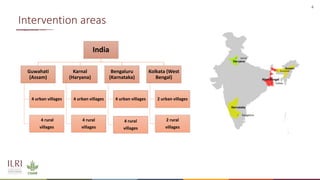
Intervention areas
India
Guwahati
(Assam)
4 urban villages
4 rural
villages
Karnal
(Haryana)
4 urban villages
4 rural
villages
Bengaluru
(Karnataka)
4 urban villages
4 rural
villages
Kolkata (West
Bengal)
2 urban villages
2 rural
villages
5
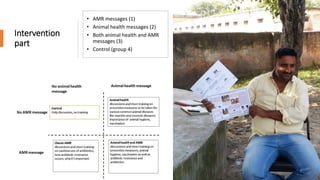
Intervention
part
• AMR messages (1)
• Animal health messages (2)
• Both animal health and AMR
messages (3)
• Control (group 4)
6
Follow up survey
• Included surveys for dairy farmers and
animal health providers.
• Questions asked: knowledge about
antibiotics, zoonotic diseases, AMR,
perceived risk, attitude on antibiotics,
and AMR.
• Any farmer, veterinarian and paravet
was allowed to participate (even those
that were not part of baseline
discussion).
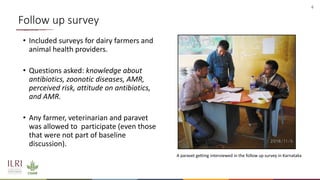
A paravet getting interviewed in the follow up survey in Karnataka
7
Data Analysis
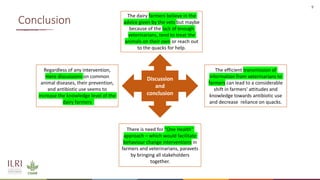
• Knowledge score was computed for each farmer: score
of ‘1’ (correct answer) and ‘0’ (for incorrect answers)
• Multivariable linear regression: assess association
between the knowledge score and the type of
intervention approach, participation in the FGDs, and
gender.
• For the veterinarian and paravet data, only descriptive
statistics were performed.
8
Results
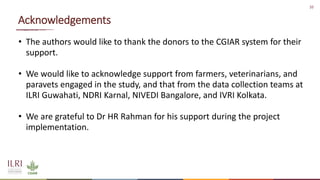
• Majority (69%; n=174) of the farmers and veterinary professionals (91%;
n=51) had participated in the intervention.
• The average knowledge score was 7.8 (median 7). Knowledge score was
higher amongst farmers who had previously participated in the focus
group discussions (p = 0.01); received intervention 2 (p = 0.03) and 3 (p =
0.01); and were females (p = 0.03).
• The veterinary professionals had good knowledge on antibiotics and AMR
but lacked interest in training the farmers about antimicrobial resistance.
9
Conclusion
Discussion
and
conclusion
Regardless of any intervention,
mere discussions on common
animal diseases, their prevention,
and antibiotic use seems to
increase the knowledge level of the
dairy farmers
The dairy farmers believe in the
advice given by the vets but maybe
because of the lack of enough
veterinarians, tend to treat the
animals on their own or reach out
to the quacks for help.
There is need for "One Health"
approach – which would facilitate
behaviour change interventions in
farmers and veterinarians, paravets
by bringing all stakeholders
together.
The efficient transmission of
information from veterinarians to
farmers can lead to a considerable
shift in farmers' attitudes and
knowledge towards antibiotic use
and decrease reliance on quacks.
10
Acknowledgements
• The authors would like to thank the donors to the CGIAR system for their
support.
• We would like to acknowledge support from farmers, veterinarians, and
paravets engaged in the study, and that from the data collection teams at
ILRI Guwahati, NDRI Karnal, NIVEDI Bangalore, and IVRI Kolkata.
• We are grateful to Dr HR Rahman for his support during the project
implementation.
THANK YOU

Comparing the effectiveness of different approaches to raise awareness about antimicrobial resistance in farmers and veterinarians of India

  • 1.
    Better lives throughlivestock Comparing the effectiveness of different approaches to raise awareness about antimicrobial resistance in farmers and veterinarians of India Garima Sharma1,2, Florence Mutua2 , Ram Pratim Deka2,3, Rajeshwari Shome4, Samiran Bandyopadhyay5, Bibek Ranjan Shome4, Naresh Goyal Kumar6, Delia Grace2,7, Tushar Kumar Dey1,2,4 and Johanna Lindahl1,2,3 1Department of Medical Biochemistry and Microbiology, Uppsala University, Uppsala, Sweden 2Department of Biosciences, International Livestock Research Institute, Nairobi, Kenya 3Department of Clinical Sciences, Swedish University of Agricultural Sciences, Uppsala, Sweden 4Bacteriology Lab 1, 2, National Institute of Veterinary Epidemiology and Disease Informatics, Bangalore, India 5Eastern Regional Station, Indian Council of Agricultural Research-Indian Veterinary Research Institute, Kolkata, India 6Dairy Microbiology Division, National Dairy Research Institute, Karnal, India 7Food and Markets Department, Natural Resources Institute, University of Greenwich, Chatham, United Kingdom 22nd International Symposium of Veterinary Epidemiology and Economics (ISVEE 22) Halifax, Canada, 9 August 2022
  • 2.
    2 Introduction [1] • Indiais the world’s leading milk producer. • Small-scale dairy farms dominate the sector. • Farmers face several challenges including diseases (mastitis, FMD etc.) Smallholder dairy farmer milking a cow in Haryana Source: https://preventit.in/abr-news
  • 3.
    3 Introduction [2] • Thereis increased use of antimicrobials (to ensure good health and improve production). Data on how these products (antibiotics) are used in the farms are limited. • Study was designed to assess the effectiveness of delivering training to dairy farmers, paravets and veterinarians (in terms of improving awareness). • The study had an intervention and a follow up (survey) component.
  • 4.
    4 Intervention areas India Guwahati (Assam) 4 urbanvillages 4 rural villages Karnal (Haryana) 4 urban villages 4 rural villages Bengaluru (Karnataka) 4 urban villages 4 rural villages Kolkata (West Bengal) 2 urban villages 2 rural villages
  • 5.
    5 Intervention part • AMR messages(1) • Animal health messages (2) • Both animal health and AMR messages (3) • Control (group 4)
  • 6.
    6 Follow up survey •Included surveys for dairy farmers and animal health providers. • Questions asked: knowledge about antibiotics, zoonotic diseases, AMR, perceived risk, attitude on antibiotics, and AMR. • Any farmer, veterinarian and paravet was allowed to participate (even those that were not part of baseline discussion). A paravet getting interviewed in the follow up survey in Karnataka
  • 7.
    7 Data Analysis • Knowledgescore was computed for each farmer: score of ‘1’ (correct answer) and ‘0’ (for incorrect answers) • Multivariable linear regression: assess association between the knowledge score and the type of intervention approach, participation in the FGDs, and gender. • For the veterinarian and paravet data, only descriptive statistics were performed.
  • 8.
    8 Results • Majority (69%;n=174) of the farmers and veterinary professionals (91%; n=51) had participated in the intervention. • The average knowledge score was 7.8 (median 7). Knowledge score was higher amongst farmers who had previously participated in the focus group discussions (p = 0.01); received intervention 2 (p = 0.03) and 3 (p = 0.01); and were females (p = 0.03). • The veterinary professionals had good knowledge on antibiotics and AMR but lacked interest in training the farmers about antimicrobial resistance.
  • 9.
    9 Conclusion Discussion and conclusion Regardless of anyintervention, mere discussions on common animal diseases, their prevention, and antibiotic use seems to increase the knowledge level of the dairy farmers The dairy farmers believe in the advice given by the vets but maybe because of the lack of enough veterinarians, tend to treat the animals on their own or reach out to the quacks for help. There is need for "One Health" approach – which would facilitate behaviour change interventions in farmers and veterinarians, paravets by bringing all stakeholders together. The efficient transmission of information from veterinarians to farmers can lead to a considerable shift in farmers' attitudes and knowledge towards antibiotic use and decrease reliance on quacks.
  • 10.
    10 Acknowledgements • The authorswould like to thank the donors to the CGIAR system for their support. • We would like to acknowledge support from farmers, veterinarians, and paravets engaged in the study, and that from the data collection teams at ILRI Guwahati, NDRI Karnal, NIVEDI Bangalore, and IVRI Kolkata. • We are grateful to Dr HR Rahman for his support during the project implementation.
  • 11.