Messaging Standards and Systems
AMQP & RabbitMQ
Gavin M. Roy
VP of Architecture
AWeber Communications
Twitter: @Crad
POSSCON
April 14, 2015
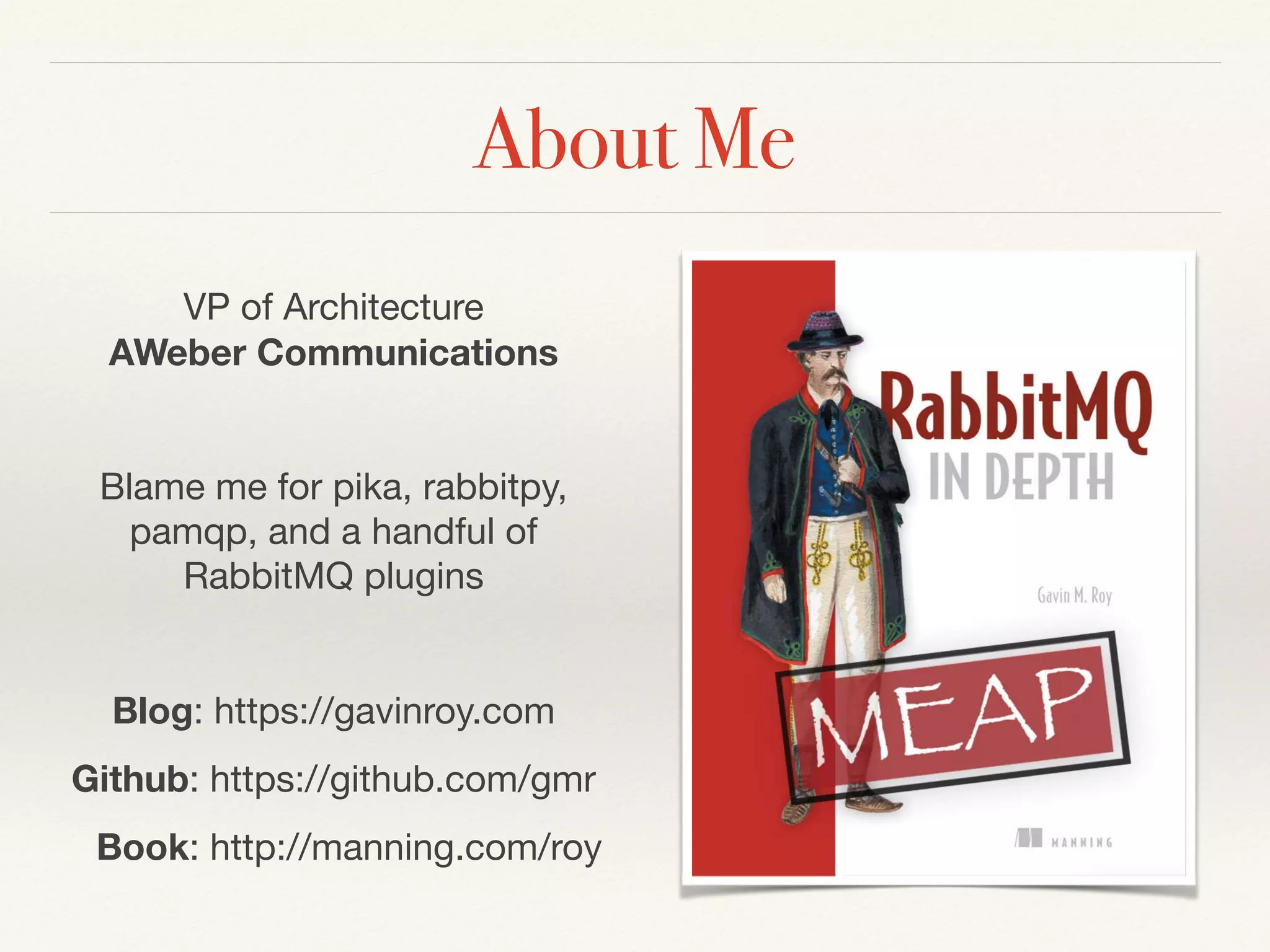
About Me
VP of Architecture

AWeber Communications

Blame me for pika, rabbitpy,
pamqp, and a handful of
RabbitMQ plugins

Blog: https://gavinroy.com 

Github: https://github.com/gmr

Book: http://manning.com/roy
Advanced Message Queueing Protocol
❖ Open Standard
❖ Platform and Vendor Neutral
❖ Multiple Versions
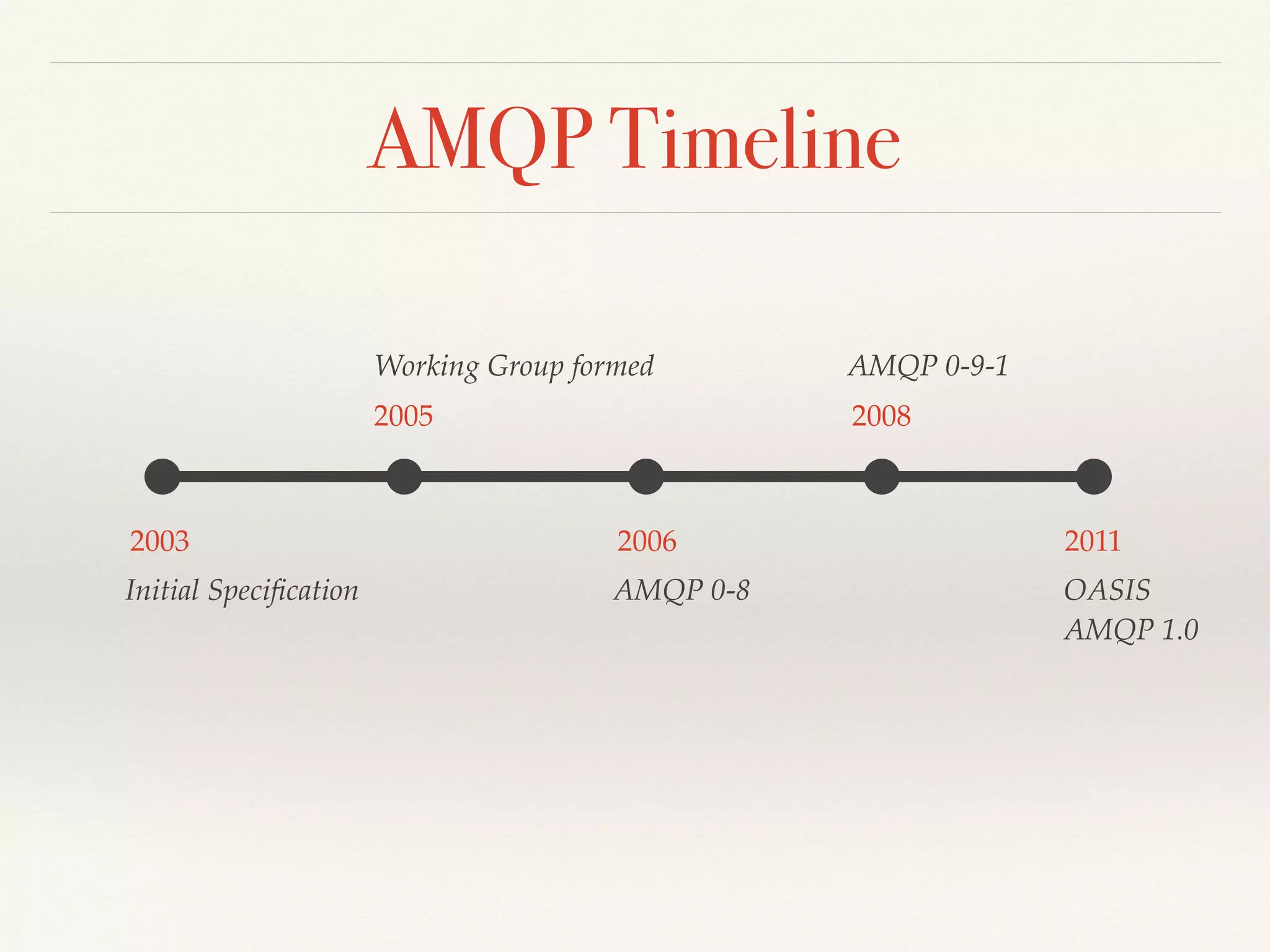
AMQP Timeline
2003
2005
2006
2008
2011
Initial Specification
Working Group formed
AMQP 0-8
AMQP 0-9-1
OASIS
AMQP 1.0
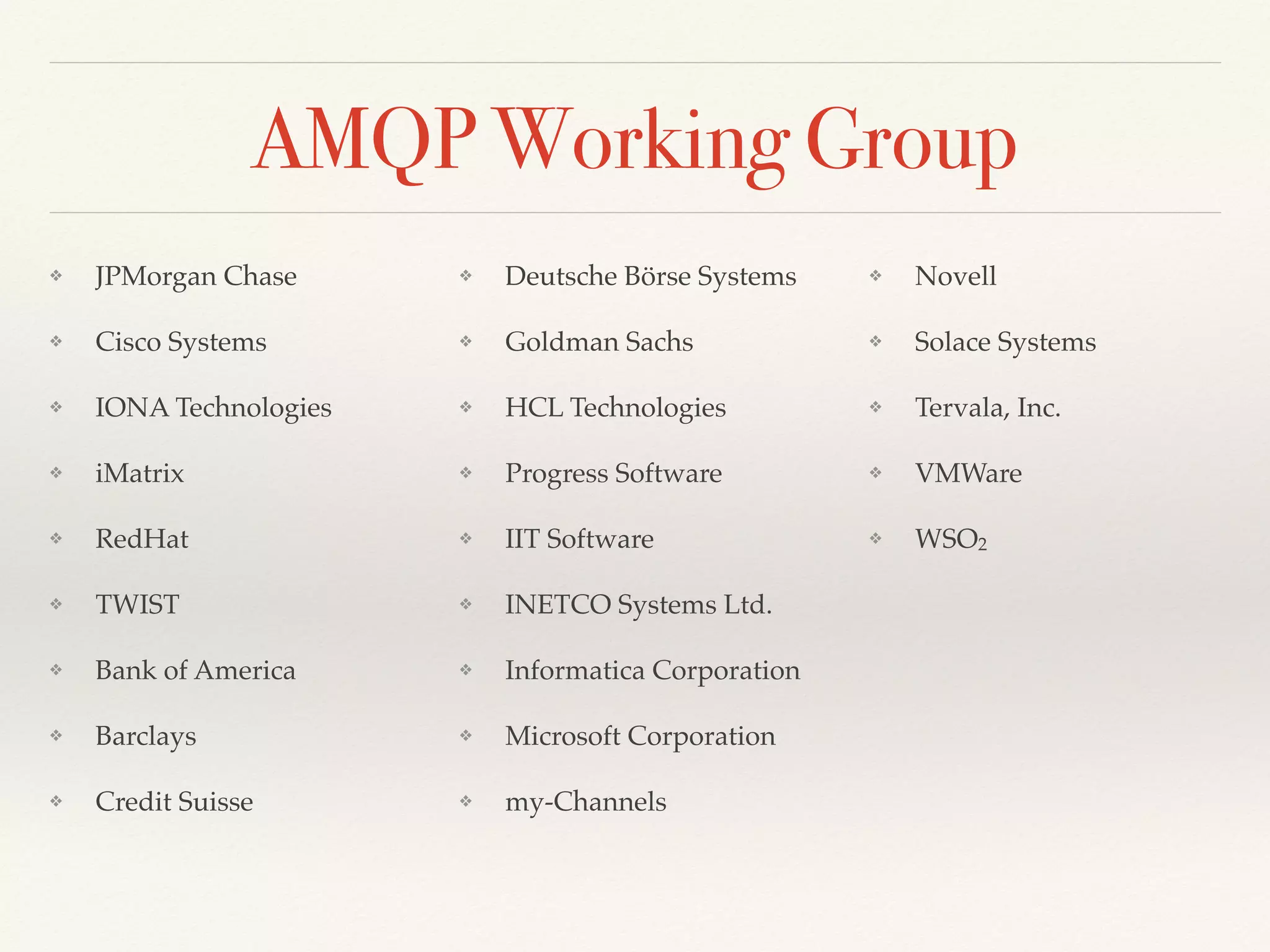
AMQP Working Group
❖ JPMorgan Chase
❖ Cisco Systems
❖ IONA Technologies
❖ iMatrix
❖ RedHat
❖ TWIST
❖ Bank of America
❖ Barclays
❖ Credit Suisse
❖ Deutsche Börse Systems
❖ Goldman Sachs
❖ HCL Technologies
❖ Progress Software
❖ IIT Software
❖ INETCO Systems Ltd.
❖ Informatica Corporation
❖ Microsoft Corporation
❖ my-Channels
❖ Novell
❖ Solace Systems
❖ Tervala, Inc.
❖ VMWare
❖ WSO2
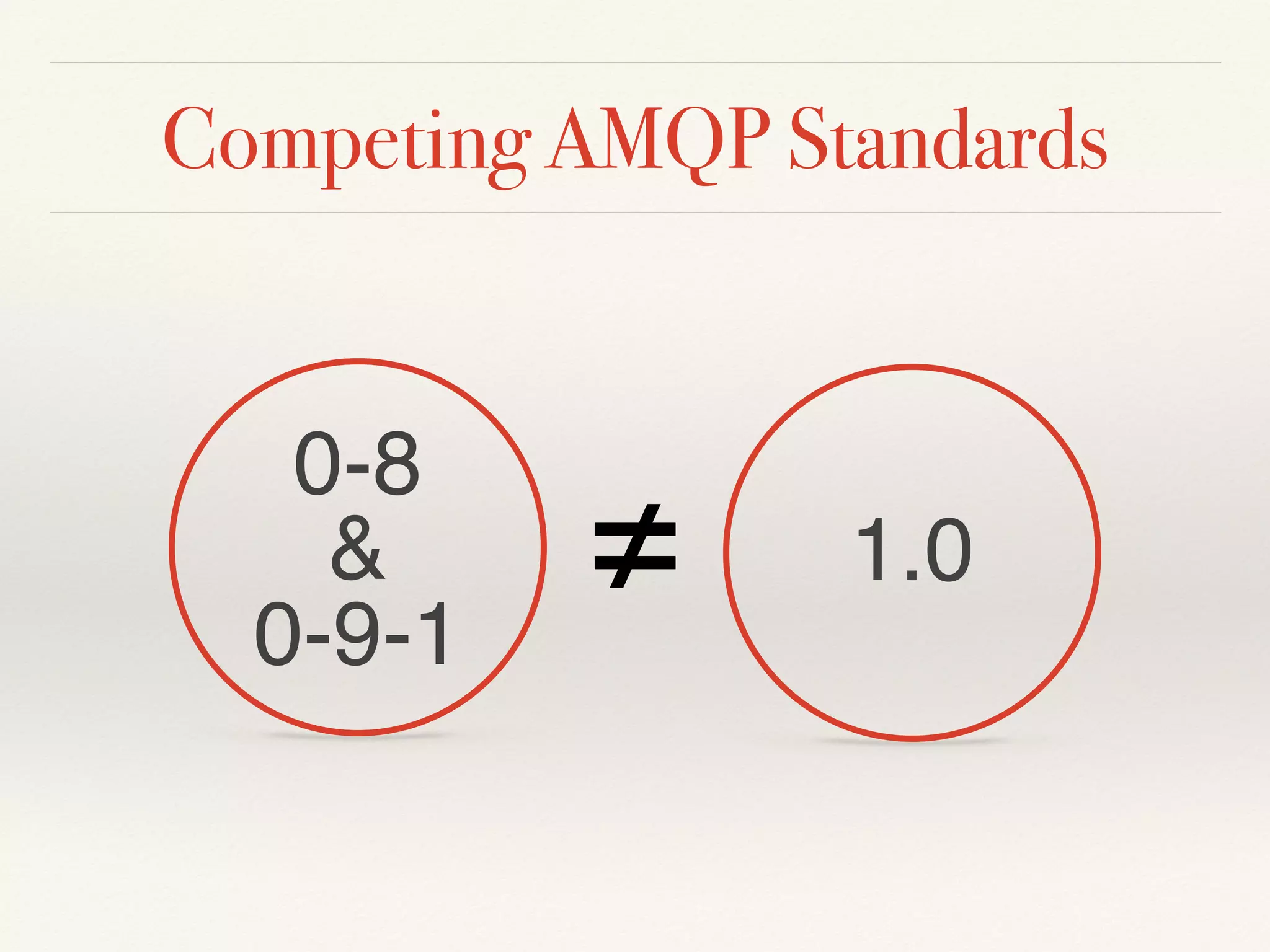
Competing AMQP Standards
≠
0-8
&
0-9-1
1.0
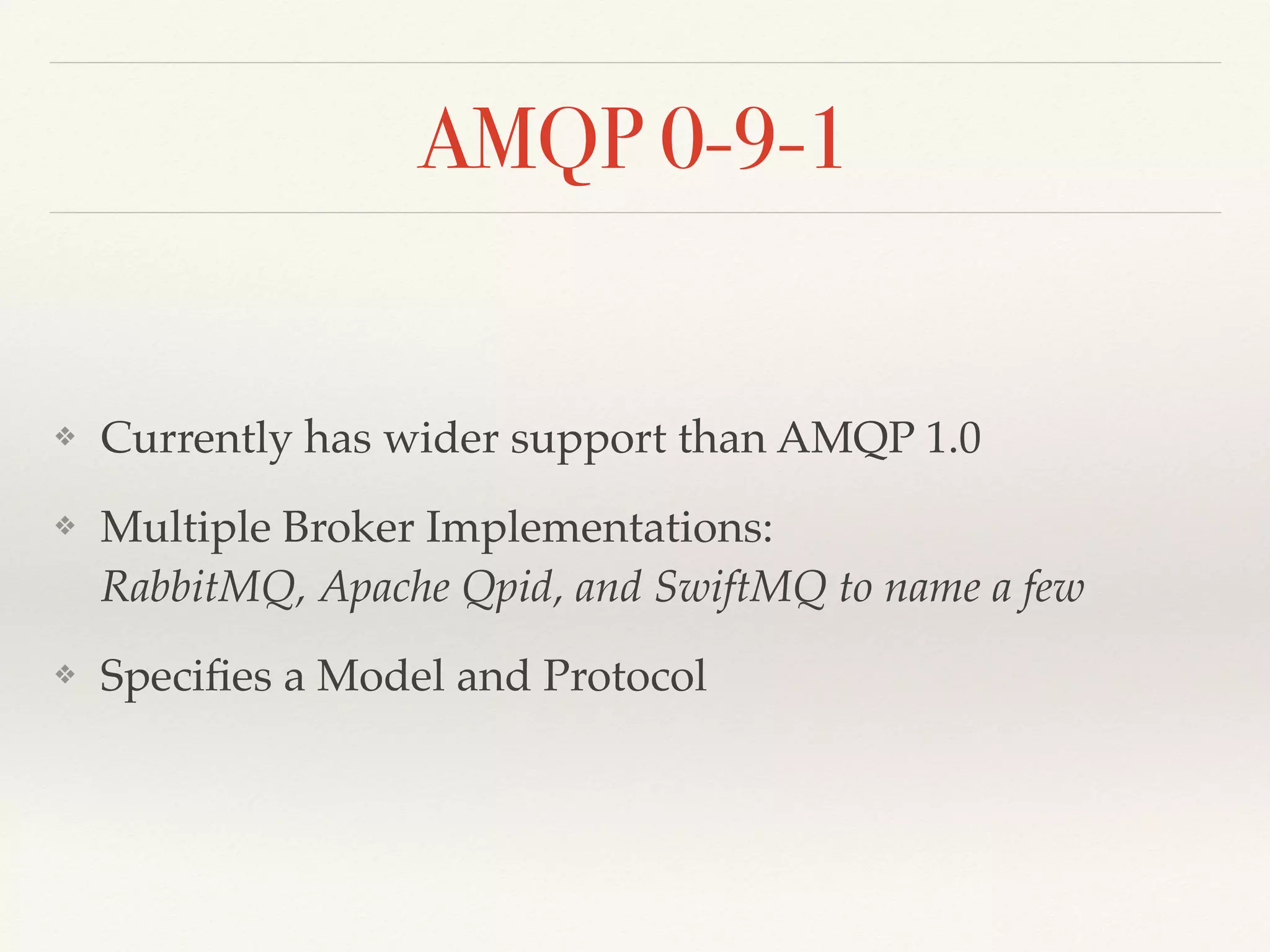
AMQP 0-9-1
❖ Currently has wider support than AMQP 1.0
❖ Multiple Broker Implementations: 

RabbitMQ, Apache Qpid, and SwiftMQ to name a few
❖ Specifies a Model and Protocol
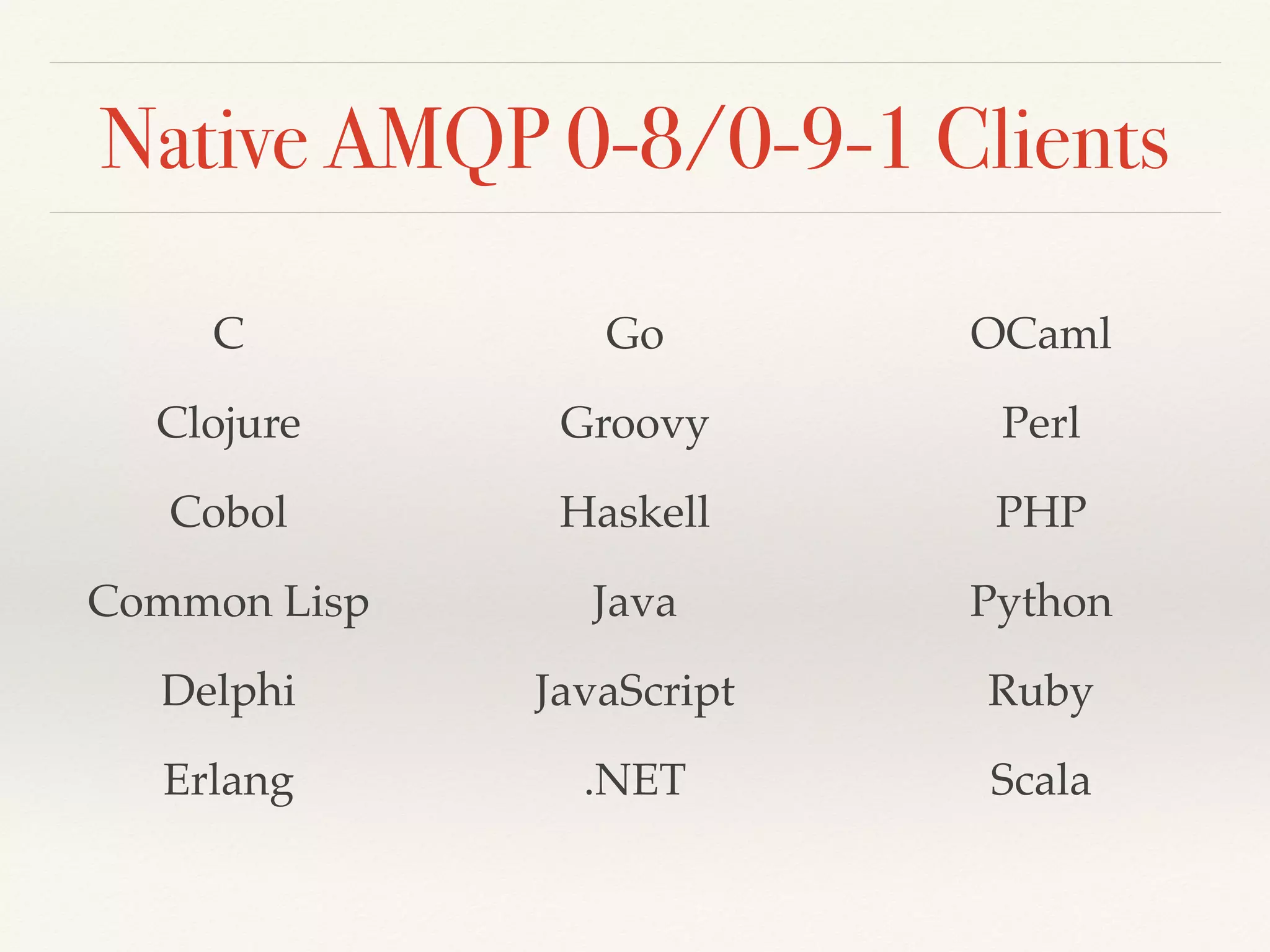
Native AMQP 0-8/0-9-1 Clients
C
Clojure
Cobol
Common Lisp
Delphi
Erlang
Go
Groovy
Haskell
Java
JavaScript
.NET
OCaml
Perl
PHP
Python
Ruby
Scala
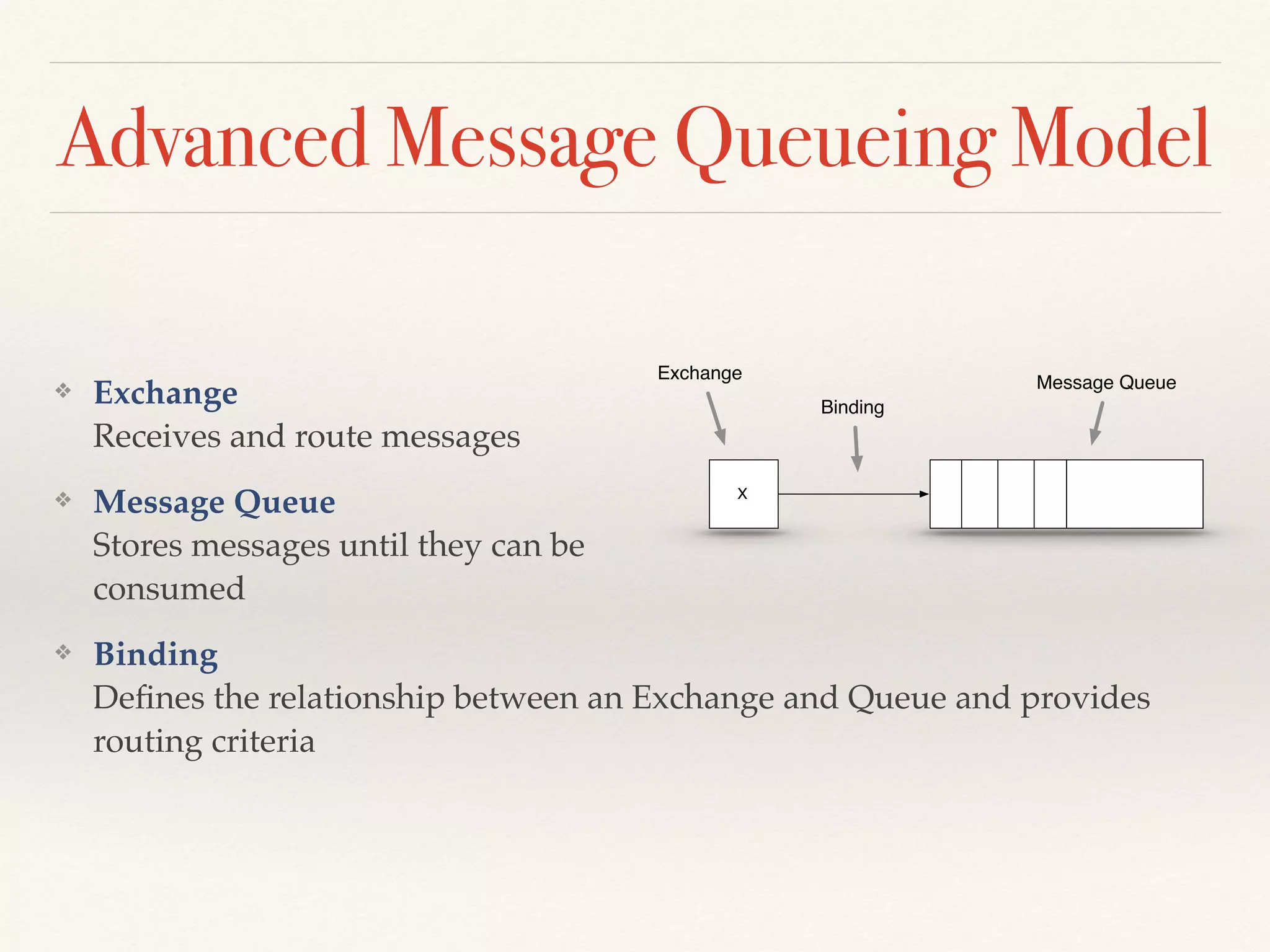
❖ Exchange

Receives and route messages
❖ Message Queue

Stores messages until they can be

consumed
❖ Binding

Defines the relationship between an Exchange and Queue and provides
routing criteria
Advanced Message Queueing Model
X
Exchange
Binding
Message Queue
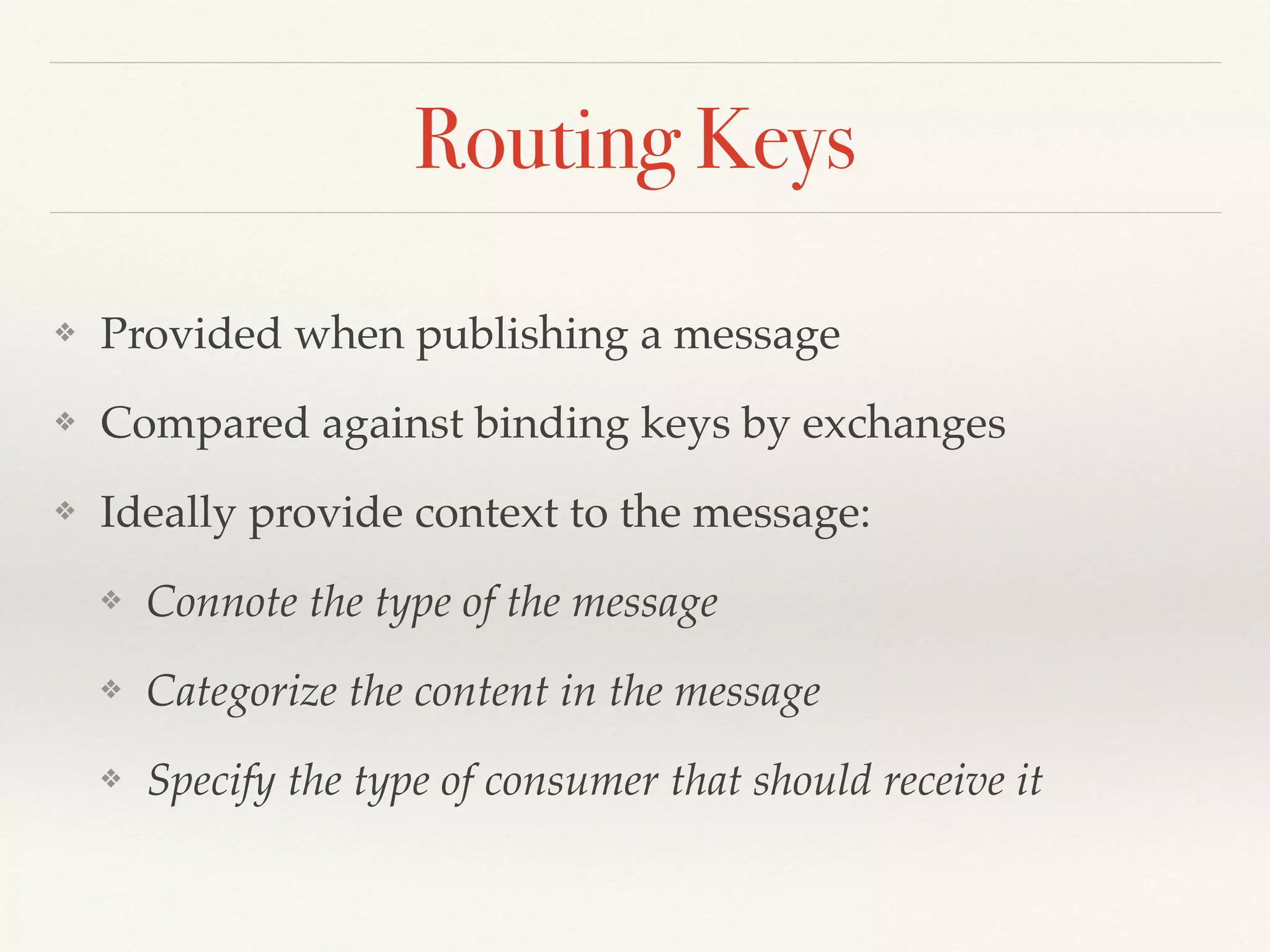
Routing Keys
❖ Provided when publishing a message
❖ Compared against binding keys by exchanges
❖ Ideally provide context to the message:
❖ Connote the type of the message
❖ Categorize the content in the message
❖ Specify the type of consumer that should receive it
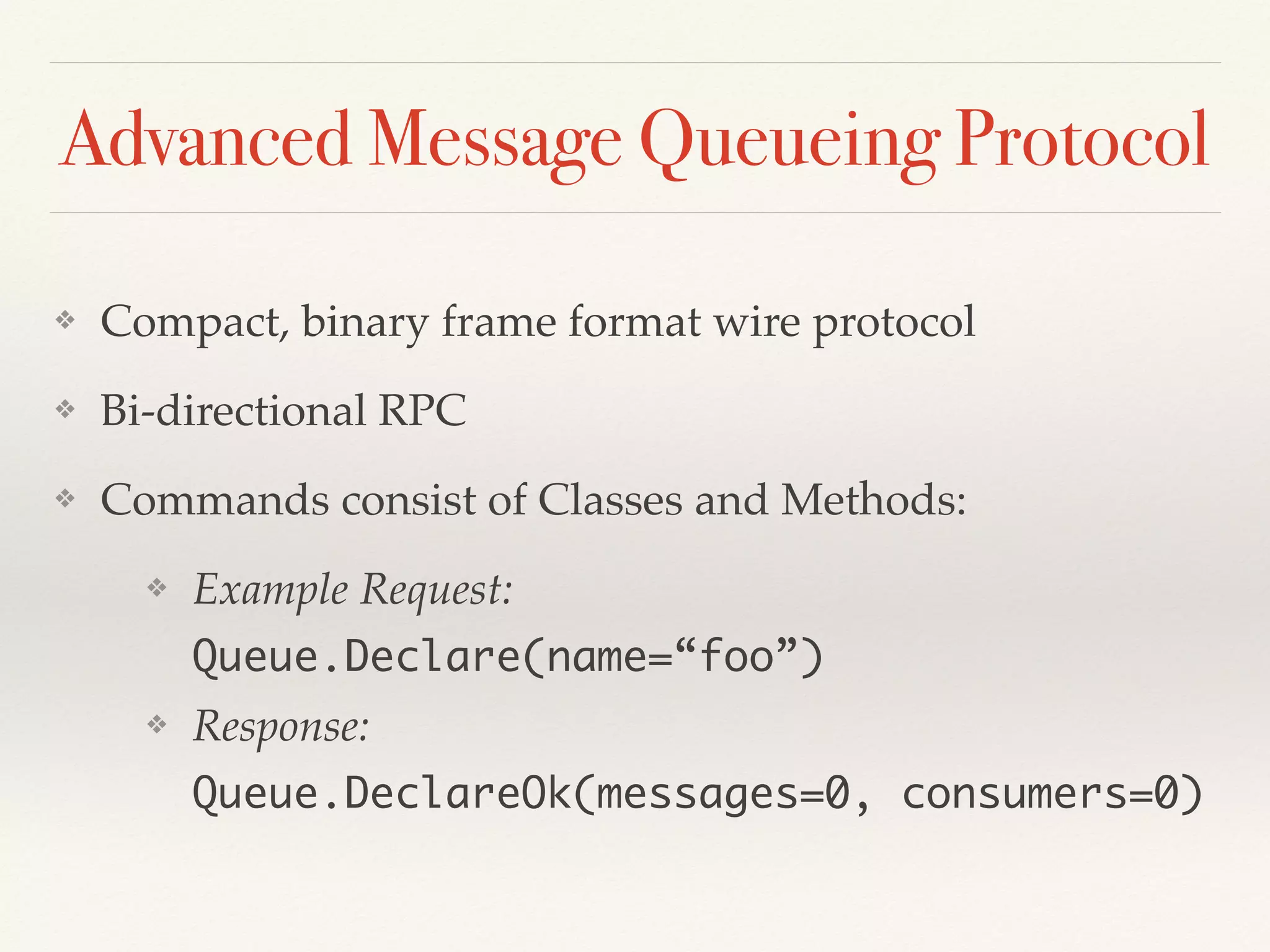
Advanced Message Queueing Protocol
❖ Compact, binary frame format wire protocol
❖ Bi-directional RPC
❖ Commands consist of Classes and Methods:
❖ Example Request:


Queue.Declare(name=“foo”)
❖ Response:


Queue.DeclareOk(messages=0, consumers=0)
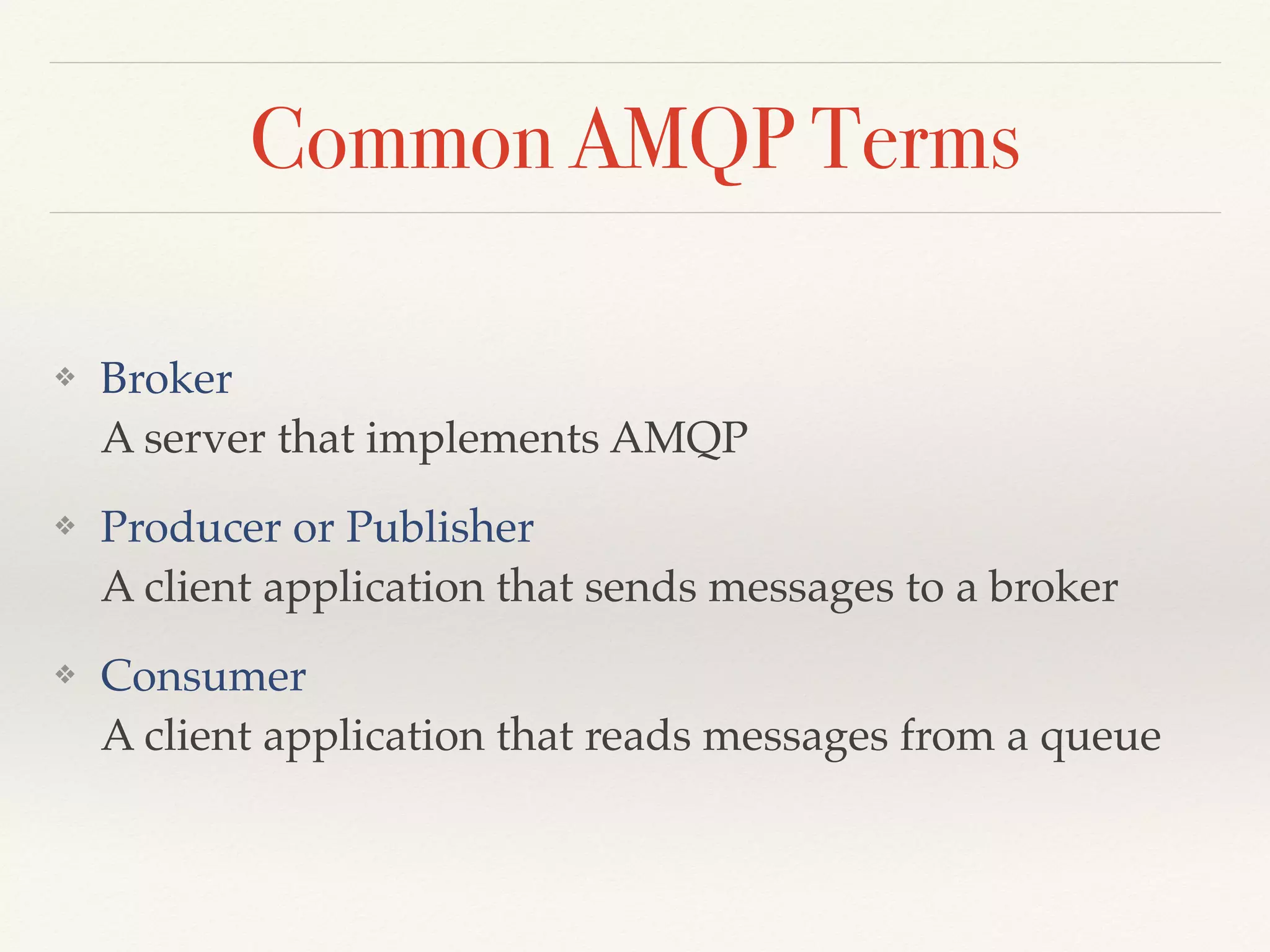
Common AMQP Terms
❖ Broker

A server that implements AMQP
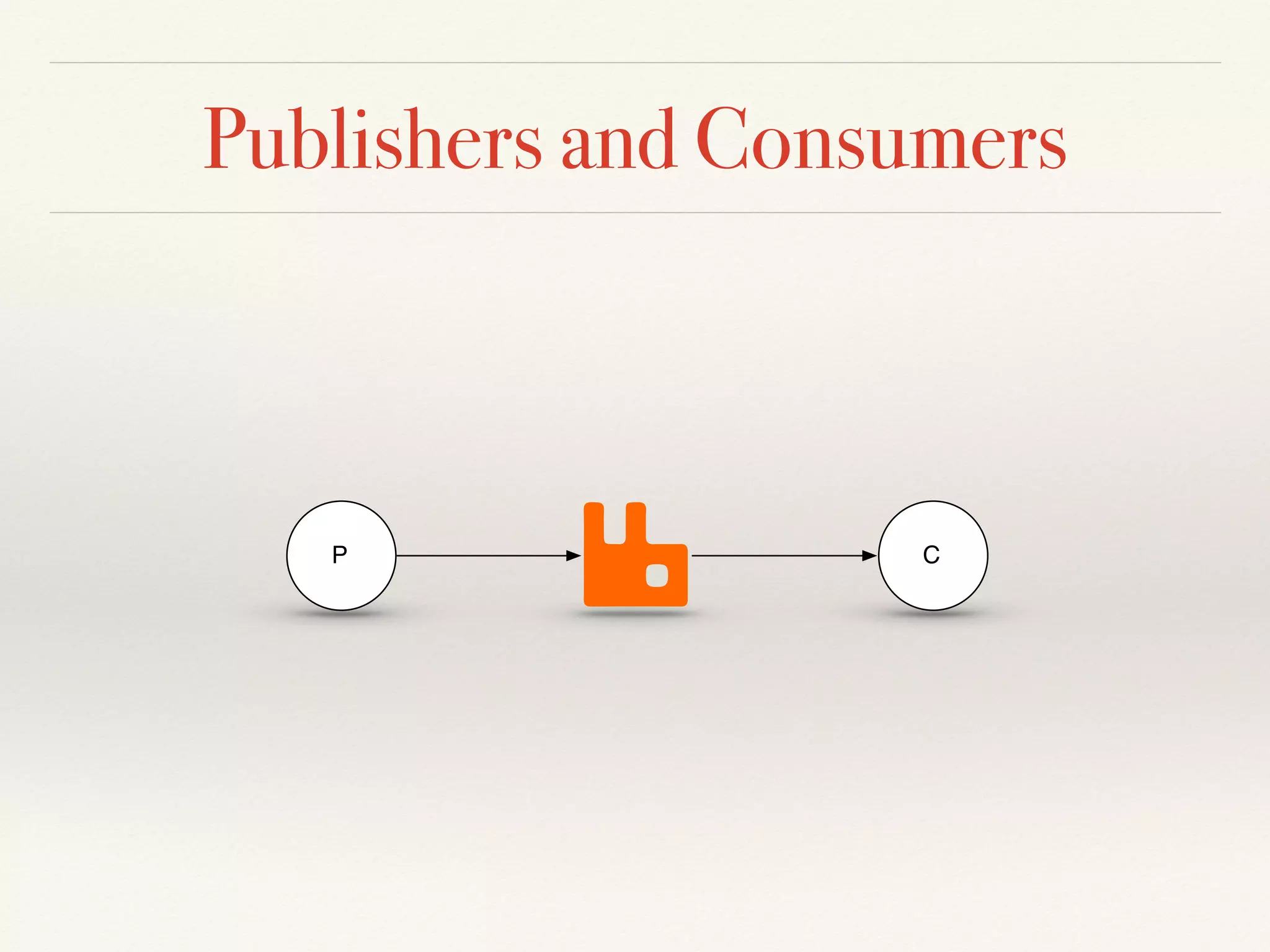
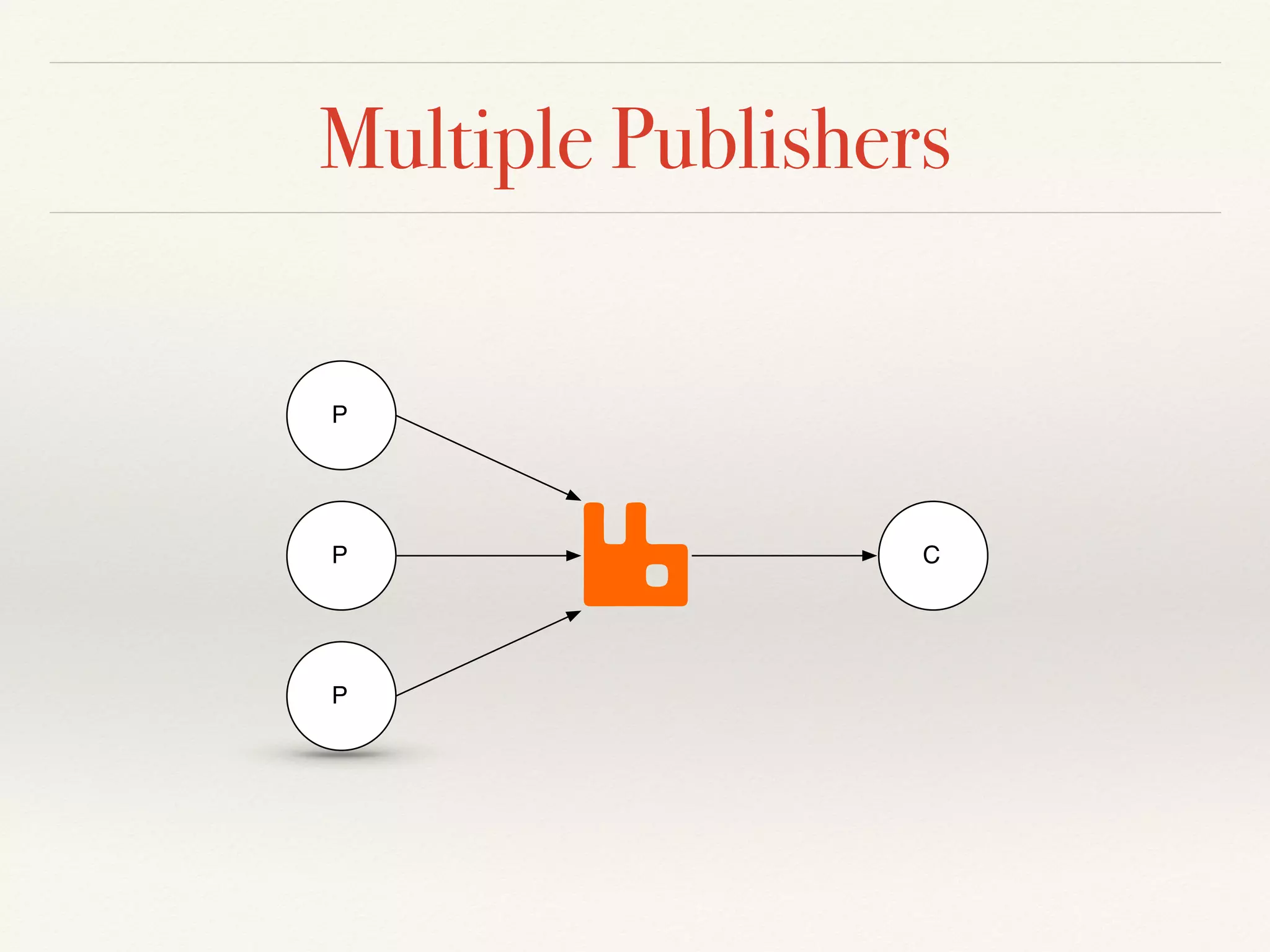
❖ Producer or Publisher

A client application that sends messages to a broker
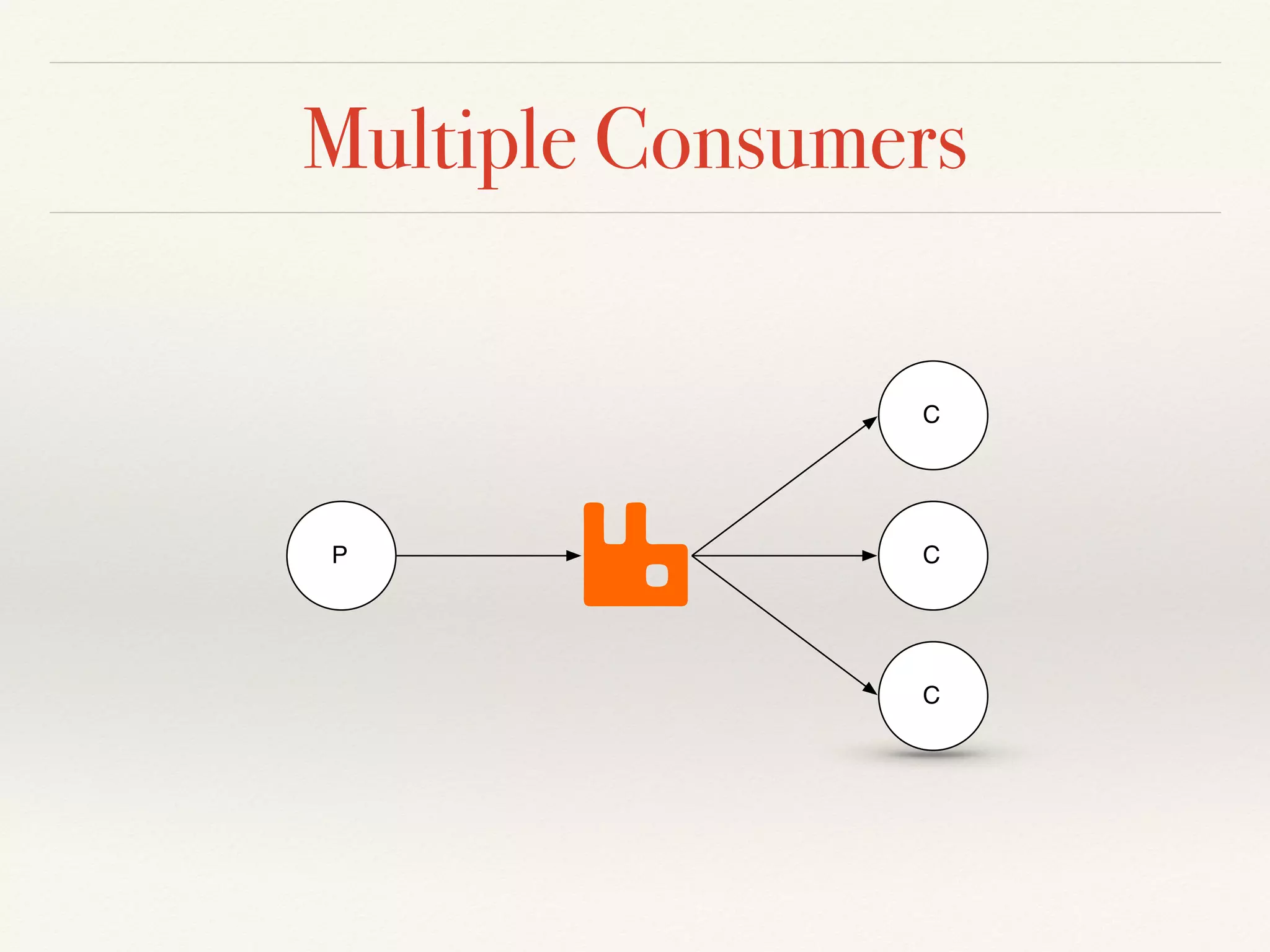
❖ Consumer

A client application that reads messages from a queue
Publishers and Consumers
CP
Multiple Publishers
CP
P
P
Multiple Consumers
C
C
C
P
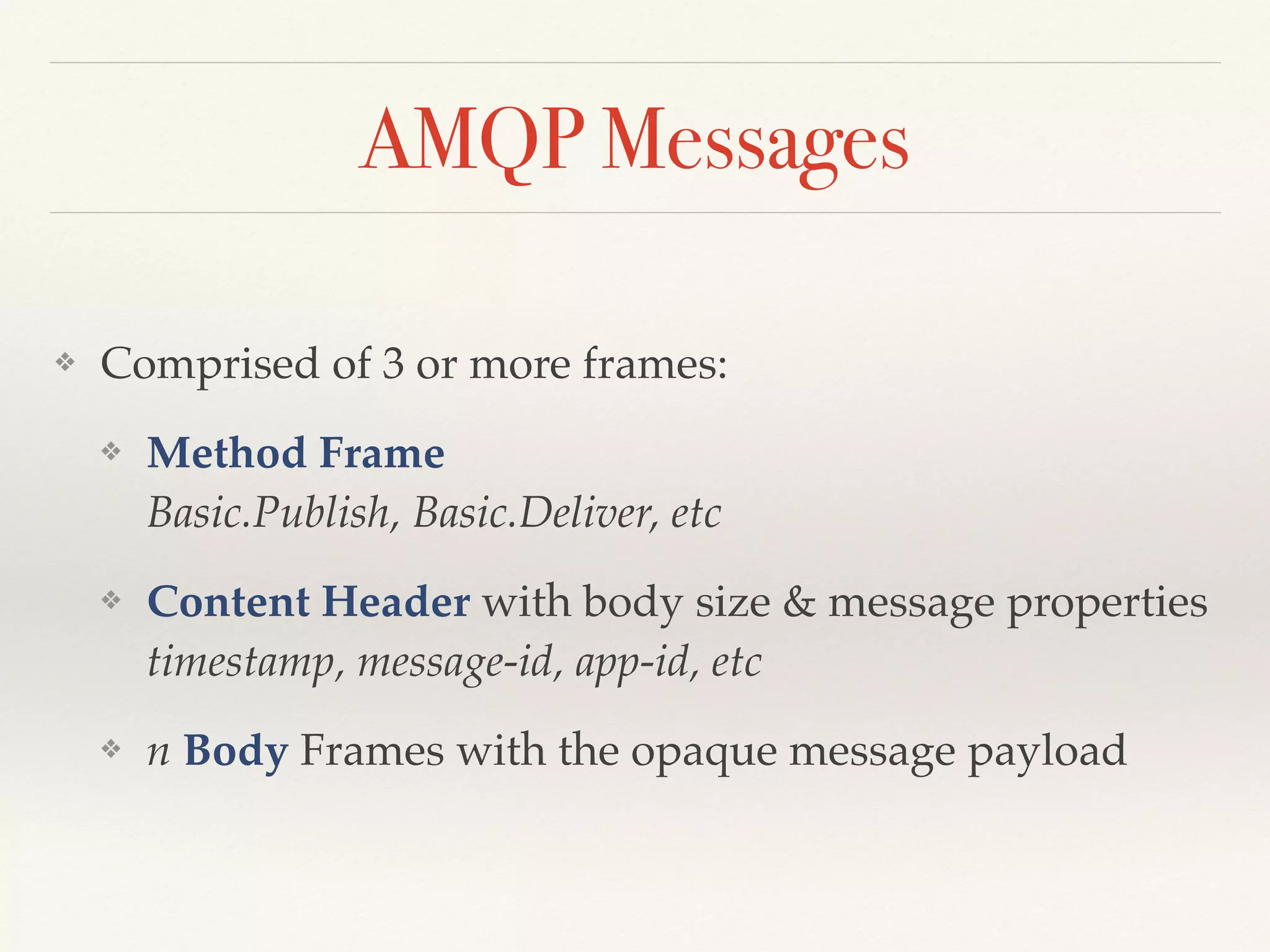
AMQP Messages
❖ Comprised of 3 or more frames:
❖ Method Frame

Basic.Publish, Basic.Deliver, etc
❖ Content Header with body size & message properties 

timestamp, message-id, app-id, etc
❖ n Body Frames with the opaque message payload
AMQP 0-9-1 Issues & Gotchas
❖ Ambiguous
❖ Authentication
❖ Asynchronous
❖ Connection Negotiation
❖ Exceptions
!
RabbitMQ
❖ Open Source (MPL)
❖ Written in Erlang/OTP
❖ Developed/Maintained by Pivotal
❖ Multi-Protocol

AMQP 0-9-1 & 1.0, MQTT, STOMP, XMPP,
HTTP, Web-STOMP & More
❖ Roots in AMQP 0-8/0-9-1
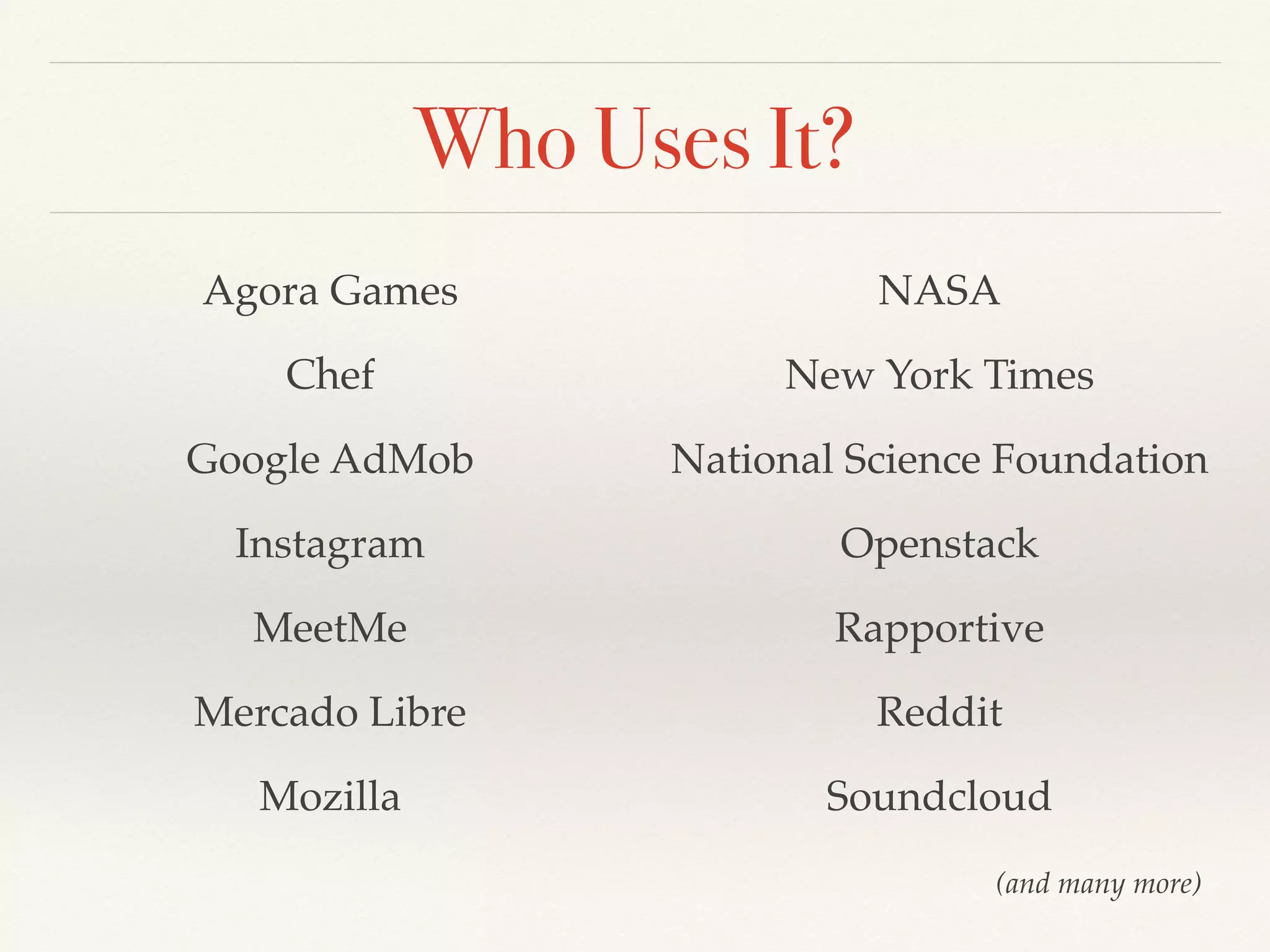
Who Uses It?
Agora Games
Chef
Google AdMob
Instagram
MeetMe
Mercado Libre
Mozilla
NASA
New York Times
National Science Foundation
Openstack
Rapportive
Reddit
Soundcloud
(and many more)
Why Use RabbitMQ?
❖ Create loosely-coupled applications
❖ Communicate across applications or platforms
❖ Tap into pre-existing message flows for new purposes
❖ Scale-out clustering for growth, throughput, and HA
❖ Federation for WAN latencies and network partitions
❖ Extensible plugin-in architecture
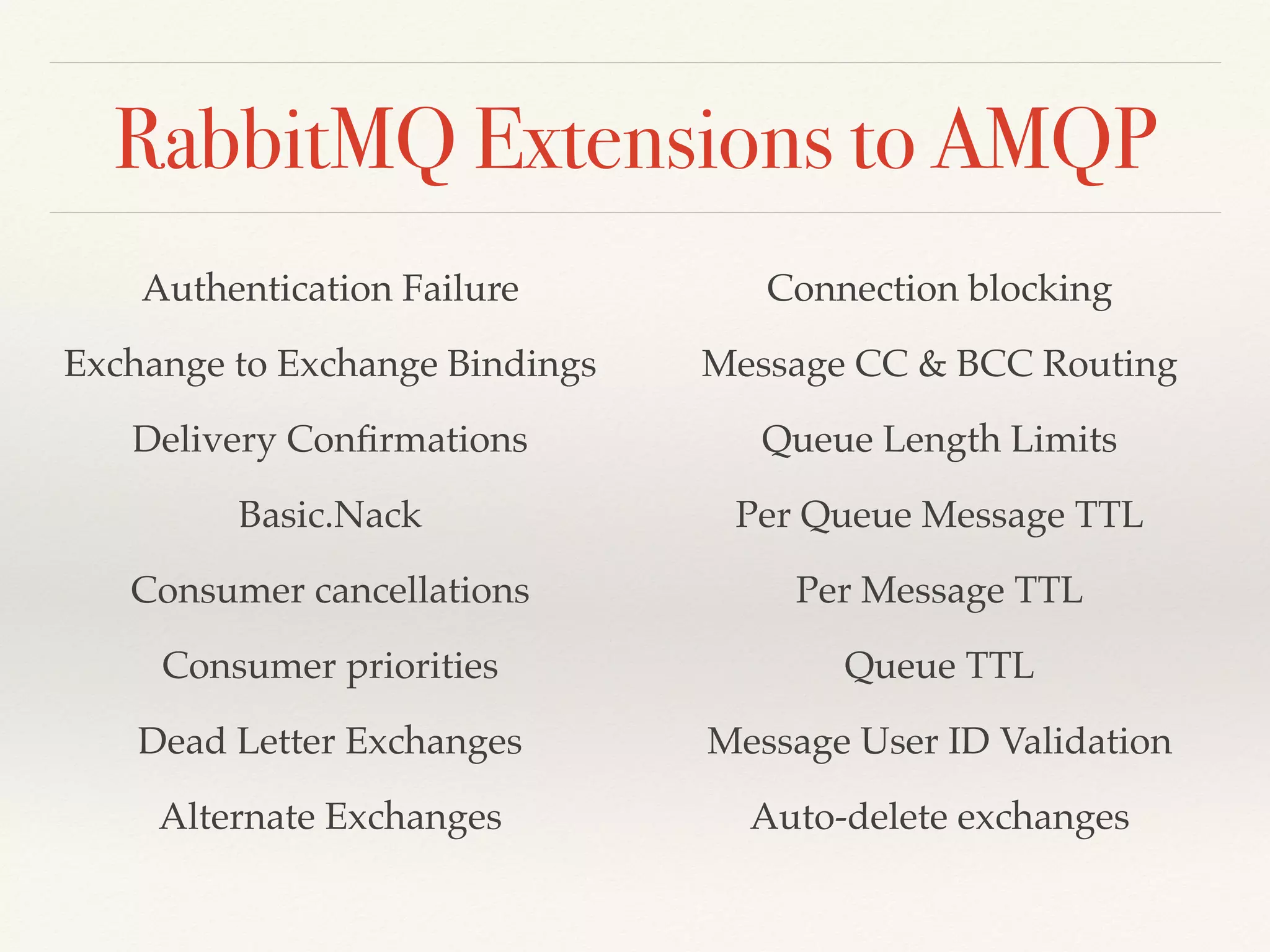
RabbitMQ Extensions to AMQP
Authentication Failure
Exchange to Exchange Bindings
Delivery Confirmations
Basic.Nack
Consumer cancellations
Consumer priorities
Dead Letter Exchanges
Alternate Exchanges
Connection blocking
Message CC & BCC Routing
Queue Length Limits
Per Queue Message TTL
Per Message TTL
Queue TTL
Message User ID Validation
Auto-delete exchanges
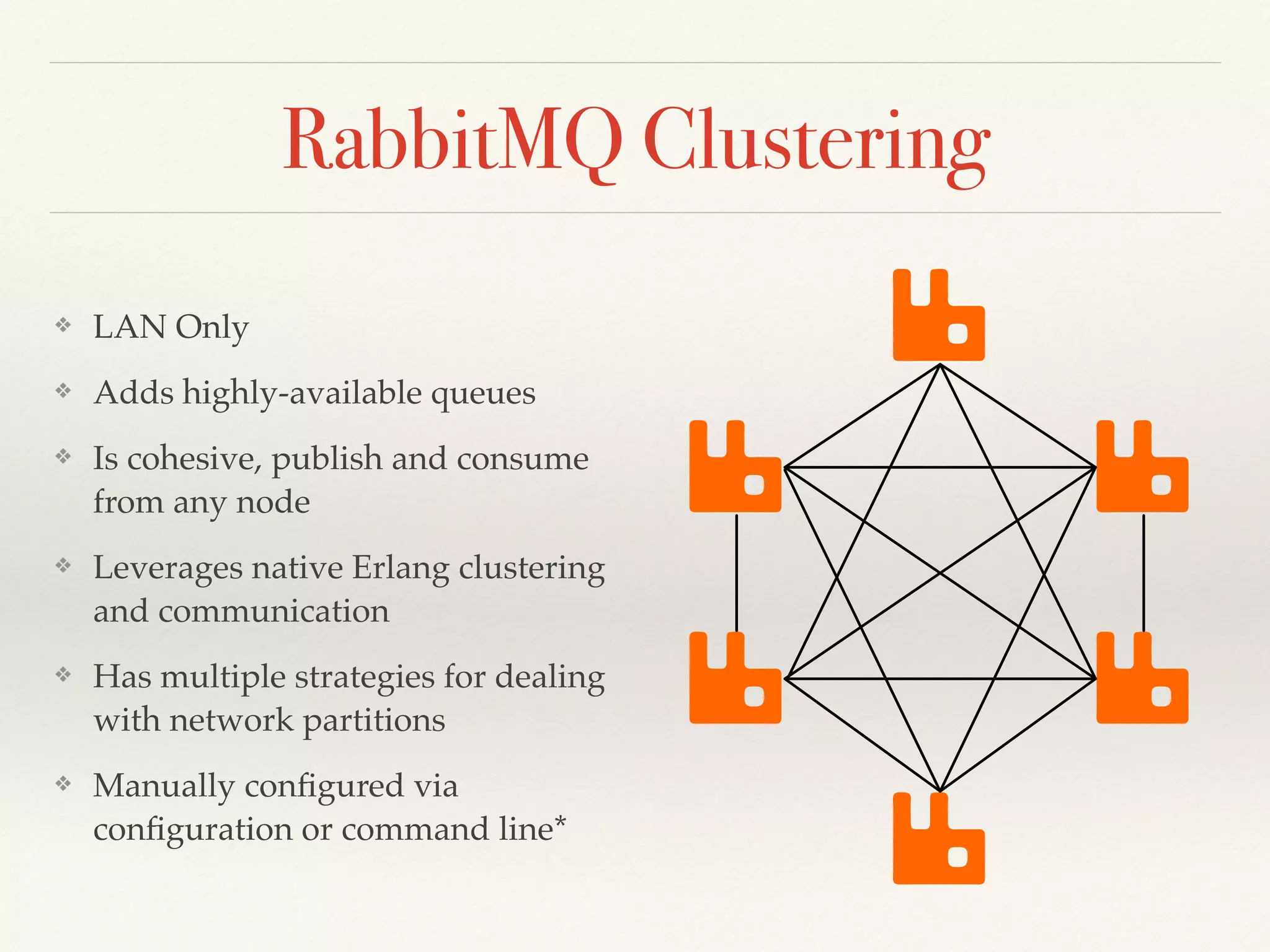
RabbitMQ Clustering
❖ LAN Only
❖ Adds highly-available queues
❖ Is cohesive, publish and consume
from any node
❖ Leverages native Erlang clustering
and communication
❖ Has multiple strategies for dealing
with network partitions
❖ Manually configured via
configuration or command line*
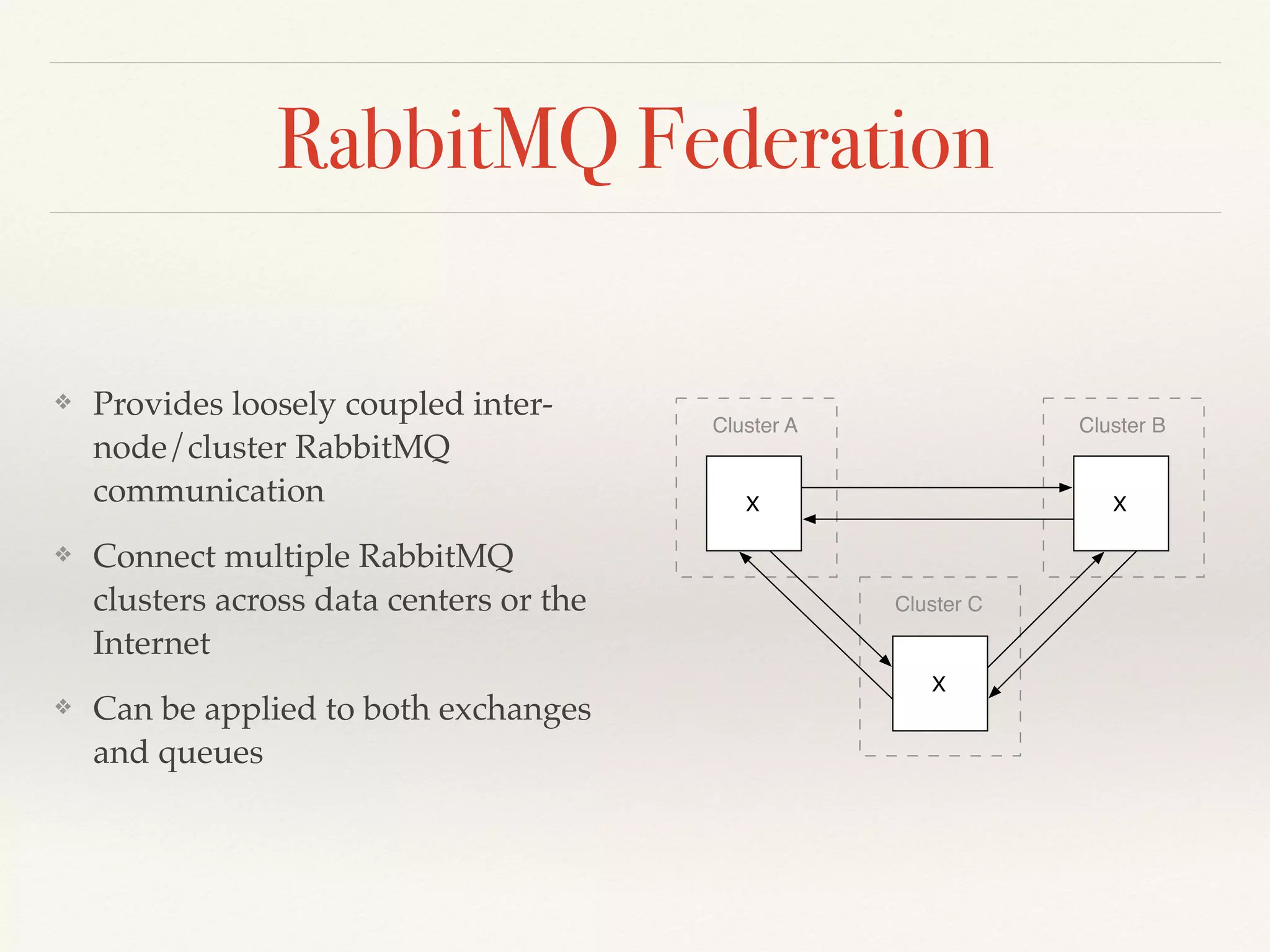
RabbitMQ Federation
❖ Provides loosely coupled inter-
node/cluster RabbitMQ
communication
❖ Connect multiple RabbitMQ
clusters across data centers or the
Internet
❖ Can be applied to both exchanges
and queues
Cluster A
X
Cluster B
X
Cluster C
X
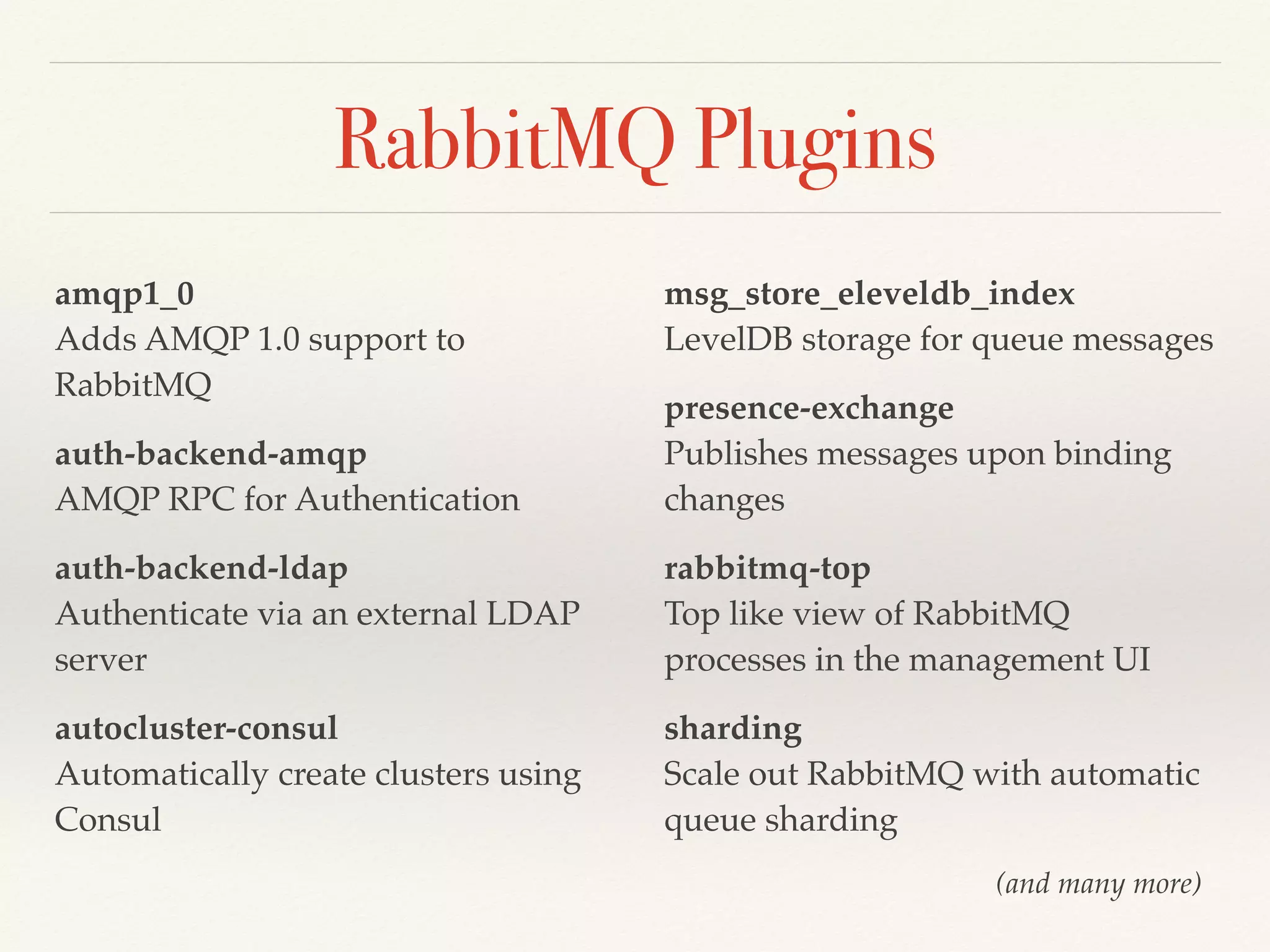
RabbitMQ Plugins
amqp1_0

Adds AMQP 1.0 support to
RabbitMQ
auth-backend-amqp

AMQP RPC for Authentication
auth-backend-ldap

Authenticate via an external LDAP
server
autocluster-consul

Automatically create clusters using
Consul
msg_store_eleveldb_index

LevelDB storage for queue messages
presence-exchange

Publishes messages upon binding
changes
rabbitmq-top

Top like view of RabbitMQ
processes in the management UI
sharding

Scale out RabbitMQ with automatic
queue sharding
(and many more)
Message Routing
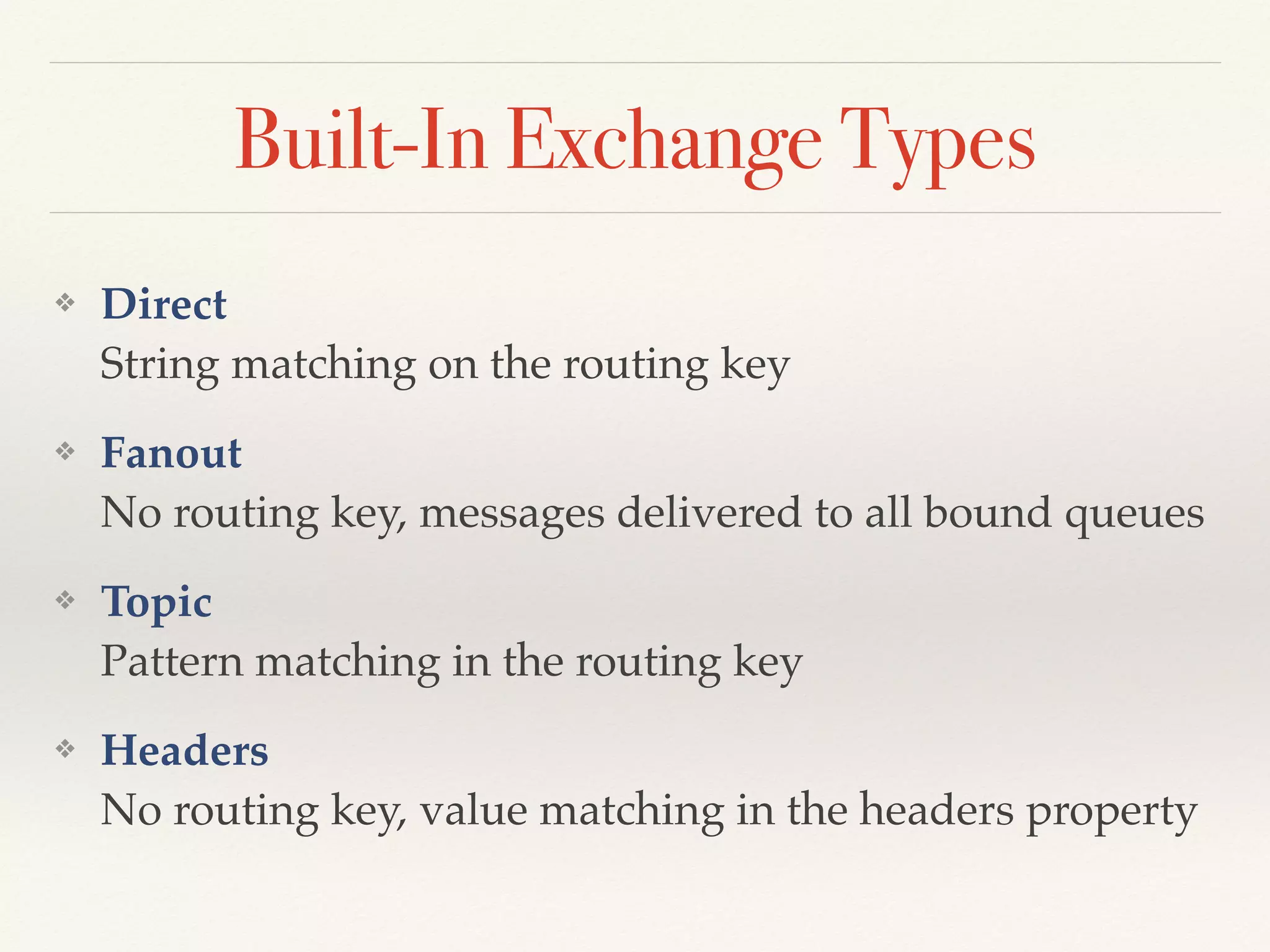
Built-In Exchange Types
❖ Direct

String matching on the routing key
❖ Fanout

No routing key, messages delivered to all bound queues
❖ Topic

Pattern matching in the routing key
❖ Headers

No routing key, value matching in the headers property
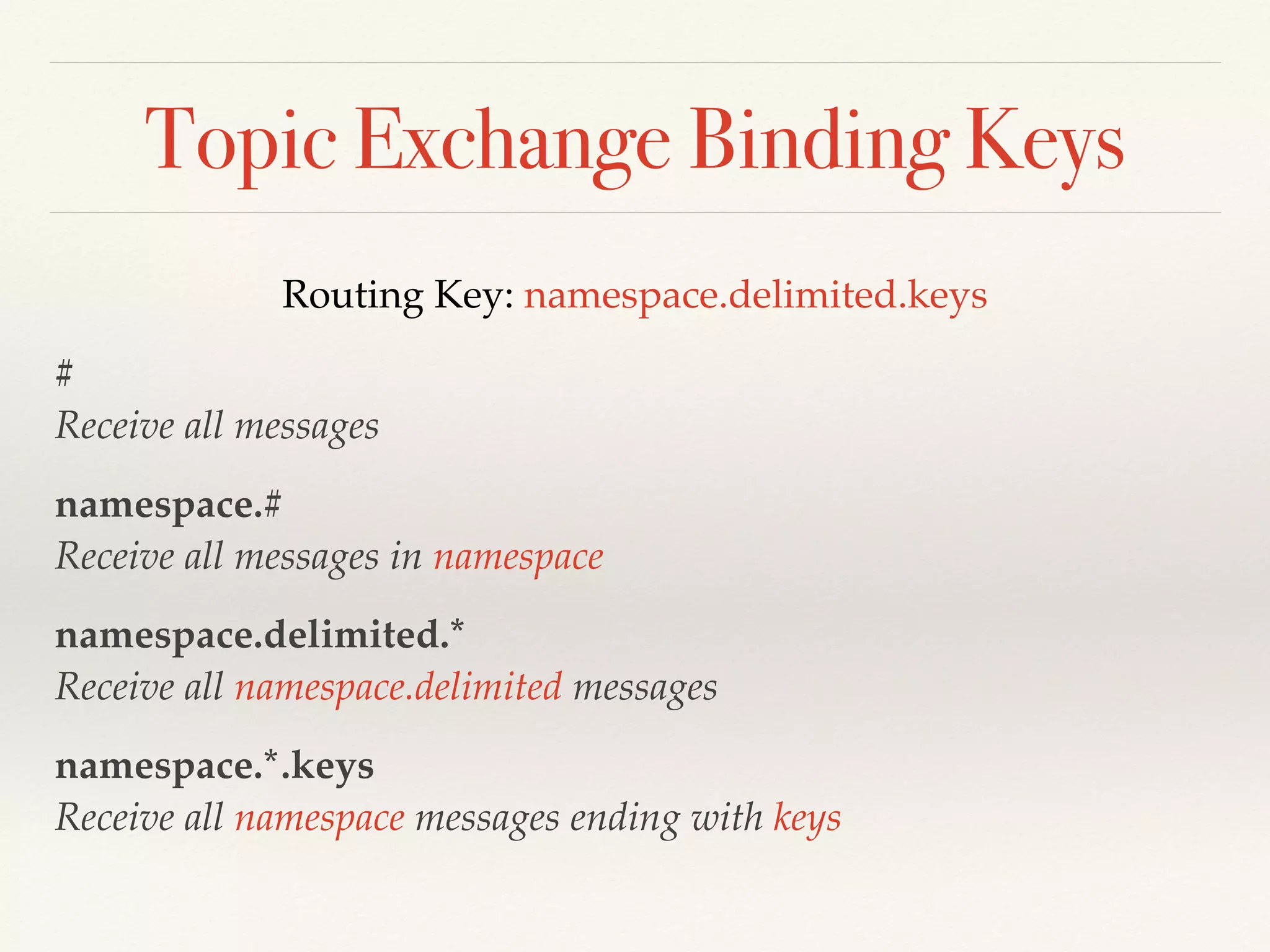
Topic Exchange Binding Keys
Routing Key: namespace.delimited.keys
#

Receive all messages
namespace.#

Receive all messages in namespace
namespace.delimited.*

Receive all namespace.delimited messages
namespace.*.keys

Receive all namespace messages ending with keys
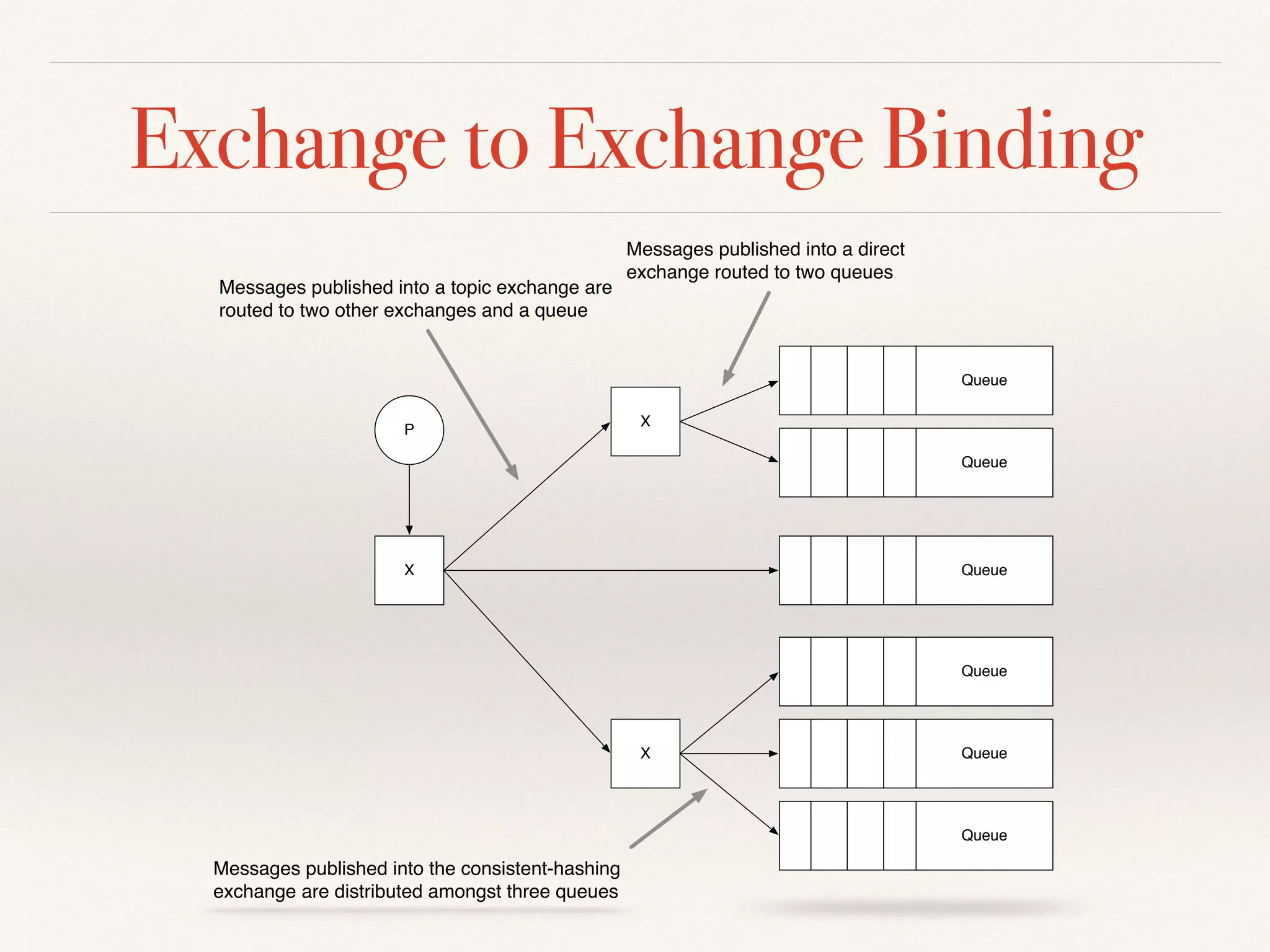
Exchange to Exchange Binding
X
X
X
Queue
Queue
Queue
Queue
Queue
Queue
Messages published into a topic exchange are
routed to two other exchanges and a queue
Messages published into the consistent-hashing
exchange are distributed amongst three queues
Messages published into a direct
exchange routed to two queues
P
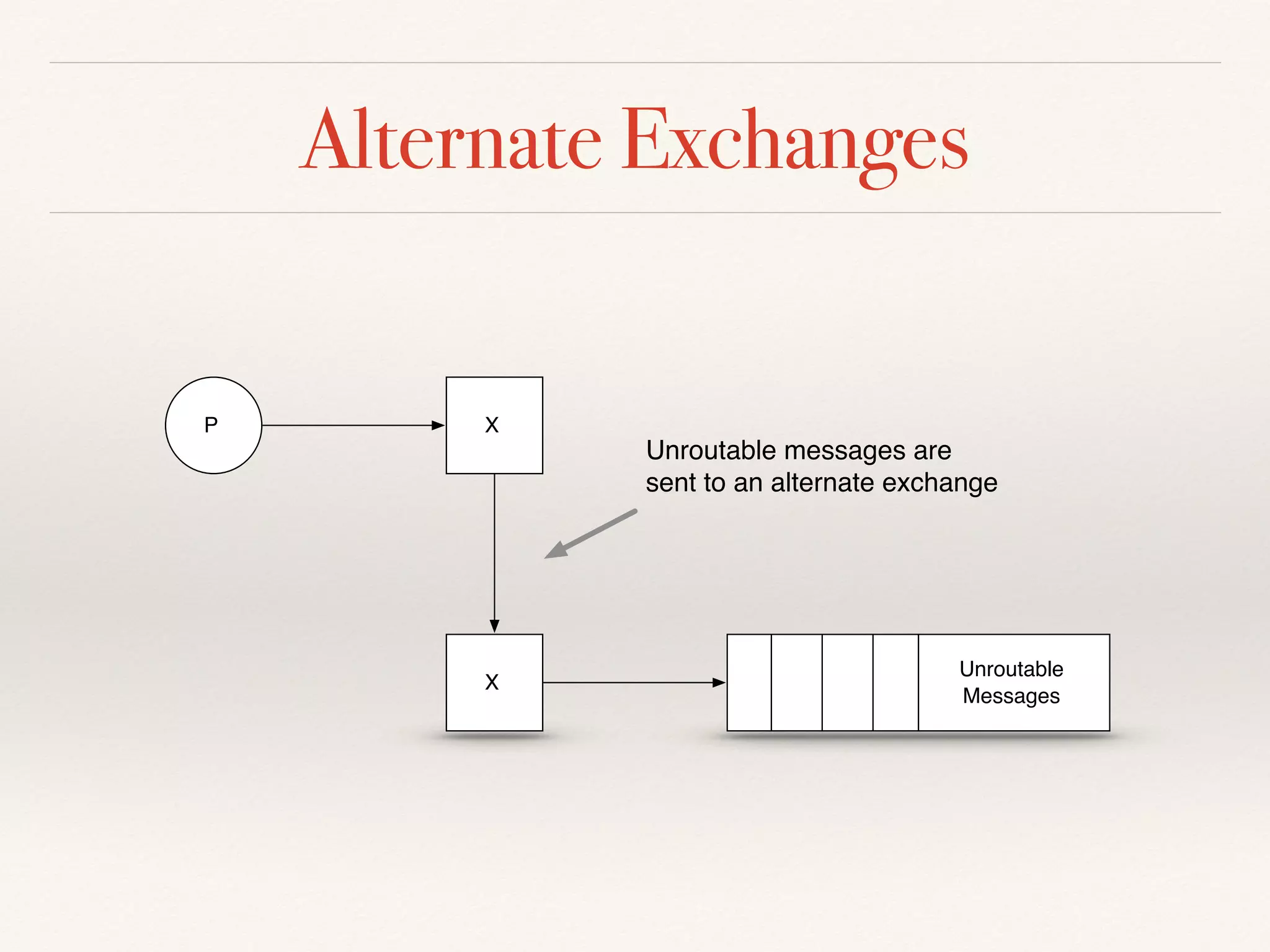
Alternate Exchanges
P X
Unroutable
Messages
X
Unroutable messages are
sent to an alternate exchange
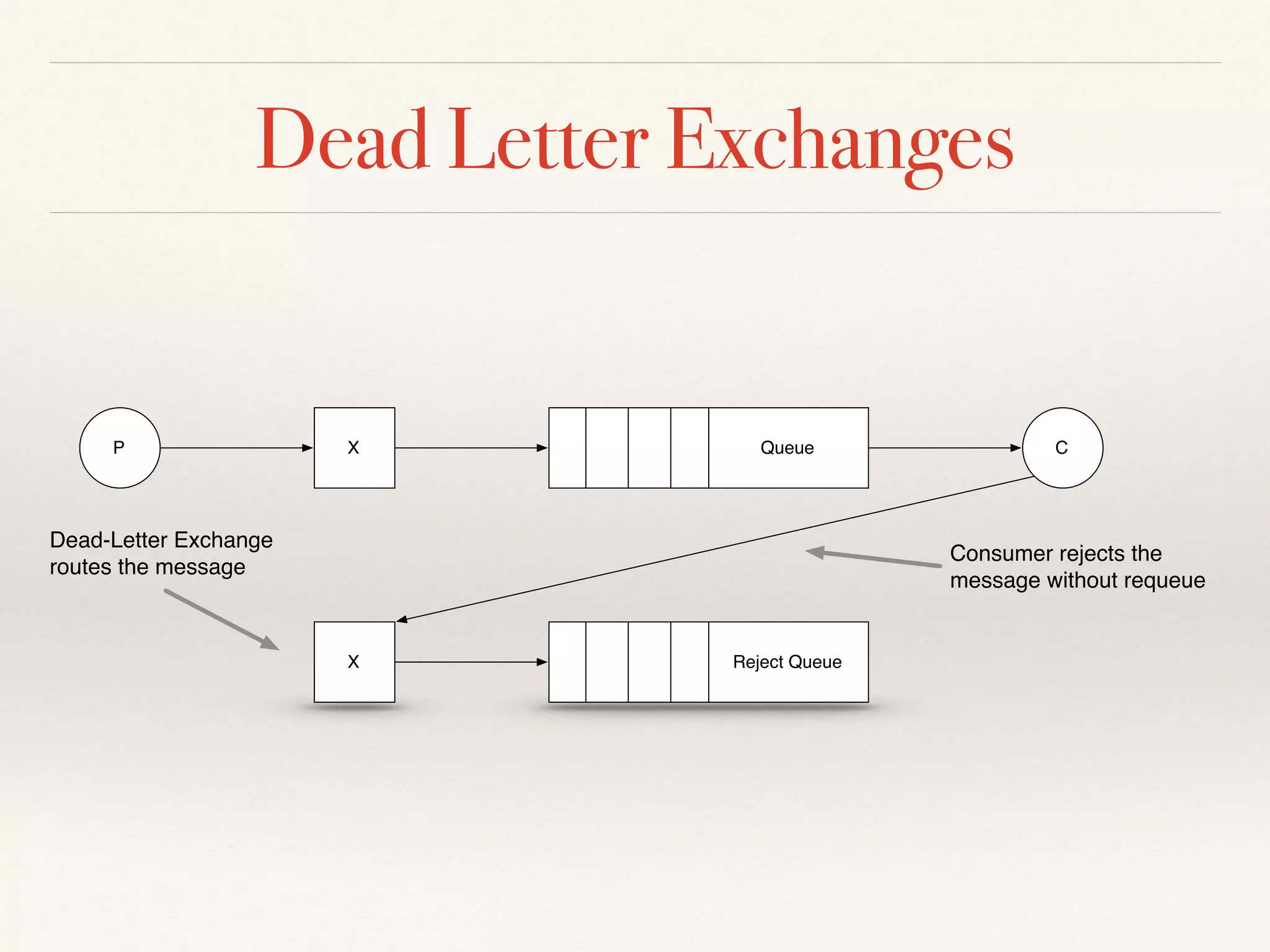
Dead Letter Exchanges
P X
Reject Queue
Queue C
X
Consumer rejects the
message without requeue
Dead-Letter Exchange
routes the message
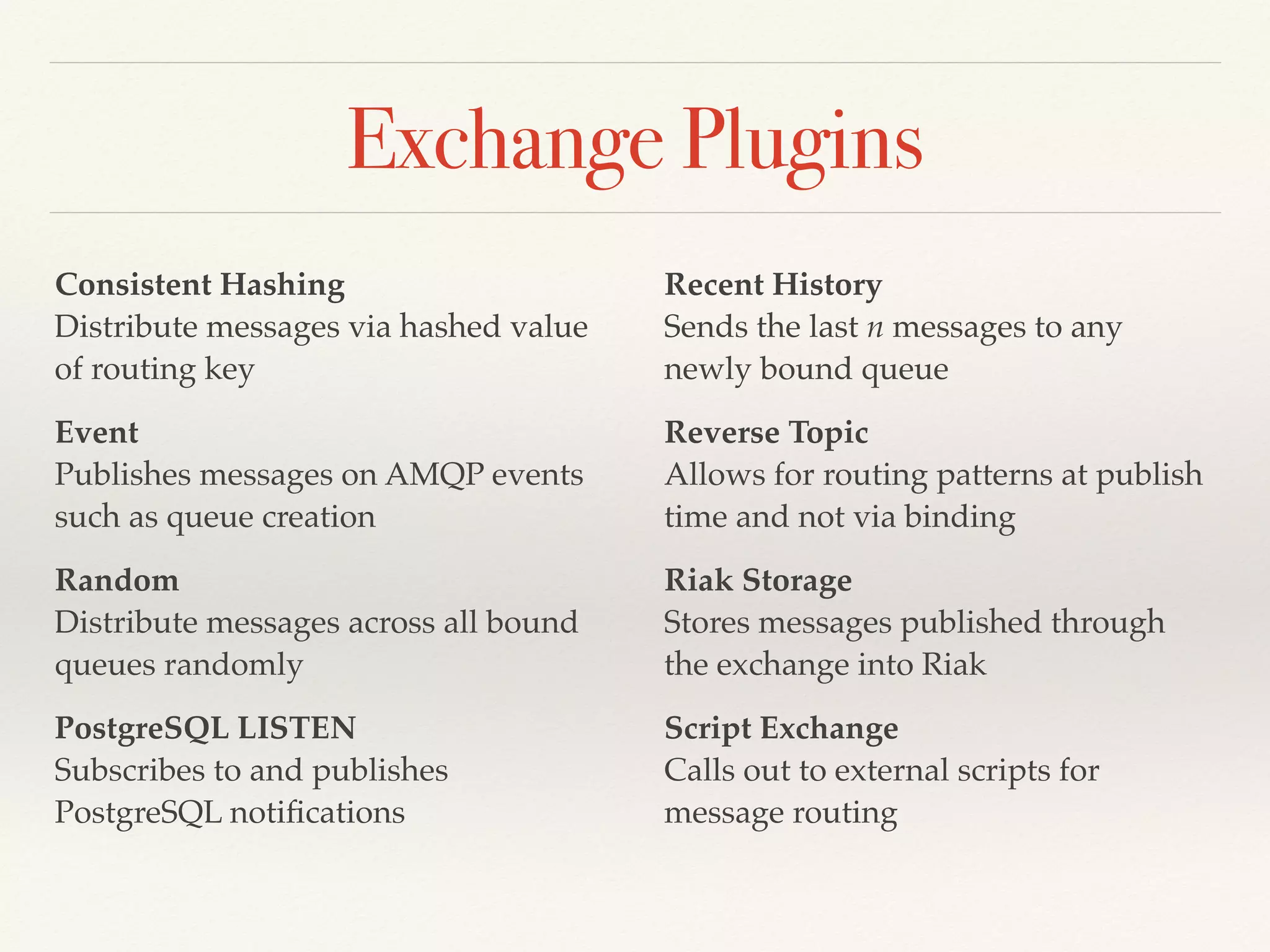
Exchange Plugins
Consistent Hashing

Distribute messages via hashed value
of routing key
Event

Publishes messages on AMQP events
such as queue creation
Random

Distribute messages across all bound
queues randomly
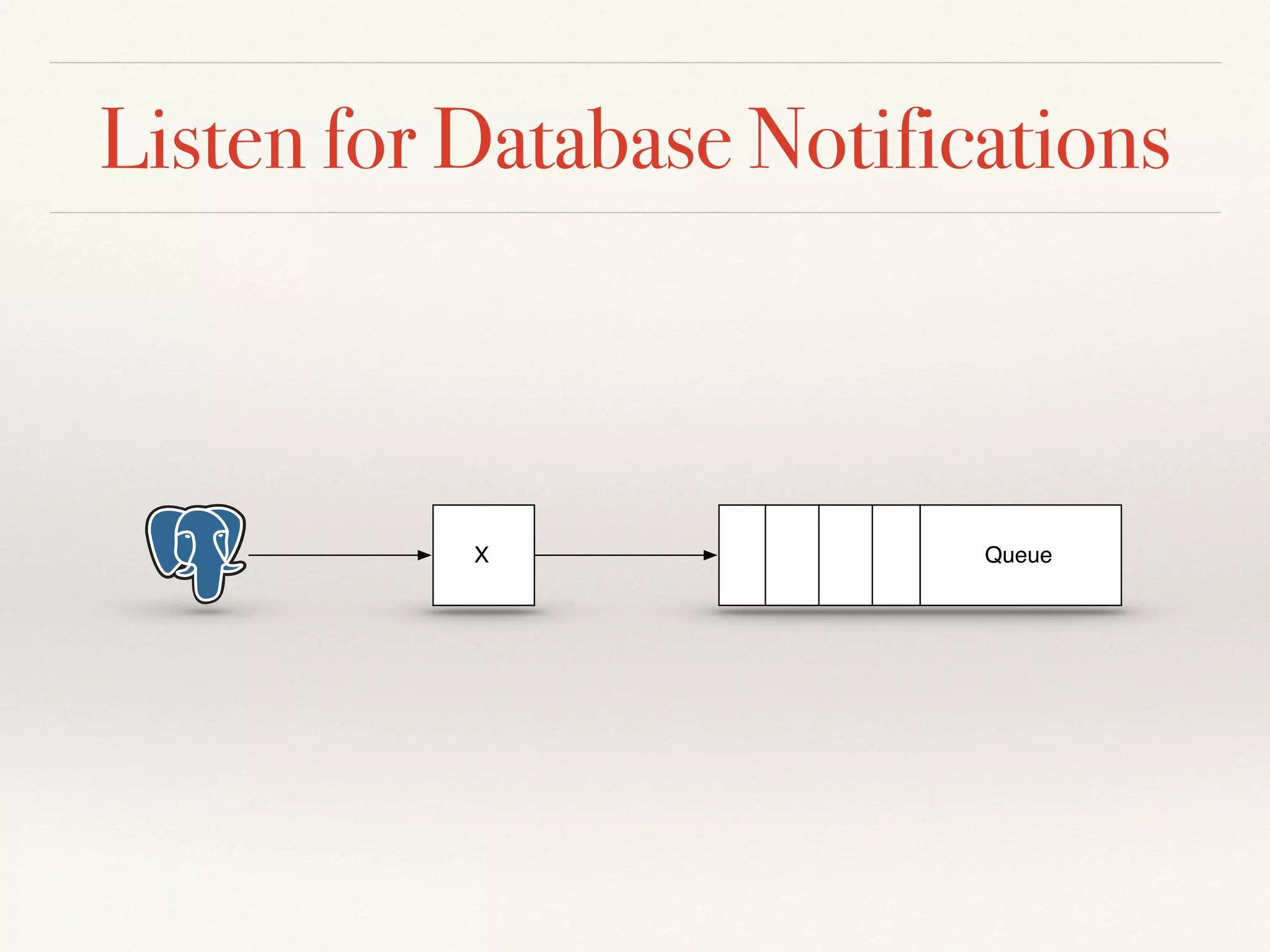
PostgreSQL LISTEN

Subscribes to and publishes
PostgreSQL notifications
Recent History

Sends the last n messages to any
newly bound queue
Reverse Topic

Allows for routing patterns at publish
time and not via binding
Riak Storage

Stores messages published through
the exchange into Riak
Script Exchange

Calls out to external scripts for
message routing
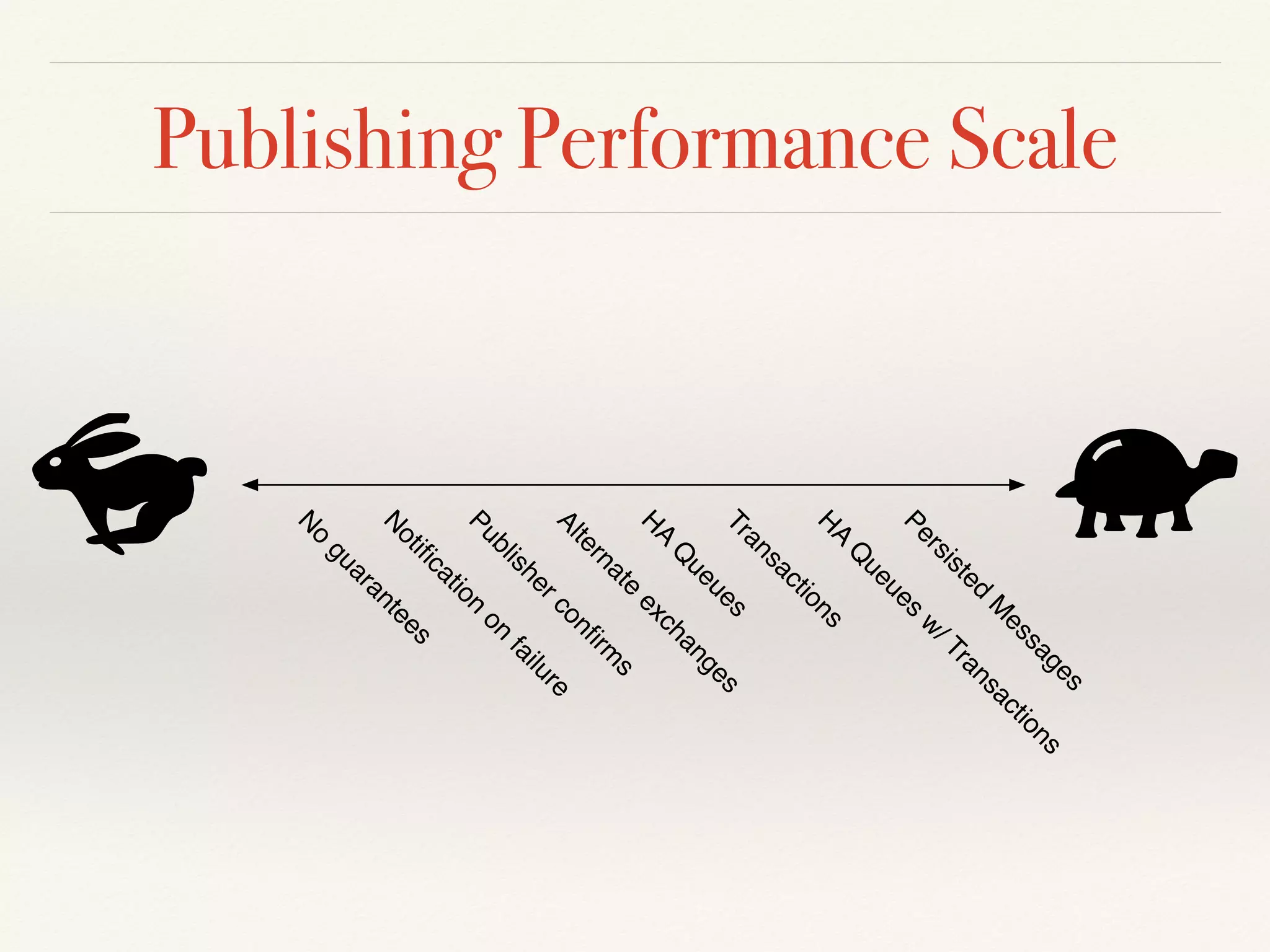
Performance Considerations
Publishing Performance Scale
Persisted
M
essages
Transactions
H
A
Q
ueues
Publisherconfirm
s
N
o
guarantees
N
otification
on
failureAlternate
exchanges
H
A
Q
ueues
w
/Transactions
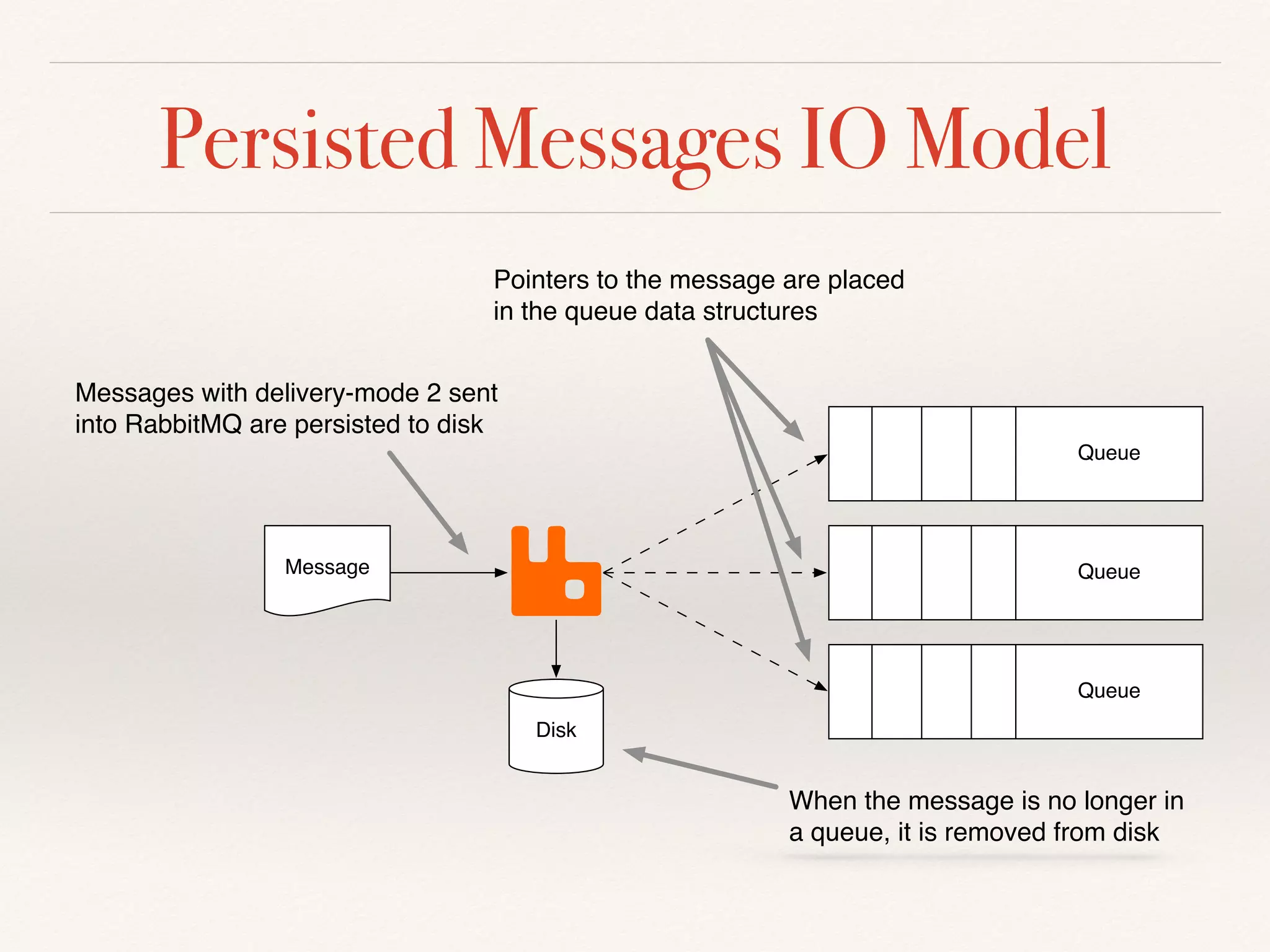
Persisted Messages IO Model
Disk
Queue
Message Queue
Queue
Messages with delivery-mode 2 sent
into RabbitMQ are persisted to disk
Pointers to the message are placed
in the queue data structures
When the message is no longer in
a queue, it is removed from disk
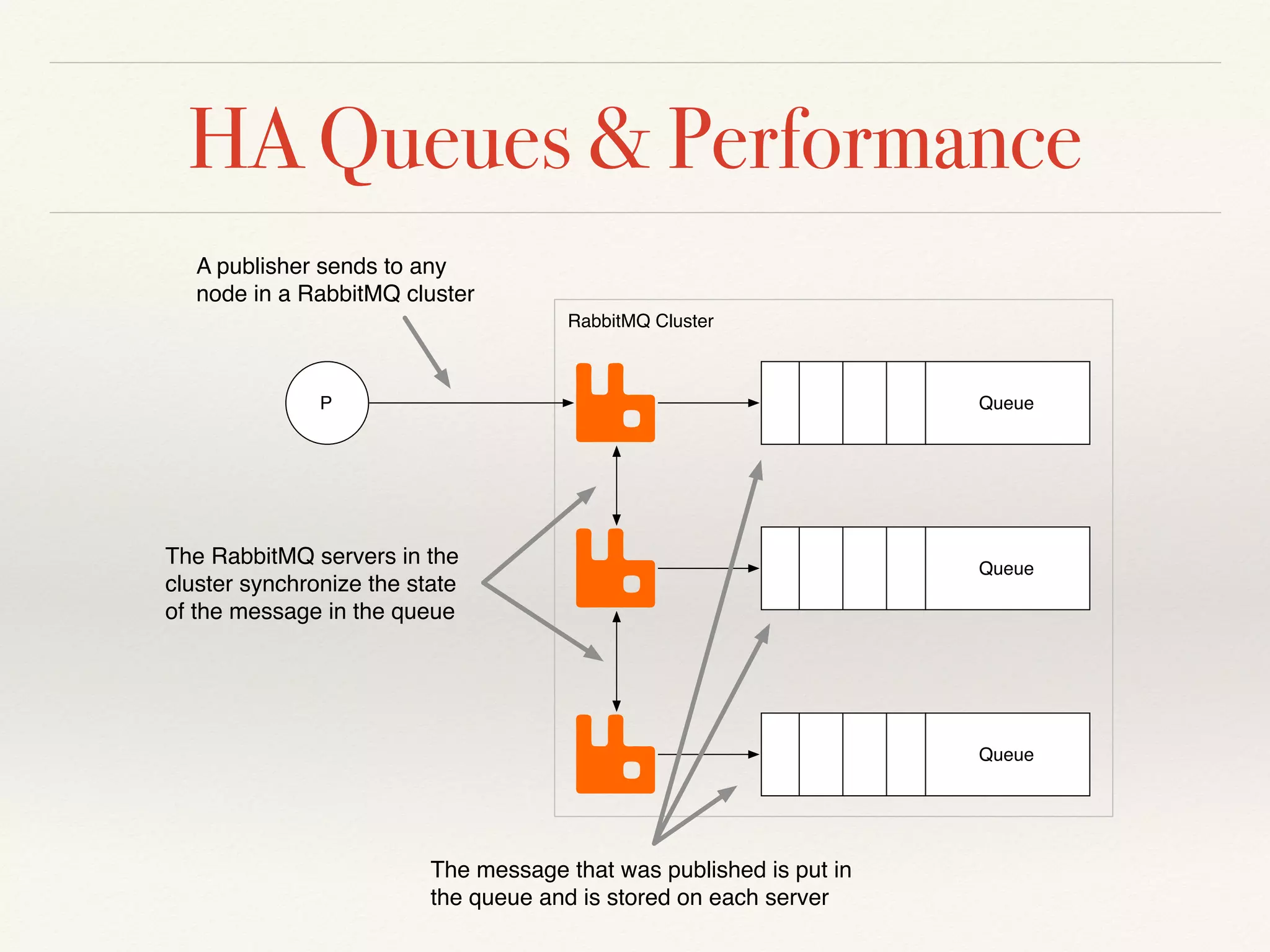
HA Queues & Performance
Queue
Queue
Queue
P
RabbitMQ Cluster
A publisher sends to any
node in a RabbitMQ cluster
The RabbitMQ servers in the
cluster synchronize the state
of the message in the queue
The message that was published is put in
the queue and is stored on each server
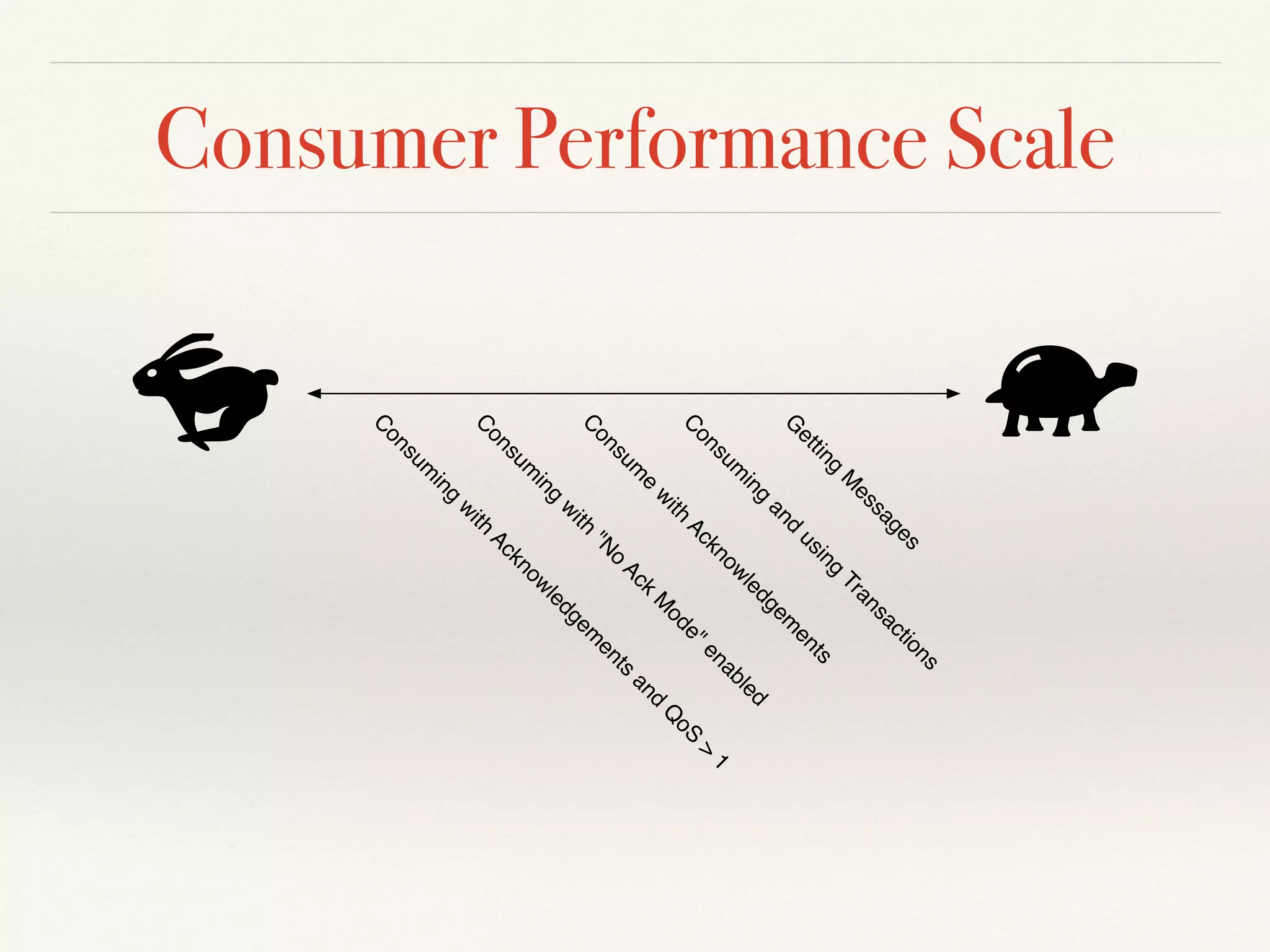
Consumer Performance Scale
G
etting
M
essages
C
onsum
ing
and
using
Transactions
C
onsum
e
w
ith
Acknow
ledgem
ents
C
onsum
ing
w
ith
"N
o
Ack
M
ode"enabled
C
onsum
ing
w
ith
Acknow
ledgem
ents
and
Q
oS
>
1
Operational Concerns
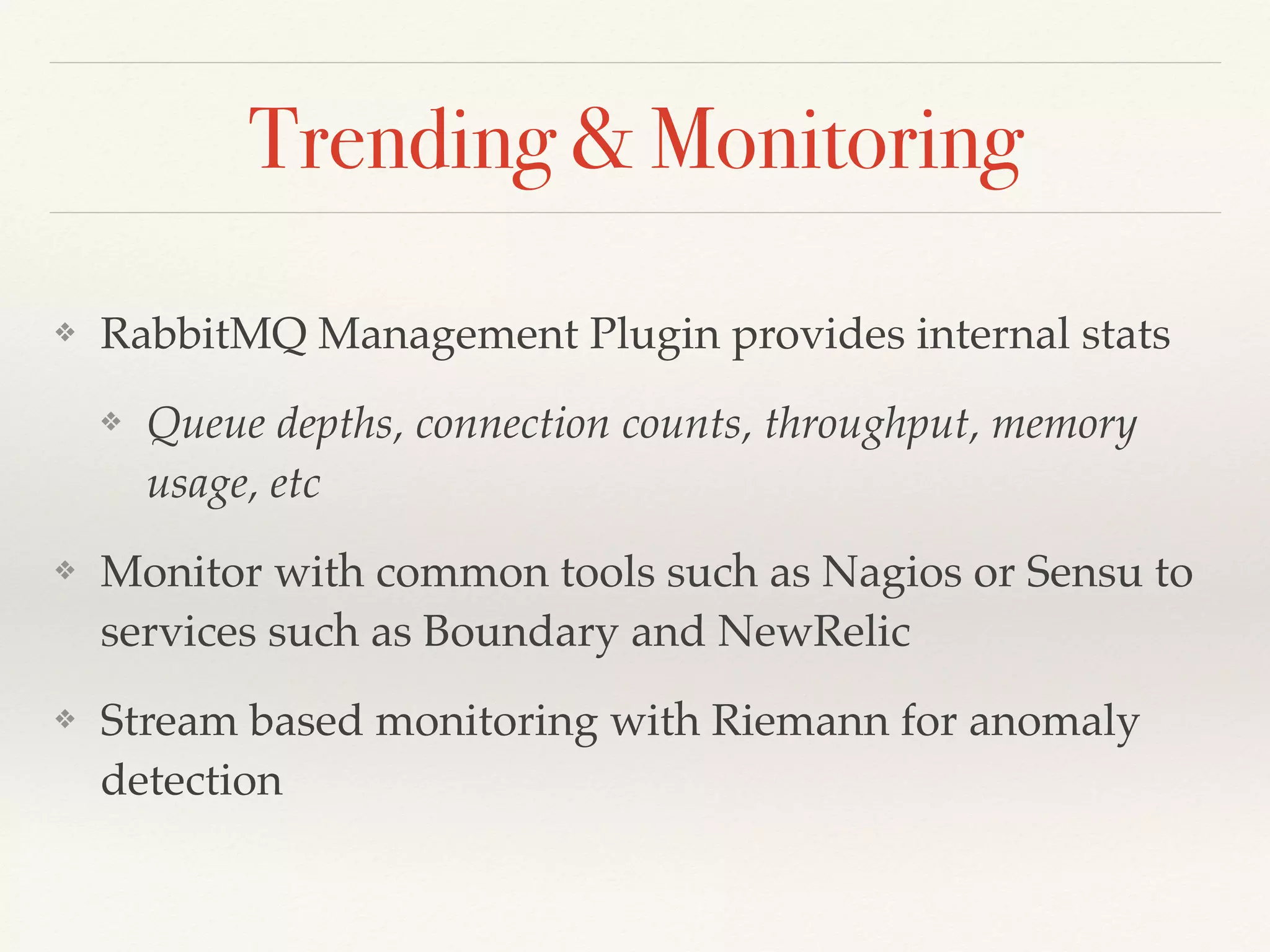
Trending & Monitoring
❖ RabbitMQ Management Plugin provides internal stats
❖ Queue depths, connection counts, throughput, memory
usage, etc
❖ Monitor with common tools such as Nagios or Sensu to
services such as Boundary and NewRelic
❖ Stream based monitoring with Riemann for anomaly
detection
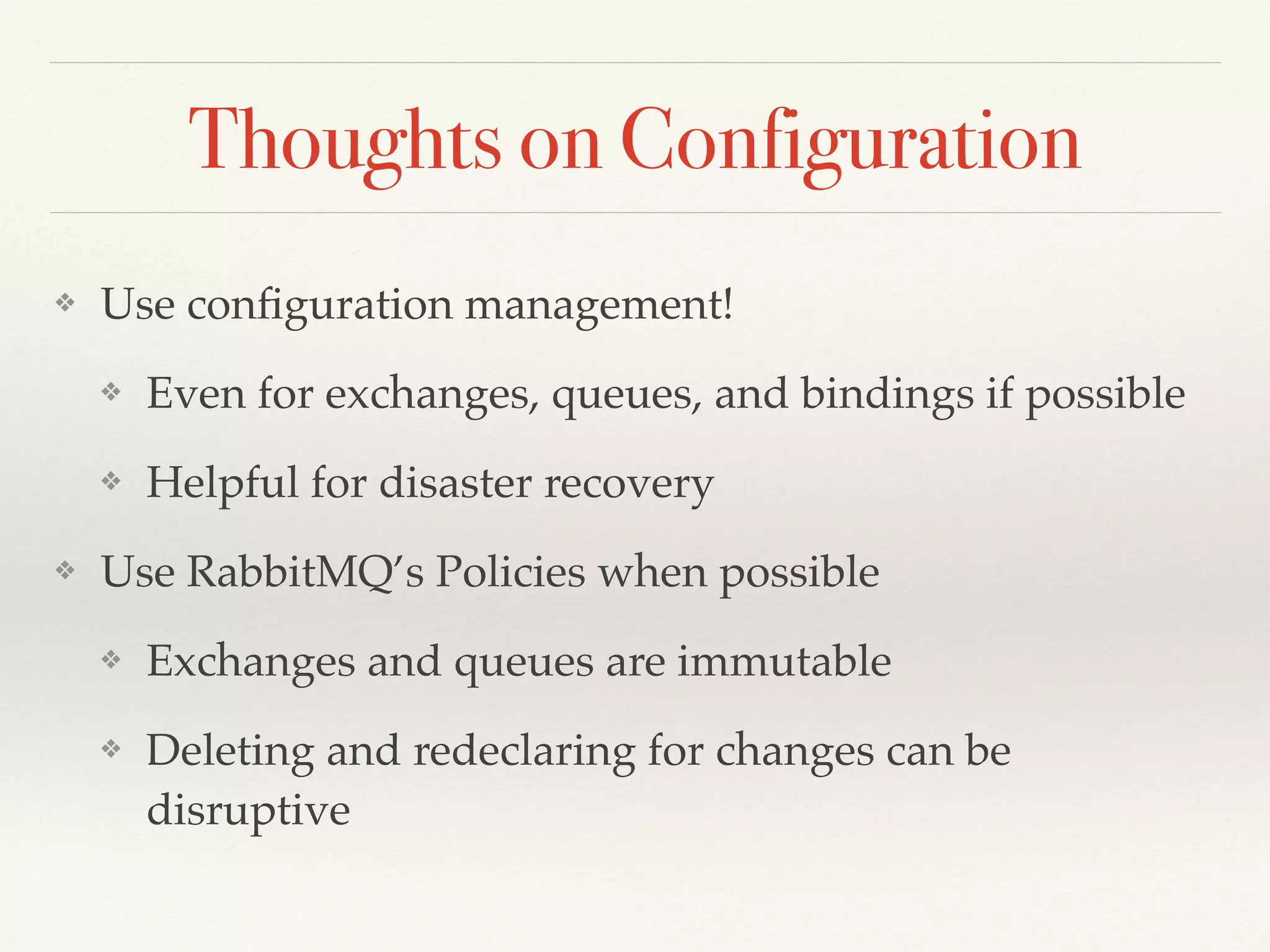
Thoughts on Configuration
❖ Use configuration management!
❖ Even for exchanges, queues, and bindings if possible
❖ Helpful for disaster recovery
❖ Use RabbitMQ’s Policies when possible
❖ Exchanges and queues are immutable
❖ Deleting and redeclaring for changes can be
disruptive
Sample Usage Patterns
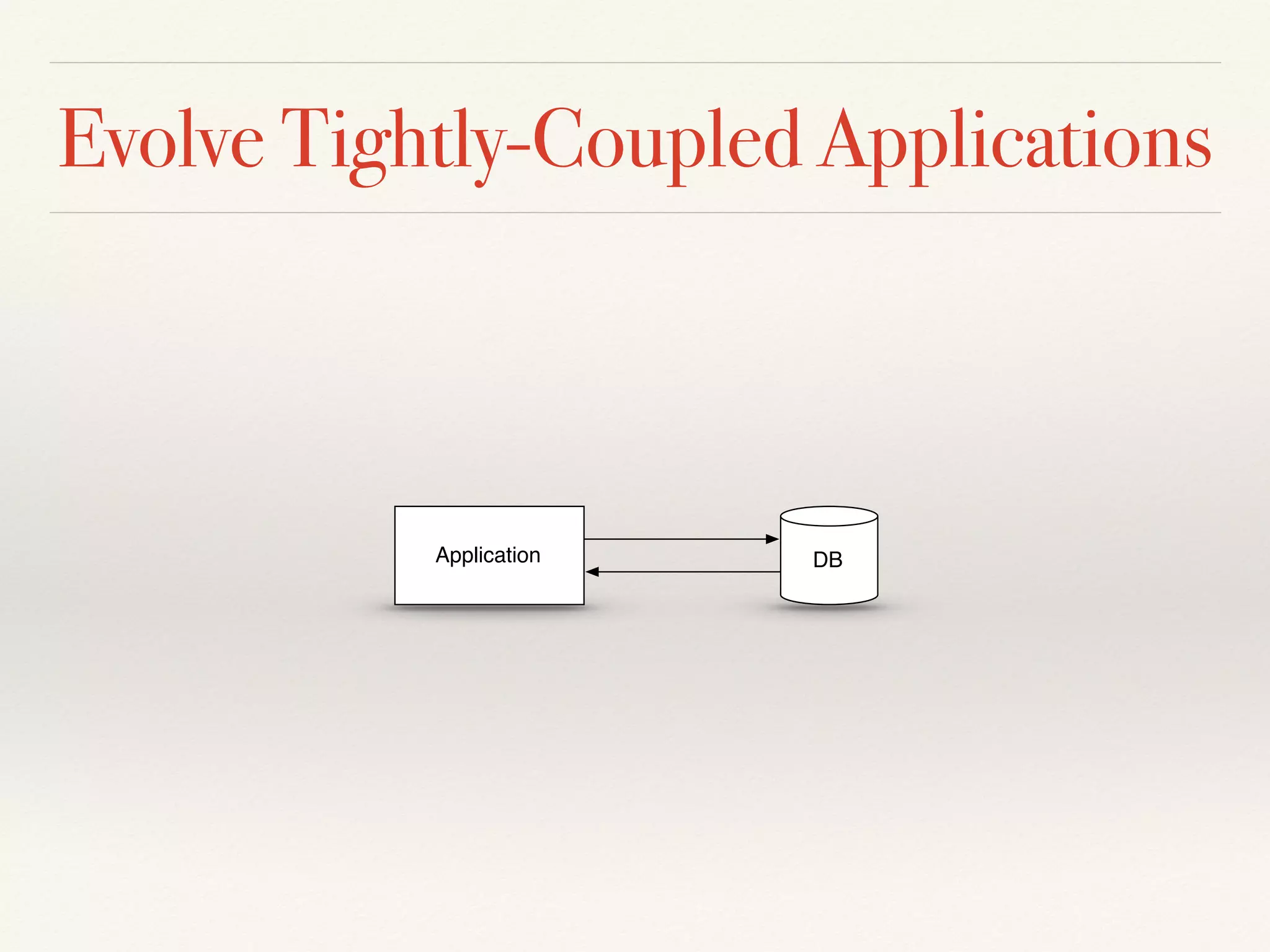
Evolve Tightly-Coupled Applications
Application DB
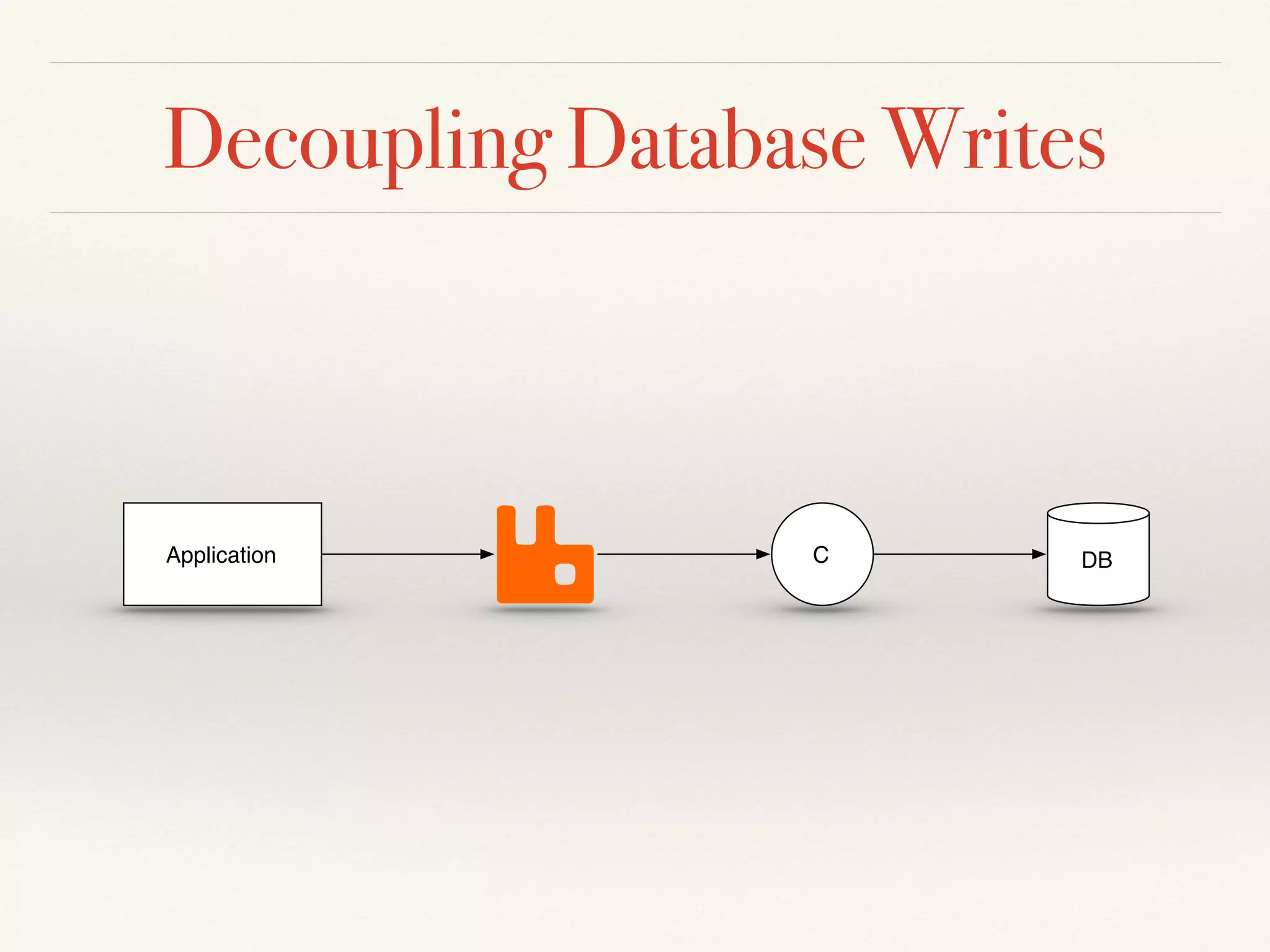
Decoupling Database Writes
Application C DB
Listen for Database Notifications
X Queue
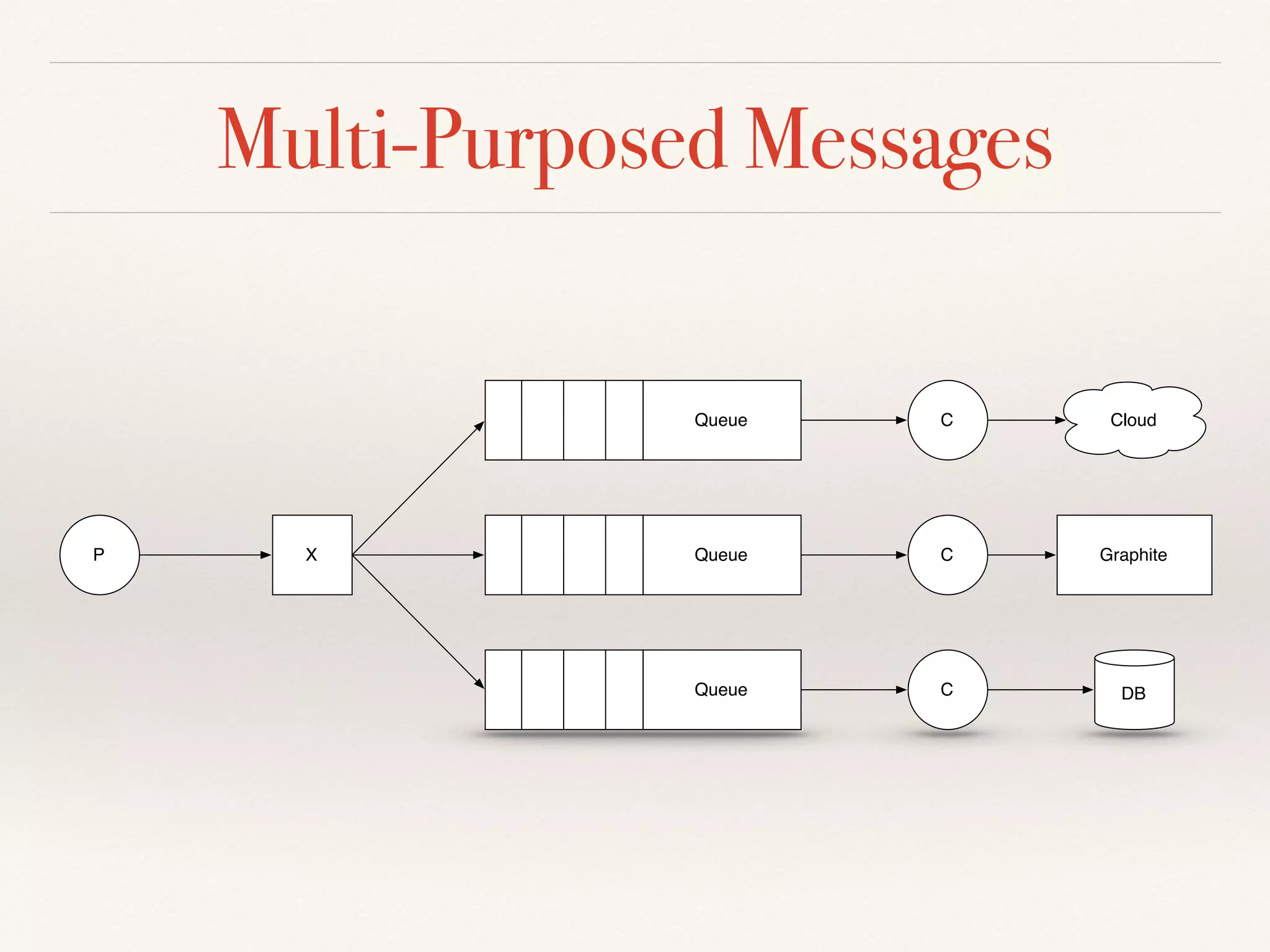
Multi-Purposed Messages
C
C
C
P
Queue
DB
Cloud
GraphiteQueue
Queue
X
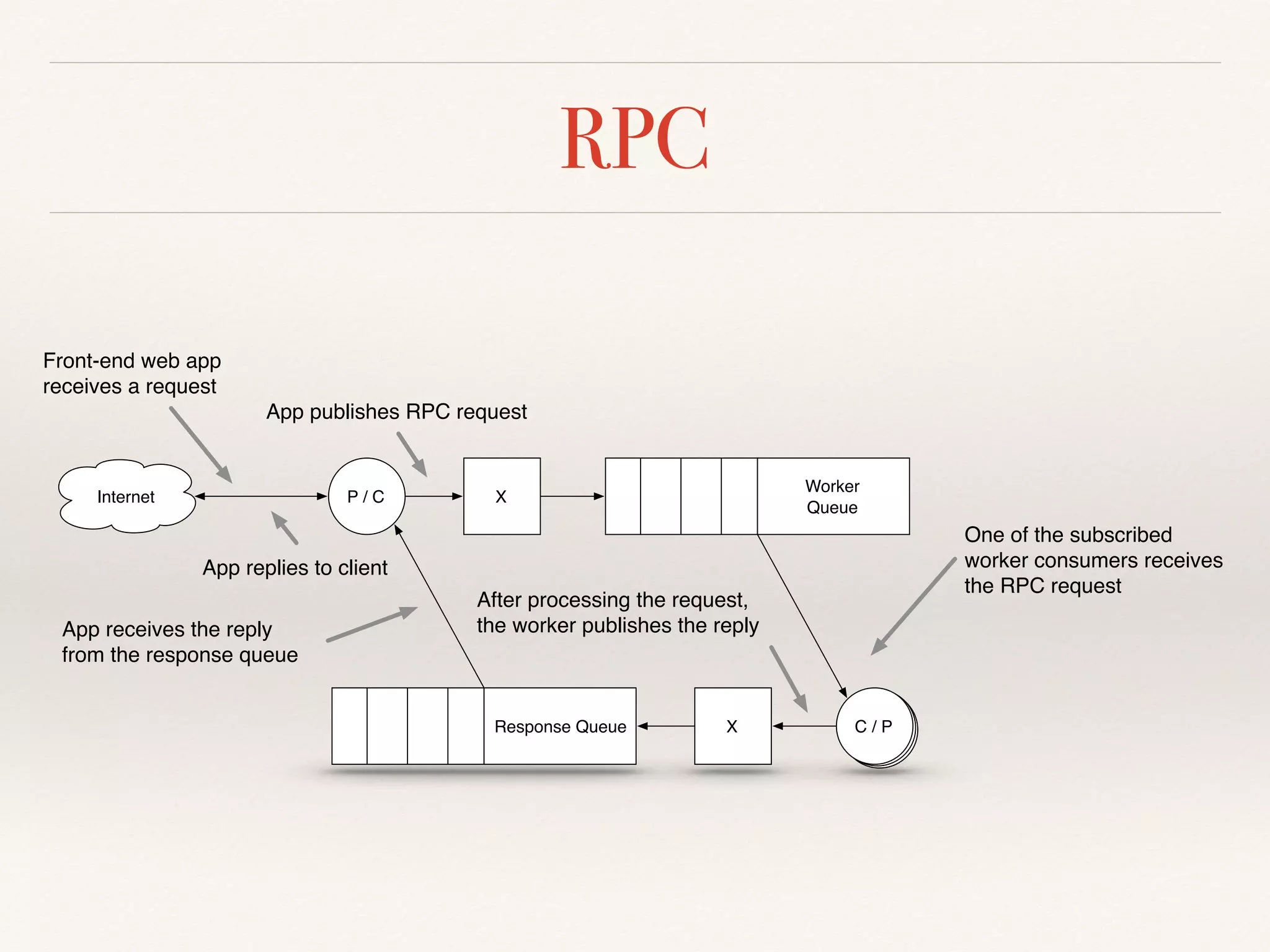
RPC
C / PC / P
P / C
C / PResponse Queue
X
X
Worker
Queue
Front-end web app
receives a request
Internet
App publishes RPC request
One of the subscribed
worker consumers receives
the RPC request
After processing the request,
the worker publishes the replyApp receives the reply
from the response queue
App replies to client
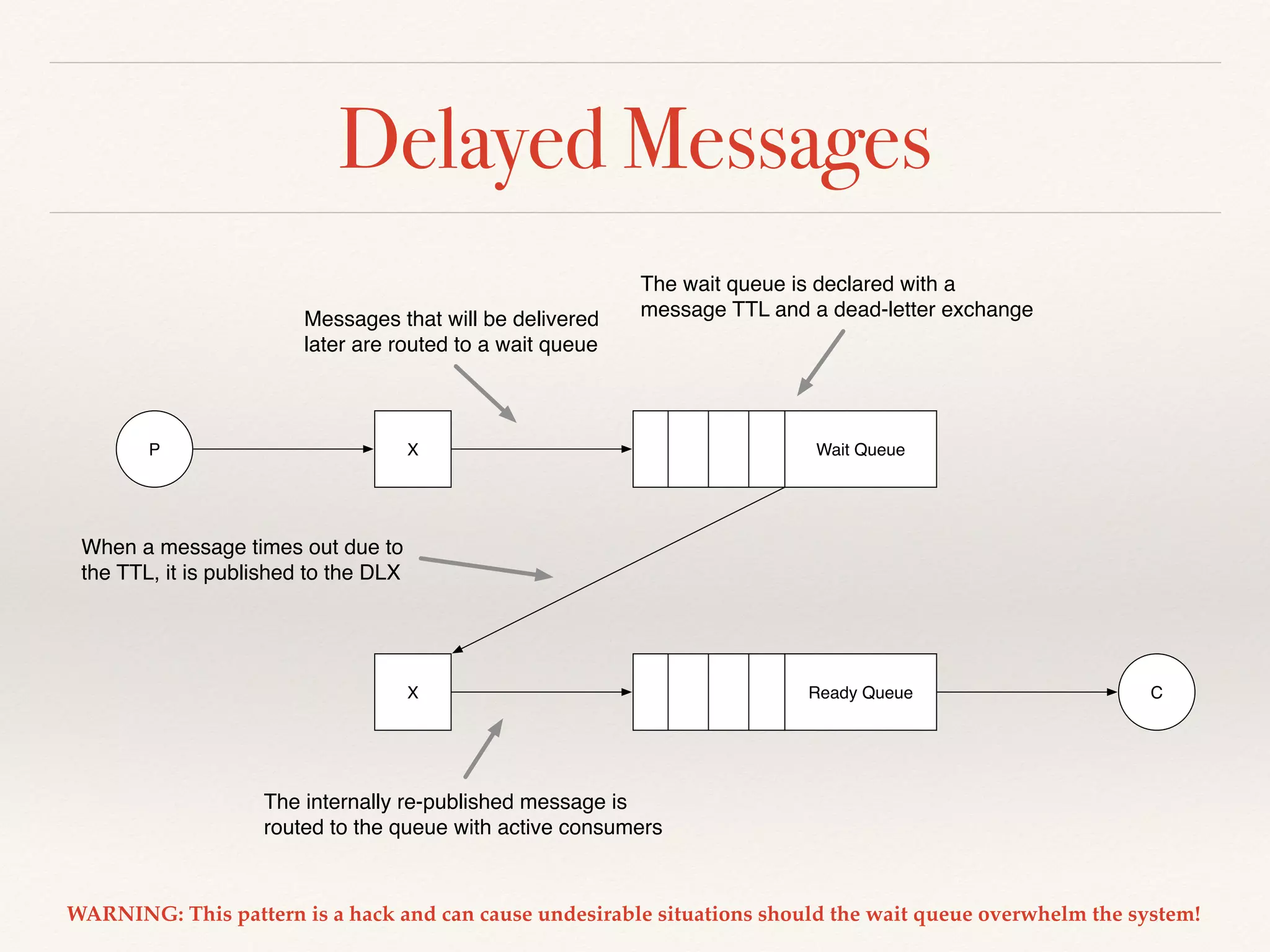
Delayed Messages
WARNING: This pattern is a hack and can cause undesirable situations should the wait queue overwhelm the system!
P X
X
Wait Queue
Ready Queue C
The wait queue is declared with a
message TTL and a dead-letter exchangeMessages that will be delivered
later are routed to a wait queue
When a message times out due to
the TTL, it is published to the DLX
The internally re-published message is
routed to the queue with active consumers
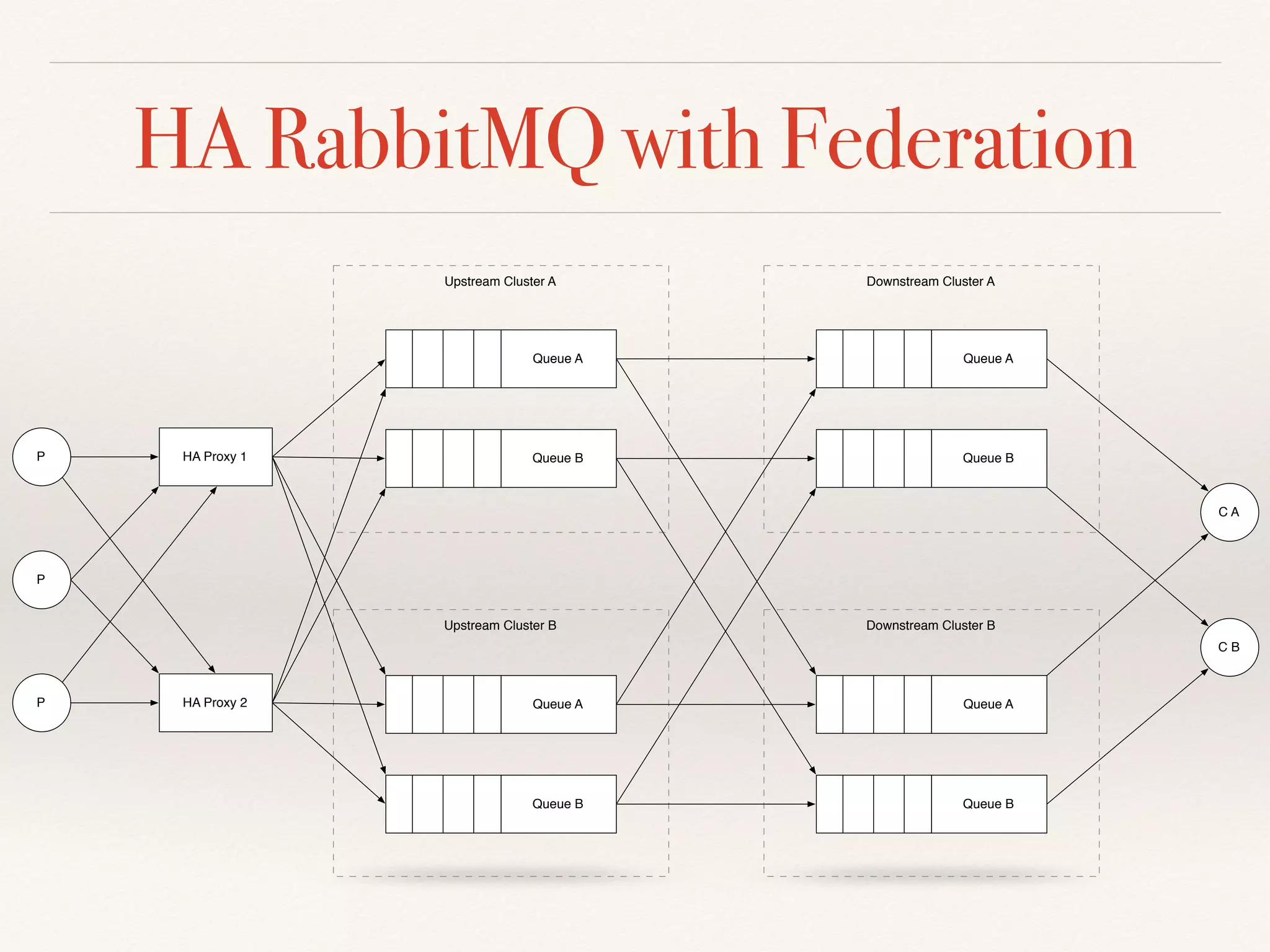
HA RabbitMQ with Federation
Upstream Cluster A
Queue A
Queue B
Upstream Cluster B
Queue A
Queue B
Downstream Cluster A
Queue A
Queue B
Downstream Cluster B
Queue A
Queue B
HA Proxy 1
HA Proxy 2
P
P
P
C A
C B
Questions?

Messaging Standards and Systems - AMQP & RabbitMQ

  • 1.
    Messaging Standards andSystems AMQP & RabbitMQ Gavin M. Roy VP of Architecture AWeber Communications Twitter: @Crad POSSCON April 14, 2015
  • 2.
    About Me VP ofArchitecture
 AWeber Communications Blame me for pika, rabbitpy, pamqp, and a handful of RabbitMQ plugins Blog: https://gavinroy.com Github: https://github.com/gmr Book: http://manning.com/roy
  • 3.
    Advanced Message QueueingProtocol ❖ Open Standard ❖ Platform and Vendor Neutral ❖ Multiple Versions
  • 4.
    AMQP Timeline 2003 2005 2006 2008 2011 Initial Specification WorkingGroup formed AMQP 0-8 AMQP 0-9-1 OASIS AMQP 1.0
  • 5.
    AMQP Working Group ❖JPMorgan Chase ❖ Cisco Systems ❖ IONA Technologies ❖ iMatrix ❖ RedHat ❖ TWIST ❖ Bank of America ❖ Barclays ❖ Credit Suisse ❖ Deutsche Börse Systems ❖ Goldman Sachs ❖ HCL Technologies ❖ Progress Software ❖ IIT Software ❖ INETCO Systems Ltd. ❖ Informatica Corporation ❖ Microsoft Corporation ❖ my-Channels ❖ Novell ❖ Solace Systems ❖ Tervala, Inc. ❖ VMWare ❖ WSO2
  • 6.
  • 7.
    AMQP 0-9-1 ❖ Currentlyhas wider support than AMQP 1.0 ❖ Multiple Broker Implementations: 
 RabbitMQ, Apache Qpid, and SwiftMQ to name a few ❖ Specifies a Model and Protocol
  • 8.
    Native AMQP 0-8/0-9-1Clients C Clojure Cobol Common Lisp Delphi Erlang Go Groovy Haskell Java JavaScript .NET OCaml Perl PHP Python Ruby Scala
  • 9.
    ❖ Exchange
 Receives androute messages ❖ Message Queue
 Stores messages until they can be
 consumed ❖ Binding
 Defines the relationship between an Exchange and Queue and provides routing criteria Advanced Message Queueing Model X Exchange Binding Message Queue
  • 10.
    Routing Keys ❖ Providedwhen publishing a message ❖ Compared against binding keys by exchanges ❖ Ideally provide context to the message: ❖ Connote the type of the message ❖ Categorize the content in the message ❖ Specify the type of consumer that should receive it
  • 11.
    Advanced Message QueueingProtocol ❖ Compact, binary frame format wire protocol ❖ Bi-directional RPC ❖ Commands consist of Classes and Methods: ❖ Example Request:
 
 Queue.Declare(name=“foo”) ❖ Response:
 
 Queue.DeclareOk(messages=0, consumers=0)
  • 12.
    Common AMQP Terms ❖Broker
 A server that implements AMQP ❖ Producer or Publisher
 A client application that sends messages to a broker ❖ Consumer
 A client application that reads messages from a queue
  • 13.
  • 14.
  • 15.
  • 16.
    AMQP Messages ❖ Comprisedof 3 or more frames: ❖ Method Frame
 Basic.Publish, Basic.Deliver, etc ❖ Content Header with body size & message properties 
 timestamp, message-id, app-id, etc ❖ n Body Frames with the opaque message payload
  • 17.
    AMQP 0-9-1 Issues& Gotchas ❖ Ambiguous ❖ Authentication ❖ Asynchronous ❖ Connection Negotiation ❖ Exceptions !
  • 18.
    RabbitMQ ❖ Open Source(MPL) ❖ Written in Erlang/OTP ❖ Developed/Maintained by Pivotal ❖ Multi-Protocol
 AMQP 0-9-1 & 1.0, MQTT, STOMP, XMPP, HTTP, Web-STOMP & More ❖ Roots in AMQP 0-8/0-9-1
  • 19.
    Who Uses It? AgoraGames Chef Google AdMob Instagram MeetMe Mercado Libre Mozilla NASA New York Times National Science Foundation Openstack Rapportive Reddit Soundcloud (and many more)
  • 20.
    Why Use RabbitMQ? ❖Create loosely-coupled applications ❖ Communicate across applications or platforms ❖ Tap into pre-existing message flows for new purposes ❖ Scale-out clustering for growth, throughput, and HA ❖ Federation for WAN latencies and network partitions ❖ Extensible plugin-in architecture
  • 21.
    RabbitMQ Extensions toAMQP Authentication Failure Exchange to Exchange Bindings Delivery Confirmations Basic.Nack Consumer cancellations Consumer priorities Dead Letter Exchanges Alternate Exchanges Connection blocking Message CC & BCC Routing Queue Length Limits Per Queue Message TTL Per Message TTL Queue TTL Message User ID Validation Auto-delete exchanges
  • 22.
    RabbitMQ Clustering ❖ LANOnly ❖ Adds highly-available queues ❖ Is cohesive, publish and consume from any node ❖ Leverages native Erlang clustering and communication ❖ Has multiple strategies for dealing with network partitions ❖ Manually configured via configuration or command line*
  • 23.
    RabbitMQ Federation ❖ Providesloosely coupled inter- node/cluster RabbitMQ communication ❖ Connect multiple RabbitMQ clusters across data centers or the Internet ❖ Can be applied to both exchanges and queues Cluster A X Cluster B X Cluster C X
  • 24.
    RabbitMQ Plugins amqp1_0
 Adds AMQP1.0 support to RabbitMQ auth-backend-amqp
 AMQP RPC for Authentication auth-backend-ldap
 Authenticate via an external LDAP server autocluster-consul
 Automatically create clusters using Consul msg_store_eleveldb_index
 LevelDB storage for queue messages presence-exchange
 Publishes messages upon binding changes rabbitmq-top
 Top like view of RabbitMQ processes in the management UI sharding
 Scale out RabbitMQ with automatic queue sharding (and many more)
  • 25.
  • 26.
    Built-In Exchange Types ❖Direct
 String matching on the routing key ❖ Fanout
 No routing key, messages delivered to all bound queues ❖ Topic
 Pattern matching in the routing key ❖ Headers
 No routing key, value matching in the headers property
  • 27.
    Topic Exchange BindingKeys Routing Key: namespace.delimited.keys #
 Receive all messages namespace.#
 Receive all messages in namespace namespace.delimited.*
 Receive all namespace.delimited messages namespace.*.keys
 Receive all namespace messages ending with keys
  • 28.
    Exchange to ExchangeBinding X X X Queue Queue Queue Queue Queue Queue Messages published into a topic exchange are routed to two other exchanges and a queue Messages published into the consistent-hashing exchange are distributed amongst three queues Messages published into a direct exchange routed to two queues P
  • 29.
    Alternate Exchanges P X Unroutable Messages X Unroutablemessages are sent to an alternate exchange
  • 30.
    Dead Letter Exchanges PX Reject Queue Queue C X Consumer rejects the message without requeue Dead-Letter Exchange routes the message
  • 31.
    Exchange Plugins Consistent Hashing
 Distributemessages via hashed value of routing key Event
 Publishes messages on AMQP events such as queue creation Random
 Distribute messages across all bound queues randomly PostgreSQL LISTEN
 Subscribes to and publishes PostgreSQL notifications Recent History
 Sends the last n messages to any newly bound queue Reverse Topic
 Allows for routing patterns at publish time and not via binding Riak Storage
 Stores messages published through the exchange into Riak Script Exchange
 Calls out to external scripts for message routing
  • 32.
  • 33.
  • 34.
    Persisted Messages IOModel Disk Queue Message Queue Queue Messages with delivery-mode 2 sent into RabbitMQ are persisted to disk Pointers to the message are placed in the queue data structures When the message is no longer in a queue, it is removed from disk
  • 35.
    HA Queues &Performance Queue Queue Queue P RabbitMQ Cluster A publisher sends to any node in a RabbitMQ cluster The RabbitMQ servers in the cluster synchronize the state of the message in the queue The message that was published is put in the queue and is stored on each server
  • 36.
  • 37.
  • 38.
    Trending & Monitoring ❖RabbitMQ Management Plugin provides internal stats ❖ Queue depths, connection counts, throughput, memory usage, etc ❖ Monitor with common tools such as Nagios or Sensu to services such as Boundary and NewRelic ❖ Stream based monitoring with Riemann for anomaly detection
  • 39.
    Thoughts on Configuration ❖Use configuration management! ❖ Even for exchanges, queues, and bindings if possible ❖ Helpful for disaster recovery ❖ Use RabbitMQ’s Policies when possible ❖ Exchanges and queues are immutable ❖ Deleting and redeclaring for changes can be disruptive
  • 40.
  • 41.
  • 42.
  • 43.
    Listen for DatabaseNotifications X Queue
  • 44.
  • 45.
    RPC C / PC/ P P / C C / PResponse Queue X X Worker Queue Front-end web app receives a request Internet App publishes RPC request One of the subscribed worker consumers receives the RPC request After processing the request, the worker publishes the replyApp receives the reply from the response queue App replies to client
  • 46.
    Delayed Messages WARNING: Thispattern is a hack and can cause undesirable situations should the wait queue overwhelm the system! P X X Wait Queue Ready Queue C The wait queue is declared with a message TTL and a dead-letter exchangeMessages that will be delivered later are routed to a wait queue When a message times out due to the TTL, it is published to the DLX The internally re-published message is routed to the queue with active consumers
  • 47.
    HA RabbitMQ withFederation Upstream Cluster A Queue A Queue B Upstream Cluster B Queue A Queue B Downstream Cluster A Queue A Queue B Downstream Cluster B Queue A Queue B HA Proxy 1 HA Proxy 2 P P P C A C B
  • 48.