Presented to :
Dr. Vandana Kumari
Presented by :
Kuldeep Singh
Roll no. : 41091
Ujjwal Gola
Roll no. : 41092
Structure
And
Physical properties of Amines
Acknowledgement
I am deeply indebted to my Chemistry teacher, Dr. Vandana
Kumari for his guidance and suggestions in completing this
project. The completion of this project was possible under
her guidance and support.
I am also very thankful to my parents and my friends who
have boosted me up morally with their continuous
support.
At last but not least, I am very thankful to God almighty
for showering his blessings upon me.
Structure of Amine
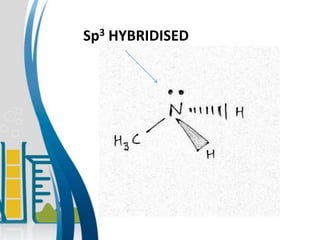
Nitrogen has 5 valence electrons and so is trivalent with a lone
pair. As per VSEPR THEORY, nitrogen present in amines is sp3
hybridized and due to the presence of lone pair, it is pyramidal
instead of tetrahedral shape which is a general structure for
most sp3 hybridized molecules. Each of the three sp3
hybridized orbitals of nitrogen overlap with orbitals of
hydrogen or carbon depending upon the configuration of
amines. Due to the presence of lone pair, the C-N-H angle
in amines is less than 109 degrees which is a
characteristic angle of tetrahedral geometry. The
angle of amines is near about 107 degrees.
Sp3 HYBRIDISED
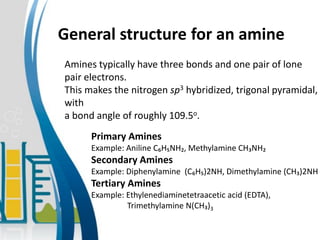
General structure for an amine
Amines typically have three bonds and one pair of lone
pair electrons.
This makes the nitrogen sp3 hybridized, trigonal pyramidal,
with
a bond angle of roughly 109.5o.
Primary Amines
Example: Aniline C₆H₅NH₂, Methylamine CH₃NH₂
Secondary Amines
Example: Diphenylamine (C₆H₅)2NH, Dimethylamine (CH₃)2NH
Tertiary Amines
Example: Ethylenediaminetetraacetic acid (EDTA),
Trimethylamine N(CH₃)3
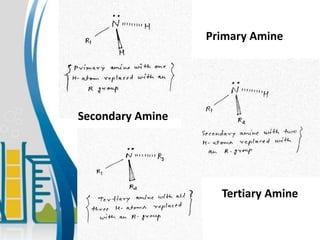
Primary Amine
Secondary Amine
Tertiary Amine
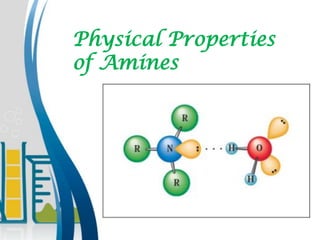
Physical Properties
of Amines
General Properties:
1.The lower aliphatic amines are gaseous in nature with a
fishy smell. Primary amines with three or four carbon atoms
are liquids at room temperature whereas higher ones are
solids.
2. Aniline and other arylamines are generally colourless,
but they get coloured if stored in open due to
atmospheric oxidation.
3. Organic solvents like alcohol, benzene, and ether readily
dissolve amines. Alcohols have higher polarity as compared
to amines and hence they form stronger intermolecular
hydrogen bonds.
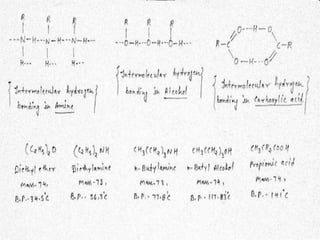
4. Primary and secondary amines are often engaged in the
intermolecular association as a result of hydrogen bonding
between nitrogen of one and hydrogen of the other
molecule.
5. The intermolecular association is more prominent in
case of primary amines as compared to secondary
due to the availability of two hydrogen atoms.
.
6. Methylamine, ethylamine, dimethylamine and
trimethylamine are all gases at room temperature.
Higher amines are colourless liquids.
7. Volatile amines usually have unpleasant odour.
Boiling Points of Amines:
1.Primary and secondary amines get engaged in intermolecula
association because of the hydrogen bonding between the
nitrogen of one molecule with the hydrogen of another
molecule.
2.Such intermolecular association is more in primary amines
as compared to secondary amines because there are two
hydrogen atoms present for bond formation.
3.Tertiary amines don’t have an intermolecular
association as it doesn’t have any hydrogen atom
available for hydrogen bond formation.
4.That’s why the order of boiling points for isomeric
amines goes like :
primary > secondary > tertiary
5.Amines have lower boiling points than alcohols and
carboxylic acids of comparable molecular mass because
N—H---N hydrogen bond is weaker than O—H---O
hydrogen bond. The N—H bond is less polar than the
O—H bond because nitrogen is less electronegative than
oxygen.
Solubility Characteristics:
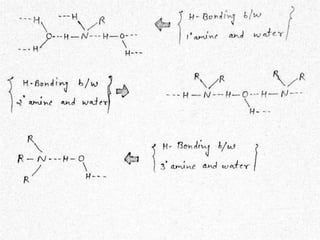
1.Lower aliphatic amines can form hydrogen bonds with water
molecules. And thus, such amines are soluble in water.
2.The solubility decreases with the increase in the size of the
alkyl group and higher amines become almost insoluble in
water.
3. Lower amines are also soluble in alcohol and ether.
4. Aromatic amines are almost insoluble in water
but are soluble in organic solvents such as ether,
benzene and chloroform.
Bibliography
Help from the :
1. Handwritten Notes
2. Class 12th NCERT
3. www.google/wikipedia.com
Physical Properties of Amines

Amines PPT.pdf

  • 1.
    Presented to : Dr.Vandana Kumari Presented by : Kuldeep Singh Roll no. : 41091 Ujjwal Gola Roll no. : 41092 Structure And Physical properties of Amines
  • 2.
    Acknowledgement I am deeplyindebted to my Chemistry teacher, Dr. Vandana Kumari for his guidance and suggestions in completing this project. The completion of this project was possible under her guidance and support. I am also very thankful to my parents and my friends who have boosted me up morally with their continuous support. At last but not least, I am very thankful to God almighty for showering his blessings upon me.
  • 3.
    Structure of Amine Nitrogenhas 5 valence electrons and so is trivalent with a lone pair. As per VSEPR THEORY, nitrogen present in amines is sp3 hybridized and due to the presence of lone pair, it is pyramidal instead of tetrahedral shape which is a general structure for most sp3 hybridized molecules. Each of the three sp3 hybridized orbitals of nitrogen overlap with orbitals of hydrogen or carbon depending upon the configuration of amines. Due to the presence of lone pair, the C-N-H angle in amines is less than 109 degrees which is a characteristic angle of tetrahedral geometry. The angle of amines is near about 107 degrees.
  • 4.
  • 5.
    General structure foran amine Amines typically have three bonds and one pair of lone pair electrons. This makes the nitrogen sp3 hybridized, trigonal pyramidal, with a bond angle of roughly 109.5o. Primary Amines Example: Aniline C₆H₅NH₂, Methylamine CH₃NH₂ Secondary Amines Example: Diphenylamine (C₆H₅)2NH, Dimethylamine (CH₃)2NH Tertiary Amines Example: Ethylenediaminetetraacetic acid (EDTA), Trimethylamine N(CH₃)3
  • 6.
  • 7.
  • 8.
    General Properties: 1.The loweraliphatic amines are gaseous in nature with a fishy smell. Primary amines with three or four carbon atoms are liquids at room temperature whereas higher ones are solids. 2. Aniline and other arylamines are generally colourless, but they get coloured if stored in open due to atmospheric oxidation.
  • 9.
    3. Organic solventslike alcohol, benzene, and ether readily dissolve amines. Alcohols have higher polarity as compared to amines and hence they form stronger intermolecular hydrogen bonds. 4. Primary and secondary amines are often engaged in the intermolecular association as a result of hydrogen bonding between nitrogen of one and hydrogen of the other molecule. 5. The intermolecular association is more prominent in case of primary amines as compared to secondary due to the availability of two hydrogen atoms. .
  • 10.
    6. Methylamine, ethylamine,dimethylamine and trimethylamine are all gases at room temperature. Higher amines are colourless liquids. 7. Volatile amines usually have unpleasant odour.
  • 11.
    Boiling Points ofAmines: 1.Primary and secondary amines get engaged in intermolecula association because of the hydrogen bonding between the nitrogen of one molecule with the hydrogen of another molecule. 2.Such intermolecular association is more in primary amines as compared to secondary amines because there are two hydrogen atoms present for bond formation. 3.Tertiary amines don’t have an intermolecular association as it doesn’t have any hydrogen atom available for hydrogen bond formation.
  • 12.
    4.That’s why theorder of boiling points for isomeric amines goes like : primary > secondary > tertiary 5.Amines have lower boiling points than alcohols and carboxylic acids of comparable molecular mass because N—H---N hydrogen bond is weaker than O—H---O hydrogen bond. The N—H bond is less polar than the O—H bond because nitrogen is less electronegative than oxygen.
  • 14.
    Solubility Characteristics: 1.Lower aliphaticamines can form hydrogen bonds with water molecules. And thus, such amines are soluble in water. 2.The solubility decreases with the increase in the size of the alkyl group and higher amines become almost insoluble in water. 3. Lower amines are also soluble in alcohol and ether. 4. Aromatic amines are almost insoluble in water but are soluble in organic solvents such as ether, benzene and chloroform.
  • 16.
    Bibliography Help from the: 1. Handwritten Notes 2. Class 12th NCERT 3. www.google/wikipedia.com
  • 17.