

American Colonies: Revolutions Brandon Richards
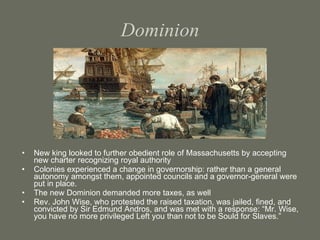
Dominion New king looked to further obedient role of Massachusetts by accepting new charter recognizing royal authority Colonies experienced a change in governorship: rather than a general autonomy amongst them, appointed councils and a governor-general were put in place. The new Dominion demanded more taxes, as well Rev. John Wise, who protested the raised taxation, was jailed, fined, and convicted by Sir Edmund Andros, and was met with a response: “Mr. Wise, you have no more privileged Left you than not to be Sould for Slaves.”
Glorious Revolutions King James arbitrarily ruled in favor of fellow Catholics, much to the shock of the Protestants New powers attained by William and Mary, following James’ departure to France, restored Anglican rule and further religious toleration for the Protestants A group known as “The Whigs” called this a “Glorious Revolution,” which they depicted as a spontaneous English uprising By end of 1690, Leisler – whom took governorship from Nicholson after militia taking of a fort – was detested by basically all English speaking colonists However, he unintentionally  lead a crusade to help vindicate the Dutch in the face of respect and power taken from them by occupiers
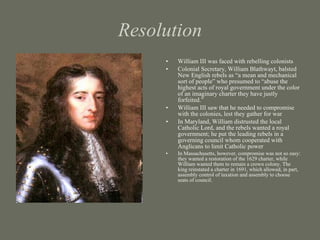
Resolution William III was faced with rebelling colonists Colonial Secretary, William Blathwayt, balsted New English rebels as “a mean and mechanical sort of people” who presumed to “abuse the highest acts of royal government under the color of an imaginary charter they have justly forfeited.” William III saw that he needed to compromise with the colonies, lest they gather for war In Maryland, William distrusted the local Catholic Lord, and the rebels wanted a royal government; he put the leading rebels in a governing council whom cooperated with Anglicans to limit Catholic power In Massachusetts, however, compromise was not so easy: they wanted a restoration of the 1629 charter, while William wanted them to remain a crown colony. The king reinstated a charter in 1691, which allowed, in part, assembly control of taxation and assembly to choose seats of council.
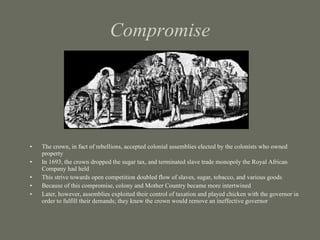
Compromise The crown, in fact of rebellions, accepted colonial assemblies elected by the colonists who owned property In 1693, the crown dropped the sugar tax, and terminated slave trade monopoly the Royal African Company had held This strive towards open competition doubled flow of slaves, sugar, tobacco, and various goods Because of this compromise, colony and Mother Country became more intertwined Later, however, assemblies exploited their control of taxation and played chicken with the governor in order to fulfill their demands; they knew the crown would remove an ineffective governor
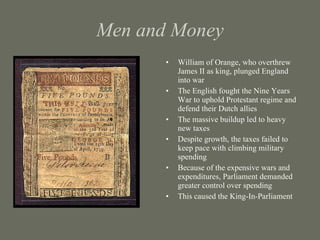
Men and Money William of Orange, who overthrew James II as king, plunged England into war  The English fought the Nine Years War to uphold Protestant regime and defend their Dutch allies The massive buildup led to heavy new taxes Despite growth, the taxes failed to keep pace with climbing military spending Because of the expensive wars and expenditures, Parliament demanded greater control over spending This caused the King-In-Parliament
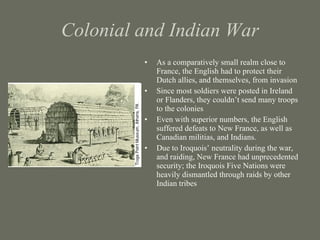
Colonial and Indian War As a comparatively small realm close to France, the English had to protect their Dutch allies, and themselves, from invasion Since most soldiers were posted in Ireland or Flanders, they couldn’t send many troops to the colonies Even with superior numbers, the English suffered defeats to New France, as well as Canadian militias, and Indians. Due to Iroquois’ neutrality during the war, and raiding, New France had unprecedented security; the Iroquois Five Nations were heavily dismantled through raids by other Indian tribes
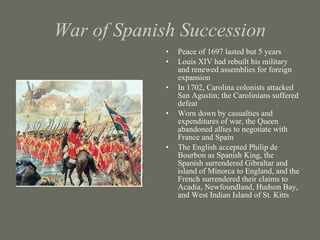
War of Spanish Succession Peace of 1697 lasted but 5 years Louis XIV had rebuilt his military and renewed assemblies for foreign expansion In 1702, Carolina colonists attacked San Agustin; the Carolinians suffered defeat Worn down by casualties and expenditures of war, the Queen abandoned allies to negotiate with France and Spain The English accepted Philip de Bourbon as Spanish King, the Spanish surrendered Gibraltar and island of Minorca to England, and the French surrendered their claims to Acadia, Newfoundland, Hudson Bay, and West Indian Island of St. Kitts
Union The peace treaty of England with France and Spain also recognized union with Scotland Many Scots merchants approved of access to English market A defiant undertaking by Scotland involved a scheme forcing an entrepot colony into Spanish America, at Darien, which attracted nearly a ¼ of Scotland’s liquid capital In 1700, however, the Spanish destroyed Darien Thereafter, the Scots colonial company collapsed, ruining investors The English, in resolution, threatened the Scots with closing of their border unless a better union was negotiated Even with political kneeling, the Scots won access to the English market

American Colonies: Revolutions

  • 1.
  • 2.
    Dominion New kinglooked to further obedient role of Massachusetts by accepting new charter recognizing royal authority Colonies experienced a change in governorship: rather than a general autonomy amongst them, appointed councils and a governor-general were put in place. The new Dominion demanded more taxes, as well Rev. John Wise, who protested the raised taxation, was jailed, fined, and convicted by Sir Edmund Andros, and was met with a response: “Mr. Wise, you have no more privileged Left you than not to be Sould for Slaves.”
  • 3.
    Glorious Revolutions KingJames arbitrarily ruled in favor of fellow Catholics, much to the shock of the Protestants New powers attained by William and Mary, following James’ departure to France, restored Anglican rule and further religious toleration for the Protestants A group known as “The Whigs” called this a “Glorious Revolution,” which they depicted as a spontaneous English uprising By end of 1690, Leisler – whom took governorship from Nicholson after militia taking of a fort – was detested by basically all English speaking colonists However, he unintentionally lead a crusade to help vindicate the Dutch in the face of respect and power taken from them by occupiers
  • 4.
    Resolution William IIIwas faced with rebelling colonists Colonial Secretary, William Blathwayt, balsted New English rebels as “a mean and mechanical sort of people” who presumed to “abuse the highest acts of royal government under the color of an imaginary charter they have justly forfeited.” William III saw that he needed to compromise with the colonies, lest they gather for war In Maryland, William distrusted the local Catholic Lord, and the rebels wanted a royal government; he put the leading rebels in a governing council whom cooperated with Anglicans to limit Catholic power In Massachusetts, however, compromise was not so easy: they wanted a restoration of the 1629 charter, while William wanted them to remain a crown colony. The king reinstated a charter in 1691, which allowed, in part, assembly control of taxation and assembly to choose seats of council.
  • 5.
    Compromise The crown,in fact of rebellions, accepted colonial assemblies elected by the colonists who owned property In 1693, the crown dropped the sugar tax, and terminated slave trade monopoly the Royal African Company had held This strive towards open competition doubled flow of slaves, sugar, tobacco, and various goods Because of this compromise, colony and Mother Country became more intertwined Later, however, assemblies exploited their control of taxation and played chicken with the governor in order to fulfill their demands; they knew the crown would remove an ineffective governor
  • 6.
    Men and MoneyWilliam of Orange, who overthrew James II as king, plunged England into war The English fought the Nine Years War to uphold Protestant regime and defend their Dutch allies The massive buildup led to heavy new taxes Despite growth, the taxes failed to keep pace with climbing military spending Because of the expensive wars and expenditures, Parliament demanded greater control over spending This caused the King-In-Parliament
  • 7.
    Colonial and IndianWar As a comparatively small realm close to France, the English had to protect their Dutch allies, and themselves, from invasion Since most soldiers were posted in Ireland or Flanders, they couldn’t send many troops to the colonies Even with superior numbers, the English suffered defeats to New France, as well as Canadian militias, and Indians. Due to Iroquois’ neutrality during the war, and raiding, New France had unprecedented security; the Iroquois Five Nations were heavily dismantled through raids by other Indian tribes
  • 8.
    War of SpanishSuccession Peace of 1697 lasted but 5 years Louis XIV had rebuilt his military and renewed assemblies for foreign expansion In 1702, Carolina colonists attacked San Agustin; the Carolinians suffered defeat Worn down by casualties and expenditures of war, the Queen abandoned allies to negotiate with France and Spain The English accepted Philip de Bourbon as Spanish King, the Spanish surrendered Gibraltar and island of Minorca to England, and the French surrendered their claims to Acadia, Newfoundland, Hudson Bay, and West Indian Island of St. Kitts
  • 9.
    Union The peacetreaty of England with France and Spain also recognized union with Scotland Many Scots merchants approved of access to English market A defiant undertaking by Scotland involved a scheme forcing an entrepot colony into Spanish America, at Darien, which attracted nearly a ¼ of Scotland’s liquid capital In 1700, however, the Spanish destroyed Darien Thereafter, the Scots colonial company collapsed, ruining investors The English, in resolution, threatened the Scots with closing of their border unless a better union was negotiated Even with political kneeling, the Scots won access to the English market