Red Hat Security Seminar
Shawn D. Wells (swells@redhat.com)
Solutions Architect, Federal Team
2
Agenda
 Start: 10:30 am
 End: 1:00 pm, ish
 Red Hat Emerging Technologies
 Red Hat Security
 Summary & Close
3
Hands On & Labs
4
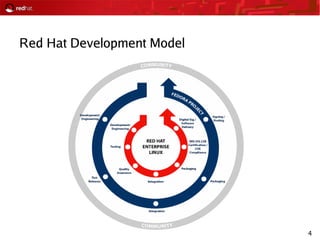
Red Hat Development Model
5
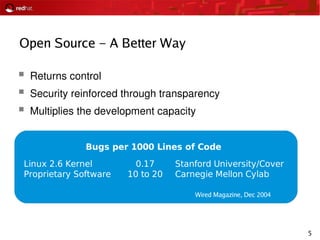
Open Source – A Better Way
 Returns control
 Security reinforced through transparency
 Multiplies the development capacity
Bugs per 1000 Lines of Code
Linux 2.6 Kernel 0.17 Stanford University/Coverity
Proprietary Software 10 to 20 Carnegie Mellon Cylab
Wired Magazine, Dec 2004
6
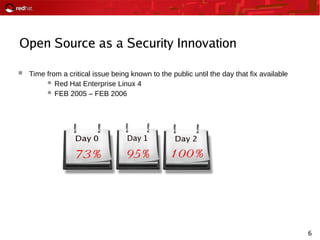
Open Source as a Security Innovation
 Time from a critical issue being known to the public until the day that fix available
 Red Hat Enterprise Linux 4
 FEB 2005 – FEB 2006
7
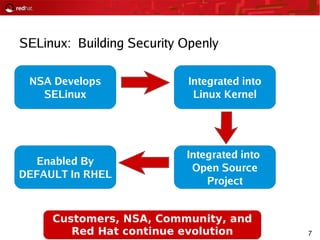
SELinux: Building Security Openly
NSA Develops
SELinux
Integrated into
Linux Kernel
Integrated into
Open Source
Project
Enabled By
DEFAULT In RHEL
Customers, NSA, Community, and
Red Hat continue evolution
8
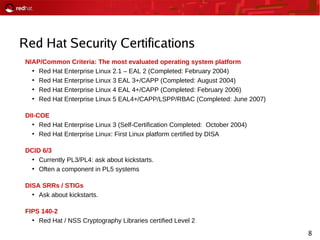
Red Hat Security Certifications
NIAP/Common Criteria: The most evaluated operating system platform
●
Red Hat Enterprise Linux 2.1 – EAL 2 (Completed: February 2004)
●
Red Hat Enterprise Linux 3 EAL 3+/CAPP (Completed: August 2004)
●
Red Hat Enterprise Linux 4 EAL 4+/CAPP (Completed: February 2006)
●
Red Hat Enterprise Linux 5 EAL4+/CAPP/LSPP/RBAC (Completed: June 2007)
DII-COE
●
Red Hat Enterprise Linux 3 (Self-Certification Completed: October 2004)
●
Red Hat Enterprise Linux: First Linux platform certified by DISA
DCID 6/3
●
Currently PL3/PL4: ask about kickstarts.
●
Often a component in PL5 systems
DISA SRRs / STIGs
●
Ask about kickstarts.
FIPS 140-2
●
Red Hat / NSS Cryptography Libraries certified Level 2
9
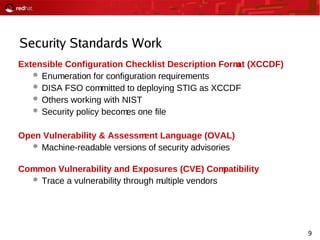
Security Standards Work
Extensible Configuration Checklist Description Format (XCCDF)
 Enumeration for configuration requirements
 DISA FSO committed to deploying STIG as XCCDF
 Others working with NIST
 Security policy becomes one file
Open Vulnerability & Assessment Language (OVAL)
 Machine-readable versions of security advisories
Common Vulnerability and Exposures (CVE) Compatibility
 Trace a vulnerability through multiple vendors
10
Questions?
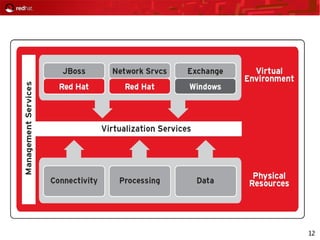
Red Hat Emerging Technologies
12
13
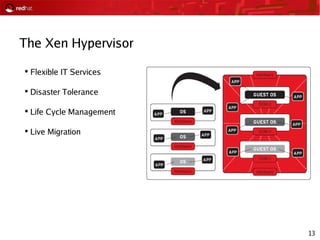
The Xen Hypervisor
●
Flexible IT Services
●
Disaster Tolerance
●
Life Cycle Management
●
Live Migration
14
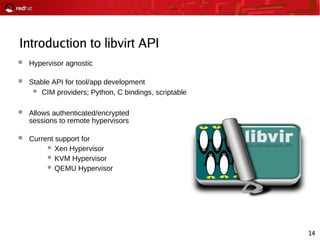
Introduction to libvirt API
 Hypervisor agnostic
 Stable API for tool/app development
 CIM providers; Python, C bindings, scriptable
 Allows authenticated/encrypted
sessions to remote hypervisors
 Current support for
 Xen Hypervisor
 KVM Hypervisor
 QEMU Hypervisor
15
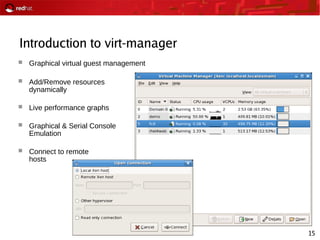
Introduction to virt-manager
 Graphical virtual guest management
 Add/Remove resources
dynamically
 Live performance graphs
 Graphical & Serial Console
Emulation
 Connect to remote
hosts
16
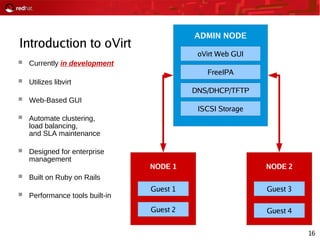
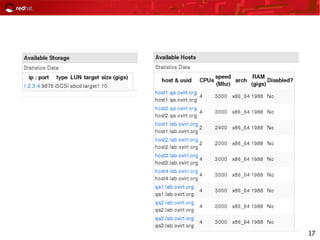
Introduction to oVirt
 Currently in development
 Utilizes libvirt
 Web-Based GUI
 Automate clustering,
load balancing,
and SLA maintenance
 Designed for enterprise
management
 Built on Ruby on Rails
 Performance tools built-in
ADMIN NODE
oVirt Web GUI
FreeIPA
DNS/DHCP/TFTP
ISCSI Storage
NODE 1 NODE 2
Guest 1
Guest 2
Guest 3
Guest 4
17
18
19
20
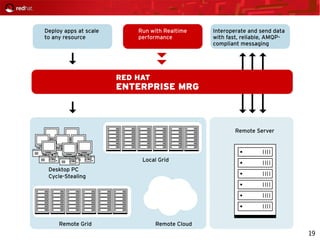
MRG: Messaging
 Provides messaging that is up to 100-fold faster than before
 Spans fast messaging, reliable messaging, large-file messaging
 Implements AMQP, the industry's first open messaging standard, for
unprecedented interoperability that is cross-language, cross-platform, multi-
vendor, spans hardware and software, and extends down to the wire level
 Uses Linux-specific optimizations to achieve optimal performance on Red Hat
Enterprise Linux and MRG Realtime
● Takes advantage of RHEL clustering, IO, kernel, and more
● Includes new high-performance AIO Journal for durable messaging
● Provides native infiniband support for transient messaging
21
About AMQP
 AMQP is an open specification for messaging
● It is a complete specification
● Anyone may use the AMQP specification to create useful implementations
without being charged for the IP rights to do so
 AMQP aims to be technology and language-neutral
● Available in C, C++, Java, JMS, .NET, C#, Ruby, Python, etc.
● Requires IP, and can be used with TCP, UDP, SCTP, Infiniband, etc.
 Products complying with AMQP are inter-operable
● AMQP is a Wire-Level protocol based on the ubiquitous IP
● Wire-level compatibility means it can be embedded in the network
● Applications written to Product X will plug into servers running Product Y
 Red Hat is a founding member of the AMQP Working Group
22
MRG Realtime
 Determinism
Ability to schedule high priority tasks predictably and
consistently
 Priority
Ensure that highest priority applications are not blocked by
low priority
 Quality Of Service (QoS)
Trustworthy, consistent response times
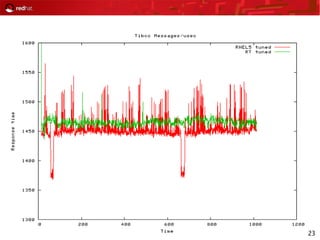
 Proven results
 Average of 38% improvement over stock RHEL5
 Timer event precision enhanced to μ s level, rather than
ms
23
24
MRG: Grid
 Brings advantages of scale-out and flexible deployment to any application
 Delivers better asset utilization, allowing applications to to take advantage of all
available computing resources
 Dynamically provisions additional peak capacity for “Christmas Rush”-like
situations
 Executes across multiple platforms and in virtual machines
 Provides seamless and flexible High Throughput Computing (HTC) and High
Performance Computing (HPC) across
 Local grids
 Remote grids
 Remote clouds (Amazon EC2)
 Cycle-stealing from desktop PCs
25
 Project
 Open Source
 www.freeipa.org
 Started and contributed to by
Red Hat
 Open to all
 IPA = Identity, Policy, Audit
 Big vision
 Start with centralized user
identity management for
UNIX/Linux
 Add robust, shared sense of
machine, service and data
identity
 Provide centrally managed
admin access control for
UNIX/Linux
 Give ability to externalize
policy and add to it easily
 Add centralized audit
 With this you can enable
flexible cross-enterprise policy
and rational audit
26
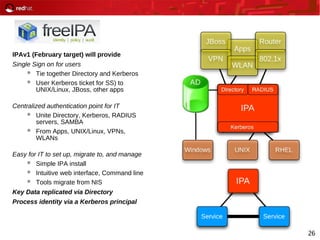
IPAv1 (February target) will provide
Single Sign on for users
 Tie together Directory and Kerberos
 User Kerberos ticket for SS) to
UNIX/Linux, JBoss, other apps
Centralized authentication point for IT
 Unite Directory, Kerberos, RADIUS
servers, SAMBA
 From Apps, UNIX/Linux, VPNs,
WLANs
Easy for IT to set up, migrate to, and manage
 Simple IPA install
 Intuitive web interface, Command line
 Tools migrate from NIS
Key Data replicated via Directory
Process identity via a Kerberos principal
27
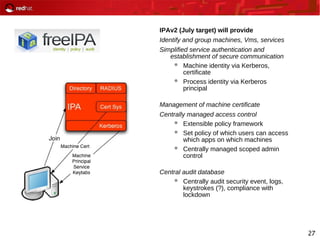
IPAv2 (July target) will provide
Identify and group machines, Vms, services
Simplified service authentication and
establishment of secure communication
 Machine identity via Kerberos,
certificate
 Process identity via Kerberos
principal
Management of machine certificate
Centrally managed access control
 Extensible policy framework
 Set policy of which users can access
which apps on which machines
 Centrally managed scoped admin
control
Central audit database
 Centrally audit security event, logs,
keystrokes (?), compliance with
lockdown
28
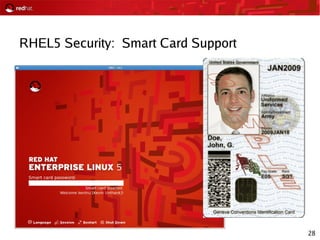
RHEL5 Security: Smart Card Support
29
Questions?
SELinux
A Wonderland of Obscure Subsystems
31
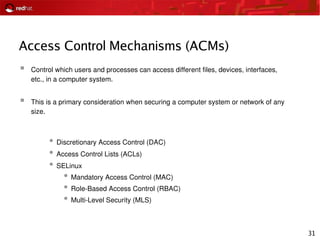
Access Control Mechanisms (ACMs)
 Control which users and processes can access different files, devices, interfaces, 
etc., in a computer system.
 This is a primary consideration when securing a computer system or network of any 
size.
 Discretionary Access Control (DAC)
 Access Control Lists (ACLs)
 SELinux
 Mandatory Access Control (MAC)
 Role­Based Access Control (RBAC)
 Multi­Level Security (MLS)
32
Discretionary Access Controls (DAC)
 Basic access controls for objects in a filesystem
 Typical access control provided by file permissions, sharing, etc
 Access is generally at the discretion of the owner of the object (file, directory,
device, etc.).
# ls -L /demos/Harris/
33
Access Control Lists (ACLs)
 Evolution of DAC
 Delegate access decisions to specific user/groups/subsets
 -rw-rw-r--+
# sudo -u hr_worker cat HR_PayrollData
# setfacl -m u:hr_worker:r HR_PayrollData
# sudo -u hr_worker cat HR_PayrollData
34
SELinux Basics: Goals
 Systems Must Be Tamperproof
There must be no way for attackers or others on the system to intentionally or
accidentally disable it or otherwise interfere with its operation
 Systems Must Be Nonbypassable
There must be no way to gain access to system resources except through
mechanisms that use the reference monitor to make access control decisions
 Access Must Be Verifiable
There must be a way to convince third-party evaluators (i.e. Auditors) that the
system will always enforce MLS correctly
 No Covert Channels
Eliminate footprints of other processes on the system (process threads, resource
utilization, disk activities, etc)
35
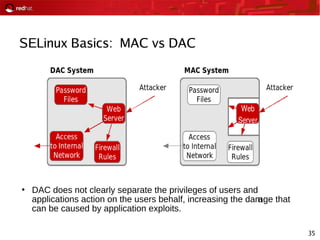
SELinux Basics: MAC vs DAC
●
DAC does not clearly separate the privileges of users and
applications action on the users behalf, increasing the damage that
can be caused by application exploits.
36
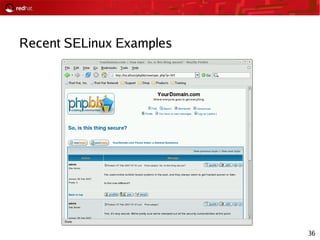
Recent SELinux Examples
37
Recent SELinux Examples
38
Recent SELinux Examples
The Result
39
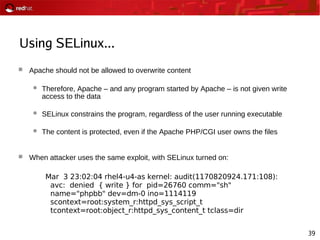
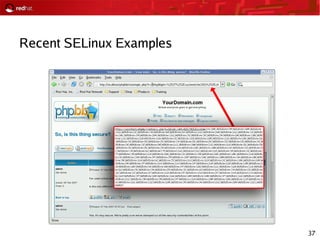
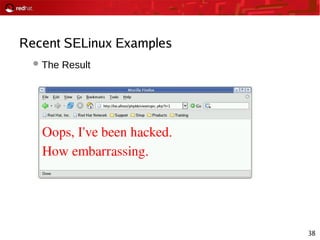
Using SELinux...
 Apache should not be allowed to overwrite content
 Therefore, Apache – and any program started by Apache – is not given write
access to the data
 SELinux constrains the program, regardless of the user running executable
 The content is protected, even if the Apache PHP/CGI user owns the files
 When attacker uses the same exploit, with SELinux turned on:
Mar 3 23:02:04 rhel4-u4-as kernel: audit(1170820924.171:108):
avc: denied { write } for pid=26760 comm="sh"
name="phpbb" dev=dm-0 ino=1114119
scontext=root:system_r:httpd_sys_script_t
tcontext=root:object_r:httpd_sys_content_t tclass=dir
40
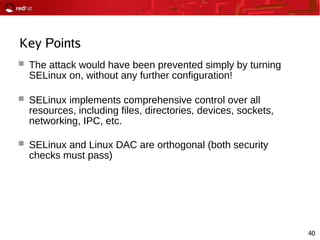
Key Points
 The attack would have been prevented simply by turning
SELinux on, without any further configuration!
 SELinux implements comprehensive control over all
resources, including files, directories, devices, sockets,
networking, IPC, etc.
 SELinux and Linux DAC are orthogonal (both security
checks must pass)
41
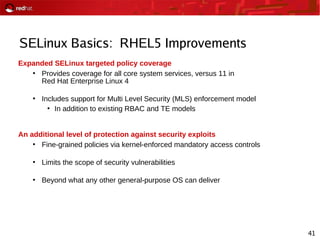
SELinux Basics: RHEL5 Improvements
Expanded SELinux targeted policy coverage
●
Provides coverage for all core system services, versus 11 in
Red Hat Enterprise Linux 4
●
Includes support for Multi Level Security (MLS) enforcement model
●
In addition to existing RBAC and TE models
An additional level of protection against security exploits
●
Fine-grained policies via kernel-enforced mandatory access controls
●
Limits the scope of security vulnerabilities
●
Beyond what any other general-purpose OS can deliver
42
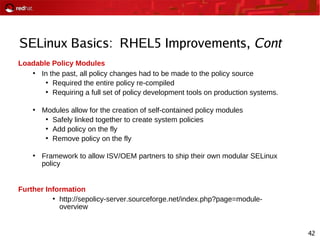
SELinux Basics: RHEL5 Improvements, Cont
Loadable Policy Modules
●
In the past, all policy changes had to be made to the policy source
●
Required the entire policy re-compiled
●
Requiring a full set of policy development tools on production systems.
●
Modules allow for the creation of self-contained policy modules
●
Safely linked together to create system policies
●
Add policy on the fly
●
Remove policy on the fly
●
Framework to allow ISV/OEM partners to ship their own modular SELinux
policy
Further Information
●
http://sepolicy-server.sourceforge.net/index.php?page=module-
overview
43
SELinux Basics: RHEL5 Improvements, Cont
ExecShield
 Prevent any memory that was writable from becoming executable.
 Prevents an attacker fromwriting his code into memory and then
executing it
Stack Smashing protection (Canary values)
 Places a canary value at a randomized point above the stack.
 This canary value is verified during normal operation.
 If the stack has been smashed, the canary value will have been
overwritten, indicating that the stack has been smashed.
 This is a method to detect buffer overflows early.
44
SELinux Basics: RHEL5 Improvements, Cont
FORTIFY_SOURCE GCC option
 Compiler knows the size of a buffer
 Functions operate on the buffer to make sure it will not overflow at
runtime.
 This works to help catch format string flaws as well as buffer
overflows.
Unconfined Memory
 Unconfined is a domain that was added to SELinux specifically to
allow applications in this domain to run as if they were not running
on an SELinux system.
 With RHEL5, memory protections have been added to the
unconfined domain.
45
SELinux Compatible Applications
●
SELinux can control all Linux applications.
●
Since policy dictates how processes will access domains, all
one needs to do is construct a policy for their application.
●
Once the policy is constructed, it can be loaded, tested, and
distributed with the application.
46
SELinux Basics: Policy Types
 Targeted Policy (Default)
Applications run unconfined unless explicitly defined policy exists
 Strict Policy
All application actions explicitly allowed through SELinux, else
actions denied
 MLS
Polyinstantiated file systems
Allows for different “views” based on clearance level
47
SELinux: Exploring Contexts
●
All objects have a security context
● user:role:type[:sensitivity:category]
●
Stored as extended attribute on the inode
User
● Strict: audit_u, admin_u, etc.
● Targeted: root, system_u, user_u
Role
● Targeted: files are object_r, processes are system_r
Type
● Type v. domain: httpd_exec_t v. httpd_t
●
Sensitivity: s0-s15, aka “SystemLow-SystemHigh”
●
Category: c0-c1023
●
Set math!
48
SELinux: Exploring Contexts
# ps -axZ
Notice context of ntpd, versus bash
# ls -Z /home
Notice context of ntpd, versus bash
Apache Example
49
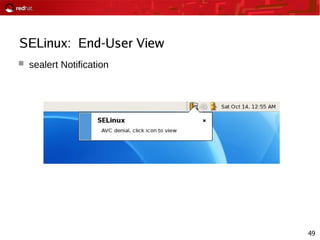
SELinux: End-User View
 sealert Notification
50
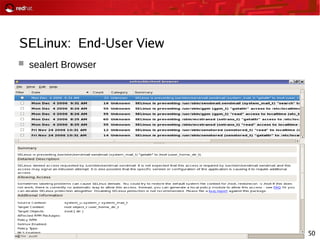
SELinux: End-User View
 sealert Browser
51
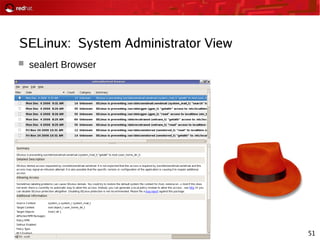
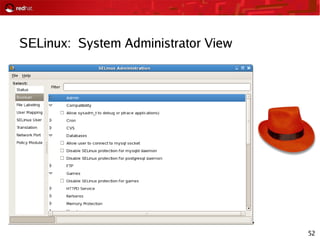
SELinux: System Administrator View
 sealert Browser
52
SELinux: System Administrator View
53
SELinux: System Administrator View
 Using audit2allow & semanage
You are experiencing SELinux errors
You know that these errors are blocking legitimate
usage
Be aware that changes to your SELinux policy could
compromise the security of your system.
54
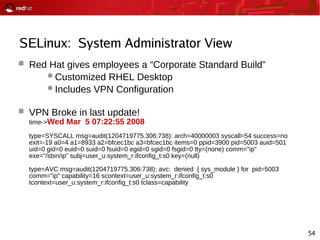
SELinux: System Administrator View
 Red Hat gives employees a “Corporate Standard Build”
Customized RHEL Desktop
Includes VPN Configuration
 VPN Broke in last update!
time->Wed Mar 5 07:22:55 2008
type=SYSCALL msg=audit(1204719775.306:738): arch=40000003 syscall=54 success=no
exit=-19 a0=4 a1=8933 a2=bfcec1bc a3=bfcec1bc items=0 ppid=3900 pid=5003 auid=501
uid=0 gid=0 euid=0 suid=0 fsuid=0 egid=0 sgid=0 fsgid=0 tty=(none) comm="ip"
exe="/sbin/ip" subj=user_u:system_r:ifconfig_t:s0 key=(null)
type=AVC msg=audit(1204719775.306:738): avc: denied { sys_module } for pid=5003
comm="ip" capability=16 scontext=user_u:system_r:ifconfig_t:s0
tcontext=user_u:system_r:ifconfig_t:s0 tclass=capability
55
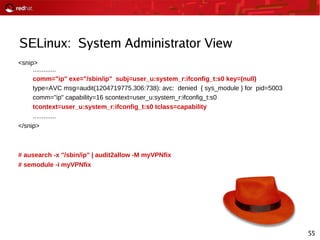
SELinux: System Administrator View
<snip>
.............
comm="ip" exe="/sbin/ip" subj=user_u:system_r:ifconfig_t:s0 key=(null)
type=AVC msg=audit(1204719775.306:738): avc: denied { sys_module } for pid=5003
comm="ip" capability=16 scontext=user_u:system_r:ifconfig_t:s0
tcontext=user_u:system_r:ifconfig_t:s0 tclass=capability
.............
</snip>
# ausearch -x "/sbin/ip" | audit2allow -M myVPNfix
# semodule -i myVPNfix
56
SELinux: Auditor View
 Centralized Logging is a must!
aureport
 # aureport –summary
ausearch
 # ausearch -ul swells
57
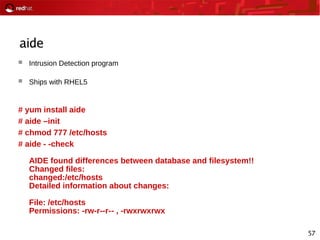
aide
 Intrusion Detection program
 Ships with RHEL5
# yum install aide
# aide –init
# chmod 777 /etc/hosts
# aide - -check
AIDE found differences between database and filesystem!!
Changed files:
changed:/etc/hosts
Detailed information about changes:
File: /etc/hosts
Permissions: -rw-r--r-- , -rwxrwxrwx
58
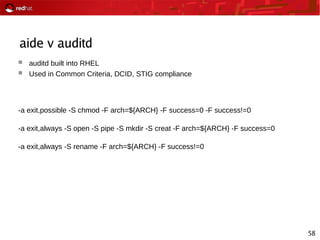
aide v auditd
 auditd built into RHEL
 Used in Common Criteria, DCID, STIG compliance
-a exit,possible -S chmod -F arch=${ARCH} -F success=0 -F success!=0
-a exit,always -S open -S pipe -S mkdir -S creat -F arch=${ARCH} -F success=0
-a exit,always -S rename -F arch=${ARCH} -F success!=0

2008-03-06 Harris Corp Security Seminar

  • 1.
    Red Hat SecuritySeminar Shawn D. Wells (swells@redhat.com) Solutions Architect, Federal Team
  • 2.
    2 Agenda  Start: 10:30 am End: 1:00 pm, ish  Red Hat Emerging Technologies  Red Hat Security  Summary & Close
  • 3.
  • 4.
  • 5.
    5 Open Source –A Better Way  Returns control  Security reinforced through transparency  Multiplies the development capacity Bugs per 1000 Lines of Code Linux 2.6 Kernel 0.17 Stanford University/Coverity Proprietary Software 10 to 20 Carnegie Mellon Cylab Wired Magazine, Dec 2004
  • 6.
    6 Open Source asa Security Innovation  Time from a critical issue being known to the public until the day that fix available  Red Hat Enterprise Linux 4  FEB 2005 – FEB 2006
  • 7.
    7 SELinux: Building SecurityOpenly NSA Develops SELinux Integrated into Linux Kernel Integrated into Open Source Project Enabled By DEFAULT In RHEL Customers, NSA, Community, and Red Hat continue evolution
  • 8.
    8 Red Hat SecurityCertifications NIAP/Common Criteria: The most evaluated operating system platform ● Red Hat Enterprise Linux 2.1 – EAL 2 (Completed: February 2004) ● Red Hat Enterprise Linux 3 EAL 3+/CAPP (Completed: August 2004) ● Red Hat Enterprise Linux 4 EAL 4+/CAPP (Completed: February 2006) ● Red Hat Enterprise Linux 5 EAL4+/CAPP/LSPP/RBAC (Completed: June 2007) DII-COE ● Red Hat Enterprise Linux 3 (Self-Certification Completed: October 2004) ● Red Hat Enterprise Linux: First Linux platform certified by DISA DCID 6/3 ● Currently PL3/PL4: ask about kickstarts. ● Often a component in PL5 systems DISA SRRs / STIGs ● Ask about kickstarts. FIPS 140-2 ● Red Hat / NSS Cryptography Libraries certified Level 2
  • 9.
    9 Security Standards Work ExtensibleConfiguration Checklist Description Format (XCCDF)  Enumeration for configuration requirements  DISA FSO committed to deploying STIG as XCCDF  Others working with NIST  Security policy becomes one file Open Vulnerability & Assessment Language (OVAL)  Machine-readable versions of security advisories Common Vulnerability and Exposures (CVE) Compatibility  Trace a vulnerability through multiple vendors
  • 10.
  • 11.
    Red Hat EmergingTechnologies
  • 12.
  • 13.
    13 The Xen Hypervisor ● FlexibleIT Services ● Disaster Tolerance ● Life Cycle Management ● Live Migration
  • 14.
    14 Introduction to libvirtAPI  Hypervisor agnostic  Stable API for tool/app development  CIM providers; Python, C bindings, scriptable  Allows authenticated/encrypted sessions to remote hypervisors  Current support for  Xen Hypervisor  KVM Hypervisor  QEMU Hypervisor
  • 15.
    15 Introduction to virt-manager Graphical virtual guest management  Add/Remove resources dynamically  Live performance graphs  Graphical & Serial Console Emulation  Connect to remote hosts
  • 16.
    16 Introduction to oVirt Currently in development  Utilizes libvirt  Web-Based GUI  Automate clustering, load balancing, and SLA maintenance  Designed for enterprise management  Built on Ruby on Rails  Performance tools built-in ADMIN NODE oVirt Web GUI FreeIPA DNS/DHCP/TFTP ISCSI Storage NODE 1 NODE 2 Guest 1 Guest 2 Guest 3 Guest 4
  • 17.
  • 18.
  • 19.
  • 20.
    20 MRG: Messaging  Providesmessaging that is up to 100-fold faster than before  Spans fast messaging, reliable messaging, large-file messaging  Implements AMQP, the industry's first open messaging standard, for unprecedented interoperability that is cross-language, cross-platform, multi- vendor, spans hardware and software, and extends down to the wire level  Uses Linux-specific optimizations to achieve optimal performance on Red Hat Enterprise Linux and MRG Realtime ● Takes advantage of RHEL clustering, IO, kernel, and more ● Includes new high-performance AIO Journal for durable messaging ● Provides native infiniband support for transient messaging
  • 21.
    21 About AMQP  AMQPis an open specification for messaging ● It is a complete specification ● Anyone may use the AMQP specification to create useful implementations without being charged for the IP rights to do so  AMQP aims to be technology and language-neutral ● Available in C, C++, Java, JMS, .NET, C#, Ruby, Python, etc. ● Requires IP, and can be used with TCP, UDP, SCTP, Infiniband, etc.  Products complying with AMQP are inter-operable ● AMQP is a Wire-Level protocol based on the ubiquitous IP ● Wire-level compatibility means it can be embedded in the network ● Applications written to Product X will plug into servers running Product Y  Red Hat is a founding member of the AMQP Working Group
  • 22.
    22 MRG Realtime  Determinism Abilityto schedule high priority tasks predictably and consistently  Priority Ensure that highest priority applications are not blocked by low priority  Quality Of Service (QoS) Trustworthy, consistent response times  Proven results  Average of 38% improvement over stock RHEL5  Timer event precision enhanced to μ s level, rather than ms
  • 23.
  • 24.
    24 MRG: Grid  Bringsadvantages of scale-out and flexible deployment to any application  Delivers better asset utilization, allowing applications to to take advantage of all available computing resources  Dynamically provisions additional peak capacity for “Christmas Rush”-like situations  Executes across multiple platforms and in virtual machines  Provides seamless and flexible High Throughput Computing (HTC) and High Performance Computing (HPC) across  Local grids  Remote grids  Remote clouds (Amazon EC2)  Cycle-stealing from desktop PCs
  • 25.
    25  Project  OpenSource  www.freeipa.org  Started and contributed to by Red Hat  Open to all  IPA = Identity, Policy, Audit  Big vision  Start with centralized user identity management for UNIX/Linux  Add robust, shared sense of machine, service and data identity  Provide centrally managed admin access control for UNIX/Linux  Give ability to externalize policy and add to it easily  Add centralized audit  With this you can enable flexible cross-enterprise policy and rational audit
  • 26.
    26 IPAv1 (February target)will provide Single Sign on for users  Tie together Directory and Kerberos  User Kerberos ticket for SS) to UNIX/Linux, JBoss, other apps Centralized authentication point for IT  Unite Directory, Kerberos, RADIUS servers, SAMBA  From Apps, UNIX/Linux, VPNs, WLANs Easy for IT to set up, migrate to, and manage  Simple IPA install  Intuitive web interface, Command line  Tools migrate from NIS Key Data replicated via Directory Process identity via a Kerberos principal
  • 27.
    27 IPAv2 (July target)will provide Identify and group machines, Vms, services Simplified service authentication and establishment of secure communication  Machine identity via Kerberos, certificate  Process identity via Kerberos principal Management of machine certificate Centrally managed access control  Extensible policy framework  Set policy of which users can access which apps on which machines  Centrally managed scoped admin control Central audit database  Centrally audit security event, logs, keystrokes (?), compliance with lockdown
  • 28.
  • 29.
  • 30.
    SELinux A Wonderland ofObscure Subsystems
  • 31.
    31 Access Control Mechanisms(ACMs)  Control which users and processes can access different files, devices, interfaces,  etc., in a computer system.  This is a primary consideration when securing a computer system or network of any  size.  Discretionary Access Control (DAC)  Access Control Lists (ACLs)  SELinux  Mandatory Access Control (MAC)  Role­Based Access Control (RBAC)  Multi­Level Security (MLS)
  • 32.
    32 Discretionary Access Controls(DAC)  Basic access controls for objects in a filesystem  Typical access control provided by file permissions, sharing, etc  Access is generally at the discretion of the owner of the object (file, directory, device, etc.). # ls -L /demos/Harris/
  • 33.
    33 Access Control Lists(ACLs)  Evolution of DAC  Delegate access decisions to specific user/groups/subsets  -rw-rw-r--+ # sudo -u hr_worker cat HR_PayrollData # setfacl -m u:hr_worker:r HR_PayrollData # sudo -u hr_worker cat HR_PayrollData
  • 34.
    34 SELinux Basics: Goals Systems Must Be Tamperproof There must be no way for attackers or others on the system to intentionally or accidentally disable it or otherwise interfere with its operation  Systems Must Be Nonbypassable There must be no way to gain access to system resources except through mechanisms that use the reference monitor to make access control decisions  Access Must Be Verifiable There must be a way to convince third-party evaluators (i.e. Auditors) that the system will always enforce MLS correctly  No Covert Channels Eliminate footprints of other processes on the system (process threads, resource utilization, disk activities, etc)
  • 35.
    35 SELinux Basics: MACvs DAC ● DAC does not clearly separate the privileges of users and applications action on the users behalf, increasing the damage that can be caused by application exploits.
  • 36.
  • 37.
  • 38.
  • 39.
    39 Using SELinux...  Apacheshould not be allowed to overwrite content  Therefore, Apache – and any program started by Apache – is not given write access to the data  SELinux constrains the program, regardless of the user running executable  The content is protected, even if the Apache PHP/CGI user owns the files  When attacker uses the same exploit, with SELinux turned on: Mar 3 23:02:04 rhel4-u4-as kernel: audit(1170820924.171:108): avc: denied { write } for pid=26760 comm="sh" name="phpbb" dev=dm-0 ino=1114119 scontext=root:system_r:httpd_sys_script_t tcontext=root:object_r:httpd_sys_content_t tclass=dir
  • 40.
    40 Key Points  Theattack would have been prevented simply by turning SELinux on, without any further configuration!  SELinux implements comprehensive control over all resources, including files, directories, devices, sockets, networking, IPC, etc.  SELinux and Linux DAC are orthogonal (both security checks must pass)
  • 41.
    41 SELinux Basics: RHEL5Improvements Expanded SELinux targeted policy coverage ● Provides coverage for all core system services, versus 11 in Red Hat Enterprise Linux 4 ● Includes support for Multi Level Security (MLS) enforcement model ● In addition to existing RBAC and TE models An additional level of protection against security exploits ● Fine-grained policies via kernel-enforced mandatory access controls ● Limits the scope of security vulnerabilities ● Beyond what any other general-purpose OS can deliver
  • 42.
    42 SELinux Basics: RHEL5Improvements, Cont Loadable Policy Modules ● In the past, all policy changes had to be made to the policy source ● Required the entire policy re-compiled ● Requiring a full set of policy development tools on production systems. ● Modules allow for the creation of self-contained policy modules ● Safely linked together to create system policies ● Add policy on the fly ● Remove policy on the fly ● Framework to allow ISV/OEM partners to ship their own modular SELinux policy Further Information ● http://sepolicy-server.sourceforge.net/index.php?page=module- overview
  • 43.
    43 SELinux Basics: RHEL5Improvements, Cont ExecShield  Prevent any memory that was writable from becoming executable.  Prevents an attacker fromwriting his code into memory and then executing it Stack Smashing protection (Canary values)  Places a canary value at a randomized point above the stack.  This canary value is verified during normal operation.  If the stack has been smashed, the canary value will have been overwritten, indicating that the stack has been smashed.  This is a method to detect buffer overflows early.
  • 44.
    44 SELinux Basics: RHEL5Improvements, Cont FORTIFY_SOURCE GCC option  Compiler knows the size of a buffer  Functions operate on the buffer to make sure it will not overflow at runtime.  This works to help catch format string flaws as well as buffer overflows. Unconfined Memory  Unconfined is a domain that was added to SELinux specifically to allow applications in this domain to run as if they were not running on an SELinux system.  With RHEL5, memory protections have been added to the unconfined domain.
  • 45.
    45 SELinux Compatible Applications ● SELinuxcan control all Linux applications. ● Since policy dictates how processes will access domains, all one needs to do is construct a policy for their application. ● Once the policy is constructed, it can be loaded, tested, and distributed with the application.
  • 46.
    46 SELinux Basics: PolicyTypes  Targeted Policy (Default) Applications run unconfined unless explicitly defined policy exists  Strict Policy All application actions explicitly allowed through SELinux, else actions denied  MLS Polyinstantiated file systems Allows for different “views” based on clearance level
  • 47.
    47 SELinux: Exploring Contexts ● Allobjects have a security context ● user:role:type[:sensitivity:category] ● Stored as extended attribute on the inode User ● Strict: audit_u, admin_u, etc. ● Targeted: root, system_u, user_u Role ● Targeted: files are object_r, processes are system_r Type ● Type v. domain: httpd_exec_t v. httpd_t ● Sensitivity: s0-s15, aka “SystemLow-SystemHigh” ● Category: c0-c1023 ● Set math!
  • 48.
    48 SELinux: Exploring Contexts #ps -axZ Notice context of ntpd, versus bash # ls -Z /home Notice context of ntpd, versus bash Apache Example
  • 49.
    49 SELinux: End-User View sealert Notification
  • 50.
  • 51.
    51 SELinux: System AdministratorView  sealert Browser
  • 52.
  • 53.
    53 SELinux: System AdministratorView  Using audit2allow & semanage You are experiencing SELinux errors You know that these errors are blocking legitimate usage Be aware that changes to your SELinux policy could compromise the security of your system.
  • 54.
    54 SELinux: System AdministratorView  Red Hat gives employees a “Corporate Standard Build” Customized RHEL Desktop Includes VPN Configuration  VPN Broke in last update! time->Wed Mar 5 07:22:55 2008 type=SYSCALL msg=audit(1204719775.306:738): arch=40000003 syscall=54 success=no exit=-19 a0=4 a1=8933 a2=bfcec1bc a3=bfcec1bc items=0 ppid=3900 pid=5003 auid=501 uid=0 gid=0 euid=0 suid=0 fsuid=0 egid=0 sgid=0 fsgid=0 tty=(none) comm="ip" exe="/sbin/ip" subj=user_u:system_r:ifconfig_t:s0 key=(null) type=AVC msg=audit(1204719775.306:738): avc: denied { sys_module } for pid=5003 comm="ip" capability=16 scontext=user_u:system_r:ifconfig_t:s0 tcontext=user_u:system_r:ifconfig_t:s0 tclass=capability
  • 55.
    55 SELinux: System AdministratorView <snip> ............. comm="ip" exe="/sbin/ip" subj=user_u:system_r:ifconfig_t:s0 key=(null) type=AVC msg=audit(1204719775.306:738): avc: denied { sys_module } for pid=5003 comm="ip" capability=16 scontext=user_u:system_r:ifconfig_t:s0 tcontext=user_u:system_r:ifconfig_t:s0 tclass=capability ............. </snip> # ausearch -x "/sbin/ip" | audit2allow -M myVPNfix # semodule -i myVPNfix
  • 56.
    56 SELinux: Auditor View Centralized Logging is a must! aureport  # aureport –summary ausearch  # ausearch -ul swells
  • 57.
    57 aide  Intrusion Detectionprogram  Ships with RHEL5 # yum install aide # aide –init # chmod 777 /etc/hosts # aide - -check AIDE found differences between database and filesystem!! Changed files: changed:/etc/hosts Detailed information about changes: File: /etc/hosts Permissions: -rw-r--r-- , -rwxrwxrwx
  • 58.
    58 aide v auditd auditd built into RHEL  Used in Common Criteria, DCID, STIG compliance -a exit,possible -S chmod -F arch=${ARCH} -F success=0 -F success!=0 -a exit,always -S open -S pipe -S mkdir -S creat -F arch=${ARCH} -F success=0 -a exit,always -S rename -F arch=${ARCH} -F success!=0