








Copyright © 2016 LOGTEL
By: Samuel Dratwa
Samuel.dratwa@gmail.com
Artificial Intelligence
Amdocs - Future Technology Trends
Copyright © 2016 LOGTEL
Agenda
 Introduction to AI
 Neural networks
 Statistic / Social AI
 NLP - Natural language processing
 The future of CRM/CEM
Copyright © 2016 LOGTEL
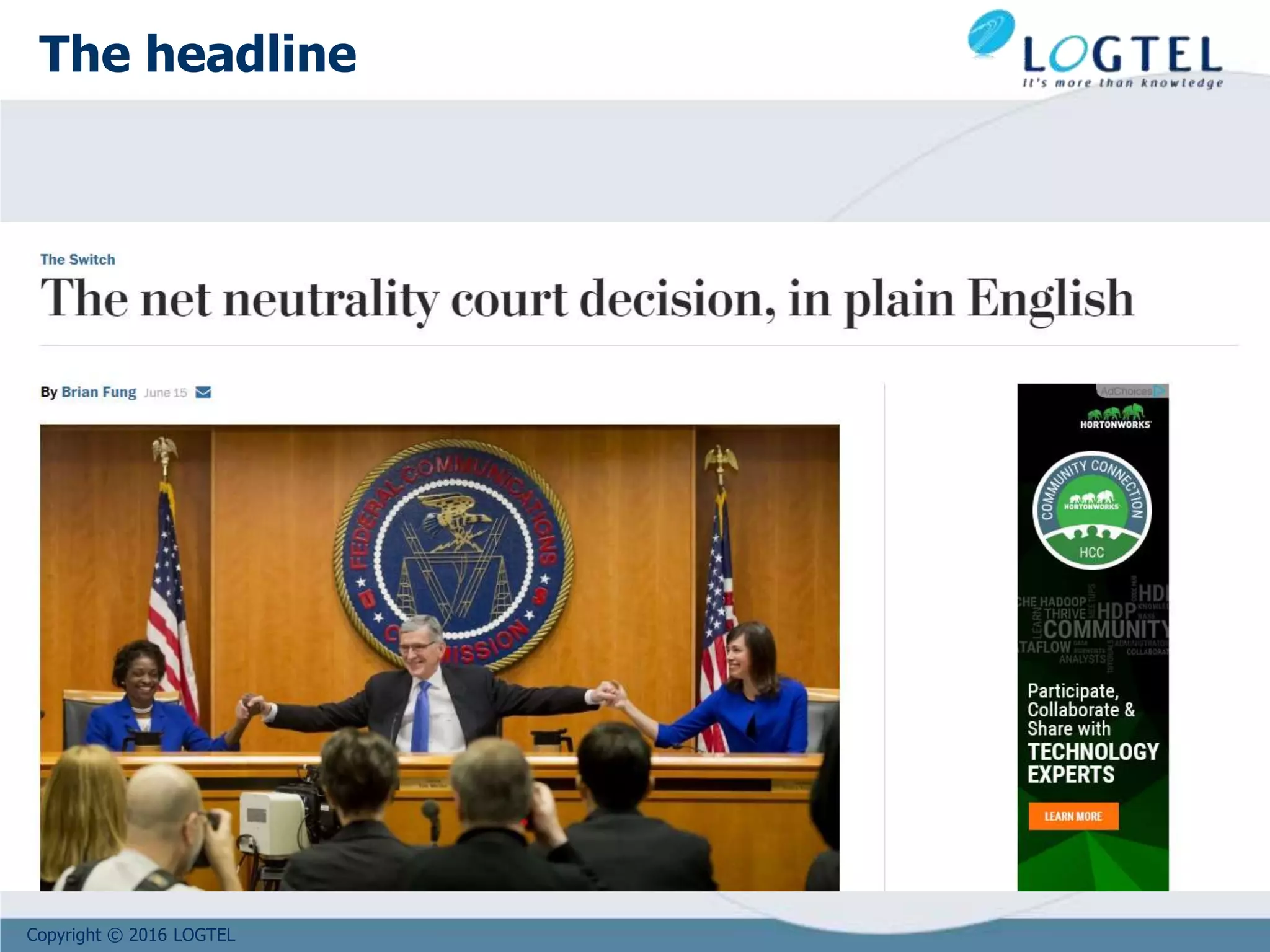
The headline
Copyright © 2016 LOGTEL
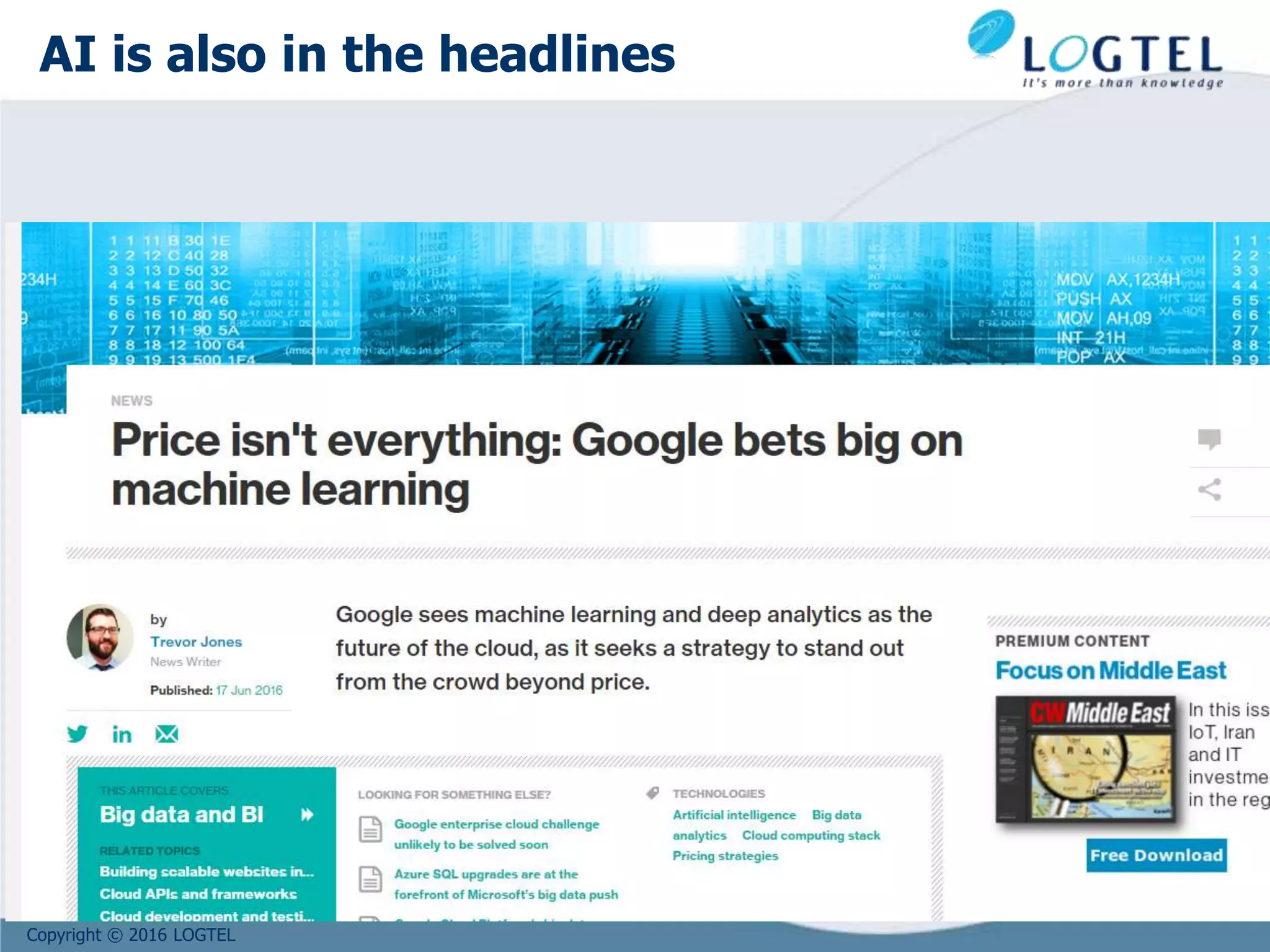
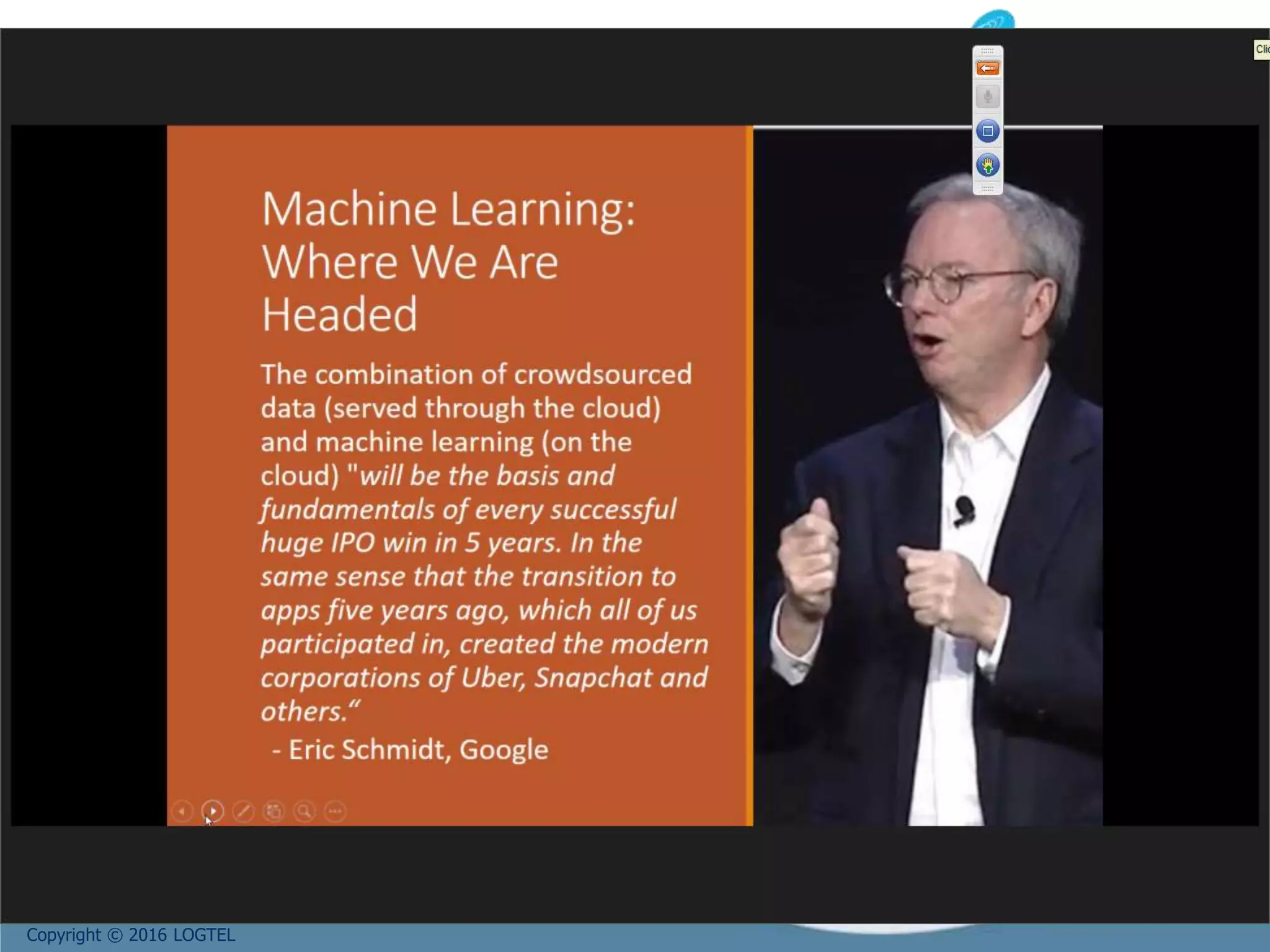
AI is also in the headlines
Copyright © 2016 LOGTEL
Can you give me an example ?
 Siri
 Google go
 Deepblue
 Autonomous cars
Copyright © 2016 LOGTEL
Our definition (after discussion)
 A (self) learning software that
can adopt to new situation and
interact with humans, giving
them a user experience like
human.
7
Copyright © 2016 LOGTEL
Academic Definition of AI
Artificial intelligence is the study of how to make
computers do things that people are better at or
would be better at if:
• they could extend what they do to a World Wide
Web-sized amount of data and
• not make mistakes.
Copyright © 2016 LOGTEL
Things that People Do Easily?
• Common sense reasoning
• Vision
• Moving around
• Language
Copyright © 2016 LOGTEL
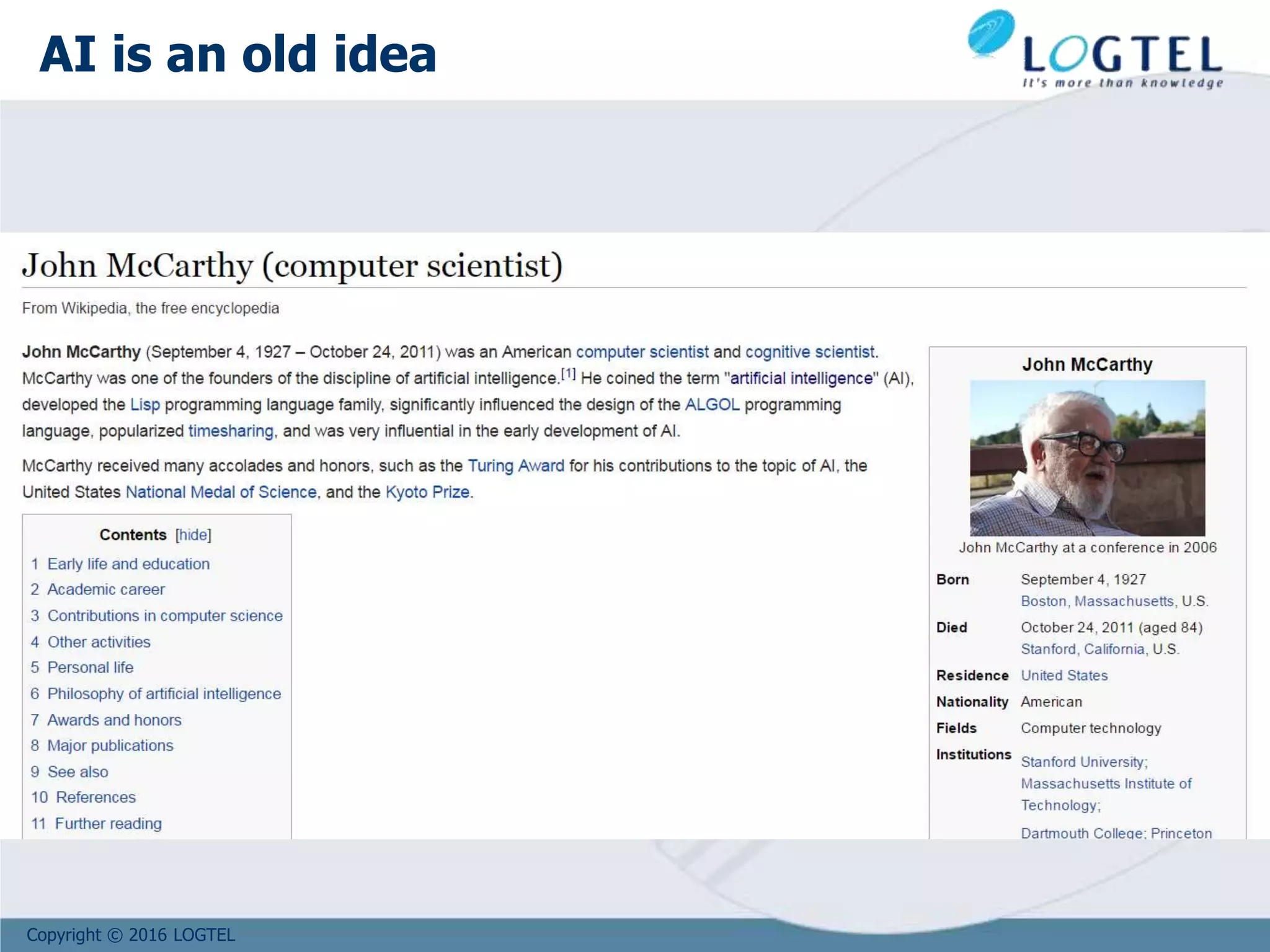
AI is an old idea
Copyright © 2016 LOGTEL
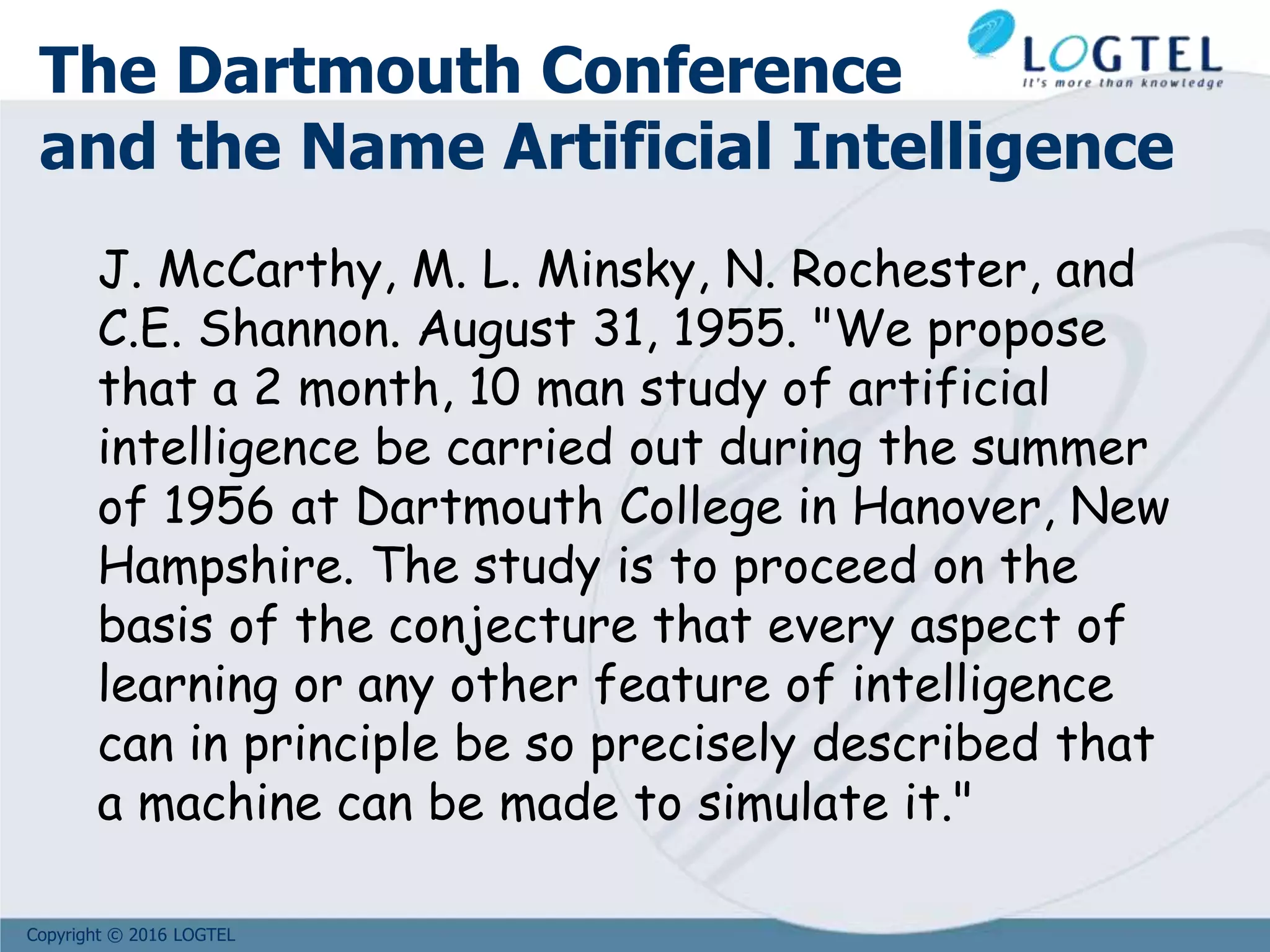
The Dartmouth Conference
and the Name Artificial Intelligence
J. McCarthy, M. L. Minsky, N. Rochester, and
C.E. Shannon. August 31, 1955. "We propose
that a 2 month, 10 man study of artificial
intelligence be carried out during the summer
of 1956 at Dartmouth College in Hanover, New
Hampshire. The study is to proceed on the
basis of the conjecture that every aspect of
learning or any other feature of intelligence
can in principle be so precisely described that
a machine can be made to simulate it."
Copyright © 2016 LOGTEL
The Origins of AI Hype
1950 Turing predicted that in about fifty years "an average
interrogator will not have more than a 70 percent chance of
making the right identification after five minutes of
questioning".
1957 Newell and Simon predicted that "Within ten years a
computer will be the world's chess champion, unless the rules
bar it from competition."
Copyright © 2016 LOGTEL
Evolution of the Main Ideas
• Wings or not?
• Games, mathematics, and other knowledge-poor tasks
• The silver bullet?
• Knowledge-based systems
• Hand-coded knowledge vs. machine learning
• Low-level (sensory and motor) processing and the resurgence of
subsymbolic systems
• Robotics
• Natural language processing
Copyright © 2016 LOGTEL
How Can We Teach Things
to Computers?
A quote from John McCarthy:
In order for a program to be capable of learning something,
it must first be capable of being told it.
Do we believe this?
Copyright © 2016 LOGTEL
What is a Concept / idea ?
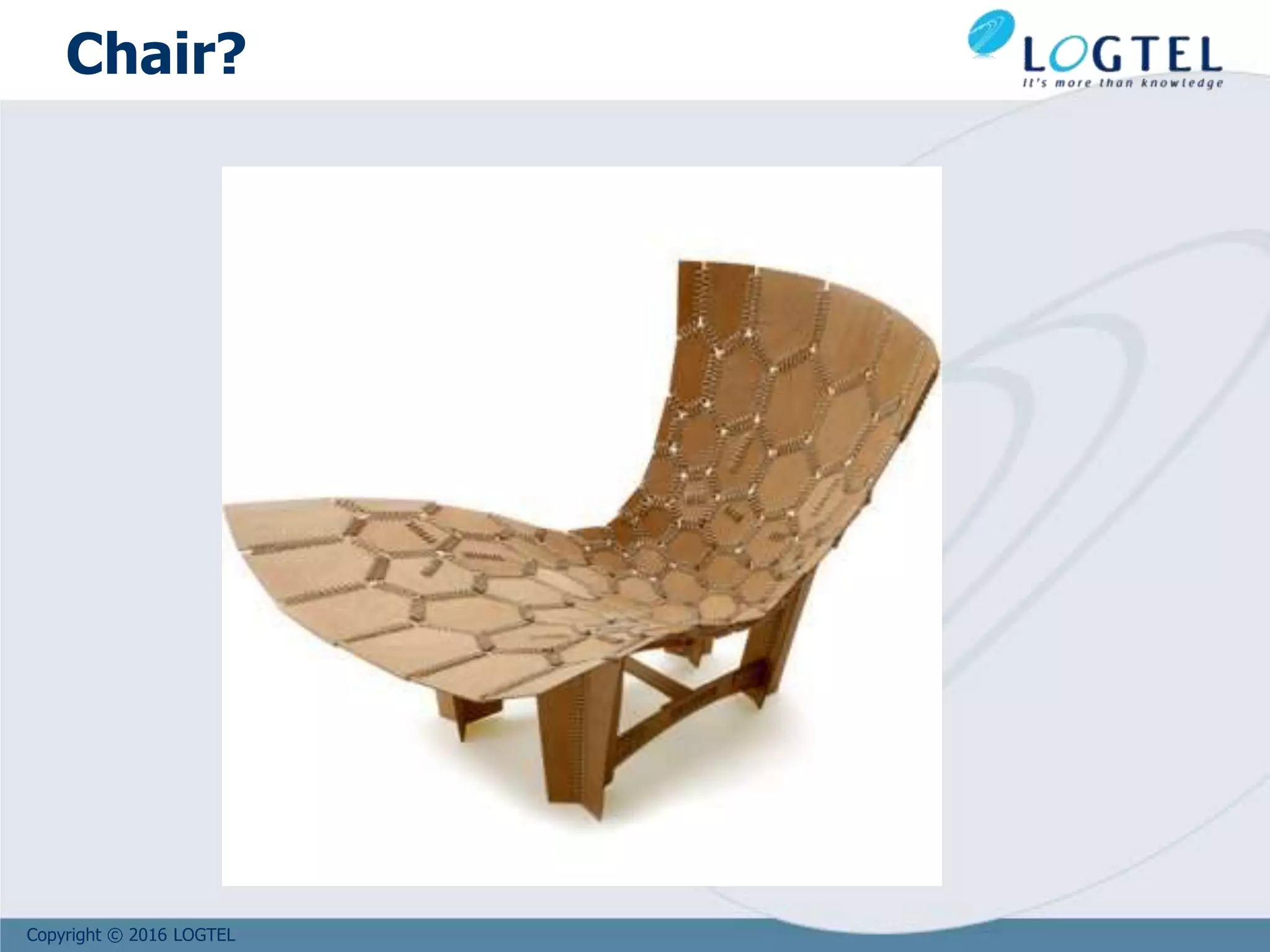
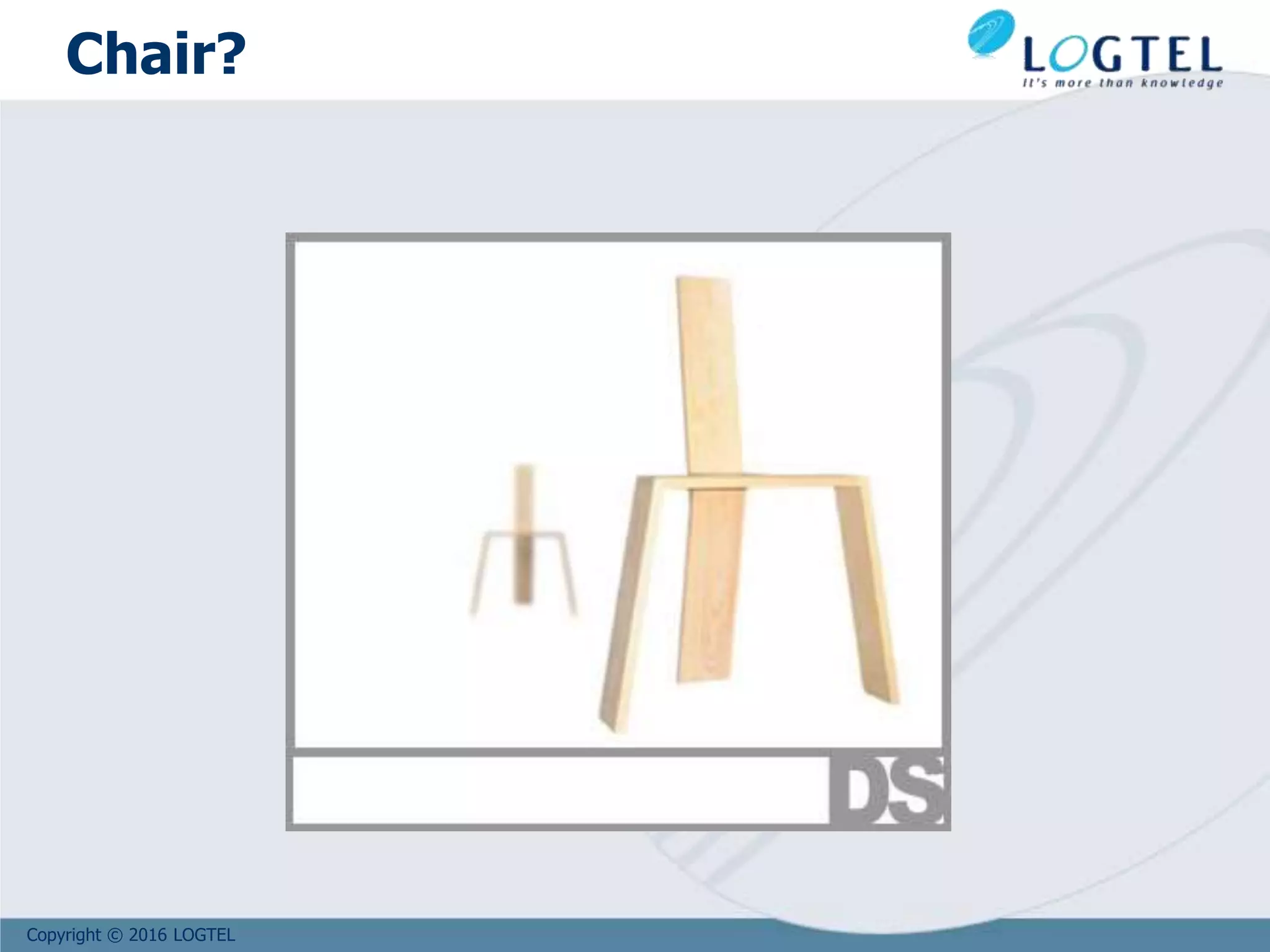
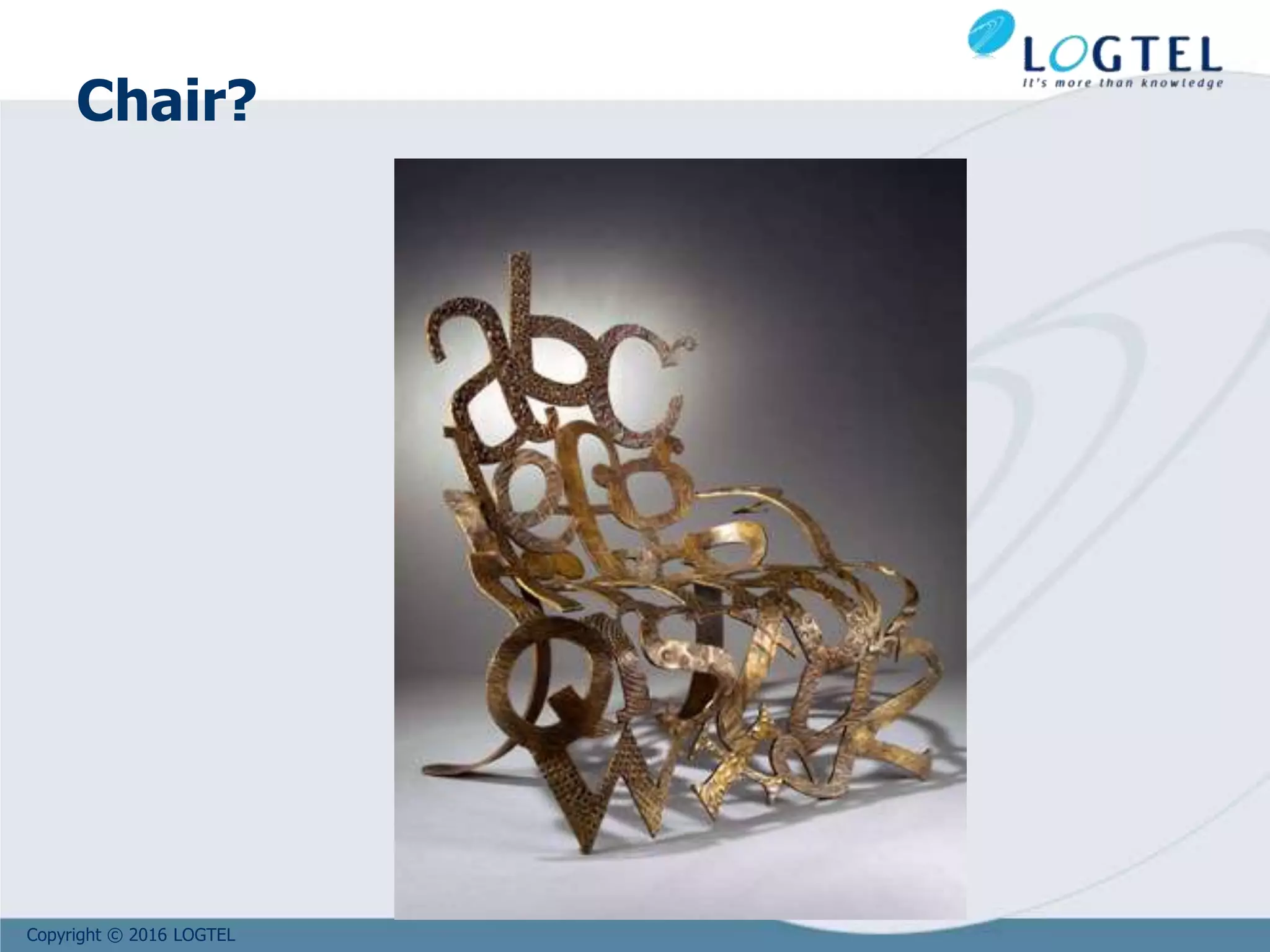
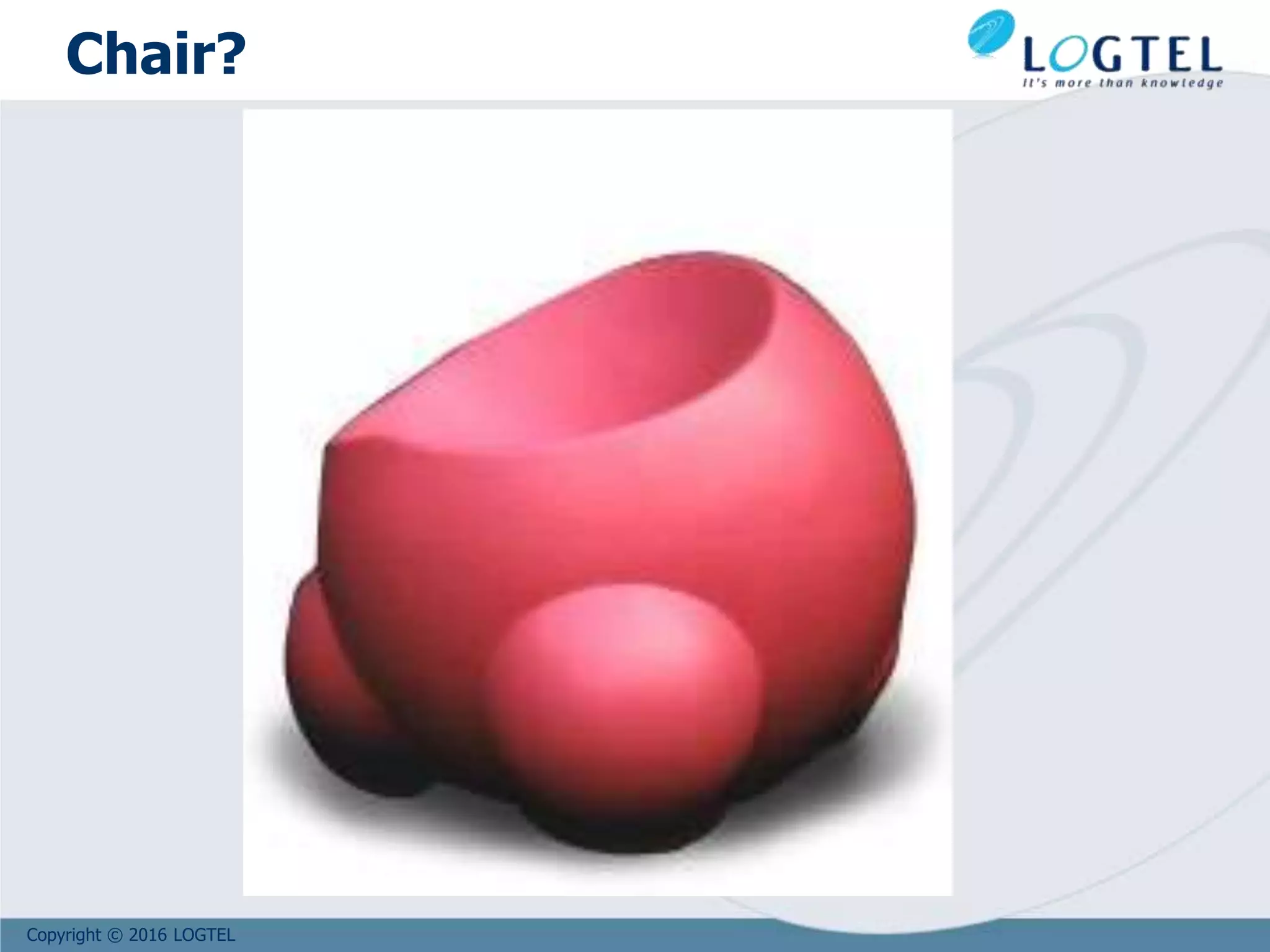
Let’s start with an easy one: chair
Copyright © 2016 LOGTEL
Chair?
Copyright © 2016 LOGTEL
Chair?
Copyright © 2016 LOGTEL
Chair?
Copyright © 2016 LOGTEL
Chair?
Copyright © 2016 LOGTEL
Chair?
Copyright © 2016 LOGTEL
Chair?
Copyright © 2016 LOGTEL
Chair?
Copyright © 2016 LOGTEL
Chair?
Copyright © 2016 LOGTEL
Chair?
Copyright © 2016 LOGTEL
Chair?
Copyright © 2016 LOGTEL
Chair?
Copyright © 2016 LOGTEL
Chair?
Copyright © 2016 LOGTEL
Chair?
Copyright © 2016 LOGTEL
Chair?
The bottom line ?
Copyright © 2016 LOGTEL
How Can We Teach Things
to Computers?
A quote from John McCarthy:
In order for a program to be capable of learning something,
it must first be capable of being told it.
Do we believe this?
Copyright © 2016 LOGTEL
Concept Acquisition
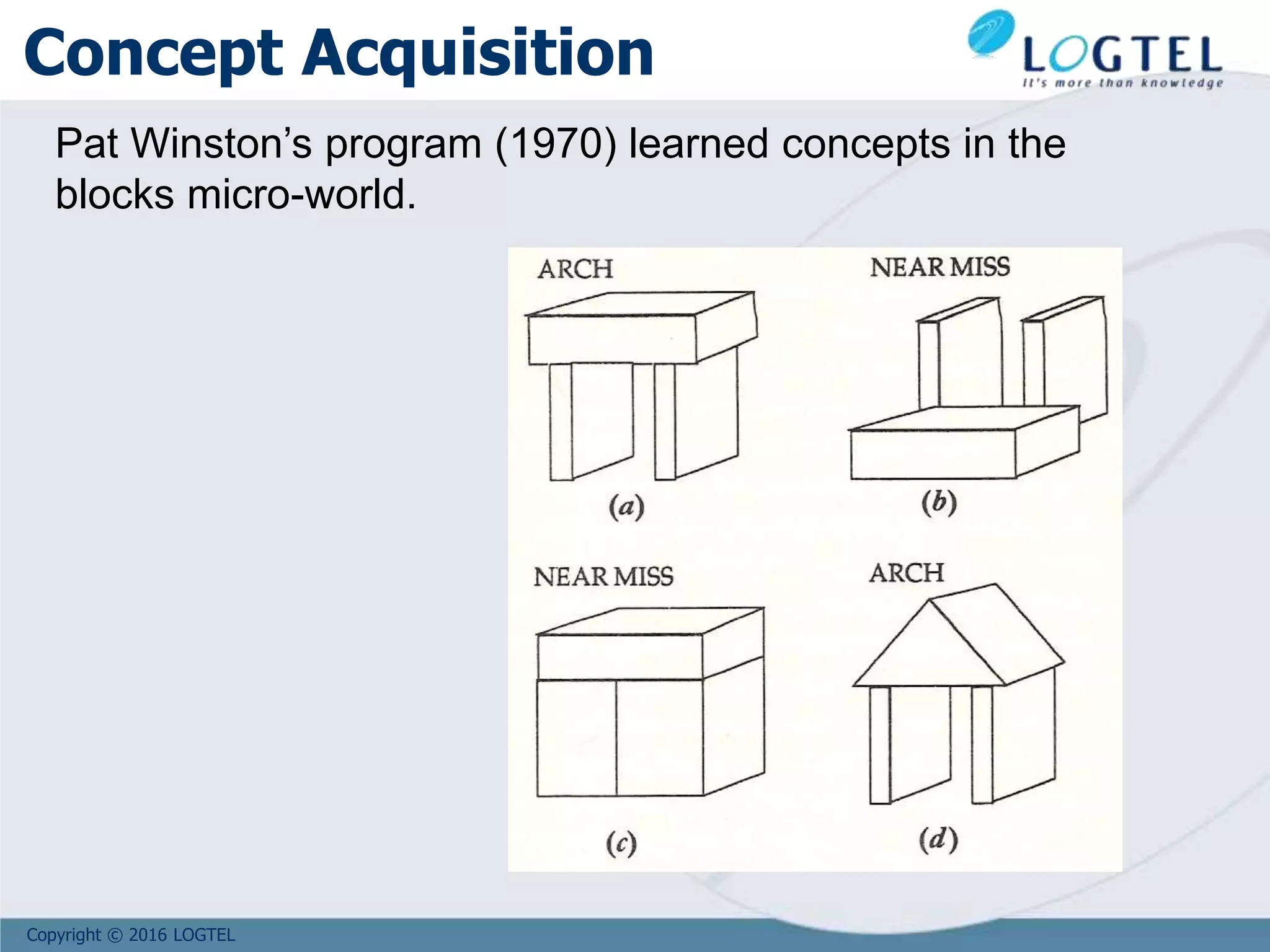
Pat Winston’s program (1970) learned concepts in the
blocks micro-world.
Copyright © 2016 LOGTEL
Compiling Common Sense Knowledge
• CYC (http://www.cyc.com)
• UT (http://www.cs.utexas.edu/users/mfkb/RKF/tree/ )
• WordNet (http://www.cogsci.princeton.edu/~wn/)
January 26, 2016Introduction to Artificial Intelligence
Lecture 1: What is Artificial Intelligence?
34
Paradigms of Computation
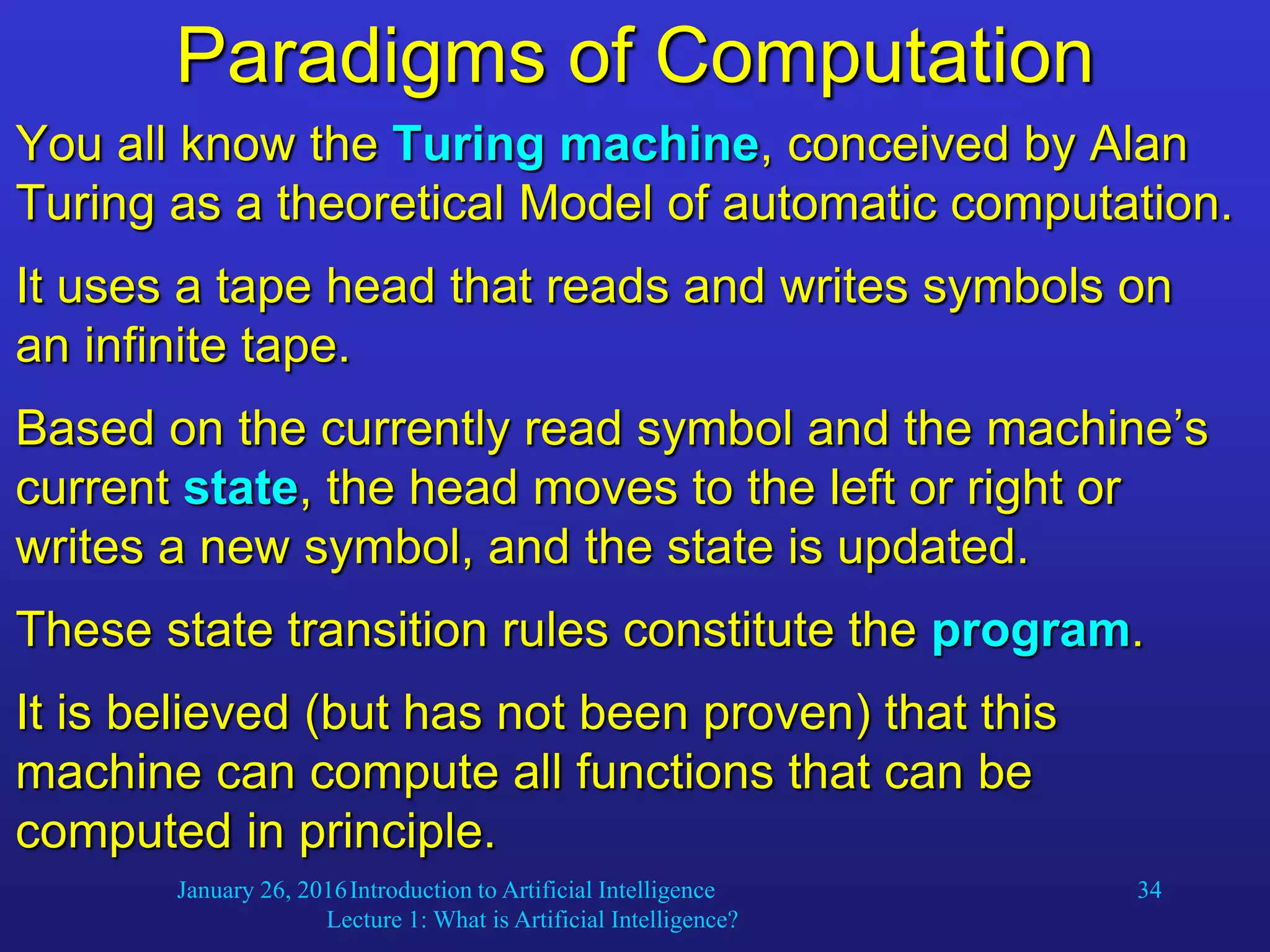
You all know the Turing machine, conceived by Alan
Turing as a theoretical Model of automatic computation.
It uses a tape head that reads and writes symbols on
an infinite tape.
Based on the currently read symbol and the machine’s
current state, the head moves to the left or right or
writes a new symbol, and the state is updated.
These state transition rules constitute the program.
It is believed (but has not been proven) that this
machine can compute all functions that can be
computed in principle.
January 26, 2016Introduction to Artificial Intelligence
Lecture 1: What is Artificial Intelligence?
35
Turing Machines
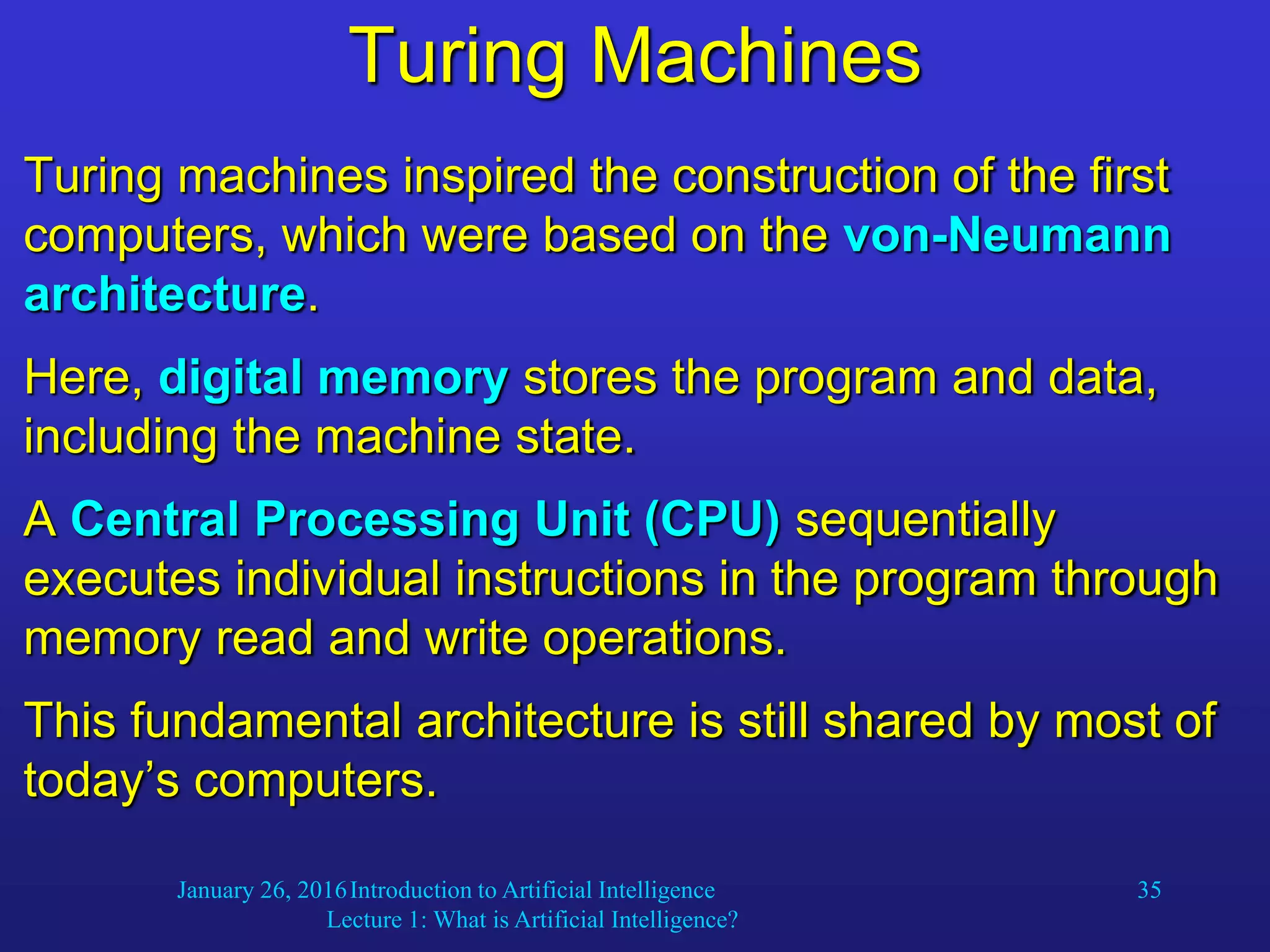
Turing machines inspired the construction of the first
computers, which were based on the von-Neumann
architecture.
Here, digital memory stores the program and data,
including the machine state.
A Central Processing Unit (CPU) sequentially
executes individual instructions in the program through
memory read and write operations.
This fundamental architecture is still shared by most of
today’s computers.
January 26, 2016Introduction to Artificial Intelligence
Lecture 1: What is Artificial Intelligence?
36
Imperative Programming
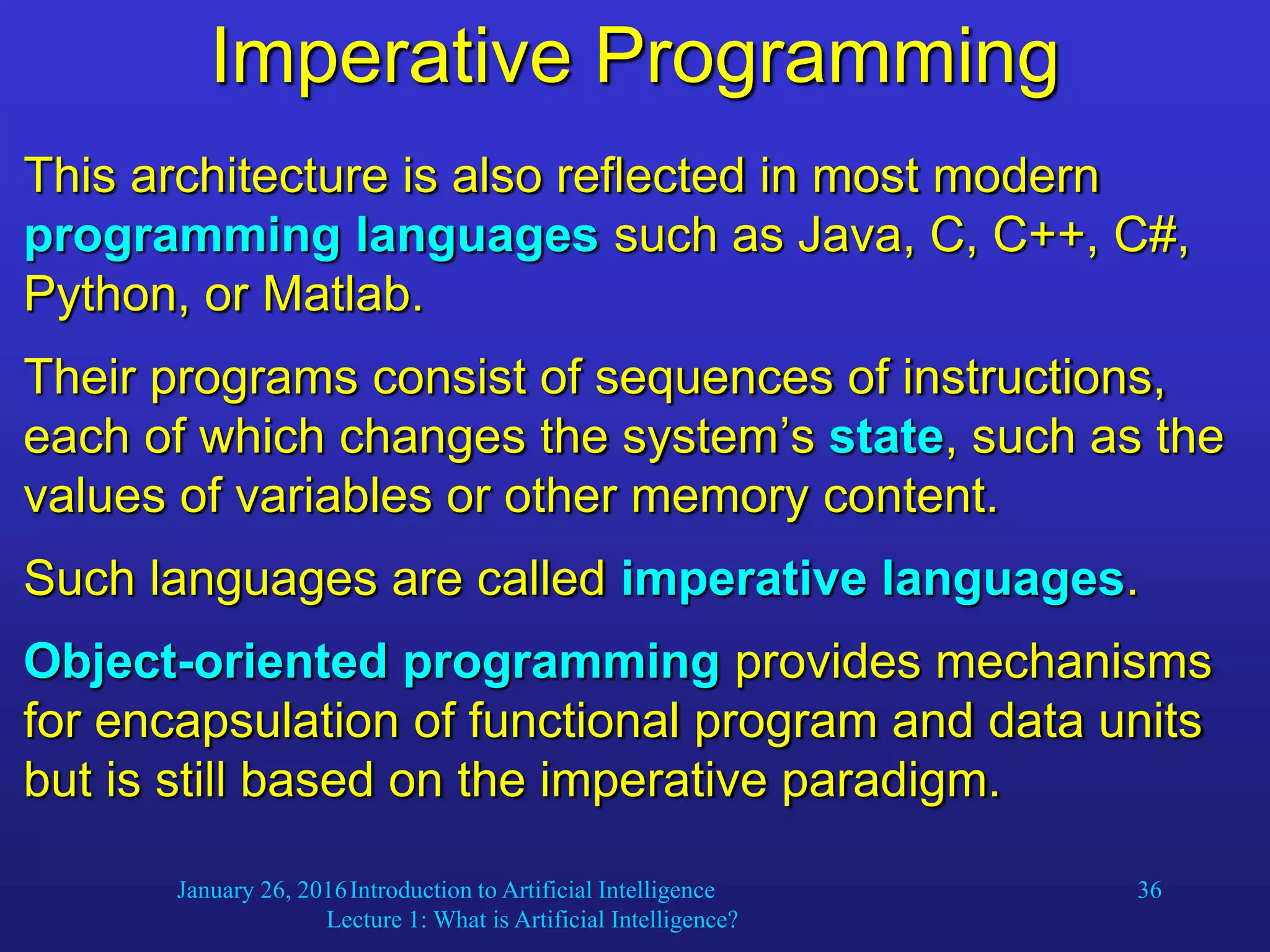
This architecture is also reflected in most modern
programming languages such as Java, C, C++, C#,
Python, or Matlab.
Their programs consist of sequences of instructions,
each of which changes the system’s state, such as the
values of variables or other memory content.
Such languages are called imperative languages.
Object-oriented programming provides mechanisms
for encapsulation of functional program and data units
but is still based on the imperative paradigm.
January 26, 2016Introduction to Artificial Intelligence
Lecture 1: What is Artificial Intelligence?
37
Lambda () Calculus
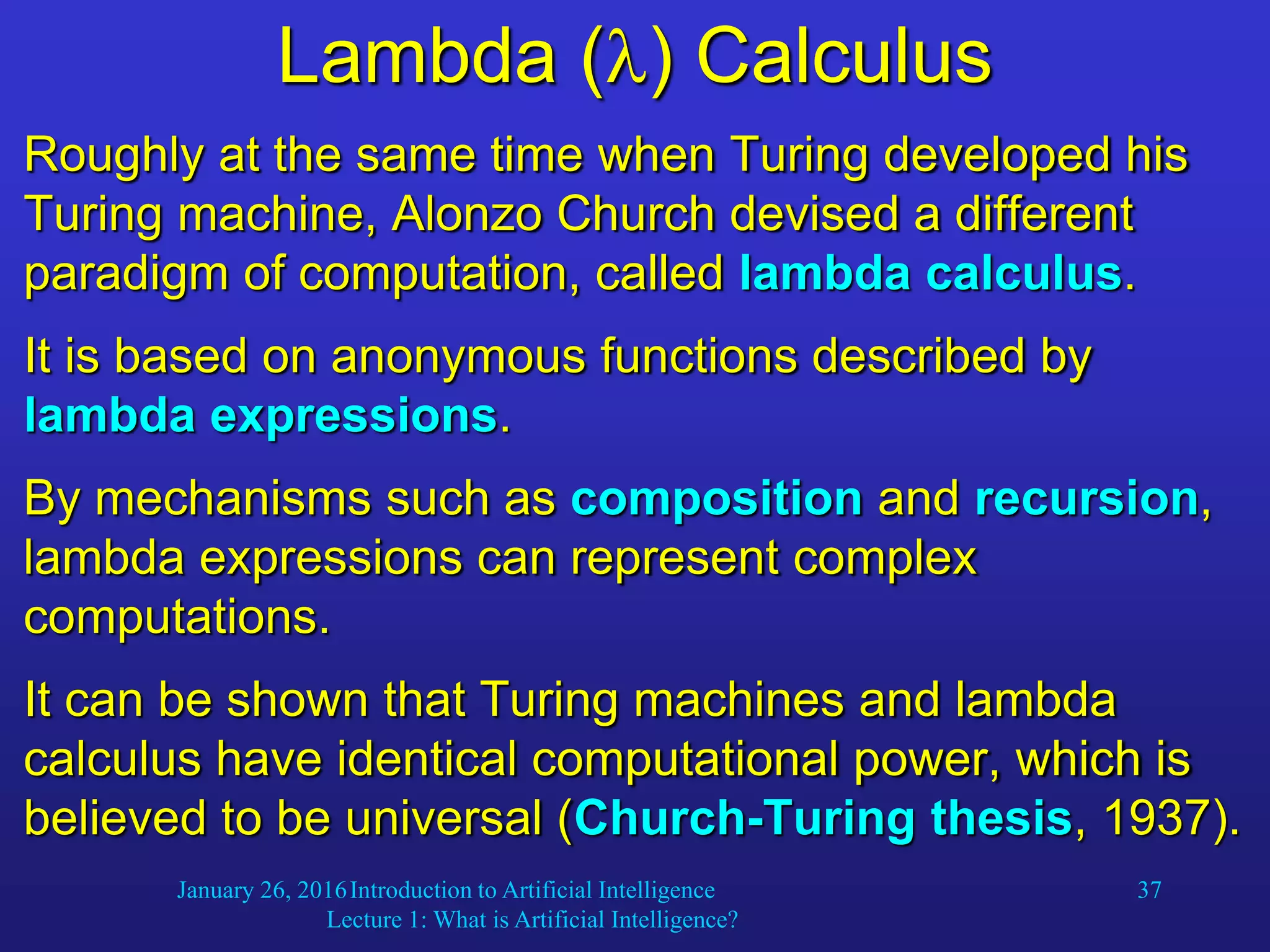
Roughly at the same time when Turing developed his
Turing machine, Alonzo Church devised a different
paradigm of computation, called lambda calculus.
It is based on anonymous functions described by
lambda expressions.
By mechanisms such as composition and recursion,
lambda expressions can represent complex
computations.
It can be shown that Turing machines and lambda
calculus have identical computational power, which is
believed to be universal (Church-Turing thesis, 1937).
January 26, 2016Introduction to Artificial Intelligence
Lecture 1: What is Artificial Intelligence?
38
Lambda () Calculus
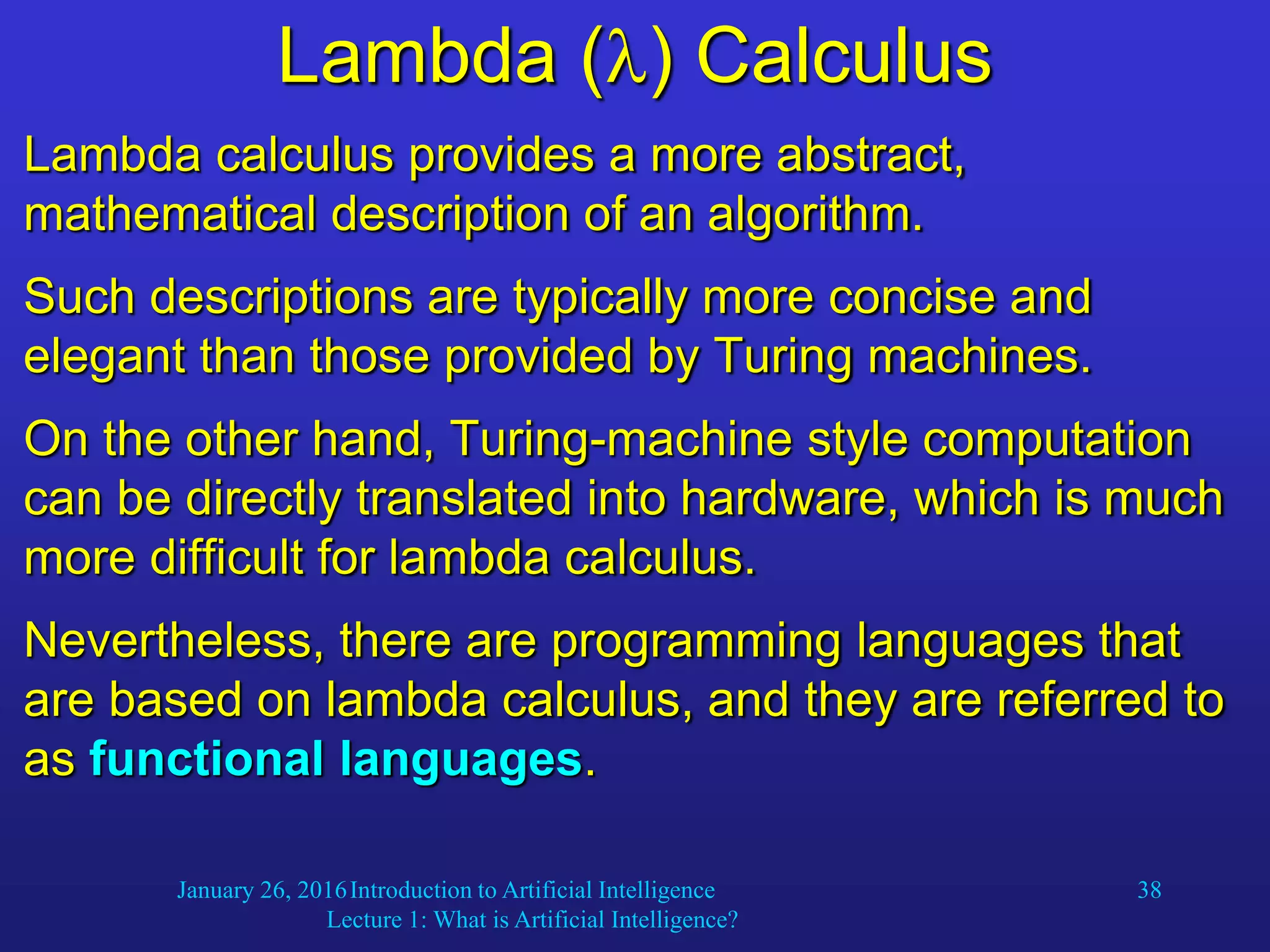
Lambda calculus provides a more abstract,
mathematical description of an algorithm.
Such descriptions are typically more concise and
elegant than those provided by Turing machines.
On the other hand, Turing-machine style computation
can be directly translated into hardware, which is much
more difficult for lambda calculus.
Nevertheless, there are programming languages that
are based on lambda calculus, and they are referred to
as functional languages.
January 26, 2016Introduction to Artificial Intelligence
Lecture 1: What is Artificial Intelligence?
39
Functional Programming
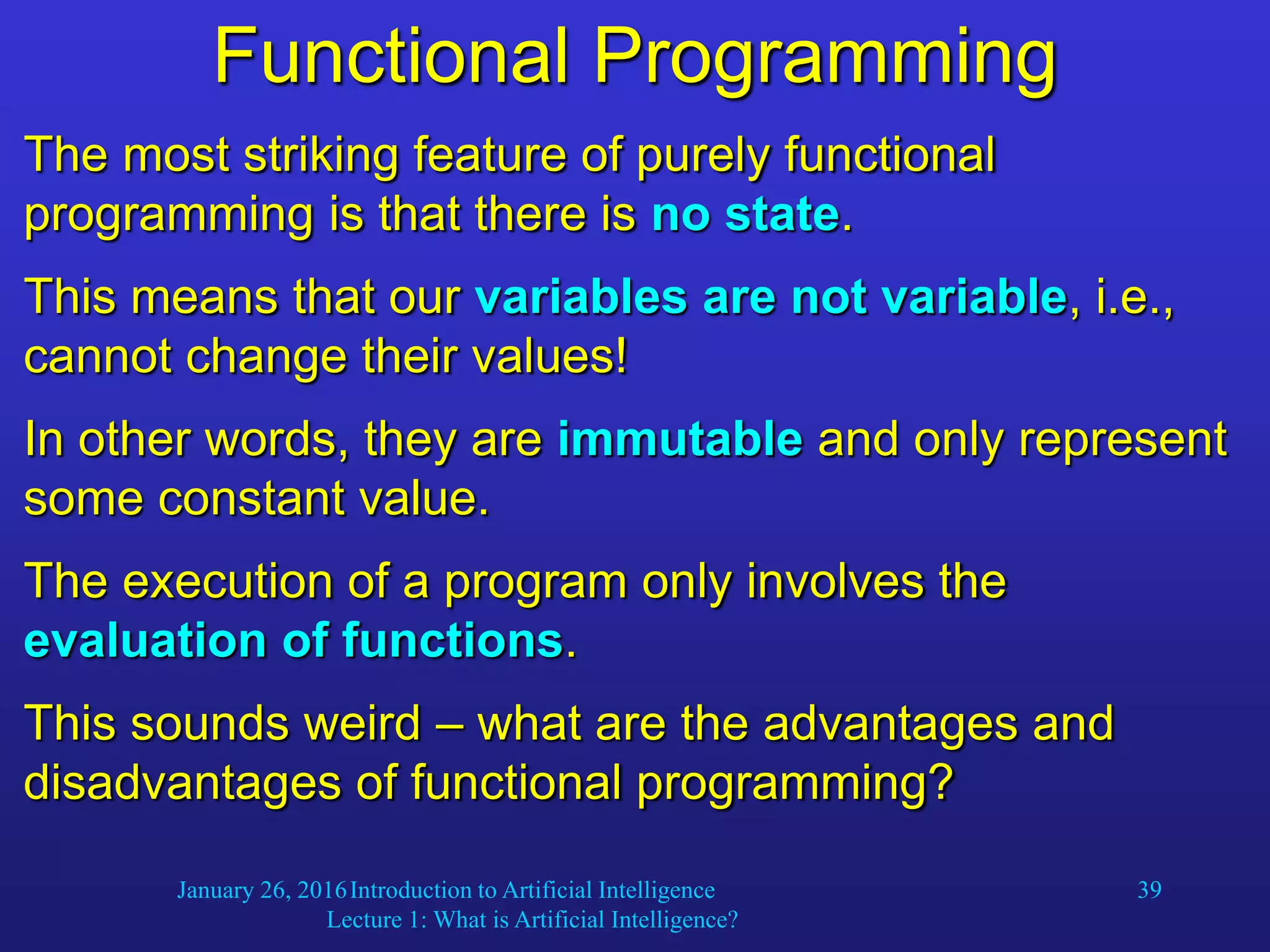
The most striking feature of purely functional
programming is that there is no state.
This means that our variables are not variable, i.e.,
cannot change their values!
In other words, they are immutable and only represent
some constant value.
The execution of a program only involves the
evaluation of functions.
This sounds weird – what are the advantages and
disadvantages of functional programming?
January 26, 2016Introduction to Artificial Intelligence
Lecture 1: What is Artificial Intelligence?
40
Functional Programming
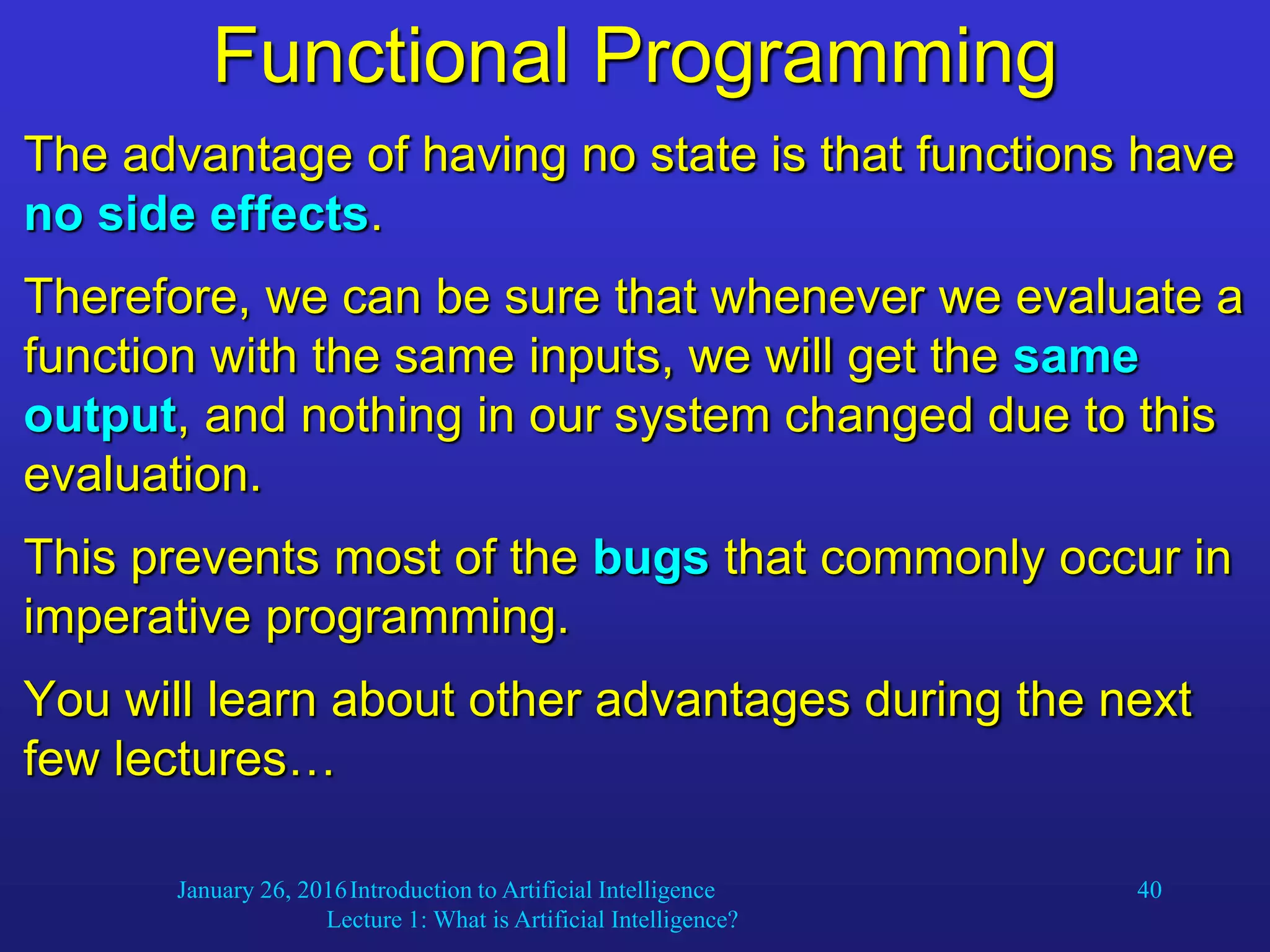
The advantage of having no state is that functions have
no side effects.
Therefore, we can be sure that whenever we evaluate a
function with the same inputs, we will get the same
output, and nothing in our system changed due to this
evaluation.
This prevents most of the bugs that commonly occur in
imperative programming.
You will learn about other advantages during the next
few lectures…
January 26, 2016Introduction to Artificial Intelligence
Lecture 1: What is Artificial Intelligence?
41
Functional Programming
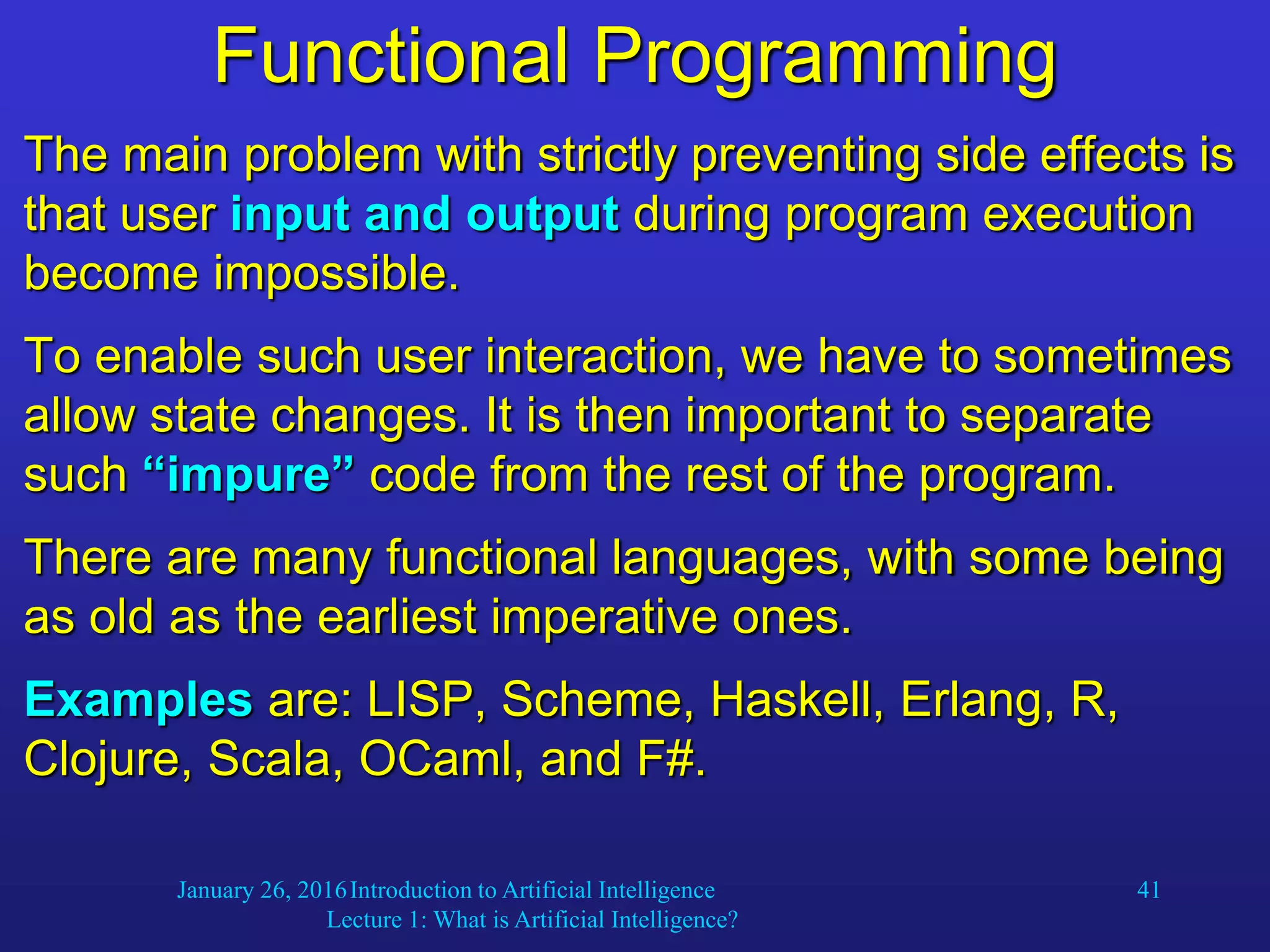
The main problem with strictly preventing side effects is
that user input and output during program execution
become impossible.
To enable such user interaction, we have to sometimes
allow state changes. It is then important to separate
such “impure” code from the rest of the program.
There are many functional languages, with some being
as old as the earliest imperative ones.
Examples are: LISP, Scheme, Haskell, Erlang, R,
Clojure, Scala, OCaml, and F#.
January 26, 2016Introduction to Artificial Intelligence
Lecture 1: What is Artificial Intelligence?
42
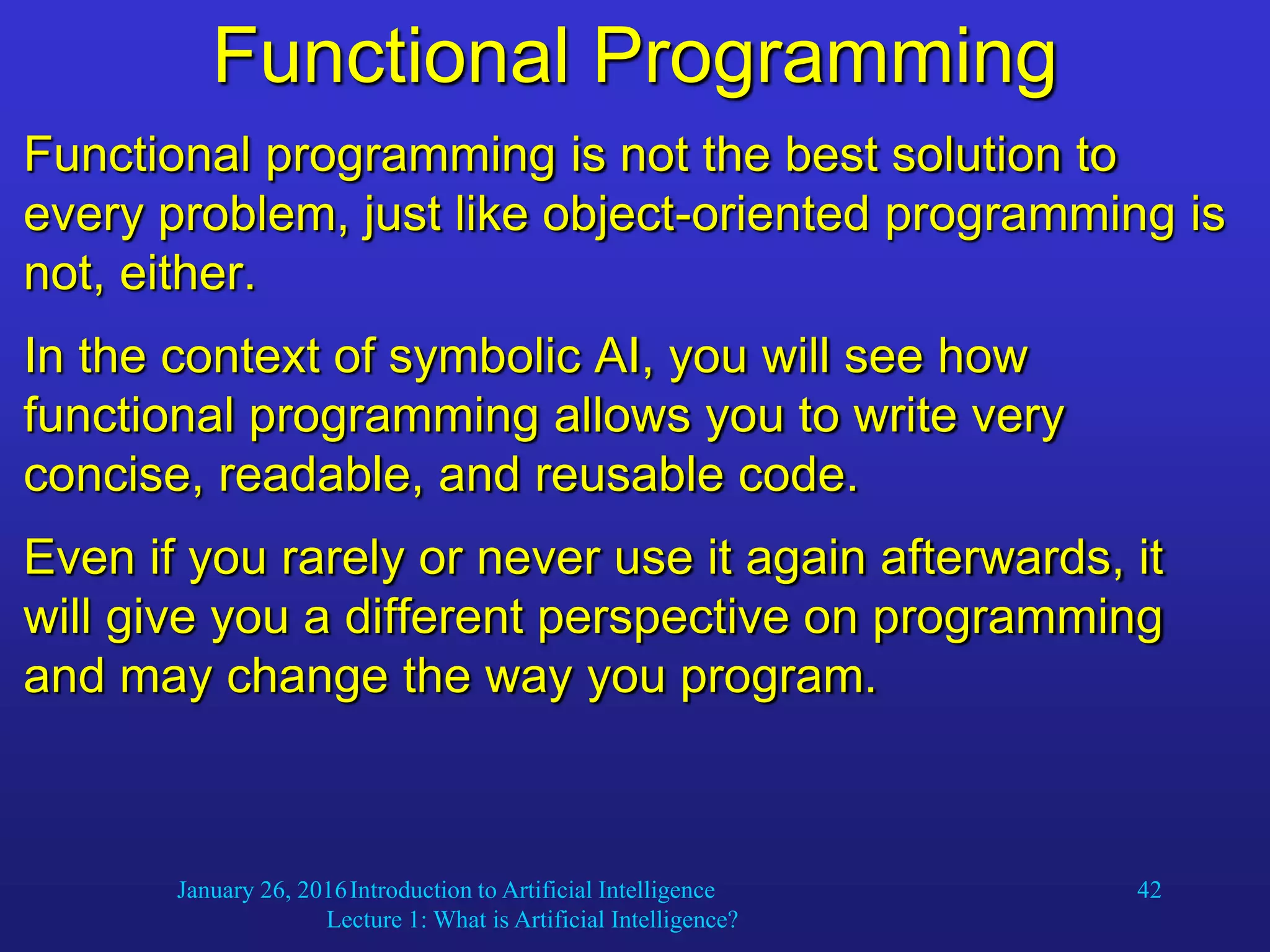
Functional Programming
Functional programming is not the best solution to
every problem, just like object-oriented programming is
not, either.
In the context of symbolic AI, you will see how
functional programming allows you to write very
concise, readable, and reusable code.
Even if you rarely or never use it again afterwards, it
will give you a different perspective on programming
and may change the way you program.
Copyright © 2016 LOGTEL
What can we do with it ?
Copyright © 2016 LOGTEL
Do we really want it ?
(this way ?)
Copyright © 2016 LOGTEL
ThankYou!!!
…and please fill the evaluation form
45

Amdocs ai s1

  • 1.
    Copyright © 2016LOGTEL By: Samuel Dratwa Samuel.dratwa@gmail.com Artificial Intelligence Amdocs - Future Technology Trends
  • 2.
    Copyright © 2016LOGTEL Agenda  Introduction to AI  Neural networks  Statistic / Social AI  NLP - Natural language processing  The future of CRM/CEM
  • 3.
    Copyright © 2016LOGTEL The headline
  • 4.
    Copyright © 2016LOGTEL AI is also in the headlines
  • 5.
  • 6.
    Copyright © 2016LOGTEL Can you give me an example ?  Siri  Google go  Deepblue  Autonomous cars
  • 7.
    Copyright © 2016LOGTEL Our definition (after discussion)  A (self) learning software that can adopt to new situation and interact with humans, giving them a user experience like human. 7
  • 8.
    Copyright © 2016LOGTEL Academic Definition of AI Artificial intelligence is the study of how to make computers do things that people are better at or would be better at if: • they could extend what they do to a World Wide Web-sized amount of data and • not make mistakes.
  • 9.
    Copyright © 2016LOGTEL Things that People Do Easily? • Common sense reasoning • Vision • Moving around • Language
  • 10.
    Copyright © 2016LOGTEL AI is an old idea
  • 11.
  • 12.
    Copyright © 2016LOGTEL The Dartmouth Conference and the Name Artificial Intelligence J. McCarthy, M. L. Minsky, N. Rochester, and C.E. Shannon. August 31, 1955. "We propose that a 2 month, 10 man study of artificial intelligence be carried out during the summer of 1956 at Dartmouth College in Hanover, New Hampshire. The study is to proceed on the basis of the conjecture that every aspect of learning or any other feature of intelligence can in principle be so precisely described that a machine can be made to simulate it."
  • 13.
    Copyright © 2016LOGTEL The Origins of AI Hype 1950 Turing predicted that in about fifty years "an average interrogator will not have more than a 70 percent chance of making the right identification after five minutes of questioning". 1957 Newell and Simon predicted that "Within ten years a computer will be the world's chess champion, unless the rules bar it from competition."
  • 14.
    Copyright © 2016LOGTEL Evolution of the Main Ideas • Wings or not? • Games, mathematics, and other knowledge-poor tasks • The silver bullet? • Knowledge-based systems • Hand-coded knowledge vs. machine learning • Low-level (sensory and motor) processing and the resurgence of subsymbolic systems • Robotics • Natural language processing
  • 15.
    Copyright © 2016LOGTEL How Can We Teach Things to Computers? A quote from John McCarthy: In order for a program to be capable of learning something, it must first be capable of being told it. Do we believe this?
  • 16.
    Copyright © 2016LOGTEL What is a Concept / idea ? Let’s start with an easy one: chair
  • 17.
    Copyright © 2016LOGTEL Chair?
  • 18.
    Copyright © 2016LOGTEL Chair?
  • 19.
    Copyright © 2016LOGTEL Chair?
  • 20.
    Copyright © 2016LOGTEL Chair?
  • 21.
    Copyright © 2016LOGTEL Chair?
  • 22.
    Copyright © 2016LOGTEL Chair?
  • 23.
    Copyright © 2016LOGTEL Chair?
  • 24.
    Copyright © 2016LOGTEL Chair?
  • 25.
    Copyright © 2016LOGTEL Chair?
  • 26.
    Copyright © 2016LOGTEL Chair?
  • 27.
    Copyright © 2016LOGTEL Chair?
  • 28.
    Copyright © 2016LOGTEL Chair?
  • 29.
    Copyright © 2016LOGTEL Chair?
  • 30.
    Copyright © 2016LOGTEL Chair? The bottom line ?
  • 31.
    Copyright © 2016LOGTEL How Can We Teach Things to Computers? A quote from John McCarthy: In order for a program to be capable of learning something, it must first be capable of being told it. Do we believe this?
  • 32.
    Copyright © 2016LOGTEL Concept Acquisition Pat Winston’s program (1970) learned concepts in the blocks micro-world.
  • 33.
    Copyright © 2016LOGTEL Compiling Common Sense Knowledge • CYC (http://www.cyc.com) • UT (http://www.cs.utexas.edu/users/mfkb/RKF/tree/ ) • WordNet (http://www.cogsci.princeton.edu/~wn/)
  • 34.
    January 26, 2016Introductionto Artificial Intelligence Lecture 1: What is Artificial Intelligence? 34 Paradigms of Computation You all know the Turing machine, conceived by Alan Turing as a theoretical Model of automatic computation. It uses a tape head that reads and writes symbols on an infinite tape. Based on the currently read symbol and the machine’s current state, the head moves to the left or right or writes a new symbol, and the state is updated. These state transition rules constitute the program. It is believed (but has not been proven) that this machine can compute all functions that can be computed in principle.
  • 35.
    January 26, 2016Introductionto Artificial Intelligence Lecture 1: What is Artificial Intelligence? 35 Turing Machines Turing machines inspired the construction of the first computers, which were based on the von-Neumann architecture. Here, digital memory stores the program and data, including the machine state. A Central Processing Unit (CPU) sequentially executes individual instructions in the program through memory read and write operations. This fundamental architecture is still shared by most of today’s computers.
  • 36.
    January 26, 2016Introductionto Artificial Intelligence Lecture 1: What is Artificial Intelligence? 36 Imperative Programming This architecture is also reflected in most modern programming languages such as Java, C, C++, C#, Python, or Matlab. Their programs consist of sequences of instructions, each of which changes the system’s state, such as the values of variables or other memory content. Such languages are called imperative languages. Object-oriented programming provides mechanisms for encapsulation of functional program and data units but is still based on the imperative paradigm.
  • 37.
    January 26, 2016Introductionto Artificial Intelligence Lecture 1: What is Artificial Intelligence? 37 Lambda () Calculus Roughly at the same time when Turing developed his Turing machine, Alonzo Church devised a different paradigm of computation, called lambda calculus. It is based on anonymous functions described by lambda expressions. By mechanisms such as composition and recursion, lambda expressions can represent complex computations. It can be shown that Turing machines and lambda calculus have identical computational power, which is believed to be universal (Church-Turing thesis, 1937).
  • 38.
    January 26, 2016Introductionto Artificial Intelligence Lecture 1: What is Artificial Intelligence? 38 Lambda () Calculus Lambda calculus provides a more abstract, mathematical description of an algorithm. Such descriptions are typically more concise and elegant than those provided by Turing machines. On the other hand, Turing-machine style computation can be directly translated into hardware, which is much more difficult for lambda calculus. Nevertheless, there are programming languages that are based on lambda calculus, and they are referred to as functional languages.
  • 39.
    January 26, 2016Introductionto Artificial Intelligence Lecture 1: What is Artificial Intelligence? 39 Functional Programming The most striking feature of purely functional programming is that there is no state. This means that our variables are not variable, i.e., cannot change their values! In other words, they are immutable and only represent some constant value. The execution of a program only involves the evaluation of functions. This sounds weird – what are the advantages and disadvantages of functional programming?
  • 40.
    January 26, 2016Introductionto Artificial Intelligence Lecture 1: What is Artificial Intelligence? 40 Functional Programming The advantage of having no state is that functions have no side effects. Therefore, we can be sure that whenever we evaluate a function with the same inputs, we will get the same output, and nothing in our system changed due to this evaluation. This prevents most of the bugs that commonly occur in imperative programming. You will learn about other advantages during the next few lectures…
  • 41.
    January 26, 2016Introductionto Artificial Intelligence Lecture 1: What is Artificial Intelligence? 41 Functional Programming The main problem with strictly preventing side effects is that user input and output during program execution become impossible. To enable such user interaction, we have to sometimes allow state changes. It is then important to separate such “impure” code from the rest of the program. There are many functional languages, with some being as old as the earliest imperative ones. Examples are: LISP, Scheme, Haskell, Erlang, R, Clojure, Scala, OCaml, and F#.
  • 42.
    January 26, 2016Introductionto Artificial Intelligence Lecture 1: What is Artificial Intelligence? 42 Functional Programming Functional programming is not the best solution to every problem, just like object-oriented programming is not, either. In the context of symbolic AI, you will see how functional programming allows you to write very concise, readable, and reusable code. Even if you rarely or never use it again afterwards, it will give you a different perspective on programming and may change the way you program.
  • 43.
    Copyright © 2016LOGTEL What can we do with it ?
  • 44.
    Copyright © 2016LOGTEL Do we really want it ? (this way ?)
  • 45.
    Copyright © 2016LOGTEL ThankYou!!! …and please fill the evaluation form 45