Understanding Artificial benifits advantage and disadvantage
1.
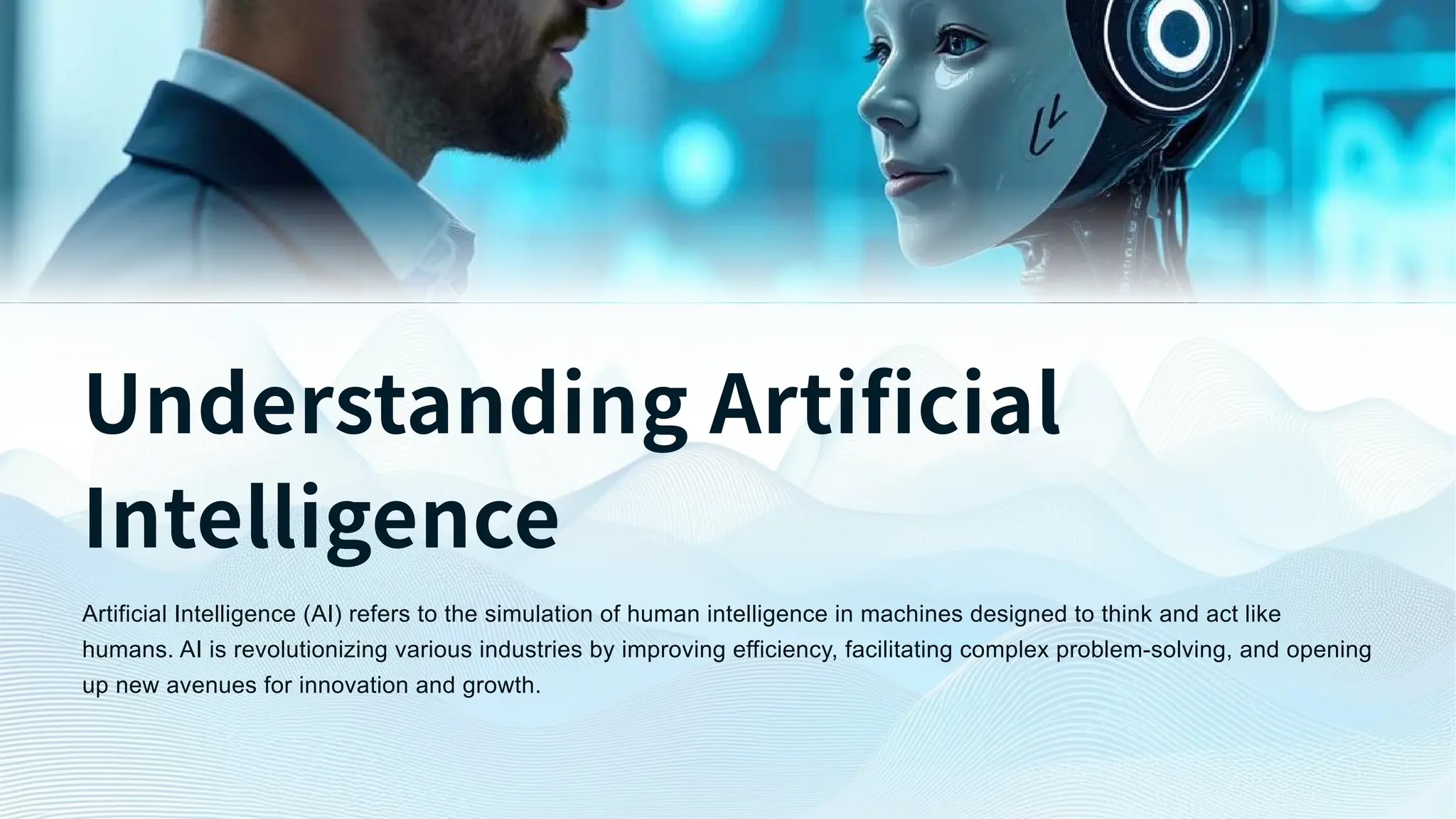
Understanding Artificial
Intelligence
Artificial Intelligence(AI) refers to the simulation of human intelligence in machines designed to think and act like
humans. AI is revolutionizing various industries by improving efficiency, facilitating complex problem-solving, and opening
up new avenues for innovation and growth.
2.
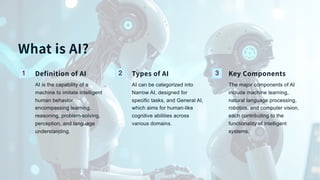
What is AI?
1Definition of AI
AI is the capability of a
machine to imitate intelligent
human behavior,
encompassing learning,
reasoning, problem-solving,
perception, and language
understanding.
2 Types of AI
AI can be categorized into
Narrow AI, designed for
specific tasks, and General AI,
which aims for human-like
cognitive abilities across
various domains.
3 Key Components
The major components of AI
include machine learning,
natural language processing,
robotics, and computer vision,
each contributing to the
functionality of intelligent
systems.
3.
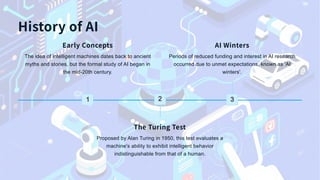
History of AI
EarlyConcepts
The idea of intelligent machines dates back to ancient
myths and stories, but the formal study of AI began in
the mid-20th century.
1
The Turing Test
Proposed by Alan Turing in 1950, this test evaluates a
machine's ability to exhibit intelligent behavior
indistinguishable from that of a human.
2
AI Winters
Periods of reduced funding and interest in AI research
occurred due to unmet expectations, known as 'AI
winters'.
3
4.
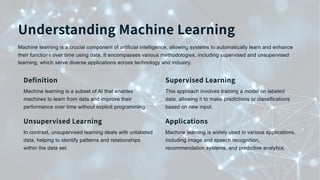
Understanding Machine Learning
Machinelearning is a crucial component of artificial intelligence, allowing systems to automatically learn and enhance
their functions over time using data. It encompasses various methodologies, including supervised and unsupervised
learning, which serve diverse applications across technology and industry.
Definition
Machine learning is a subset of AI that enables
machines to learn from data and improve their
performance over time without explicit programming.
Supervised Learning
This approach involves training a model on labeled
data, allowing it to make predictions or classifications
based on new input.
Unsupervised Learning
In contrast, unsupervised learning deals with unlabeled
data, helping to identify patterns and relationships
within the data set.
Applications
Machine learning is widely used in various applications,
including image and speech recognition,
recommendation systems, and predictive analytics.
5.
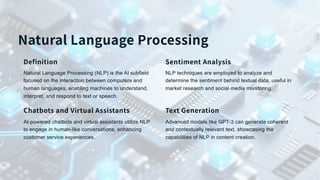
Natural Language Processing
Definition
NaturalLanguage Processing (NLP) is the AI subfield
focused on the interaction between computers and
human languages, enabling machines to understand,
interpret, and respond to text or speech.
Sentiment Analysis
NLP techniques are employed to analyze and
determine the sentiment behind textual data, useful in
market research and social media monitoring.
Chatbots and Virtual Assistants
AI-powered chatbots and virtual assistants utilize NLP
to engage in human-like conversations, enhancing
customer service experiences.
Text Generation
Advanced models like GPT-3 can generate coherent
and contextually relevant text, showcasing the
capabilities of NLP in content creation.
6.
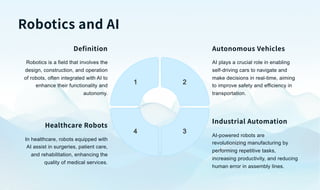
Robotics and AI
12
3
4
Definition
Robotics is a field that involves the
design, construction, and operation
of robots, often integrated with AI to
enhance their functionality and
autonomy.
Autonomous Vehicles
AI plays a crucial role in enabling
self-driving cars to navigate and
make decisions in real-time, aiming
to improve safety and efficiency in
transportation.
Industrial Automation
AI-powered robots are
revolutionizing manufacturing by
performing repetitive tasks,
increasing productivity, and reducing
human error in assembly lines.
Healthcare Robots
In healthcare, robots equipped with
AI assist in surgeries, patient care,
and rehabilitation, enhancing the
quality of medical services.
7.
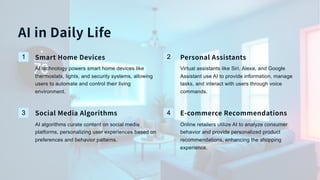
AI in DailyLife
1 Smart Home Devices
AI technology powers smart home devices like
thermostats, lights, and security systems, allowing
users to automate and control their living
environment.
2 Personal Assistants
Virtual assistants like Siri, Alexa, and Google
Assistant use AI to provide information, manage
tasks, and interact with users through voice
commands.
3 Social Media Algorithms
AI algorithms curate content on social media
platforms, personalizing user experiences based on
preferences and behavior patterns.
4 E-commerce Recommendations
Online retailers utilize AI to analyze consumer
behavior and provide personalized product
recommendations, enhancing the shopping
experience.
8.
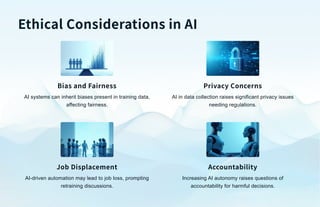
Ethical Considerations inAI
Bias and Fairness
AI systems can inherit biases present in training data,
affecting fairness.
Privacy Concerns
AI in data collection raises significant privacy issues
needing regulations.
Job Displacement
AI-driven automation may lead to job loss, prompting
retraining discussions.
Accountability
Increasing AI autonomy raises questions of
accountability for harmful decisions.
9.
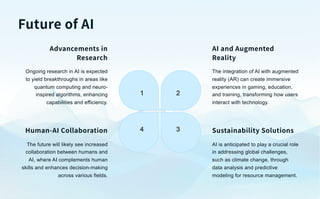
Future of AI
12
3
4
Advancements in
Research
Ongoing research in AI is expected
to yield breakthroughs in areas like
quantum computing and neuro-
inspired algorithms, enhancing
capabilities and efficiency.
AI and Augmented
Reality
The integration of AI with augmented
reality (AR) can create immersive
experiences in gaming, education,
and training, transforming how users
interact with technology.
Sustainability Solutions
AI is anticipated to play a crucial role
in addressing global challenges,
such as climate change, through
data analysis and predictive
modeling for resource management.
Human-AI Collaboration
The future will likely see increased
collaboration between humans and
AI, where AI complements human
skills and enhances decision-making
across various fields.
10.
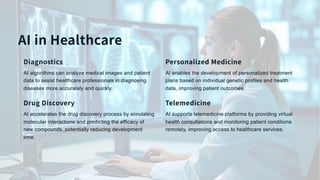
AI in Healthcare
Diagnostics
AIalgorithms can analyze medical images and patient
data to assist healthcare professionals in diagnosing
diseases more accurately and quickly.
Personalized Medicine
AI enables the development of personalized treatment
plans based on individual genetic profiles and health
data, improving patient outcomes.
Drug Discovery
AI accelerates the drug discovery process by simulating
molecular interactions and predicting the efficacy of
new compounds, potentially reducing development
time.
Telemedicine
AI supports telemedicine platforms by providing virtual
health consultations and monitoring patient conditions
remotely, improving access to healthcare services.
11.
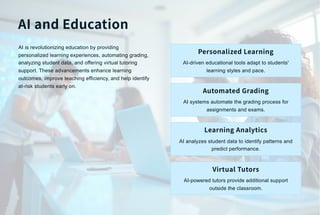
AI and Education
AIis revolutionizing education by providing
personalized learning experiences, automating grading,
analyzing student data, and offering virtual tutoring
support. These advancements enhance learning
outcomes, improve teaching efficiency, and help identify
at-risk students early on.
Personalized Learning
AI-driven educational tools adapt to students'
learning styles and pace.
Automated Grading
AI systems automate the grading process for
assignments and exams.
Learning Analytics
AI analyzes student data to identify patterns and
predict performance.
Virtual Tutors
AI-powered tutors provide additional support
outside the classroom.
12.
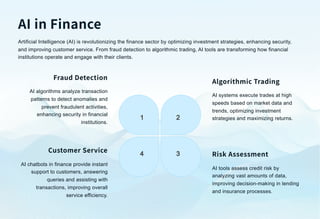
AI in Finance
ArtificialIntelligence (AI) is revolutionizing the finance sector by optimizing investment strategies, enhancing security,
and improving customer service. From fraud detection to algorithmic trading, AI tools are transforming how financial
institutions operate and engage with their clients.
1 2
3
4
Fraud Detection
AI algorithms analyze transaction
patterns to detect anomalies and
prevent fraudulent activities,
enhancing security in financial
institutions.
Algorithmic Trading
AI systems execute trades at high
speeds based on market data and
trends, optimizing investment
strategies and maximizing returns.
Risk Assessment
AI tools assess credit risk by
analyzing vast amounts of data,
improving decision-making in lending
and insurance processes.
Customer Service
AI chatbots in finance provide instant
support to customers, answering
queries and assisting with
transactions, improving overall
service efficiency.
13.
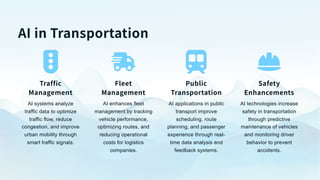
AI in Transportation
Traffic
Management
AIsystems analyze
traffic data to optimize
traffic flow, reduce
congestion, and improve
urban mobility through
smart traffic signals.
Fleet
Management
AI enhances fleet
management by tracking
vehicle performance,
optimizing routes, and
reducing operational
costs for logistics
companies.
Public
Transportation
AI applications in public
transport improve
scheduling, route
planning, and passenger
experience through real-
time data analysis and
feedback systems.
Safety
Enhancements
AI technologies increase
safety in transportation
through predictive
maintenance of vehicles
and monitoring driver
behavior to prevent
accidents.
14.
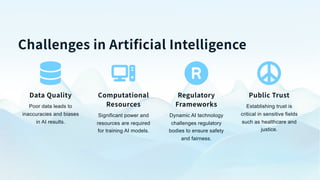
Challenges in ArtificialIntelligence
Data Quality
Poor data leads to
inaccuracies and biases
in AI results.
Computational
Resources
Significant power and
resources are required
for training AI models.
Regulatory
Frameworks
Dynamic AI technology
challenges regulatory
bodies to ensure safety
and fairness.
Public Trust
Establishing trust is
critical in sensitive fields
such as healthcare and
justice.
15.
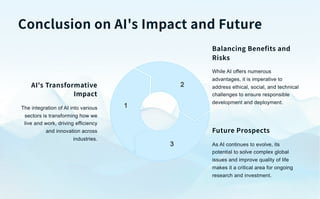
Conclusion on AI'sImpact and Future
1
2
3
AI's Transformative
Impact
The integration of AI into various
sectors is transforming how we
live and work, driving efficiency
and innovation across
industries.
Balancing Benefits and
Risks
While AI offers numerous
advantages, it is imperative to
address ethical, social, and technical
challenges to ensure responsible
development and deployment.
Future Prospects
As AI continues to evolve, its
potential to solve complex global
issues and improve quality of life
makes it a critical area for ongoing
research and investment.

![Download Chimera Tool Setup V42.47.0924 [Latest Version]](https://cdn.slidesharecdn.com/ss_thumbnails/artificialintelligence4-250505221011-8e660a4e-thumbnail.jpg?width=640&height=640&fit=bounds)


![AI_presentation_AICT[1] [Read-Only].pptx](https://cdn.slidesharecdn.com/ss_thumbnails/aipresentationaict1read-only-250905174825-38ac6625-thumbnail.jpg?width=640&height=640&fit=bounds)
![AI_presentation_AICT[1] [Read-Only].pptx](https://cdn.slidesharecdn.com/ss_thumbnails/aipresentationaict1read-only-250905174916-d5ef4934-thumbnail.jpg?width=640&height=640&fit=bounds)
![AI_presentation_AICT[1] [Read-Only].pptx](https://cdn.slidesharecdn.com/ss_thumbnails/aipresentationaict1read-only-250905175118-16902bff-thumbnail.jpg?width=640&height=640&fit=bounds)


