This PPT was created in Microsoft Office 13
so some transitions and effects may not be
worked.
And I have created this with use of some
fonts, so those fonts you don’t have will not
display in this PPT. You can change them
according to your need.
AI
01

Artificial

Intelligence
What Is Artificial

AI
02

• Made or produced by human beings
rather than occurring naturally,
typically as a copy of something
Natural.
• Not existing naturally
What Is Intelligence
• Intelligence is the ability to learn
about, to learn from, to understand
about, and interact with one’s
environment.
• The ability to acquire and apply
knowledge and skills.

AI
03
What Is Artificial Intelligence

AI
04

the study and design of Intelligent agents.
John McCarthy, who coined the term in 1955, defines it as "the
science and engineering of making intelligent machines“
……….
Artificial intelligence (AI) is technology and a branch of computer
science that studies and develops intelligent machines and software.
where an intelligent agent is a system that perceives its
environment and takes actions that maximize its chances of success
What Is Artificial Intelligence

AI
05

The field was founded on the claim that a central ability of
humans, intelligence.
AI research is highly technical and specialized, deeply divided into
subfields. There are subfields which are focused on the solution of
specific problems, on one of several possible approaches, on the use of
widely differing tools and towards the accomplishment of particular
applications. There are an enormous number of tools used in
AI, including versions of search and mathematical
optimization, logic, methods based on probability and economics, and
many others. Today it has become an essential part of the technology
industry and many of the most difficult problems in computer science.
History of Artificial Intelligence

AI
06

The field of AI research was founded at a conference on the campus of Dartmouth
College in the summer of 1956. The attendees, including John McCarthy, Marvin
Minsky, Allen Newell and Herbert Simon, became the leaders of AI research for
many decades. Computers were solving word problems in algebra, proving logical
theorems and speaking English. By the middle of the 1960s, research in the U.S.
was heavily funded by the Department of Defense and laboratories had been
established around the world. They had failed to recognize the difficulty of some of
the problems they faced. In 1974, in response to the criticism of Sir James Lighthill
and ongoing pressure from the US Congress to fund more productive projects,
both the U.S. and British governments cut off all undirected exploratory research in
AI. The next few years would later be called an "AI winter", a period when funding
for AI projects was hard to find.
History of Artificial Intelligence

AI
07

In the early 1980s, AI research was revived by the commercial success of expert
systems, a form of AI program that simulated the knowledge and analytical skills of
one or more human experts. By 1985 the market for AI had reached over a billion
dollars. At the same time, Japan's fifth generation computer project inspired the
U.S and British governments to restore funding for academic research in the field.
However, beginning with the collapse of the Lisp Machine market in 1987, AI once
again fell into disrepute, and a second, longer lasting AI winter began. In the 1990s
and early 21st century, AI achieved its greatest successes. Artificial intelligence is
used for logistics, data mining, medical diagnosis and many other areas
throughout the technology industry.[12] The success was due to several factors:
the increasing computational power of computers (see Moore's law), a greater
emphasis on solving specific sub problems, the creation of new ties between AI
and other fields working on similar problems, and a new commitment by
researchers to solid mathematical methods and rigorous scientific standards.
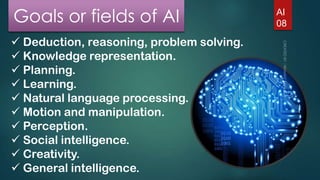
Goals or fields of AI
 Deduction, reasoning, problem solving.
 Knowledge representation.
 Planning.
 Learning.
 Natural language processing.
 Motion and manipulation.
 Perception.
 Social intelligence.
 Creativity.
 General intelligence.

AI
08
Tools of AI









AI
09

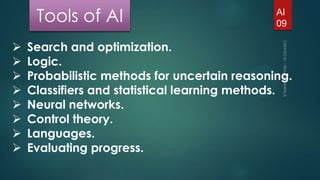
Search and optimization.
Logic.
Probabilistic methods for uncertain reasoning.
Classifiers and statistical learning methods.
Neural networks.
Control theory.
Languages.
Evaluating progress.
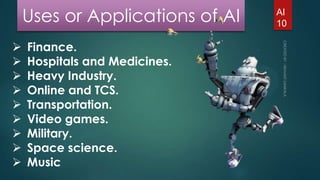
Uses or Applications of AI










Finance.
Hospitals and Medicines.
Heavy Industry.
Online and TCS.
Transportation.
Video games.
Military.
Space science.
Music

AI
10
Pros. of AI

AI
11

• Ability to simulate human behavior and
cognitive processes Capture and
preserve human expertise
Fast Response.
• The ability to comprehend large amounts
of data quickly.
Cons. of AI

AI
12

• No “common sense”.
• Cannot readily deal with “mixed”
knowledge.
• May have high development costs.
• Raise legal and ethical concerns.
Need of AI

AI
13

To supplement natural intelligence for
e.g. we are building intelligence in an
object so that it can do what we want it
to do, as for example-- robots, thus
reducing human labour and reducing
human mistakes
QUESTIONS
?

Artificial intelligence my ppt by hemant sankhla

  • 1.
    This PPT wascreated in Microsoft Office 13 so some transitions and effects may not be worked. And I have created this with use of some fonts, so those fonts you don’t have will not display in this PPT. You can change them according to your need.
  • 2.
  • 3.
    What Is Artificial AI 02 •Made or produced by human beings rather than occurring naturally, typically as a copy of something Natural. • Not existing naturally
  • 4.
    What Is Intelligence •Intelligence is the ability to learn about, to learn from, to understand about, and interact with one’s environment. • The ability to acquire and apply knowledge and skills. AI 03
  • 5.
    What Is ArtificialIntelligence AI 04 the study and design of Intelligent agents. John McCarthy, who coined the term in 1955, defines it as "the science and engineering of making intelligent machines“ ………. Artificial intelligence (AI) is technology and a branch of computer science that studies and develops intelligent machines and software. where an intelligent agent is a system that perceives its environment and takes actions that maximize its chances of success
  • 6.
    What Is ArtificialIntelligence AI 05 The field was founded on the claim that a central ability of humans, intelligence. AI research is highly technical and specialized, deeply divided into subfields. There are subfields which are focused on the solution of specific problems, on one of several possible approaches, on the use of widely differing tools and towards the accomplishment of particular applications. There are an enormous number of tools used in AI, including versions of search and mathematical optimization, logic, methods based on probability and economics, and many others. Today it has become an essential part of the technology industry and many of the most difficult problems in computer science.
  • 7.
    History of ArtificialIntelligence AI 06 The field of AI research was founded at a conference on the campus of Dartmouth College in the summer of 1956. The attendees, including John McCarthy, Marvin Minsky, Allen Newell and Herbert Simon, became the leaders of AI research for many decades. Computers were solving word problems in algebra, proving logical theorems and speaking English. By the middle of the 1960s, research in the U.S. was heavily funded by the Department of Defense and laboratories had been established around the world. They had failed to recognize the difficulty of some of the problems they faced. In 1974, in response to the criticism of Sir James Lighthill and ongoing pressure from the US Congress to fund more productive projects, both the U.S. and British governments cut off all undirected exploratory research in AI. The next few years would later be called an "AI winter", a period when funding for AI projects was hard to find.
  • 8.
    History of ArtificialIntelligence AI 07 In the early 1980s, AI research was revived by the commercial success of expert systems, a form of AI program that simulated the knowledge and analytical skills of one or more human experts. By 1985 the market for AI had reached over a billion dollars. At the same time, Japan's fifth generation computer project inspired the U.S and British governments to restore funding for academic research in the field. However, beginning with the collapse of the Lisp Machine market in 1987, AI once again fell into disrepute, and a second, longer lasting AI winter began. In the 1990s and early 21st century, AI achieved its greatest successes. Artificial intelligence is used for logistics, data mining, medical diagnosis and many other areas throughout the technology industry.[12] The success was due to several factors: the increasing computational power of computers (see Moore's law), a greater emphasis on solving specific sub problems, the creation of new ties between AI and other fields working on similar problems, and a new commitment by researchers to solid mathematical methods and rigorous scientific standards.
  • 9.
    Goals or fieldsof AI  Deduction, reasoning, problem solving.  Knowledge representation.  Planning.  Learning.  Natural language processing.  Motion and manipulation.  Perception.  Social intelligence.  Creativity.  General intelligence. AI 08
  • 10.
    Tools of AI         AI 09 Searchand optimization. Logic. Probabilistic methods for uncertain reasoning. Classifiers and statistical learning methods. Neural networks. Control theory. Languages. Evaluating progress.
  • 11.
    Uses or Applicationsof AI          Finance. Hospitals and Medicines. Heavy Industry. Online and TCS. Transportation. Video games. Military. Space science. Music AI 10
  • 12.
    Pros. of AI AI 11 •Ability to simulate human behavior and cognitive processes Capture and preserve human expertise Fast Response. • The ability to comprehend large amounts of data quickly.
  • 13.
    Cons. of AI AI 12 •No “common sense”. • Cannot readily deal with “mixed” knowledge. • May have high development costs. • Raise legal and ethical concerns.
  • 14.
    Need of AI AI 13 Tosupplement natural intelligence for e.g. we are building intelligence in an object so that it can do what we want it to do, as for example-- robots, thus reducing human labour and reducing human mistakes
  • 15.