ARTIFICIAL
INTELLIGENCE
&
SOFT
COMPUTING
BY
RAMANUJA S.V.L
&
PRAVEEN KUMAR MUTCHARLA
CONTENTS
 What is AI?
 Differences Between Artificial Intelligence and Natural Intelligence
 History of AI
 Applications of AI
 Objective of AI
 Disciplines of Artificial Intelligence
 Languages for AI
 Components for AI
 Definition of Soft Computing
 Components of Soft Computing
 Neural Networks
 Fuzzy Logic
 Conclusion
What is Artificial Intelligence ?
• Artificial: A copy of something which is Natural
• Intelligence: The ability to apply and acquire knowledge and skills
 Intelligence is a property which is most widely studied in
humans.
 So Artificial Intelligence(AI) can be defined as the intelligence
in machines which evolved out of human creation.
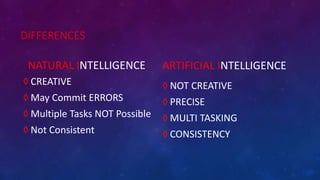
DIFFERENCES
NATURAL INTELLIGENCE
◊ CREATIVE
◊ May Commit ERRORS
◊ Multiple Tasks NOT Possible
◊ Not Consistent
ARTIFICIAL INTELLIGENCE
◊ NOT CREATIVE
◊ PRECISE
◊ MULTI TASKING
◊ CONSISTENCY
HISTORY OF Artificial Intelligence
 Advancements in Programmable Computers in the early 1940’s
 British mathematician Alan Turing’s 1950 paper on Computing
Machinery and Intelligence, opens with the words:
“I propose to consider the question,
‘Can machines think?’”
The term ‘Artificial Intelligence’ was Coined at a conference held
at Dartmouth College in 1956.
• In 1958, MIT Artificial Intelligence lab was established.
• The year 1958, LISP, a Programming Language was developed by
John McCarthy.
 AI Boom 1980-1987
o Rise in Machine Learning and development of Expert Systems.
 AI Winter 1987-1993
o AI Suffered a series of Financial setbacks.
Present Day AI is a much sought after field of research with it’s
applications in several fields.
APPLICATIONS OF Artificial Intelligence
Computer Science:
o Face Recognition
o Virtual Reality
o Game AI
Finance:
o Artificial Neural Networks to detect fake Stock claims.
o Since 1987 unauthorized use of debit cards was prevented by AI
Systems.
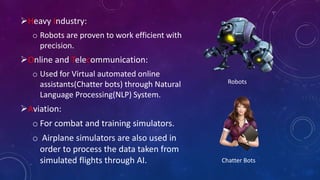
Heavy Industry:
o Robots are proven to work efficient with
precision.
Online and Telecommunication:
o Used for Virtual automated online
assistants(Chatter bots) through Natural
Language Processing(NLP) System.
Aviation:
o For combat and training simulators.
o Airplane simulators are also used in
order to process the data taken from
simulated flights through AI.
Robots
Chatter Bots
OBJECTIVE OF AI
AI is used to automate anything and almost everything
from real world.
To design fault proof systems by eliminating human error.
AI is employed to solve complex problems in an efficient
way using its disciplines.
In essence the existence of AI systems is to make the
works of humans easier.
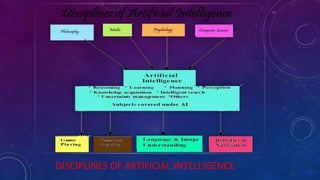
DISCIPLINES OF ARTIFICIAL INTELLIGENCE
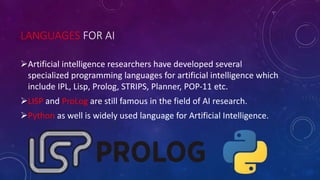
LANGUAGES FOR AI
Artificial intelligence researchers have developed several
specialized programming languages for artificial intelligence which
include IPL, Lisp, Prolog, STRIPS, Planner, POP-11 etc.
LISP and ProLog are still famous in the field of AI research.
Python as well is widely used language for Artificial Intelligence.
COMPONENTS OF AI
AI techniques must be independent of the problem
domain as far as possible.
AI program should have:
o Knowledge Base
o Navigational Capability
o Inferencing
Knowledge Base:
o It consists of facts and rules.
o Characteristics of Knowledge:
• It may be incomplete and imprecise.
• It may keep on changing (dynamic).
o So AI programs should be learning in nature and update its
knowledge accordingly.
Navigational Capability:
o Navigational capability contains various control strategies that
determine the rules to be applied.
Inference:
o Inferencing requires search through knowledge base and derive new
knowledge
DEFINITION OF SOFT COMPUTING
Soft Computing is a term applied to a field within
computer science which is characterized by the use of
inexact solutions to computationally-hard tasks such as
the solution of problems, for which an exact solution can
not be derived in polynomial time.
The principal Aim of Soft Computing is to exploit the
tolerance of uncertainty and vagueness in AI Systems.
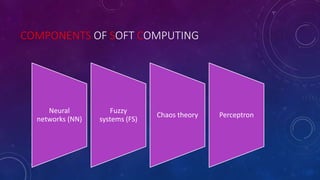
COMPONENTS OF SOFT COMPUTING
Neural
networks (NN)
Fuzzy
systems (FS)
Chaos theory Perceptron
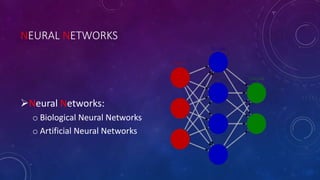
NEURAL NETWORKS
Neural Networks:
o Biological Neural Networks
o Artificial Neural Networks
FUZZY LOGIC
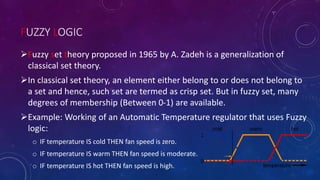
Fuzzy set theory proposed in 1965 by A. Zadeh is a generalization of
classical set theory.
In classical set theory, an element either belong to or does not belong to
a set and hence, such set are termed as crisp set. But in fuzzy set, many
degrees of membership (Between 0-1) are available.
Example: Working of an Automatic Temperature regulator that uses Fuzzy
logic:
o IF temperature IS cold THEN fan speed is zero.
o IF temperature IS warm THEN fan speed is moderate.
o IF temperature IS hot THEN fan speed is high.
CONCLUSION
AI is at the centre of a new enterprise to build computational
models of intelligence.
Renowned persons like Stephen Hawking and Bill Gates predict
that the rise in dependence on the automated systems like that of
AI can outperform Human experts.
There is a need to control this outbreak in technology before it’s
out of control.
This brings us to a conundrum, is Technology boon or bane? The
answer for that would depend on the way its put in to the world.
Artificial intelligence original

Artificial intelligence original

  • 1.
  • 2.
    CONTENTS  What isAI?  Differences Between Artificial Intelligence and Natural Intelligence  History of AI  Applications of AI  Objective of AI  Disciplines of Artificial Intelligence  Languages for AI  Components for AI  Definition of Soft Computing  Components of Soft Computing  Neural Networks  Fuzzy Logic  Conclusion
  • 3.
    What is ArtificialIntelligence ? • Artificial: A copy of something which is Natural • Intelligence: The ability to apply and acquire knowledge and skills  Intelligence is a property which is most widely studied in humans.  So Artificial Intelligence(AI) can be defined as the intelligence in machines which evolved out of human creation.
  • 4.
    DIFFERENCES NATURAL INTELLIGENCE ◊ CREATIVE ◊May Commit ERRORS ◊ Multiple Tasks NOT Possible ◊ Not Consistent ARTIFICIAL INTELLIGENCE ◊ NOT CREATIVE ◊ PRECISE ◊ MULTI TASKING ◊ CONSISTENCY
  • 5.
    HISTORY OF ArtificialIntelligence  Advancements in Programmable Computers in the early 1940’s  British mathematician Alan Turing’s 1950 paper on Computing Machinery and Intelligence, opens with the words: “I propose to consider the question, ‘Can machines think?’” The term ‘Artificial Intelligence’ was Coined at a conference held at Dartmouth College in 1956.
  • 6.
    • In 1958,MIT Artificial Intelligence lab was established. • The year 1958, LISP, a Programming Language was developed by John McCarthy.  AI Boom 1980-1987 o Rise in Machine Learning and development of Expert Systems.  AI Winter 1987-1993 o AI Suffered a series of Financial setbacks. Present Day AI is a much sought after field of research with it’s applications in several fields.
  • 7.
    APPLICATIONS OF ArtificialIntelligence Computer Science: o Face Recognition o Virtual Reality o Game AI Finance: o Artificial Neural Networks to detect fake Stock claims. o Since 1987 unauthorized use of debit cards was prevented by AI Systems.
  • 8.
    Heavy Industry: o Robotsare proven to work efficient with precision. Online and Telecommunication: o Used for Virtual automated online assistants(Chatter bots) through Natural Language Processing(NLP) System. Aviation: o For combat and training simulators. o Airplane simulators are also used in order to process the data taken from simulated flights through AI. Robots Chatter Bots
  • 9.
    OBJECTIVE OF AI AIis used to automate anything and almost everything from real world. To design fault proof systems by eliminating human error. AI is employed to solve complex problems in an efficient way using its disciplines. In essence the existence of AI systems is to make the works of humans easier.
  • 10.
  • 11.
    LANGUAGES FOR AI Artificialintelligence researchers have developed several specialized programming languages for artificial intelligence which include IPL, Lisp, Prolog, STRIPS, Planner, POP-11 etc. LISP and ProLog are still famous in the field of AI research. Python as well is widely used language for Artificial Intelligence.
  • 12.
    COMPONENTS OF AI AItechniques must be independent of the problem domain as far as possible. AI program should have: o Knowledge Base o Navigational Capability o Inferencing
  • 13.
    Knowledge Base: o Itconsists of facts and rules. o Characteristics of Knowledge: • It may be incomplete and imprecise. • It may keep on changing (dynamic). o So AI programs should be learning in nature and update its knowledge accordingly. Navigational Capability: o Navigational capability contains various control strategies that determine the rules to be applied. Inference: o Inferencing requires search through knowledge base and derive new knowledge
  • 14.
    DEFINITION OF SOFTCOMPUTING Soft Computing is a term applied to a field within computer science which is characterized by the use of inexact solutions to computationally-hard tasks such as the solution of problems, for which an exact solution can not be derived in polynomial time. The principal Aim of Soft Computing is to exploit the tolerance of uncertainty and vagueness in AI Systems.
  • 15.
    COMPONENTS OF SOFTCOMPUTING Neural networks (NN) Fuzzy systems (FS) Chaos theory Perceptron
  • 16.
    NEURAL NETWORKS Neural Networks: oBiological Neural Networks o Artificial Neural Networks
  • 17.
    FUZZY LOGIC Fuzzy settheory proposed in 1965 by A. Zadeh is a generalization of classical set theory. In classical set theory, an element either belong to or does not belong to a set and hence, such set are termed as crisp set. But in fuzzy set, many degrees of membership (Between 0-1) are available. Example: Working of an Automatic Temperature regulator that uses Fuzzy logic: o IF temperature IS cold THEN fan speed is zero. o IF temperature IS warm THEN fan speed is moderate. o IF temperature IS hot THEN fan speed is high.
  • 18.
    CONCLUSION AI is atthe centre of a new enterprise to build computational models of intelligence. Renowned persons like Stephen Hawking and Bill Gates predict that the rise in dependence on the automated systems like that of AI can outperform Human experts. There is a need to control this outbreak in technology before it’s out of control. This brings us to a conundrum, is Technology boon or bane? The answer for that would depend on the way its put in to the world.