ALZHEIMER’S DISEASE 
SUBJECT: SYSTEMIC PHARMACOLGY 
20-10-2014 
MERIN BABU 
M.Pharm 1st Semester 
Department of Pharmacology
ALZHEIMER’S DISEASE 
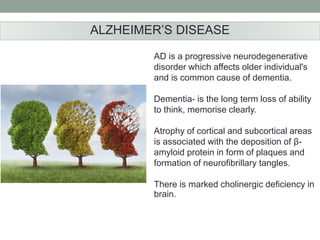
AD is a progressive neurodegenerative 
disorder which affects older individual's 
and is common cause of dementia. 
Dementia- is the long term loss of ability 
to think, memorise clearly. 
Atrophy of cortical and subcortical areas 
is associated with the deposition of β- 
amyloid protein in form of plaques and 
formation of neurofibrillary tangles. 
There is marked cholinergic deficiency in 
brain.
STAGES OF ALZHEIMER’S DISEASE 
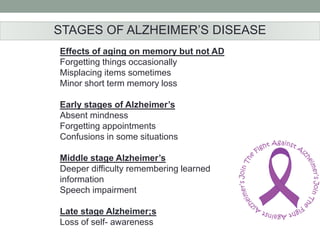
Effects of aging on memory but not AD 
Forgetting things occasionally 
Misplacing items sometimes 
Minor short term memory loss 
Early stages of Alzheimer’s 
Absent mindness 
Forgetting appointments 
Confusions in some situations 
Middle stage Alzheimer’s 
Deeper difficulty remembering learned 
information 
Speech impairment 
Late stage Alzheimer;s 
Loss of self- awareness
CAUSES OF ALZHEIMER’S- EARLY ONSET 
 Due to alterations on chromosome 1,14 and 21. 
 Mutation on chromosome 14 --- produces a protein PRESENILIN 1 
(PSEN1). 
 Mutation on chromosome 1 --- produces a protein PRESENILIN 2 
(PSEN2). 
 PRESENILIN 1 & 2 encode for membrane protein involved for AMYLOID 
PRECURSOR PROTEIN (APP). 
 Mutations lead to activity of γ-secretase , an enzyme important in β- 
amyloid peptide (βAP) formation. 
 APP is encoded on chromosome 21. 
 Mutation on APP gene – overproduction of βAP.
CAUSES OF ALZHEIMER’S- LATE ONSET 
 Due to apo-lipoprotein E ( apoE) gene. 
 Gene responsible for production of apoE gene – chromosome 19. 
 Inheritance of apoE4 allele posses genetic risk in sporadic AD. 
 Degree of risk depends on: 
Number of copies of apoE4 genes 
Age 
Ethnicity 
 Presence of apoE4 allele increases risk of developing late onset AD.
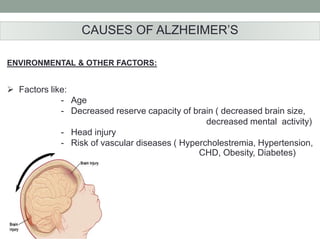
CAUSES OF ALZHEIMER’S 
ENVIRONMENTAL & OTHER FACTORS: 
 Factors like: 
- Age 
- Decreased reserve capacity of brain ( decreased brain size, 
decreased mental activity) 
- Head injury 
- Risk of vascular diseases ( Hypercholestremia, Hypertension, 
CHD, Obesity, Diabetes)
PATHOPHYSIOLOGY 
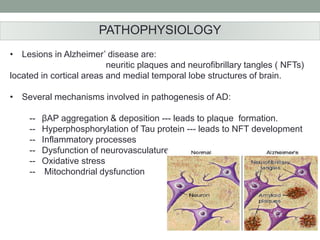
• Lesions in Alzheimer’ disease are: 
neuritic plaques and neurofibrillary tangles ( NFTs) 
located in cortical areas and medial temporal lobe structures of brain. 
• Several mechanisms involved in pathogenesis of AD: 
-- βAP aggregation & deposition --- leads to plaque formation. 
-- Hyperphosphorylation of Tau protein --- leads to NFT development 
-- Inflammatory processes 
-- Dysfunction of neurovasculature 
-- Oxidative stress 
-- Mitochondrial dysfunction
PATHOPHYSIOLOGY 
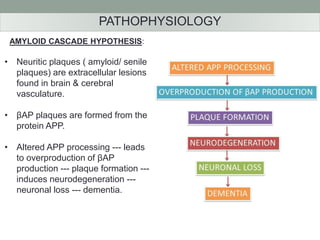
AMYLOID CASCADE HYPOTHESIS: 
• Neuritic plaques ( amyloid/ senile 
plaques) are extracellular lesions 
found in brain & cerebral 
vasculature. 
• βAP plaques are formed from the 
protein APP. 
• Altered APP processing --- leads 
to overproduction of βAP 
production --- plaque formation --- 
induces neurodegeneration --- 
neuronal loss --- dementia.
PATHOPHYSIOLOGY 
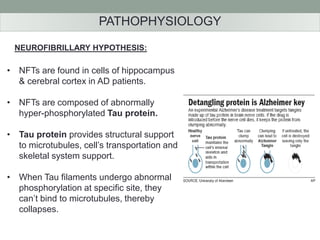
NEUROFIBRILLARY HYPOTHESIS: 
• NFTs are found in cells of hippocampus 
& cerebral cortex in AD patients. 
• NFTs are composed of abnormally 
hyper-phosphorylated Tau protein. 
• Tau protein provides structural support 
to microtubules, cell’s transportation and 
skeletal system support. 
• When Tau filaments undergo abnormal 
phosphorylation at specific site, they 
can’t bind to microtubules, thereby 
collapses.
PATHOPHYSIOLOGY 
INFLAMMATORY MEDIATORS: 
• Brain amyloid deposition is associated with local inflammatory and 
immunologic alleviations. 
• It is associated with release of Nitric oxide, cytokines, other radical 
species & complement factors that injure neurons and promote 
inflammation. 
CHOLINERGIC HYPOTHESIS: 
• Loss of cholinergic activity correlates with AD severity. 
• In late AD, number of cholinergic neurons are decreased, loss of 
nicotinic receptors in hippocampus and cortex.
PATHOPHYSIOLOGY 
OTHER NEUROTRANSMITTER ABNORMALITIES: 
• Glutamate & other excitatory amino acid NTs act as potential 
neurotoxins for AD. 
• If glutamate remains in synapse for a long period of time : destroys 
nerve cells. 
• Blocking of NMDA receptors decreases the glutamate activity in 
synapse – decreases cellular injury in AD. 
BRAIN VASCULAR DISEASE & HIGH CHOLESTROL: 
• ApoE lipoprotein (synthesised in liver, CNS and CSF) carries cholesterol 
in blood through brain. 
• ApoE4 is associated with increased deposition of βAP. 
• Increased cholesterol in brain neurons --- alter membrane functioning --- 
leads to plaque formation --- Alzheimer’s disease.
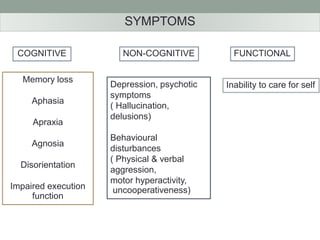
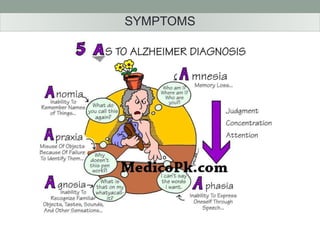
SYMPTOMS 
COGNITIVE NON-COGNITIVE FUNCTIONAL 
Memory loss 
Aphasia 
Apraxia 
Agnosia 
Disorientation 
Impaired execution 
function 
Depression, psychotic 
symptoms 
( Hallucination, 
delusions) 
Behavioural 
disturbances 
( Physical & verbal 
aggression, 
motor hyperactivity, 
uncooperativeness) 
Inability to care for self
SYMPTOMS
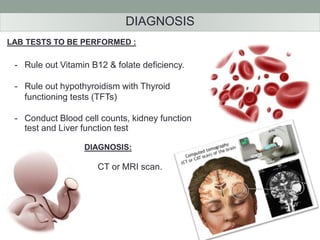
DIAGNOSIS 
LAB TESTS TO BE PERFORMED : 
- Rule out Vitamin B12 & folate deficiency. 
- Rule out hypothyroidism with Thyroid 
functioning tests (TFTs) 
- Conduct Blood cell counts, kidney function 
test and Liver function test 
DIAGNOSIS: 
CT or MRI scan.
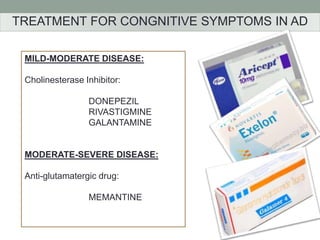
TREATMENT FOR CONGNITIVE SYMPTOMS IN AD 
MILD-MODERATE DISEASE: 
Cholinesterase Inhibitor: 
DONEPEZIL 
RIVASTIGMINE 
GALANTAMINE 
MODERATE-SEVERE DISEASE: 
Anti-glutamatergic drug: 
MEMANTINE
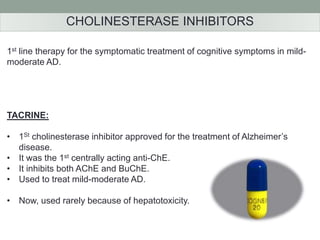
CHOLINESTERASE INHIBITORS 
1st line therapy for the symptomatic treatment of cognitive symptoms in mild-moderate 
AD. 
TACRINE: 
• 1St cholinesterase inhibitor approved for the treatment of Alzheimer’s 
disease. 
• It was the 1st centrally acting anti-ChE. 
• It inhibits both AChE and BuChE. 
• Used to treat mild-moderate AD. 
• Now, used rarely because of hepatotoxicity.
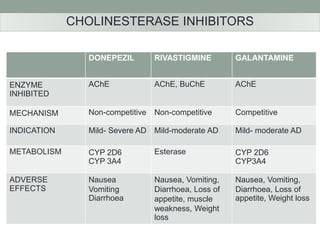
CHOLINESTERASE INHIBITORS 
DONEPEZIL RIVASTIGMINE GALANTAMINE 
ENZYME 
INHIBITED 
AChE AChE, BuChE AChE 
MECHANISM Non-competitive Non-competitive Competitive 
INDICATION Mild- Severe AD Mild-moderate AD Mild- moderate AD 
METABOLISM CYP 2D6 
CYP 3A4 
Esterase CYP 2D6 
CYP3A4 
ADVERSE 
EFFECTS 
Nausea 
Vomiting 
Diarrhoea 
Nausea, Vomiting, 
Diarrhoea, Loss of 
appetite, muscle 
weakness, Weight 
loss 
Nausea, Vomiting, 
Diarrhoea, Loss of 
appetite, Weight loss
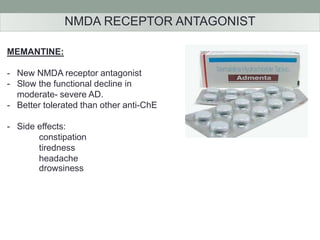
NMDA RECEPTOR ANTAGONIST 
MEMANTINE: 
- New NMDA receptor antagonist 
- Slow the functional decline in 
moderate- severe AD. 
- Better tolerated than other anti-ChE 
- Side effects: 
constipation 
tiredness 
headache 
drowsiness
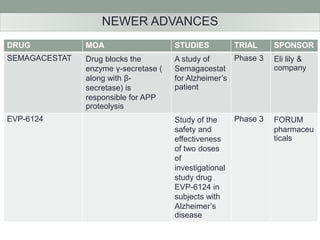
DRUG MOA STUDIES TRIAL SPONSOR 
SEMAGACESTAT Drug blocks the 
enzyme γ-secretase ( 
along with β- 
secretase) is 
responsible for APP 
proteolysis 
A study of 
Semagacestat 
for Alzheimer’s 
patient 
Phase 3 Eli lily & 
company 
EVP-6124 Study of the 
safety and 
effectiveness 
of two doses 
of 
investigational 
study drug 
EVP-6124 in 
subjects with 
Alzheimer’s 
disease 
Phase 3 FORUM 
pharmaceu 
ticals 
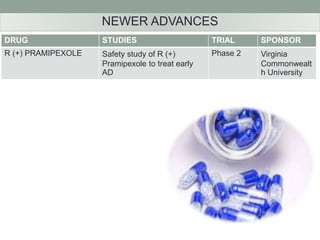
NEWER ADVANCES
NEWER ADVANCES 
DRUG STUDIES TRIAL SPONSOR 
R (+) PRAMIPEXOLE Safety study of R (+) 
Pramipexole to treat early 
AD 
Phase 2 Virginia 
Commonwealt 
h University
REFERENCE 
i. Laurence L.B, Bruce A C, Bjorn C K. Goodman and Gilman’s The 
Pharmacological Basis of Therapeutics.2011. 12th edition. China: Mc Graw Hill 
books; pp: 619- 623. 
ii. Dipiro J T, Talbert R L, Yee G C et al. Pharmacotherapy- A Pathophysiological 
Approach. 7th edition. China : Mc Graw Hill books; pp: 1085. 
iii. Roger Walker, Cate Whittlesea. Clinical pharmacy and therapeutics. 5th edition. 
Sydney: Churchill Livingstone; 2012. 
iv. KD Tripathi, Essentials of medical pharmacology. 6th edition. New Delhi : Jaypee 
Brothers Medial Publishers; 2009. 
v. http://wikipedia.com 
vi. www.clinicaltrials.org

Alzheimer's disease

  • 1.
    ALZHEIMER’S DISEASE SUBJECT:SYSTEMIC PHARMACOLGY 20-10-2014 MERIN BABU M.Pharm 1st Semester Department of Pharmacology
  • 2.
    ALZHEIMER’S DISEASE ADis a progressive neurodegenerative disorder which affects older individual's and is common cause of dementia. Dementia- is the long term loss of ability to think, memorise clearly. Atrophy of cortical and subcortical areas is associated with the deposition of β- amyloid protein in form of plaques and formation of neurofibrillary tangles. There is marked cholinergic deficiency in brain.
  • 3.
    STAGES OF ALZHEIMER’SDISEASE Effects of aging on memory but not AD Forgetting things occasionally Misplacing items sometimes Minor short term memory loss Early stages of Alzheimer’s Absent mindness Forgetting appointments Confusions in some situations Middle stage Alzheimer’s Deeper difficulty remembering learned information Speech impairment Late stage Alzheimer;s Loss of self- awareness
  • 4.
    CAUSES OF ALZHEIMER’S-EARLY ONSET  Due to alterations on chromosome 1,14 and 21.  Mutation on chromosome 14 --- produces a protein PRESENILIN 1 (PSEN1).  Mutation on chromosome 1 --- produces a protein PRESENILIN 2 (PSEN2).  PRESENILIN 1 & 2 encode for membrane protein involved for AMYLOID PRECURSOR PROTEIN (APP).  Mutations lead to activity of γ-secretase , an enzyme important in β- amyloid peptide (βAP) formation.  APP is encoded on chromosome 21.  Mutation on APP gene – overproduction of βAP.
  • 5.
    CAUSES OF ALZHEIMER’S-LATE ONSET  Due to apo-lipoprotein E ( apoE) gene.  Gene responsible for production of apoE gene – chromosome 19.  Inheritance of apoE4 allele posses genetic risk in sporadic AD.  Degree of risk depends on: Number of copies of apoE4 genes Age Ethnicity  Presence of apoE4 allele increases risk of developing late onset AD.
  • 6.
    CAUSES OF ALZHEIMER’S ENVIRONMENTAL & OTHER FACTORS:  Factors like: - Age - Decreased reserve capacity of brain ( decreased brain size, decreased mental activity) - Head injury - Risk of vascular diseases ( Hypercholestremia, Hypertension, CHD, Obesity, Diabetes)
  • 7.
    PATHOPHYSIOLOGY • Lesionsin Alzheimer’ disease are: neuritic plaques and neurofibrillary tangles ( NFTs) located in cortical areas and medial temporal lobe structures of brain. • Several mechanisms involved in pathogenesis of AD: -- βAP aggregation & deposition --- leads to plaque formation. -- Hyperphosphorylation of Tau protein --- leads to NFT development -- Inflammatory processes -- Dysfunction of neurovasculature -- Oxidative stress -- Mitochondrial dysfunction
  • 8.
    PATHOPHYSIOLOGY AMYLOID CASCADEHYPOTHESIS: • Neuritic plaques ( amyloid/ senile plaques) are extracellular lesions found in brain & cerebral vasculature. • βAP plaques are formed from the protein APP. • Altered APP processing --- leads to overproduction of βAP production --- plaque formation --- induces neurodegeneration --- neuronal loss --- dementia.
  • 9.
    PATHOPHYSIOLOGY NEUROFIBRILLARY HYPOTHESIS: • NFTs are found in cells of hippocampus & cerebral cortex in AD patients. • NFTs are composed of abnormally hyper-phosphorylated Tau protein. • Tau protein provides structural support to microtubules, cell’s transportation and skeletal system support. • When Tau filaments undergo abnormal phosphorylation at specific site, they can’t bind to microtubules, thereby collapses.
  • 10.
    PATHOPHYSIOLOGY INFLAMMATORY MEDIATORS: • Brain amyloid deposition is associated with local inflammatory and immunologic alleviations. • It is associated with release of Nitric oxide, cytokines, other radical species & complement factors that injure neurons and promote inflammation. CHOLINERGIC HYPOTHESIS: • Loss of cholinergic activity correlates with AD severity. • In late AD, number of cholinergic neurons are decreased, loss of nicotinic receptors in hippocampus and cortex.
  • 11.
    PATHOPHYSIOLOGY OTHER NEUROTRANSMITTERABNORMALITIES: • Glutamate & other excitatory amino acid NTs act as potential neurotoxins for AD. • If glutamate remains in synapse for a long period of time : destroys nerve cells. • Blocking of NMDA receptors decreases the glutamate activity in synapse – decreases cellular injury in AD. BRAIN VASCULAR DISEASE & HIGH CHOLESTROL: • ApoE lipoprotein (synthesised in liver, CNS and CSF) carries cholesterol in blood through brain. • ApoE4 is associated with increased deposition of βAP. • Increased cholesterol in brain neurons --- alter membrane functioning --- leads to plaque formation --- Alzheimer’s disease.
  • 12.
    SYMPTOMS COGNITIVE NON-COGNITIVEFUNCTIONAL Memory loss Aphasia Apraxia Agnosia Disorientation Impaired execution function Depression, psychotic symptoms ( Hallucination, delusions) Behavioural disturbances ( Physical & verbal aggression, motor hyperactivity, uncooperativeness) Inability to care for self
  • 13.
  • 14.
    DIAGNOSIS LAB TESTSTO BE PERFORMED : - Rule out Vitamin B12 & folate deficiency. - Rule out hypothyroidism with Thyroid functioning tests (TFTs) - Conduct Blood cell counts, kidney function test and Liver function test DIAGNOSIS: CT or MRI scan.
  • 15.
    TREATMENT FOR CONGNITIVESYMPTOMS IN AD MILD-MODERATE DISEASE: Cholinesterase Inhibitor: DONEPEZIL RIVASTIGMINE GALANTAMINE MODERATE-SEVERE DISEASE: Anti-glutamatergic drug: MEMANTINE
  • 16.
    CHOLINESTERASE INHIBITORS 1stline therapy for the symptomatic treatment of cognitive symptoms in mild-moderate AD. TACRINE: • 1St cholinesterase inhibitor approved for the treatment of Alzheimer’s disease. • It was the 1st centrally acting anti-ChE. • It inhibits both AChE and BuChE. • Used to treat mild-moderate AD. • Now, used rarely because of hepatotoxicity.
  • 17.
    CHOLINESTERASE INHIBITORS DONEPEZILRIVASTIGMINE GALANTAMINE ENZYME INHIBITED AChE AChE, BuChE AChE MECHANISM Non-competitive Non-competitive Competitive INDICATION Mild- Severe AD Mild-moderate AD Mild- moderate AD METABOLISM CYP 2D6 CYP 3A4 Esterase CYP 2D6 CYP3A4 ADVERSE EFFECTS Nausea Vomiting Diarrhoea Nausea, Vomiting, Diarrhoea, Loss of appetite, muscle weakness, Weight loss Nausea, Vomiting, Diarrhoea, Loss of appetite, Weight loss
  • 18.
    NMDA RECEPTOR ANTAGONIST MEMANTINE: - New NMDA receptor antagonist - Slow the functional decline in moderate- severe AD. - Better tolerated than other anti-ChE - Side effects: constipation tiredness headache drowsiness
  • 19.
    DRUG MOA STUDIESTRIAL SPONSOR SEMAGACESTAT Drug blocks the enzyme γ-secretase ( along with β- secretase) is responsible for APP proteolysis A study of Semagacestat for Alzheimer’s patient Phase 3 Eli lily & company EVP-6124 Study of the safety and effectiveness of two doses of investigational study drug EVP-6124 in subjects with Alzheimer’s disease Phase 3 FORUM pharmaceu ticals NEWER ADVANCES
  • 20.
    NEWER ADVANCES DRUGSTUDIES TRIAL SPONSOR R (+) PRAMIPEXOLE Safety study of R (+) Pramipexole to treat early AD Phase 2 Virginia Commonwealt h University
  • 21.
    REFERENCE i. LaurenceL.B, Bruce A C, Bjorn C K. Goodman and Gilman’s The Pharmacological Basis of Therapeutics.2011. 12th edition. China: Mc Graw Hill books; pp: 619- 623. ii. Dipiro J T, Talbert R L, Yee G C et al. Pharmacotherapy- A Pathophysiological Approach. 7th edition. China : Mc Graw Hill books; pp: 1085. iii. Roger Walker, Cate Whittlesea. Clinical pharmacy and therapeutics. 5th edition. Sydney: Churchill Livingstone; 2012. iv. KD Tripathi, Essentials of medical pharmacology. 6th edition. New Delhi : Jaypee Brothers Medial Publishers; 2009. v. http://wikipedia.com vi. www.clinicaltrials.org