Presented by: Santos Alvarado
Developing better tools to identify those works that actually are in the public domain. Orphan works lack sufficient information to identify their owners.
“ Implied licenses give you rights to, uh, well, uh, that's the problem with implied licenses, they're not real clear -- but they're there and within reason you can and should rely on them”
 
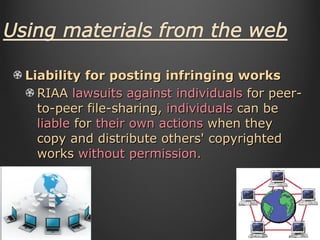
Liability for posting infringing works RIAA   lawsuits against individuals  for peer-to-peer file-sharing,  individuals  can be  liable   for   their own actions  when they copy and distribute others' copyrighted works  without permission.
Fair use is better described as a shadowy territory whose boundaries are disputed. Penalties for infringement are very harsh:  the court can award up to  $150,000  for each separate act of willful infringement.
Answer these three questions to decide whether you need permission to use a copyrighted work. Is the work protected? If the work is protected, has your campus already licensed rights for you to use the work? Is the work available freely on the open Web, and therefor covered by an implied license?
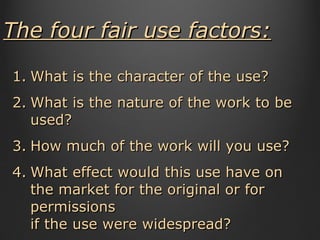
The four fair use factors: What is the character of the use?  What is the nature of the work to be used?  How much of the work will you use?  What effect would this use have on the market for the original or for permissions  if the use were widespread?
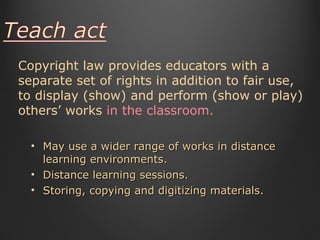
May use a wider range of works in distance learning environments.  Distance learning sessions. Storing, copying and digitizing materials.  Copyright law provides educators with a separate set of rights in addition to fair use, to display (show) and perform (show or play) others’ works  in the classroom.
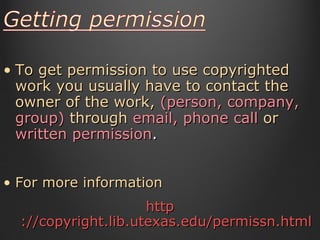
To get permission to use copyrighted work you usually have to contact the owner of the work,  (person, company, group)  through   email, phone call  or   written permission .  For more information http ://copyright.lib.utexas.edu/permissn.html
Reference The Copyright Crash Course  © 2001, 2007 Georgia K. Harper

alvarado revised copyright crash course

  • 1.
  • 2.
    Developing better toolsto identify those works that actually are in the public domain. Orphan works lack sufficient information to identify their owners.
  • 3.
    “ Implied licensesgive you rights to, uh, well, uh, that's the problem with implied licenses, they're not real clear -- but they're there and within reason you can and should rely on them”
  • 4.
  • 5.
    Liability for postinginfringing works RIAA lawsuits against individuals for peer-to-peer file-sharing, individuals can be liable for their own actions when they copy and distribute others' copyrighted works without permission.
  • 6.
    Fair use isbetter described as a shadowy territory whose boundaries are disputed. Penalties for infringement are very harsh: the court can award up to $150,000 for each separate act of willful infringement.
  • 7.
    Answer these threequestions to decide whether you need permission to use a copyrighted work. Is the work protected? If the work is protected, has your campus already licensed rights for you to use the work? Is the work available freely on the open Web, and therefor covered by an implied license?
  • 8.
    The four fairuse factors: What is the character of the use? What is the nature of the work to be used? How much of the work will you use? What effect would this use have on the market for the original or for permissions if the use were widespread?
  • 9.
    May use awider range of works in distance learning environments. Distance learning sessions. Storing, copying and digitizing materials. Copyright law provides educators with a separate set of rights in addition to fair use, to display (show) and perform (show or play) others’ works in the classroom.
  • 10.
    To get permissionto use copyrighted work you usually have to contact the owner of the work, (person, company, group) through email, phone call or written permission . For more information http ://copyright.lib.utexas.edu/permissn.html
  • 11.
    Reference The CopyrightCrash Course © 2001, 2007 Georgia K. Harper