Crash Course
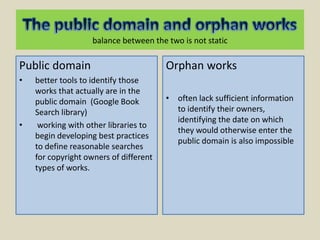
The public domain and orphan worksbalance between the two is not staticPublic domainbetter tools to identify those works that actually are in the public domain  (Google Book Search library) working with other libraries to begin developing best practices to define reasonable searches for copyright owners of different types of works. Orphan worksoften lack sufficient information to identify their owners, identifying the date on which they would otherwise enter the public domain is also impossible
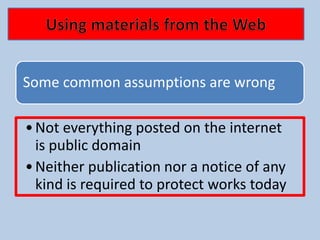
Using materials from the Web
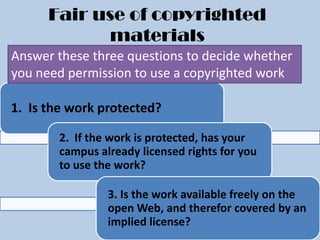
Fair use of copyrighted materialsAnswer these three questions to decide whether you need permission to use a copyrighted work
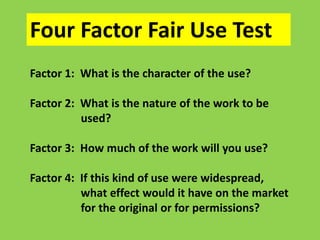
Four Factor Fair Use TestFactor 1:  What is the character of the use?Factor 2:  What is the nature of the work to be                  used?Factor 3:  How much of the work will you use?Factor 4:  If this kind of use were widespread,                  what effect would it have on the market                  for the original or for permissions?
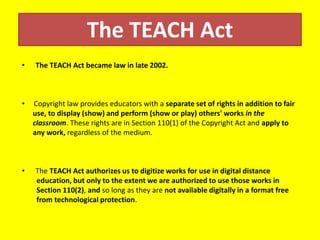
The TEACH Act      The TEACH Act became law in late 2002.
     Copyright law provides educators with a separate set of rights in addition to fair      use, to display (show) and perform (show or play) others' works in the      classroom. These rights are in Section 110(1) of the Copyright Act and apply to      any work, regardless of the medium.       The TEACH Act authorizes us to digitize works for use in digital distance         education, but only to the extent we are authorized to use those works in         Section 110(2), and so long as they are not available digitally in a format free        from technological protection.
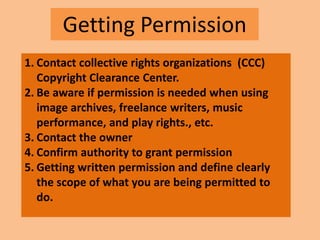
Getting PermissionContact collective rights organizations  (CCC) Copyright Clearance Center.Be aware if permission is needed when using image archives, freelance writers, music performance, and play rights., etc.Contact the ownerConfirm authority to grant permissionGetting written permission and define clearly the scope of what you are being permitted to do.

Copyright crash course 2 ppt 6340

  • 1.
  • 2.
    The public domainand orphan worksbalance between the two is not staticPublic domainbetter tools to identify those works that actually are in the public domain (Google Book Search library) working with other libraries to begin developing best practices to define reasonable searches for copyright owners of different types of works. Orphan worksoften lack sufficient information to identify their owners, identifying the date on which they would otherwise enter the public domain is also impossible
  • 3.
  • 6.
    Fair use ofcopyrighted materialsAnswer these three questions to decide whether you need permission to use a copyrighted work
  • 7.
    Four Factor FairUse TestFactor 1: What is the character of the use?Factor 2: What is the nature of the work to be used?Factor 3: How much of the work will you use?Factor 4: If this kind of use were widespread, what effect would it have on the market for the original or for permissions?
  • 8.
    The TEACH Act The TEACH Act became law in late 2002.
  • 9.
    Copyright law provides educators with a separate set of rights in addition to fair use, to display (show) and perform (show or play) others' works in the classroom. These rights are in Section 110(1) of the Copyright Act and apply to any work, regardless of the medium. The TEACH Act authorizes us to digitize works for use in digital distance education, but only to the extent we are authorized to use those works in Section 110(2), and so long as they are not available digitally in a format free from technological protection.
  • 10.
    Getting PermissionContact collectiverights organizations (CCC) Copyright Clearance Center.Be aware if permission is needed when using image archives, freelance writers, music performance, and play rights., etc.Contact the ownerConfirm authority to grant permissionGetting written permission and define clearly the scope of what you are being permitted to do.