Alternative impact measures for open access documents?
An examination how to generate interoperable usage
information from distributed open access services


IFLA 2010
Session 72 - Statistics and Evaluation
Göteborg, 11.08.2010


Initiated by:    Ulrich Herb                                      Funded by:
                 Saarland University and State Library, Germany
                 u.herb@sulb.uni-saarland.de
Overview
 Impact measures:
   relevance
   a categorisation


 Usage-based impact measures: standardisation?

 Project: Open Access Statistics
   Aims
   Technical infrastructure
   Results
   Outlook
Impact Measures

„The ‚impact factor‘ is the most commonly used
assessment aid for deciding which journals should receive
a scholarly submission or attention from research
readership. It is also an often misunderstood tool.“
Dong et al. 2005


                                                            3
Impact measures: relevance
 Individual level: publish or perish

   If a scientist does not publish she/he does not have any
   scientific capital, reputation or impact
   Without any impact, she/he won’t make her/his career


 Organisational level: evaluation

   Evaluation results determine prospective resources of
   institutes and the future main research
   Criteria: number of doctoral candidates, amount of third
   party funds, publications
From publications to impact
 Scientific reputation (or scientific capital) is
 derived from publication impact

 Impact is calculated mostly by citation measures
   Journal impact factor (JIF)
   Hirsch-index (h-index)

    Especially within the STM domain
Citation impact: calculation
JIF
In year X, the impact factor of a journal Y is the
average number of citations to articles that were
published in Y during the two years preceding X
Garfield: „We never predicted that people would turn this into an evaluation tool for
giving out grants and funding.“ From: Richard Monastersky (2005), The Number That's
Devouring Science The Chronicle of Higher Education


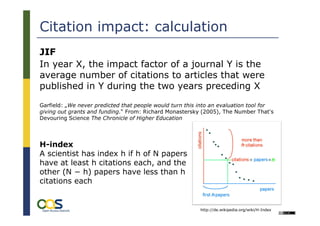
H-index
A scientist has index h if h of N papers
have at least h citations each, and the
other (N − h) papers have less than h
citations each


                                                          http://de.wikipedia.org/wiki/H-Index
Citation impact: critical points
 Restricted scope, exclusion of many publication types
 Based exclusively on journal citation reports / web of
 science (JIF) or other databases
 Language bias: items in English language are
 overrepresented within the database, so they reach
 higher citation scores
 JIF focuses on journals: few articles evoke most
 citations
 JIF discriminates disciplines with lifecycles of scientific
 information > 2 years

   Mixture of quality and popularity
Impact measures: a categorisation
 Citation based measures
   Author-centred
   Delayed measurement: at first in the following generation of
   publications
   Impact of a separate object is mostly not described


 Usage based measures
   Reader-centred
   Measuring: on-the-fly and consecutive
   Impact of a separate object can be described
   Automated measurement is possible
Impact measures: a categorisation, pt. II
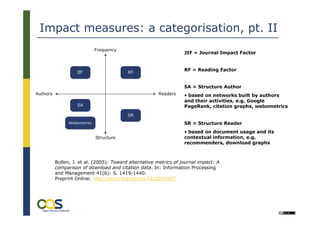
                                                           JIF = Journal Impact Factor


                                                           RF = Reading Factor


                                                           SA = Structure Author
                                                           • based on networks built by authors
                                                           and their activities, e.g. Google
                                                           PageRank, citation graphs, webometrics


                                                           SR = Structure Reader
                                                           • based on document usage and its
                                                           contextual information, e.g.
                                                           recommenders, download graphs


  Bollen, J. et al. (2005): Toward alternative metrics of journal impact: A
  comparison of download and citation data. In: Information Processing
  and Management 41(6): S. 1419-1440.
  Preprint Online: http://arxiv.org/abs/cs.DL/0503007
Standards


„An important issue, however, was the lack of standards
on how to produce and report the usage data in a way that
could be compared“
Baker et al. 2008


        OL2OC – Open Linking to Open Content, München, 24. 11.2009
        Was zählt? – Nutzungsstatistiken als alternative Impact Messung,
        Daniel Metje
Usage based impact: standardisation?


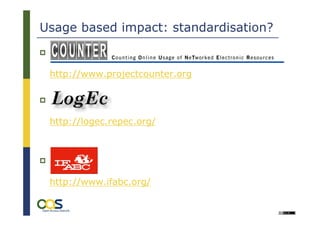
 http://www.projectcounter.org


 http://logec.repec.org/


 http://www.ifabc.org/
Usage based impact: standardisation?
 The models mentioned differ in many aspects
   Detection and elimination of non-human access
   (robots, automatic harvesting)
   Definition of double click intervals
   …


 General problems
   Ignorance of context information
   Detection of duplicate users
   Detection of duplicate information items
   Ignorance of philosophical questions like: “What degree of
   similarity makes two files the same document?”
Alternative impact measures: conclusion
 Alternative impact measures are possible

 But: very little standardisation

 Promising, but complex examples/models like
 MESUR
 http://www.mesur.org


 Requirement: sophisticated infrastructure to
 generate and exchange interoperable usage
 information within a network of several different
 servers
Project:
Open Access Statistics


    OL2OC – Open Linking to Open Content, München, 24. 11.2009
    Was zählt? – Nutzungsstatistiken als alternative Impact Messung,
    Daniel Metje
Open Access Statistics (OAS)
 07/2008 – 02/2010
 Project partners:


    Initiated by:                    Funded by:


  http://www.dini.de/projekte/oa-statistik/english/
Open Access Statistics: motivation
  open access publications are often excluded from citation
  based impact measures
      repository documents by definition
      articles in open access journals due to their short
      citation history and often also due to their language
  citation based impact measures are revealing several
  deficiencies
  citation based impact measures should be complemented
  by usage based impact measures
      because a multi-faceted approach could remedy some of
      their deficiencies
      because the latter ones could create an incentive to use
      open access services


       16
                                                         Université Lille 3:
                                              International Symposium on
                                             „Academic Online Ressources
OAS: aims
 A common standard to exchange usage data
 between different services

 An infrastructure to collect, process and
 exchange usage information between different
 services

 Usage information should be processed according
 to the standards of COUNTER, LogEc and IFABC

 Additional service for repositories

 Implementation guidelines
OAS: associated projects
 Open Access Statistics


 DOARC
 (Distributed Open Access Reference and Citation Services)


 Open Access Network
OAS: associated Projects
  Open Access Statistics addresses usage description

  DOARC address the issue of tracking citations between
  electronic publications

  Open Access Network
    intends to build a network of repositories
    will bundle the results of DOARC and Open Access
    Statistics in one user interface
    offers services for DOARC and Open Access Statistics,
    e.g. deduplication of documents (based on a asymmetric
    similarity of fulltext documents)


       19
                                                        Université Lille 3:
                                             International Symposium on
                                            „Academic Online Ressources
Technical Infrastructure


„Collecting, processing, and interpreting usage data is a
challenge for libraries, big and small“
Manoff et al. 2006


         OL2OC – Open Linking to Open Content, München, 24. 11.2009
         Was zählt? – Nutzungsstatistiken als alternative Impact Messung,
         Daniel Metje
OAS: background
 Data pools at partner institutions

 Aggregation of usage events in a central service
 provider

 Services provided by the central service provider

 Usage data will be retransferred to the local data
 pools and to the Open Access Network Service
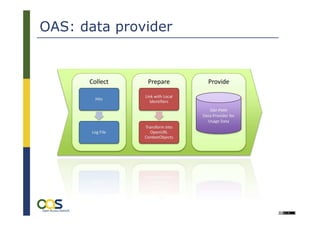
OAS: data provider
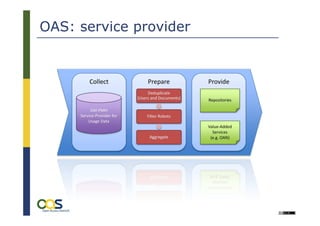
OAS: service provider
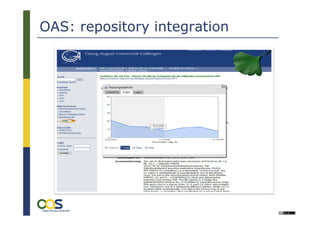
OAS: repository integration
OAS: usage scenarios
data may be used

  from an user perspective as a criterion to estimate the
  relevance of a document (e.g. rankings)
  from an author perspective as an indicator for the
  dissemination of a concept
  from a service provider perspective:
     as additional metadata for search engines, databases …
     as a recommender service
  from a repository perspective:
     as a recommender service
     as additional metadata for users


       25
                                                        Université Lille 3:
                                             International Symposium on
                                            „Academic Online Ressources
Results and Outlook


    OL2OC – Open Linking to Open Content, München, 24. 11.2009
    Was zählt? – Nutzungsstatistiken als alternative Impact Messung,
    Daniel Metje
OAS: lessons learned
linkresolvers are rarely offering suitable information
      external services (ovid) don’t offer usage information
      SFX-logs are very heterogenous
         target may be a splash page or a fulltext
     hardly any information about open access documents

document deduplication seems difficult
     a given document may have more than one IDs
     cause: multiple fulltext deposit on several repositories
     a given document may have several splash pages on
     different servers pointing at one fulltext on one single
     server
     cause: metadata harvesting
     …
        27
                                                                 Université Lille 3:
                                                      International Symposium on
                                                     „Academic Online Ressources
OAS: lessons learned
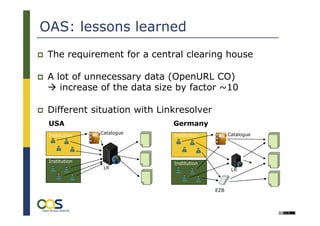
 The requirement for a central clearing house
                             USA

 A lot of unnecessary data (OpenURL CO)
    increase of the data size by factor ~10

 Different situation with Linkresolver
 USA                         Germany
               Catalogue                         Catalogue
 Institution                 Institution


 Institution                 Institution                     ?
                LR                               LRLR


                                                 EZB
                                           EZB


                                                                 28
OAS: results
 Infrastructure for exchange usage statistics

 Modules for OPUS- and DSpace-based
 repositories, other products can be configured
 easily (http://www.dini.de/projekte/oa-statistik/english/software/)

 Specification of the data format and exchange

 Online demo
 (http://oa-statistik.sub.uni-goettingen.de/statsdemo)


 Website with further information
 (http://www.dini.de/projekte/oa-statistik/english/)
OAS: further plans                OAS 2
Aims for a possible second funding:

  Opening the OAS infrastructure to offer
  standardised usage statistics

  Evaluation of metrics more sophisticated than the
  calculation of pure usage frequencies

  Cooperation for international comparable usage
  statistics

  Offer a suitable service infrastructure
OAS: international cooperation
 SURFSure

 COUNTER

 PIRUS

 Knowledge Exchange – Usage Statistics Group

 NEEO

 PEER

 OAPEN
Thanks for your attention!

IFLA 2010
Session 72 - Statistics and Evaluation
Göteborg, 11.08.2010


Initiated by:    Ulrich Herb                                      Funded by:
                 Saarland University and State Library, Germany
                 u.herb@sulb.uni-saarland.de

Alternative impact measures for open access documents?

  • 1.
    Alternative impact measuresfor open access documents? An examination how to generate interoperable usage information from distributed open access services IFLA 2010 Session 72 - Statistics and Evaluation Göteborg, 11.08.2010 Initiated by: Ulrich Herb Funded by: Saarland University and State Library, Germany u.herb@sulb.uni-saarland.de
  • 2.
    Overview Impact measures: relevance a categorisation Usage-based impact measures: standardisation? Project: Open Access Statistics Aims Technical infrastructure Results Outlook
  • 3.
    Impact Measures „The ‚impactfactor‘ is the most commonly used assessment aid for deciding which journals should receive a scholarly submission or attention from research readership. It is also an often misunderstood tool.“ Dong et al. 2005 3
  • 4.
    Impact measures: relevance Individual level: publish or perish If a scientist does not publish she/he does not have any scientific capital, reputation or impact Without any impact, she/he won’t make her/his career Organisational level: evaluation Evaluation results determine prospective resources of institutes and the future main research Criteria: number of doctoral candidates, amount of third party funds, publications
  • 5.
    From publications toimpact Scientific reputation (or scientific capital) is derived from publication impact Impact is calculated mostly by citation measures Journal impact factor (JIF) Hirsch-index (h-index) Especially within the STM domain
  • 6.
    Citation impact: calculation JIF Inyear X, the impact factor of a journal Y is the average number of citations to articles that were published in Y during the two years preceding X Garfield: „We never predicted that people would turn this into an evaluation tool for giving out grants and funding.“ From: Richard Monastersky (2005), The Number That's Devouring Science The Chronicle of Higher Education H-index A scientist has index h if h of N papers have at least h citations each, and the other (N − h) papers have less than h citations each http://de.wikipedia.org/wiki/H-Index
  • 7.
    Citation impact: criticalpoints Restricted scope, exclusion of many publication types Based exclusively on journal citation reports / web of science (JIF) or other databases Language bias: items in English language are overrepresented within the database, so they reach higher citation scores JIF focuses on journals: few articles evoke most citations JIF discriminates disciplines with lifecycles of scientific information > 2 years Mixture of quality and popularity
  • 8.
    Impact measures: acategorisation Citation based measures Author-centred Delayed measurement: at first in the following generation of publications Impact of a separate object is mostly not described Usage based measures Reader-centred Measuring: on-the-fly and consecutive Impact of a separate object can be described Automated measurement is possible
  • 9.
    Impact measures: acategorisation, pt. II JIF = Journal Impact Factor RF = Reading Factor SA = Structure Author • based on networks built by authors and their activities, e.g. Google PageRank, citation graphs, webometrics SR = Structure Reader • based on document usage and its contextual information, e.g. recommenders, download graphs Bollen, J. et al. (2005): Toward alternative metrics of journal impact: A comparison of download and citation data. In: Information Processing and Management 41(6): S. 1419-1440. Preprint Online: http://arxiv.org/abs/cs.DL/0503007
  • 10.
    Standards „An important issue,however, was the lack of standards on how to produce and report the usage data in a way that could be compared“ Baker et al. 2008 OL2OC – Open Linking to Open Content, München, 24. 11.2009 Was zählt? – Nutzungsstatistiken als alternative Impact Messung, Daniel Metje
  • 11.
    Usage based impact:standardisation? http://www.projectcounter.org http://logec.repec.org/ http://www.ifabc.org/
  • 12.
    Usage based impact:standardisation? The models mentioned differ in many aspects Detection and elimination of non-human access (robots, automatic harvesting) Definition of double click intervals … General problems Ignorance of context information Detection of duplicate users Detection of duplicate information items Ignorance of philosophical questions like: “What degree of similarity makes two files the same document?”
  • 13.
    Alternative impact measures:conclusion Alternative impact measures are possible But: very little standardisation Promising, but complex examples/models like MESUR http://www.mesur.org Requirement: sophisticated infrastructure to generate and exchange interoperable usage information within a network of several different servers
  • 14.
    Project: Open Access Statistics OL2OC – Open Linking to Open Content, München, 24. 11.2009 Was zählt? – Nutzungsstatistiken als alternative Impact Messung, Daniel Metje
  • 15.
    Open Access Statistics(OAS) 07/2008 – 02/2010 Project partners: Initiated by: Funded by: http://www.dini.de/projekte/oa-statistik/english/
  • 16.
    Open Access Statistics:motivation open access publications are often excluded from citation based impact measures repository documents by definition articles in open access journals due to their short citation history and often also due to their language citation based impact measures are revealing several deficiencies citation based impact measures should be complemented by usage based impact measures because a multi-faceted approach could remedy some of their deficiencies because the latter ones could create an incentive to use open access services 16 Université Lille 3: International Symposium on „Academic Online Ressources
  • 17.
    OAS: aims Acommon standard to exchange usage data between different services An infrastructure to collect, process and exchange usage information between different services Usage information should be processed according to the standards of COUNTER, LogEc and IFABC Additional service for repositories Implementation guidelines
  • 18.
    OAS: associated projects Open Access Statistics DOARC (Distributed Open Access Reference and Citation Services) Open Access Network
  • 19.
    OAS: associated Projects Open Access Statistics addresses usage description DOARC address the issue of tracking citations between electronic publications Open Access Network intends to build a network of repositories will bundle the results of DOARC and Open Access Statistics in one user interface offers services for DOARC and Open Access Statistics, e.g. deduplication of documents (based on a asymmetric similarity of fulltext documents) 19 Université Lille 3: International Symposium on „Academic Online Ressources
  • 20.
    Technical Infrastructure „Collecting, processing,and interpreting usage data is a challenge for libraries, big and small“ Manoff et al. 2006 OL2OC – Open Linking to Open Content, München, 24. 11.2009 Was zählt? – Nutzungsstatistiken als alternative Impact Messung, Daniel Metje
  • 21.
    OAS: background Datapools at partner institutions Aggregation of usage events in a central service provider Services provided by the central service provider Usage data will be retransferred to the local data pools and to the Open Access Network Service
  • 22.
  • 23.
  • 24.
  • 25.
    OAS: usage scenarios datamay be used from an user perspective as a criterion to estimate the relevance of a document (e.g. rankings) from an author perspective as an indicator for the dissemination of a concept from a service provider perspective: as additional metadata for search engines, databases … as a recommender service from a repository perspective: as a recommender service as additional metadata for users 25 Université Lille 3: International Symposium on „Academic Online Ressources
  • 26.
    Results and Outlook OL2OC – Open Linking to Open Content, München, 24. 11.2009 Was zählt? – Nutzungsstatistiken als alternative Impact Messung, Daniel Metje
  • 27.
    OAS: lessons learned linkresolversare rarely offering suitable information external services (ovid) don’t offer usage information SFX-logs are very heterogenous target may be a splash page or a fulltext hardly any information about open access documents document deduplication seems difficult a given document may have more than one IDs cause: multiple fulltext deposit on several repositories a given document may have several splash pages on different servers pointing at one fulltext on one single server cause: metadata harvesting … 27 Université Lille 3: International Symposium on „Academic Online Ressources
  • 28.
    OAS: lessons learned The requirement for a central clearing house USA A lot of unnecessary data (OpenURL CO) increase of the data size by factor ~10 Different situation with Linkresolver USA Germany Catalogue Catalogue Institution Institution Institution Institution ? LR LRLR EZB EZB 28
  • 29.
    OAS: results Infrastructurefor exchange usage statistics Modules for OPUS- and DSpace-based repositories, other products can be configured easily (http://www.dini.de/projekte/oa-statistik/english/software/) Specification of the data format and exchange Online demo (http://oa-statistik.sub.uni-goettingen.de/statsdemo) Website with further information (http://www.dini.de/projekte/oa-statistik/english/)
  • 30.
    OAS: further plans OAS 2 Aims for a possible second funding: Opening the OAS infrastructure to offer standardised usage statistics Evaluation of metrics more sophisticated than the calculation of pure usage frequencies Cooperation for international comparable usage statistics Offer a suitable service infrastructure
  • 31.
    OAS: international cooperation SURFSure COUNTER PIRUS Knowledge Exchange – Usage Statistics Group NEEO PEER OAPEN
  • 32.
    Thanks for yourattention! IFLA 2010 Session 72 - Statistics and Evaluation Göteborg, 11.08.2010 Initiated by: Ulrich Herb Funded by: Saarland University and State Library, Germany u.herb@sulb.uni-saarland.de