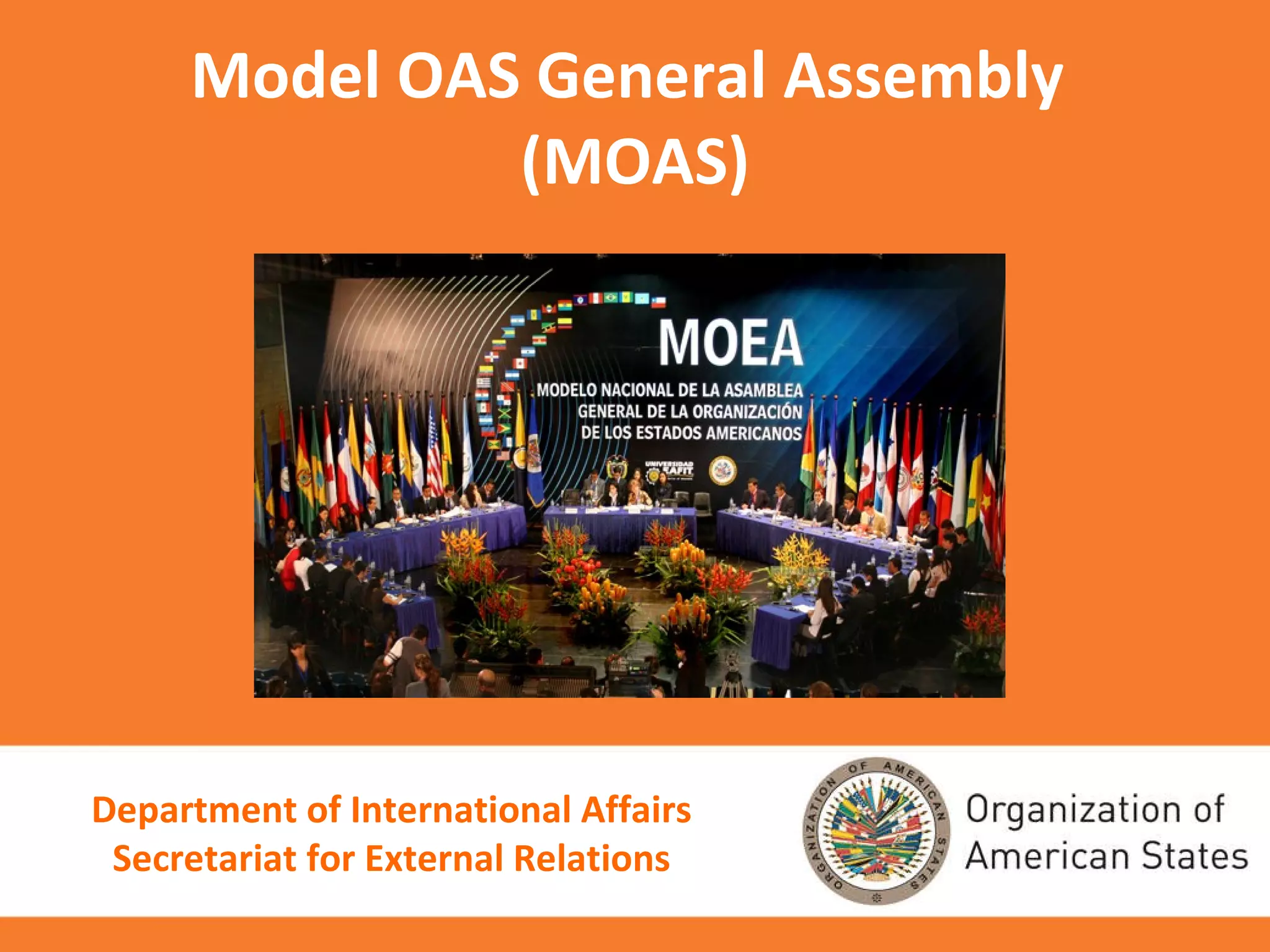
Model OAS General Assembly  (MOAS) Department of International Affairs Secretariat for External Relations
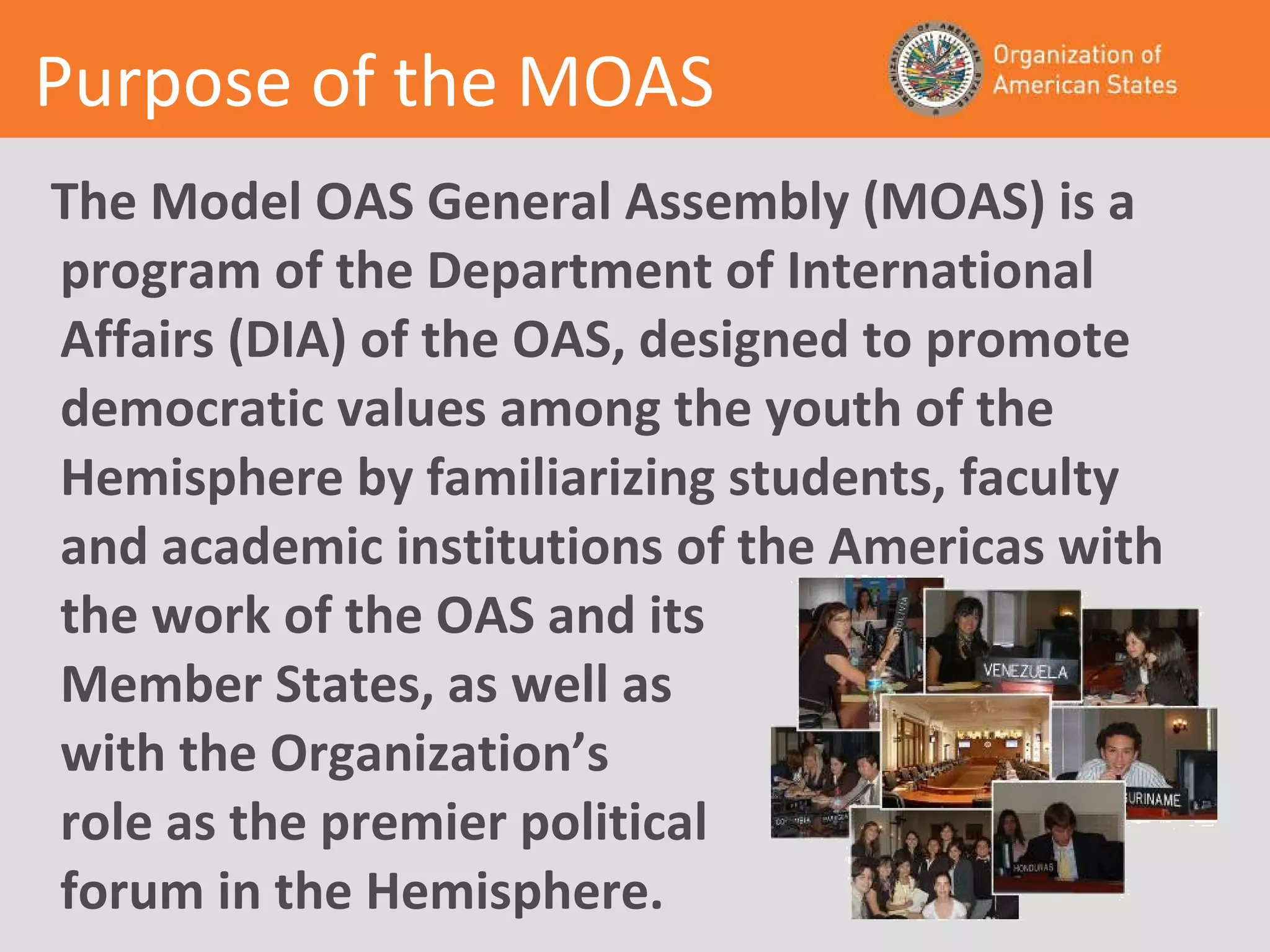
Purpose of the MOAS The Model OAS General Assembly (MOAS) is a program of the Department of International Affairs (DIA) of the OAS, designed to promote democratic values among the youth of the Hemisphere by familiarizing students, faculty and academic institutions of the Americas with the work of the OAS and its  Member States, as well as  with the Organization’s role as the premier political forum in the Hemisphere.
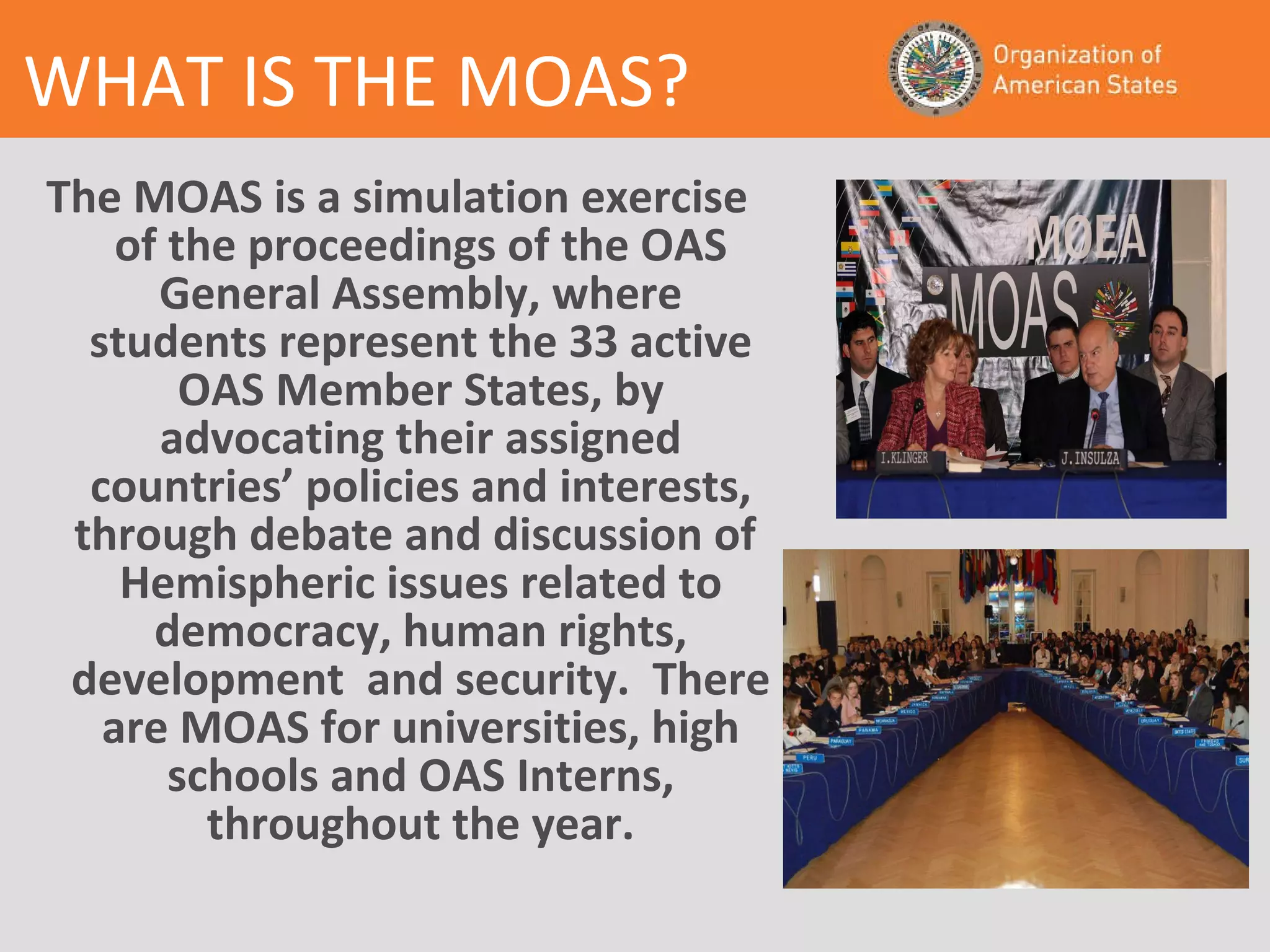
The MOAS is a simulation exercise of the proceedings of the OAS General Assembly, where students represent the 33 active OAS Member States, by advocating their assigned countries’ policies and interests, through debate and discussion of  Hemispheric issues related to democracy, human rights, development  and security.  There are MOAS for universities, high schools and OAS Interns, throughout the year. WHAT IS THE MOAS?
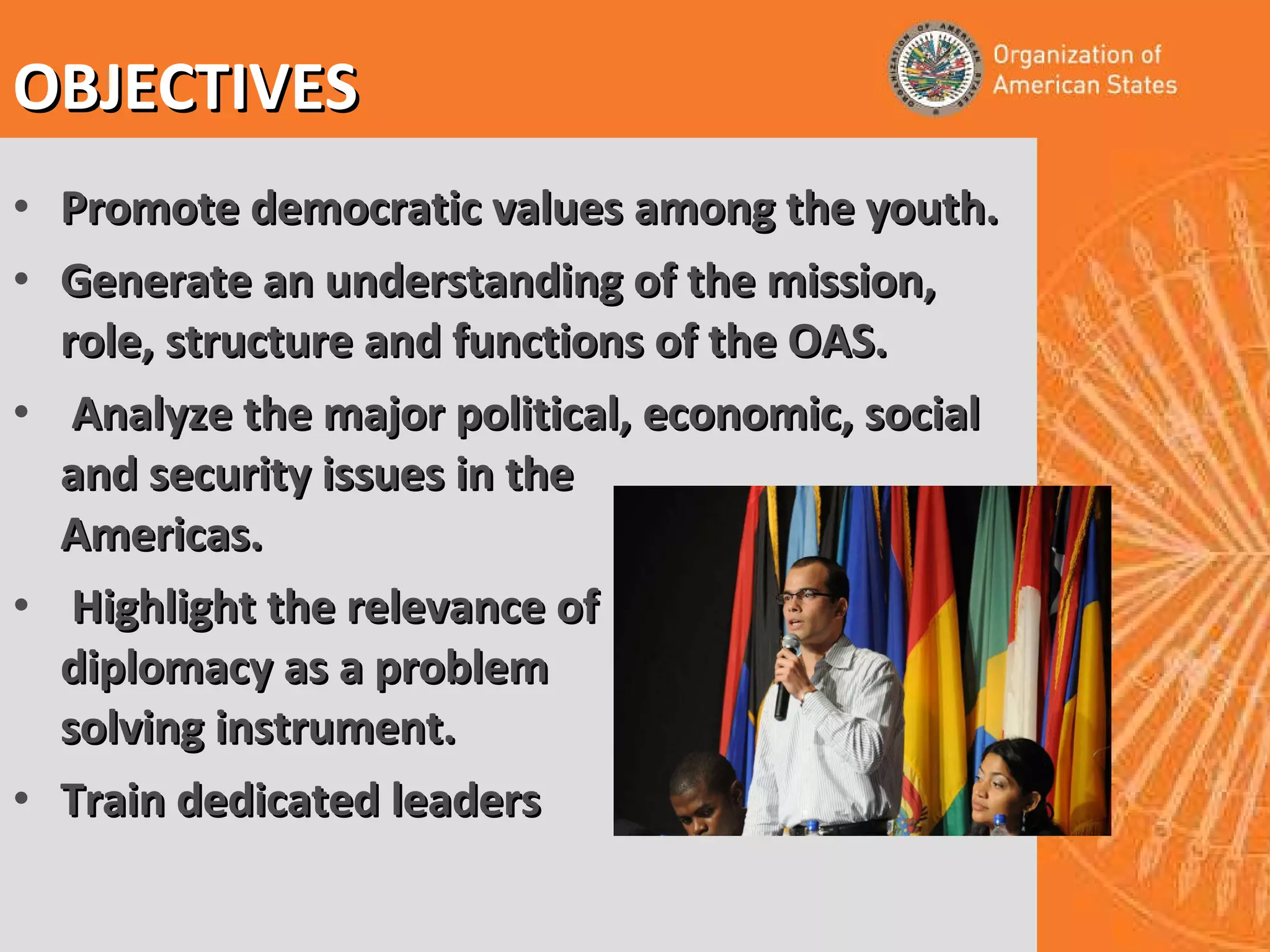
Promote democratic values among the youth. Generate an understanding of the mission, role, structure and functions of the OAS. Analyze the major political, economic, social and security issues in the Americas. Highlight the relevance of diplomacy as a problem solving instrument. Train dedicated leaders OBJECTIVES
STUDENTS´RESPONSIBILITIES   Represent their assigned country’s interests and policies. Understand their assigned  countries’ perspectives through research and contact with  diplomatic representatives. Understand current regional issues.  Draft resolutions and negotiate support from other delegates. Debate and approve resolutions during committee meetings.  Practice parliamentary procedures and diplomacy to reach consensus and address regional problems .
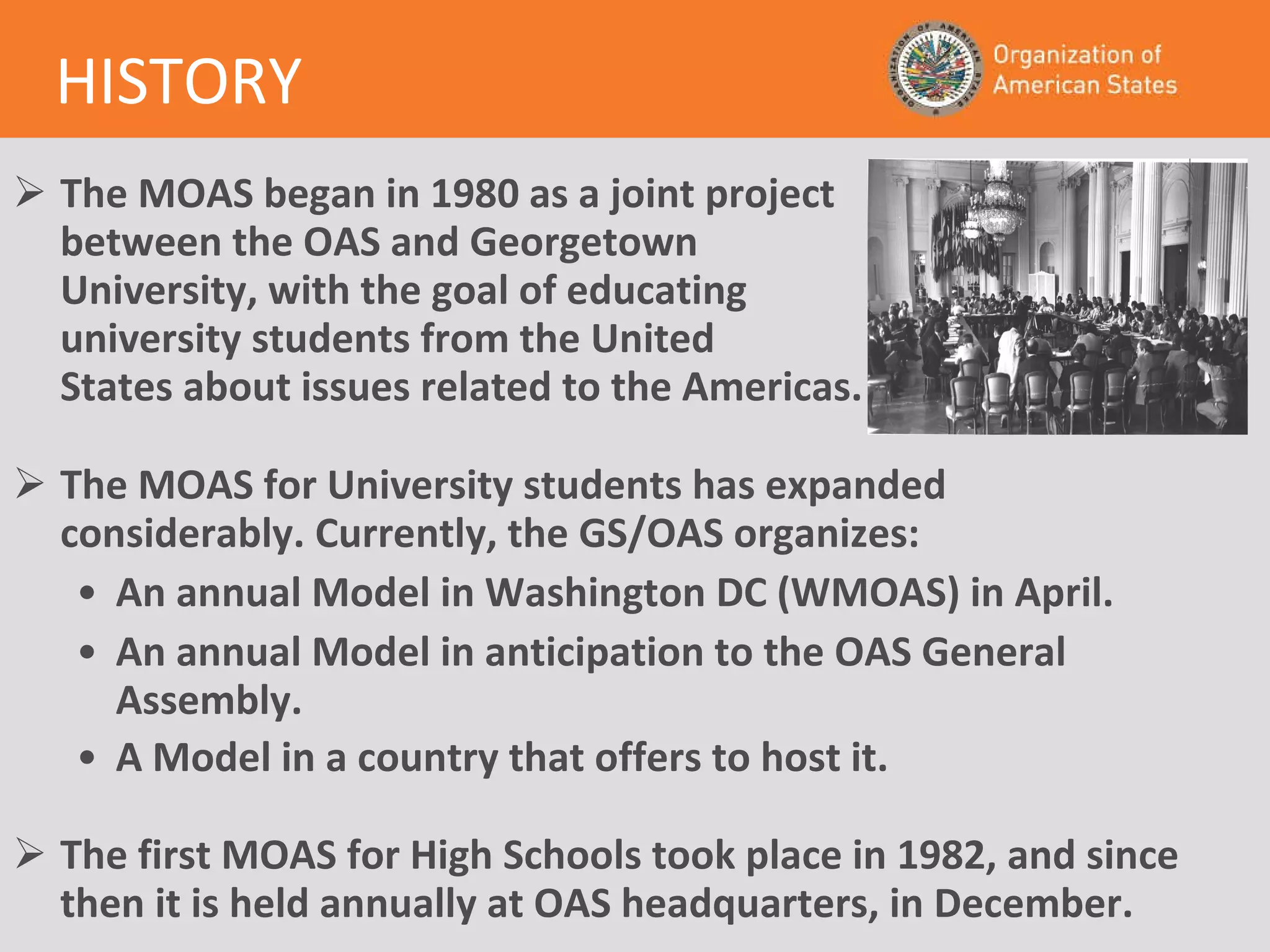
The MOAS began in 1980 as a joint project between the OAS and Georgetown  University, with the goal of educating university students from the United  States about issues related to the Americas.   The MOAS for University students has expanded  considerably. Currently, the GS/OAS organizes: An annual Model in Washington DC (WMOAS) in April. An annual Model in anticipation to the OAS General Assembly. A Model in a country that offers to host it.    The first MOAS for High Schools took place in 1982, and since then it is held annually at OAS headquarters, in December.   HISTORY
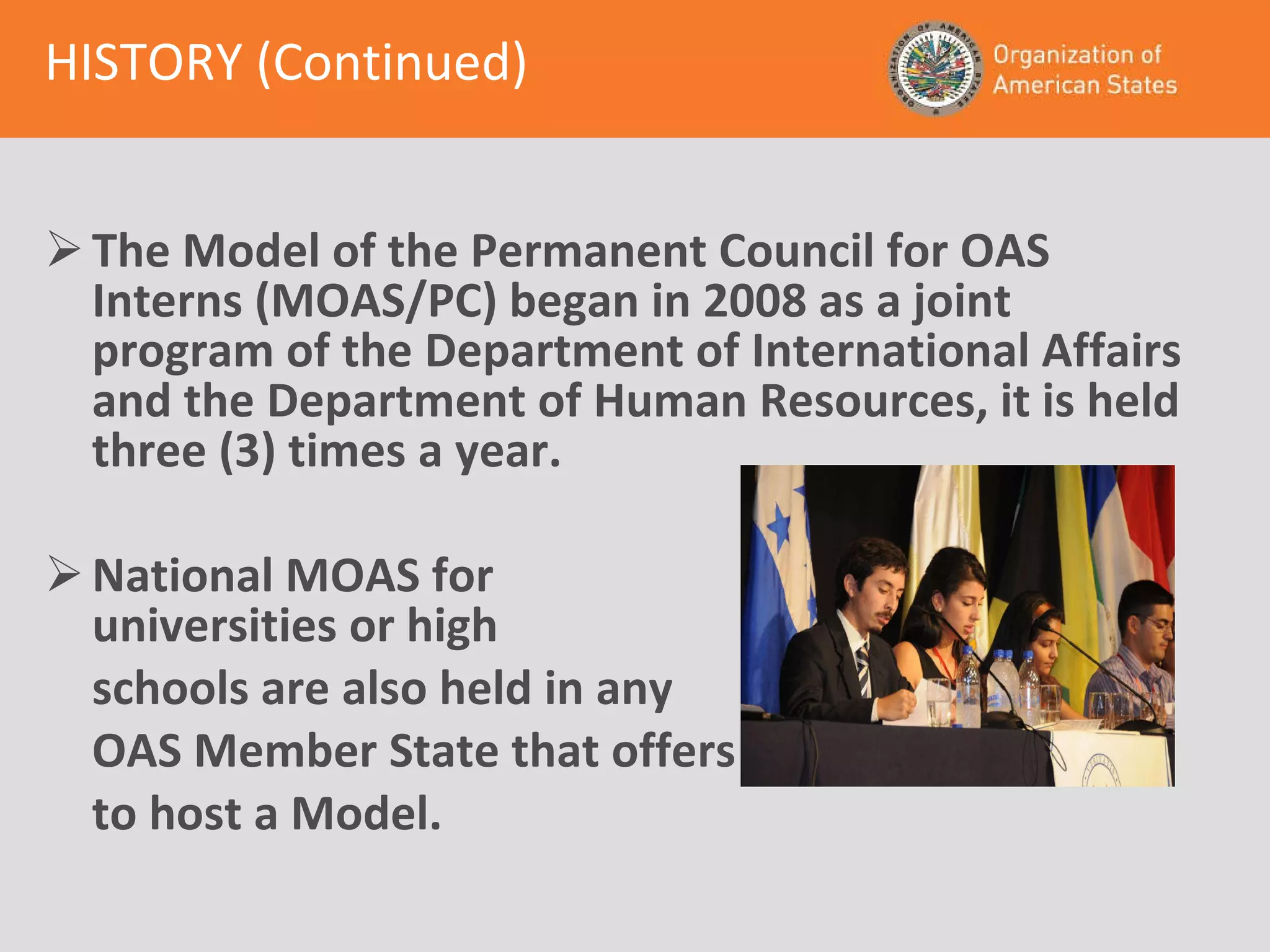
HISTORY (Continued) The Model of the Permanent Council for OAS Interns (MOAS/PC) began in 2008 as a joint program of the Department of International Affairs and the Department of Human Resources, it is held three (3) times a year. National MOAS for  universities or high  schools are also held in any OAS Member State that offers to host a Model.
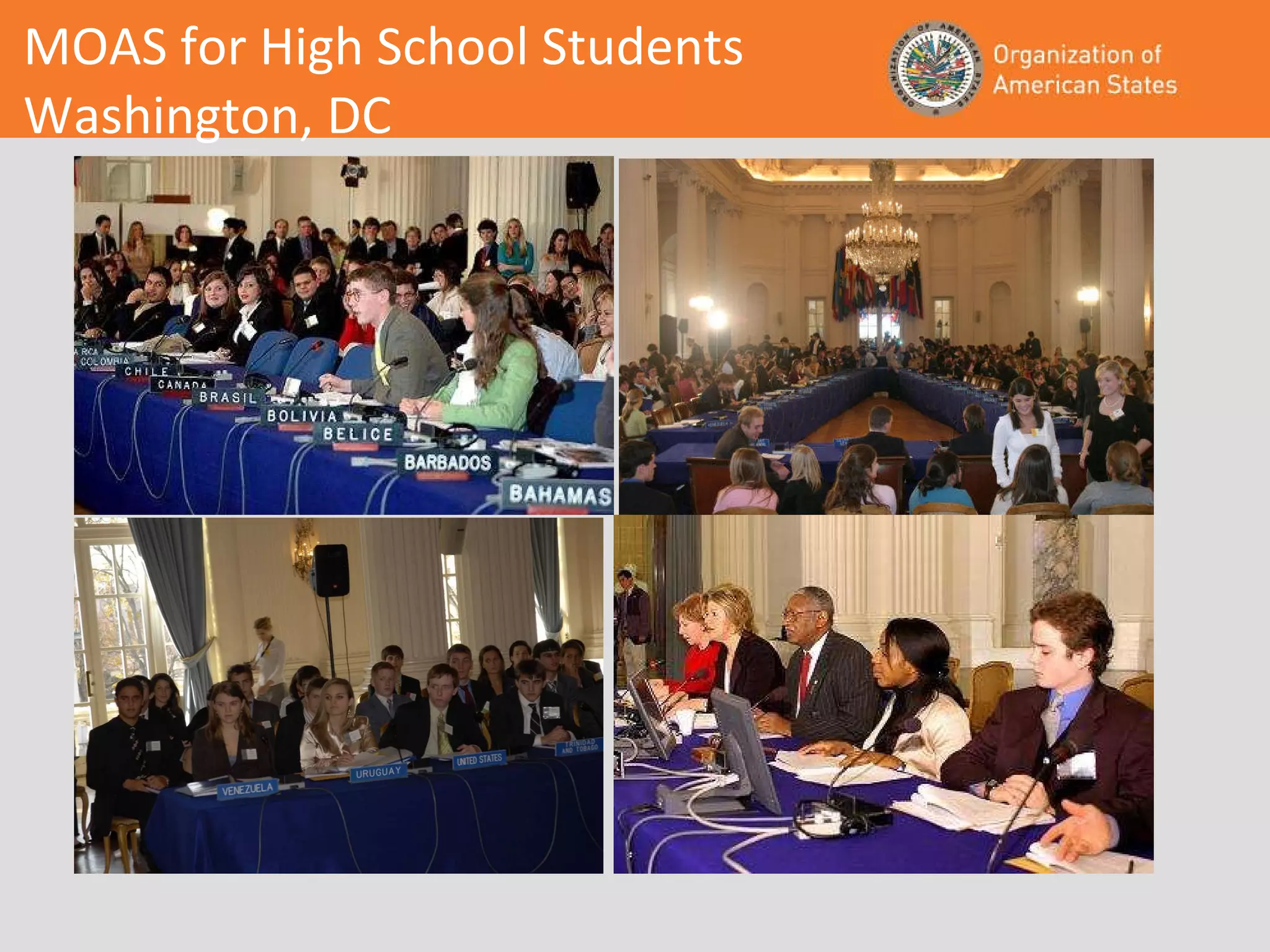
MOAS  for High School Students Washington, DC
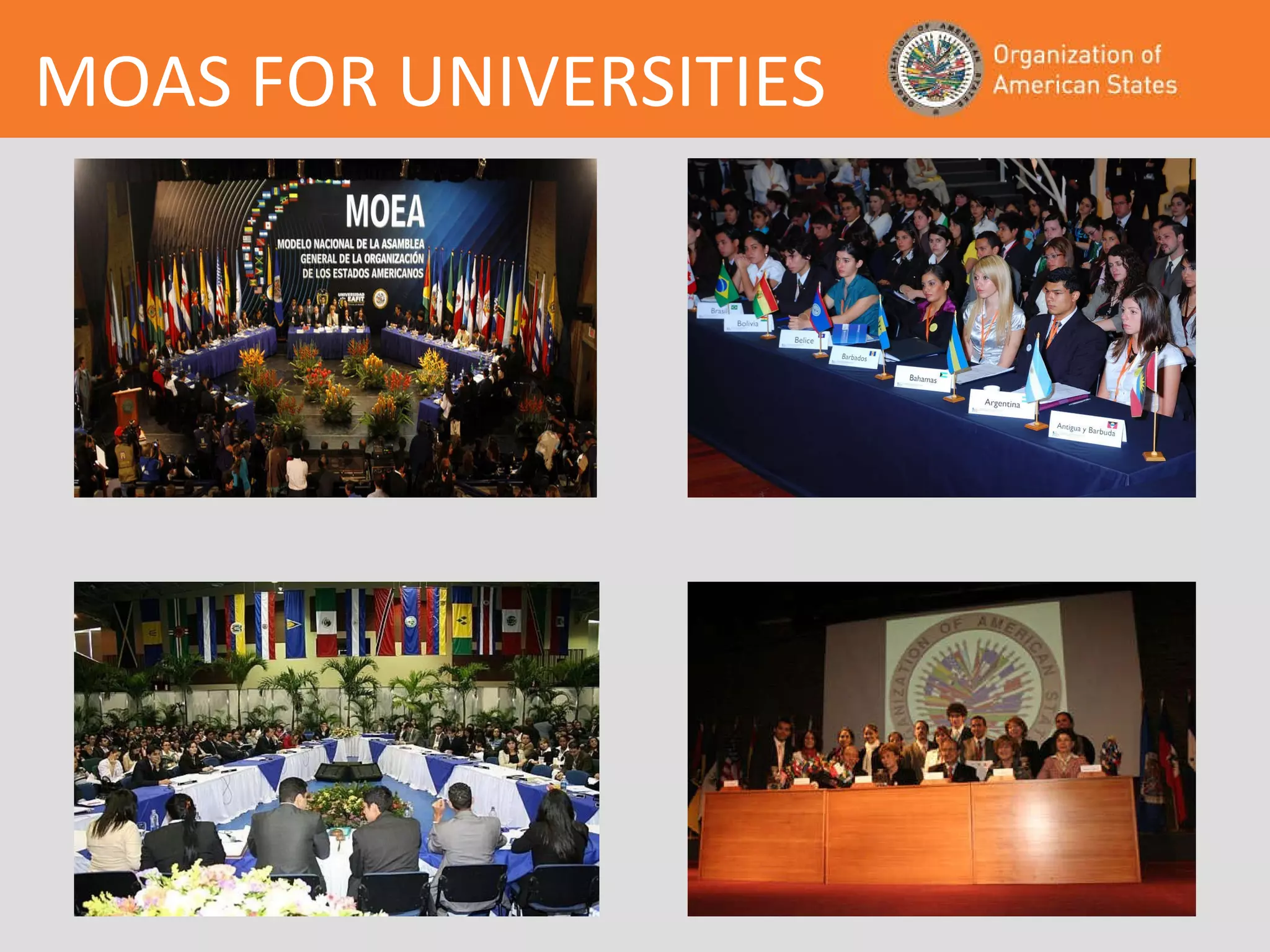
MOAS FOR UNIVERSITIES
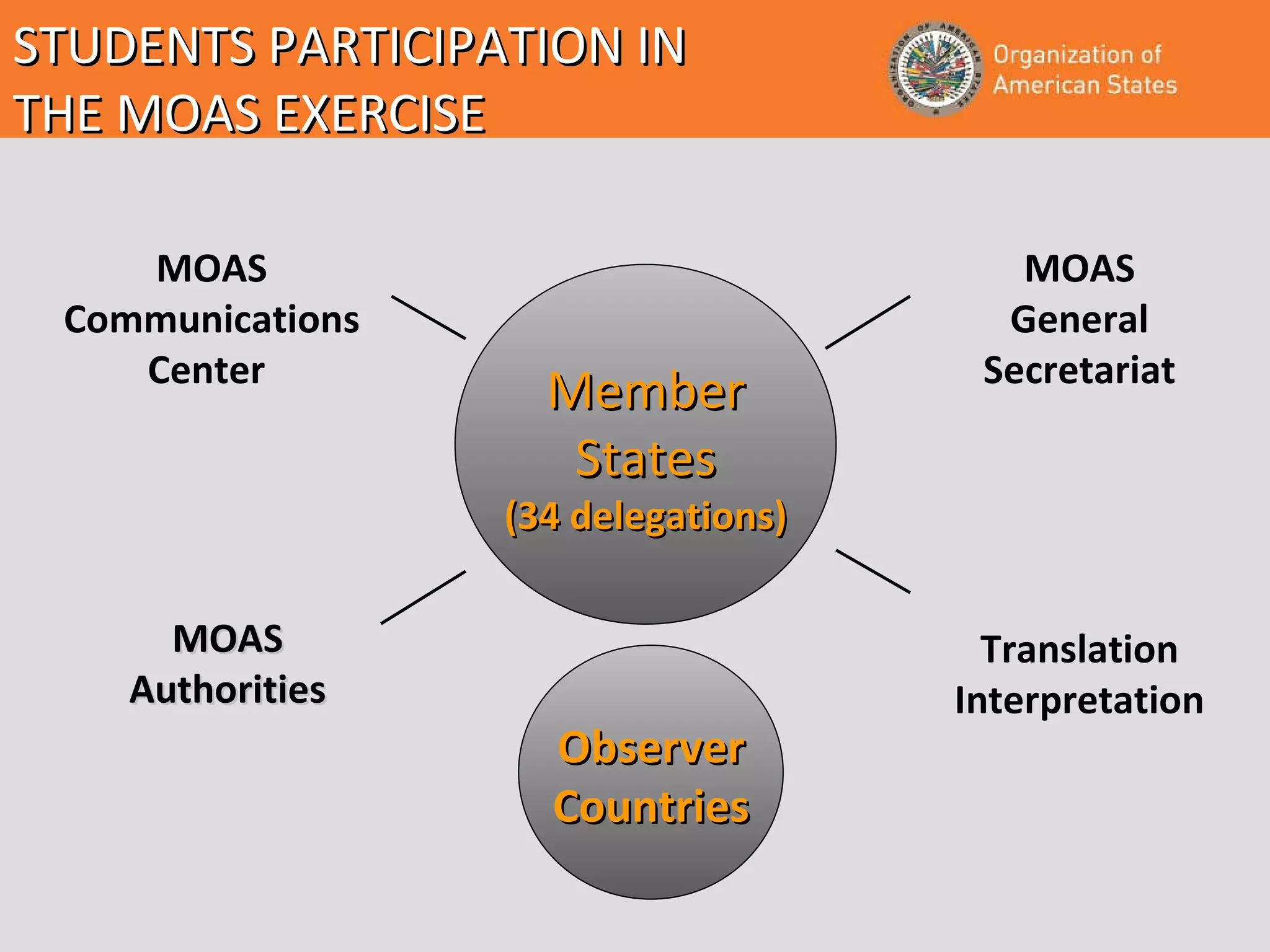
MOAS General Secretariat MOAS Communications Center   Translation Interpretation Member States (34 delegations) Observer Countries STUDENTS PARTICIPATION IN  THE MOAS EXERCISE MOAS Authorities
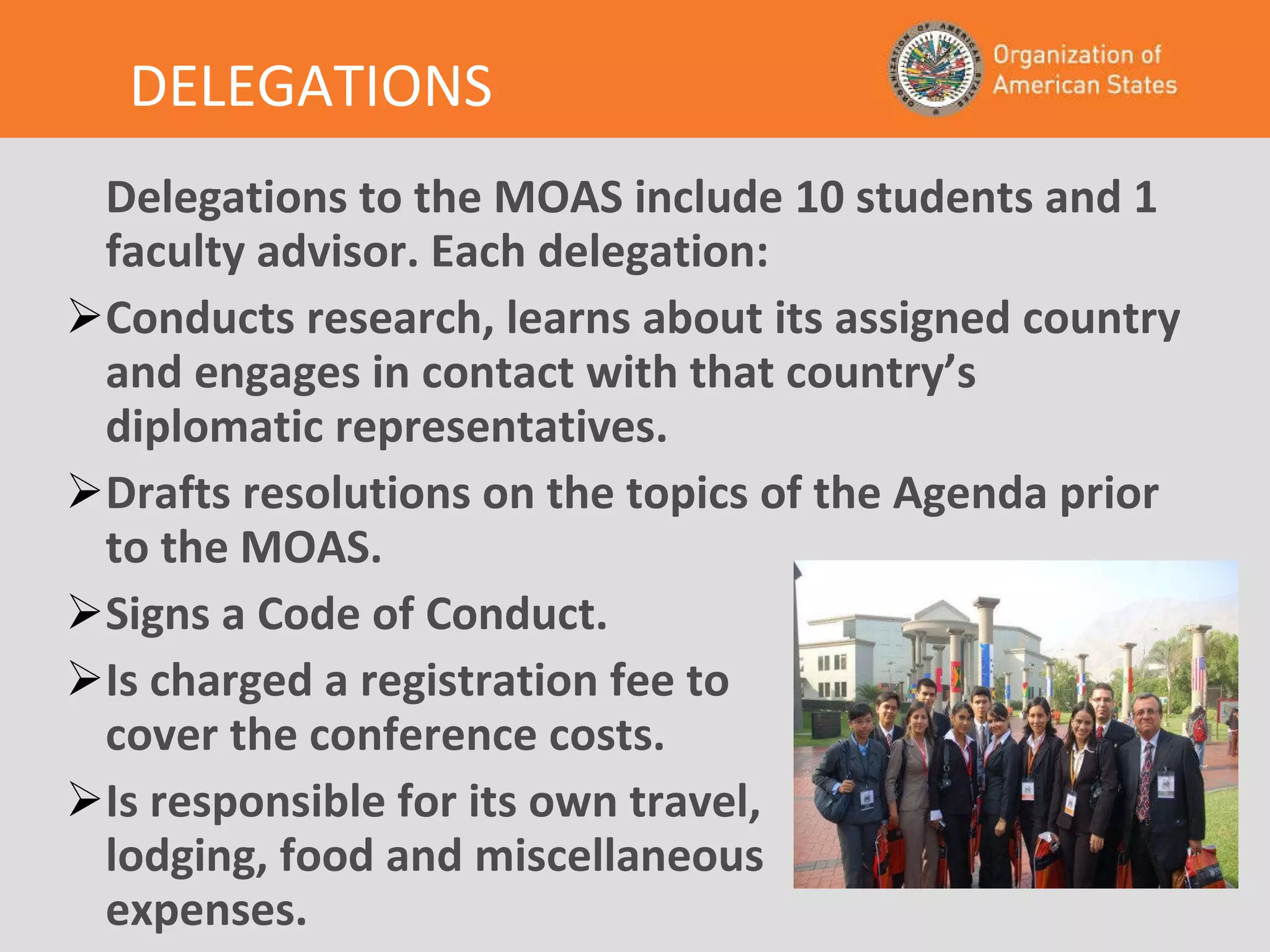
DELEGATIONS Delegations to the MOAS include 10 students and 1 faculty advisor. Each delegation: Conducts research, learns about its assigned country and engages in contact with that country’s diplomatic representatives. Drafts resolutions on the topics of the Agenda prior to the MOAS. Signs a Code of Conduct. Is charged a registration fee to cover the conference costs. Is responsible for its own travel, lodging, food and miscellaneous expenses.
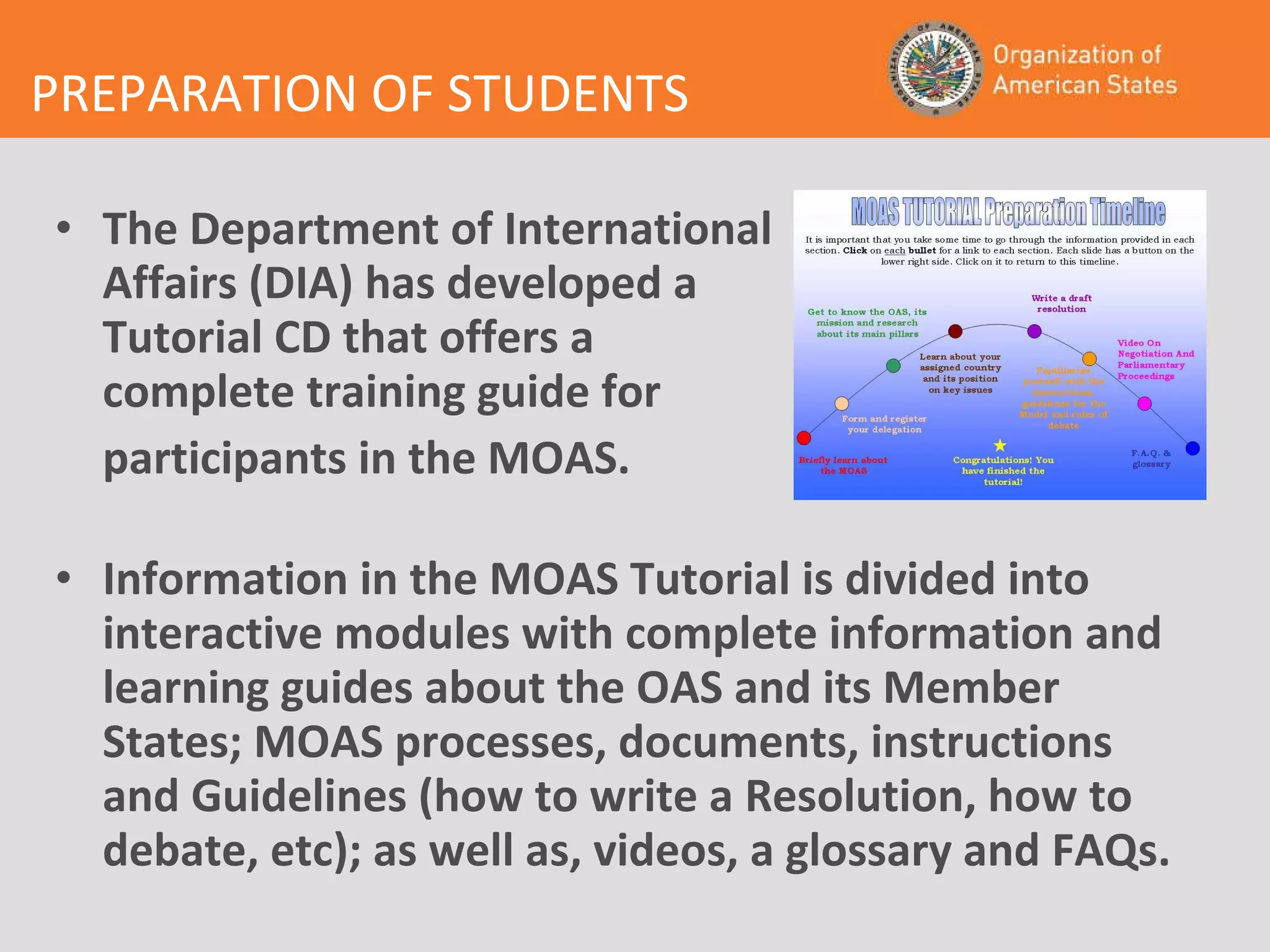
PREPARATION OF STUDENTS The Department of International  Affairs (DIA) has developed a  Tutorial CD that offers a  complete training guide for participants in the MOAS. Information in the MOAS Tutorial is divided into interactive modules with complete information and learning guides about the OAS and its Member States; MOAS processes, documents, instructions and Guidelines (how to write a Resolution, how to debate, etc); as well as, videos, a glossary and FAQs.
BASIC DOCUMENTS   (As posted on   www.oas.org ) OAS Charter as per its 1967 amendment and subsequent amendments. History, structure, principles and objectives of the OAS. Inter-American Democratic Charter. Agreements and official conventions relevant to the topic of the agenda and/or policies of the represented member state. Assigned country’s views and policies . Documents/webs related to Agenda topics.
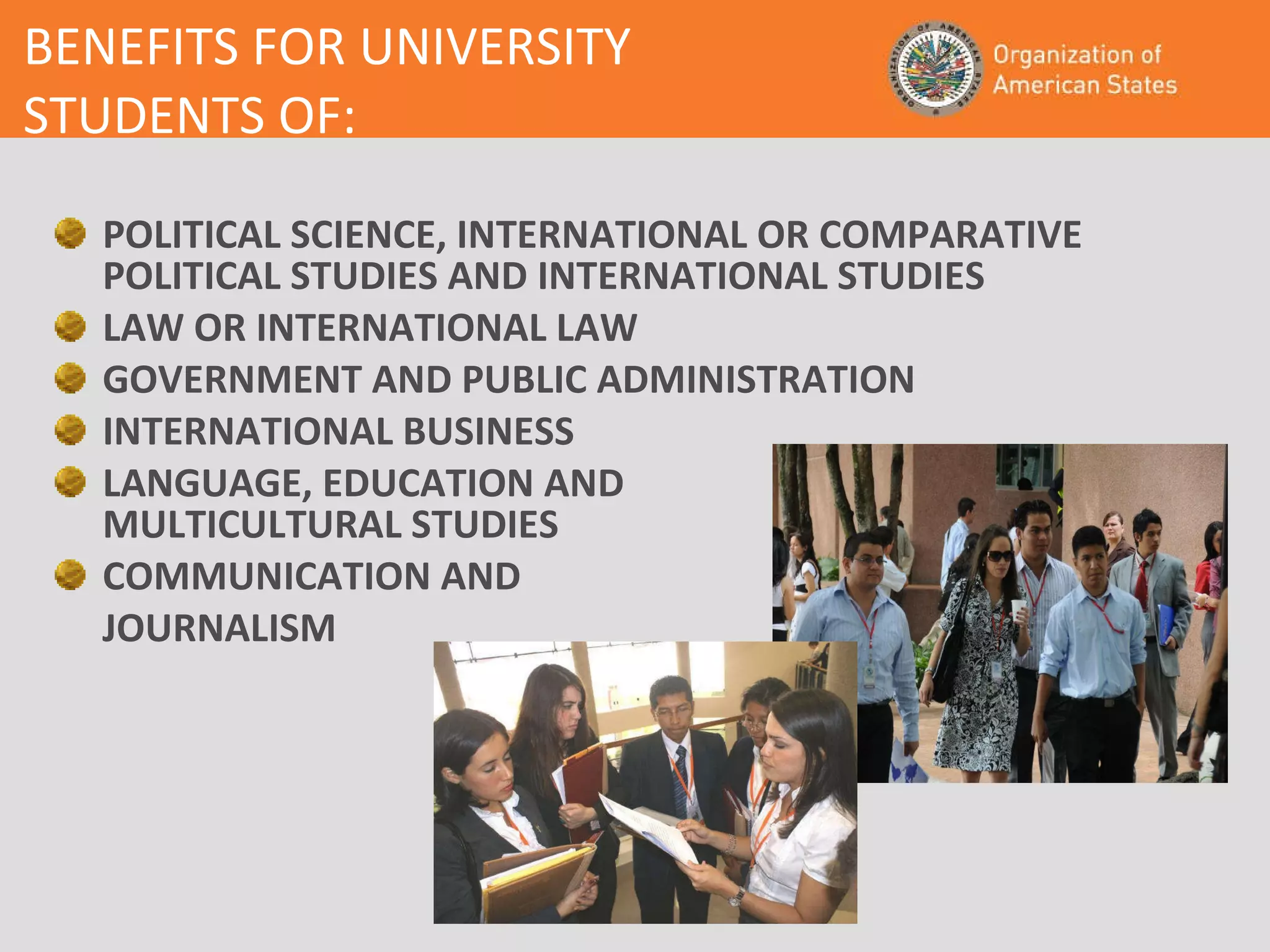
BENEFITS FOR UNIVERSITY  STUDENTS OF: POLITICAL SCIENCE, INTERNATIONAL OR COMPARATIVE POLITICAL STUDIES AND INTERNATIONAL STUDIES LAW OR INTERNATIONAL LAW GOVERNMENT AND PUBLIC ADMINISTRATION INTERNATIONAL BUSINESS LANGUAGE, EDUCATION AND  MULTICULTURAL STUDIES COMMUNICATION AND  JOURNALISM
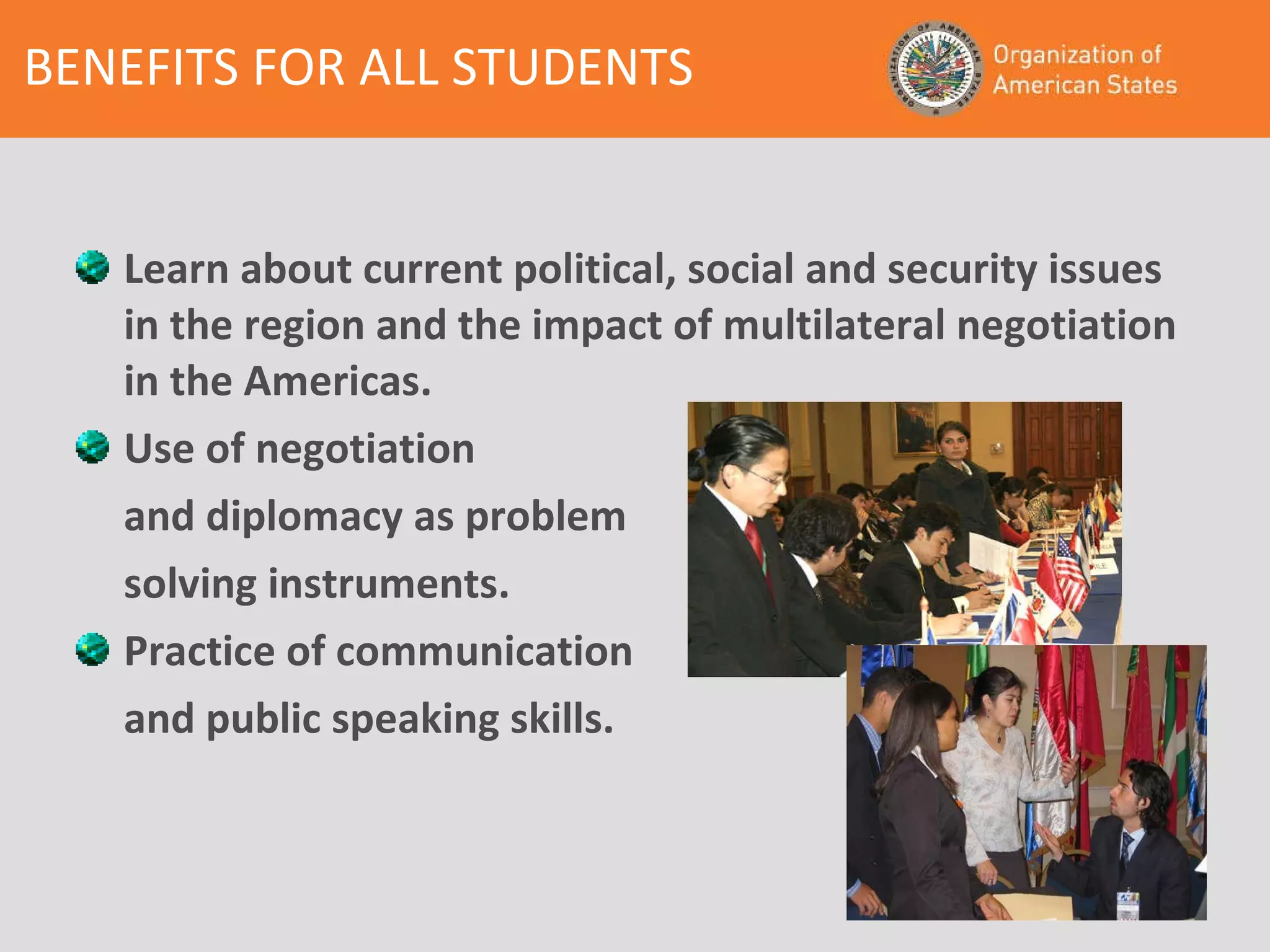
Learn about current political, social and security issues in the region and the impact of multilateral negotiation in the Americas. Use of negotiation  and diplomacy as problem  solving instruments. Practice of communication and public speaking skills. BENEFITS FOR ALL STUDENTS
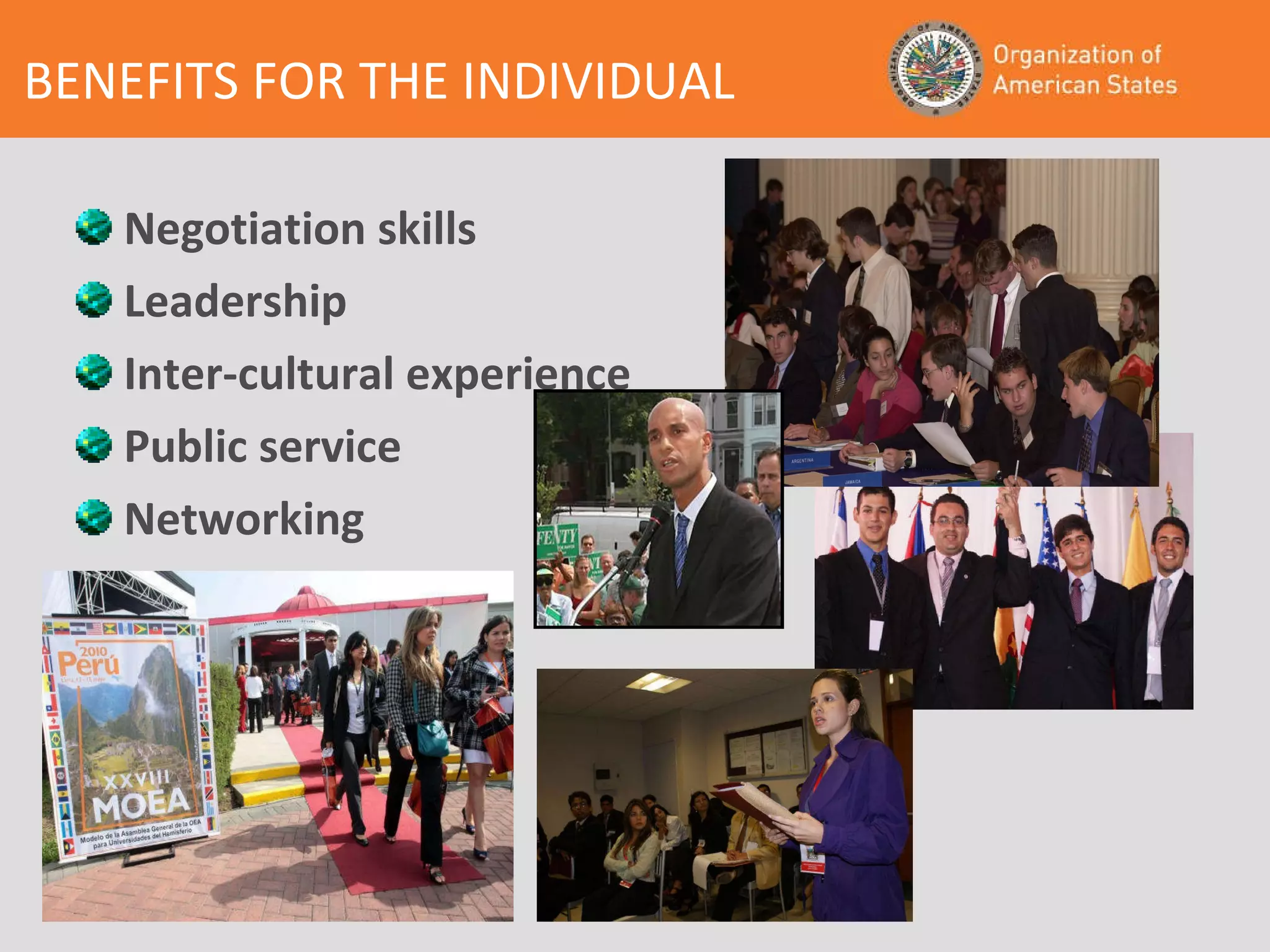
BENEFITS FOR THE INDIVIDUAL Negotiation skills Leadership Inter-cultural experience Public service Networking
Courses based on MOAS in  Universities of the Americas
For more information about the MOAS, please visit our Web Site:   www.moas.oas.org Department of International Affairs Irene Klinger Director Nelly Robinson  MOAS Coordinator Phone: (202) 458-6897 Fax: (202) 458-6239 E-mail:  [email_address]

MOAS

  • 1.
    Model OAS GeneralAssembly (MOAS) Department of International Affairs Secretariat for External Relations
  • 2.
    Purpose of theMOAS The Model OAS General Assembly (MOAS) is a program of the Department of International Affairs (DIA) of the OAS, designed to promote democratic values among the youth of the Hemisphere by familiarizing students, faculty and academic institutions of the Americas with the work of the OAS and its Member States, as well as with the Organization’s role as the premier political forum in the Hemisphere.
  • 3.
    The MOAS isa simulation exercise of the proceedings of the OAS General Assembly, where students represent the 33 active OAS Member States, by advocating their assigned countries’ policies and interests, through debate and discussion of Hemispheric issues related to democracy, human rights, development and security.  There are MOAS for universities, high schools and OAS Interns, throughout the year. WHAT IS THE MOAS?
  • 4.
    Promote democratic valuesamong the youth. Generate an understanding of the mission, role, structure and functions of the OAS. Analyze the major political, economic, social and security issues in the Americas. Highlight the relevance of diplomacy as a problem solving instrument. Train dedicated leaders OBJECTIVES
  • 5.
    STUDENTS´RESPONSIBILITIES Represent their assigned country’s interests and policies. Understand their assigned countries’ perspectives through research and contact with diplomatic representatives. Understand current regional issues. Draft resolutions and negotiate support from other delegates. Debate and approve resolutions during committee meetings. Practice parliamentary procedures and diplomacy to reach consensus and address regional problems .
  • 6.
    The MOAS beganin 1980 as a joint project between the OAS and Georgetown University, with the goal of educating university students from the United States about issues related to the Americas. The MOAS for University students has expanded considerably. Currently, the GS/OAS organizes: An annual Model in Washington DC (WMOAS) in April. An annual Model in anticipation to the OAS General Assembly. A Model in a country that offers to host it. The first MOAS for High Schools took place in 1982, and since then it is held annually at OAS headquarters, in December. HISTORY
  • 7.
    HISTORY (Continued) TheModel of the Permanent Council for OAS Interns (MOAS/PC) began in 2008 as a joint program of the Department of International Affairs and the Department of Human Resources, it is held three (3) times a year. National MOAS for universities or high schools are also held in any OAS Member State that offers to host a Model.
  • 8.
    MOAS forHigh School Students Washington, DC
  • 9.
  • 10.
    MOAS General SecretariatMOAS Communications Center Translation Interpretation Member States (34 delegations) Observer Countries STUDENTS PARTICIPATION IN THE MOAS EXERCISE MOAS Authorities
  • 11.
    DELEGATIONS Delegations tothe MOAS include 10 students and 1 faculty advisor. Each delegation: Conducts research, learns about its assigned country and engages in contact with that country’s diplomatic representatives. Drafts resolutions on the topics of the Agenda prior to the MOAS. Signs a Code of Conduct. Is charged a registration fee to cover the conference costs. Is responsible for its own travel, lodging, food and miscellaneous expenses.
  • 12.
    PREPARATION OF STUDENTSThe Department of International Affairs (DIA) has developed a Tutorial CD that offers a complete training guide for participants in the MOAS. Information in the MOAS Tutorial is divided into interactive modules with complete information and learning guides about the OAS and its Member States; MOAS processes, documents, instructions and Guidelines (how to write a Resolution, how to debate, etc); as well as, videos, a glossary and FAQs.
  • 13.
    BASIC DOCUMENTS (As posted on www.oas.org ) OAS Charter as per its 1967 amendment and subsequent amendments. History, structure, principles and objectives of the OAS. Inter-American Democratic Charter. Agreements and official conventions relevant to the topic of the agenda and/or policies of the represented member state. Assigned country’s views and policies . Documents/webs related to Agenda topics.
  • 14.
    BENEFITS FOR UNIVERSITY STUDENTS OF: POLITICAL SCIENCE, INTERNATIONAL OR COMPARATIVE POLITICAL STUDIES AND INTERNATIONAL STUDIES LAW OR INTERNATIONAL LAW GOVERNMENT AND PUBLIC ADMINISTRATION INTERNATIONAL BUSINESS LANGUAGE, EDUCATION AND MULTICULTURAL STUDIES COMMUNICATION AND JOURNALISM
  • 15.
    Learn about currentpolitical, social and security issues in the region and the impact of multilateral negotiation in the Americas. Use of negotiation and diplomacy as problem solving instruments. Practice of communication and public speaking skills. BENEFITS FOR ALL STUDENTS
  • 16.
    BENEFITS FOR THEINDIVIDUAL Negotiation skills Leadership Inter-cultural experience Public service Networking
  • 17.
    Courses based onMOAS in Universities of the Americas
  • 18.
    For more informationabout the MOAS, please visit our Web Site: www.moas.oas.org Department of International Affairs Irene Klinger Director Nelly Robinson MOAS Coordinator Phone: (202) 458-6897 Fax: (202) 458-6239 E-mail: [email_address]