Scholarly Information Practices in the Online Environment:  Implications for Shared Library Service Frameworks Constance Malpas Ricky Erway RLG Partnership Meeting 1 June 2009
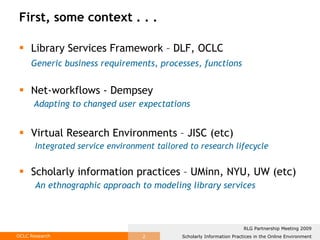
First, some context . . . Library Services Framework – DLF, OCLC Generic business requirements, processes, functions   Net-workflows - Dempsey   Adapting to changed user expectations Virtual Research Environments – JISC (etc) Integrated service environment tailored to research lifecycle Scholarly information practices – UMinn, NYU, UW (etc) An ethnographic approach to modeling library services
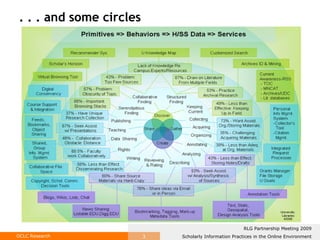
. . . and some circles
Viewpoint and vision: As scholarly workflows move to the network, new opportunities for research support services will emerge. Libraries lack a collective vision of their place in this changed infrastructure.  Implications: Shared service frameworks based on core scholarly activities are needed to avoid unnecessary duplication of effort, enabling libraries to focus investment where it is most needed.
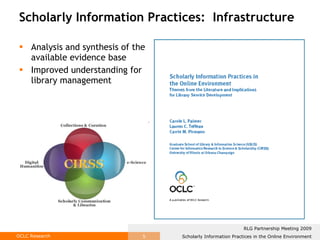
Scholarly Information Practices:  Infrastructure Analysis and synthesis of the available evidence base Improved understanding for library management
Aim and Intent Identify current themes in the literature Disciplinary differences in scholarly work; commonalities Reflect on how library services can support current scholarly practices Expectations cultivated in broader online environment Assess ‘specific gravity’ of service requirements Local, group and global solutions; intensity of demand A literature review aimed at library managers
Analytic Framework & Methodology Scholarly ‘primitives’ (Unsworth, 2000)  “ functions common to scholarly activity across disciplines” Five core activities Searching, Collecting, Reading, Writing, Collaborating Disciplinary patterns, high-intensity activities Different modalities of scholarly work  Adaptive services within (and beyond) the library Areas for future research and development
Key Findings Opportunities for shared service development are concentrated in a few areas Knowledge organization, discovery, curation Operational & network ‘location’ of services varies Some solutions will be found (and should be sought) outside the library, or between the library and CIT Significant convergence in disciplinary information practices  Core service requirements can be modeled generically
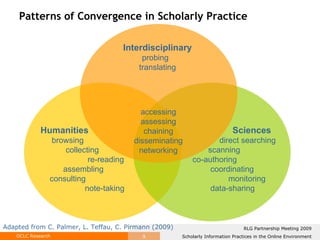
Patterns of Convergence in Scholarly Practice accessing assessing chaining disseminating networking Interdisciplinary probing  translating Humanities Sciences direct searching scanning co-authoring coordinating monitoring data-sharing browsing collecting re-reading assembling consulting note-taking Adapted from C. Palmer, L. Teffau, C. Pirmann (2009)
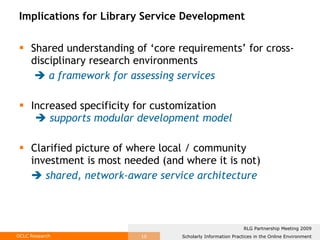
Implications for Library Service Development Shared understanding of ‘core requirements’ for cross-disciplinary research environments      a framework for assessing services Increased specificity for customization    supports modular development model Clarified picture of where local / community investment is most needed (and where it is not)    shared, network-aware service architecture
Getting from here to there Insights from a variety of studies Examples emerging What role for RLG Partnership? Lie of the Land Research Information Management Projects Your ideas
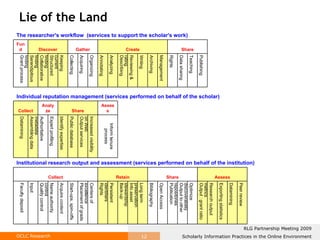
Lie of the Land The researcher's workflow  (services to support the scholar's work) Fund Discover Gather Create Share Grant process Serendipitous finding Collaborative finding Structured finding Keeping current Collecting Acquiring Organizing Annotating Analyzing Describing Reviewing & rating Writing Archiving Management Rights Data sharing Teaching Publishing Individual reputation management (services performed on behalf of the scholar) Collect Analyze Share Assess Datamining Assembling data Authoritative metadata Expert profiling Identify expertise Public database Output services Increased visibility on Web  Inform tenure process Institutional research output and assessment (services performed on behalf of the institution) Collect Retain Share Assess Faculty deposit Input Quality control Name authority control Acquire  content   Start-ups, spin-offs Placement of grads Centers of excellence Rights Persistent identifiers Back-up Info asset stewardship Long term preservation Bibliography Open Access Publication Output to other repositories Optimize discoverability Output : grant ratio Research output metrics Exporting statistics Datamining Peer review
Lie of the Land (detail)
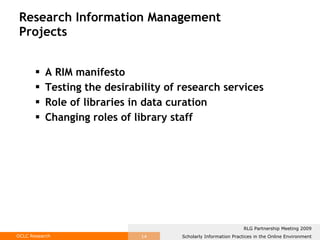
Research Information Management  Projects A RIM manifesto Testing the desirability of research services Role of libraries in data curation Changing roles of library staff
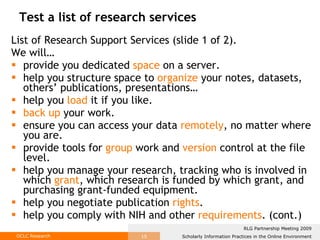
Test a list of research services List of Research Support Services (slide 1 of 2).  We will…  provide you dedicated  space  on a server. help you structure space to  organize  your notes, datasets, others’ publications, presentations… help you  load  it if you like. back up  your work. ensure you can access your data  remotely , no matter where you are. provide tools for  group  work and  version  control at the file level. help you manage your research, tracking who is involved in which  grant , which research is funded by which grant, and purchasing grant-funded equipment.  help you negotiate publication  rights .  help you comply with NIH and other  requirements . (cont.)
(Cont. 2 of 2)  We will…  see that your work is  disseminated  broadly, quickly, and openly and that you get maximum  impact  for you and your university. do the  authority  work to ensure you are credited for all your work, despite the various forms of your name used in indicating authorship. keep your personal  bibliography  up-to-date.  provide you with a customizable personal  web page . include you in the campus  expertise database  and facilitate inclusion in disciplinary expert databases. preserve  your outputs in the institutional repository and facilitate inclusion in disciplinary repositories. see that you can take your work with you if you  leave  this institution  Test a list of research services
Assess library contributions related to data curation Big science vs. little science and humanities Derivative data and source data Data lifecycle management Data reuse Institutional vs. disciplinary approaches Data   Curation
Explore changing roles of library staff: Increasing demands  Role of "data librarians"  Faculty liaison role Specialization in rights and open access Ways to work with departments to increase data management awareness and skills Changing Roles of Library Staff
Your ideas We’re quite eager to hear any ideas, suggestions, course corrections you might have But first…..
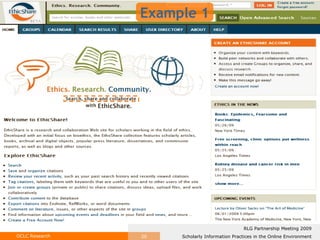
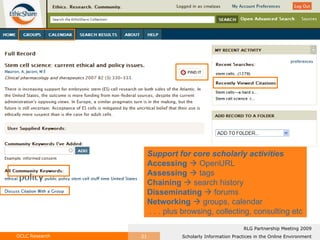
Example 1
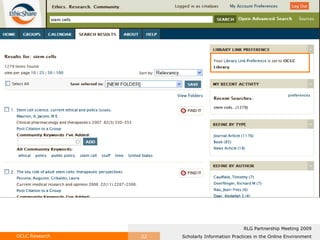
Support for core scholarly activities Accessing     OpenURL Assessing     tags Chaining     search history Disseminating     forums Networking    groups, calendar . . . plus browsing, collecting, consulting etc
 
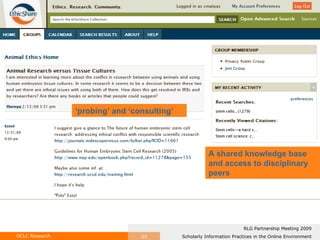
A shared knowledge base and access to disciplinary peers ‘ probing’ and ‘consulting’
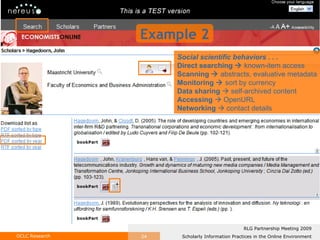
Social scientific behaviors . . . Direct searching     known-item access   Scanning     abstracts, evaluative metadata Monitoring     sort by currency Data sharing     self-archived content Accessing    OpenURL Networking    contact details Example 2
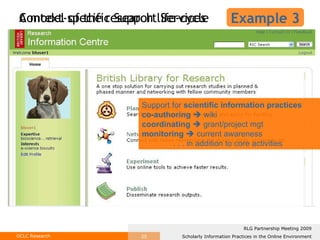
A model of the research life-cycle Context-specific Support Services Support for  scientific information practices co-authoring    wiki coordinating    grant/project mgt monitoring     current awareness . . . in addition to core activities Example 3
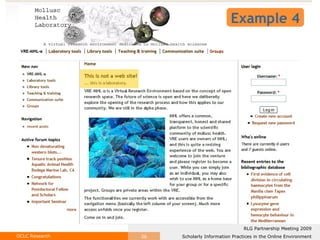
Example 4
 
(Other library service environments)
 
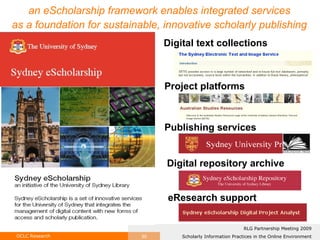
an eScholarship framework enables integrated services as a foundation for sustainable, innovative scholarly publishing Digital text collections Project platforms Publishing services Digital repository archive eResearch support
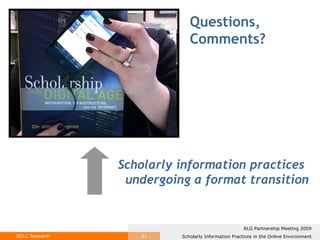
Questions,  Comments? Scholarly information practices undergoing a format transition
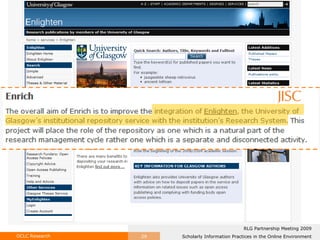
Further Information Palmer, Carole L., et al. 2009.  Scholarly Information Practices in the Online Environment: Themes from the Literature and Implications for Library Service Development  (OCLC, 2009)  Support for the Research Process  program  JISC Virtual Research Environments Programme  summary EconomistsOnline   prototype British Library Research Information Centre  presentation UPEI Virtual Research Environment  demonstrators University of Minnesota  EthicShare  demonstrator University of Glasgow “ Enrich ” project Sydney eScholarship  initiative

Scholarly Information Practices In The Online Environment

  • 1.
    Scholarly Information Practicesin the Online Environment: Implications for Shared Library Service Frameworks Constance Malpas Ricky Erway RLG Partnership Meeting 1 June 2009
  • 2.
    First, some context. . . Library Services Framework – DLF, OCLC Generic business requirements, processes, functions Net-workflows - Dempsey Adapting to changed user expectations Virtual Research Environments – JISC (etc) Integrated service environment tailored to research lifecycle Scholarly information practices – UMinn, NYU, UW (etc) An ethnographic approach to modeling library services
  • 3.
    . . .and some circles
  • 4.
    Viewpoint and vision:As scholarly workflows move to the network, new opportunities for research support services will emerge. Libraries lack a collective vision of their place in this changed infrastructure. Implications: Shared service frameworks based on core scholarly activities are needed to avoid unnecessary duplication of effort, enabling libraries to focus investment where it is most needed.
  • 5.
    Scholarly Information Practices: Infrastructure Analysis and synthesis of the available evidence base Improved understanding for library management
  • 6.
    Aim and IntentIdentify current themes in the literature Disciplinary differences in scholarly work; commonalities Reflect on how library services can support current scholarly practices Expectations cultivated in broader online environment Assess ‘specific gravity’ of service requirements Local, group and global solutions; intensity of demand A literature review aimed at library managers
  • 7.
    Analytic Framework &Methodology Scholarly ‘primitives’ (Unsworth, 2000) “ functions common to scholarly activity across disciplines” Five core activities Searching, Collecting, Reading, Writing, Collaborating Disciplinary patterns, high-intensity activities Different modalities of scholarly work Adaptive services within (and beyond) the library Areas for future research and development
  • 8.
    Key Findings Opportunitiesfor shared service development are concentrated in a few areas Knowledge organization, discovery, curation Operational & network ‘location’ of services varies Some solutions will be found (and should be sought) outside the library, or between the library and CIT Significant convergence in disciplinary information practices Core service requirements can be modeled generically
  • 9.
    Patterns of Convergencein Scholarly Practice accessing assessing chaining disseminating networking Interdisciplinary probing translating Humanities Sciences direct searching scanning co-authoring coordinating monitoring data-sharing browsing collecting re-reading assembling consulting note-taking Adapted from C. Palmer, L. Teffau, C. Pirmann (2009)
  • 10.
    Implications for LibraryService Development Shared understanding of ‘core requirements’ for cross-disciplinary research environments  a framework for assessing services Increased specificity for customization  supports modular development model Clarified picture of where local / community investment is most needed (and where it is not)  shared, network-aware service architecture
  • 11.
    Getting from hereto there Insights from a variety of studies Examples emerging What role for RLG Partnership? Lie of the Land Research Information Management Projects Your ideas
  • 12.
    Lie of theLand The researcher's workflow (services to support the scholar's work) Fund Discover Gather Create Share Grant process Serendipitous finding Collaborative finding Structured finding Keeping current Collecting Acquiring Organizing Annotating Analyzing Describing Reviewing & rating Writing Archiving Management Rights Data sharing Teaching Publishing Individual reputation management (services performed on behalf of the scholar) Collect Analyze Share Assess Datamining Assembling data Authoritative metadata Expert profiling Identify expertise Public database Output services Increased visibility on Web Inform tenure process Institutional research output and assessment (services performed on behalf of the institution) Collect Retain Share Assess Faculty deposit Input Quality control Name authority control Acquire content Start-ups, spin-offs Placement of grads Centers of excellence Rights Persistent identifiers Back-up Info asset stewardship Long term preservation Bibliography Open Access Publication Output to other repositories Optimize discoverability Output : grant ratio Research output metrics Exporting statistics Datamining Peer review
  • 13.
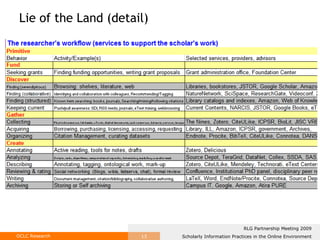
    Lie of theLand (detail)
  • 14.
    Research Information Management Projects A RIM manifesto Testing the desirability of research services Role of libraries in data curation Changing roles of library staff
  • 15.
    Test a listof research services List of Research Support Services (slide 1 of 2). We will… provide you dedicated space on a server. help you structure space to organize your notes, datasets, others’ publications, presentations… help you load it if you like. back up your work. ensure you can access your data remotely , no matter where you are. provide tools for group work and version control at the file level. help you manage your research, tracking who is involved in which grant , which research is funded by which grant, and purchasing grant-funded equipment. help you negotiate publication rights . help you comply with NIH and other requirements . (cont.)
  • 16.
    (Cont. 2 of2) We will… see that your work is disseminated broadly, quickly, and openly and that you get maximum impact for you and your university. do the authority work to ensure you are credited for all your work, despite the various forms of your name used in indicating authorship. keep your personal bibliography up-to-date. provide you with a customizable personal web page . include you in the campus expertise database and facilitate inclusion in disciplinary expert databases. preserve your outputs in the institutional repository and facilitate inclusion in disciplinary repositories. see that you can take your work with you if you leave this institution Test a list of research services
  • 17.
    Assess library contributionsrelated to data curation Big science vs. little science and humanities Derivative data and source data Data lifecycle management Data reuse Institutional vs. disciplinary approaches Data Curation
  • 18.
    Explore changing rolesof library staff: Increasing demands Role of "data librarians" Faculty liaison role Specialization in rights and open access Ways to work with departments to increase data management awareness and skills Changing Roles of Library Staff
  • 19.
    Your ideas We’requite eager to hear any ideas, suggestions, course corrections you might have But first…..
  • 20.
  • 21.
    Support for corescholarly activities Accessing  OpenURL Assessing  tags Chaining  search history Disseminating  forums Networking  groups, calendar . . . plus browsing, collecting, consulting etc
  • 22.
  • 23.
    A shared knowledgebase and access to disciplinary peers ‘ probing’ and ‘consulting’
  • 24.
    Social scientific behaviors. . . Direct searching  known-item access Scanning  abstracts, evaluative metadata Monitoring  sort by currency Data sharing  self-archived content Accessing  OpenURL Networking  contact details Example 2
  • 25.
    A model ofthe research life-cycle Context-specific Support Services Support for scientific information practices co-authoring  wiki coordinating  grant/project mgt monitoring  current awareness . . . in addition to core activities Example 3
  • 26.
  • 27.
  • 28.
  • 29.
  • 30.
    an eScholarship frameworkenables integrated services as a foundation for sustainable, innovative scholarly publishing Digital text collections Project platforms Publishing services Digital repository archive eResearch support
  • 31.
    Questions, Comments?Scholarly information practices undergoing a format transition
  • 32.
    Further Information Palmer,Carole L., et al. 2009. Scholarly Information Practices in the Online Environment: Themes from the Literature and Implications for Library Service Development (OCLC, 2009) Support for the Research Process program JISC Virtual Research Environments Programme summary EconomistsOnline prototype British Library Research Information Centre presentation UPEI Virtual Research Environment demonstrators University of Minnesota EthicShare demonstrator University of Glasgow “ Enrich ” project Sydney eScholarship initiative

Editor's Notes

  • #2 In this session we will Recap key research findings and map these to emerging library service frameworks (Malpas) Introduce an emerging program of work in exploring library roles in research support services (Erway) Invite reflection and discussion of how library resources can be most effectively directed to shared service development. As we proceed, we encourage attendees to consider: What kind of community change is possible in this arena – where can the RLG Partnership and OCLC Research make a difference .