Aloe Vera :
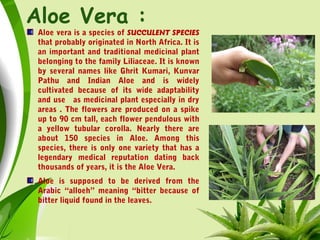
Aloe vera is a species of SUCCULENT SPECIES
that probably originated in North Africa. It is
an important and traditional medicinal plant
belonging to the family Liliaceae. It is known
by several names like Ghrit Kumari, Kunvar
Pathu and Indian Aloe and is widely
cultivated because of its wide adaptability
and use as medicinal plant especially in dry
areas . The flowers are produced on a spike
up to 90 cm tall, each flower pendulous with
a yellow tubular corolla. Nearly there are
about 150 species in Aloe. Among this
species, there is only one variety that has a
legendary medical reputation dating back
thousands of years, it is the Aloe Vera.
Aloe is supposed to be derived from the
Arabic “alloeh” meaning “bitter because of
bitter liquid found in the leaves.
Introduction :
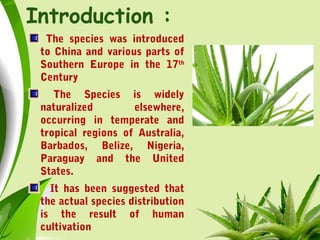
The species was introduced
to China and various parts of
Southern Europe in the 17th
Century
The Species is widely
naturalized elsewhere,
occurring in temperate and
tropical regions of Australia,
Barbados, Belize, Nigeria,
Paraguay and the United
States.
It has been suggested that
the actual species distribution
is the result of human
cultivation
Some Important Information
Kingdom : - Plantae
Clade : - Angiosperms
Clade : - Monocots
Order : - Asparagales
Family : - Xanthorrhoeaceac
Modern History
First modern medical paper published in 1934.
Described how the whole leaf was used to treat
radiation dermatitis.
Many papers published in the 20th century describing
a wide range of medicinal properties.
Reports have mainly focused on the anti diabetic,
anticancer and antimicrobial properties of the whole
leaf, gel or juice of the plant.
Many species of Aloe have been studied.
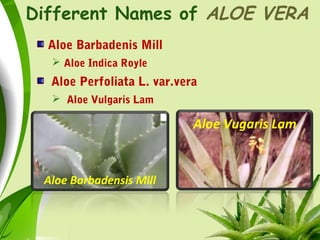
Different Names of ALOE VERA
Aloe Barbadenis Mill
 Aloe Indica Royle
Aloe Perfoliata L. var.vera
 Aloe Vulgaris Lam
Aloe Barbadensis Mill
Aloe Vugaris Lam
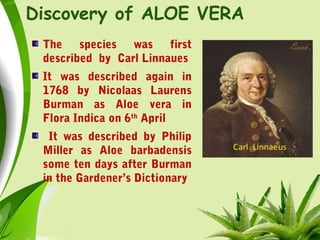
Discovery of ALOE VERA
The species was first
described by Carl Linnaues
It was described again in
1768 by Nicolaas Laurens
Burman as Aloe vera in
Flora Indica on 6th
April
It was described by Philip
Miller as Aloe barbadensis
some ten days after Burman
in the Gardener’s Dictionary
Growing the Aloe Vera Herb
According to botanists, Aloe Vera plants originated
in warm conditions and mostlu flourished in tropial
and sub-tropical regions
Africa is one of the largest homes of Aloe Vera
plants
But the plant had been carried to various parts of
the world and due to its great adaptable nature, the
plant flourished in any region.
Factors in Production
Climate
Aloe is grown in warm tropical areas and cannot
survive freezing temperatures.
It can be seen growing good in warm humid or
dry climate. However, it is intolerant to extreme
cool conditions. The plant flourishes well on dry
sandy soils at localities with lower annual rainfall
of 50 to 300mm. It needs protection against frost
and low winter temperature
Factors in Production
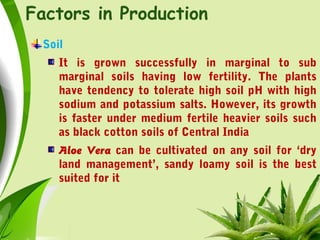
Soil
It is grown successfully in marginal to sub
marginal soils having low fertility. The plants
have tendency to tolerate high soil pH with high
sodium and potassium salts. However, its growth
is faster under medium fertile heavier soils such
as black cotton soils of Central India
Aloe Vera can be cultivated on any soil for ‘dry
land management’, sandy loamy soil is the best
suited for it
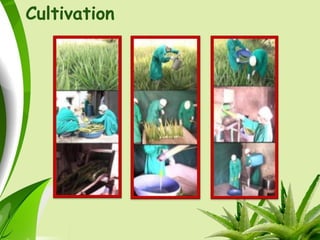
Cultivation
Biochemistry
The Aloe Vera plant contains at least sis
antiseptic agents: lupeol, salicyclic acid, urea
nitrogen, cinnamic acid, pheno and Sulphur
It contains over 200 ingredients and seems to
affect thousands of biomedical actions in the
body
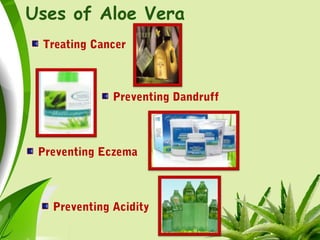
Uses of Aloe Vera
Treating Cancer
Preventing Dandruff
Preventing Eczema
Preventing Acidity
Uses of Aloe Vera
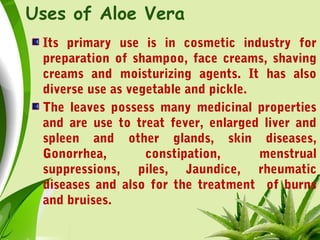
Its primary use is in cosmetic industry for
preparation of shampoo, face creams, shaving
creams and moisturizing agents. It has also
diverse use as vegetable and pickle.
The leaves possess many medicinal properties
and are use to treat fever, enlarged liver and
spleen and other glands, skin diseases,
Gonorrhea, constipation, menstrual
suppressions, piles, Jaundice, rheumatic
diseases and also for the treatment of burns
and bruises.
Commodities
Aloe vera is now widely used on facial tissues, where it is
promoted as a moisturizer and /or anti-irritant to reduce
chafing of the nose of users suffering hay-fever or cold
It is common practice for cosmetic companies to ass sap
or other derivatives fro Aloe Vera to products such as:
Make up
Tissues
Moisturizers
Soaps
Sunscreens
Shaving Cream
Dietary Supplement
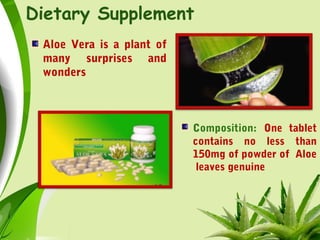
Aloe Vera is a plant of
many surprises and
wonders
Composition: One tablet
contains no less than
150mg of powder of Aloe
leaves genuine
Aloe Vera Juice
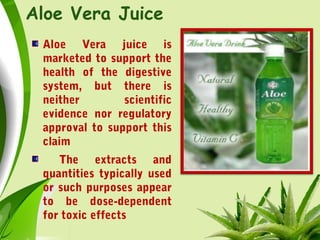
Aloe Vera juice is
marketed to support the
health of the digestive
system, but there is
neither scientific
evidence nor regulatory
approval to support this
claim
The extracts and
quantities typically used
or such purposes appear
to be dose-dependent
for toxic effects
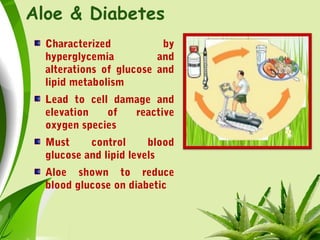
Aloe & Diabetes
Characterized by
hyperglycemia and
alterations of glucose and
lipid metabolism
Lead to cell damage and
elevation of reactive
oxygen species
Must control blood
glucose and lipid levels
Aloe shown to reduce
blood glucose on diabetic
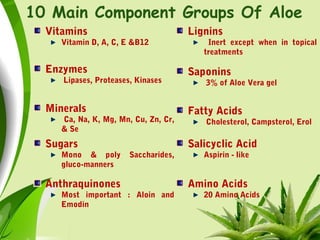
10 Main Component Groups Of Aloe
Vitamins
Vitamin D, A, C, E &B12
Lignins
Inert except when in topical
treatments
Enzymes
Lipases, Proteases, Kinases
Saponins
3% of Aloe Vera gel
Minerals
Ca, Na, K, Mg, Mn, Cu, Zn, Cr,
& Se
Fatty Acids
Cholesterol, Campsterol, Erol
Sugars
Mono & poly Saccharides,
gluco-manners
Salicyclic Acid
Aspirin - like
Anthraquinones
Most important : Aloin and
Emodin
Amino Acids
20 Amino Acids
Aloe vera

Aloe vera

  • 2.
    Aloe Vera : Aloevera is a species of SUCCULENT SPECIES that probably originated in North Africa. It is an important and traditional medicinal plant belonging to the family Liliaceae. It is known by several names like Ghrit Kumari, Kunvar Pathu and Indian Aloe and is widely cultivated because of its wide adaptability and use as medicinal plant especially in dry areas . The flowers are produced on a spike up to 90 cm tall, each flower pendulous with a yellow tubular corolla. Nearly there are about 150 species in Aloe. Among this species, there is only one variety that has a legendary medical reputation dating back thousands of years, it is the Aloe Vera. Aloe is supposed to be derived from the Arabic “alloeh” meaning “bitter because of bitter liquid found in the leaves.
  • 3.
    Introduction : The specieswas introduced to China and various parts of Southern Europe in the 17th Century The Species is widely naturalized elsewhere, occurring in temperate and tropical regions of Australia, Barbados, Belize, Nigeria, Paraguay and the United States. It has been suggested that the actual species distribution is the result of human cultivation
  • 4.
    Some Important Information Kingdom: - Plantae Clade : - Angiosperms Clade : - Monocots Order : - Asparagales Family : - Xanthorrhoeaceac
  • 5.
    Modern History First modernmedical paper published in 1934. Described how the whole leaf was used to treat radiation dermatitis. Many papers published in the 20th century describing a wide range of medicinal properties. Reports have mainly focused on the anti diabetic, anticancer and antimicrobial properties of the whole leaf, gel or juice of the plant. Many species of Aloe have been studied.
  • 6.
    Different Names ofALOE VERA Aloe Barbadenis Mill  Aloe Indica Royle Aloe Perfoliata L. var.vera  Aloe Vulgaris Lam Aloe Barbadensis Mill Aloe Vugaris Lam
  • 7.
    Discovery of ALOEVERA The species was first described by Carl Linnaues It was described again in 1768 by Nicolaas Laurens Burman as Aloe vera in Flora Indica on 6th April It was described by Philip Miller as Aloe barbadensis some ten days after Burman in the Gardener’s Dictionary
  • 8.
    Growing the AloeVera Herb According to botanists, Aloe Vera plants originated in warm conditions and mostlu flourished in tropial and sub-tropical regions Africa is one of the largest homes of Aloe Vera plants But the plant had been carried to various parts of the world and due to its great adaptable nature, the plant flourished in any region.
  • 9.
    Factors in Production Climate Aloeis grown in warm tropical areas and cannot survive freezing temperatures. It can be seen growing good in warm humid or dry climate. However, it is intolerant to extreme cool conditions. The plant flourishes well on dry sandy soils at localities with lower annual rainfall of 50 to 300mm. It needs protection against frost and low winter temperature
  • 10.
    Factors in Production Soil Itis grown successfully in marginal to sub marginal soils having low fertility. The plants have tendency to tolerate high soil pH with high sodium and potassium salts. However, its growth is faster under medium fertile heavier soils such as black cotton soils of Central India Aloe Vera can be cultivated on any soil for ‘dry land management’, sandy loamy soil is the best suited for it
  • 11.
  • 12.
    Biochemistry The Aloe Veraplant contains at least sis antiseptic agents: lupeol, salicyclic acid, urea nitrogen, cinnamic acid, pheno and Sulphur It contains over 200 ingredients and seems to affect thousands of biomedical actions in the body
  • 13.
    Uses of AloeVera Treating Cancer Preventing Dandruff Preventing Eczema Preventing Acidity
  • 14.
    Uses of AloeVera Its primary use is in cosmetic industry for preparation of shampoo, face creams, shaving creams and moisturizing agents. It has also diverse use as vegetable and pickle. The leaves possess many medicinal properties and are use to treat fever, enlarged liver and spleen and other glands, skin diseases, Gonorrhea, constipation, menstrual suppressions, piles, Jaundice, rheumatic diseases and also for the treatment of burns and bruises.
  • 15.
    Commodities Aloe vera isnow widely used on facial tissues, where it is promoted as a moisturizer and /or anti-irritant to reduce chafing of the nose of users suffering hay-fever or cold It is common practice for cosmetic companies to ass sap or other derivatives fro Aloe Vera to products such as: Make up Tissues Moisturizers Soaps Sunscreens Shaving Cream
  • 16.
    Dietary Supplement Aloe Verais a plant of many surprises and wonders Composition: One tablet contains no less than 150mg of powder of Aloe leaves genuine
  • 17.
    Aloe Vera Juice AloeVera juice is marketed to support the health of the digestive system, but there is neither scientific evidence nor regulatory approval to support this claim The extracts and quantities typically used or such purposes appear to be dose-dependent for toxic effects
  • 18.
    Aloe & Diabetes Characterizedby hyperglycemia and alterations of glucose and lipid metabolism Lead to cell damage and elevation of reactive oxygen species Must control blood glucose and lipid levels Aloe shown to reduce blood glucose on diabetic
  • 19.
    10 Main ComponentGroups Of Aloe Vitamins Vitamin D, A, C, E &B12 Lignins Inert except when in topical treatments Enzymes Lipases, Proteases, Kinases Saponins 3% of Aloe Vera gel Minerals Ca, Na, K, Mg, Mn, Cu, Zn, Cr, & Se Fatty Acids Cholesterol, Campsterol, Erol Sugars Mono & poly Saccharides, gluco-manners Salicyclic Acid Aspirin - like Anthraquinones Most important : Aloin and Emodin Amino Acids 20 Amino Acids