Unit 3 ,topic 2
Learning
Learning
Learning
•Involves change
•Is relatively permanent
•Is acquired through experience
Learning
Any relatively permanent change in behavior
that occurs as a result of experience.
Theories of Learning
Key Concepts
•Unconditioned stimulus
•Unconditioned response
•Conditioned stimulus
•Conditioned response
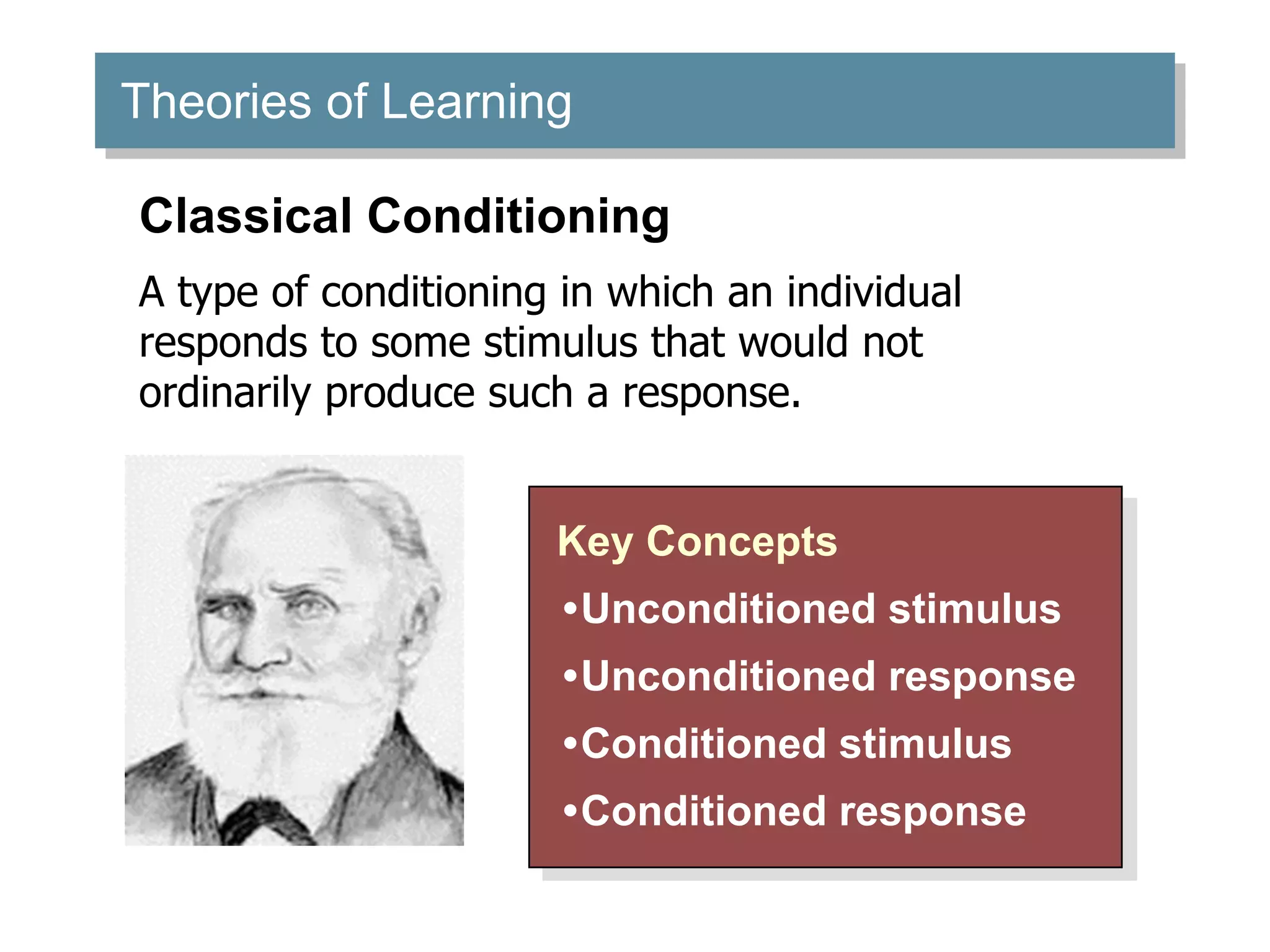
Classical Conditioning
A type of conditioning in which an individual
responds to some stimulus that would not
ordinarily produce such a response.
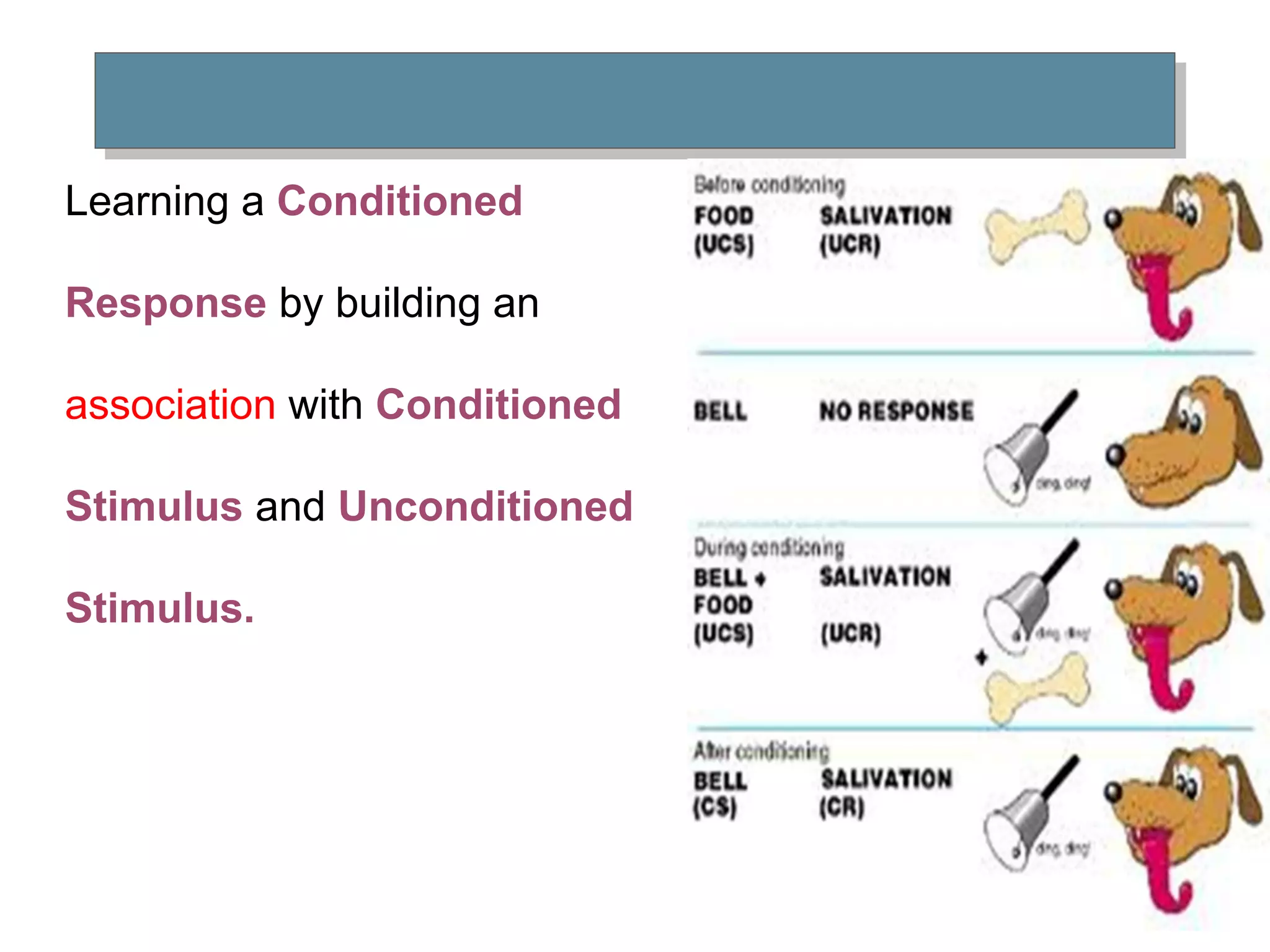
Learning a Conditioned
Response by building an
association with Conditioned
Stimulus and Unconditioned
Stimulus.
Theories of Learning (cont’d)
Key Concepts
•Reflexive (unlearned) behavior
•Conditioned (learned)
behavior
•Reinforcement
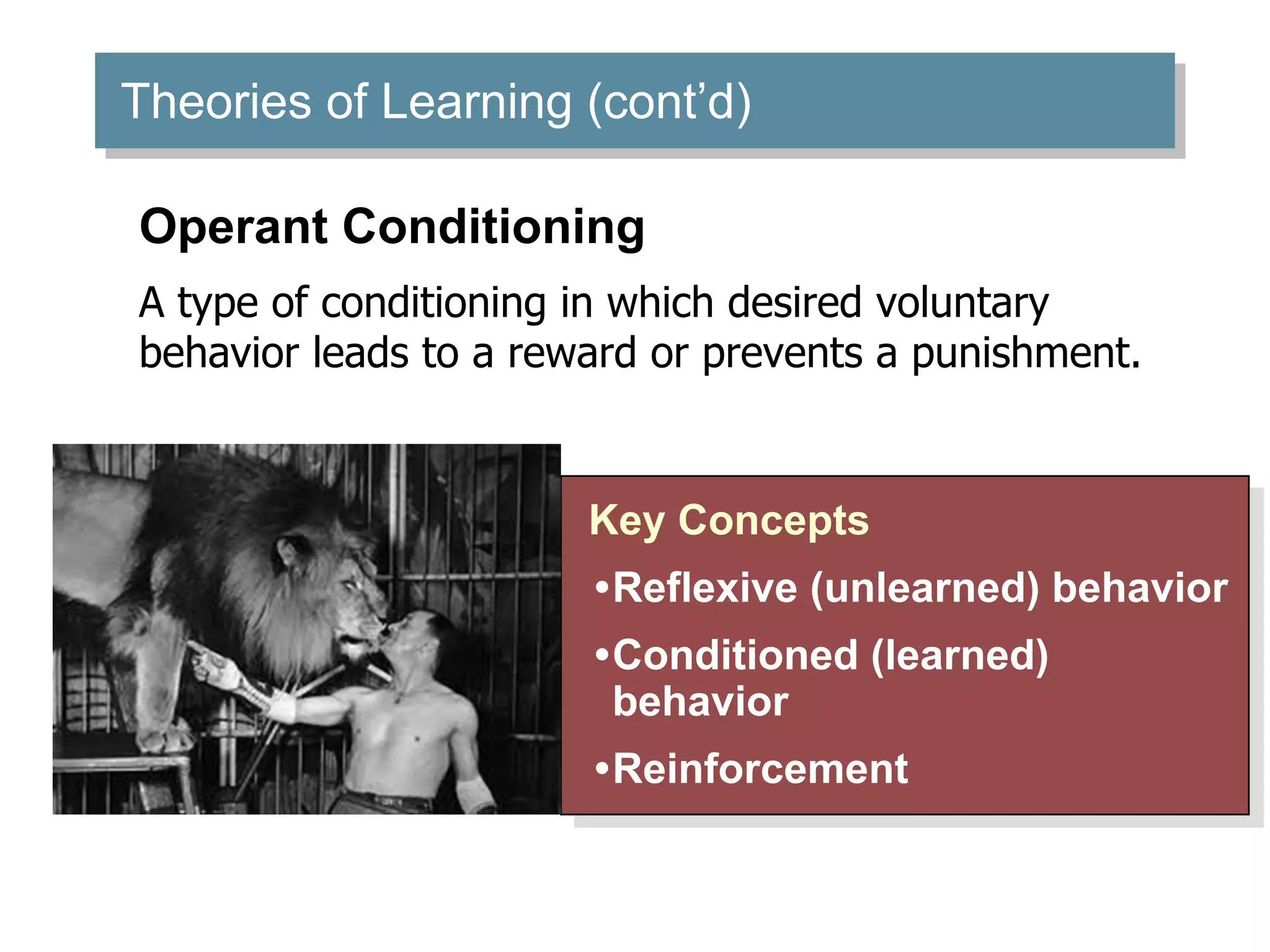
Operant Conditioning
A type of conditioning in which desired voluntary
behavior leads to a reward or prevents a punishment.
26
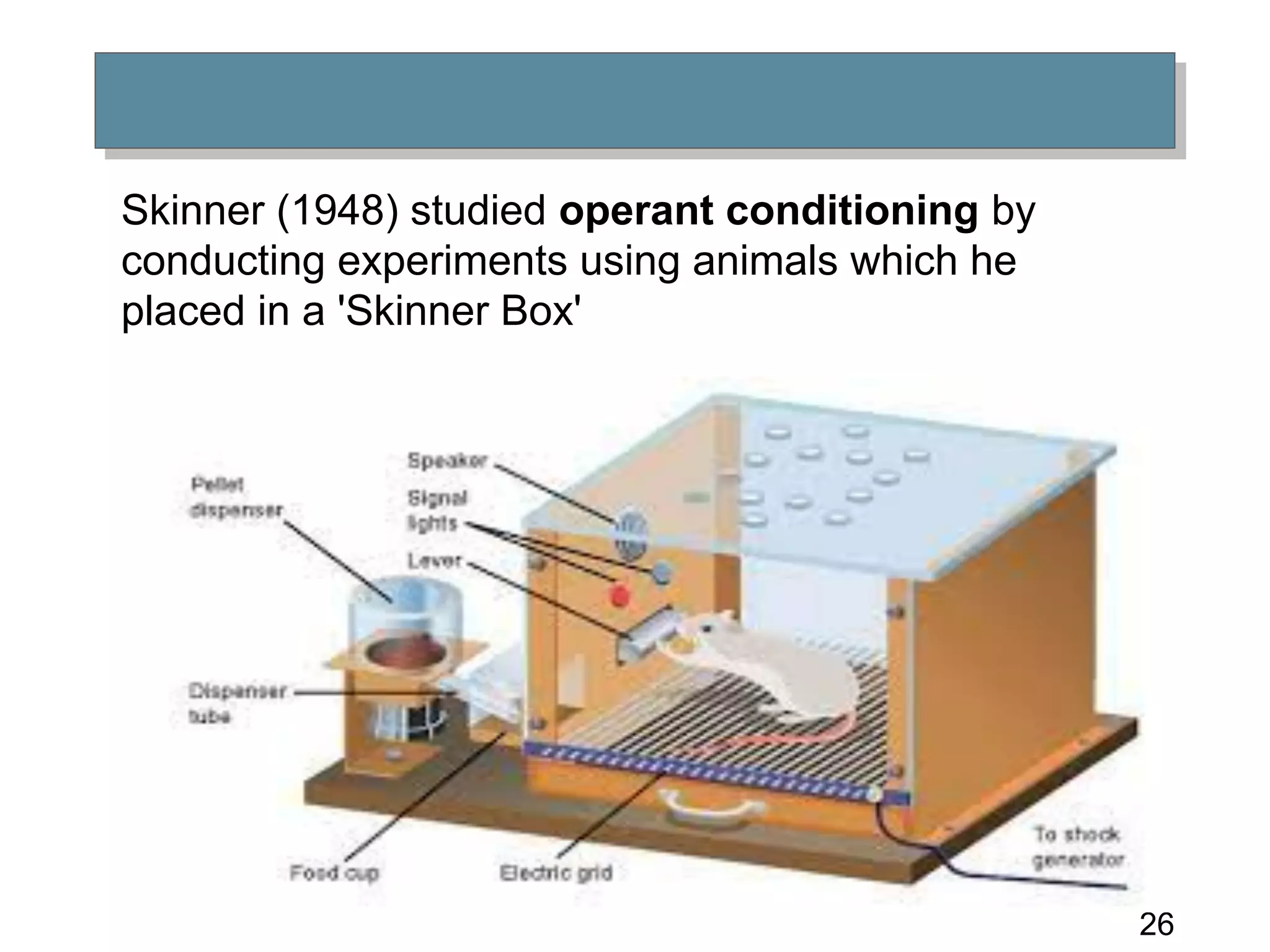
Skinner (1948) studied operant conditioning by
conducting experiments using animals which he
placed in a 'Skinner Box'
Theories of Learning (cont’d)
Key Concepts
•Reinforcement is required to change behavior.
•Some rewards are more effective than others.
•The timing of reinforcement affects learning
speed and permanence.
Shaping Behavior
Systematically reinforcing each successive step that
moves an individual closer to the desired response.
Types of Reinforcement
Positive reinforcement
– Providing a reward for a desired behavior.
Negative reinforcement
– Removing an unpleasant consequence when the
desired behavior occurs.
Punishment
– Applying an undesirable condition to eliminate an
undesirable behavior.
Extinction
– Withholding reinforcement of a behavior to cause its
cessation.
Think of negative reinforcement as taking something negative
away in order to increase a response.
Imagine a teenager who is nagged by his mother to take out the
garbage week after week. After complaining to his friends about
the nagging, he finally one day performs the task and to his
amazement, the nagging stops. The elimination of this negative
stimulus is reinforcing and will likely increase the chances that he
will take out the garbage next week.
Punishment refers to adding something aversive in order to
decrease a behavior. The most common example of this is
disciplining (e.g. spanking) a child for misbehaving. The reason
we do this is because the child begins to associate being
punished with the negative behavior. The punishment is not
liked and therefore to avoid it, he or she will stop behaving in
that manner.
Let us assume a situation.
A students enters a class late.
Teacher says: Get! Out!
So, for that student its a punishment.
For other students who were sitting it is negative
reinforcement.
(as they will have a assumption that when they will be
late same will apply to them).
Reinforcement strengthens/increases behavior;
punishment decreases/weakens
Theories of Learning (cont’d)
Social-Learning Theory
People can learn through observation and direct
experience.(BANDURA)
Social learning theory is a theory of learning
process and social behavior which proposes that
new behaviors can be acquired by observing and
imitating others.
In addition to the observation of behavior, learning
also occurs through the observation of rewards and
punishments, a process known as vicarious
reinforcement.
LEARNING in Organizations.
Payment
– Reduces absenteeism by rewarding attendance, not
absence.
Employee Discipline
– The use of punishment can be counter-productive.
Developing Training Programs
– OB MOD methods improve training effectiveness.
Self-management
– Reduces the need for external management control.

Learning.pdf

  • 1.
    Unit 3 ,topic2 Learning
  • 2.
    Learning Learning •Involves change •Is relativelypermanent •Is acquired through experience Learning Any relatively permanent change in behavior that occurs as a result of experience.
  • 3.
    Theories of Learning KeyConcepts •Unconditioned stimulus •Unconditioned response •Conditioned stimulus •Conditioned response Classical Conditioning A type of conditioning in which an individual responds to some stimulus that would not ordinarily produce such a response.
  • 4.
    Learning a Conditioned Responseby building an association with Conditioned Stimulus and Unconditioned Stimulus.
  • 5.
    Theories of Learning(cont’d) Key Concepts •Reflexive (unlearned) behavior •Conditioned (learned) behavior •Reinforcement Operant Conditioning A type of conditioning in which desired voluntary behavior leads to a reward or prevents a punishment.
  • 6.
    26 Skinner (1948) studiedoperant conditioning by conducting experiments using animals which he placed in a 'Skinner Box'
  • 7.
    Theories of Learning(cont’d) Key Concepts •Reinforcement is required to change behavior. •Some rewards are more effective than others. •The timing of reinforcement affects learning speed and permanence. Shaping Behavior Systematically reinforcing each successive step that moves an individual closer to the desired response.
  • 8.
    Types of Reinforcement Positivereinforcement – Providing a reward for a desired behavior. Negative reinforcement – Removing an unpleasant consequence when the desired behavior occurs. Punishment – Applying an undesirable condition to eliminate an undesirable behavior. Extinction – Withholding reinforcement of a behavior to cause its cessation.
  • 9.
    Think of negativereinforcement as taking something negative away in order to increase a response. Imagine a teenager who is nagged by his mother to take out the garbage week after week. After complaining to his friends about the nagging, he finally one day performs the task and to his amazement, the nagging stops. The elimination of this negative stimulus is reinforcing and will likely increase the chances that he will take out the garbage next week. Punishment refers to adding something aversive in order to decrease a behavior. The most common example of this is disciplining (e.g. spanking) a child for misbehaving. The reason we do this is because the child begins to associate being punished with the negative behavior. The punishment is not liked and therefore to avoid it, he or she will stop behaving in that manner.
  • 10.
    Let us assumea situation. A students enters a class late. Teacher says: Get! Out! So, for that student its a punishment. For other students who were sitting it is negative reinforcement. (as they will have a assumption that when they will be late same will apply to them). Reinforcement strengthens/increases behavior; punishment decreases/weakens
  • 11.
    Theories of Learning(cont’d) Social-Learning Theory People can learn through observation and direct experience.(BANDURA) Social learning theory is a theory of learning process and social behavior which proposes that new behaviors can be acquired by observing and imitating others. In addition to the observation of behavior, learning also occurs through the observation of rewards and punishments, a process known as vicarious reinforcement.
  • 12.
    LEARNING in Organizations. Payment –Reduces absenteeism by rewarding attendance, not absence. Employee Discipline – The use of punishment can be counter-productive. Developing Training Programs – OB MOD methods improve training effectiveness. Self-management – Reduces the need for external management control.