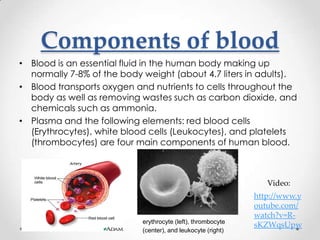
Components of blood
• Blood is an essential fluid in the human body making up
normally 7-8% of the body weight (about 4.7 liters in adults).
• Blood transports oxygen and nutrients to cells throughout the
body as well as removing wastes such as carbon dioxide, and
chemicals such as ammonia.
• Plasma and the following elements: red blood cells
(Erythrocytes), white blood cells (Leukocytes), and platelets
(thrombocytes) are four main components of human blood.
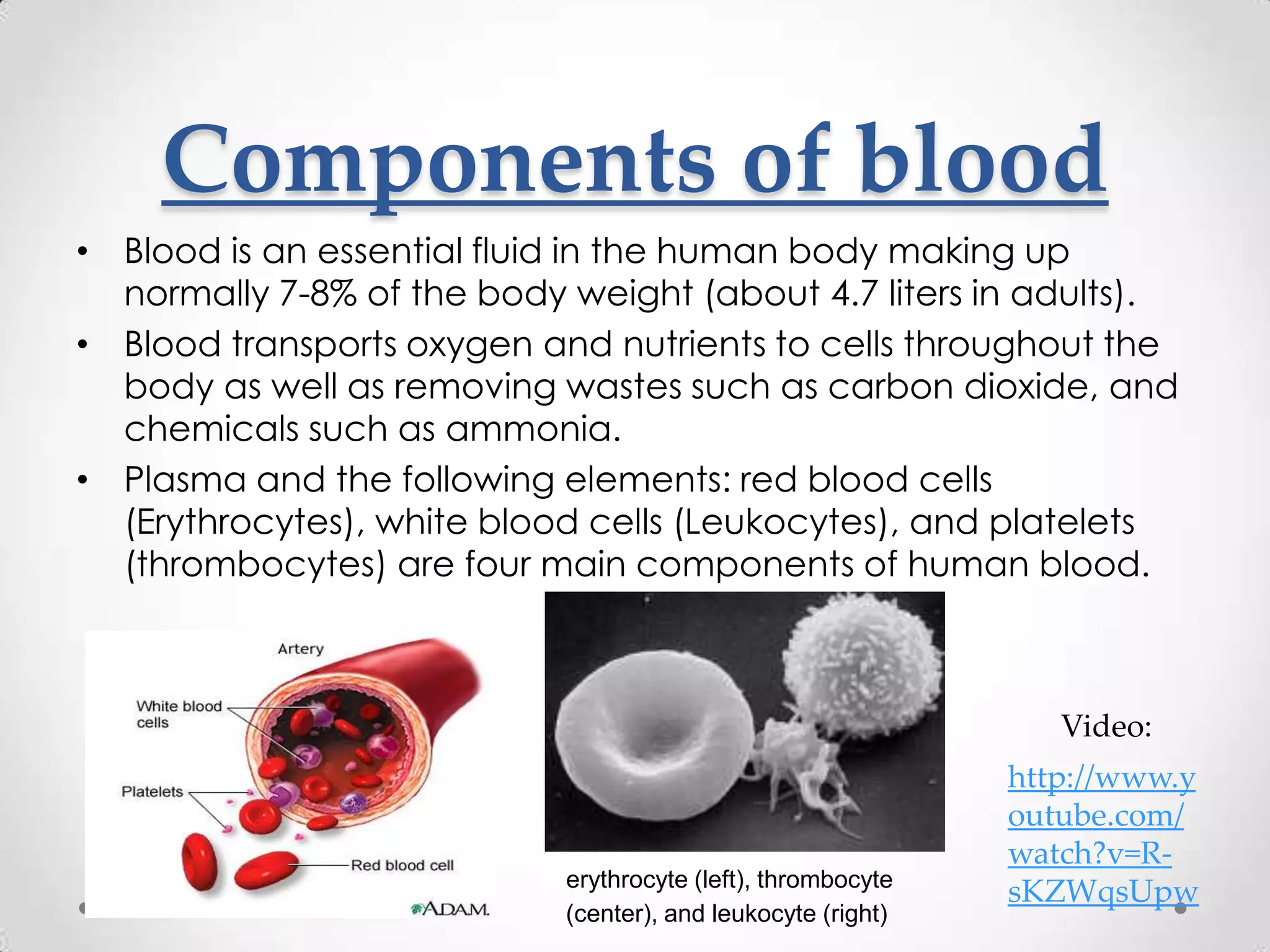
erythrocyte (left), thrombocyte
(center), and leukocyte (right)
http://www.y
outube.com/
watch?v=R-
sKZWqsUpw
Video:
Red blood cells
(Erythrocytes)
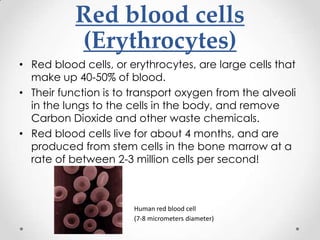
• Red blood cells, or erythrocytes, are large cells that
make up 40-50% of blood.
• Their function is to transport oxygen from the alveoli
in the lungs to the cells in the body, and remove
Carbon Dioxide and other waste chemicals.
• Red blood cells live for about 4 months, and are
produced from stem cells in the bone marrow at a
rate of between 2-3 million cells per second!
Human red blood cell
(7-8 micrometers diameter)
White Blood Cells
(Leukocytes)
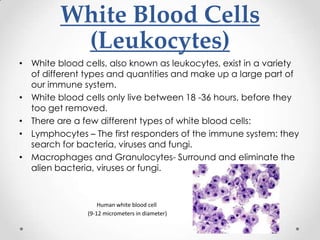
• White blood cells, also known as leukocytes, exist in a variety
of different types and quantities and make up a large part of
our immune system.
• White blood cells only live between 18 -36 hours, before they
too get removed.
• There are a few different types of white blood cells:
• Lymphocytes – The first responders of the immune system: they
search for bacteria, viruses and fungi.
• Macrophages and Granulocytes- Surround and eliminate the
alien bacteria, viruses or fungi.
Human white blood cell
(9-12 micrometers in diameter)
Platelets (Thrombocytes)
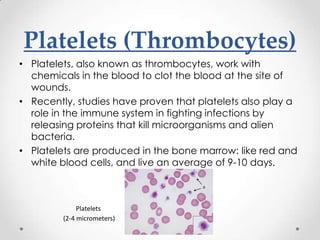
• Platelets, also known as thrombocytes, work with
chemicals in the blood to clot the blood at the site of
wounds.
• Recently, studies have proven that platelets also play a
role in the immune system in fighting infections by
releasing proteins that kill microorganisms and alien
bacteria.
• Platelets are produced in the bone marrow: like red and
white blood cells, and live an average of 9-10 days.
Platelets
(2-4 micrometers)
Blood Plasma
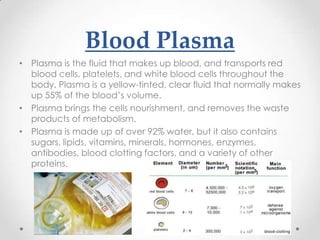
• Plasma is the fluid that makes up blood, and transports red
blood cells, platelets, and white blood cells throughout the
body. Plasma is a yellow-tinted, clear fluid that normally makes
up 55% of the blood’s volume.
• Plasma brings the cells nourishment, and removes the waste
products of metabolism.
• Plasma is made up of over 92% water, but it also contains
sugars, lipids, vitamins, minerals, hormones, enzymes,
antibodies, blood clotting factors, and a variety of other
proteins.
Blood Components
Resources:
• http://answers.yahoo.com/question/index?qid=201105291515
20AAyV0FO
• http://www.nsbri.org/humanphysspace/focus3/earthphys-
frame.html
• http://thenextweb.com/shareables/2011/02/09/its-art-when-
white-blood-cells-attack-each-other/
• http://www.fi.edu/learn/heart/blood/white.html
• http://www.bloodservices.ca/centreapps/internet/uw_v502_
mainengine.nsf/page/Plasma
• https://ahdc.vet.cornell.edu/clinpath/modules/heme1/pltc.ht
m
• http://www.beltina.org/health-dictionary/blood-plasma-
blood-cells.html
• http://answers.yahoo.com/question/index?qid=200901011219
10AAHRDXX

Blood components case study presentation july 2013

  • 1.
    Components of blood •Blood is an essential fluid in the human body making up normally 7-8% of the body weight (about 4.7 liters in adults). • Blood transports oxygen and nutrients to cells throughout the body as well as removing wastes such as carbon dioxide, and chemicals such as ammonia. • Plasma and the following elements: red blood cells (Erythrocytes), white blood cells (Leukocytes), and platelets (thrombocytes) are four main components of human blood. erythrocyte (left), thrombocyte (center), and leukocyte (right) http://www.y outube.com/ watch?v=R- sKZWqsUpw Video:
  • 2.
    Red blood cells (Erythrocytes) •Red blood cells, or erythrocytes, are large cells that make up 40-50% of blood. • Their function is to transport oxygen from the alveoli in the lungs to the cells in the body, and remove Carbon Dioxide and other waste chemicals. • Red blood cells live for about 4 months, and are produced from stem cells in the bone marrow at a rate of between 2-3 million cells per second! Human red blood cell (7-8 micrometers diameter)
  • 3.
    White Blood Cells (Leukocytes) •White blood cells, also known as leukocytes, exist in a variety of different types and quantities and make up a large part of our immune system. • White blood cells only live between 18 -36 hours, before they too get removed. • There are a few different types of white blood cells: • Lymphocytes – The first responders of the immune system: they search for bacteria, viruses and fungi. • Macrophages and Granulocytes- Surround and eliminate the alien bacteria, viruses or fungi. Human white blood cell (9-12 micrometers in diameter)
  • 4.
    Platelets (Thrombocytes) • Platelets,also known as thrombocytes, work with chemicals in the blood to clot the blood at the site of wounds. • Recently, studies have proven that platelets also play a role in the immune system in fighting infections by releasing proteins that kill microorganisms and alien bacteria. • Platelets are produced in the bone marrow: like red and white blood cells, and live an average of 9-10 days. Platelets (2-4 micrometers)
  • 5.
    Blood Plasma • Plasmais the fluid that makes up blood, and transports red blood cells, platelets, and white blood cells throughout the body. Plasma is a yellow-tinted, clear fluid that normally makes up 55% of the blood’s volume. • Plasma brings the cells nourishment, and removes the waste products of metabolism. • Plasma is made up of over 92% water, but it also contains sugars, lipids, vitamins, minerals, hormones, enzymes, antibodies, blood clotting factors, and a variety of other proteins.
  • 6.
    Blood Components Resources: • http://answers.yahoo.com/question/index?qid=201105291515 20AAyV0FO •http://www.nsbri.org/humanphysspace/focus3/earthphys- frame.html • http://thenextweb.com/shareables/2011/02/09/its-art-when- white-blood-cells-attack-each-other/ • http://www.fi.edu/learn/heart/blood/white.html • http://www.bloodservices.ca/centreapps/internet/uw_v502_ mainengine.nsf/page/Plasma • https://ahdc.vet.cornell.edu/clinpath/modules/heme1/pltc.ht m • http://www.beltina.org/health-dictionary/blood-plasma- blood-cells.html • http://answers.yahoo.com/question/index?qid=200901011219 10AAHRDXX