Overactive Bladder
DR LAXMI SHRIKHANDE
DR ANIL SHRIKHANDE
❑Overactive bladder (OAB) is not a disease; it is a
symptom; Patients with OAB do not complain of pain or
dysuria
❑Bladder storage symptoms have a severe impact on many areas
as regards the quality of life including health-related, social,
psychological and working functions
❑Overactive bladder (OAB) is highly prevalent and is
associated with considerable morbidity, especially in
aging population
OAB
OAB-Symptoms
Urgency
Frequent strong, sudden and
unpredictable desire to urinate
UrgeIncontinence
Involuntary urine loss associatedwith
sudden, strong desire to void
Eur.Ass.Gyn.Obs,1999
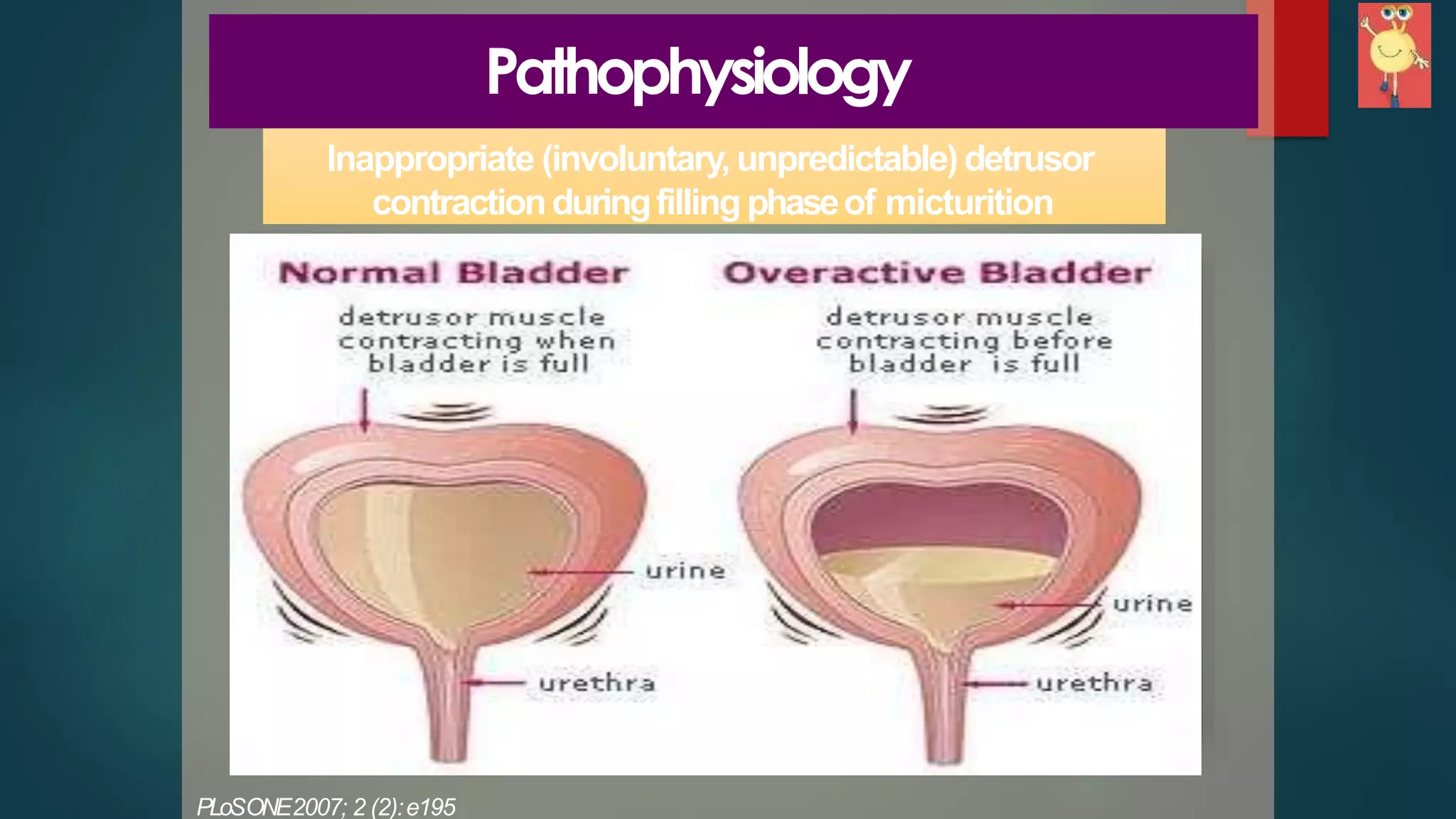
Inappropriate (involuntary, unpredictable)detrusor
contractionduringfilling phaseof micturition
Pathophysiology
PLoSONE2007; 2 (2):e195
SOLIACT
Overactive bladder: treatment options
First-line treatments:
❑Behavioral therapies (e.g. bladder training, bladder control
strategies, pelvic floor muscle training, fluid management) as
first-line therapy to all patients with overactive bladder.
❑Pharmacologic management.
7
Mattiasson A. Urology. 2000;55(suppl 5a):12-13, Mattiasson A. Neuro Urodyn. 2001;20:403-404, Burgio et al. JAGS. 2000;48:370-374.
Drug therapy: becoming increasingly important & currently
mainstay in treatment for OAB
OAB: Pharmacotherapy
Antimuscarinic agents: Gold standard
Second-line treatments:
8
Ideal muscarinic receptor antagonist
 Efficacious:
 Inhibits involuntary bladder contractions
 Does not adversely affect voluntary detrusor activity
 Organ selective:
 Preferentially affects bladder over other organs
 Minimal side effects
 Tolerable:
 Improves compliance
Choice of agent
 may not experience the full benefit of these drugs until after
4 weeks of treatment
 If the first choice is not effective or is poorly tolerated, it is
reasonable to offer another drug, preferably the least
expensive.
 should be counseled about the need for concurrent
behavioral therapy, because these drugs are more effective
in combination with behavioral therapy than with either
treatment modality alone.
Side effects
 Common adverse effects include constipation,
impaired cognition, sedation, and blurred vision.
 These agents should not be used in patients with
narrow angle glaucoma because they can increase
intraocular pressure.
 Extra caution in frail patients-cognitive function
 SR preparation preferred
 start with Lowest possible dose
Drugs
 Oxybutynin- side effects
 Tolterodine 4 mg OD
 Trospium 60 mg OD- safe in elderly as it doesn’t cross
blood brain barrier
 Darifenacin-frequency 7.5mg OD /15 mg
 Solifenacin-urgency 5mg OD / 10mg
 Mirabegron-50 mg OD
 Combination
Mirabegron-Beta 3 agonist
 USFDA approved in 2012
 A placebo controlled RCT found that patients taking once daily mirabegron
had 1.1 (−1.35 to −0.91) fewer daily episodes of urinary incontinence with
placebo, compared with 1.5 (−1.69 to −1.25) for 50 mg mirabegron, and 1.6
(−1.86 to −1.40) with 100 mg mirabegron, from a baseline of 2.4 episodes daily.
 Adverse effects were uncommon, with dry mouth and constipation reported in
less than 2% of all patients.
 In addition, a pooled phase III clinical trial showed no significant increase in
hypertension (<1 mm Hg) with mirabegron versus placebo.
 Dose- 50 mg ODX 8 weeks- 12 month
 Can be given in association with solifenacin 5 mg OD-urgency/nocturia
 Caution- renal impairment and HT
Third-line treatments:
❑ Intradetrusor onabotulinum toxin A (100 U) as third-line treatment in the carefully-selected
and thoroughly counseled; patient who has been refractory to first- and second-line
overactive bladder treatments. The patient must be able and willing to return for frequent
post-void residual evaluation and able and willing to perform self-catheterization if
necessary.
Standard Option
❑ Peripheral tibial nerve stimulation (PTNS) as third-line treatment in a carefully selected
patient population.
❑ Sacral neuromodulation (SNS) as third-line treatment in a carefully selected patient
population characterized
❑ By severe refractory overactive bladder symptoms or patients who are not candidates for
second-line therapy and are willing to undergo a surgical procedure.
Additional treatments:
❑ Indwelling catheters (including transurethral, suprapubic, etc.) are not recommended as a
management strategy for overactive bladder because of the adverse risk/benefit balance
except as a last resort in selected patients.
❑ In rare cases, augmentation cystoplasty or urinary diversion for severe, refractory,
complicated overactive bladder patients may be considered.
Overactive bladder: treatment options
1. Underreporting • Increase patient awareness
about OABasadisease
2. High discontinuation
rates with antimuscarinic
therapy
• Increase awareness
regarding OABmanagement
• Need anantimuscarinic
agent:
➢ Better efficacy
➢ Better persistencerates
➢ Goodsafety profile
➢ Integration with behavioural
therapy

All you need to know about Overactive Bladder Disease

  • 1.
    Overactive Bladder DR LAXMISHRIKHANDE DR ANIL SHRIKHANDE
  • 2.
    ❑Overactive bladder (OAB)is not a disease; it is a symptom; Patients with OAB do not complain of pain or dysuria ❑Bladder storage symptoms have a severe impact on many areas as regards the quality of life including health-related, social, psychological and working functions ❑Overactive bladder (OAB) is highly prevalent and is associated with considerable morbidity, especially in aging population OAB
  • 3.
    OAB-Symptoms Urgency Frequent strong, suddenand unpredictable desire to urinate UrgeIncontinence Involuntary urine loss associatedwith sudden, strong desire to void Eur.Ass.Gyn.Obs,1999
  • 4.
    Inappropriate (involuntary, unpredictable)detrusor contractionduringfillingphaseof micturition Pathophysiology PLoSONE2007; 2 (2):e195
  • 5.
  • 6.
    Overactive bladder: treatmentoptions First-line treatments: ❑Behavioral therapies (e.g. bladder training, bladder control strategies, pelvic floor muscle training, fluid management) as first-line therapy to all patients with overactive bladder. ❑Pharmacologic management.
  • 7.
    7 Mattiasson A. Urology.2000;55(suppl 5a):12-13, Mattiasson A. Neuro Urodyn. 2001;20:403-404, Burgio et al. JAGS. 2000;48:370-374. Drug therapy: becoming increasingly important & currently mainstay in treatment for OAB OAB: Pharmacotherapy Antimuscarinic agents: Gold standard Second-line treatments:
  • 8.
    8 Ideal muscarinic receptorantagonist  Efficacious:  Inhibits involuntary bladder contractions  Does not adversely affect voluntary detrusor activity  Organ selective:  Preferentially affects bladder over other organs  Minimal side effects  Tolerable:  Improves compliance
  • 9.
    Choice of agent may not experience the full benefit of these drugs until after 4 weeks of treatment  If the first choice is not effective or is poorly tolerated, it is reasonable to offer another drug, preferably the least expensive.  should be counseled about the need for concurrent behavioral therapy, because these drugs are more effective in combination with behavioral therapy than with either treatment modality alone.
  • 10.
    Side effects  Commonadverse effects include constipation, impaired cognition, sedation, and blurred vision.  These agents should not be used in patients with narrow angle glaucoma because they can increase intraocular pressure.  Extra caution in frail patients-cognitive function  SR preparation preferred  start with Lowest possible dose
  • 11.
    Drugs  Oxybutynin- sideeffects  Tolterodine 4 mg OD  Trospium 60 mg OD- safe in elderly as it doesn’t cross blood brain barrier  Darifenacin-frequency 7.5mg OD /15 mg  Solifenacin-urgency 5mg OD / 10mg  Mirabegron-50 mg OD  Combination
  • 12.
    Mirabegron-Beta 3 agonist USFDA approved in 2012  A placebo controlled RCT found that patients taking once daily mirabegron had 1.1 (−1.35 to −0.91) fewer daily episodes of urinary incontinence with placebo, compared with 1.5 (−1.69 to −1.25) for 50 mg mirabegron, and 1.6 (−1.86 to −1.40) with 100 mg mirabegron, from a baseline of 2.4 episodes daily.  Adverse effects were uncommon, with dry mouth and constipation reported in less than 2% of all patients.  In addition, a pooled phase III clinical trial showed no significant increase in hypertension (<1 mm Hg) with mirabegron versus placebo.  Dose- 50 mg ODX 8 weeks- 12 month  Can be given in association with solifenacin 5 mg OD-urgency/nocturia  Caution- renal impairment and HT
  • 13.
    Third-line treatments: ❑ Intradetrusoronabotulinum toxin A (100 U) as third-line treatment in the carefully-selected and thoroughly counseled; patient who has been refractory to first- and second-line overactive bladder treatments. The patient must be able and willing to return for frequent post-void residual evaluation and able and willing to perform self-catheterization if necessary. Standard Option ❑ Peripheral tibial nerve stimulation (PTNS) as third-line treatment in a carefully selected patient population. ❑ Sacral neuromodulation (SNS) as third-line treatment in a carefully selected patient population characterized ❑ By severe refractory overactive bladder symptoms or patients who are not candidates for second-line therapy and are willing to undergo a surgical procedure. Additional treatments: ❑ Indwelling catheters (including transurethral, suprapubic, etc.) are not recommended as a management strategy for overactive bladder because of the adverse risk/benefit balance except as a last resort in selected patients. ❑ In rare cases, augmentation cystoplasty or urinary diversion for severe, refractory, complicated overactive bladder patients may be considered. Overactive bladder: treatment options
  • 14.
    1. Underreporting •Increase patient awareness about OABasadisease 2. High discontinuation rates with antimuscarinic therapy • Increase awareness regarding OABmanagement • Need anantimuscarinic agent: ➢ Better efficacy ➢ Better persistencerates ➢ Goodsafety profile ➢ Integration with behavioural therapy