DR.ARSLA
DR AHMED AL BADR
KING FAHAD MEDICAL CITY RIYADH
TOPICS
 INTRODUCTION
 BACKGROUND
 INTERNATIONAL GUIDELINES REVIEW
 PFMT AND TYPES
 LITERATURE REVIEW
prevalence
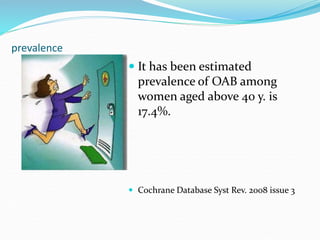
 It has been estimated
prevalence of OAB among
women aged above 40 y. is
17.4%.
 Cochrane Database Syst Rev. 2008 issue 3
OAB
 “urinary urgency, usually accompanied by frequency
and nocturia, with or without urgency urinary
incontinence, in the absence of a urinary tract
infection (UTI) or other obvious pathology.
An International Urogynecological Association (IUGA)/International
Continence Society (ICS) joint report on the terminology for female pelvic
floor dysfunction. Neurourology and Urodynamics 29, 4-20 (2010).
INTRODUCTION
 Drugs are the mainstay of treatment for OAB in USA but, current
medications often have limited efficacy, resulting in incomplete
resolution of OAB symptoms in a large proportion of patients.
Prospective, randomized, double-blind study of the efficacy and
tolerability of the extended-release formulations of oxybutynin
and tolterodine for overactive bladder: results of the OPERA trial.
2003 Jun;
5
INTRODUCTION
 Side-effects are the most important issue relating to persistence
and adherence to drug therapy, even among patients who may
experience symptomatic benefit.
5 6
Shaya FT, Blume S, Gu A, Zyczynski T, Jumadilova Z
Persistence with overactive bladder pharmacotherapy
in a Medicaid population.
Am J Manag Care. 2005 Jul
INTRODUCTION
 patient compliance with antimuscarinic treatment is relatively
low.;
 only 27% were receiving medication at the time of the study.
 Patients often take suboptimal dose to avoid side effects or stop
taking the medication altogether.
 more than 70% of patients do not continue therapy beyond nine
months.
 Symptom of OAB.population based study BJU int2001
6 7
 MANEGMENT OF OAB
 INTERNATIONAL
GUIDELINES(REVIEW)
DIAGNOSIS AND TREATMENT OF
OVERACTIVE BLADDER (Non-Neurogenic) IN
ADULTS:
2014 AUA/SUFU GUIDELINE
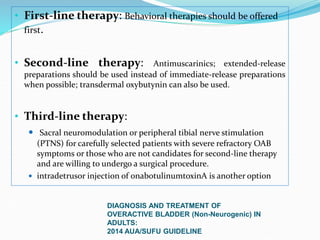
• First-line therapy: Behavioral therapies should be offered
first.
• Second-line therapy: Antimuscarinics; extended-release
preparations should be used instead of immediate-release preparations
when possible; transdermal oxybutynin can also be used.
• Third-line therapy:
 Sacral neuromodulation or peripheral tibial nerve stimulation
(PTNS) for carefully selected patients with severe refractory OAB
symptoms or those who are not candidates for second-line therapy
and are willing to undergo a surgical procedure.
 intradetrusor injection of onabotulinumtoxinA is another option
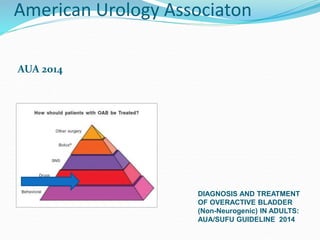
American Urology Associaton
AUA 2014
DIAGNOSIS AND TREATMENT
OF OVERACTIVE BLADDER
(Non-Neurogenic) IN ADULTS:
AUA/SUFU GUIDELINE 2014
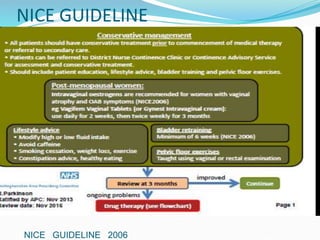
NICE GUIDELINE
NICE GUIDELINE 2006
SOCIETY OF OBSTETRITIAN AND GYNEACOLOGY OF CANADA
 Behavioural management protocols and functional electrical
stimulation should be offered in the spectrum of effective primary
treatments for overactive bladder syndrome. (I-A)
SOGC CLINICAL PRACTICE
GUIDELINE
Treatments for Overactive
Bladder:
Focus on Pharmacotherapy
Nov 2012
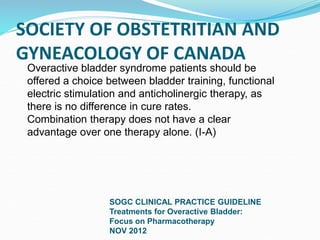
SOCIETY OF OBSTETRITIAN AND
GYNEACOLOGY OF CANADA
SOGC CLINICAL PRACTICE GUIDELINE
Treatments for Overactive Bladder:
Focus on Pharmacotherapy
NOV 2012
Overactive bladder syndrome patients should be
offered a choice between bladder training, functional
electric stimulation and anticholinergic therapy, as
there is no difference in cure rates.
Combination therapy does not have a clear
advantage over one therapy alone. (I-A)
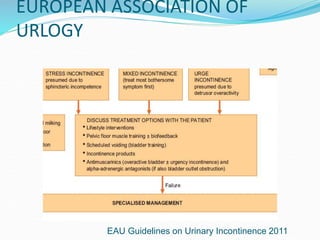
EUROPEAN ASSOCIATION OF
URLOGY
EAU Guidelines on Urinary Incontinence 2011
American Urogynocologic
Society
Pelvic floor rehabilitation therapy, including pelvic floor
stimulation and biofeedback guided pelvic floor
exercises, used alone or in combination, are a proven
method used to treat symptoms of urinary incontinence
and pelvic floor dysfunction.
AMERICAN
UROGYNAECOLOGIC SOCIETY
2013
the Cochrane Collaboration a review, Pelvic Floor
MuscleTraining vs. No Treatment, or Inactive Control
Treatments, for Urinary Incontinence in Women, which
analyzed the effectiveness of pelvic floor strengthening in
stress and urge incontinence. 2010
 Physiotherapists with specialized training in pelvic
floor rehabilitation (using internal examination to teach
the exercises) should be the first line of managment,
before surgical consultation, for stress, urge and
mixed incontinence in women.
Level I/ Grade A evidence
BEHAVIORAL THERAPY
BEHAVIORAL THERAPY is the first-line treatments
because they are as effective in reducing symptom
levels as are anti-muscarinic medications, it consists of
two parts
 bladder training
 pelvic floor muscle therapy
DIAGNOSIS AND TREATMENT OF OVERACTIVE
BLADDER (Non-Neurogenic) IN ADULTS:
AUA/SUFU GUIDELINE 201 17
BLADDER TRAINING
 Schduled or prompted voiding
 Fluid management
 Avoidance of bladder irritants
 No reported side effects
 Does not limit future treatment
 Generally used for urge incontinence
ACOG PRACTICE BULLETIN
URINARY INCONTINENCE
JUNE 2005
BLADDER TRAINING
 The cure rate of bladder training remained quite high,
73% to 70% (from 81% to 75% in the case of sensory
bladder)
Oxybutynin and bladder training in
the management of female urinary
urge incontinence: A randomized
International Urogynecology Journal
1995, Volume 6, Issue 2, pp 63-67
study
What is Pelvic Floor
Physiotherapy?
PFMT
 PFMT involves exercises that improve the function of
the pelvic floor.
 The rationale for use of PFMT in OAB is that
contraction of the muscles can reflexly or voluntarily
inhibit contraction of the detrusor muscle.
Pelvic floor exercise for urinary incontinence: A
systematic literature review
DOI: 10.1016/j.maturitas.2010.
PFMT IN SUI
• RCT have pelvic floor muscle exercise is particularly beneficial in
the treatment of urinary stress incontinence in females.
• Studies have shown up to 70% improvement in symptoms of
stress incontinence following appropriately performed pelvic floor
exercise
Pelvic floor exercise for urinary
incontinence: A systematic literature review
DOI: 10.1016/j.maturitas.2010
PFMT IN SUI
 This improvement is evident across all age groups.
There is evidence that women perform better with
exercise regimes supervised by specialist
physiotherapists or continence nurses, as opposed to
unsupervised or leaflet-based care.
. Pelvic floor exercise for urinary
incontinence: A systematic literature
review1016/j.maturitas.2010.08.004
Systemic Review on the role Behavorial Therapy for OABSystemic Review concluded
 Decreas in number of incontinence episodes (decreased from 64% to
86% after treatment versus before treatment)
 Improvement in quality of life (P≤0.001)
 Decrease in irritative symptoms (P=0.035 to P<0.001)
 Nocturia
 Activities and participation, maximum flow rate, mean
voided volume and daytime frequency were not
significantly improved in all trials..
[Pelvic floor muscles training, electrical stimulation,
bladder training and lifestyle interventions to manage lower
urinary tract dysfunction in multiple sclerosis: a systematic
2013 Dec 11 review].
Systemic Review on the role of Behavorial Therapy for
OAB
The objective of this study is to evaluate the effectiveness of existing
physiotherapy modalities for the treatment of urge urinary
incontinence (UUI)
 Outcomes assessed were reduction in UUI, urinary frequency, and
nocturia.
 Significant improvement in UUI was reported for all physiotherapy
techniques except vaginal cone therapy.
 There are insufficient data to determine if pelvic physiotherapy
improves urinary frequency or nocturia.
 Evidence suggests that physiotherapy techniques may be beneficial for
the treatment of UUI.
. Pelvic floor muscle training for urgency
urinary incontinence in women: a systematic review
4 2012 Int Urogynecol J.
Comparative effectiveness
randomized trial
Comparative effectiveness randomized trial indicates that behavioral
treatments are generally either equivalent to or superior to medications
in terms of reducing incontinence episodes, improving frequency,
nocturia and improving QOL .(Followed upto 12 weeks by VD and UDS)
 overall symptomatic improvement in 77% of the women treated with
oxybutynin, 52% with FES, and 76% with PFT
 Urgency resolved in 64% of women with oxybutynin, 52% with FES, and
in 57% with PFT.
 Urodynamic evaluation was normal in 36% treated with oxybutynin,
57% with FES, and 52% with PFT.
 Maximum detrusor involuntary contraction pressure decreased in all
groups (p<0.05).
•Prospective randomized comparison of oxybutynin, functional
electrostimulation, and pelvic floor training for treatment of
detrusor overactivity in women.
•Int Urogynecol J Pelvic Floor Dysfunct. 2008 AUG
Comparative effectiveness
randomized trial
 randomized controlled trial showed no difference
between electrical stimulation and anticholinergics.
Smith jj I ntravaginal stimulation randomized trial. J Urol.
1996 Jan
Comparative effectiveness
randomized trial
 One study showed 69% of women with OAB using PFES were cured or
improved by 50% over a follow-up period of 20 weeks.
 The greatest improvement came in the first six weeks of therapy,
however improvement continued beyond this time interval.
 Another study showed that 78.3% of the participants using MT
experienced symptom improvement after two months of therapy with a
mean improvement rate of 41.9%
•Siegel SW, Richardson DA, Miller KL, Karram MM, Blackwood NB,
Sand PK, Staskin DR, Tuttle Pelvic floor electrical stimulation for the
treatment of urge and mixed urinary incontinence in women. Urology.
199
•But I, Faganelj M, Sostaric A
J Urol. 2005
A retrospective comparison of
ring pessary and
multicomponent behavioral
therapy in managing overactive
bladder
Int urogynecol 2014 may
Ring pessary and multicomponent
behavioral therapy had similar cure
rates [19 %] vs [20 %] respectively.
PFMT
 50% of women are not able to contract the right
muscles based on verbal or written instructions.
Assessment of Kegel pelvic muscle exercise
performance after brief verbal instruction. Am J
Obstet Gynecol. 1991;165:322-27
How are Kegel exercises done?
Kegel exercises tone pelvic muscles. Advised and taught to the patients
while pelvic examination.
• that Squeeze the muscles that are use to stop the flow of urine
should not be done while urinating), and hold for up to 10 seconds,
then release.
• Do this 10–20 times in a row at least 3 times a day.
• Be careful not to squeeze the muscles of the leg, buttock, or
abdomen.
• Exercises should be on a regular basis.
• It may take 4–6 weeks to notice an improvement in urinary
incontinence symptoms.
FAQ081, May 2011 ACOG
1 URGE SUPRESSIVE TECHNIQUES
 The ‘Quick Flick’ is a technique for use by women with
urge incontinence or mixed urinary incontinence. This
exercise involves taking slow deep breaths, while
contracting the pelvic floor muscles rapidly 3–5 times,
when the urge to void is felt. This has been found to
suppress the urge to void.
Int J Clin Pract, August 2009
2 Biofeedback
 Biofeedback can be used in combination with an exercise
program to help make sure targeting the proper muscle groups.
 It provides information by a computer screen or a sound that
tells when contracting the correct muscles,enables pt to control
the muscles during functional activities
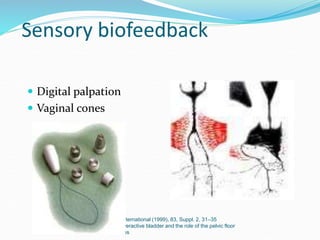
Sensory biofeedback
 Digital palpation
 Vaginal cones
BJU International (1999), 83, Suppl. 2, 31–35
The overactive bladder and the role of the pelvic floor
muscles
Pressure biofeedback
 Perineometry
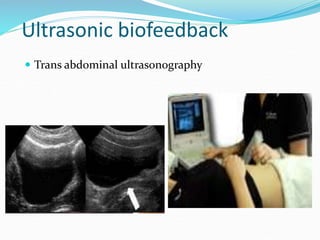
Ultrasonic biofeedback
 Trans abdominal ultrasonography
3 electrical stimulation
 Pelvic floor electrical stimulation involves placement
of a small transvaginal or transanal device by the
patient.
 Electrical stimulation for 15 min twice daily, every day
or every other day is then carried out over the length of
therapy
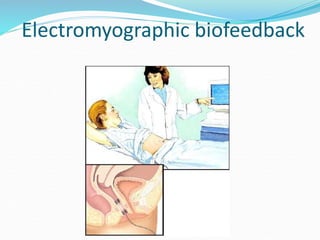
Electromyographic biofeedback
.
Pelvic floor muscle training for urgency urinary
incontinence in women: a systematic review
Int journal urogynaecol 2012 june
 electrical stimulation and biofeedback could be
considered in women who cannot actively
contract pelvic floor muscles, in order to aid
motivation and adherence to therapy.
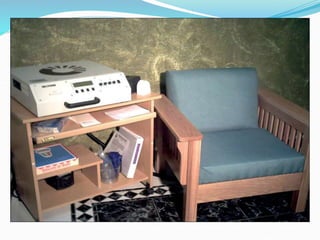
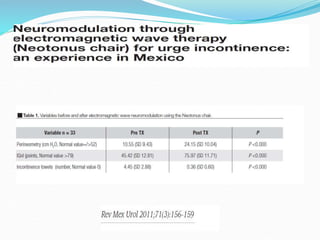
4 Magnetic therapy
 stimulate the pelvic floor muscles by placing them
within an electromagnetic field,avoiding an
intracavitary probe.
 The women remain fully clothed throughout the
procedure and may find the process more acceptable
when compared with electrical stimulation.
 Patients simply sit on a MT chair twice a week for
20min for at least eight weeks
SUMMARY
 The collective literature indicates that PFMT is effective for
incontinence, as well as urgency, frequency, and nocturia.
 It can be combined with all other treatment modalities and holds
potential for prevention of bladder symptoms.
 No side effects ,should be advised in pt with OAB as first line
therapy for atleast three months,
THANKYOU

Role of pmft in oab

  • 1.
    DR.ARSLA DR AHMED ALBADR KING FAHAD MEDICAL CITY RIYADH
  • 2.
    TOPICS  INTRODUCTION  BACKGROUND INTERNATIONAL GUIDELINES REVIEW  PFMT AND TYPES  LITERATURE REVIEW
  • 3.
    prevalence  It hasbeen estimated prevalence of OAB among women aged above 40 y. is 17.4%.  Cochrane Database Syst Rev. 2008 issue 3
  • 4.
    OAB  “urinary urgency,usually accompanied by frequency and nocturia, with or without urgency urinary incontinence, in the absence of a urinary tract infection (UTI) or other obvious pathology. An International Urogynecological Association (IUGA)/International Continence Society (ICS) joint report on the terminology for female pelvic floor dysfunction. Neurourology and Urodynamics 29, 4-20 (2010).
  • 5.
    INTRODUCTION  Drugs arethe mainstay of treatment for OAB in USA but, current medications often have limited efficacy, resulting in incomplete resolution of OAB symptoms in a large proportion of patients. Prospective, randomized, double-blind study of the efficacy and tolerability of the extended-release formulations of oxybutynin and tolterodine for overactive bladder: results of the OPERA trial. 2003 Jun; 5
  • 6.
    INTRODUCTION  Side-effects arethe most important issue relating to persistence and adherence to drug therapy, even among patients who may experience symptomatic benefit. 5 6 Shaya FT, Blume S, Gu A, Zyczynski T, Jumadilova Z Persistence with overactive bladder pharmacotherapy in a Medicaid population. Am J Manag Care. 2005 Jul
  • 7.
    INTRODUCTION  patient compliancewith antimuscarinic treatment is relatively low.;  only 27% were receiving medication at the time of the study.  Patients often take suboptimal dose to avoid side effects or stop taking the medication altogether.  more than 70% of patients do not continue therapy beyond nine months.  Symptom of OAB.population based study BJU int2001 6 7
  • 8.
     MANEGMENT OFOAB  INTERNATIONAL GUIDELINES(REVIEW)
  • 9.
    DIAGNOSIS AND TREATMENTOF OVERACTIVE BLADDER (Non-Neurogenic) IN ADULTS: 2014 AUA/SUFU GUIDELINE • First-line therapy: Behavioral therapies should be offered first. • Second-line therapy: Antimuscarinics; extended-release preparations should be used instead of immediate-release preparations when possible; transdermal oxybutynin can also be used. • Third-line therapy:  Sacral neuromodulation or peripheral tibial nerve stimulation (PTNS) for carefully selected patients with severe refractory OAB symptoms or those who are not candidates for second-line therapy and are willing to undergo a surgical procedure.  intradetrusor injection of onabotulinumtoxinA is another option
  • 10.
    American Urology Associaton AUA2014 DIAGNOSIS AND TREATMENT OF OVERACTIVE BLADDER (Non-Neurogenic) IN ADULTS: AUA/SUFU GUIDELINE 2014
  • 11.
  • 12.
    SOCIETY OF OBSTETRITIANAND GYNEACOLOGY OF CANADA  Behavioural management protocols and functional electrical stimulation should be offered in the spectrum of effective primary treatments for overactive bladder syndrome. (I-A) SOGC CLINICAL PRACTICE GUIDELINE Treatments for Overactive Bladder: Focus on Pharmacotherapy Nov 2012
  • 13.
    SOCIETY OF OBSTETRITIANAND GYNEACOLOGY OF CANADA SOGC CLINICAL PRACTICE GUIDELINE Treatments for Overactive Bladder: Focus on Pharmacotherapy NOV 2012 Overactive bladder syndrome patients should be offered a choice between bladder training, functional electric stimulation and anticholinergic therapy, as there is no difference in cure rates. Combination therapy does not have a clear advantage over one therapy alone. (I-A)
  • 14.
    EUROPEAN ASSOCIATION OF URLOGY EAUGuidelines on Urinary Incontinence 2011
  • 15.
    American Urogynocologic Society Pelvic floorrehabilitation therapy, including pelvic floor stimulation and biofeedback guided pelvic floor exercises, used alone or in combination, are a proven method used to treat symptoms of urinary incontinence and pelvic floor dysfunction. AMERICAN UROGYNAECOLOGIC SOCIETY 2013
  • 16.
    the Cochrane Collaborationa review, Pelvic Floor MuscleTraining vs. No Treatment, or Inactive Control Treatments, for Urinary Incontinence in Women, which analyzed the effectiveness of pelvic floor strengthening in stress and urge incontinence. 2010  Physiotherapists with specialized training in pelvic floor rehabilitation (using internal examination to teach the exercises) should be the first line of managment, before surgical consultation, for stress, urge and mixed incontinence in women. Level I/ Grade A evidence
  • 17.
    BEHAVIORAL THERAPY BEHAVIORAL THERAPYis the first-line treatments because they are as effective in reducing symptom levels as are anti-muscarinic medications, it consists of two parts  bladder training  pelvic floor muscle therapy DIAGNOSIS AND TREATMENT OF OVERACTIVE BLADDER (Non-Neurogenic) IN ADULTS: AUA/SUFU GUIDELINE 201 17
  • 18.
    BLADDER TRAINING  Schduledor prompted voiding  Fluid management  Avoidance of bladder irritants  No reported side effects  Does not limit future treatment  Generally used for urge incontinence ACOG PRACTICE BULLETIN URINARY INCONTINENCE JUNE 2005
  • 19.
    BLADDER TRAINING  Thecure rate of bladder training remained quite high, 73% to 70% (from 81% to 75% in the case of sensory bladder) Oxybutynin and bladder training in the management of female urinary urge incontinence: A randomized International Urogynecology Journal 1995, Volume 6, Issue 2, pp 63-67 study
  • 20.
    What is PelvicFloor Physiotherapy?
  • 21.
    PFMT  PFMT involvesexercises that improve the function of the pelvic floor.  The rationale for use of PFMT in OAB is that contraction of the muscles can reflexly or voluntarily inhibit contraction of the detrusor muscle. Pelvic floor exercise for urinary incontinence: A systematic literature review DOI: 10.1016/j.maturitas.2010.
  • 22.
    PFMT IN SUI •RCT have pelvic floor muscle exercise is particularly beneficial in the treatment of urinary stress incontinence in females. • Studies have shown up to 70% improvement in symptoms of stress incontinence following appropriately performed pelvic floor exercise Pelvic floor exercise for urinary incontinence: A systematic literature review DOI: 10.1016/j.maturitas.2010
  • 23.
    PFMT IN SUI This improvement is evident across all age groups. There is evidence that women perform better with exercise regimes supervised by specialist physiotherapists or continence nurses, as opposed to unsupervised or leaflet-based care. . Pelvic floor exercise for urinary incontinence: A systematic literature review1016/j.maturitas.2010.08.004
  • 24.
    Systemic Review onthe role Behavorial Therapy for OABSystemic Review concluded  Decreas in number of incontinence episodes (decreased from 64% to 86% after treatment versus before treatment)  Improvement in quality of life (P≤0.001)  Decrease in irritative symptoms (P=0.035 to P<0.001)  Nocturia  Activities and participation, maximum flow rate, mean voided volume and daytime frequency were not significantly improved in all trials.. [Pelvic floor muscles training, electrical stimulation, bladder training and lifestyle interventions to manage lower urinary tract dysfunction in multiple sclerosis: a systematic 2013 Dec 11 review].
  • 25.
    Systemic Review onthe role of Behavorial Therapy for OAB The objective of this study is to evaluate the effectiveness of existing physiotherapy modalities for the treatment of urge urinary incontinence (UUI)  Outcomes assessed were reduction in UUI, urinary frequency, and nocturia.  Significant improvement in UUI was reported for all physiotherapy techniques except vaginal cone therapy.  There are insufficient data to determine if pelvic physiotherapy improves urinary frequency or nocturia.  Evidence suggests that physiotherapy techniques may be beneficial for the treatment of UUI. . Pelvic floor muscle training for urgency urinary incontinence in women: a systematic review 4 2012 Int Urogynecol J.
  • 26.
    Comparative effectiveness randomized trial Comparativeeffectiveness randomized trial indicates that behavioral treatments are generally either equivalent to or superior to medications in terms of reducing incontinence episodes, improving frequency, nocturia and improving QOL .(Followed upto 12 weeks by VD and UDS)  overall symptomatic improvement in 77% of the women treated with oxybutynin, 52% with FES, and 76% with PFT  Urgency resolved in 64% of women with oxybutynin, 52% with FES, and in 57% with PFT.  Urodynamic evaluation was normal in 36% treated with oxybutynin, 57% with FES, and 52% with PFT.  Maximum detrusor involuntary contraction pressure decreased in all groups (p<0.05). •Prospective randomized comparison of oxybutynin, functional electrostimulation, and pelvic floor training for treatment of detrusor overactivity in women. •Int Urogynecol J Pelvic Floor Dysfunct. 2008 AUG
  • 27.
    Comparative effectiveness randomized trial randomized controlled trial showed no difference between electrical stimulation and anticholinergics. Smith jj I ntravaginal stimulation randomized trial. J Urol. 1996 Jan
  • 28.
    Comparative effectiveness randomized trial One study showed 69% of women with OAB using PFES were cured or improved by 50% over a follow-up period of 20 weeks.  The greatest improvement came in the first six weeks of therapy, however improvement continued beyond this time interval.  Another study showed that 78.3% of the participants using MT experienced symptom improvement after two months of therapy with a mean improvement rate of 41.9% •Siegel SW, Richardson DA, Miller KL, Karram MM, Blackwood NB, Sand PK, Staskin DR, Tuttle Pelvic floor electrical stimulation for the treatment of urge and mixed urinary incontinence in women. Urology. 199 •But I, Faganelj M, Sostaric A J Urol. 2005
  • 29.
    A retrospective comparisonof ring pessary and multicomponent behavioral therapy in managing overactive bladder Int urogynecol 2014 may Ring pessary and multicomponent behavioral therapy had similar cure rates [19 %] vs [20 %] respectively.
  • 30.
    PFMT  50% ofwomen are not able to contract the right muscles based on verbal or written instructions. Assessment of Kegel pelvic muscle exercise performance after brief verbal instruction. Am J Obstet Gynecol. 1991;165:322-27
  • 31.
    How are Kegelexercises done? Kegel exercises tone pelvic muscles. Advised and taught to the patients while pelvic examination. • that Squeeze the muscles that are use to stop the flow of urine should not be done while urinating), and hold for up to 10 seconds, then release. • Do this 10–20 times in a row at least 3 times a day. • Be careful not to squeeze the muscles of the leg, buttock, or abdomen. • Exercises should be on a regular basis. • It may take 4–6 weeks to notice an improvement in urinary incontinence symptoms. FAQ081, May 2011 ACOG
  • 32.
    1 URGE SUPRESSIVETECHNIQUES  The ‘Quick Flick’ is a technique for use by women with urge incontinence or mixed urinary incontinence. This exercise involves taking slow deep breaths, while contracting the pelvic floor muscles rapidly 3–5 times, when the urge to void is felt. This has been found to suppress the urge to void. Int J Clin Pract, August 2009
  • 33.
    2 Biofeedback  Biofeedbackcan be used in combination with an exercise program to help make sure targeting the proper muscle groups.  It provides information by a computer screen or a sound that tells when contracting the correct muscles,enables pt to control the muscles during functional activities
  • 34.
    Sensory biofeedback  Digitalpalpation  Vaginal cones BJU International (1999), 83, Suppl. 2, 31–35 The overactive bladder and the role of the pelvic floor muscles
  • 35.
  • 36.
    Ultrasonic biofeedback  Transabdominal ultrasonography
  • 37.
    3 electrical stimulation Pelvic floor electrical stimulation involves placement of a small transvaginal or transanal device by the patient.  Electrical stimulation for 15 min twice daily, every day or every other day is then carried out over the length of therapy
  • 38.
  • 39.
    . Pelvic floor muscletraining for urgency urinary incontinence in women: a systematic review Int journal urogynaecol 2012 june  electrical stimulation and biofeedback could be considered in women who cannot actively contract pelvic floor muscles, in order to aid motivation and adherence to therapy.
  • 40.
    4 Magnetic therapy stimulate the pelvic floor muscles by placing them within an electromagnetic field,avoiding an intracavitary probe.  The women remain fully clothed throughout the procedure and may find the process more acceptable when compared with electrical stimulation.  Patients simply sit on a MT chair twice a week for 20min for at least eight weeks
  • 43.
    SUMMARY  The collectiveliterature indicates that PFMT is effective for incontinence, as well as urgency, frequency, and nocturia.  It can be combined with all other treatment modalities and holds potential for prevention of bladder symptoms.  No side effects ,should be advised in pt with OAB as first line therapy for atleast three months,
  • 44.