The problem asks to find the first ten digits of the sum of 100 50-digit numbers. It provides the 100 numbers. The numbers are summed and the first ten digits of the very large resulting sum are reported as the answer.
If we listall the natural numbers below 10 that are multiples of 3 or 5, we
get 3, 5, 6 and 9. The sum of these multiples is 23.
Find the sum of all the multiples of 3 or 5 below 1000.
Each new term in the Fibonacci sequence is generated by adding the
previous two terms. By starting with 1 and 2, the first 10 terms will be:
1, 2, 3, 5, 8, 13, 21, 34, 55, 89, ...
By considering the terms in the Fibonacci sequence whose values do not
exceed four million, find the sum of the even-valued terms.
The prime factors of 13195 are 5, 7, 13 and 29.
What is the largest prime factor of the number 600851475143 ?
A palindromic number reads the same both ways. The largest palindrome
made from the product of two 2-digit numbers is 9009 = 91 × 99.
Find the largest palindrome made from the product of two 3-digit numbers.
Problem 1: Multiples of 3 and 5
Problem 2: Even Fibonacci numbers
Problem 3: Largest prime factor
Problem 4: Largest palindrome product
2.
2520 is thesmallest number that can be divided by each of the numbers
from 1 to 10 without any remainder.
What is the smallest positive number that is evenly divisible by all of the
numbers from 1 to 20?
The sum of the squares of the first ten natural numbers is,
12 + 22 + ... + 102 = 385
The square of the sum of the first ten natural numbers is,
(1 + 2 + ... + 10)2 = 552 = 3025
Hence the difference between the sum of the squares of the first ten
natural numbers and the square of the sum is 3025 − 385 = 2640.
Find the difference between the sum of the squares of the first one
hundred natural numbers and the square of the sum.
By listing the first six prime numbers: 2, 3, 5, 7, 11, and 13, we can see
that the 6th prime is 13.
What is the 10 001st prime number?
Problem 5: Smallest multiple
Problem 6: Sum square difference
Problem 7: 10001st prime
3.
The four adjacentdigits in the 1000-digit number that have the greatest
product are 9 × 9 × 8 × 9 = 5832.
73167176531330624919225119674426574742355349194934
96983520312774506326239578318016984801869478851843
85861560789112949495459501737958331952853208805511
12540698747158523863050715693290963295227443043557
66896648950445244523161731856403098711121722383113
62229893423380308135336276614282806444486645238749
30358907296290491560440772390713810515859307960866
70172427121883998797908792274921901699720888093776
65727333001053367881220235421809751254540594752243
52584907711670556013604839586446706324415722155397
53697817977846174064955149290862569321978468622482
83972241375657056057490261407972968652414535100474
82166370484403199890008895243450658541227588666881
16427171479924442928230863465674813919123162824586
17866458359124566529476545682848912883142607690042
24219022671055626321111109370544217506941658960408
07198403850962455444362981230987879927244284909188
84580156166097919133875499200524063689912560717606
05886116467109405077541002256983155200055935729725
71636269561882670428252483600823257530420752963450
Find the thirteen adjacent digits in the 1000-digit number that have the
greatest product. What is the value of this product?
A Pythagorean triplet is a set of three natural numbers, a < b < c, for
which,
a2 + b2 = c2
For example, 32 + 42 = 9 + 16 = 25 = 52.
There exists exactly one Pythagorean triplet for which a + b + c = 1000.
Find the product abc.
Problem 8: Largest product in a series
Problem 9: Special Pythagorean triplet
The sequence oftriangle numbers is generated by adding the natural
numbers. So the 7th triangle number would be 1 + 2 + 3 + 4 + 5 + 6 + 7
= 28. The first ten terms would be:
1, 3, 6, 10, 15, 21, 28, 36, 45, 55, ...
Let us list the factors of the first seven triangle numbers:
1: 1
3: 1,3
6: 1,2,3,6
10: 1,2,5,10
15: 1,3,5,15
21: 1,3,7,21
28: 1,2,4,7,14,28
We can see that 28 is the first triangle number to have over five divisors.
What is the value of the first triangle number to have over five hundred
divisors?
Problem 12: Highly divisible triangular number
6.
Work out thefirst ten digits of the sum of the following one-hundred
50-digit numbers.
37107287533902102798797998220837590246510135740250
46376937677490009712648124896970078050417018260538
74324986199524741059474233309513058123726617309629
91942213363574161572522430563301811072406154908250
23067588207539346171171980310421047513778063246676
89261670696623633820136378418383684178734361726757
28112879812849979408065481931592621691275889832738
44274228917432520321923589422876796487670272189318
47451445736001306439091167216856844588711603153276
70386486105843025439939619828917593665686757934951
62176457141856560629502157223196586755079324193331
64906352462741904929101432445813822663347944758178
92575867718337217661963751590579239728245598838407
58203565325359399008402633568948830189458628227828
80181199384826282014278194139940567587151170094390
35398664372827112653829987240784473053190104293586
86515506006295864861532075273371959191420517255829
71693888707715466499115593487603532921714970056938
54370070576826684624621495650076471787294438377604
53282654108756828443191190634694037855217779295145
36123272525000296071075082563815656710885258350721
45876576172410976447339110607218265236877223636045
17423706905851860660448207621209813287860733969412
81142660418086830619328460811191061556940512689692
51934325451728388641918047049293215058642563049483
62467221648435076201727918039944693004732956340691
15732444386908125794514089057706229429197107928209
55037687525678773091862540744969844508330393682126
18336384825330154686196124348767681297534375946515
80386287592878490201521685554828717201219257766954
78182833757993103614740356856449095527097864797581
16726320100436897842553539920931837441497806860984
48403098129077791799088218795327364475675590848030
87086987551392711854517078544161852424320693150332
59959406895756536782107074926966537676326235447210
69793950679652694742597709739166693763042633987085
41052684708299085211399427365734116182760315001271
65378607361501080857009149939512557028198746004375
35829035317434717326932123578154982629742552737307
94953759765105305946966067683156574377167401875275
88902802571733229619176668713819931811048770190271
25267680276078003013678680992525463401061632866526
36270218540497705585629946580636237993140746255962
24074486908231174977792365466257246923322810917141
91430288197103288597806669760892938638285025333403
34413065578016127815921815005561868836468420090470
23053081172816430487623791969842487255036638784583
11487696932154902810424020138335124462181441773470
63783299490636259666498587618221225225512486764533
67720186971698544312419572409913959008952310058822
95548255300263520781532296796249481641953868218774
76085327132285723110424803456124867697064507995236
Problem 13: Large sum
The following iterativesequence is defined for the set of positive integers:
n → n/2 (n is even)
n → 3n + 1 (n is odd)
Using the rule above and starting with 13, we generate the following
sequence:
13 → 40 → 20 → 10 → 5 → 16 → 8 → 4 → 2 → 1
It can be seen that this sequence (starting at 13 and finishing at 1)
contains 10 terms. Although it has not been proved yet (Collatz Problem),
it is thought that all starting numbers finish at 1.
Which starting number, under one million, produces the longest chain?
NOTE: Once the chain starts the terms are allowed to go above one million.
Starting in the top left corner of a 2×2 grid, and only being able to move to
the right and down, there are exactly 6 routes to the bottom right corner.
How many such routes are there through a 20×20 grid?
215 = 32768 and the sum of its digits is 3 + 2 + 7 + 6 + 8 = 26.
What is the sum of the digits of the number 21000?
Problem 14: Longest Collatz sequence
Problem 15: Lattice paths
Problem 16: Power digit sum
9.
If the numbers1 to 5 are written out in words: one, two, three, four, five,
then there are 3 + 3 + 5 + 4 + 4 = 19 letters used in total.
If all the numbers from 1 to 1000 (one thousand) inclusive were written out
in words, how many letters would be used?
NOTE: Do not count spaces or hyphens. For example, 342 (three hundred and
forty-two) contains 23 letters and 115 (one hundred and fifteen) contains 20
letters. The use of "and" when writing out numbers is in compliance with British
usage.
Problem 17: Number letter counts
10.
By starting atthe top of the triangle below and moving to adjacent
numbers on the row below, the maximum total from top to bottom is 23.
3
7 4
2 4 6
8 5 9 3
That is, 3 + 7 + 4 + 9 = 23.
Find the maximum total from top to bottom of the triangle below:
75
95 64
17 47 82
18 35 87 10
20 04 82 47 65
19 01 23 75 03 34
88 02 77 73 07 63 67
99 65 04 28 06 16 70 92
41 41 26 56 83 40 80 70 33
41 48 72 33 47 32 37 16 94 29
53 71 44 65 25 43 91 52 97 51 14
70 11 33 28 77 73 17 78 39 68 17 57
91 71 52 38 17 14 91 43 58 50 27 29 48
63 66 04 68 89 53 67 30 73 16 69 87 40 31
04 62 98 27 23 09 70 98 73 93 38 53 60 04 23
NOTE: As there are only 16384 routes, it is possible to solve this problem by
trying every route. However, Problem 67, is the same challenge with a triangle
containing one-hundred rows; it cannot be solved by brute force, and requires a
clever method! ;o)
Problem 18: Maximum path sum I
11.
You are giventhe following information, but you may prefer to do some
research for yourself.
1 Jan 1900 was a Monday.
Thirty days has September,
April, June and November.
All the rest have thirty-one,
Saving February alone,
Which has twenty-eight, rain or shine.
And on leap years, twenty-nine.
A leap year occurs on any year evenly divisible by 4, but not on a
century unless it is divisible by 400.
How many Sundays fell on the first of the month during the twentieth
century (1 Jan 1901 to 31 Dec 2000)?
n! means n × (n − 1) × ... × 3 × 2 × 1
For example, 10! = 10 × 9 × ... × 3 × 2 × 1 = 3628800,
and the sum of the digits in the number 10! is 3 + 6 + 2 + 8 + 8 + 0 + 0 =
27.
Find the sum of the digits in the number 100!
Let d(n) be defined as the sum of proper divisors of n (numbers less than n
which divide evenly into n).
If d(a) = b and d(b) = a, where a ≠ b, then a and b are an amicable pair
and each of a and b are called amicable numbers.
For example, the proper divisors of 220 are 1, 2, 4, 5, 10, 11, 20, 22, 44, 55
and 110; therefore d(220) = 284. The proper divisors of 284 are 1, 2, 4, 71
and 142; so d(284) = 220.
Evaluate the sum of all the amicable numbers under 10000.
Problem 19: Counting Sundays
Problem 20: Factorial digit sum
Problem 21: Amicable numbers
12.
Using names.txt (rightclick and 'Save Link/Target As...'), a 46K text file
containing over five-thousand first names, begin by sorting it into
alphabetical order. Then working out the alphabetical value for each name,
multiply this value by its alphabetical position in the list to obtain a name
score.
For example, when the list is sorted into alphabetical order, COLIN, which
is worth 3 + 15 + 12 + 9 + 14 = 53, is the 938th name in the list. So,
COLIN would obtain a score of 938 × 53 = 49714.
What is the total of all the name scores in the file?
A perfect number is a number for which the sum of its proper divisors is
exactly equal to the number. For example, the sum of the proper divisors
of 28 would be 1 + 2 + 4 + 7 + 14 = 28, which means that 28 is a perfect
number.
A number n is called deficient if the sum of its proper divisors is less than
n and it is called abundant if this sum exceeds n.
As 12 is the smallest abundant number, 1 + 2 + 3 + 4 + 6 = 16, the
smallest number that can be written as the sum of two abundant numbers
is 24. By mathematical analysis, it can be shown that all integers greater
than 28123 can be written as the sum of two abundant numbers. However,
this upper limit cannot be reduced any further by analysis even though it is
known that the greatest number that cannot be expressed as the sum of
two abundant numbers is less than this limit.
Find the sum of all the positive integers which cannot be written as the
sum of two abundant numbers.
Problem 22: Names scores
Problem 23: Non-abundant sums
13.
A permutation isan ordered arrangement of objects. For example, 3124 is
one possible permutation of the digits 1, 2, 3 and 4. If all of the
permutations are listed numerically or alphabetically, we call it
lexicographic order. The lexicographic permutations of 0, 1 and 2 are:
012 021 102 120 201 210
What is the millionth lexicographic permutation of the digits 0, 1, 2, 3, 4, 5,
6, 7, 8 and 9?
The Fibonacci sequence is defined by the recurrence relation:
Fn = Fn−1 + Fn−2, where F1 = 1 and F2 = 1.
Hence the first 12 terms will be:
F1 = 1
F2 = 1
F3 = 2
F4 = 3
F5 = 5
F6 = 8
F7 = 13
F8 = 21
F9 = 34
F10 = 55
F11 = 89
F12 = 144
The 12th term, F12, is the first term to contain three digits.
What is the index of the first term in the Fibonacci sequence to contain
1000 digits?
Problem 24: Lexicographic permutations
Problem 25: 1000-digit Fibonacci number
14.
A unit fractioncontains 1 in the numerator. The decimal representation of
the unit fractions with denominators 2 to 10 are given:
1/2 = 0.5
1/3 = 0.(3)
1/4 = 0.25
1/5 = 0.2
1/6 = 0.1(6)
1/7 = 0.(142857)
1/8 = 0.125
1/9 = 0.(1)
1/10 = 0.1
Where 0.1(6) means 0.166666..., and has a 1-digit recurring cycle. It can
be seen that 1/7 has a 6-digit recurring cycle.
Find the value of d < 1000 for which 1/d contains the longest recurring
cycle in its decimal fraction part.
Problem 26: Reciprocal cycles
15.
Euler discovered theremarkable quadratic formula:
n² + n + 41
It turns out that the formula will produce 40 primes for the consecutive
values n = 0 to 39. However, when n = 40, 402 + 40 + 41 = 40(40 + 1) +
41 is divisible by 41, and certainly when n = 41, 41² + 41 + 41 is clearly
divisible by 41.
The incredible formula n² − 79n + 1601 was discovered, which produces
80 primes for the consecutive values n = 0 to 79. The product of the
coefficients, −79 and 1601, is −126479.
Considering quadratics of the form:
n² + an + b, where |a| < 1000 and |b| < 1000
Find the product of the coefficients, a and b, for the quadratic expression
that produces the maximum number of primes for consecutive values of n,
starting with n = 0.
Starting with the number 1 and moving to the right in a clockwise direction
a 5 by 5 spiral is formed as follows:
21 22 23 24 25
20 7 8 9 10
19 6 1 2 11
18 5 4 3 12
17 16 15 14 13
It can be verified that the sum of the numbers on the diagonals is 101.
What is the sum of the numbers on the diagonals in a 1001 by 1001 spiral
formed in the same way?
Problem 27: Quadratic primes
where |n| is the modulus/absolute value of n
e.g. |11| = 11 and |−4| = 4
Problem 28: Number spiral diagonals
16.
Consider all integercombinations of ab for 2 ≤ a ≤ 5 and 2 ≤ b ≤ 5:
22=4, 23=8, 24=16, 25=32
32=9, 33=27, 34=81, 35=243
42=16, 43=64, 44=256, 45=1024
52=25, 53=125, 54=625, 55=3125
If they are then placed in numerical order, with any repeats removed, we
get the following sequence of 15 distinct terms:
4, 8, 9, 16, 25, 27, 32, 64, 81, 125, 243, 256, 625, 1024, 3125
How many distinct terms are in the sequence generated by ab for 2 ≤ a ≤
100 and 2 ≤ b ≤ 100?
Surprisingly there are only three numbers that can be written as the sum
of fourth powers of their digits:
1634 = 14 + 64 + 34 + 44
8208 = 84 + 24 + 04 + 84
9474 = 94 + 44 + 74 + 44
The sum of these numbers is 1634 + 8208 + 9474 = 19316.
Find the sum of all the numbers that can be written as the sum of fifth
powers of their digits.
Problem 29: Distinct powers
Problem 30: Digit fifth powers
As 1 = 14 is not a sum it is not included.
17.
In England thecurrency is made up of pound, £, and pence, p, and there
are eight coins in general circulation:
1p, 2p, 5p, 10p, 20p, 50p, £1 (100p) and £2 (200p).
It is possible to make £2 in the following way:
1×£1 + 1×50p + 2×20p + 1×5p + 1×2p + 3×1p
How many different ways can £2 be made using any number of coins?
We shall say that an n-digit number is pandigital if it makes use of all the
digits 1 to n exactly once; for example, the 5-digit number, 15234, is 1
through 5 pandigital.
The product 7254 is unusual, as the identity, 39 × 186 = 7254, containing
multiplicand, multiplier, and product is 1 through 9 pandigital.
Find the sum of all products whose multiplicand/multiplier/product identity
can be written as a 1 through 9 pandigital.
HINT: Some products can be obtained in more than one way so be sure to only
include it once in your sum.
The fraction 49/98 is a curious fraction, as an inexperienced mathematician
in attempting to simplify it may incorrectly believe that 49/98 = 4/8, which
is correct, is obtained by cancelling the 9s.
We shall consider fractions like, 30/50 = 3/5, to be trivial examples.
There are exactly four non-trivial examples of this type of fraction, less
than one in value, and containing two digits in the numerator and
denominator.
If the product of these four fractions is given in its lowest common terms,
find the value of the denominator.
Problem 31: Coin sums
Problem 32: Pandigital products
Problem 33: Digit cancelling fractions
18.
145 is acurious number, as 1! + 4! + 5! = 1 + 24 + 120 = 145.
Find the sum of all numbers which are equal to the sum of the factorial of
their digits.
The number, 197, is called a circular prime because all rotations of the
digits: 197, 971, and 719, are themselves prime.
There are thirteen such primes below 100: 2, 3, 5, 7, 11, 13, 17, 31, 37, 71,
73, 79, and 97.
How many circular primes are there below one million?
The decimal number, 585 = 10010010012 (binary), is palindromic in both
bases.
Find the sum of all numbers, less than one million, which are palindromic in
base 10 and base 2.
The number 3797 has an interesting property. Being prime itself, it is
possible to continuously remove digits from left to right, and remain prime
at each stage: 3797, 797, 97, and 7. Similarly we can work from right to
left: 3797, 379, 37, and 3.
Find the sum of the only eleven primes that are both truncatable from left
to right and right to left.
Problem 34: Digit factorials
Note: as 1! = 1 and 2! = 2 are not sums they are not included.
Problem 35: Circular primes
Problem 36: Double-base palindromes
(Please note that the palindromic number, in either base, may not include
leading zeros.)
Problem 37: Truncatable primes
NOTE: 2, 3, 5, and 7 are not considered to be truncatable primes.
19.
Take the number192 and multiply it by each of 1, 2, and 3:
192 × 1 = 192
192 × 2 = 384
192 × 3 = 576
By concatenating each product we get the 1 to 9 pandigital, 192384576.
We will call 192384576 the concatenated product of 192 and (1,2,3)
The same can be achieved by starting with 9 and multiplying by 1, 2, 3, 4,
and 5, giving the pandigital, 918273645, which is the concatenated
product of 9 and (1,2,3,4,5).
What is the largest 1 to 9 pandigital 9-digit number that can be formed as
the concatenated product of an integer with (1,2, ... , n) where n > 1?
If p is the perimeter of a right angle triangle with integral length sides,
{a,b,c}, there are exactly three solutions for p = 120.
{20,48,52}, {24,45,51}, {30,40,50}
For which value of p ≤ 1000, is the number of solutions maximised?
An irrational decimal fraction is created by concatenating the positive
integers:
0.123456789101112131415161718192021...
It can be seen that the 12th digit of the fractional part is 1.
If dn represents the nth digit of the fractional part, find the value of the
following expression.
d1 × d10 × d100 × d1000 × d10000 × d100000 × d1000000
Problem 38: Pandigital multiples
Problem 39: Integer right triangles
Problem 40: Champernowne's constant
20.
We shall saythat an n-digit number is pandigital if it makes use of all the
digits 1 to n exactly once. For example, 2143 is a 4-digit pandigital and is
also prime.
What is the largest n-digit pandigital prime that exists?
The nth term of the sequence of triangle numbers is given by, tn =
½n(n+1); so the first ten triangle numbers are:
1, 3, 6, 10, 15, 21, 28, 36, 45, 55, ...
By converting each letter in a word to a number corresponding to its
alphabetical position and adding these values we form a word value. For
example, the word value for SKY is 19 + 11 + 25 = 55 = t10. If the word
value is a triangle number then we shall call the word a triangle word.
Using words.txt (right click and 'Save Link/Target As...'), a 16K text file
containing nearly two-thousand common English words, how many are
triangle words?
The number, 1406357289, is a 0 to 9 pandigital number because it is
made up of each of the digits 0 to 9 in some order, but it also has a rather
interesting sub-string divisibility property.
Let d1 be the 1st digit, d2 be the 2nd digit, and so on. In this way, we note
the following:
d2d3d4=406 is divisible by 2
d3d4d5=063 is divisible by 3
d4d5d6=635 is divisible by 5
d5d6d7=357 is divisible by 7
d6d7d8=572 is divisible by 11
d7d8d9=728 is divisible by 13
d8d9d10=289 is divisible by 17
Find the sum of all 0 to 9 pandigital numbers with this property.
Problem 41: Pandigital prime
Problem 42: Coded triangle numbers
Problem 43: Sub-string divisibility
21.
Pentagonal numbers aregenerated by the formula, Pn=n(3n−1)/2. The
first ten pentagonal numbers are:
1, 5, 12, 22, 35, 51, 70, 92, 117, 145, ...
It can be seen that P4 + P7 = 22 + 70 = 92 = P8. However, their
difference, 70 − 22 = 48, is not pentagonal.
Find the pair of pentagonal numbers, Pj and Pk, for which their sum and
difference are pentagonal and D = |Pk − Pj| is minimised; what is the value
of D?
Triangle, pentagonal, and hexagonal numbers are generated by the
following formulae:
Triangle Tn=n(n+1)/2 1, 3, 6, 10, 15, ...
Pentagonal Pn=n(3n−1)/2 1, 5, 12, 22, 35, ...
Hexagonal Hn=n(2n−1) 1, 6, 15, 28, 45, ...
It can be verified that T285 = P165 = H143 = 40755.
Find the next triangle number that is also pentagonal and hexagonal.
Problem 44: Pentagon numbers
Problem 45: Triangular, pentagonal, and hexagonal
22.
It was proposedby Christian Goldbach that every odd composite number
can be written as the sum of a prime and twice a square.
9 = 7 + 2×12
15 = 7 + 2×22
21 = 3 + 2×32
25 = 7 + 2×32
27 = 19 + 2×22
33 = 31 + 2×12
It turns out that the conjecture was false.
What is the smallest odd composite that cannot be written as the sum of a
prime and twice a square?
The first two consecutive numbers to have two distinct prime factors are:
14 = 2 × 7
15 = 3 × 5
The first three consecutive numbers to have three distinct prime factors
are:
644 = 2² × 7 × 23
645 = 3 × 5 × 43
646 = 2 × 17 × 19.
Find the first four consecutive integers to have four distinct prime factors.
What is the first of these numbers?
The series, 11 + 22 + 33 + ... + 1010 = 10405071317.
Find the last ten digits of the series, 11 + 22 + 33 + ... + 10001000.
Problem 46: Goldbach's other conjecture
Problem 47: Distinct primes factors
Problem 48: Self powers
23.
The arithmetic sequence,1487, 4817, 8147, in which each of the terms
increases by 3330, is unusual in two ways: (i) each of the three terms are
prime, and, (ii) each of the 4-digit numbers are permutations of one
another.
There are no arithmetic sequences made up of three 1-, 2-, or 3-digit
primes, exhibiting this property, but there is one other 4-digit increasing
sequence.
What 12-digit number do you form by concatenating the three terms in this
sequence?
The prime 41, can be written as the sum of six consecutive primes:
41 = 2 + 3 + 5 + 7 + 11 + 13
This is the longest sum of consecutive primes that adds to a prime below
one-hundred.
The longest sum of consecutive primes below one-thousand that adds to a
prime, contains 21 terms, and is equal to 953.
Which prime, below one-million, can be written as the sum of the most
consecutive primes?
By replacing the 1st digit of the 2-digit number *3, it turns out that six of
the nine possible values: 13, 23, 43, 53, 73, and 83, are all prime.
By replacing the 3rd and 4th digits of 56**3 with the same digit, this 5-digit
number is the first example having seven primes among the ten generated
numbers, yielding the family: 56003, 56113, 56333, 56443, 56663, 56773,
and 56993. Consequently 56003, being the first member of this family, is
the smallest prime with this property.
Find the smallest prime which, by replacing part of the number (not
necessarily adjacent digits) with the same digit, is part of an eight prime
value family.
Problem 49: Prime permutations
Problem 50: Consecutive prime sum
Problem 51: Prime digit replacements
24.
It can beseen that the number, 125874, and its double, 251748, contain
exactly the same digits, but in a different order.
Find the smallest positive integer, x, such that 2x, 3x, 4x, 5x, and 6x,
contain the same digits.
There are exactly ten ways of selecting three from five, 12345:
123, 124, 125, 134, 135, 145, 234, 235, 245, and 345
In combinatorics, we use the notation, 5C3 = 10.
In general,
nCr =
n!
r!(n−r)!
,where r ≤ n, n! = n×(n−1)×...×3×2×1, and 0! = 1.
It is not until n = 23, that a value exceeds one-million: 23C10 = 1144066.
How many, not necessarily distinct, values of nCr, for 1 ≤ n ≤ 100, are
greater than one-million?
Problem 52: Permuted multiples
Problem 53: Combinatoric selections
In the cardgame poker, a hand consists of five cards and are ranked, from
lowest to highest, in the following way:
High Card: Highest value card.
One Pair: Two cards of the same value.
Two Pairs: Two different pairs.
Three of a Kind: Three cards of the same value.
Straight: All cards are consecutive values.
Flush: All cards of the same suit.
Full House: Three of a kind and a pair.
Four of a Kind: Four cards of the same value.
Straight Flush: All cards are consecutive values of same suit.
Royal Flush: Ten, Jack, Queen, King, Ace, in same suit.
The cards are valued in the order:
2, 3, 4, 5, 6, 7, 8, 9, 10, Jack, Queen, King, Ace.
If two players have the same ranked hands then the rank made up of the
highest value wins; for example, a pair of eights beats a pair of fives (see
example 1 below). But if two ranks tie, for example, both players have a
pair of queens, then highest cards in each hand are compared (see
example 4 below); if the highest cards tie then the next highest cards are
compared, and so on.
Consider the following five hands dealt to two players:
Hand Player 1 Player 2 Winner
1 5H 5C 6S 7S KD
Pair of Fives
2C 3S 8S 8D TD
Pair of Eights
Player 2
2 5D 8C 9S JS AC
Highest card Ace
2C 5C 7D 8S QH
Highest card Queen
Player 1
3 2D 9C AS AH AC
Three Aces
3D 6D 7D TD QD
Flush with Diamonds
Player 2
4 4D 6S 9H QH QC
Pair of Queens
Highest card Nine
3D 6D 7H QD QS
Pair of Queens
Highest card Seven
Player 1
5 2H 2D 4C 4D 4S
Full House
With Three Fours
3C 3D 3S 9S 9D
Full House
with Three Threes
Player 1
The file, poker.txt, contains one-thousand random hands dealt to two
players. Each line of the file contains ten cards (separated by a single
space): the first five are Player 1's cards and the last five are Player 2's
cards. You can assume that all hands are valid (no invalid characters or
repeated cards), each player's hand is in no specific order, and in each
hand there is a clear winner.
How many hands does Player 1 win?
27.
If we take47, reverse and add, 47 + 74 = 121, which is palindromic.
Not all numbers produce palindromes so quickly. For example,
349 + 943 = 1292,
1292 + 2921 = 4213
4213 + 3124 = 7337
That is, 349 took three iterations to arrive at a palindrome.
Although no one has proved it yet, it is thought that some numbers, like
196, never produce a palindrome. A number that never forms a palindrome
through the reverse and add process is called a Lychrel number. Due to the
theoretical nature of these numbers, and for the purpose of this problem,
we shall assume that a number is Lychrel until proven otherwise. In
addition you are given that for every number below ten-thousand, it will
either (i) become a palindrome in less than fifty iterations, or, (ii) no one,
with all the computing power that exists, has managed so far to map it to a
palindrome. In fact, 10677 is the first number to be shown to require over
fifty iterations before producing a palindrome:
4668731596684224866951378664 (53 iterations, 28-digits).
Surprisingly, there are palindromic numbers that are themselves Lychrel
numbers; the first example is 4994.
How many Lychrel numbers are there below ten-thousand?
NOTE: Wording was modified slightly on 24 April 2007 to emphasise the
theoretical nature of Lychrel numbers.
A googol (10100) is a massive number: one followed by one-hundred zeros;
100100 is almost unimaginably large: one followed by two-hundred zeros.
Despite their size, the sum of the digits in each number is only 1.
Considering natural numbers of the form, ab, where a, b < 100, what is the
maximum digital sum?
Problem 55: Lychrel numbers
Problem 56: Powerful digit sum
28.
It is possibleto show that the square root of two can be expressed as an
infinite continued fraction.
√ 2 = 1 + 1/(2 + 1/(2 + 1/(2 + ... ))) = 1.414213...
By expanding this for the first four iterations, we get:
1 + 1/2 = 3/2 = 1.5
1 + 1/(2 + 1/2) = 7/5 = 1.4
1 + 1/(2 + 1/(2 + 1/2)) = 17/12 = 1.41666...
1 + 1/(2 + 1/(2 + 1/(2 + 1/2))) = 41/29 = 1.41379...
The next three expansions are 99/70, 239/169, and 577/408, but the
eighth expansion, 1393/985, is the first example where the number of
digits in the numerator exceeds the number of digits in the denominator.
In the first one-thousand expansions, how many fractions contain a
numerator with more digits than denominator?
Starting with 1 and spiralling anticlockwise in the following way, a square
spiral with side length 7 is formed.
37 36 35 34 33 32 31
38 17 16 15 14 13 30
39 18 5 4 3 12 29
40 19 6 1 2 11 28
41 20 7 8 9 10 27
42 21 22 23 24 25 26
43 44 45 46 47 48 49
It is interesting to note that the odd squares lie along the bottom right
diagonal, but what is more interesting is that 8 out of the 13 numbers lying
along both diagonals are prime; that is, a ratio of 8/13 ≈ 62%.
If one complete new layer is wrapped around the spiral above, a square
spiral with side length 9 will be formed. If this process is continued, what is
the side length of the square spiral for which the ratio of primes along both
diagonals first falls below 10%?
Problem 57: Square root convergents
Problem 58: Spiral primes
29.
Each character ona computer is assigned a unique code and the preferred
standard is ASCII (American Standard Code for Information Interchange).
For example, uppercase A = 65, asterisk (*) = 42, and lowercase k = 107.
A modern encryption method is to take a text file, convert the bytes to
ASCII, then XOR each byte with a given value, taken from a secret key. The
advantage with the XOR function is that using the same encryption key on
the cipher text, restores the plain text; for example, 65 XOR 42 = 107,
then 107 XOR 42 = 65.
For unbreakable encryption, the key is the same length as the plain text
message, and the key is made up of random bytes. The user would keep
the encrypted message and the encryption key in different locations, and
without both "halves", it is impossible to decrypt the message.
Unfortunately, this method is impractical for most users, so the modified
method is to use a password as a key. If the password is shorter than the
message, which is likely, the key is repeated cyclically throughout the
message. The balance for this method is using a sufficiently long password
key for security, but short enough to be memorable.
Your task has been made easy, as the encryption key consists of three
lower case characters. Using cipher.txt (right click and 'Save Link/Target
As...'), a file containing the encrypted ASCII codes, and the knowledge that
the plain text must contain common English words, decrypt the message
and find the sum of the ASCII values in the original text.
The primes 3, 7, 109, and 673, are quite remarkable. By taking any two
primes and concatenating them in any order the result will always be
prime. For example, taking 7 and 109, both 7109 and 1097 are prime. The
sum of these four primes, 792, represents the lowest sum for a set of four
primes with this property.
Find the lowest sum for a set of five primes for which any two primes
concatenate to produce another prime.
Problem 59: XOR decryption
Problem 60: Prime pair sets
30.
Triangle, square, pentagonal,hexagonal, heptagonal, and octagonal
numbers are all figurate (polygonal) numbers and are generated by the
following formulae:
Triangle P3,n=n(n+1)/2 1, 3, 6, 10, 15, ...
Square P4,n=n2 1, 4, 9, 16, 25, ...
Pentagonal P5,n=n(3n−1)/2 1, 5, 12, 22, 35, ...
Hexagonal P6,n=n(2n−1) 1, 6, 15, 28, 45, ...
Heptagonal P7,n=n(5n−3)/2 1, 7, 18, 34, 55, ...
Octagonal P8,n=n(3n−2) 1, 8, 21, 40, 65, ...
The ordered set of three 4-digit numbers: 8128, 2882, 8281, has three
interesting properties.
The set is cyclic, in that the last two digits of each number is the first
two digits of the next number (including the last number with the
first).
1.
Each polygonal type: triangle (P3,127=8128), square (P4,91=8281),
and pentagonal (P5,44=2882), is represented by a different number in
the set.
2.
This is the only set of 4-digit numbers with this property.
3.
Find the sum of the only ordered set of six cyclic 4-digit numbers for which
each polygonal type: triangle, square, pentagonal, hexagonal, heptagonal,
and octagonal, is represented by a different number in the set.
The cube, 41063625 (3453), can be permuted to produce two other cubes:
56623104 (3843) and 66430125 (4053). In fact, 41063625 is the smallest
cube which has exactly three permutations of its digits which are also
cube.
Find the smallest cube for which exactly five permutations of its digits are
cube.
Problem 61: Cyclical figurate numbers
Problem 62: Cubic permutations
31.
The 5-digit number,16807=75, is also a fifth power. Similarly, the 9-digit
number, 134217728=89, is a ninth power.
How many n-digit positive integers exist which are also an nth power?
Problem 63: Powerful digit counts
32.
All square rootsare periodic when written as continued fractions and can
be written in the form:
√N = a0 + 1
a1 + 1
a2 + 1
a3 + ...
For example, let us consider √23:
√23 = 4 + √23 — 4 = 4 + 1 = 4 + 1
1
√23—4
1 +
√23 – 3
7
If we continue we would get the following expansion:
√23 = 4 + 1
1 + 1
3 + 1
1 + 1
8 + ...
The process can be summarised as follows:
a0 = 4,
1
√23—4
=
√23+4
7
= 1 +
√23—3
7
a1 = 1,
7
√23—3
=
7(√23+3)
14
= 3 +
√23—3
2
a2 = 3,
2
√23—3
=
2(√23+3)
14
= 1 +
√23—4
7
a3 = 1,
7
√23—4
=
7(√23+4)
7
= 8 + √23—4
a4 = 8,
1
√23—4
=
√23+4
7
= 1 +
√23—3
7
a5 = 1,
7
√23—3
=
7(√23+3)
14
= 3 +
√23—3
2
a6 = 3,
2
√23—3
=
2(√23+3)
14
= 1 +
√23—4
7
a7 = 1,
7
√23—4
=
7(√23+4)
7
= 8 + √23—4
It can be seen that the sequence is repeating. For conciseness, we use the
notation √23 = [4;(1,3,1,8)], to indicate that the block (1,3,1,8) repeats
indefinitely.
The first ten continued fraction representations of (irrational) square roots
are:
Problem 64: Odd period square roots
33.
√2=[1;(2)], period=1
√3=[1;(1,2)], period=2
√5=[2;(4)],period=1
√6=[2;(2,4)], period=2
√7=[2;(1,1,1,4)], period=4
√8=[2;(1,4)], period=2
√10=[3;(6)], period=1
√11=[3;(3,6)], period=2
√12= [3;(2,6)], period=2
√13=[3;(1,1,1,1,6)], period=5
Exactly four continued fractions, for N ≤ 13, have an odd period.
How many continued fractions for N ≤ 10000 have an odd period?
34.
The square rootof 2 can be written as an infinite continued fraction.
√2 = 1 + 1
2 + 1
2 + 1
2 + 1
2 + ...
The infinite continued fraction can be written, √2 = [1;(2)], (2) indicates
that 2 repeats ad infinitum. In a similar way, √23 = [4;(1,3,1,8)].
It turns out that the sequence of partial values of continued fractions for
square roots provide the best rational approximations. Let us consider the
convergents for √2.
1 +1= 3/2
2
1 + 1 = 7/5
2 +1
2
1 + 1 = 17/12
2 + 1
2 +1
2
1 + 1 = 41/29
2 + 1
2 + 1
2 +1
2
Hence the sequence of the first ten convergents for √2 are:
1, 3/2, 7/5, 17/12, 41/29, 99/70, 239/169, 577/408, 1393/985, 3363/2378, ...
What is most surprising is that the important mathematical constant,
e = [2; 1,2,1, 1,4,1, 1,6,1 , ... , 1,2k,1, ...].
The first ten terms in the sequence of convergents for e are:
2, 3, 8/3, 11/4, 19/7, 87/32, 106/39, 193/71, 1264/465, 1457/536, ...
The sum of digits in the numerator of the 10th convergent is
1+4+5+7=17.
Find the sum of digits in the numerator of the 100th convergent of the
continued fraction for e.
Problem 65: Convergents of e
35.
Consider quadratic Diophantineequations of the form:
x2 – Dy2 = 1
For example, when D=13, the minimal solution in x is 6492 – 13×1802 = 1.
It can be assumed that there are no solutions in positive integers when D is
square.
By finding minimal solutions in x for D = {2, 3, 5, 6, 7}, we obtain the
following:
32 – 2×22 = 1
22 – 3×12 = 1
92 – 5×42 = 1
52 – 6×22 = 1
82 – 7×32 = 1
Hence, by considering minimal solutions in x for D ≤ 7, the largest x is
obtained when D=5.
Find the value of D ≤ 1000 in minimal solutions of x for which the largest
value of x is obtained.
By starting at the top of the triangle below and moving to adjacent
numbers on the row below, the maximum total from top to bottom is 23.
3
7 4
2 4 6
8 5 9 3
That is, 3 + 7 + 4 + 9 = 23.
Find the maximum total from top to bottom in triangle.txt (right click and
'Save Link/Target As...'), a 15K text file containing a triangle with
one-hundred rows.
NOTE: This is a much more difficult version of Problem 18. It is not possible to try
every route to solve this problem, as there are 299 altogether! If you could check
one trillion (1012) routes every second it would take over twenty billion years to
check them all. There is an efficient algorithm to solve it. ;o)
Problem 66: Diophantine equation
Problem 67: Maximum path sum II
36.
Consider the following"magic" 3-gon ring, filled with the numbers 1 to 6,
and each line adding to nine.
Working clockwise, and starting from the group of three with the
numerically lowest external node (4,3,2 in this example), each solution can
be described uniquely. For example, the above solution can be described
by the set: 4,3,2; 6,2,1; 5,1,3.
It is possible to complete the ring with four different totals: 9, 10, 11, and
12. There are eight solutions in total.
Total Solution Set
9 4,2,3; 5,3,1; 6,1,2
9 4,3,2; 6,2,1; 5,1,3
10 2,3,5; 4,5,1; 6,1,3
10 2,5,3; 6,3,1; 4,1,5
11 1,4,6; 3,6,2; 5,2,4
11 1,6,4; 5,4,2; 3,2,6
12 1,5,6; 2,6,4; 3,4,5
12 1,6,5; 3,5,4; 2,4,6
By concatenating each group it is possible to form 9-digit strings; the
maximum string for a 3-gon ring is 432621513.
Using the numbers 1 to 10, and depending on arrangements, it is possible
to form 16- and 17-digit strings. What is the maximum 16-digit string for a
"magic" 5-gon ring?
Problem 68: Magic 5-gon ring
37.
Euler's Totient function,φ(n) [sometimes called the phi function], is used to
determine the number of numbers less than n which are relatively prime to
n. For example, as 1, 2, 4, 5, 7, and 8, are all less than nine and relatively
prime to nine, φ(9)=6.
n Relatively Prime φ(n) n/φ(n)
2 1 1 2
3 1,2 2 1.5
4 1,3 2 2
5 1,2,3,4 4 1.25
6 1,5 2 3
7 1,2,3,4,5,6 6 1.1666...
8 1,3,5,7 4 2
9 1,2,4,5,7,8 6 1.5
10 1,3,7,9 4 2.5
It can be seen that n=6 produces a maximum n/φ(n) for n ≤ 10.
Find the value of n ≤ 1,000,000 for which n/φ(n) is a maximum.
Problem 69: Totient maximum
38.
Euler's Totient function,φ(n) [sometimes called the phi function], is used to
determine the number of positive numbers less than or equal to n which
are relatively prime to n. For example, as 1, 2, 4, 5, 7, and 8, are all less
than nine and relatively prime to nine, φ(9)=6.
The number 1 is considered to be relatively prime to every positive
number, so φ(1)=1.
Interestingly, φ(87109)=79180, and it can be seen that 87109 is a
permutation of 79180.
Find the value of n, 1 < n < 107, for which φ(n) is a permutation of n and
the ratio n/φ(n) produces a minimum.
Consider the fraction, n/d, where n and d are positive integers. If n<d and
HCF(n,d)=1, it is called a reduced proper fraction.
If we list the set of reduced proper fractions for d ≤ 8 in ascending order of
size, we get:
1/8, 1/7, 1/6, 1/5, 1/4, 2/7, 1/3, 3/8, 2/5, 3/7, 1/2, 4/7, 3/5, 5/8, 2/3, 5/7, 3/4, 4/5,
5/6, 6/7, 7/8
It can be seen that 2/5 is the fraction immediately to the left of 3/7.
By listing the set of reduced proper fractions for d ≤ 1,000,000 in
ascending order of size, find the numerator of the fraction immediately to
the left of 3/7.
Problem 70: Totient permutation
Problem 71: Ordered fractions
39.
Consider the fraction,n/d, where n and d are positive integers. If n<d and
HCF(n,d)=1, it is called a reduced proper fraction.
If we list the set of reduced proper fractions for d ≤ 8 in ascending order of
size, we get:
1/8, 1/7, 1/6, 1/5, 1/4, 2/7, 1/3, 3/8, 2/5, 3/7, 1/2, 4/7, 3/5, 5/8, 2/3, 5/7, 3/4, 4/5,
5/6, 6/7, 7/8
It can be seen that there are 21 elements in this set.
How many elements would be contained in the set of reduced proper
fractions for d ≤ 1,000,000?
Consider the fraction, n/d, where n and d are positive integers. If n<d and
HCF(n,d)=1, it is called a reduced proper fraction.
If we list the set of reduced proper fractions for d ≤ 8 in ascending order of
size, we get:
1/8, 1/7, 1/6, 1/5, 1/4, 2/7, 1/3, 3/8, 2/5, 3/7, 1/2, 4/7, 3/5, 5/8, 2/3, 5/7, 3/4, 4/5,
5/6, 6/7, 7/8
It can be seen that there are 3 fractions between 1/3 and 1/2.
How many fractions lie between 1/3 and 1/2 in the sorted set of reduced
proper fractions for d ≤ 12,000?
Problem 72: Counting fractions
Problem 73: Counting fractions in a range
40.
The number 145is well known for the property that the sum of the
factorial of its digits is equal to 145:
1! + 4! + 5! = 1 + 24 + 120 = 145
Perhaps less well known is 169, in that it produces the longest chain of
numbers that link back to 169; it turns out that there are only three such
loops that exist:
169 → 363601 → 1454 → 169
871 → 45361 → 871
872 → 45362 → 872
It is not difficult to prove that EVERY starting number will eventually get
stuck in a loop. For example,
69 → 363600 → 1454 → 169 → 363601 (→ 1454)
78 → 45360 → 871 → 45361 (→ 871)
540 → 145 (→ 145)
Starting with 69 produces a chain of five non-repeating terms, but the
longest non-repeating chain with a starting number below one million is
sixty terms.
How many chains, with a starting number below one million, contain
exactly sixty non-repeating terms?
Problem 74: Digit factorial chains
41.
It turns outthat 12 cm is the smallest length of wire that can be bent to
form an integer sided right angle triangle in exactly one way, but there are
many more examples.
12 cm: (3,4,5)
24 cm: (6,8,10)
30 cm: (5,12,13)
36 cm: (9,12,15)
40 cm: (8,15,17)
48 cm: (12,16,20)
In contrast, some lengths of wire, like 20 cm, cannot be bent to form an
integer sided right angle triangle, and other lengths allow more than one
solution to be found; for example, using 120 cm it is possible to form
exactly three different integer sided right angle triangles.
120 cm: (30,40,50), (20,48,52), (24,45,51)
Given that L is the length of the wire, for how many values of L ≤
1,500,000 can exactly one integer sided right angle triangle be formed?
It is possible to write five as a sum in exactly six different ways:
4 + 1
3 + 2
3 + 1 + 1
2 + 2 + 1
2 + 1 + 1 + 1
1 + 1 + 1 + 1 + 1
How many different ways can one hundred be written as a sum of at least
two positive integers?
Problem 75: Singular integer right triangles
Problem 76: Counting summations
42.
It is possibleto write ten as the sum of primes in exactly five different
ways:
7 + 3
5 + 5
5 + 3 + 2
3 + 3 + 2 + 2
2 + 2 + 2 + 2 + 2
What is the first value which can be written as the sum of primes in over
five thousand different ways?
Let p(n) represent the number of different ways in which n coins can be
separated into piles. For example, five coins can be separated into piles in
exactly seven different ways, so p(5)=7.
OOOOO
OOOO O
OOO OO
OOO O O
OO OO O
OO O O O
O O O O O
Find the least value of n for which p(n) is divisible by one million.
Problem 77: Prime summations
Problem 78: Coin partitions
43.
A common securitymethod used for online banking is to ask the user for
three random characters from a passcode. For example, if the passcode
was 531278, they may ask for the 2nd, 3rd, and 5th characters; the
expected reply would be: 317.
The text file, keylog.txt, contains fifty successful login attempts.
Given that the three characters are always asked for in order, analyse the
file so as to determine the shortest possible secret passcode of unknown
length.
It is well known that if the square root of a natural number is not an
integer, then it is irrational. The decimal expansion of such square roots is
infinite without any repeating pattern at all.
The square root of two is 1.41421356237309504880..., and the digital sum
of the first one hundred decimal digits is 475.
For the first one hundred natural numbers, find the total of the digital sums
of the first one hundred decimal digits for all the irrational square roots.
In the 5 by 5 matrix below, the minimal path sum from the top left to the
bottom right, by only moving to the right and down, is indicated in
bold red and is equal to 2427.
Find the minimal path sum, in matrix.txt (right click and "Save Link/Target
As..."), a 31K text file containing a 80 by 80 matrix, from the top left to the
bottom right by only moving right and down.
Problem 79: Passcode derivation
Problem 80: Square root digital expansion
Problem 81: Path sum: two ways
⎛
⎝
⎜
⎜
⎜
⎜
⎜
⎜
131
201
630
537
805
673
96
803
699
732
234
342
746
497
524
103
965
422
121
37
18
150
111
956
331
⎞
⎠
⎟
⎟
⎟
⎟
⎟
⎟
44.
NOTE: This problemis a more challenging version of Problem 81.
The minimal path sum in the 5 by 5 matrix below, by starting in any cell in
the left column and finishing in any cell in the right column, and only
moving up, down, and right, is indicated in red and bold; the sum is equal
to 994.
Find the minimal path sum, in matrix.txt (right click and "Save Link/Target
As..."), a 31K text file containing a 80 by 80 matrix, from the left column to
the right column.
NOTE: This problem is a significantly more challenging version of Problem 81.
In the 5 by 5 matrix below, the minimal path sum from the top left to the
bottom right, by moving left, right, up, and down, is indicated in bold red
and is equal to 2297.
Find the minimal path sum, in matrix.txt (right click and "Save Link/Target
As..."), a 31K text file containing a 80 by 80 matrix, from the top left to the
bottom right by moving left, right, up, and down.
Problem 82: Path sum: three ways
⎛
⎝
⎜
⎜
⎜
⎜
⎜
⎜
131
201
630
537
805
673
96
803
699
732
234
342
746
497
524
103
965
422
121
37
18
150
111
956
331
⎞
⎠
⎟
⎟
⎟
⎟
⎟
⎟
Problem 83: Path sum: four ways
⎛
⎝
⎜
⎜
⎜
⎜
⎜
⎜
131
201
630
537
805
673
96
803
699
732
234
342
746
497
524
103
965
422
121
37
18
150
111
956
331
⎞
⎠
⎟
⎟
⎟
⎟
⎟
⎟
45.
In the game,Monopoly, the standard board is set up in the following way:
GO A1 CC1 A2 T1 R1 B1 CH1 B2 B3 JAIL
H2 C1
T2 U1
H1 C2
CH3 C3
R4 R2
G3 D1
CC3 CC2
G2 D2
G1 D3
G2J F3 U2 F2 F1 R3 E3 E2 CH2 E1 FP
A player starts on the GO square and adds the scores on two 6-sided dice
to determine the number of squares they advance in a clockwise direction.
Without any further rules we would expect to visit each square with equal
probability: 2.5%. However, landing on G2J (Go To Jail), CC (community
chest), and CH (chance) changes this distribution.
In addition to G2J, and one card from each of CC and CH, that orders the
player to go directly to jail, if a player rolls three consecutive doubles, they
do not advance the result of their 3rd roll. Instead they proceed directly to
jail.
At the beginning of the game, the CC and CH cards are shuffled. When a
player lands on CC or CH they take a card from the top of the respective
pile and, after following the instructions, it is returned to the bottom of the
pile. There are sixteen cards in each pile, but for the purpose of this
problem we are only concerned with cards that order a movement; any
instruction not concerned with movement will be ignored and the player
will remain on the CC/CH square.
Community Chest (2/16 cards):
Advance to GO
1.
Go to JAIL
2.
Chance (10/16 cards):
Advance to GO
1.
Go to JAIL
2.
Go to C1
3.
Go to E3
4.
Go to H2
5.
Problem 84: Monopoly odds
46.
Go to R1
6.
Goto next R (railway company)
7.
Go to next R
8.
Go to next U (utility company)
9.
Go back 3 squares.
10.
The heart of this problem concerns the likelihood of visiting a particular
square. That is, the probability of finishing at that square after a roll. For
this reason it should be clear that, with the exception of G2J for which the
probability of finishing on it is zero, the CH squares will have the lowest
probabilities, as 5/8 request a movement to another square, and it is the
final square that the player finishes at on each roll that we are interested
in. We shall make no distinction between "Just Visiting" and being sent to
JAIL, and we shall also ignore the rule about requiring a double to "get out
of jail", assuming that they pay to get out on their next turn.
By starting at GO and numbering the squares sequentially from 00 to 39
we can concatenate these two-digit numbers to produce strings that
correspond with sets of squares.
Statistically it can be shown that the three most popular squares, in order,
are JAIL (6.24%) = Square 10, E3 (3.18%) = Square 24, and GO (3.09%) =
Square 00. So these three most popular squares can be listed with the
six-digit modal string: 102400.
If, instead of using two 6-sided dice, two 4-sided dice are used, find the
six-digit modal string.
By counting carefully it can be seen that a rectangular grid measuring 3 by
2 contains eighteen rectangles:
Although there exists no rectangular grid that contains exactly two million
rectangles, find the area of the grid with the nearest solution.
Problem 85: Counting rectangles
47.
A spider, S,sits in one corner of a cuboid room, measuring 6 by 5 by 3, and
a fly, F, sits in the opposite corner. By travelling on the surfaces of the
room the shortest "straight line" distance from S to F is 10 and the path is
shown on the diagram.
However, there are up to three "shortest" path candidates for any given
cuboid and the shortest route doesn't always have integer length.
It can be shown that there are exactly 2060 distinct cuboids, ignoring
rotations, with integer dimensions, up to a maximum size of M by M by M,
for which the shortest route has integer length when M = 100. This is the
least value of M for which the number of solutions first exceeds two
thousand; the number of solutions when M = 99 is 1975.
Find the least value of M such that the number of solutions first exceeds
one million.
The smallest number expressible as the sum of a prime square, prime
cube, and prime fourth power is 28. In fact, there are exactly four numbers
below fifty that can be expressed in such a way:
28 = 22 + 23 + 24
33 = 32 + 23 + 24
49 = 52 + 23 + 24
47 = 22 + 33 + 24
How many numbers below fifty million can be expressed as the sum of a
prime square, prime cube, and prime fourth power?
Problem 86: Cuboid route
Problem 87: Prime power triples
48.
A natural number,N, that can be written as the sum and product of a given
set of at least two natural numbers, {a1, a2, ... , ak} is called a
product-sum number: N = a1 + a2 + ... + ak = a1 × a2 × ... × ak.
For example, 6 = 1 + 2 + 3 = 1 × 2 × 3.
For a given set of size, k, we shall call the smallest N with this property a
minimal product-sum number. The minimal product-sum numbers for sets
of size, k = 2, 3, 4, 5, and 6 are as follows.
k=2: 4 = 2 × 2 = 2 + 2
k=3: 6 = 1 × 2 × 3 = 1 + 2 + 3
k=4: 8 = 1 × 1 × 2 × 4 = 1 + 1 + 2 + 4
k=5: 8 = 1 × 1 × 2 × 2 × 2 = 1 + 1 + 2 + 2 + 2
k=6: 12 = 1 × 1 × 1 × 1 × 2 × 6 = 1 + 1 + 1 + 1 + 2 + 6
Hence for 2≤k≤6, the sum of all the minimal product-sum numbers is
4+6+8+12 = 30; note that 8 is only counted once in the sum.
In fact, as the complete set of minimal product-sum numbers for 2≤k≤12
is {4, 6, 8, 12, 15, 16}, the sum is 61.
What is the sum of all the minimal product-sum numbers for 2≤k≤12000?
Problem 88: Product-sum numbers
49.
For a numberwritten in Roman numerals to be considered valid there are
basic rules which must be followed. Even though the rules allow some
numbers to be expressed in more than one way there is always a "best"
way of writing a particular number.
For example, it would appear that there are at least six ways of writing the
number sixteen:
IIIIIIIIIIIIIIII
VIIIIIIIIIII
VVIIIIII
XIIIIII
VVVI
XVI
However, according to the rules only XIIIIII and XVI are valid, and the
last example is considered to be the most efficient, as it uses the least
number of numerals.
The 11K text file, roman.txt (right click and 'Save Link/Target As...'),
contains one thousand numbers written in valid, but not necessarily
minimal, Roman numerals; see About... Roman Numerals for the definitive
rules for this problem.
Find the number of characters saved by writing each of these in their
minimal form.
Note: You can assume that all the Roman numerals in the file contain no more
than four consecutive identical units.
Problem 89: Roman numerals
50.
Each of thesix faces on a cube has a different digit (0 to 9) written on it;
the same is done to a second cube. By placing the two cubes side-by-side
in different positions we can form a variety of 2-digit numbers.
For example, the square number 64 could be formed:
In fact, by carefully choosing the digits on both cubes it is possible to
display all of the square numbers below one-hundred: 01, 04, 09, 16, 25,
36, 49, 64, and 81.
For example, one way this can be achieved is by placing {0, 5, 6, 7, 8, 9}
on one cube and {1, 2, 3, 4, 8, 9} on the other cube.
However, for this problem we shall allow the 6 or 9 to be turned
upside-down so that an arrangement like {0, 5, 6, 7, 8, 9} and {1, 2, 3, 4,
6, 7} allows for all nine square numbers to be displayed; otherwise it
would be impossible to obtain 09.
In determining a distinct arrangement we are interested in the digits on
each cube, not the order.
{1, 2, 3, 4, 5, 6} is equivalent to {3, 6, 4, 1, 2, 5}
{1, 2, 3, 4, 5, 6} is distinct from {1, 2, 3, 4, 5, 9}
But because we are allowing 6 and 9 to be reversed, the two distinct sets
in the last example both represent the extended set {1, 2, 3, 4, 5, 6, 9} for
the purpose of forming 2-digit numbers.
How many distinct arrangements of the two cubes allow for all of the
square numbers to be displayed?
Problem 90: Cube digit pairs
51.
The points P(x1, y1) and Q (x2, y2) are plotted at integer co-ordinates and
are joined to the origin, O(0,0), to form ΔOPQ.
There are exactly fourteen triangles containing a right angle that can be
formed when each co-ordinate lies between 0 and 2 inclusive; that is,
0 ≤ x1, y1, x2, y2 ≤ 2.
Given that 0 ≤ x1, y1, x2, y2 ≤ 50, how many right triangles can be
formed?
Problem 91: Right triangles with integer coordinates
52.
A number chainis created by continuously adding the square of the digits
in a number to form a new number until it has been seen before.
For example,
44 → 32 → 13 → 10 → 1 → 1
85 → 89 → 145 → 42 → 20 → 4 → 16 → 37 → 58 → 89
Therefore any chain that arrives at 1 or 89 will become stuck in an endless
loop. What is most amazing is that EVERY starting number will eventually
arrive at 1 or 89.
How many starting numbers below ten million will arrive at 89?
By using each of the digits from the set, {1, 2, 3, 4}, exactly once, and
making use of the four arithmetic operations (+, −, *, /) and
brackets/parentheses, it is possible to form different positive integer
targets.
For example,
8 = (4 * (1 + 3)) / 2
14 = 4 * (3 + 1 / 2)
19 = 4 * (2 + 3) − 1
36 = 3 * 4 * (2 + 1)
Note that concatenations of the digits, like 12 + 34, are not allowed.
Using the set, {1, 2, 3, 4}, it is possible to obtain thirty-one different target
numbers of which 36 is the maximum, and each of the numbers 1 to 28
can be obtained before encountering the first non-expressible number.
Find the set of four distinct digits, a < b < c < d, for which the longest set
of consecutive positive integers, 1 to n, can be obtained, giving your
answer as a string: abcd.
Problem 92: Square digit chains
Problem 93: Arithmetic expressions
53.
It is easilyproved that no equilateral triangle exists with integral length
sides and integral area. However, the almost equilateral triangle 5-5-6 has
an area of 12 square units.
We shall define an almost equilateral triangle to be a triangle for which two
sides are equal and the third differs by no more than one unit.
Find the sum of the perimeters of all almost equilateral triangles with
integral side lengths and area and whose perimeters do not exceed one
billion (1,000,000,000).
The proper divisors of a number are all the divisors excluding the number
itself. For example, the proper divisors of 28 are 1, 2, 4, 7, and 14. As the
sum of these divisors is equal to 28, we call it a perfect number.
Interestingly the sum of the proper divisors of 220 is 284 and the sum of
the proper divisors of 284 is 220, forming a chain of two numbers. For this
reason, 220 and 284 are called an amicable pair.
Perhaps less well known are longer chains. For example, starting with
12496, we form a chain of five numbers:
12496 → 14288 → 15472 → 14536 → 14264 (→ 12496 → ...)
Since this chain returns to its starting point, it is called an amicable chain.
Find the smallest member of the longest amicable chain with no element
exceeding one million.
Problem 94: Almost equilateral triangles
Problem 95: Amicable chains
54.
Su Doku (Japanesemeaning number place) is the name given to a popular
puzzle concept. Its origin is unclear, but credit must be attributed to
Leonhard Euler who invented a similar, and much more difficult, puzzle
idea called Latin Squares. The objective of Su Doku puzzles, however, is to
replace the blanks (or zeros) in a 9 by 9 grid in such that each row,
column, and 3 by 3 box contains each of the digits 1 to 9. Below is an
example of a typical starting puzzle grid and its solution grid.
0 0 3
9 0 0
0 0 1
0 2 0
3 0 5
8 0 6
6 0 0
0 0 1
4 0 0
0 0 8
7 0 0
0 0 6
1 0 2
0 0 0
7 0 8
9 0 0
0 0 8
2 0 0
0 0 2
8 0 0
0 0 5
6 0 9
2 0 3
0 1 0
5 0 0
0 0 9
3 0 0
4 8 3
9 6 7
2 5 1
9 2 1
3 4 5
8 7 6
6 5 7
8 2 1
4 9 3
5 4 8
7 2 9
1 3 6
1 3 2
5 6 4
7 9 8
9 7 6
1 3 8
2 4 5
3 7 2
8 1 4
6 9 5
6 8 9
2 5 3
4 1 7
5 1 4
7 6 9
3 8 2
A well constructed Su Doku puzzle has a unique solution and can be solved
by logic, although it may be necessary to employ "guess and test"
methods in order to eliminate options (there is much contested opinion
over this). The complexity of the search determines the difficulty of the
puzzle; the example above is considered easy because it can be solved by
straight forward direct deduction.
The 6K text file, sudoku.txt (right click and 'Save Link/Target As...'),
contains fifty different Su Doku puzzles ranging in difficulty, but all with
unique solutions (the first puzzle in the file is the example above).
By solving all fifty puzzles find the sum of the 3-digit numbers found in the
top left corner of each solution grid; for example, 483 is the 3-digit number
found in the top left corner of the solution grid above.
Problem 96: Su Doku
55.
The first knownprime found to exceed one million digits was discovered in
1999, and is a Mersenne prime of the form 26972593−1; it contains exactly
2,098,960 digits. Subsequently other Mersenne primes, of the form 2p−1,
have been found which contain more digits.
However, in 2004 there was found a massive non-Mersenne prime which
contains 2,357,207 digits: 28433×27830457+1.
Find the last ten digits of this prime number.
By replacing each of the letters in the word CARE with 1, 2, 9, and 6
respectively, we form a square number: 1296 = 362. What is remarkable is
that, by using the same digital substitutions, the anagram, RACE, also
forms a square number: 9216 = 962. We shall call CARE (and RACE) a
square anagram word pair and specify further that leading zeroes are not
permitted, neither may a different letter have the same digital value as
another letter.
Using words.txt (right click and 'Save Link/Target As...'), a 16K text file
containing nearly two-thousand common English words, find all the square
anagram word pairs (a palindromic word is NOT considered to be an
anagram of itself).
What is the largest square number formed by any member of such a pair?
Problem 97: Large non-Mersenne prime
Problem 98: Anagramic squares
NOTE: All anagrams formed must be contained in the given text file.
56.
Comparing two numberswritten in index form like 211 and 37 is not
difficult, as any calculator would confirm that 211 = 2048 < 37 = 2187.
However, confirming that 632382518061 > 519432525806 would be much
more difficult, as both numbers contain over three million digits.
Using base_exp.txt (right click and 'Save Link/Target As...'), a 22K text file
containing one thousand lines with a base/exponent pair on each line,
determine which line number has the greatest numerical value.
If a box contains twenty-one coloured discs, composed of fifteen blue discs
and six red discs, and two discs were taken at random, it can be seen that
the probability of taking two blue discs, P(BB) = (15/21)×(14/20) = 1/2.
The next such arrangement, for which there is exactly 50% chance of
taking two blue discs at random, is a box containing eighty-five blue discs
and thirty-five red discs.
By finding the first arrangement to contain over 1012 = 1,000,000,000,000
discs in total, determine the number of blue discs that the box would
contain.
Problem 99: Largest exponential
NOTE: The first two lines in the file represent the numbers in the example
given above.
Problem 100: Arranged probability
57.
If we arepresented with the first k terms of a sequence it is impossible to
say with certainty the value of the next term, as there are infinitely many
polynomial functions that can model the sequence.
As an example, let us consider the sequence of cube numbers. This is
defined by the generating function,
un = n3: 1, 8, 27, 64, 125, 216, ...
Suppose we were only given the first two terms of this sequence. Working
on the principle that "simple is best" we should assume a linear
relationship and predict the next term to be 15 (common difference 7).
Even if we were presented with the first three terms, by the same principle
of simplicity, a quadratic relationship should be assumed.
We shall define OP(k, n) to be the nth term of the optimum polynomial
generating function for the first k terms of a sequence. It should be clear
that OP(k, n) will accurately generate the terms of the sequence for n ≤ k,
and potentially the first incorrect term (FIT) will be OP(k, k+1); in which
case we shall call it a bad OP (BOP).
As a basis, if we were only given the first term of sequence, it would be
most sensible to assume constancy; that is, for n ≥ 2, OP(1, n) = u1.
Hence we obtain the following OPs for the cubic sequence:
OP(1, n) = 1 1, 1, 1, 1, ...
OP(2, n) = 7n−6 1, 8, 15, ...
OP(3, n) = 6n2−11n+6 1, 8, 27, 58, ...
OP(4, n) = n3 1, 8, 27, 64, 125, ...
Clearly no BOPs exist for k ≥ 4.
By considering the sum of FITs generated by the BOPs (indicated in red
above), we obtain 1 + 15 + 58 = 74.
Consider the following tenth degree polynomial generating function:
un = 1 − n + n2 − n3 + n4 − n5 + n6 − n7 + n8 − n9 + n10
Find the sum of FITs for the BOPs.
Problem 101: Optimum polynomial
58.
Three distinct pointsare plotted at random on a Cartesian plane, for which
-1000 ≤ x, y ≤ 1000, such that a triangle is formed.
Consider the following two triangles:
A(-340,495), B(-153,-910), C(835,-947)
X(-175,41), Y(-421,-714), Z(574,-645)
It can be verified that triangle ABC contains the origin, whereas triangle
XYZ does not.
Using triangles.txt (right click and 'Save Link/Target As...'), a 27K text file
containing the co-ordinates of one thousand "random" triangles, find the
number of triangles for which the interior contains the origin.
Problem 102: Triangle containment
NOTE: The first two examples in the file represent the triangles in the
example given above.
59.
Let S(A) representthe sum of elements in set A of size n. We shall call it a
special sum set if for any two non-empty disjoint subsets, B and C, the
following properties are true:
S(B) ≠ S(C); that is, sums of subsets cannot be equal.
i.
If B contains more elements than C then S(B) > S(C).
ii.
If S(A) is minimised for a given n, we shall call it an optimum special sum
set. The first five optimum special sum sets are given below.
n = 1: {1}
n = 2: {1, 2}
n = 3: {2, 3, 4}
n = 4: {3, 5, 6, 7}
n = 5: {6, 9, 11, 12, 13}
It seems that for a given optimum set, A = {a1, a2, ... , an}, the next
optimum set is of the form B = {b, a1+b, a2+b, ... ,an+b}, where b is the
"middle" element on the previous row.
By applying this "rule" we would expect the optimum set for n = 6 to be A
= {11, 17, 20, 22, 23, 24}, with S(A) = 117. However, this is not the
optimum set, as we have merely applied an algorithm to provide a near
optimum set. The optimum set for n = 6 is A = {11, 18, 19, 20, 22, 25},
with S(A) = 115 and corresponding set string: 111819202225.
Given that A is an optimum special sum set for n = 7, find its set string.
NOTE: This problem is related to Problem 105 and Problem 106.
The Fibonacci sequence is defined by the recurrence relation:
Fn = Fn−1 + Fn−2, where F1 = 1 and F2 = 1.
It turns out that F541, which contains 113 digits, is the first Fibonacci
number for which the last nine digits are 1-9 pandigital (contain all the
digits 1 to 9, but not necessarily in order). And F2749, which contains 575
digits, is the first Fibonacci number for which the first nine digits are 1-9
pandigital.
Given that Fk is the first Fibonacci number for which the first nine digits
AND the last nine digits are 1-9 pandigital, find k.
Problem 103: Special subset sums: optimum
Problem 104: Pandigital Fibonacci ends
60.
Let S(A) representthe sum of elements in set A of size n. We shall call it a
special sum set if for any two non-empty disjoint subsets, B and C, the
following properties are true:
S(B) ≠ S(C); that is, sums of subsets cannot be equal.
i.
If B contains more elements than C then S(B) > S(C).
ii.
For example, {81, 88, 75, 42, 87, 84, 86, 65} is not a special sum set
because 65 + 87 + 88 = 75 + 81 + 84, whereas {157, 150, 164, 119, 79,
159, 161, 139, 158} satisfies both rules for all possible subset pair
combinations and S(A) = 1286.
Using sets.txt (right click and "Save Link/Target As..."), a 4K text file with
one-hundred sets containing seven to twelve elements (the two examples
given above are the first two sets in the file), identify all the special sum
sets, A1, A2, ..., Ak, and find the value of S(A1) + S(A2) + ... + S(Ak).
NOTE: This problem is related to Problem 103 and Problem 106.
Let S(A) represent the sum of elements in set A of size n. We shall call it a
special sum set if for any two non-empty disjoint subsets, B and C, the
following properties are true:
S(B) ≠ S(C); that is, sums of subsets cannot be equal.
i.
If B contains more elements than C then S(B) > S(C).
ii.
For this problem we shall assume that a given set contains n strictly
increasing elements and it already satisfies the second rule.
Surprisingly, out of the 25 possible subset pairs that can be obtained from
a set for which n = 4, only 1 of these pairs need to be tested for equality
(first rule). Similarly, when n = 7, only 70 out of the 966 subset pairs need
to be tested.
For n = 12, how many of the 261625 subset pairs that can be obtained
need to be tested for equality?
NOTE: This problem is related to Problem 103 and Problem 105.
Problem 105: Special subset sums: testing
Problem 106: Special subset sums: meta-testing
61.
The following undirectednetwork consists of seven vertices and twelve
edges with a total weight of 243.
The same network can be represented by the matrix below.
A B C D E F G
A - 16 12 21 - - -
B 16 - - 17 20 - -
C 12 - - 28 - 31 -
D 21 17 28 - 18 19 23
E - 20 - 18 - - 11
F - - 31 19 - - 27
G - - - 23 11 27 -
However, it is possible to optimise the network by removing some edges
and still ensure that all points on the network remain connected. The
network which achieves the maximum saving is shown below. It has a
weight of 93, representing a saving of 243 − 93 = 150 from the original
network.
Problem 107: Minimal network
62.
Using network.txt (rightclick and 'Save Link/Target As...'), a 6K text file
containing a network with forty vertices, and given in matrix form, find the
maximum saving which can be achieved by removing redundant edges
whilst ensuring that the network remains connected.
In the following equation x, y, and n are positive integers.
1
x
+
1
y
=
1
n
For n = 4 there are exactly three distinct solutions:
1
5
+
1
20
=
1
4
1
6
+
1
12
=
1
4
1
8
+
1
8
=
1
4
What is the least value of n for which the number of distinct solutions
exceeds one-thousand?
NOTE: This problem is an easier version of Problem 110; it is strongly advised that
you solve this one first.
Problem 108: Diophantine reciprocals I
63.
In the gameof darts a player throws three darts at a target board which is
split into twenty equal sized sections numbered one to twenty.
The score of a dart is determined by the number of the region that the dart
lands in. A dart landing outside the red/green outer ring scores zero. The
black and cream regions inside this ring represent single scores. However,
the red/green outer ring and middle ring score double and treble scores
respectively.
At the centre of the board are two concentric circles called the bull region,
or bulls-eye. The outer bull is worth 25 points and the inner bull is a
double, worth 50 points.
There are many variations of rules but in the most popular game the
players will begin with a score 301 or 501 and the first player to reduce
their running total to zero is a winner. However, it is normal to play a
"doubles out" system, which means that the player must land a double
(including the double bulls-eye at the centre of the board) on their final
dart to win; any other dart that would reduce their running total to one or
lower means the score for that set of three darts is "bust".
When a player is able to finish on their current score it is called a
"checkout" and the highest checkout is 170: T20 T20 D25 (two treble 20s
and double bull).
There are exactly eleven distinct ways to checkout on a score of 6:
Problem 109: Darts
64.
D3
D1 D2
S2 D2
D2D1
S4 D1
S1 S1 D2
S1 T1 D1
S1 S3 D1
D1 D1 D1
D1 S2 D1
S2 S2 D1
Note that D1 D2 is considered different to D2 D1 as they finish on
different doubles. However, the combination S1 T1 D1 is considered the
same as T1 S1 D1.
In addition we shall not include misses in considering combinations; for
example, D3 is the same as 0 D3 and 0 0 D3.
Incredibly there are 42336 distinct ways of checking out in total.
How many distinct ways can a player checkout with a score less than 100?
65.
In the followingequation x, y, and n are positive integers.
1
x
+
1
y
=
1
n
It can be verified that when n = 1260 there are 113 distinct solutions and
this is the least value of n for which the total number of distinct solutions
exceeds one hundred.
What is the least value of n for which the number of distinct solutions
exceeds four million?
NOTE: This problem is a much more difficult version of Problem 108 and as it is
well beyond the limitations of a brute force approach it requires a clever
implementation.
Problem 110: Diophantine reciprocals II
66.
Considering 4-digit primescontaining repeated digits it is clear that they
cannot all be the same: 1111 is divisible by 11, 2222 is divisible by 22, and
so on. But there are nine 4-digit primes containing three ones:
1117, 1151, 1171, 1181, 1511, 1811, 2111, 4111, 8111
We shall say that M(n, d) represents the maximum number of repeated
digits for an n-digit prime where d is the repeated digit, N(n, d) represents
the number of such primes, and S(n, d) represents the sum of these
primes.
So M(4, 1) = 3 is the maximum number of repeated digits for a 4-digit
prime where one is the repeated digit, there are N(4, 1) = 9 such primes,
and the sum of these primes is S(4, 1) = 22275. It turns out that for d = 0,
it is only possible to have M(4, 0) = 2 repeated digits, but there are N(4, 0)
= 13 such cases.
In the same way we obtain the following results for 4-digit primes.
Digit, d M(4, d) N(4, d) S(4, d)
0 2 13 67061
1 3 9 22275
2 3 1 2221
3 3 12 46214
4 3 2 8888
5 3 1 5557
6 3 1 6661
7 3 9 57863
8 3 1 8887
9 3 7 48073
For d = 0 to 9, the sum of all S(4, d) is 273700.
Find the sum of all S(10, d).
Problem 111: Primes with runs
67.
Working from left-to-rightif no digit is exceeded by the digit to its left it is
called an increasing number; for example, 134468.
Similarly if no digit is exceeded by the digit to its right it is called a
decreasing number; for example, 66420.
We shall call a positive integer that is neither increasing nor decreasing a
"bouncy" number; for example, 155349.
Clearly there cannot be any bouncy numbers below one-hundred, but just
over half of the numbers below one-thousand (525) are bouncy. In fact, the
least number for which the proportion of bouncy numbers first reaches
50% is 538.
Surprisingly, bouncy numbers become more and more common and by the
time we reach 21780 the proportion of bouncy numbers is equal to 90%.
Find the least number for which the proportion of bouncy numbers is
exactly 99%.
Working from left-to-right if no digit is exceeded by the digit to its left it is
called an increasing number; for example, 134468.
Similarly if no digit is exceeded by the digit to its right it is called a
decreasing number; for example, 66420.
We shall call a positive integer that is neither increasing nor decreasing a
"bouncy" number; for example, 155349.
As n increases, the proportion of bouncy numbers below n increases such
that there are only 12951 numbers below one-million that are not bouncy
and only 277032 non-bouncy numbers below 1010.
How many numbers below a googol (10100) are not bouncy?
Problem 112: Bouncy numbers
Problem 113: Non-bouncy numbers
68.
A row measuringseven units in length has red blocks with a minimum
length of three units placed on it, such that any two red blocks (which are
allowed to be different lengths) are separated by at least one black square.
There are exactly seventeen ways of doing this.
How many ways can a row measuring fifty units in length be filled?
NOTE: Although the example above does not lend itself to the possibility, in
general it is permitted to mix block sizes. For example, on a row measuring eight
units in length you could use red (3), black (1), and red (4).
Problem 114: Counting block combinations I
69.
NOTE: This isa more difficult version of Problem 114.
A row measuring n units in length has red blocks with a minimum length of
m units placed on it, such that any two red blocks (which are allowed to be
different lengths) are separated by at least one black square.
Let the fill-count function, F(m, n), represent the number of ways that a
row can be filled.
For example, F(3, 29) = 673135 and F(3, 30) = 1089155.
That is, for m = 3, it can be seen that n = 30 is the smallest value for
which the fill-count function first exceeds one million.
In the same way, for m = 10, it can be verified that F(10, 56) = 880711
and F(10, 57) = 1148904, so n = 57 is the least value for which the
fill-count function first exceeds one million.
For m = 50, find the least value of n for which the fill-count function first
exceeds one million.
Problem 115: Counting block combinations II
70.
A row offive black square tiles is to have a number of its tiles replaced
with coloured oblong tiles chosen from red (length two), green (length
three), or blue (length four).
If red tiles are chosen there are exactly seven ways this can be done.
If green tiles are chosen there are three ways.
And if blue tiles are chosen there are two ways.
Assuming that colours cannot be mixed there are 7 + 3 + 2 = 12 ways of
replacing the black tiles in a row measuring five units in length.
How many different ways can the black tiles in a row measuring fifty units
in length be replaced if colours cannot be mixed and at least one coloured
tile must be used?
NOTE: This is related to Problem 117.
Problem 116: Red, green or blue tiles
71.
Using a combinationof black square tiles and oblong tiles chosen from: red
tiles measuring two units, green tiles measuring three units, and blue tiles
measuring four units, it is possible to tile a row measuring five units in
length in exactly fifteen different ways.
How many ways can a row measuring fifty units in length be tiled?
NOTE: This is related to Problem 116.
Using all of the digits 1 through 9 and concatenating them freely to form
decimal integers, different sets can be formed. Interestingly with the set
{2,5,47,89,631}, all of the elements belonging to it are prime.
How many distinct sets containing each of the digits one through nine
exactly once contain only prime elements?
Problem 117: Red, green, and blue tiles
Problem 118: Pandigital prime sets
72.
The number 512is interesting because it is equal to the sum of its digits
raised to some power: 5 + 1 + 2 = 8, and 83 = 512. Another example of a
number with this property is 614656 = 284.
We shall define an to be the nth term of this sequence and insist that a
number must contain at least two digits to have a sum.
You are given that a2 = 512 and a10 = 614656.
Find a30.
Let r be the remainder when (a−1)n + (a+1)n is divided by a2.
For example, if a = 7 and n = 3, then r = 42: 63 + 83 = 728 ≡ 42 mod 49.
And as n varies, so too will r, but for a = 7 it turns out that rmax = 42.
For 3 ≤ a ≤ 1000, find ∑ rmax.
A bag contains one red disc and one blue disc. In a game of chance a
player takes a disc at random and its colour is noted. After each turn the
disc is returned to the bag, an extra red disc is added, and another disc is
taken at random.
The player pays £1 to play and wins if they have taken more blue discs
than red discs at the end of the game.
If the game is played for four turns, the probability of a player winning is
exactly 11/120, and so the maximum prize fund the banker should allocate
for winning in this game would be £10 before they would expect to incur a
loss. Note that any payout will be a whole number of pounds and also
includes the original £1 paid to play the game, so in the example given the
player actually wins £9.
Find the maximum prize fund that should be allocated to a single game in
which fifteen turns are played.
Problem 119: Digit power sum
Problem 120: Square remainders
Problem 121: Disc game prize fund
73.
The most naiveway of computing n15 requires fourteen multiplications:
n × n × ... × n = n15
But using a "binary" method you can compute it in six multiplications:
n × n = n2
n2 × n2 = n4
n4 × n4 = n8
n8 × n4 = n12
n12 × n2 = n14
n14 × n = n15
However it is yet possible to compute it in only five multiplications:
n × n = n2
n2 × n = n3
n3 × n3 = n6
n6 × n6 = n12
n12 × n3 = n15
We shall define m(k) to be the minimum number of multiplications to
compute nk; for example m(15) = 5.
For 1 ≤ k ≤ 200, find ∑ m(k).
Let pn be the nth prime: 2, 3, 5, 7, 11, ..., and let r be the remainder when
(pn−1)n + (pn+1)n is divided by pn
2.
For example, when n = 3, p3 = 5, and 43 + 63 = 280 ≡ 5 mod 25.
The least value of n for which the remainder first exceeds 109 is 7037.
Find the least value of n for which the remainder first exceeds 1010.
Problem 122: Efficient exponentiation
Problem 123: Prime square remainders
74.
The radical ofn, rad(n), is the product of the distinct prime factors of n. For
example, 504 = 23 × 32 × 7, so rad(504) = 2 × 3 × 7 = 42.
If we calculate rad(n) for 1 ≤ n ≤ 10, then sort them on rad(n), and sorting
on n if the radical values are equal, we get:
Unsorted Sorted
n rad(n) n rad(n) k
1 1 1 1 1
2 2 2 2 2
3 3 4 2 3
4 2 8 2 4
5 5 3 3 5
6 6 9 3 6
7 7 5 5 7
8 2 6 6 8
9 3 7 7 9
10 10 10 10 10
Let E(k) be the kth element in the sorted n column; for example, E(4) = 8
and E(6) = 9.
If rad(n) is sorted for 1 ≤ n ≤ 100000, find E(10000).
The palindromic number 595 is interesting because it can be written as the
sum of consecutive squares: 62 + 72 + 82 + 92 + 102 + 112 + 122.
There are exactly eleven palindromes below one-thousand that can be
written as consecutive square sums, and the sum of these palindromes is
4164. Note that 1 = 02 + 12 has not been included as this problem is
concerned with the squares of positive integers.
Find the sum of all the numbers less than 108 that are both palindromic
and can be written as the sum of consecutive squares.
Problem 124: Ordered radicals
Problem 125: Palindromic sums
75.
The minimum numberof cubes to cover every visible face on a cuboid
measuring 3 x 2 x 1 is twenty-two.
If we then add a second layer to this solid it would require forty-six cubes
to cover every visible face, the third layer would require seventy-eight
cubes, and the fourth layer would require one-hundred and eighteen cubes
to cover every visible face.
However, the first layer on a cuboid measuring 5 x 1 x 1 also requires
twenty-two cubes; similarly the first layer on cuboids measuring 5 x 3 x 1,
7 x 2 x 1, and 11 x 1 x 1 all contain forty-six cubes.
We shall define C(n) to represent the number of cuboids that contain n
cubes in one of its layers. So C(22) = 2, C(46) = 4, C(78) = 5, and C(118)
= 8.
It turns out that 154 is the least value of n for which C(n) = 10.
Find the least value of n for which C(n) = 1000.
Problem 126: Cuboid layers
76.
The radical ofn, rad(n), is the product of distinct prime factors of n. For
example, 504 = 23 × 32 × 7, so rad(504) = 2 × 3 × 7 = 42.
We shall define the triplet of positive integers (a, b, c) to be an abc-hit if:
GCD(a, b) = GCD(a, c) = GCD(b, c) = 1
1.
a < b
2.
a + b = c
3.
rad(abc) < c
4.
For example, (5, 27, 32) is an abc-hit, because:
GCD(5, 27) = GCD(5, 32) = GCD(27, 32) = 1
1.
5 < 27
2.
5 + 27 = 32
3.
rad(4320) = 30 < 32
4.
It turns out that abc-hits are quite rare and there are only thirty-one
abc-hits for c < 1000, with ∑c = 12523.
Find ∑c for c < 120000.
Problem 127: abc-hits
77.
A hexagonal tilewith number 1 is surrounded by a ring of six hexagonal
tiles, starting at "12 o'clock" and numbering the tiles 2 to 7 in an
anti-clockwise direction.
New rings are added in the same fashion, with the next rings being
numbered 8 to 19, 20 to 37, 38 to 61, and so on. The diagram below shows
the first three rings.
By finding the difference between tile n and each of its six neighbours we
shall define PD(n) to be the number of those differences which are prime.
For example, working clockwise around tile 8 the differences are 12, 29,
11, 6, 1, and 13. So PD(8) = 3.
In the same way, the differences around tile 17 are 1, 17, 16, 1, 11, and
10, hence PD(17) = 2.
It can be shown that the maximum value of PD(n) is 3.
If all of the tiles for which PD(n) = 3 are listed in ascending order to form a
sequence, the 10th tile would be 271.
Find the 2000th tile in this sequence.
Problem 128: Hexagonal tile differences
78.
A number consistingentirely of ones is called a repunit. We shall define
R(k) to be a repunit of length k; for example, R(6) = 111111.
Given that n is a positive integer and GCD(n, 10) = 1, it can be shown that
there always exists a value, k, for which R(k) is divisible by n, and let A(n)
be the least such value of k; for example, A(7) = 6 and A(41) = 5.
The least value of n for which A(n) first exceeds ten is 17.
Find the least value of n for which A(n) first exceeds one-million.
A number consisting entirely of ones is called a repunit. We shall define
R(k) to be a repunit of length k; for example, R(6) = 111111.
Given that n is a positive integer and GCD(n, 10) = 1, it can be shown that
there always exists a value, k, for which R(k) is divisible by n, and let A(n)
be the least such value of k; for example, A(7) = 6 and A(41) = 5.
You are given that for all primes, p > 5, that p − 1 is divisible by A(p). For
example, when p = 41, A(41) = 5, and 40 is divisible by 5.
However, there are rare composite values for which this is also true; the
first five examples being 91, 259, 451, 481, and 703.
Find the sum of the first twenty-five composite values of n for which
GCD(n, 10) = 1 and n − 1 is divisible by A(n).
There are some prime values, p, for which there exists a positive integer,
n, such that the expression n3 + n2p is a perfect cube.
For example, when p = 19, 83 + 82×19 = 123.
What is perhaps most surprising is that for each prime with this property
the value of n is unique, and there are only four such primes below
one-hundred.
How many primes below one million have this remarkable property?
Problem 129: Repunit divisibility
Problem 130: Composites with prime repunit property
Problem 131: Prime cube partnership
79.
A number consistingentirely of ones is called a repunit. We shall define
R(k) to be a repunit of length k.
For example, R(10) = 1111111111 = 11×41×271×9091, and the sum of
these prime factors is 9414.
Find the sum of the first forty prime factors of R(109).
A number consisting entirely of ones is called a repunit. We shall define
R(k) to be a repunit of length k; for example, R(6) = 111111.
Let us consider repunits of the form R(10n).
Although R(10), R(100), or R(1000) are not divisible by 17, R(10000) is
divisible by 17. Yet there is no value of n for which R(10n) will divide by 19.
In fact, it is remarkable that 11, 17, 41, and 73 are the only four primes
below one-hundred that can be a factor of R(10n).
Find the sum of all the primes below one-hundred thousand that will never
be a factor of R(10n).
Consider the consecutive primes p1 = 19 and p2 = 23. It can be verified
that 1219 is the smallest number such that the last digits are formed by p1
whilst also being divisible by p2.
In fact, with the exception of p1 = 3 and p2 = 5, for every pair of
consecutive primes, p2 > p1, there exist values of n for which the last
digits are formed by p1 and n is divisible by p2. Let S be the smallest of
these values of n.
Find ∑ S for every pair of consecutive primes with 5 ≤ p1 ≤ 1000000.
Problem 132: Large repunit factors
Problem 133: Repunit nonfactors
Problem 134: Prime pair connection
80.
Given the positiveintegers, x, y, and z, are consecutive terms of an
arithmetic progression, the least value of the positive integer, n, for which
the equation, x2 − y2 − z2 = n, has exactly two solutions is n = 27:
342 − 272 − 202 = 122 − 92 − 62 = 27
It turns out that n = 1155 is the least value which has exactly ten
solutions.
How many values of n less than one million have exactly ten distinct
solutions?
The positive integers, x, y, and z, are consecutive terms of an arithmetic
progression. Given that n is a positive integer, the equation, x2 − y2 − z2 =
n, has exactly one solution when n = 20:
132 − 102 − 72 = 20
In fact there are twenty-five values of n below one hundred for which the
equation has a unique solution.
How many values of n less than fifty million have exactly one solution?
Problem 135: Same differences
Problem 136: Singleton difference
81.
Consider the infinitepolynomial series AF(x) = xF1 + x2F2 + x3F3 + ...,
where Fk is the kth term in the Fibonacci sequence: 1, 1, 2, 3, 5, 8, ... ; that
is, Fk = Fk−1 + Fk−2, F1 = 1 and F2 = 1.
For this problem we shall be interested in values of x for which AF(x) is a
positive integer.
Surprisingly
AF(1/2)
= (1/2).1 + (1/2)2.1 + (1/2)3.2 + (1/2)4.3 + (1/2)5.5 +
...
= 1/2 + 1/4 + 2/8 + 3/16 + 5/32 + ...
= 2
The corresponding values of x for the first five natural numbers are shown
below.
x AF(x)
√2−1 1
1/2 2
(√13−2)/3 3
(√89−5)/8 4
(√34−3)/5 5
We shall call AF(x) a golden nugget if x is rational, because they become
increasingly rarer; for example, the 10th golden nugget is 74049690.
Find the 15th golden nugget.
Problem 137: Fibonacci golden nuggets
82.
Consider the isoscelestriangle with base length, b = 16, and legs, L = 17.
By using the Pythagorean theorem it can be seen that the height of the
triangle, h = √(172 − 82) = 15, which is one less than the base length.
With b = 272 and L = 305, we get h = 273, which is one more than the
base length, and this is the second smallest isosceles triangle with the
property that h = b ± 1.
Find ∑ L for the twelve smallest isosceles triangles for which h = b ± 1 and
b, L are positive integers.
Problem 138: Special isosceles triangles
83.
Let (a, b,c) represent the three sides of a right angle triangle with integral
length sides. It is possible to place four such triangles together to form a
square with length c.
For example, (3, 4, 5) triangles can be placed together to form a 5 by 5
square with a 1 by 1 hole in the middle and it can be seen that the 5 by 5
square can be tiled with twenty-five 1 by 1 squares.
However, if (5, 12, 13) triangles were used then the hole would measure 7
by 7 and these could not be used to tile the 13 by 13 square.
Given that the perimeter of the right triangle is less than one-hundred
million, how many Pythagorean triangles would allow such a tiling to take
place?
Problem 139: Pythagorean tiles
84.
Consider the infinitepolynomial series AG(x) = xG1 + x2G2 + x3G3 + ...,
where Gk is the kth term of the second order recurrence relation Gk = Gk−1
+ Gk−2, G1 = 1 and G2 = 4; that is, 1, 4, 5, 9, 14, 23, ... .
For this problem we shall be concerned with values of x for which AG(x) is a
positive integer.
The corresponding values of x for the first five natural numbers are shown
below.
x AG(x)
(√5−1)/4 1
2/5 2
(√22−2)/6 3
(√137−5)/14 4
1/2 5
We shall call AG(x) a golden nugget if x is rational, because they become
increasingly rarer; for example, the 20th golden nugget is 211345365.
Find the sum of the first thirty golden nuggets.
A positive integer, n, is divided by d and the quotient and remainder are q
and r respectively. In addition d, q, and r are consecutive positive integer
terms in a geometric sequence, but not necessarily in that order.
For example, 58 divided by 6 has quotient 9 and remainder 4. It can also
be seen that 4, 6, 9 are consecutive terms in a geometric sequence
(common ratio 3/2).
We will call such numbers, n, progressive.
Some progressive numbers, such as 9 and 10404 = 1022, happen to also
be perfect squares.
The sum of all progressive perfect squares below one hundred thousand is
124657.
Find the sum of all progressive perfect squares below one trillion (1012).
Problem 140: Modified Fibonacci golden nuggets
Problem 141: Investigating progressive numbers, n, which are
also square
85.
Find the smallestx + y + z with integers x > y > z > 0 such that x + y, x −
y, x + z, x − z, y + z, y − z are all perfect squares.
Problem 142: Perfect Square Collection
86.
Let ABC bea triangle with all interior angles being less than 120 degrees.
Let X be any point inside the triangle and let XA = p, XC = q, and XB = r.
Fermat challenged Torricelli to find the position of X such that p + q + r
was minimised.
Torricelli was able to prove that if equilateral triangles AOB, BNC and AMC
are constructed on each side of triangle ABC, the circumscribed circles of
AOB, BNC, and AMC will intersect at a single point, T, inside the triangle.
Moreover he proved that T, called the Torricelli/Fermat point, minimises p +
q + r. Even more remarkable, it can be shown that when the sum is
minimised, AN = BM = CO = p + q + r and that AN, BM and CO also
intersect at T.
If the sum is minimised and a, b, c, p, q and r are all positive integers we
shall call triangle ABC a Torricelli triangle. For example, a = 399, b = 455, c
Problem 143: Investigating the Torricelli point of a
triangle
87.
= 511 isan example of a Torricelli triangle, with p + q + r = 784.
Find the sum of all distinct values of p + q + r ≤ 120000 for Torricelli
triangles.
88.
In laser physics,a "white cell" is a mirror system that acts as a delay line
for the laser beam. The beam enters the cell, bounces around on the
mirrors, and eventually works its way back out.
The specific white cell we will be considering is an ellipse with the equation
4x2 + y2 = 100
The section corresponding to −0.01 ≤ x ≤ +0.01 at the top is missing,
allowing the light to enter and exit through the hole.
The light beam in this problem starts at the point (0.0,10.1) just outside
the white cell, and the beam first impacts the mirror at (1.4,-9.6).
Each time the laser beam hits the surface of the ellipse, it follows the usual
law of reflection "angle of incidence equals angle of reflection." That is,
both the incident and reflected beams make the same angle with the
normal line at the point of incidence.
In the figure on the left, the red line shows the first two points of contact
between the laser beam and the wall of the white cell; the blue line shows
the line tangent to the ellipse at the point of incidence of the first bounce.
The slope m of the tangent line at any point (x,y) of the given ellipse is: m
= −4x/y
The normal line is perpendicular to this tangent line at the point of
incidence.
The animation on the right shows the first 10 reflections of the beam.
How many times does the beam hit the internal surface of the white cell
Problem 144: Investigating multiple reflections of a laser
beam
89.
before exiting?
Some positiveintegers n have the property that the sum [ n + reverse(n) ]
consists entirely of odd (decimal) digits. For instance, 36 + 63 = 99 and
409 + 904 = 1313. We will call such numbers reversible; so 36, 63, 409,
and 904 are reversible. Leading zeroes are not allowed in either n or
reverse(n).
There are 120 reversible numbers below one-thousand.
How many reversible numbers are there below one-billion (109)?
The smallest positive integer n for which the numbers n2+1, n2+3, n2+7,
n2+9, n2+13, and n2+27 are consecutive primes is 10. The sum of all such
integers n below one-million is 1242490.
What is the sum of all such integers n below 150 million?
Problem 145: How many reversible numbers are there below
one-billion?
Problem 146: Investigating a Prime Pattern
90.
In a 3x2cross-hatched grid, a total of 37 different rectangles could be
situated within that grid as indicated in the sketch.
There are 5 grids smaller than 3x2, vertical and horizontal dimensions
being important, i.e. 1x1, 2x1, 3x1, 1x2 and 2x2. If each of them is cross-
hatched, the following number of different rectangles could be situated
within those smaller grids:
1x1: 1
2x1: 4
3x1: 8
1x2: 4
2x2: 18
Adding those to the 37 of the 3x2 grid, a total of 72 different rectangles
could be situated within 3x2 and smaller grids.
How many different rectangles could be situated within 47x43 and smaller
grids?
Problem 147: Rectangles in cross-hatched grids
91.
We can easilyverify that none of the entries in the first seven rows of
Pascal's triangle are divisible by 7:
1
1 1
1 2 1
1 3 3 1
1 4 6 4 1
1 5 10 10 5 1
1 6 15 20 15 6 1
However, if we check the first one hundred rows, we will find that only
2361 of the 5050 entries are not divisible by 7.
Find the number of entries which are not divisible by 7 in the first one
billion (109) rows of Pascal's triangle.
Problem 148: Exploring Pascal's triangle
92.
Looking at thetable below, it is easy to verify that the maximum possible
sum of adjacent numbers in any direction (horizontal, vertical, diagonal or
anti-diagonal) is 16 (= 8 + 7 + 1).
−2 5 3 2
9 −6 5 1
3 2 7 3
−1 8 −4 8
Now, let us repeat the search, but on a much larger scale:
First, generate four million pseudo-random numbers using a specific form
of what is known as a "Lagged Fibonacci Generator":
For 1 ≤ k ≤ 55, sk = [100003 − 200003k + 300007k3] (modulo 1000000)
− 500000.
For 56 ≤ k ≤ 4000000, sk = [sk−24 + sk−55 + 1000000] (modulo 1000000)
− 500000.
Thus, s10 = −393027 and s100 = 86613.
The terms of s are then arranged in a 2000×2000 table, using the first
2000 numbers to fill the first row (sequentially), the next 2000 numbers to
fill the second row, and so on.
Finally, find the greatest sum of (any number of) adjacent entries in any
direction (horizontal, vertical, diagonal or anti-diagonal).
Problem 149: Searching for a maximum-sum subsequence
In a triangulararray of positive and negative integers, we wish to find a
sub-triangle such that the sum of the numbers it contains is the smallest
possible.
In the example below, it can be easily verified that the marked triangle
satisfies this condition having a sum of −42.
We wish to make such a triangular array with one thousand rows, so we
generate 500500 pseudo-random numbers sk in the range ±219, using a
type of random number generator (known as a Linear Congruential
Generator) as follows:
t := 0
for k = 1 up to k = 500500:
t := (615949*t + 797807) modulo 220
sk := t−219
Thus: s1 = 273519, s2 = −153582, s3 = 450905 etc
Our triangular array is then formed using the pseudo-random numbers
thus:
s1
s2 s3
s4 s5 s6
s7 s8 s9 s10
...
Sub-triangles can start at any element of the array and extend down as far
as we like (taking-in the two elements directly below it from the next row,
the three elements directly below from the row after that, and so on).
The "sum of a sub-triangle" is defined as the sum of all the elements it
contains.
Find the smallest possible sub-triangle sum.
95.
A printing shopruns 16 batches (jobs) every week and each batch requires
a sheet of special colour-proofing paper of size A5.
Every Monday morning, the foreman opens a new envelope, containing a
large sheet of the special paper with size A1.
He proceeds to cut it in half, thus getting two sheets of size A2. Then he
cuts one of them in half to get two sheets of size A3 and so on until he
obtains the A5-size sheet needed for the first batch of the week.
All the unused sheets are placed back in the envelope.
At the beginning of each subsequent batch, he takes from the envelope
one sheet of paper at random. If it is of size A5, he uses it. If it is larger, he
repeats the 'cut-in-half' procedure until he has what he needs and any
remaining sheets are always placed back in the envelope.
Excluding the first and last batch of the week, find the expected number of
times (during each week) that the foreman finds a single sheet of paper in
the envelope.
Give your answer rounded to six decimal places using the format
x.xxxxxx .
Problem 151: Paper sheets of standard sizes: an
expected-value problem
96.
There are severalways to write the number 1/2 as a sum of inverse
squares using distinct integers.
For instance, the numbers {2,3,4,5,7,12,15,20,28,35} can be used:
In fact, only using integers between 2 and 45 inclusive, there are exactly
three ways to do it, the remaining two being:
{2,3,4,6,7,9,10,20,28,35,36,45} and {2,3,4,6,7,9,12,15,28,30,35,36,45}.
How many ways are there to write the number 1/2 as a sum of inverse
squares using distinct integers between 2 and 80 inclusive?
Problem 152: Writing 1/2 as a sum of inverse squares
97.
As we allknow the equation x2=-1 has no solutions for real x.
If we however introduce the imaginary number i this equation has two
solutions: x=i and x=-i.
If we go a step further the equation (x-3)2=-4 has two complex solutions:
x=3+2i and x=3-2i.
x=3+2i and x=3-2i are called each others' complex conjugate.
Numbers of the form a+bi are called complex numbers.
In general a+bi and a−bi are each other's complex conjugate.
A Gaussian Integer is a complex number a+bi such that both a and b are
integers.
The regular integers are also Gaussian integers (with b=0).
To distinguish them from Gaussian integers with b ≠ 0 we call such
integers "rational integers."
A Gaussian integer is called a divisor of a rational integer n if the result is
also a Gaussian integer.
If for example we divide 5 by 1+2i we can simplify in the following
manner:
Multiply numerator and denominator by the complex conjugate of 1+2i:
1−2i.
The result is .
So 1+2i is a divisor of 5.
Note that 1+i is not a divisor of 5 because .
Note also that if the Gaussian Integer (a+bi) is a divisor of a rational
integer n, then its complex conjugate (a−bi) is also a divisor of n.
In fact, 5 has six divisors such that the real part is positive: {1, 1 + 2i, 1 −
2i, 2 + i, 2 − i, 5}.
The following is a table of all of the divisors for the first five positive
rational integers:
n
Gaussian integer divisors
with positive real part
Sum s(n) of
these divisors
1 1 1
2 1, 1+i, 1-i, 2 5
3 1, 3 4
4 1, 1+i, 1-i, 2, 2+2i, 2-2i,4 13
Problem 153: Investigating Gaussian Integers
98.
5 1, 1+2i,1-2i, 2+i, 2-i, 5 12
For divisors with positive real parts, then, we have: .
For 1 ≤ n ≤ 105, ∑ s(n)=17924657155.
What is ∑ s(n) for 1 ≤ n ≤ 108?
99.
A triangular pyramidis constructed using spherical balls so that each ball
rests on exactly three balls of the next lower level.
Then, we calculate the number of paths leading from the apex to each
position:
A path starts at the apex and progresses downwards to any of the three
spheres directly below the current position.
Consequently, the number of paths to reach a certain position is the sum
of the numbers immediately above it (depending on the position, there are
up to three numbers above it).
The result is Pascal's pyramid and the numbers at each level n are the
coefficients of the trinomial expansion (x + y + z)n.
How many coefficients in the expansion of (x + y + z)200000 are multiples
of 1012?
Problem 154: Exploring Pascal's pyramid
100.
An electric circuituses exclusively identical capacitors of the same value C.
The capacitors can be connected in series or in parallel to form sub-units,
which can then be connected in series or in parallel with other capacitors
or other sub-units to form larger sub-units, and so on up to a final circuit.
Using this simple procedure and up to n identical capacitors, we can make
circuits having a range of different total capacitances. For example, using
up to n=3 capacitors of 60 F each, we can obtain the following 7 distinct
total capacitance values:
If we denote by D(n) the number of distinct total capacitance values we
can obtain when using up to n equal-valued capacitors and the simple
procedure described above, we have: D(1)=1, D(2)=3, D(3)=7 ...
Find D(18).
Problem 155: Counting Capacitor Circuits
101.
Reminder : Whenconnecting capacitors C1, C2 etc in parallel, the total
capacitance is CT = C1 + C2 +...,
whereas when connecting them in series, the overall capacitance is given
by:
102.
Starting from zerothe natural numbers are written down in base 10 like
this:
0 1 2 3 4 5 6 7 8 9 10 11 12....
Consider the digit d=1. After we write down each number n, we will
update the number of ones that have occurred and call this number f(n,1).
The first values for f(n,1), then, are as follows:
n f(n,1)
0 0
1 1
2 1
3 1
4 1
5 1
6 1
7 1
8 1
9 1
10 2
11 4
12 5
Note that f(n,1) never equals 3.
So the first two solutions of the equation f(n,1)=n are n=0 and n=1. The
next solution is n=199981.
In the same manner the function f(n,d) gives the total number of digits d
that have been written down after the number n has been written.
In fact, for every digit d ≠ 0, 0 is the first solution of the equation
f(n,d)=n.
Let s(d) be the sum of all the solutions for which f(n,d)=n.
You are given that s(1)=22786974071.
Find ∑ s(d) for 1 ≤ d ≤ 9.
Note: if, for some n, f(n,d)=n for more than one value of d this value of n
is counted again for every value of d for which f(n,d)=n.
Problem 156: Counting Digits
103.
Consider the diophantineequation 1/a+1/b= p/10n with a, b, p, n positive
integers and a ≤ b.
For n=1 this equation has 20 solutions that are listed below:
1/1+1/1=20/10
1/1+1/2=15/10
1/1+1/5=12/10
1/1+1/10=11/10
1/2+1/2=10/10
1/2+1/5=7/10
1/2+1/10=6/10
1/3+1/6=5/10
1/3+1/15=4/10
1/4+1/4=5/10
1/4+1/20=3/10
1/5+1/5=4/10
1/5+1/10=3/10
1/6+1/30=2/10
1/10+1
/10=2/10
1/11+1
/110=1/10
1/12+1
/60=1/10
1/14+1
/35=1/10
1/15+1/30=1/10
1/20+1
/20=1/10
How many solutions has this equation for 1 ≤ n ≤ 9?
Taking three different letters from the 26 letters of the alphabet, character
strings of length three can be formed.
Examples are 'abc', 'hat' and 'zyx'.
When we study these three examples we see that for 'abc' two characters
come lexicographically after its neighbour to the left.
For 'hat' there is exactly one character that comes lexicographically after
its neighbour to the left. For 'zyx' there are zero characters that come
lexicographically after its neighbour to the left.
In all there are 10400 strings of length 3 for which exactly one character
comes lexicographically after its neighbour to the left.
We now consider strings of n ≤ 26 different characters from the alphabet.
For every n, p(n) is the number of strings of length n for which exactly one
character comes lexicographically after its neighbour to the left.
What is the maximum value of p(n)?
Problem 157: Solving the diophantine equation 1/a+1/b= p/10n
Problem 158: Exploring strings for which only one character
comes lexicographically after its neighbour to the left
104.
A composite numbercan be factored many different ways. For instance,
not including multiplication by one, 24 can be factored in 7 distinct ways:
24 = 2x2x2x3
24 = 2x3x4
24 = 2x2x6
24 = 4x6
24 = 3x8
24 = 2x12
24 = 24
Recall that the digital root of a number, in base 10, is found by adding
together the digits of that number, and repeating that process until a
number is arrived at that is less than 10. Thus the digital root of 467 is 8.
We shall call a Digital Root Sum (DRS) the sum of the digital roots of the
individual factors of our number.
The chart below demonstrates all of the DRS values for 24.
Factorisation Digital Root Sum
2x2x2x3 9
2x3x4 9
2x2x6 10
4x6 10
3x8 11
2x12 5
24 6
The maximum Digital Root Sum of 24 is 11.
The function mdrs(n) gives the maximum Digital Root Sum of n. So
mdrs(24)=11.
Find ∑mdrs(n) for 1 < n < 1,000,000.
Problem 159: Digital root sums of factorisations
105.
For any N,let f(N) be the last five digits before the trailing zeroes in N!.
For example,
9! = 362880 so f(9)=36288
10! = 3628800 so f(10)=36288
20! = 2432902008176640000 so f(20)=17664
Find f(1,000,000,000,000)
Problem 160: Factorial trailing digits
106.
A triomino isa shape consisting of three squares joined via the edges.
There are two basic forms:
If all possible orientations are taken into account there are six:
Any n by m grid for which nxm is divisible by 3 can be tiled with
triominoes.
If we consider tilings that can be obtained by reflection or rotation from
another tiling as different there are 41 ways a 2 by 9 grid can be tiled with
triominoes:
In how many ways can a 9 by 12 grid be tiled in this way by triominoes?
Problem 161: Triominoes
107.
In the hexadecimalnumber system numbers are represented using 16
different digits:
0,1,2,3,4,5,6,7,8,9,A,B,C,D,E,F
The hexadecimal number AF when written in the decimal number system
equals 10x16+15=175.
In the 3-digit hexadecimal numbers 10A, 1A0, A10, and A01 the digits 0,1
and A are all present.
Like numbers written in base ten we write hexadecimal numbers without
leading zeroes.
How many hexadecimal numbers containing at most sixteen hexadecimal
digits exist with all of the digits 0,1, and A present at least once?
Give your answer as a hexadecimal number.
(A,B,C,D,E and F in upper case, without any leading or trailing code that
marks the number as hexadecimal and without leading zeroes , e.g. 1A3F
and not: 1a3f and not 0x1a3f and not $1A3F and not #1A3F and not
0000001A3F)
Problem 162: Hexadecimal numbers
108.
Consider an equilateraltriangle in which straight lines are drawn from each
vertex to the middle of the opposite side, such as in the size 1 triangle in
the sketch below.
Sixteen triangles of either different shape or size or orientation or location
can now be observed in that triangle. Using size 1 triangles as building
blocks, larger triangles can be formed, such as the size 2 triangle in the
above sketch. One-hundred and four triangles of either different shape or
size or orientation or location can now be observed in that size 2 triangle.
It can be observed that the size 2 triangle contains 4 size 1 triangle
building blocks. A size 3 triangle would contain 9 size 1 triangle building
blocks and a size n triangle would thus contain n2 size 1 triangle building
blocks.
If we denote T(n) as the number of triangles present in a triangle of size n,
then
T(1) = 16
T(2) = 104
Find T(36).
How many 20 digit numbers n (without any leading zero) exist such that
no three consecutive digits of n have a sum greater than 9?
Problem 163: Cross-hatched triangles
Problem 164: Numbers for which no three consecutive digits
have a sum greater than a given value
A segment isuniquely defined by its two endpoints.
By considering two line segments in plane geometry there are three
possibilities:
the segments have zero points, one point, or infinitely many points in
common.
Moreover when two segments have exactly one point in common it might
be the case that that common point is an endpoint of either one of the
segments or of both. If a common point of two segments is not an endpoint
of either of the segments it is an interior point of both segments.
We will call a common point T of two segments L1 and L2 a true
intersection point of L1 and L2 if T is the only common point of L1 and L2
and T is an interior point of both segments.
Consider the three segments L1, L2, and L3:
L1: (27, 44) to (12, 32)
L2: (46, 53) to (17, 62)
L3: (46, 70) to (22, 40)
It can be verified that line segments L2 and L3 have a true intersection
point. We note that as the one of the end points of L3: (22,40) lies on L1
this is not considered to be a true point of intersection. L1 and L2 have no
common point. So among the three line segments, we find one true
intersection point.
Now let us do the same for 5000 line segments. To this end, we generate
20000 numbers using the so-called "Blum Blum Shub" pseudo-random
number generator.
s0 = 290797
sn+1 = sn×sn (modulo 50515093)
tn = sn (modulo 500)
To create each line segment, we use four consecutive numbers tn. That is,
the first line segment is given by:
(t1, t2) to (t3, t4)
The first four numbers computed according to the above generator should
be: 27, 144, 12 and 232. The first segment would thus be (27,144) to
(12,232).
How many distinct true intersection points are found among the 5000 line
segments?
111.
A 4x4 gridis filled with digits d, 0 ≤ d ≤ 9.
It can be seen that in the grid
6 3 3 0
5 0 4 3
0 7 1 4
1 2 4 5
the sum of each row and each column has the value 12. Moreover the sum
of each diagonal is also 12.
In how many ways can you fill a 4x4 grid with the digits d, 0 ≤ d ≤ 9 so
that each row, each column, and both diagonals have the same sum?
For two positive integers a and b, the Ulam sequence U(a,b) is defined by
U(a,b)1 = a, U(a,b)2 = b and for k > 2, U(a,b)k is the smallest integer
greater than U(a,b)(k-1) which can be written in exactly one way as the
sum of two distinct previous members of U(a,b).
For example, the sequence U(1,2) begins with
1, 2, 3 = 1 + 2, 4 = 1 + 3, 6 = 2 + 4, 8 = 2 + 6, 11 = 3 + 8;
5 does not belong to it because 5 = 1 + 4 = 2 + 3 has two representations
as the sum of two previous members, likewise 7 = 1 + 6 = 3 + 4.
Find ∑U(2,2n+1)k for 2 ≤ n ≤10, where k = 1011.
Consider the number 142857. We can right-rotate this number by moving
the last digit (7) to the front of it, giving us 714285.
It can be verified that 714285=5×142857.
This demonstrates an unusual property of 142857: it is a divisor of its
right-rotation.
Find the last 5 digits of the sum of all integers n, 10 < n < 10100, that
have this property.
Problem 166: Criss Cross
Problem 167: Investigating Ulam sequences
Problem 168: Number Rotations
112.
Define f(0)=1 andf(n) to be the number of different ways n can be
expressed as a sum of integer powers of 2 using each power no more than
twice.
For example, f(10)=5 since there are five different ways to express 10:
1 + 1 + 8
1 + 1 + 4 + 4
1 + 1 + 2 + 2 + 4
2 + 4 + 4
2 + 8
What is f(1025)?
Take the number 6 and multiply it by each of 1273 and 9854:
6 × 1273 = 7638
6 × 9854 = 59124
By concatenating these products we get the 1 to 9 pandigital 763859124.
We will call 763859124 the "concatenated product of 6 and (1273,9854)".
Notice too, that the concatenation of the input numbers, 612739854, is
also 1 to 9 pandigital.
The same can be done for 0 to 9 pandigital numbers.
What is the largest 0 to 9 pandigital 10-digit concatenated product of an
integer with two or more other integers, such that the concatenation of the
input numbers is also a 0 to 9 pandigital 10-digit number?
Problem 169: Exploring the number of different ways a number
can be expressed as a sum of powers of 2
Problem 170: Find the largest 0 to 9 pandigital that can be
formed by concatenating products
113.
For a positiveinteger n, let f(n) be the sum of the squares of the digits (in
base 10) of n, e.g.
f(3) = 32 = 9,
f(25) = 22 + 52 = 4 + 25 = 29,
f(442) = 42 + 42 + 22 = 16 + 16 + 4 = 36
Find the last nine digits of the sum of all n, 0 < n < 1020, such that f(n) is
a perfect square.
How many 18-digit numbers n (without leading zeros) are there such that
no digit occurs more than three times in n?
Problem 171: Finding numbers for which the sum of the
squares of the digits is a square
Problem 172: Investigating numbers with few repeated digits
114.
We shall definea square lamina to be a square outline with a square "hole"
so that the shape possesses vertical and horizontal symmetry. For
example, using exactly thirty-two square tiles we can form two different
square laminae:
With one-hundred tiles, and not necessarily using all of the tiles at one
time, it is possible to form forty-one different square laminae.
Using up to one million tiles how many different square laminae can be
formed?
Problem 173: Using up to one million tiles how many
different "hollow" square laminae can be formed?
115.
We shall definea square lamina to be a square outline with a square "hole"
so that the shape possesses vertical and horizontal symmetry.
Given eight tiles it is possible to form a lamina in only one way: 3x3 square
with a 1x1 hole in the middle. However, using thirty-two tiles it is possible
to form two distinct laminae.
If t represents the number of tiles used, we shall say that t = 8 is type L(1)
and t = 32 is type L(2).
Let N(n) be the number of t ≤ 1000000 such that t is type L(n); for
example, N(15) = 832.
What is ∑ N(n) for 1 ≤ n ≤ 10?
Problem 174: Counting the number of "hollow" square laminae
that can form one, two, three, ... distinct arrangements
116.
Define f(0)=1 andf(n) to be the number of ways to write n as a sum of
powers of 2 where no power occurs more than twice.
For example, f(10)=5 since there are five different ways to express 10:
10 = 8+2 = 8+1+1 = 4+4+2 = 4+2+2+1+1 = 4+4+1+1
It can be shown that for every fraction p/q (p>0, q>0) there exists at least
one integer n such that
f(n)/f(n-1)=p/q.
For instance, the smallest n for which f(n)/f(n-1)=13/17 is 241.
The binary expansion of 241 is 11110001.
Reading this binary number from the most significant bit to the least
significant bit there are 4 one's, 3 zeroes and 1 one. We shall call the string
4,3,1 the Shortened Binary Expansion of 241.
Find the Shortened Binary Expansion of the smallest n for which
f(n)/f(n-1)=123456789/987654321.
Give your answer as comma separated integers, without any whitespaces.
The four right-angled triangles with sides (9,12,15), (12,16,20), (5,12,13)
and (12,35,37) all have one of the shorter sides (catheti) equal to 12. It
can be shown that no other integer sided right-angled triangle exists with
one of the catheti equal to 12.
Find the smallest integer that can be the length of a cathetus of exactly
47547 different integer sided right-angled triangles.
Problem 175: Fractions involving the number of different
ways a number can be expressed as a sum of powers of 2
Problem 176: Right-angled triangles that share a cathetus
117.
Let ABCD bea convex quadrilateral, with diagonals AC and BD. At each
vertex the diagonal makes an angle with each of the two sides, creating
eight corner angles.
For example, at vertex A, the two angles are CAD, CAB.
We call such a quadrilateral for which all eight corner angles have integer
values when measured in degrees an "integer angled quadrilateral". An
example of an integer angled quadrilateral is a square, where all eight
corner angles are 45°. Another example is given by DAC = 20°, BAC = 60°,
ABD = 50°, CBD = 30°, BCA = 40°, DCA = 30°, CDB = 80°, ADB = 50°.
What is the total number of non-similar integer angled quadrilaterals?
Note: In your calculations you may assume that a calculated angle is
integral if it is within a tolerance of 10-9 of an integer value.
Consider the number 45656.
It can be seen that each pair of consecutive digits of 45656 has a
difference of one.
A number for which every pair of consecutive digits has a difference of one
is called a step number.
A pandigital number contains every decimal digit from 0 to 9 at least once.
How many pandigital step numbers less than 1040 are there?
Find the number of integers 1 < n < 107, for which n and n + 1 have the
same number of positive divisors. For example, 14 has the positive divisors
1, 2, 7, 14 while 15 has 1, 3, 5, 15.
Problem 177: Integer angled Quadrilaterals
Problem 178: Step Numbers
Problem 179: Consecutive positive divisors
118.
For any integern, consider the three functions
f1,n(x,y,z) = xn+1 + yn+1 − zn+1
f2,n(x,y,z) = (xy + yz + zx)*(xn-1 + yn-1 − zn-1)
f3,n(x,y,z) = xyz*(xn-2 + yn-2 − zn-2)
and their combination
fn(x,y,z) = f1,n(x,y,z) + f2,n(x,y,z) − f3,n(x,y,z)
We call (x,y,z) a golden triple of order k if x, y, and z are all rational
numbers of the form a / b with
0 < a < b ≤ k and there is (at least) one integer n, so that fn(x,y,z) = 0.
Let s(x,y,z) = x + y + z.
Let t = u / v be the sum of all distinct s(x,y,z) for all golden triples (x,y,z)
of order 35.
All the s(x,y,z) and t must be in reduced form.
Find u + v.
Having three black objects B and one white object W they can be grouped
in 7 ways like this:
(BBBW) (B,BBW) (B,B,BW) (B,B,B,W) (B,BB,W) (BBB,W) (BB,BW)
In how many ways can sixty black objects B and forty white objects W be
thus grouped?
Problem 180: Rational zeros of a function of three variables
Problem 181: Investigating in how many ways objects of two
different colours can be grouped
119.
The RSA encryptionis based on the following procedure:
Generate two distinct primes p and q.
Compute n=pq and φ=(p-1)(q-1).
Find an integer e, 1<e<φ, such that gcd(e,φ)=1.
A message in this system is a number in the interval [0,n-1].
A text to be encrypted is then somehow converted to messages (numbers
in the interval [0,n-1]).
To encrypt the text, for each message, m, c=me mod n is calculated.
To decrypt the text, the following procedure is needed: calculate d such
that ed=1 mod φ, then for each encrypted message, c, calculate m=cd
mod n.
There exist values of e and m such that me mod n=m.
We call messages m for which me mod n=m unconcealed messages.
An issue when choosing e is that there should not be too many
unconcealed messages.
For instance, let p=19 and q=37.
Then n=19*37=703 and φ=18*36=648.
If we choose e=181, then, although gcd(181,648)=1 it turns out that all
possible messages
m (0≤m≤n-1) are unconcealed when calculating me mod n.
For any valid choice of e there exist some unconcealed messages.
It's important that the number of unconcealed messages is at a minimum.
Choose p=1009 and q=3643.
Find the sum of all values of e, 1<e<φ(1009,3643) and gcd(e,φ)=1, so
that the number of unconcealed messages for this value of e is at a
minimum.
Problem 182: RSA encryption
120.
Let N bea positive integer and let N be split into k equal parts, r = N/k, so
that N = r + r + ... + r.
Let P be the product of these parts, P = r × r × ... × r = rk.
For example, if 11 is split into five equal parts, 11 = 2.2 + 2.2 + 2.2 + 2.2
+ 2.2, then P = 2.25 = 51.53632.
Let M(N) = Pmax for a given value of N.
It turns out that the maximum for N = 11 is found by splitting eleven into
four equal parts which leads to Pmax = (11/4)4; that is, M(11) = 14641/256
= 57.19140625, which is a terminating decimal.
However, for N = 8 the maximum is achieved by splitting it into three
equal parts, so M(8) = 512/27, which is a non-terminating decimal.
Let D(N) = N if M(N) is a non-terminating decimal and D(N) = -N if M(N) is a
terminating decimal.
For example, ΣD(N) for 5 ≤ N ≤ 100 is 2438.
Find ΣD(N) for 5 ≤ N ≤ 10000.
Problem 183: Maximum product of parts
121.
Consider the setIr of points (x,y) with integer co-ordinates in the interior
of the circle with radius r, centered at the origin, i.e. x2 + y2 < r2.
For a radius of 2, I2 contains the nine points (0,0), (1,0), (1,1), (0,1), (-1,1),
(-1,0), (-1,-1), (0,-1) and (1,-1). There are eight triangles having all three
vertices in I2 which contain the origin in the interior. Two of them are
shown below, the others are obtained from these by rotation.
For a radius of 3, there are 360 triangles containing the origin in the
interior and having all vertices in I3 and for I5 the number is 10600.
How many triangles are there containing the origin in the interior and
having all three vertices in I105?
Problem 184: Triangles containing the origin
122.
The game NumberMind is a variant of the well known game Master Mind.
Instead of coloured pegs, you have to guess a secret sequence of digits.
After each guess you're only told in how many places you've guessed the
correct digit. So, if the sequence was 1234 and you guessed 2036, you'd
be told that you have one correct digit; however, you would NOT be told
that you also have another digit in the wrong place.
For instance, given the following guesses for a 5-digit secret sequence,
90342 ;2 correct
70794 ;0 correct
39458 ;2 correct
34109 ;1 correct
51545 ;2 correct
12531 ;1 correct
The correct sequence 39542 is unique.
Based on the following guesses,
5616185650518293 ;2 correct
3847439647293047 ;1 correct
5855462940810587 ;3 correct
9742855507068353 ;3 correct
4296849643607543 ;3 correct
3174248439465858 ;1 correct
4513559094146117 ;2 correct
7890971548908067 ;3 correct
8157356344118483 ;1 correct
2615250744386899 ;2 correct
8690095851526254 ;3 correct
6375711915077050 ;1 correct
6913859173121360 ;1 correct
6442889055042768 ;2 correct
2321386104303845 ;0 correct
2326509471271448 ;2 correct
5251583379644322 ;2 correct
1748270476758276 ;3 correct
4895722652190306 ;1 correct
3041631117224635 ;3 correct
1841236454324589 ;3 correct
2659862637316867 ;2 correct
Find the unique 16-digit secret sequence.
Problem 185: Number Mind
123.
Here are therecords from a busy telephone system with one million users:
RecNr Caller Called
1 200007 100053
2 600183 500439
3 600863 701497
... ... ...
The telephone number of the caller and the called number in record n are
Caller(n) = S2n-1 and Called(n) = S2n where S1,2,3,... come from the
"Lagged Fibonacci Generator":
For 1 ≤ k ≤ 55, Sk = [100003 - 200003k + 300007k3] (modulo 1000000)
For 56 ≤ k, Sk = [Sk-24 + Sk-55] (modulo 1000000)
If Caller(n) = Called(n) then the user is assumed to have misdialled and
the call fails; otherwise the call is successful.
From the start of the records, we say that any pair of users X and Y are
friends if X calls Y or vice-versa. Similarly, X is a friend of a friend of Z if X
is a friend of Y and Y is a friend of Z; and so on for longer chains.
The Prime Minister's phone number is 524287. After how many successful
calls, not counting misdials, will 99% of the users (including the PM) be a
friend, or a friend of a friend etc., of the Prime Minister?
A composite is a number containing at least two prime factors. For
example, 15 = 3 × 5; 9 = 3 × 3; 12 = 2 × 2 × 3.
There are ten composites below thirty containing precisely two, not
necessarily distinct, prime factors: 4, 6, 9, 10, 14, 15, 21, 22, 25, 26.
How many composite integers, n < 108, have precisely two, not
necessarily distinct, prime factors?
Problem 186: Connectedness of a network
Problem 187: Semiprimes
124.
The hyperexponentiation ortetration of a number a by a positive integer b,
denoted by a↑↑b or ba, is recursively defined by:
a↑↑1 = a,
a↑↑(k+1) = a(a↑↑k).
Thus we have e.g. 3↑↑2 = 33 = 27, hence 3↑↑3 = 327 = 7625597484987
and 3↑↑4 is roughly 103.6383346400240996*10^12.
Find the last 8 digits of 1777↑↑1855.
Problem 188: The hyperexponentiation of a number
Consider the followingconfiguration of 64 triangles:
We wish to colour the interior of each triangle with one of three colours:
red, green or blue, so that no two neighbouring triangles have the same
colour. Such a colouring shall be called valid. Here, two triangles are said
to be neighbouring if they share an edge.
Note: if they only share a vertex, then they are not neighbours.
For example, here is a valid colouring of the above grid:
A colouring C' which is obtained from a colouring C by rotation or reflection
is considered distinct from C unless the two are identical.
How many distinct valid colourings are there for the above configuration?
127.
Let Sm =(x1, x2, ... , xm) be the m-tuple of positive real numbers with x1 +
x2 + ... + xm = m for which Pm = x1 * x2
2 * ... * xm
m is maximised.
For example, it can be verified that [P10] = 4112 ([ ] is the integer part
function).
Find Σ[Pm] for 2 ≤ m ≤ 15.
A particular school offers cash rewards to children with good attendance
and punctuality. If they are absent for three consecutive days or late on
more than one occasion then they forfeit their prize.
During an n-day period a trinary string is formed for each child consisting
of L's (late), O's (on time), and A's (absent).
Although there are eighty-one trinary strings for a 4-day period that can be
formed, exactly forty-three strings would lead to a prize:
OOOO OOOA OOOL OOAO OOAA OOAL OOLO OOLA OAOO OAOA
OAOL OAAO OAAL OALO OALA OLOO OLOA OLAO OLAA AOOO
AOOA AOOL AOAO AOAA AOAL AOLO AOLA AAOO AAOA AAOL
AALO AALA ALOO ALOA ALAO ALAA LOOO LOOA LOAO LOAA
LAOO LAOA LAAO
How many "prize" strings exist over a 30-day period?
Problem 190: Maximising a weighted product
Problem 191: Prize Strings
128.
Let x bea real number.
A best approximation to x for the denominator bound d is a rational
number r/s in reduced form, with s ≤ d, such that any rational number
which is closer to x than r/s has a denominator larger than d:
|p/q-x| < |r/s-x| ⇒ q > d
For example, the best approximation to √13 for the denominator bound 20
is 18/5 and the best approximation to √13 for the denominator bound 30 is
101/28.
Find the sum of all denominators of the best approximations to √n for the
denominator bound 1012, where n is not a perfect square and 1 < n ≤
100000.
A positive integer n is called squarefree, if no square of a prime divides n,
thus 1, 2, 3, 5, 6, 7, 10, 11 are squarefree, but not 4, 8, 9, 12.
How many squarefree numbers are there below 250?
Problem 192: Best Approximations
Problem 193: Squarefree Numbers
129.
Consider graphs builtwith the units A: and B: , where the units
are glued along the vertical edges as in the graph .
A configuration of type (a,b,c) is a graph thus built of a units A and b units
B, where the graph's vertices are coloured using up to c colours, so that no
two adjacent vertices have the same colour.
The compound graph above is an example of a configuration of type
(2,2,6), in fact of type (2,2,c) for all c ≥ 4.
Let N(a,b,c) be the number of configurations of type (a,b,c).
For example, N(1,0,3) = 24, N(0,2,4) = 92928 and N(2,2,3) = 20736.
Find the last 8 digits of N(25,75,1984).
Let's call an integer sided triangle with exactly one angle of 60 degrees a
60-degree triangle.
Let r be the radius of the inscribed circle of such a 60-degree triangle.
There are 1234 60-degree triangles for which r ≤ 100.
Let T(n) be the number of 60-degree triangles for which r ≤ n, so
T(100) = 1234, T(1000) = 22767, and T(10000) = 359912.
Find T(1053779).
Problem 194: Coloured Configurations
Problem 195: Inscribed circles of triangles with one angle
of 60 degrees
130.
Build a trianglefrom all positive integers in the following way:
1
2 3
4 5 6
7 8 9 10
11 12 13 14 15
16 17 18 19 20 21
22 23 24 25 26 27 28
29 30 31 32 33 34 35 36
37 38 39 40 41 42 43 44 45
46 47 48 49 50 51 52 53 54 55
56 57 58 59 60 61 62 63 64 65 66
. . .
Each positive integer has up to eight neighbours in the triangle.
A set of three primes is called a prime triplet if one of the three primes has
the other two as neighbours in the triangle.
For example, in the second row, the prime numbers 2 and 3 are elements
of some prime triplet.
If row 8 is considered, it contains two primes which are elements of some
prime triplet, i.e. 29 and 31.
If row 9 is considered, it contains only one prime which is an element of
some prime triplet: 37.
Define S(n) as the sum of the primes in row n which are elements of any
prime triplet.
Then S(8)=60 and S(9)=37.
You are given that S(10000)=950007619.
Find S(5678027) + S(7208785).
Problem 196: Prime triplets
131.
Given is thefunction f(x) = ⌊230.403243784-x2
⌋ × 10-9 ( ⌊ ⌋ is the floor-
function),
the sequence un is defined by u0 = -1 and un+1 = f(un).
Find un + un+1 for n = 1012.
Give your answer with 9 digits after the decimal point.
A best approximation to a real number x for the denominator bound d is a
rational number r/s (in reduced form) with s ≤ d, so that any rational
number p/q which is closer to x than r/s has q > d.
Usually the best approximation to a real number is uniquely determined for
all denominator bounds. However, there are some exceptions, e.g. 9/40
has the two best approximations 1/4 and 1/5 for the denominator bound 6.
We shall call a real number x ambiguous, if there is at least one
denominator bound for which x possesses two best approximations.
Clearly, an ambiguous number is necessarily rational.
How many ambiguous numbers x = p/q, 0 < x < 1/100, are there whose
denominator q does not exceed 108?
Problem 197: Investigating the behaviour of a recursively
defined sequence
Problem 198: Ambiguous Numbers
132.
Three circles ofequal radius are placed inside a larger circle such that each
pair of circles is tangent to one another and the inner circles do not
overlap. There are four uncovered "gaps" which are to be filled iteratively
with more tangent circles.
At each iteration, a maximally sized circle is placed in each gap, which
creates more gaps for the next iteration. After 3 iterations (pictured), there
are 108 gaps and the fraction of the area which is not covered by circles is
0.06790342, rounded to eight decimal places.
What fraction of the area is not covered by circles after 10 iterations?
Give your answer rounded to eight decimal places using the format
x.xxxxxxxx .
Problem 199: Iterative Circle Packing
133.
We shall definea sqube to be a number of the form, p2q3, where p and q
are distinct primes.
For example, 200 = 5223 or 120072949 = 232613.
The first five squbes are 72, 108, 200, 392, and 500.
Interestingly, 200 is also the first number for which you cannot change any
single digit to make a prime; we shall call such numbers, prime-proof. The
next prime-proof sqube which contains the contiguous sub-string "200" is
1992008.
Find the 200th prime-proof sqube containing the contiguous sub-string
"200".
Problem 200: Find the 200th prime-proof sqube containing the
contiguous sub-string "200"
134.
For any setA of numbers, let sum(A) be the sum of the elements of A.
Consider the set B = {1,3,6,8,10,11}.
There are 20 subsets of B containing three elements, and their sums are:
sum({1,3,6}) = 10,
sum({1,3,8}) = 12,
sum({1,3,10}) = 14,
sum({1,3,11}) = 15,
sum({1,6,8}) = 15,
sum({1,6,10}) = 17,
sum({1,6,11}) = 18,
sum({1,8,10}) = 19,
sum({1,8,11}) = 20,
sum({1,10,11}) = 22,
sum({3,6,8}) = 17,
sum({3,6,10}) = 19,
sum({3,6,11}) = 20,
sum({3,8,10}) = 21,
sum({3,8,11}) = 22,
sum({3,10,11}) = 24,
sum({6,8,10}) = 24,
sum({6,8,11}) = 25,
sum({6,10,11}) = 27,
sum({8,10,11}) = 29.
Some of these sums occur more than once, others are unique.
For a set A, let U(A,k) be the set of unique sums of k-element subsets of A,
in our example we find U(B,3) = {10,12,14,18,21,25,27,29} and
sum(U(B,3)) = 156.
Now consider the 100-element set S = {12, 22, ... , 1002}.
S has 100891344545564193334812497256 50-element subsets.
Determine the sum of all integers which are the sum of exactly one of the
50-element subsets of S, i.e. find sum(U(S,50)).
Problem 201: Subsets with a unique sum
135.
Three mirrors arearranged in the shape of an equilateral triangle, with
their reflective surfaces pointing inwards. There is an infinitesimal gap at
each vertex of the triangle through which a laser beam may pass.
Label the vertices A, B and C. There are 2 ways in which a laser beam may
enter vertex C, bounce off 11 surfaces, then exit through the same vertex:
one way is shown below; the other is the reverse of that.
There are 80840 ways in which a laser beam may enter vertex C, bounce
off 1000001 surfaces, then exit through the same vertex.
In how many ways can a laser beam enter at vertex C, bounce off
12017639147 surfaces, then exit through the same vertex?
Problem 202: Laserbeam
136.
The binomial coefficientsnCk can be arranged in triangular form, Pascal's
triangle, like this:
1
1 1
1 2 1
1 3 3 1
1 4 6 4 1
1 5 10 10 5 1
1 6 15 20 15 6 1
1 7 21 35 35 21 7 1
.........
It can be seen that the first eight rows of Pascal's triangle contain twelve
distinct numbers: 1, 2, 3, 4, 5, 6, 7, 10, 15, 20, 21 and 35.
A positive integer n is called squarefree if no square of a prime divides n.
Of the twelve distinct numbers in the first eight rows of Pascal's triangle,
all except 4 and 20 are squarefree. The sum of the distinct squarefree
numbers in the first eight rows is 105.
Find the sum of the distinct squarefree numbers in the first 51 rows of
Pascal's triangle.
A Hamming number is a positive number which has no prime factor larger
than 5.
So the first few Hamming numbers are 1, 2, 3, 4, 5, 6, 8, 9, 10, 12, 15.
There are 1105 Hamming numbers not exceeding 108.
We will call a positive number a generalised Hamming number of type n, if
it has no prime factor larger than n.
Hence the Hamming numbers are the generalised Hamming numbers of
type 5.
How many generalised Hamming numbers of type 100 are there which
don't exceed 109?
Problem 203: Squarefree Binomial Coefficients
Problem 204: Generalised Hamming Numbers
137.
Peter has ninefour-sided (pyramidal) dice, each with faces numbered 1, 2,
3, 4.
Colin has six six-sided (cubic) dice, each with faces numbered 1, 2, 3, 4, 5,
6.
Peter and Colin roll their dice and compare totals: the highest total wins.
The result is a draw if the totals are equal.
What is the probability that Pyramidal Pete beats Cubic Colin? Give your
answer rounded to seven decimal places in the form 0.abcdefg
Find the unique positive integer whose square has the form
1_2_3_4_5_6_7_8_9_0,
where each “_” is a single digit.
Problem 205: Dice Game
Problem 206: Concealed Square
138.
For some positiveintegers k, there exists an integer partition of the form
4t = 2t + k,
where 4t, 2t, and k are all positive integers and t is a real number.
The first two such partitions are 41 = 21 + 2 and 41.5849625... =
21.5849625... + 6.
Partitions where t is also an integer are called perfect.
For any m ≥ 1 let P(m) be the proportion of such partitions that are perfect
with k ≤ m.
Thus P(6) = 1/2.
In the following table are listed some values of P(m)
P(5) = 1/1
P(10) = 1/2
P(15) = 2/3
P(20) = 1/2
P(25) = 1/2
P(30) = 2/5
...
P(180) = 1/4
P(185) = 3/13
Find the smallest m for which P(m) < 1/12345
Problem 207: Integer partition equations
139.
A robot movesin a series of one-fifth circular arcs (72°), with a free choice
of a clockwise or an anticlockwise arc for each step, but no turning on the
spot.
One of 70932 possible closed paths of 25 arcs starting northward is
Given that the robot starts facing North, how many journeys of 70 arcs in
length can it take that return it, after the final arc, to its starting position?
(Any arc may be traversed multiple times.)
Problem 208: Robot Walks
140.
x y xAND y
0 0 0
0 1 0
1 0 0
1 1 1
x y x XOR y
0 0 0
0 1 1
1 0 1
1 1 0
A k-input binary truth table is a map from k input bits (binary digits, 0
[false] or 1 [true]) to 1 output bit. For example, the 2-input binary truth
tables for the logical AND and XOR functions are:
How many 6-input binary truth tables, τ, satisfy the formula
τ(a, b, c, d, e, f) AND τ(b, c, d, e, f, a XOR (b AND c)) = 0
for all 6-bit inputs (a, b, c, d, e, f)?
Consider the set S(r) of points (x,y) with integer coordinates satisfying |x|
+ |y| ≤ r.
Let O be the point (0,0) and C the point (r/4,r/4).
Let N(r) be the number of points B in S(r), so that the triangle OBC has an
obtuse angle, i.e. the largest angle α satisfies 90°<α<180°.
So, for example, N(4)=24 and N(8)=100.
What is N(1,000,000,000)?
For a positive integer n, let σ2(n) be the sum of the squares of its divisors.
For example,
σ2(10) = 1 + 4 + 25 + 100 = 130.
Find the sum of all n, 0 < n < 64,000,000 such that σ2(n) is a perfect
square.
Problem 209: Circular Logic
Problem 210: Obtuse Angled Triangles
Problem 211: Divisor Square Sum
141.
An axis-aligned cuboid,specified by parameters { (x0,y0,z0), (dx,dy,dz) },
consists of all points (X,Y,Z) such that x0 ≤ X ≤ x0+dx, y0 ≤ Y ≤ y0+dy and
z0 ≤ Z ≤ z0+dz. The volume of the cuboid is the product, dx × dy × dz.
The combined volume of a collection of cuboids is the volume of their
union and will be less than the sum of the individual volumes if any
cuboids overlap.
Let C1,...,C50000 be a collection of 50000 axis-aligned cuboids such that Cn
has parameters
x0 = S6n-5 modulo 10000
y0 = S6n-4 modulo 10000
z0 = S6n-3 modulo 10000
dx = 1 + (S6n-2 modulo 399)
dy = 1 + (S6n-1 modulo 399)
dz = 1 + (S6n modulo 399)
where S1,...,S300000 come from the "Lagged Fibonacci Generator":
For 1 ≤ k ≤ 55, Sk = [100003 - 200003k + 300007k3] (modulo
1000000)
For 56 ≤ k, Sk = [Sk-24 + Sk-55] (modulo 1000000)
Thus, C1 has parameters {(7,53,183),(94,369,56)}, C2 has parameters
{(2383,3563,5079),(42,212,344)}, and so on.
The combined volume of the first 100 cuboids, C1,...,C100, is 723581599.
What is the combined volume of all 50000 cuboids, C1,...,C50000 ?
A 30×30 grid of squares contains 900 fleas, initially one flea per square.
When a bell is rung, each flea jumps to an adjacent square at random
(usually 4 possibilities, except for fleas on the edge of the grid or at the
corners).
What is the expected number of unoccupied squares after 50 rings of the
bell? Give your answer rounded to six decimal places.
Problem 212: Combined Volume of Cuboids
Problem 213: Flea Circus
142.
Let φ beEuler's totient function, i.e. for a natural number n, φ(n) is the
number of k, 1 ≤ k ≤ n, for which gcd(k,n) = 1.
By iterating φ, each positive integer generates a decreasing chain of
numbers ending in 1.
E.g. if we start with 5 the sequence 5,4,2,1 is generated.
Here is a listing of all chains with length 4:
5,4,2,1
7,6,2,1
8,4,2,1
9,6,2,1
10,4,2,1
12,4,2,1
14,6,2,1
18,6,2,1
Only two of these chains start with a prime, their sum is 12.
What is the sum of all primes less than 40000000 which generate a chain
of length 25?
Consider the problem of building a wall out of 2×1 and 3×1 bricks
(horizontal×vertical dimensions) such that, for extra strength, the gaps
between horizontally-adjacent bricks never line up in consecutive layers,
i.e. never form a "running crack".
For example, the following 9×3 wall is not acceptable due to the running
crack shown in red:
There are eight ways of forming a crack-free 9×3 wall, written W(9,3) = 8.
Calculate W(32,10).
Problem 214: Totient Chains
Problem 215: Crack-free Walls
143.
Consider numbers t(n)of the form t(n) = 2n2-1 with n > 1.
The first such numbers are 7, 17, 31, 49, 71, 97, 127 and 161.
It turns out that only 49 = 7*7 and 161 = 7*23 are not prime.
For n ≤ 10000 there are 2202 numbers t(n) that are prime.
How many numbers t(n) are prime for n ≤ 50,000,000 ?
A positive integer with k (decimal) digits is called balanced if its first ⌈k/2⌉
digits sum to the same value as its last ⌈k/2⌉ digits, where ⌈x⌉, pronounced
ceiling of x, is the smallest integer ≥ x, thus ⌈π⌉ = 4 and ⌈5⌉ = 5.
So, for example, all palindromes are balanced, as is 13722.
Let T(n) be the sum of all balanced numbers less than 10n.
Thus: T(1) = 45, T(2) = 540 and T(5) = 334795890.
Find T(47) mod 315
Problem 216: Investigating the primality of numbers of the
form 2n2-1
Problem 217: Balanced Numbers
144.
Consider the rightangled triangle with sides a=7, b=24 and c=25. The
area of this triangle is 84, which is divisible by the perfect numbers 6 and
28.
Moreover it is a primitive right angled triangle as gcd(a,b)=1 and
gcd(b,c)=1.
Also c is a perfect square.
We will call a right angled triangle perfect if
-it is a primitive right angled triangle
-its hypotenuse is a perfect square
We will call a right angled triangle super-perfect if
-it is a perfect right angled triangle and
-its area is a multiple of the perfect numbers 6 and 28.
How many perfect right-angled triangles with c≤1016 exist that are not
super-perfect?
Let A and B be bit strings (sequences of 0's and 1's).
If A is equal to the leftmost length(A) bits of B, then A is said to be a prefix
of B.
For example, 00110 is a prefix of 001101001, but not of 00111 or 100110.
A prefix-free code of size n is a collection of n distinct bit strings such that
no string is a prefix of any other. For example, this is a prefix-free code of
size 6:
0000, 0001, 001, 01, 10, 11
Now suppose that it costs one penny to transmit a '0' bit, but four pence to
transmit a '1'.
Then the total cost of the prefix-free code shown above is 35 pence, which
happens to be the cheapest possible for the skewed pricing scheme in
question.
In short, we write Cost(6) = 35.
What is Cost(109) ?
Problem 218: Perfect right-angled triangles
Problem 219: Skew-cost coding
145.
Let D0 bethe two-letter string "Fa". For n≥1, derive Dn from Dn-1 by the
string-rewriting rules:
"a" → "aRbFR"
"b" → "LFaLb"
Thus, D0 = "Fa", D1 = "FaRbFR", D2 = "FaRbFRRLFaLbFR", and so on.
These strings can be interpreted as instructions to a computer graphics
program, with "F" meaning "draw forward one unit", "L" meaning "turn left
90 degrees", "R" meaning "turn right 90 degrees", and "a" and "b" being
ignored. The initial position of the computer cursor is (0,0), pointing up
towards (0,1).
Then Dn is an exotic drawing known as the Heighway Dragon of order n.
For example, D10 is shown below; counting each "F" as one step, the
highlighted spot at (18,16) is the position reached after 500 steps.
What is the position of the cursor after 1012 steps in D50 ?
Give your answer in the form x,y with no spaces.
Problem 220: Heighway Dragon
146.
We shall calla positive integer A an "Alexandrian integer", if there exist
integers p, q, r such that:
A = p · q · r and
1
A
=
1
p
+
1
q
+
1
r
For example, 630 is an Alexandrian integer (p = 5, q = −7, r = −18). In
fact, 630 is the 6th Alexandrian integer, the first 6 Alexandrian integers
being: 6, 42, 120, 156, 420 and 630.
Find the 150000th Alexandrian integer.
What is the length of the shortest pipe, of internal radius 50mm, that can
fully contain 21 balls of radii 30mm, 31mm, ..., 50mm?
Give your answer in micrometres (10-6 m) rounded to the nearest integer.
Let us call an integer sided triangle with sides a ≤ b ≤ c barely acute if the
sides satisfy
a2 + b2 = c2 + 1.
How many barely acute triangles are there with perimeter ≤ 25,000,000?
Let us call an integer sided triangle with sides a ≤ b ≤ c barely obtuse if
the sides satisfy
a2 + b2 = c2 - 1.
How many barely obtuse triangles are there with perimeter ≤ 75,000,000?
Problem 221: Alexandrian Integers
Problem 222: Sphere Packing
Problem 223: Almost right-angled triangles I
Problem 224: Almost right-angled triangles II
147.
The sequence 1,1, 1, 3, 5, 9, 17, 31, 57, 105, 193, 355, 653, 1201 ...
is defined by T1 = T2 = T3 = 1 and Tn = Tn-1 + Tn-2 + Tn-3.
It can be shown that 27 does not divide any terms of this sequence.
In fact, 27 is the first odd number with this property.
Find the 124th odd number that does not divide any terms of the above
sequence.
The blancmange curve is the set of points (x,y) such that 0 ≤ x ≤ 1 and
,
where s(x) = the distance from x to the nearest integer.
The area under the blancmange curve is equal to ½, shown in pink in the
diagram below.
Let C be the circle with centre (¼,½) and radius ¼, shown in black in the
diagram.
What area under the blancmange curve is enclosed by C?
Give your answer rounded to eight decimal places in the form 0.abcdefgh
Problem 225: Tribonacci non-divisors
Problem 226: A Scoop of Blancmange
148.
"The Chase" isa game played with two dice and an even number of
players.
The players sit around a table; the game begins with two opposite players
having one die each. On each turn, the two players with a die roll it.
If a player rolls a 1, he passes the die to his neighbour on the left; if he
rolls a 6, he passes the die to his neighbour on the right; otherwise, he
keeps the die for the next turn.
The game ends when one player has both dice after they have been rolled
and passed; that player has then lost.
In a game with 100 players, what is the expected number of turns the
game lasts?
Give your answer rounded to ten significant digits.
Problem 227: The Chase
149.
Let Sn bethe regular n-sided polygon – or shape – whose vertices vk (k =
1,2,…,n) have coordinates:
xk = cos( 2k-1/n ×180° )
yk = sin( 2k-1/n ×180° )
Each Sn is to be interpreted as a filled shape consisting of all points on the
perimeter and in the interior.
The Minkowski sum, S+T, of two shapes S and T is the result of adding
every point in S to every point in T, where point addition is performed
coordinate-wise: (u, v) + (x, y) = (u+x, v+y).
For example, the sum of S3 and S4 is the six-sided shape shown in pink
below:
How many sides does S1864 + S1865 + … + S1909 have?
Problem 228: Minkowski Sums
150.
Consider the number3600. It is very special, because
3600 = 482 + 362
3600 = 202 + 2×402
3600 = 302 + 3×302
3600 = 452 + 7×152
Similarly, we find that 88201 = 992 + 2802 = 2872 + 2×542 = 2832 +
3×522 = 1972 + 7×842.
In 1747, Euler proved which numbers are representable as a sum of two
squares. We are interested in the numbers n which admit representations
of all of the following four types:
n = a1
2 + b1
2
n = a2
2 + 2 b2
2
n = a3
2 + 3 b3
2
n = a7
2 + 7 b7
2,
where the ak and bk are positive integers.
There are 75373 such numbers that do not exceed 107.
How many such numbers are there that do not exceed 2×10⁹?
Problem 229: Four Representations using Squares
151.
For any twostrings of digits, A and B, we define FA,B to be the sequence
(A,B,AB,BAB,ABBAB,...) in which each term is the concatenation of the
previous two.
Further, we define DA,B(n) to be the nth digit in the first term of FA,B that
contains at least n digits.
Example:
Let A=1415926535, B=8979323846. We wish to find DA,B(35), say.
The first few terms of FA,B are:
1415926535
8979323846
14159265358979323846
897932384614159265358979323846
14159265358979323846897932384614159265358979323846
Then DA,B(35) is the 35th digit in the fifth term, which is 9.
Now we use for A the first 100 digits of π behind the decimal point:
14159265358979323846264338327950288419716939937510
58209749445923078164062862089986280348253421170679
and for B the next hundred digits:
82148086513282306647093844609550582231725359408128
48111745028410270193852110555964462294895493038196 .
Find ∑n = 0,1,...,17 10n× DA,B((127+19n)×7n) .
The binomial coefficient 10C3 = 120.
120 = 23 × 3 × 5 = 2 × 2 × 2 × 3 × 5, and 2 + 2 + 2 + 3 + 5 = 14.
So the sum of the terms in the prime factorisation of 10C3 is 14.
Find the sum of the terms in the prime factorisation of 20000000C15000000.
Problem 230: Fibonacci Words
Problem 231: The prime factorisation of binomial
coefficients
152.
Two players sharean unbiased coin and take it in turns to play "The Race".
On Player 1's turn, he tosses the coin once: if it comes up Heads, he scores
one point; if it comes up Tails, he scores nothing. On Player 2's turn, she
chooses a positive integer T and tosses the coin T times: if it comes up all
Heads, she scores 2T-1 points; otherwise, she scores nothing. Player 1
goes first. The winner is the first to 100 or more points.
On each turn Player 2 selects the number, T, of coin tosses that maximises
the probability of her winning.
What is the probability that Player 2 wins?
Give your answer rounded to eight decimal places in the form 0.abcdefgh .
Let f(N) be the number of points with integer coordinates that are on a
circle passing through (0,0), (N,0),(0,N), and (N,N).
It can be shown that f(10000) = 36.
What is the sum of all positive integers N ≤ 1011 such that f(N) = 420 ?
Problem 232: The Race
Problem 233: Lattice points on a circle
153.
For an integern ≥ 4, we define the lower prime square root of n, denoted
by lps(n), as the largest prime ≤ √n and the upper prime square root of n,
ups(n), as the smallest prime ≥ √n.
So, for example, lps(4) = 2 = ups(4), lps(1000) = 31, ups(1000) = 37.
Let us call an integer n ≥ 4 semidivisible, if one of lps(n) and ups(n)
divides n, but not both.
The sum of the semidivisible numbers not exceeding 15 is 30, the numbers
are 8, 10 and 12.
15 is not semidivisible because it is a multiple of both lps(15) = 3 and
ups(15) = 5.
As a further example, the sum of the 92 semidivisible numbers up to 1000
is 34825.
What is the sum of all semidivisible numbers not exceeding 999966663333
?
Given is the arithmetic-geometric sequence u(k) = (900-3k)rk-1.
Let s(n) = Σk=1...nu(k).
Find the value of r for which s(5000) = -600,000,000,000.
Give your answer rounded to 12 places behind the decimal point.
Problem 234: Semidivisible numbers
Problem 235: An Arithmetic Geometric sequence
154.
Suppliers 'A' and'B' provided the following numbers of products for the
luxury hamper market:
Product 'A' 'B'
Beluga Caviar 5248 640
Christmas Cake 1312 1888
Gammon Joint 2624 3776
Vintage Port 5760 3776
Champagne Truffles 3936 5664
Although the suppliers try very hard to ship their goods in perfect
condition, there is inevitably some spoilage - i.e. products gone bad.
The suppliers compare their performance using two types of statistic:
The five per-product spoilage rates for each supplier are equal to the
number of products gone bad divided by the number of products
supplied, for each of the five products in turn.
The overall spoilage rate for each supplier is equal to the total
number of products gone bad divided by the total number of products
provided by that supplier.
To their surprise, the suppliers found that each of the five per-product
spoilage rates was worse (higher) for 'B' than for 'A' by the same factor
(ratio of spoilage rates), m>1; and yet, paradoxically, the overall spoilage
rate was worse for 'A' than for 'B', also by a factor of m.
There are thirty-five m>1 for which this surprising result could have
occurred, the smallest of which is 1476/1475.
What's the largest possible value of m?
Give your answer as a fraction reduced to its lowest terms, in the form u/v.
Problem 236: Luxury Hampers
155.
Let T(n) bethe number of tours over a 4 × n playing board such that:
The tour starts in the top left corner.
The tour consists of moves that are up, down, left, or right one
square.
The tour visits each square exactly once.
The tour ends in the bottom left corner.
The diagram shows one tour over a 4 × 10 board:
T(10) is 2329. What is T(1012) modulo 108?
Problem 237: Tours on a 4 x n playing board
156.
Create a sequenceof numbers using the "Blum Blum Shub" pseudo-
random number generator:
s0 = 14025256
sn+1 = sn
2 mod 20300713
Concatenate these numbers s0s1s2… to create a string w of infinite
length.
Then, w = 14025256741014958470038053646…
For a positive integer k, if no substring of w exists with a sum of digits
equal to k, p(k) is defined to be zero. If at least one substring of w exists
with a sum of digits equal to k, we define p(k) = z, where z is the starting
position of the earliest such substring.
For instance:
The substrings 1, 14, 1402, …
with respective sums of digits equal to 1, 5, 7, …
start at position 1, hence p(1) = p(5) = p(7) = … = 1.
The substrings 4, 402, 4025, …
with respective sums of digits equal to 4, 6, 11, …
start at position 2, hence p(4) = p(6) = p(11) = … = 2.
The substrings 02, 0252, …
with respective sums of digits equal to 2, 9, …
start at position 3, hence p(2) = p(9) = … = 3.
Note that substring 025 starting at position 3, has a sum of digits equal to
7, but there was an earlier substring (starting at position 1) with a sum of
digits equal to 7, so p(7) = 1, not 3.
We can verify that, for 0 < k ≤ 103, ∑ p(k) = 4742.
Find ∑ p(k), for 0 < k ≤ 2·1015.
Problem 238: Infinite string tour
157.
A set ofdisks numbered 1 through 100 are placed in a line in random
order.
What is the probability that we have a partial derangement such that
exactly 22 prime number discs are found away from their natural
positions?
(Any number of non-prime disks may also be found in or out of their
natural positions.)
Give your answer rounded to 12 places behind the decimal point in the
form 0.abcdefghijkl.
There are 1111 ways in which five 6-sided dice (sides numbered 1 to 6)
can be rolled so that the top three sum to 15. Some examples are:
D1,D2,D3,D4,D5 = 4,3,6,3,5
D1,D2,D3,D4,D5 = 4,3,3,5,6
D1,D2,D3,D4,D5 = 3,3,3,6,6
D1,D2,D3,D4,D5 = 6,6,3,3,3
In how many ways can twenty 12-sided dice (sides numbered 1 to 12) be
rolled so that the top ten sum to 70?
For a positive integer n, let σ(n) be the sum of all divisors of n, so e.g. σ(6)
= 1 + 2 + 3 + 6 = 12.
A perfect number, as you probably know, is a number with σ(n) = 2n.
Let us define the perfection quotient of a positive integer
as
p(n) =
σ(n)
n
.
Find the sum of all positive integers n ≤ 1018 for which p(n) has the form
k + 1⁄2, where k is an integer.
Problem 239: Twenty-two Foolish Primes
Problem 240: Top Dice
Problem 241: Perfection Quotients
158.
Given the set{1,2,...,n}, we define f(n,k) as the number of its k-element
subsets with an odd sum of elements. For example, f(5,3) = 4, since the set
{1,2,3,4,5} has four 3-element subsets having an odd sum of elements,
i.e.: {1,2,4}, {1,3,5}, {2,3,4} and {2,4,5}.
When all three values n, k and f(n,k) are odd, we say that they make
an odd-triplet [n,k,f(n,k)].
There are exactly five odd-triplets with n ≤ 10, namely:
[1,1,f(1,1) = 1], [5,1,f(5,1) = 3], [5,5,f(5,5) = 1], [9,1,f(9,1) = 5] and
[9,9,f(9,9) = 1].
How many odd-triplets are there with n ≤ 1012 ?
A positive fraction whose numerator is less than its denominator is called a
proper fraction.
For any denominator, d, there will be d−1 proper fractions; for example,
with d = 12:
1/12 , 2/12 , 3/12 , 4/12 , 5/12 , 6/12 , 7/12 , 8/12 , 9/12 , 10/12 , 11/12 .
We shall call a fraction that cannot be cancelled down a resilient fraction.
Furthermore we shall define the resilience of a denominator, R(d), to be
the ratio of its proper fractions that are resilient; for example, R(12) = 4/11
.
In fact, d = 12 is the smallest denominator having a resilience R(d) < 4/10 .
Find the smallest denominator d, having a resilience R(d) < 15499/94744 .
Problem 242: Odd Triplets
Problem 243: Resilience
159.
You probably knowthe game Fifteen Puzzle. Here, instead of numbered
tiles, we have seven red tiles and eight blue tiles.
A move is denoted by the uppercase initial of the direction (Left, Right, Up,
Down) in which the tile is slid, e.g. starting from configuration (S), by the
sequence LULUR we reach the configuration (E):
(S) , (E)
For each path, its checksum is calculated by (pseudocode):
checksum = 0
checksum = (checksum × 243 + m1) mod 100 000 007
checksum = (checksum × 243 + m2) mod 100 000 007
…
checksum = (checksum × 243 + mn) mod 100 000 007
where mk is the ASCII value of the kth letter in the move sequence and
the ASCII values for the moves are:
L 76
R 82
U 85
D 68
For the sequence LULUR given above, the checksum would be 19761398.
Now, starting from configuration (S), find all shortest ways to reach
configuration (T).
(S) , (T)
What is the sum of all checksums for the paths having the minimal length?
Problem 244: Sliders
160.
We shall calla fraction that cannot be cancelled down a resilient fraction.
Furthermore we shall define the resilience of a denominator, R(d), to be
the ratio of its proper fractions that are resilient; for example, R(12) = 4⁄11.
The resilience of a number d > 1 is
then
φ(d)
d −
1
, where φ is Euler's totient
function.
We further define the coresilience of a number n > 1 as
C(n)
=
n −
φ(n)
n − 1
.
The coresilience of a prime p is C(p) =
1
p − 1
.
Find the sum of all composite integers 1 < n ≤ 2×10¹¹, for which C(n) is
a unit fraction.
Problem 245: Coresilience
161.
A definition foran ellipse is:
Given a circle c with centre M and radius r and a point G such that
d(G,M)<r, the locus of the points that are equidistant from c and G form an
ellipse.
The construction of the points of the ellipse is shown below.
Given are the points M(-2000,1500) and G(8000,1500).
Given is also the circle c with centre M and radius 15000.
The locus of the points that are equidistant from G and c form an ellipse e.
From a point P outside e the two tangents t1 and t2 to the ellipse are
drawn.
Let the points where t1 and t2 touch the ellipse be R and S.
Problem 246: Tangents to an ellipse
162.
For how manylattice points P is angle RPS greater than 45 degrees?
163.
Consider the regionconstrained by 1 ≤ x and 0 ≤ y ≤ 1/x.
Let S1 be the largest square that can fit under the curve.
Let S2 be the largest square that fits in the remaining area, and so on.
Let the index of Sn be the pair (left, below) indicating the number of
squares to the left of Sn and the number of squares below Sn.
The diagram shows some such squares labelled by number.
S2 has one square to its left and none below, so the index of S2 is (1,0).
It can be seen that the index of S32 is (1,1) as is the index of S50.
50 is the largest n for which the index of Sn is (1,1).
What is the largest n for which the index of Sn is (3,3)?
The first number n for which φ(n)=13! is 6227180929.
Find the 150,000th such number.
Problem 247: Squares under a hyperbola
Problem 248: Numbers for which Euler’s totient function
equals 13!
164.
Let S ={2, 3, 5, ..., 4999} be the set of prime numbers less than 5000.
Find the number of subsets of S, the sum of whose elements is a prime
number.
Enter the rightmost 16 digits as your answer.
Find the number of non-empty subsets of {11, 22, 33,..., 250250250250},
the sum of whose elements is divisible by 250. Enter the rightmost 16
digits as your answer.
A triplet of positive integers (a,b,c) is called a Cardano Triplet if it satisfies
the condition:
For example, (2,1,5) is a Cardano Triplet.
There exist 149 Cardano Triplets for which a+b+c ≤ 1000.
Find how many Cardano Triplets exist such that a+b+c ≤ 110,000,000.
Problem 249: Prime Subset Sums
Problem 250: 250250
Problem 251: Cardano Triplets
165.
Given a setof points on a plane, we define a convex hole to be a convex
polygon having as vertices any of the given points and not containing any
of the given points in its interior (in addition to the vertices, other given
points may lie on the perimeter of the polygon).
As an example, the image below shows a set of twenty points and a few
such convex holes. The convex hole shown as a red heptagon has an area
equal to 1049694.5 square units, which is the highest possible area for a
convex hole on the given set of points.
For our example, we used the first 20 points (T2k−1, T2k), for k =
1,2,…,20, produced with the pseudo-random number generator:
S0 = 290797
Sn+1 = Sn
2 mod 50515093
Tn = ( Sn mod 2000 ) − 1000
i.e. (527, 144), (−488, 732), (−454, −947), …
What is the maximum area for a convex hole on the set containing the first
500 points in the pseudo-random sequence?
Specify your answer including one digit after the decimal point.
Problem 252: Convex Holes
166.
A small childhas a “number caterpillar” consisting of forty jigsaw pieces,
each with one number on it, which, when connected together in a line,
reveal the numbers 1 to 40 in order.
Every night, the child's father has to pick up the pieces of the caterpillar
that have been scattered across the play room. He picks up the pieces at
random and places them in the correct order.
As the caterpillar is built up in this way, it forms distinct segments that
gradually merge together.
The number of segments starts at zero (no pieces placed), generally
increases up to about eleven or twelve, then tends to drop again before
finishing at a single segment (all pieces placed).
For example:
Piece
Placed
Segments
So Far
12 1
4 2
29 3
6 4
34 5
5 4
35 4
… …
Let M be the maximum number of segments encountered during a
random tidy-up of the caterpillar.
For a caterpillar of ten pieces, the number of possibilities for each M is
M Possibilities
1 512
2 250912
3 1815264
4 1418112
5 144000
so the most likely value of M is 3 and the average value is 385643⁄113400 =
3.400732, rounded to six decimal places.
The most likely value of M for a forty-piece caterpillar is 11; but what is
the average value of M?
Problem 253: Tidying up
167.
Give your answerrounded to six decimal places.
Define f(n) as the sum of the factorials of the digits of n. For example,
f(342) = 3! + 4! + 2! = 32.
Define sf(n) as the sum of the digits of f(n). So sf(342) = 3 + 2 = 5.
Define g(i) to be the smallest positive integer n such that sf(n) = i. Though
sf(342) is 5, sf(25) is also 5, and it can be verified that g(5) is 25.
Define sg(i) as the sum of the digits of g(i). So sg(5) = 2 + 5 = 7.
Further, it can be verified that g(20) is 267 and ∑ sg(i) for 1 ≤ i ≤ 20 is
156.
What is ∑ sg(i) for 1 ≤ i ≤ 150?
Problem 254: Sums of Digit Factorials
168.
We define therounded-square-root of a positive integer n as the square
root of n rounded to the nearest integer.
The following procedure (essentially Heron's method adapted to integer
arithmetic) finds the rounded-square-root of n:
Let d be the number of digits of the number n.
If d is odd, set x0 = 2×10(d-1)⁄2.
If d is even, set x0 = 7×10(d-2)⁄2.
Repeat:
until xk+1 = xk.
As an example, let us find the rounded-square-root of n = 4321.
n has 4 digits, so x0 = 7×10(4-2)⁄2 = 70.
Since x2 = x1, we stop here.
So, after just two iterations, we have found that the rounded-square-root of
4321 is 66 (the actual square root is 65.7343137…).
The number of iterations required when using this method is surprisingly
low.
For example, we can find the rounded-square-root of a 5-digit integer
(10,000 ≤ n ≤ 99,999) with an average of 3.2102888889 iterations (the
average value was rounded to 10 decimal places).
Using the procedure described above, what is the average number of
iterations required to find the rounded-square-root of a 14-digit number
(1013 ≤ n < 1014)?
Give your answer rounded to 10 decimal places.
Note: The symbols ⌊x⌋ and ⌈x⌉ represent the floor function and ceiling
function respectively.
Problem 255: Rounded Square Roots
169.
Tatami are rectangularmats, used to completely cover the floor of a room,
without overlap.
Assuming that the only type of available tatami has dimensions 1×2, there
are obviously some limitations for the shape and size of the rooms that can
be covered.
For this problem, we consider only rectangular rooms with integer
dimensions a, b and even size s = a·b.
We use the term 'size' to denote the floor surface area of the room, and —
without loss of generality — we add the condition a ≤ b.
There is one rule to follow when laying out tatami: there must be no points
where corners of four different mats meet.
For example, consider the two arrangements below for a 4×4 room:
The arrangement on the left is acceptable, whereas the one on the right is
not: a red "X" in the middle, marks the point where four tatami meet.
Because of this rule, certain even-sized rooms cannot be covered with
tatami: we call them tatami-free rooms.
Further, we define T(s) as the number of tatami-free rooms of size s.
The smallest tatami-free room has size s = 70 and dimensions 7×10.
All the other rooms of size s = 70 can be covered with tatami; they are:
1×70, 2×35 and 5×14.
Hence, T(70) = 1.
Similarly, we can verify that T(1320) = 5 because there are exactly 5
tatami-free rooms of size s = 1320:
20×66, 22×60, 24×55, 30×44 and 33×40.
In fact, s = 1320 is the smallest room-size s for which T(s) = 5.
Find the smallest room-size s for which T(s) = 200.
Problem 256: Tatami-Free Rooms
170.
Given is aninteger sided triangle ABC with sides a ≤ b ≤ c. (AB = c, BC = a
and AC = b).
The angular bisectors of the triangle intersect the sides at points E, F and
G (see picture below).
The segments EF, EG and FG partition the triangle ABC into four smaller
triangles: AEG, BFE, CGF and EFG.
It can be proven that for each of these four triangles the ratio
area(ABC)/area(subtriangle) is rational.
However, there exist triangles for which some or all of these ratios are
integral.
How many triangles ABC with perimeter≤100,000,000 exist so that the
ratio area(ABC)/area(AEG) is integral?
A sequence is defined as:
gk = 1, for 0 ≤ k ≤ 1999
gk = gk-2000 + gk-1999, for k ≥ 2000.
Find gk mod 20092010 for k = 1018.
Problem 257: Angular Bisectors
Problem 258: A lagged Fibonacci sequence
171.
A positive integerwill be called reachable if it can result from an arithmetic
expression obeying the following rules:
Uses the digits 1 through 9, in that order and exactly once each.
Any successive digits can be concatenated (for example, using the
digits 2, 3 and 4 we obtain the number 234).
Only the four usual binary arithmetic operations (addition,
subtraction, multiplication and division) are allowed.
Each operation can be used any number of times, or not at all.
Unary minus is not allowed.
Any number of (possibly nested) parentheses may be used to define
the order of operations.
For example, 42 is reachable, since (1/23) * ((4*5)-6) * (78-9) = 42.
What is the sum of all positive reachable integers?
Problem 259: Reachable Numbers
172.
A game isplayed with three piles of stones and two players.
At her turn, a player removes one or more stones from the piles. However,
if she takes stones from more than one pile, she must remove the same
number of stones from each of the selected piles.
In other words, the player chooses some N>0 and removes:
N stones from any single pile; or
N stones from each of any two piles (2N total); or
N stones from each of the three piles (3N total).
The player taking the last stone(s) wins the game.
A winning configuration is one where the first player can force a win.
For example, (0,0,13), (0,11,11) and (5,5,5) are winning configurations
because the first player can immediately remove all stones.
A losing configuration is one where the second player can force a win, no
matter what the first player does.
For example, (0,1,2) and (1,3,3) are losing configurations: any legal move
leaves a winning configuration for the second player.
Consider all losing configurations (xi,yi,zi) where xi ≤ yi ≤ zi ≤ 100.
We can verify that Σ(xi+yi+zi) = 173895 for these.
Find Σ(xi+yi+zi) where (xi,yi,zi) ranges over the losing configurations
with xi ≤ yi ≤ zi ≤ 1000.
Problem 260: Stone Game
173.
Let us calla positive integer k a square-pivot, if there is a pair of
integers m > 0 and n ≥ k, such that the sum of the (m+1) consecutive
squares up to k equals the sum of the m consecutive squares from (n+1)
on:
(k-m)2 + ... + k2 = (n+1)2 + ... + (n+m)2.
Some small square-pivots are
4: 32 + 42 = 52
21: 202 + 212 = 292
24: 212 + 222 + 232 + 242 = 252 + 262 + 272
110: 1082 + 1092 + 1102 = 1332 + 1342
Find the sum of all distinct square-pivots ≤ 1010.
Problem 261: Pivotal Square Sums
174.
The following equationrepresents the continuous topography of a
mountainous region, giving the elevation h at any point (x,y):
A mosquito intends to fly from A(200,200) to B(1400,1400), without
leaving the area given by 0 ≤ x, y ≤ 1600.
Because of the intervening mountains, it first rises straight up to a point A',
having elevation f. Then, while remaining at the same elevation f, it flies
around any obstacles until it arrives at a point B' directly above B.
First, determine fmin which is the minimum constant elevation allowing
such a trip from A to B, while remaining in the specified area.
Then, find the length of the shortest path between A' and B', while flying at
that constant elevation fmin.
Give that length as your answer, rounded to three decimal places.
Note: For convenience, the elevation function shown above is repeated
below, in a form suitable for most programming languages:
h=( 5000-0.005*(x*x+y*y+x*y)+12.5*(x+y) ) * exp( -abs(0.000001*
(x*x+y*y)-0.0015*(x+y)+0.7) )
Problem 262: Mountain Range
175.
Consider the number6. The divisors of 6 are: 1,2,3 and 6.
Every number from 1 up to and including 6 can be written as a sum of
distinct divisors of 6:
1=1, 2=2, 3=1+2, 4=1+3, 5=2+3, 6=6.
A number n is called a practical number if every number from 1 up to and
including n can be expressed as a sum of distinct divisors of n.
A pair of consecutive prime numbers with a difference of six is called a
sexy pair (since "sex" is the Latin word for "six"). The first sexy pair is (23,
29).
We may occasionally find a triple-pair, which means three consecutive
sexy prime pairs, such that the second member of each pair is the first
member of the next pair.
We shall call a number n such that :
(n-9, n-3), (n-3,n+3), (n+3, n+9) form a triple-pair, and
the numbers n-8, n-4, n, n+4 and n+8 are all practical,
an engineers’ paradise.
Find the sum of the first four engineers’ paradises.
Problem 263: An engineers' dream come true
176.
Consider all thetriangles having:
All their vertices on lattice points.
Circumcentre at the origin O.
Orthocentre at the point H(5, 0).
There are nine such triangles having a perimeter ≤ 50.
Listed and shown in ascending order of their perimeter, they are:
A(-4, 3), B(5, 0), C(4, -3)
A(4, 3), B(5, 0), C(-4, -3)
A(-3, 4), B(5, 0), C(3, -4)
A(3, 4), B(5, 0), C(-3, -4)
A(0, 5), B(5, 0), C(0, -5)
A(1, 8), B(8, -1), C(-4, -7)
A(8, 1), B(1, -8), C(-4, 7)
A(2, 9), B(9, -2), C(-6, -7)
A(9, 2), B(2, -9), C(-6, 7)
The sum of their perimeters, rounded to four decimal places, is 291.0089.
Find all such triangles with a perimeter ≤ 105.
Enter as your answer the sum of their perimeters rounded to four decimal
places.
Problem 264: Triangle Centres
177.
2N binary digitscan be placed in a circle so that all the N-digit clockwise
subsequences are distinct.
For N=3, two such circular arrangements are possible, ignoring rotations:
For the first arrangement, the 3-digit subsequences, in clockwise order,
are:
000, 001, 010, 101, 011, 111, 110 and 100.
Each circular arrangement can be encoded as a number by concatenating
the binary digits starting with the subsequence of all zeros as the most
significant bits and proceeding clockwise. The two arrangements for N=3
are thus represented as 23 and 29:
00010111 2 = 23
00011101 2 = 29
Calling S(N) the sum of the unique numeric representations, we can see
that S(3) = 23 + 29 = 52.
Find S(5).
The divisors of 12 are: 1,2,3,4,6 and 12.
The largest divisor of 12 that does not exceed the square root of 12 is 3.
We shall call the largest divisor of an integer n that does not exceed the
square root of n the pseudo square root (PSR) of n.
It can be seen that PSR(3102)=47.
Let p be the product of the primes below 190.
Find PSR(p) mod 1016.
Problem 265: Binary Circles
Problem 266: Pseudo Square Root
178.
You are givena unique investment opportunity.
Starting with £1 of capital, you can choose a fixed proportion, f, of your
capital to bet on a fair coin toss repeatedly for 1000 tosses.
Your return is double your bet for heads and you lose your bet for tails.
For example, if f = 1/4, for the first toss you bet £0.25, and if heads comes
up you win £0.5 and so then have £1.5. You then bet £0.375 and if the
second toss is tails, you have £1.125.
Choosing f to maximize your chances of having at least £1,000,000,000
after 1,000 flips, what is the chance that you become a billionaire?
All computations are assumed to be exact (no rounding), but give your
answer rounded to 12 digits behind the decimal point in the form
0.abcdefghijkl.
It can be verified that there are 23 positive integers less than 1000 that
are divisible by at least four distinct primes less than 100.
Find how many positive integers less than 1016 are divisible by at least
four distinct primes less than 100.
Problem 267: Billionaire
Problem 268: Counting numbers with at least four distinct
prime factors less than 100
179.
A root orzero of a polynomial P(x) is a solution to the equation P(x) = 0.
Define Pn as the polynomial whose coefficients are the digits of n.
For example, P5703(x) = 5x3 + 7x2 + 3.
We can see that:
Pn(0) is the last digit of n,
Pn(1) is the sum of the digits of n,
Pn(10) is n itself.
Define Z(k) as the number of positive integers, n, not exceeding k for
which the polynomial Pn has at least one integer root.
It can be verified that Z(100 000) is 14696.
What is Z(1016)?
Problem 269: Polynomials with at least one integer root
180.
A square pieceof paper with integer dimensions N×N is placed with a
corner at the origin and two of its sides along the x- and y-axes. Then, we
cut it up respecting the following rules:
We only make straight cuts between two points lying on different
sides of the square, and having integer coordinates.
Two cuts cannot cross, but several cuts can meet at the same border
point.
Proceed until no more legal cuts can be made.
Counting any reflections or rotations as distinct, we call C(N) the number of
ways to cut an N×N square. For example, C(1) = 2 and C(2) = 30 (shown
below).
What is C(30) mod 108 ?
Problem 270: Cutting Squares
181.
For a positivenumber n, define S(n) as the sum of the integers x, for
which 1<x<n and
x3≡1 mod n.
When n=91, there are 8 possible values for x, namely : 9, 16, 22, 29, 53,
74, 79, 81.
Thus, S(91)=9+16+22+29+53+74+79+81=363.
Find S(13082761331670030).
For a positive number n, define C(n) as the number of the integers x, for
which 1<x<n and
x3≡1 mod n.
When n=91, there are 8 possible values for x, namely : 9, 16, 22, 29, 53,
74, 79, 81.
Thus, C(91)=8.
Find the sum of the positive numbers n≤1011 for which C(n)=242.
Consider equations of the form: a2 + b2 = N, 0 ≤ a ≤ b, a, b and N
integer.
For N=65 there are two solutions:
a=1, b=8 and a=4, b=7.
We call S(N) the sum of the values of a of all solutions of a2 + b2 = N, 0 ≤
a ≤ b, a, b and N integer.
Thus S(65) = 1 + 4 = 5.
Find ∑S(N), for all squarefree N only divisible by primes of the form 4k+1
with 4k+1 < 150.
Problem 271: Modular Cubes, part 1
Problem 272: Modular Cubes, part 2
Problem 273: Sum of Squares
182.
For each integerp > 1 coprime to 10 there is a positive divisibility
multiplier m < p which preserves divisibility by p for the following function
on any positive integer, n:
f(n) = (all but the last digit of n) + (the last digit of n) * m
That is, if m is the divisibility multiplier for p, then f(n) is divisible by p if
and only if n is divisible by p.
(When n is much larger than p, f(n) will be less than n and repeated
application of f provides a multiplicative divisibility test for p.)
For example, the divisibility multiplier for 113 is 34.
f(76275) = 7627 + 5 * 34 = 7797 : 76275 and 7797 are both divisible by
113
f(12345) = 1234 + 5 * 34 = 1404 : 12345 and 1404 are both not divisible
by 113
The sum of the divisibility multipliers for the primes that are coprime to 10
and less than 1000 is 39517. What is the sum of the divisibility multipliers
for the primes that are coprime to 10 and less than 107?
Problem 274: Divisibility Multipliers
183.
Let us definea balanced sculpture of order n as follows:
A polyomino made up of n+1 tiles known as the blocks (n tiles)
and the plinth (remaining tile);
the plinth has its centre at position (x = 0, y = 0);
the blocks have y-coordinates greater than zero (so the plinth is the
unique lowest tile);
the centre of mass of all the blocks, combined, has x-coordinate equal
to zero.
When counting the sculptures, any arrangements which are simply
reflections about the y-axis, are not counted as distinct. For example, the
18 balanced sculptures of order 6 are shown below; note that each pair of
mirror images (about the y-axis) is counted as one sculpture:
There are 964 balanced sculptures of order 10 and 360505 of order 15.
How many balanced sculptures are there of order 18?
Consider the triangles with integer sides a, b and c with a ≤ b ≤ c.
An integer sided triangle (a,b,c) is called primitive if gcd(a,b,c)=1.
How many primitive integer sided triangles exist with a perimeter not
exceeding 10 000 000?
Problem 275: Balanced Sculptures
Problem 276: Primitive Triangles
184.
A modified Collatzsequence of integers is obtained from a starting value
a1 in the following way:
an+1 = an/3 if an is divisible by 3. We shall denote this as a large
downward step, "D".
an+1 = (4an + 2)/3 if an divided by 3 gives a remainder of 1. We shall
denote this as an upward step, "U".
an+1 = (2an - 1)/3 if an divided by 3 gives a remainder of 2. We shall
denote this as a small downward step, "d".
The sequence terminates when some an = 1.
Given any integer, we can list out the sequence of steps.
For instance if a1=231, then the sequence
{an}={231,77,51,17,11,7,10,14,9,3,1} corresponds to the steps
"DdDddUUdDD".
Of course, there are other sequences that begin with that same sequence
"DdDddUUdDD....".
For instance, if a1=1004064, then the sequence is
DdDddUUdDDDdUDUUUdDdUUDDDUdDD.
In fact, 1004064 is the smallest possible a1 > 106 that begins with the
sequence DdDddUUdDD.
What is the smallest a1 > 1015 that begins with the sequence
"UDDDUdddDDUDDddDdDddDDUDDdUUDd"?
Problem 277: A Modified Collatz sequence
185.
Given the valuesof integers 1 < a1 < a2 <... < an, consider the linear
combination
q1a1 + q2a2 + ... + qnan = b, using only integer values qk ≥ 0.
Note that for a given set of ak, it may be that not all values of b are
possible.
For instance, if a1 = 5 and a2 = 7, there are no q1 ≥ 0 and q2 ≥ 0 such
that b could be
1, 2, 3, 4, 6, 8, 9, 11, 13, 16, 18 or 23.
In fact, 23 is the largest impossible value of b for a1 = 5 and a2 = 7.
We therefore call f(5, 7) = 23.
Similarly, it can be shown that f(6, 10, 15)=29 and f(14, 22, 77) = 195.
Find ∑ f(p*q,p*r,q*r), where p, q and r are prime numbers and p < q <
r < 5000.
How many triangles are there with integral sides, at least one integral
angle (measured in degrees), and a perimeter that does not exceed 108?
A laborious ant walks randomly on a 5x5 grid. The walk starts from the
central square. At each step, the ant moves to an adjacent square at
random, without leaving the grid; thus there are 2, 3 or 4 possible moves
at each step depending on the ant's position.
At the start of the walk, a seed is placed on each square of the lower row.
When the ant isn't carrying a seed and reaches a square of the lower row
containing a seed, it will start to carry the seed. The ant will drop the seed
on the first empty square of the upper row it eventually reaches.
What's the expected number of steps until all seeds have been dropped in
the top row?
Give your answer rounded to 6 decimal places.
Problem 278: Linear Combinations of Semiprimes
Problem 279: Triangles with integral sides and an integral
angle
Problem 280: Ant and seeds
186.
You are givena pizza (perfect circle) that has been cut into m·n equal
pieces and you want to have exactly one topping on each slice.
Let f(m,n) denote the number of ways you can have toppings on the pizza
with m different toppings (m ≥ 2), using each topping on exactly n slices
(n ≥ 1).
Reflections are considered distinct, rotations are not.
Thus, for instance, f(2,1) = 1, f(2,2) = f(3,1) = 2 and f(3,2) = 16.
f(3,2) is shown below:
Find the sum of all f(m,n) such that f(m,n) ≤ 1015.
For non-negative integers m, n, the Ackermann function A(m, n) is
defined as follows:
For example A(1, 0) = 2, A(2, 2) = 7 and A(3, 4) = 125.
Find A(n, n) and give your answer mod 148.
Problem 281: Pizza Toppings
Problem 282: The Ackermann function
187.
Consider the trianglewith sides 6, 8 and 10. It can be seen that the
perimeter and the area are both equal to 24. So the area/perimeter ratio is
equal to 1.
Consider also the triangle with sides 13, 14 and 15. The perimeter equals
42 while the area is equal to 84. So for this triangle the area/perimeter
ratio is equal to 2.
Find the sum of the perimeters of all integer sided triangles for which the
area/perimeter ratios are equal to positive integers not exceeding 1000.
The 3-digit number 376 in the decimal numbering system is an example of
numbers with the special property that its square ends with the same
digits: 3762 = 141376. Let's call a number with this property a steady
square.
Steady squares can also be observed in other numbering systems. In the
base 14 numbering system, the 3-digit number c37 is also a steady
square: c372 = aa0c37, and the sum of its digits is c+3+7=18 in the same
numbering system. The letters a, b, c and d are used for the 10, 11, 12 and
13 digits respectively, in a manner similar to the hexadecimal numbering
system.
For 1 ≤ n ≤ 9, the sum of the digits of all the n-digit steady squares in the
base 14 numbering system is 2d8 (582 decimal). Steady squares with
leading 0's are not allowed.
Find the sum of the digits of all the n-digit steady squares in the base 14
numbering system for
1 ≤ n ≤ 10000 (decimal) and give your answer in the base 14 system
using lower case letters where necessary.
Problem 283: Integer sided triangles for which the
area/perimeter ratio is integral
Problem 284: Steady Squares
188.
Albert chooses apositive integer k, then two real numbers a, b are
randomly chosen in the interval [0,1] with uniform distribution.
The square root of the sum (k·a+1)2 + (k·b+1)2 is then computed and
rounded to the nearest integer. If the result is equal to k, he scores k
points; otherwise he scores nothing.
For example, if k = 6, a = 0.2 and b = 0.85, then (k·a+1)2 + (k·b+1)2 =
42.05.
The square root of 42.05 is 6.484... and when rounded to the nearest
integer, it becomes 6.
This is equal to k, so he scores 6 points.
It can be shown that if he plays 10 turns with k = 1, k = 2, ..., k = 10, the
expected value of his total score, rounded to five decimal places, is
10.20914.
If he plays 105 turns with k = 1, k = 2, k = 3, ..., k = 105, what is the
expected value of his total score, rounded to five decimal places?
Barbara is a mathematician and a basketball player. She has found that
the probability of scoring a point when shooting from a distance x is
exactly (1 - x/q), where q is a real constant greater than 50.
During each practice run, she takes shots from distances x = 1, x = 2, ..., x
= 50 and, according to her records, she has precisely a 2 % chance to
score a total of exactly 20 points.
Find q and give your answer rounded to 10 decimal places.
Problem 285: Pythagorean odds
Problem 286: Scoring probabilities
189.
The quadtree encodingallows us to describe a 2N×2N black and white
image as a sequence of bits (0 and 1). Those sequences are to be read
from left to right like this:
the first bit deals with the complete 2N×2N region;
"0" denotes a split:
the current 2n×2n region is divided into 4 sub-regions of dimension
2n-1×2n-1,
the next bits contains the description of the top left, top right, bottom
left and bottom right sub-regions - in that order;
"10" indicates that the current region contains only black pixels;
"11" indicates that the current region contains only white pixels.
Consider the following 4×4 image (colored marks denote places where a
split can occur):
This image can be described by several sequences, for example :
"001010101001011111011010101010", of length 30, or
"0100101111101110", of length 16, which is the minimal sequence for this
image.
For a positive integer N, define DN as the 2N×2N image with the
following coloring scheme:
the pixel with coordinates x = 0, y = 0 corresponds to the bottom left
pixel,
if (x - 2N-1)2 + (y - 2N-1)2 ≤ 22N-2 then the pixel is black,
otherwise the pixel is white.
What is the length of the minimal sequence describing D24 ?
Problem 287: Quadtree encoding (a simple compression
algorithm)
190.
For any primep the number N(p,q) is defined by N(p,q) = ∑n=0 to q Tn*pn
with Tn generated by the following random number generator:
S0 = 290797
Sn+1 = Sn
2 mod 50515093
Tn = Sn mod p
Let Nfac(p,q) be the factorial of N(p,q).
Let NF(p,q) be the number of factors p in Nfac(p,q).
You are given that NF(3,10000) mod 320=624955285.
Find NF(61,107) mod 6110
Problem 288: An enormous factorial
191.
Let C(x,y) bea circle passing through the points (x, y), (x, y+1), (x+1, y)
and (x+1, y+1).
For positive integers m and n, let E(m,n) be a configuration which consists
of the m·n circles:
{ C(x,y): 0 ≤ x < m, 0 ≤ y < n, x and y are integers }
An Eulerian cycle on E(m,n) is a closed path that passes through each arc
exactly once.
Many such paths are possible on E(m,n), but we are only interested in
those which are not self-crossing: A non-crossing path just touches itself at
lattice points, but it never crosses itself.
The image below shows E(3,3) and an example of an Eulerian non-crossing
path.
Let L(m,n) be the number of Eulerian non-crossing paths on E(m,n).
For example, L(1,2) = 2, L(2,2) = 37 and L(3,3) = 104290.
Find L(6,10) mod 1010.
How many integers 0 ≤ n < 1018 have the property that the sum of the
digits of n equals the sum of digits of 137n?
Problem 289: Eulerian Cycles
Problem 290: Digital Signature
192.
A prime numberp is called a Panaitopol prime if for some
positive integers
x and y.
Find how many Panaitopol primes are less than 5×10¹⁵.
We shall define a pythagorean polygon to be a convex polygon with the
following properties:
there are at least three vertices,
no three vertices are aligned,
each vertex has integer coordinates,
each edge has integer length.
For a given integer n, define P(n) as the number of distinct pythagorean
polygons for which the perimeter is ≤ n.
Pythagorean polygons should be considered distinct as long as none is a
translation of another.
You are given that P(4) = 1, P(30) = 3655 and P(60) = 891045.
Find P(120).
Problem 291: Panaitopol Primes
Problem 292: Pythagorean Polygons
193.
An even positiveinteger N will be called admissible, if it is a power of 2 or
its distinct prime factors are consecutive primes.
The first twelve admissible numbers are 2,4,6,8,12,16,18,24,30,32,36,48.
If N is admissible, the smallest integer M > 1 such that N+M is prime, will
be called the pseudo-Fortunate number for N.
For example, N=630 is admissible since it is even and its distinct prime
factors are the consecutive primes 2,3,5 and 7.
The next prime number after 631 is 641; hence, the pseudo-Fortunate
number for 630 is M=11.
It can also be seen that the pseudo-Fortunate number for 16 is 3.
Find the sum of all distinct pseudo-Fortunate numbers for admissible
numbers N less than 109.
For a positive integer k, define d(k) as the sum of the digits of k in its usual
decimal representation. Thus d(42) = 4+2 = 6.
For a positive integer n, define S(n) as the number of positive integers k <
10n with the following properties :
k is divisible by 23 and
d(k) = 23.
You are given that S(9) = 263626 and S(42) = 6377168878570056.
Find S(1112) and give your answer mod 109.
Problem 293: Pseudo-Fortunate Numbers
Problem 294: Sum of digits - experience #23
194.
We call theconvex area enclosed by two circles a lenticular hole if:
The centres of both circles are on lattice points.
The two circles intersect at two distinct lattice points.
The interior of the convex area enclosed by both circles does not
contain any lattice points.
Consider the circles:
C0: x2+y2=25
C1: (x+4)2+(y-4)2=1
C2: (x-12)2+(y-4)2=65
The circles C0, C1 and C2 are drawn in the picture below.
C0 and C1 form a lenticular hole, as well as C0 and C2.
We call an ordered pair of positive real numbers (r1, r2) a lenticular pair if
there exist two circles with radii r1 and r2 that form a lenticular hole. We
can verify that (1, 5) and (5, √65) are the lenticular pairs of the example
above.
Let L(N) be the number of distinct lenticular pairs (r1, r2) for which 0 < r1
Problem 295: Lenticular holes
195.
≤ r2 ≤N.
We can verify that L(10) = 30 and L(100) = 3442.
Find L(100 000).
Given is an integer sided triangle ABC with BC ≤ AC ≤ AB.
k is the angular bisector of angle ACB.
m is the tangent at C to the circumscribed circle of ABC.
n is a line parallel to m through B.
The intersection of n and k is called E.
How many triangles ABC with a perimeter not exceeding 100 000 exist
such that BE has integral length?
Problem 296: Angular Bisector and Tangent
196.
Each new termin the Fibonacci sequence is generated by adding the
previous two terms.
Starting with 1 and 2, the first 10 terms will be: 1, 2, 3, 5, 8, 13, 21, 34, 55,
89.
Every positive integer can be uniquely written as a sum of nonconsecutive
terms of the Fibonacci sequence. For example, 100 = 3 + 8 + 89.
Such a sum is called the Zeckendorf representation of the number.
For any integer n>0, let z(n) be the number of terms in the Zeckendorf
representation of n.
Thus, z(5) = 1, z(14) = 2, z(100) = 3 etc.
Also, for 0<n<106, ∑ z(n) = 7894453.
Find ∑ z(n) for 0<n<1017.
Problem 297: Zeckendorf Representation
197.
Larry and Robinplay a memory game involving of a sequence of random
numbers between 1 and 10, inclusive, that are called out one at a time.
Each player can remember up to 5 previous numbers. When the called
number is in a player's memory, that player is awarded a point. If it's not,
the player adds the called number to his memory, removing another
number if his memory is full.
Both players start with empty memories. Both players always add new
missed numbers to their memory but use a different strategy in deciding
which number to remove:
Larry's strategy is to remove the number that hasn't been called in the
longest time.
Robin's strategy is to remove the number that's been in the memory the
longest time.
Example game:
Turn
Called
number
Larry's
memory
Larry's
score
Robin's
memory
Robin's
score
1 1 1 0 1 0
2 2 1,2 0 1,2 0
3 4 1,2,4 0 1,2,4 0
4 6 1,2,4,6 0 1,2,4,6 0
5 1 1,2,4,6 1 1,2,4,6 1
6 8 1,2,4,6,8 1 1,2,4,6,8 1
7 10 1,4,6,8,10 1 2,4,6,8,10 1
8 2 1,2,6,8,10 1 2,4,6,8,10 2
9 4 1,2,4,8,10 1 2,4,6,8,10 3
10 1 1,2,4,8,10 2 1,4,6,8,10 3
Denoting Larry's score by L and Robin's score by R, what is the expected
value of |L-R| after 50 turns? Give your answer rounded to eight decimal
places using the format x.xxxxxxxx .
Problem 298: Selective Amnesia
198.
Four points withinteger coordinates are selected:
A(a, 0), B(b, 0), C(0, c) and D(0, d), with 0 < a < b and 0 < c < d.
Point P, also with integer coordinates, is chosen on the line AC so that the
three triangles ABP, CDP and BDP are all similar.
It is easy to prove that the three triangles can be similar, only if a=c.
So, given that a=c, we are looking for triplets (a,b,d) such that at least
one point P (with integer coordinates) exists on AC, making the three
triangles ABP, CDP and BDP all similar.
For example, if (a,b,d)=(2,3,4), it can be easily verified that point P(1,1)
satisfies the above condition. Note that the triplets (2,3,4) and (2,4,3) are
considered as distinct, although point P(1,1) is common for both.
If b+d < 100, there are 92 distinct triplets (a,b,d) such that point P exists.
If b+d < 100 000, there are 320471 distinct triplets (a,b,d) such that point
P exists.
If b+d < 100 000 000, how many distinct triplets (a,b,d) are there such
that point P exists?
Problem 299: Three similar triangles
199.
In a verysimplified form, we can consider proteins as strings consisting of
hydrophobic (H) and polar (P) elements, e.g. HHPPHHHPHHPH.
For this problem, the orientation of a protein is important; e.g. HPP is
considered distinct from PPH. Thus, there are 2n distinct proteins
consisting of n elements.
When one encounters these strings in nature, they are always folded in
such a way that the number of H-H contact points is as large as possible,
since this is energetically advantageous.
As a result, the H-elements tend to accumulate in the inner part, with the
P-elements on the outside.
Natural proteins are folded in three dimensions of course, but we will only
consider protein folding in two dimensions.
The figure below shows two possible ways that our example protein could
be folded (H-H contact points are shown with red dots).
The folding on the left has only six H-H contact points, thus it would never
occur naturally.
On the other hand, the folding on the right has nine H-H contact points,
which is optimal for this string.
Assuming that H and P elements are equally likely to occur in any position
along the string, the average number of H-H contact points in an optimal
folding of a random protein string of length 8 turns out to be
850 / 28=3.3203125.
What is the average number of H-H contact points in an optimal folding of
a random protein string of length 15?
Give your answer using as many decimal places as necessary for an exact
result.
Problem 300: Protein folding
200.
Nim is agame played with heaps of stones, where two players take it in
turn to remove any number of stones from any heap until no stones
remain.
We'll consider the three-heap normal-play version of Nim, which works as
follows:
- At the start of the game there are three heaps of stones.
- On his turn the player removes any positive number of stones from any
single heap.
- The first player unable to move (because no stones remain) loses.
If (n1,n2,n3) indicates a Nim position consisting of heaps of size n1, n2 and
n3 then there is a simple function X(n1,n2,n3) — that you may look up or
attempt to deduce for yourself — that returns:
zero if, with perfect strategy, the player about to move will eventually
lose; or
non-zero if, with perfect strategy, the player about to move will
eventually win.
For example X(1,2,3) = 0 because, no matter what the current player
does, his opponent can respond with a move that leaves two heaps of
equal size, at which point every move by the current player can be
mirrored by his opponent until no stones remain; so the current player
loses. To illustrate:
- current player moves to (1,2,1)
- opponent moves to (1,0,1)
- current player moves to (0,0,1)
- opponent moves to (0,0,0), and so wins.
For how many positive integers n ≤ 230 does X(n,2n,3n) = 0 ?
Problem 301: Nim
201.
A positive integern is powerful if p2 is a divisor of n for every prime
factor p in n.
A positive integer n is a perfect power if n can be expressed as a power
of another positive integer.
A positive integer n is an Achilles number if n is powerful but not a
perfect power. For example, 864 and 1800 are Achilles numbers: 864 =
25·33 and 1800 = 23·32·52.
We shall call a positive integer S a Strong Achilles number if both S and
φ(S) are Achilles numbers.1
For example, 864 is a Strong Achilles number: φ(864) = 288 = 25·32.
However, 1800 isn't a Strong Achilles number because: φ(1800) = 480 =
25·31·51.
There are 7 Strong Achilles numbers below 104 and 656 below 108.
How many Strong Achilles numbers are there below 1018?
1 φ denotes Euler's totient function.
For a positive integer n, define f(n) as the least positive multiple of n that,
written in base 10, uses only digits ≤ 2.
Thus f(2)=2, f(3)=12, f(7)=21, f(42)=210, f(89)=1121222.
Also, .
Find .
Problem 302: Strong Achilles Numbers
Problem 303: Multiples with small digits
202.
For any positiveinteger n the function next_prime(n) returns the smallest
prime p
such that p>n.
The sequence a(n) is defined by:
a(1)=next_prime(1014) and a(n)=next_prime(a(n-1)) for n>1.
The fibonacci sequence f(n) is defined by: f(0)=0, f(1)=1 and f(n)=f(n-
1)+f(n-2) for n>1.
The sequence b(n) is defined as f(a(n)).
Find ∑b(n) for 1≤n≤100 000. Give your answer mod 1234567891011.
Let's call S the (infinite) string that is made by concatenating the
consecutive positive integers (starting from 1) written down in base 10.
Thus, S = 1234567891011121314151617181920212223242...
It's easy to see that any number will show up an infinite number of times in
S.
Let's call f(n) the starting position of the nth occurrence of n in S.
For example, f(1)=1, f(5)=81, f(12)=271 and f(7780)=111111365.
Find ∑f(3k) for 1≤k≤13.
Problem 304: Primonacci
Problem 305: Reflexive Position
203.
The following gameis a classic example of Combinatorial Game Theory:
Two players start with a strip of n white squares and they take alternate
turns.
On each turn, a player picks two contiguous white squares and paints them
black.
The first player who cannot make a move loses.
If n = 1, there are no valid moves, so the first player loses
automatically.
If n = 2, there is only one valid move, after which the second player
loses.
If n = 3, there are two valid moves, but both leave a situation where
the second player loses.
If n = 4, there are three valid moves for the first player; she can win
the game by painting the two middle squares.
If n = 5, there are four valid moves for the first player (shown below
in red); but no matter what she does, the second player (blue) wins.
So, for 1 ≤ n ≤ 5, there are 3 values of n for which the first player can
force a win.
Similarly, for 1 ≤ n ≤ 50, there are 40 values of n for which the first player
can force a win.
For 1 ≤ n ≤ 1 000 000, how many values of n are there for which the first
player can force a win?
Problem 306: Paper-strip Game
204.
k defects arerandomly distributed amongst n integrated-circuit chips
produced by a factory (any number of defects may be found on a chip and
each defect is independent of the other defects).
Let p(k,n) represent the probability that there is a chip with at least 3
defects.
For instance p(3,7) ≈ 0.0204081633.
Find p(20 000, 1 000 000) and give your answer rounded to 10 decimal
places in the form 0.abcdefghij
A program written in the programming language Fractran consists of a list
of fractions.
The internal state of the Fractran Virtual Machine is a positive integer,
which is initially set to a seed value. Each iteration of a Fractran program
multiplies the state integer by the first fraction in the list which will leave it
an integer.
For example, one of the Fractran programs that John Horton Conway wrote
for prime-generation consists of the following 14 fractions:
17
91
,
78
85
,
19
51
,
23
38
,
29
33
,
77
29
,
95
23
,
77
19
,
1
17
,
11
13
,
13
11
,
15
2
Starting with the seed integer 2, successive iterations of the program
produce the sequence:
15, 825, 725, 1925, 2275, 425, ..., 68, 4, 30, ..., 136, 8, 60, ..., 544, 32,
240, ...
The powers of 2 that appear in this sequence are 22, 23, 25, ...
It can be shown that all the powers of 2 in this sequence have prime
exponents and that all the primes appear as exponents of powers of 2, in
proper order!
If someone uses the above Fractran program to solve Project Euler Problem
7 (find the 10001st prime), how many iterations would be needed until the
program produces 210001st prime ?
Problem 307: Chip Defects
Problem 308: An amazing Prime-generating Automaton
205.
In the classic"Crossing Ladders" problem, we are given the lengths x and
y of two ladders resting on the opposite walls of a narrow, level street. We
are also given the height h above the street where the two ladders cross
and we are asked to find the width of the street (w).
Here, we are only concerned with instances where all four variables are
positive integers.
For example, if x = 70, y = 119 and h = 30, we can calculate that w = 56.
In fact, for integer values x, y, h and 0 < x < y < 200, there are only five
triplets (x,y,h) producing integer solutions for w:
(70, 119, 30), (74, 182, 21), (87, 105, 35), (100, 116, 35) and (119, 175,
40).
For integer values x, y, h and 0 < x < y < 1 000 000, how many triplets
(x,y,h) produce integer solutions for w?
Problem 309: Integer Ladders
206.
Alice and Bobplay the game Nim Square.
Nim Square is just like ordinary three-heap normal play Nim, but the
players may only remove a square number of stones from a heap.
The number of stones in the three heaps is represented by the ordered
triple (a,b,c).
If 0≤a≤b≤c≤29 then the number of losing positions for the next player is
1160.
Find the number of losing positions for the next player if 0≤a≤b≤c≤100
000.
ABCD is a convex, integer sided quadrilateral with 1 ≤ AB < BC < CD <
AD.
BD has integer length. O is the midpoint of BD. AO has integer length.
We'll call ABCD a biclinic integral quadrilateral if AO = CO ≤ BO = DO.
For example, the following quadrilateral is a biclinic integral quadrilateral:
AB = 19, BC = 29, CD = 37, AD = 43, BD = 48 and AO = CO = 23.
Let B(N) be the number of distinct biclinic integral quadrilaterals ABCD
that satisfy AB2+BC2+CD2+AD2 ≤ N.
We can verify that B(10 000) = 49 and B(1 000 000) = 38239.
Find B(10 000 000 000).
Problem 310: Nim Square
Problem 311: Biclinic Integral Quadrilaterals
207.
- A Sierpińskigraph of order-1 (S1) is an equilateral triangle.
- Sn+1 is obtained from Sn by positioning three copies of Sn so that every
pair of copies has one common corner.
Let C(n) be the number of cycles that pass exactly once through all the
vertices of Sn.
For example, C(3) = 8 because eight such cycles can be drawn on S3, as
shown below:
It can also be verified that :
C(1) = C(2) = 1
C(5) = 71328803586048
C(10 000) mod 108 = 37652224
C(10 000) mod 138 = 617720485
Find C(C(C(10 000))) mod 138.
Problem 312: Cyclic paths on Sierpiński graphs
208.
In a slidinggame a counter may slide horizontally or vertically into an
empty space. The objective of the game is to move the red counter from
the top left corner of a grid to the bottom right corner; the space always
starts in the bottom right corner. For example, the following sequence of
pictures show how the game can be completed in five moves on a 2 by 2
grid.
Let S(m,n) represent the minimum number of moves to complete the game
on an m by n grid. For example, it can be verified that S(5,4) = 25.
Problem 313: Sliding game
209.
There are exactly5482 grids for which S(m,n) = p2, where p < 100 is
prime.
How many grids does S(m,n) = p2, where p < 106 is prime?
The moon hasbeen opened up, and land can be obtained for free, but
there is a catch. You have to build a wall around the land that you stake
out, and building a wall on the moon is expensive. Every country has been
allotted a 500 m by 500 m square area, but they will possess only that
area which they wall in. 251001 posts have been placed in a rectangular
grid with 1 meter spacing. The wall must be a closed series of straight
lines, each line running from post to post.
The bigger countries of course have built a 2000 m wall enclosing the
entire 250 000 m2 area. The Duchy of Grand Fenwick, has a tighter budget,
and has asked you (their Royal Programmer) to compute what shape would
get best maximum enclosed-area/wall-length ratio.
You have done some preliminary calculations on a sheet of paper. For a
2000 meter wall enclosing the 250 000 m2 area the enclosed-area/wall-
length ratio is 125.
Although not allowed , but to get an idea if this is anything better: if you
place a circle inside the square area touching the four sides the area will
be equal to π*2502 m2 and the perimeter will be π*500 m, so the enclosed-
area/wall-length ratio will also be 125.
However, if you cut off from the square four triangles with sides 75 m, 75
m and 75√2 m the total area becomes 238750 m2 and the perimeter
becomes 1400+300√2 m. So this gives an enclosed-area/wall-length ratio
of 130.87, which is significantly better.
Find the maximum enclosed-area/wall-length ratio.
Give your answer rounded to 8 places behind the decimal point in the form
abc.defghijk.
212.
Sam and Maxare asked to transform two digital clocks into two "digital
root" clocks.
A digital root clock is a digital clock that calculates digital roots step by
step.
When a clock is fed a number, it will show it and then it will start the
calculation, showing all the intermediate values until it gets to the result.
For example, if the clock is fed the number 137, it will show: "137" → "11"
→ "2" and then it will go black, waiting for the next number.
Every digital number consists of some light segments: three horizontal
(top, middle, bottom) and four vertical (top-left, top-right, bottom-left,
bottom-right).
Number "1" is made of vertical top-right and bottom-right, number "4" is
made by middle horizontal and vertical top-left, top-right and bottom-right.
Number "8" lights them all.
The clocks consume energy only when segments are turned on/off.
To turn on a "2" will cost 5 transitions, while a "7" will cost only 4
transitions.
Sam and Max built two different clocks.
Sam's clock is fed e.g. number 137: the clock shows "137", then the panel
is turned off, then the next number ("11") is turned on, then the panel is
turned off again and finally the last number ("2") is turned on and, after
some time, off.
For the example, with number 137, Sam's clock requires:
"137" : (2 + 5 + 4) × 2 = 22 transitions ("137" on/off).
"11" : (2 + 2) × 2 = 8 transitions ("11" on/off).
"2" : (5) × 2 = 10 transitions ("2" on/off).
For a grand total of 40 transitions.
Max's clock works differently. Instead of turning off the whole panel, it is
Problem 315: Digital root clocks
213.
smart enough toturn off only those segments that won't be needed for the
next number.
For number 137, Max's clock requires:
"137" :
2 + 5 + 4 = 11 transitions ("137" on)
7 transitions (to turn off the segments that are not needed for
number "11").
"11" :
0 transitions (number "11" is already turned on correctly)
3 transitions (to turn off the first "1" and the bottom part of the
second "1";
the top part is common with number "2").
"2" :
4 transitions (to turn on the remaining segments in order to get a
"2")
5 transitions (to turn off number "2").
For a grand total of 30 transitions.
Of course, Max's clock consumes less power than Sam's one.
The two clocks are fed all the prime numbers between A = 107 and B =
2×10⁷.
Find the difference between the total number of transitions needed by
Sam's clock and that needed by Max's one.
214.
Let p =p1 p2 p3 ... be an infinite sequence of random digits, selected from
{0,1,2,3,4,5,6,7,8,9} with equal probability.
It can be seen that p corresponds to the real number 0.p1 p2 p3 ....
It can also be seen that choosing a random real number from the interval
[0,1) is equivalent to choosing an infinite sequence of random digits
selected from {0,1,2,3,4,5,6,7,8,9} with equal probability.
For any positive integer n with d decimal digits, let k be the smallest index
such that
pk, pk+1, ...pk+d-1 are the decimal digits of n, in the same order.
Also, let g(n) be the expected value of k; it can be proven that g(n) is
always finite and, interestingly, always an integer number.
For example, if n = 535, then
for p = 31415926535897...., we get k = 9
for p = 355287143650049560000490848764084685354..., we get k = 36
etc and we find that g(535) = 1008.
Given that , find
Note: represents the floor function.
A firecracker explodes at a height of 100 m above level ground. It breaks
into a large number of very small fragments, which move in every
direction; all of them have the same initial velocity of 20 m/s.
We assume that the fragments move without air resistance, in a uniform
gravitational field with g=9.81 m/s2.
Find the volume (in m3) of the region through which the fragments move
before reaching the ground. Give your answer rounded to four decimal
places.
Problem 316: Numbers in decimal expansions
Problem 317: Firecracker
215.
Consider the realnumber √2+√3.
When we calculate the even powers of √2+√3 we get:
(√2+√3)2 = 9.898979485566356...
(√2+√3)4 = 97.98979485566356...
(√2+√3)6 = 969.998969071069263...
(√2+√3)8 = 9601.99989585502907...
(√2+√3)10 = 95049.999989479221...
(√2+√3)12 = 940897.9999989371855...
(√2+√3)14 = 9313929.99999989263...
(√2+√3)16 = 92198401.99999998915...
It looks like that the number of consecutive nines at the beginning of the
fractional part of these powers is non-decreasing.
In fact it can be proven that the fractional part of (√2+√3)2n approaches 1
for large n.
Consider all real numbers of the form √p+√q with p and q positive integers
and p<q, such that the fractional part of (√p+√q)2n approaches 1 for large
n.
Let C(p,q,n) be the number of consecutive nines at the beginning of the
fractional part of
(√p+√q)2n.
Let N(p,q) be the minimal value of n such that C(p,q,n) ≥ 2011.
Find ∑N(p,q) for p+q ≤ 2011.
Problem 318: 2011 nines
216.
Let x1, x2,...,xn be a sequence of length n such that:
x1 = 2
for all 1 < i ≤ n : xi-1 < xi
for all i and j with 1 ≤ i, j ≤ n : (xi) j < (xj + 1)i
There are only five such sequences of length 2, namely: {2,4}, {2,5},
{2,6}, {2,7} and {2,8}.
There are 293 such sequences of length 5; three examples are given
below:
{2,5,11,25,55}, {2,6,14,36,88}, {2,8,22,64,181}.
Let t(n) denote the number of such sequences of length n.
You are given that t(10) = 86195 and t(20) = 5227991891.
Find t(1010) and give your answer modulo 109.
Let N(i) be the smallest integer n such that n! is divisible by (i!)1234567890
Let S(u)=∑N(i) for 10 ≤ i ≤ u.
S(1000)=614538266565663.
Find S(1 000 000) mod 1018.
Problem 319: Bounded Sequences
Problem 320: Factorials divisible by a huge integer
217.
A horizontal rowcomprising of 2n + 1 squares has n red counters placed
at one end and n blue counters at the other end, being separated by a
single empty square in the centre. For example, when n = 3.
A counter can move from one square to the next (slide) or can jump over
another counter (hop) as long as the square next to that counter is
unoccupied.
Let M(n) represent the minimum number of moves/actions to completely
reverse the positions of the coloured counters; that is, move all the red
counters to the right and all the blue counters to the left.
It can be verified M(3) = 15, which also happens to be a triangle number.
If we create a sequence based on the values of n for which M(n) is a
triangle number then the first five terms would be:
1, 3, 10, 22, and 63, and their sum would be 99.
Find the sum of the first forty terms of this sequence.
Let T(m, n) be the number of the binomial coefficients iCn that are
divisible by 10 for n ≤ i < m(i, m and n are positive integers).
You are given that T(109, 107-10) = 989697000.
Find T(1018, 1012-10).
Problem 321: Swapping Counters
Problem 322: Binomial coefficients divisible by 10
218.
Let y0, y1,y2,... be a sequence of random unsigned 32 bit integers
(i.e. 0 ≤ yi < 232, every value equally likely).
For the sequence xi the following recursion is given:
x0 = 0 and
xi = xi-1| yi-1, for i > 0. ( | is the bitwise-OR operator)
It can be seen that eventually there will be an index N such that xi = 232
-1 (a bit-pattern of all ones) for all i ≥ N.
Find the expected value of N.
Give your answer rounded to 10 digits after the decimal point.
Let f(n) represent the number of ways one can fill a 3×3×n tower with
blocks of 2×1×1.
You're allowed to rotate the blocks in any way you like; however, rotations,
reflections etc of the tower itself are counted as distinct.
For example (with q = 100000007) :
f(2) = 229,
f(4) = 117805,
f(10) mod q = 96149360,
f(103) mod q = 24806056,
f(106) mod q = 30808124.
Find f(1010000) mod 100000007.
Problem 323: Bitwise-OR operations on random integers
Problem 324: Building a tower
219.
A game isplayed with two piles of stones and two players. At her turn, a
player removes a number of stones from the larger pile. The number of
stones she removes must be a positive multiple of the number of stones in
the smaller pile.
E.g., let the ordered pair(6,14) describe a configuration with 6 stones in the
smaller pile and 14 stones in the larger pile, then the first player can
remove 6 or 12 stones from the larger pile.
The player taking all the stones from a pile wins the game.
A winning configuration is one where the first player can force a win. For
example, (1,5), (2,6) and (3,12) are winning configurations because the
first player can immediately remove all stones in the second pile.
A losing configuration is one where the second player can force a win, no
matter what the first player does. For example, (2,3) and (3,4) are losing
configurations: any legal move leaves a winning configuration for the
second player.
Define S(N) as the sum of (xi+yi) for all losing configurations (xi,yi), 0 <
xi < yi ≤ N. We can verify that S(10) = 211 and S(104) = 230312207313.
Find S(1016) mod 710.
Problem 325: Stone Game II
220.
Let an bea sequence recursively defined by:
.
So the first 10 elements of an are: 1,1,0,3,0,3,5,4,1,9.
Let f(N,M) represent the number of pairs (p,q) such that:
It can be seen that f(10,10)=4 with the pairs (3,3), (5,5), (7,9) and (9,10).
You are also given that f(104,103)=97158.
Find f(1012,106).
Problem 326: Modulo Summations
A series ofthree rooms are connected to each other by automatic doors.
Each door is operated by a security card. Once you enter a room the door
automatically closes and that security card cannot be used again. A
machine at the start will dispense an unlimited number of cards, but each
room (including the starting room) contains scanners and if they detect
that you are holding more than three security cards or if they detect an
unattended security card on the floor, then all the doors will become
permanently locked. However, each room contains a box where you may
safely store any number of security cards for use at a later stage.
If you simply tried to travel through the rooms one at a time then as you
entered room 3 you would have used all three cards and would be trapped
in that room forever!
However, if you make use of the storage boxes, then escape is possible.
For example, you could enter room 1 using your first card, place one card
in the storage box, and use your third card to exit the room back to the
start. Then after collecting three more cards from the dispensing machine
you could use one to enter room 1 and collect the card you placed in the
box a moment ago. You now have three cards again and will be able to
travel through the remaining three doors. This method allows you to travel
through all three rooms using six security cards in total.
It is possible to travel through six rooms using a total of 123 security cards
while carrying a maximum of 3 cards.
Let C be the maximum number of cards which can be carried at any time.
Let R be the number of rooms to travel through.
Let M(C,R) be the minimum number of cards required from the dispensing
machine to travel through R rooms carrying up to a maximum of C cards
at any time.
For example, M(3,6)=123 and M(4,6)=23.
And, ΣM(C,6)=146 for 3 ≤ C ≤ 4.
You are given that ΣM(C,10)=10382 for 3 ≤ C ≤ 10.
Find ΣM(C,30) for 3 ≤ C ≤ 40.
223.
We are tryingto find a hidden number selected from the set of integers {1,
2, ..., n} by asking questions. Each number (question) we ask, has a cost
equal to the number asked and we get one of three possible answers:
"Your guess is lower than the hidden number", or
"Yes, that's it!", or
"Your guess is higher than the hidden number".
Given the value of n, an optimal strategy minimizes the total cost (i.e. the
sum of all the questions asked) for the worst possible case. E.g.
If n=3, the best we can do is obviously to ask the number "2". The answer
will immediately lead us to find the hidden number (at a total cost = 2).
If n=8, we might decide to use a "binary search" type of strategy: Our first
question would be "4" and if the hidden number is higher than 4 we will
need one or two additional questions.
Let our second question be "6". If the hidden number is still higher than 6,
we will need a third question in order to discriminate between 7 and 8.
Thus, our third question will be "7" and the total cost for this worst-case
scenario will be 4+6+7=17.
We can improve considerably the worst-case cost for n=8, by asking "5" as
our first question.
If we are told that the hidden number is higher than 5, our second question
will be "7", then we'll know for certain what the hidden number is (for a
total cost of 5+7=12).
If we are told that the hidden number is lower than 5, our second question
will be "3" and if the hidden number is lower than 3 our third question will
be "1", giving a total cost of 5+3+1=9.
Since 12>9, the worst-case cost for this strategy is 12. That's better than
what we achieved previously with the "binary search" strategy; it is also
better than or equal to any other strategy.
So, in fact, we have just described an optimal strategy for n=8.
Let C(n) be the worst-case cost achieved by an optimal strategy for n, as
described above.
Thus C(1) = 0, C(2) = 1, C(3) = 2 and C(8) = 12.
Similarly, C(100) = 400 and C(n) = 17575.
Find C(n).
Problem 328: Lowest-cost Search
224.
Susan has aprime frog.
Her frog is jumping around over 500 squares numbered 1 to 500. He can
only jump one square to the left or to the right, with equal probability, and
he cannot jump outside the range [1;500].
(if it lands at either end, it automatically jumps to the only available square
on the next move.)
When he is on a square with a prime number on it, he croaks 'P' (PRIME)
with probability 2/3 or 'N' (NOT PRIME) with probability 1/3 just before
jumping to the next square.
When he is on a square with a number on it that is not a prime he croaks
'P' with probability 1/3 or 'N' with probability 2/3 just before jumping to the
next square.
Given that the frog's starting position is random with the same probability
for every square, and given that she listens to his first 15 croaks, what is
the probability that she hears the sequence PPPPNNPPPNPPNPN?
Give your answer as a fraction p/q in reduced form.
Problem 329: Prime Frog
225.
An infinite sequenceof real numbers a(n) is defined for all integers n as
follows:
For example,
a(0) =
1
1!
+
1
2!
+
1
3!
+ ... = e − 1
a(1) =
e − 1
1!
+
1
2!
+
1
3!
+ ... = 2e − 3
a(2) =
2e − 3
1!
+
e − 1
2!
+
1
3!
+ ... =
7
2
e − 6
with e = 2.7182818... being Euler's constant.
It can be shown that a(n) is of the
form
A(n) e +
B(n)
n!
for integers A(n) and
B(n).
For example a(10) =
328161643 e − 652694486
10!
.
Find A(109) + B(109) and give your answer mod 77 777 777.
Problem 330: Euler's Number
226.
N×N disks areplaced on a square game board. Each disk has a black side
and white side.
At each turn, you may choose a disk and flip all the disks in the same row
and the same column as this disk: thus 2×N-1 disks are flipped. The game
ends when all disks show their white side. The following example shows a
game on a 5×5 board.
It can be proven that 3 is the minimal number of turns to finish this game.
The bottom left disk on the N×N board has coordinates (0,0);
the bottom right disk has coordinates (N-1,0) and the top left disk has
coordinates (0,N-1).
Let CN be the following configuration of a board with N×N disks:
A disk at (x,y) satisfying , shows its black side;
otherwise, it shows its white side. C5 is shown above.
Let T(N) be the minimal number of turns to finish a game starting from
configuration CN or 0 if configuration CN is unsolvable.
We have shown that T(5)=3. You are also given that T(10)=29 and T(1
000)=395253.
Find .
Problem 331: Cross flips
227.
A spherical triangleis a figure formed on the surface of a sphere by
three great circular arcs intersecting pairwise in three vertices.
Let C(r) be the sphere with the centre (0,0,0) and radius r.
Let Z(r) be the set of points on the surface of C(r) with integer
coordinates.
Let T(r) be the set of spherical triangles with vertices in Z(r). Degenerate
spherical triangles, formed by three points on the same great arc, are not
included in T(r).
Let A(r) be the area of the smallest spherical triangle in T(r).
For example A(14) is 3.294040 rounded to six decimal places.
Find A(r). Give your answer rounded to six decimal places.
Problem 332: Spherical triangles
228.
All positive integerscan be partitioned in such a way that each and every
term of the partition can be expressed as 2ix3j, where i,j ≥ 0.
Let's consider only those such partitions where none of the terms can
divide any of the other terms.
For example, the partition of 17 = 2 + 6 + 9 = (21x30 + 21x31 + 20x32)
would not be valid since 2 can divide 6. Neither would the partition 17 =
16 + 1 = (24x30 + 20x30) since 1 can divide 16. The only valid partition of
17 would be 8 + 9 = (23x30 + 20x32).
Many integers have more than one valid partition, the first being 11 having
the following two partitions.
11 = 2 + 9 = (21x30 + 20x32)
11 = 8 + 3 = (23x30 + 20x31)
Let's define P(n) as the number of valid partitions of n. For example, P(11)
= 2.
Let's consider only the prime integers q which would have a single valid
partition such as P(17).
The sum of the primes q <100 such that P(q)=1 equals 233.
Find the sum of the primes q <1000000 such that P(q)=1.
Problem 333: Special partitions
229.
In Plato's heaven,there exist an infinite number of bowls in a straight line.
Each bowl either contains some or none of a finite number of beans.
A child plays a game, which allows only one kind of move: removing two
beans from any bowl, and putting one in each of the two adjacent bowls.
The game ends when each bowl contains either one or no beans.
For example, consider two adjacent bowls containing 2 and 3 beans
respectively, all other bowls being empty. The following eight moves will
finish the game:
You are given the following sequences:
t0 = 123456.
ti =
ti-1
2
, if ti-1 is even
ti-1
2
926252,if ti-1 is odd
where ⌊x⌋ is the floor function
and is the bitwise XOR operator.
bi = ( ti mod 211) + 1.
The first two terms of the last sequence are b1 = 289 and b2 = 145.
If we start with b1 and b2 beans in two adjacent bowls, 3419100 moves
would be required to finish the game.
Consider now 1500 adjacent bowls containing b1, b2,..., b1500 beans
respectively, all other bowls being empty. Find how many moves it takes
before the game ends.
Problem 334: Spilling the beans
230.
Whenever Peter feelsbored, he places some bowls, containing one bean
each, in a circle. After this, he takes all the beans out of a certain bowl and
drops them one by one in the bowls going clockwise. He repeats this,
starting from the bowl he dropped the last bean in, until the initial situation
appears again. For example with 5 bowls he acts as follows:
So with 5 bowls it takes Peter 15 moves to return to the initial situation.
Let M(x) represent the number of moves required to return to the initial
situation, starting with x bowls. Thus, M(5) = 15. It can also be verified
that M(100) = 10920.
Find M(2k+1). Give your answer modulo 79.
Problem 335: Gathering the beans
231.
A train isused to transport four carriages in the order: ABCD. However,
sometimes when the train arrives to collect the carriages they are not in
the correct order.
To rearrange the carriages they are all shunted on to a large rotating
turntable. After the carriages are uncoupled at a specific point the train
moves off the turntable pulling the carriages still attached with it. The
remaining carriages are rotated 180 degrees. All of the carriages are then
rejoined and this process is repeated as often as necessary in order to
obtain the least number of uses of the turntable.
Some arrangements, such as ADCB, can be solved easily: the carriages are
separated between A and D, and after DCB are rotated the correct order
has been achieved.
However, Simple Simon, the train driver, is not known for his efficiency, so
he always solves the problem by initially getting carriage A in the correct
place, then carriage B, and so on.
Using four carriages, the worst possible arrangements for Simon, which we
shall call maximix arrangements, are DACB and DBAC; each requiring him
five rotations (although, using the most efficient approach, they could be
solved using just three rotations). The process he uses for DACB is shown
below.
Problem 336: Maximix Arrangements
232.
It can beverified that there are 24 maximix arrangements for six
carriages, of which the tenth lexicographic maximix arrangement is
DFAECB.
Find the 2011th lexicographic maximix arrangement for eleven carriages.
233.
Let {a1, a2,...,an} be an integer sequence of length n such that:
a1 = 6
for all 1 ≤ i < n : φ(ai) < φ(ai+1) < ai < ai+1
1
Let S(N) be the number of such sequences with an ≤ N.
For example, S(10) = 4: {6}, {6, 8}, {6, 8, 9} and {6, 10}.
We can verify that S(100) = 482073668 and S(10 000) mod 108 =
73808307.
Find S(20 000 000) mod 108.
1 φ denotes Euler's totient function.
Problem 337: Totient Stairstep Sequences
234.
A rectangular sheetof grid paper with integer dimensions w × h is given.
Its grid spacing is 1.
When we cut the sheet along the grid lines into two pieces and rearrange
those pieces without overlap, we can make new rectangles with different
dimensions.
For example, from a sheet with dimensions 9 × 4 , we can make rectangles
with dimensions 18 × 2, 12 × 3 and 6 × 6 by cutting and rearranging as
below:
Similarly, from a sheet with dimensions 9 × 8 , we can make rectangles
with dimensions 18 × 4 and 12 × 6 .
For a pair w and h, let F(w,h) be the number of distinct rectangles that
can be made from a sheet with dimensions w × h .
For example, F(2,1) = 0, F(2,2) = 1, F(9,4) = 3 and F(9,8) = 2.
Note that rectangles congruent to the initial one are not counted in F(w,h).
Note also that rectangles with dimensions w × h and dimensions h × w
are not considered distinct.
For an integer N, let G(N) be the sum of F(w,h) for all pairs w and h
which satisfy 0 < h ≤ w ≤ N.
We can verify that G(10) = 55, G(103) = 971745 and G(105) =
9992617687.
Find G(1012). Give your answer modulo 108.
Problem 338: Cutting Rectangular Grid Paper
235.
"And he cametowards a valley, through which ran a river; and the borders
of the valley were wooded, and on each side of the river were level
meadows. And on one side of the river he saw a flock of white sheep, and
on the other a flock of black sheep. And whenever one of the white sheep
bleated, one of the black sheep would cross over and become white; and
when one of the black sheep bleated, one of the white sheep would cross
over and become black."
en.wikisource.org
Initially each flock consists of n sheep. Each sheep (regardless of colour) is
equally likely to be the next sheep to bleat. After a sheep has bleated and
a sheep from the other flock has crossed over, Peredur may remove a
number of white sheep in order to maximize the expected final number of
black sheep. Let E(n) be the expected final number of black sheep if
Peredur uses an optimal strategy.
You are given that E(5) = 6.871346 rounded to 6 places behind the
decimal point.
Find E(10 000) and give your answer rounded to 6 places behind the
decimal point.
For fixed integers a, b, c, define the crazy function F(n) as follows:
F(n) = n - c for all n > b
F(n) = F(a + F(a + F(a + F(a + n)))) for all n ≤ b.
Also, define S(a, b, c) = .
For example, if a = 50, b = 2000 and c = 40, then F(0) = 3240 and F(2000)
= 2040.
Also, S(50, 2000, 40) = 5204240.
Find the last 9 digits of S(217, 721, 127).
Problem 339: Peredur fab Efrawg
Problem 340: Crazy Function
236.
The Golomb's self-describingsequence {G(n)} is the only
nondecreasing sequence of natural numbers such that n appears exactly
G(n) times in the sequence. The values of G(n) for the first few n are
n 1 2 3 4 5 6 7 8 9 10 11 12 13 14 15 …
G(n) 1 2 2 3 3 4 4 4 5 5 5 6 6 6 6 …
You are given that G(103) = 86, G(106) = 6137.
You are also given that ΣG(n3) = 153506976 for 1 ≤ n < 103.
Find ΣG(n3) for 1 ≤ n < 106.
Consider the number 50.
502 = 2500 = 22 × 54, so φ(2500) = 2 × 4 × 53 = 8 × 53 = 23 × 53. 1
So 2500 is a square and φ(2500) is a cube.
Find the sum of all numbers n, 1 < n < 1010 such that φ(n2) is a cube.
1 φ denotes Euler's totient function.
Problem 341: Golomb's self-describing sequence
Problem 342: The totient of a square is a cube
237.
For any positiveinteger k, a finite sequence ai of fractions xi/yi is defined
by:
a1 = 1/k and
ai = (xi-1+1)/(yi-1-1) reduced to lowest terms for i>1.
When ai reaches some integer n, the sequence stops. (That is, when
yi=1.)
Define f(k) = n.
For example, for k = 20:
1/20 → 2/19 → 3/18 = 1/6 → 2/5 → 3/4 → 4/3 → 5/2 → 6/1 = 6
So f(20) = 6.
Also f(1) = 1, f(2) = 2, f(3) = 1 and Σf(k3) = 118937 for 1 ≤ k ≤ 100.
Find Σf(k3) for 1 ≤ k ≤ 2×10⁶.
Problem 343: Fractional Sequences
238.
One variant ofN.G. de Bruijn's silver dollar game can be described as
follows:
On a strip of squares a number of coins are placed, at most one coin per
square. Only one coin, called the silver dollar, has any value. Two players
take turns making moves. At each turn a player must make either a regular
or a special move.
A regular move consists of selecting one coin and moving it one or more
squares to the left. The coin cannot move out of the strip or jump on or
over another coin.
Alternatively, the player can choose to make the special move of pocketing
the leftmost coin rather than making a regular move. If no regular moves
are possible, the player is forced to pocket the leftmost coin.
The winner is the player who pockets the silver dollar.
A winning configuration is an arrangement of coins on the strip where the
first player can force a win no matter what the second player does.
Let W(n,c) be the number of winning configurations for a strip of n
squares, c worthless coins and one silver dollar.
You are given that W(10,2) = 324 and W(100,10) = 1514704946113500.
Find W(1 000 000, 100) modulo the semiprime 1000 036 000 099 (= 1 000
003 · 1 000 033).
Problem 344: Silver dollar game
239.
We define theMatrix Sum of a matrix as the maximum sum of matrix
elements with each element being the only one in his row and column. For
example, the Matrix Sum of the matrix below equals 3315 ( = 863 + 383 +
343 + 959 + 767):
7 53 183 439 863
497 383 563 79 973
287 63 343 169 583
627 343 773 959 943
767 473 103 699 303
Find the Matrix Sum of:
7 53 183 439 863 497 383 563 79 973 287 63 343 169 583
627 343 773 959 943 767 473 103 699 303 957 703 583 639 913
447 283 463 29 23 487 463 993 119 883 327 493 423 159 743
217 623 3 399 853 407 103 983 89 463 290 516 212 462 350
960 376 682 962 300 780 486 502 912 800 250 346 172 812 350
870 456 192 162 593 473 915 45 989 873 823 965 425 329 803
973 965 905 919 133 673 665 235 509 613 673 815 165 992 326
322 148 972 962 286 255 941 541 265 323 925 281 601 95 973
445 721 11 525 473 65 511 164 138 672 18 428 154 448 848
414 456 310 312 798 104 566 520 302 248 694 976 430 392 198
184 829 373 181 631 101 969 613 840 740 778 458 284 760 390
821 461 843 513 17 901 711 993 293 157 274 94 192 156 574
34 124 4 878 450 476 712 914 838 669 875 299 823 329 699
815 559 813 459 522 788 168 586 966 232 308 833 251 631 107
813 883 451 509 615 77 281 613 459 205 380 274 302 35 805
The number 7 is special, because 7 is 111 written in base 2, and 11 written
in base 6
(i.e. 710 = 116 = 1112). In other words, 7 is a repunit in at least two bases
b > 1.
We shall call a positive integer with this property a strong repunit. It can be
verified that there are 8 strong repunits below 50:
{1,7,13,15,21,31,40,43}.
Furthermore, the sum of all strong repunits below 1000 equals 15864.
Find the sum of all strong repunits below 1012.
Problem 345: Matrix Sum
Problem 346: Strong Repunits
240.
The largest integer≤ 100 that is only divisible by both the primes 2 and 3
is 96, as 96=32*3=25*3. For two distinct primes p and q let M(p,q,N) be
the largest positive integer ≤N only divisible by both p and q and
M(p,q,N)=0 if such a positive integer does not exist.
E.g. M(2,3,100)=96.
M(3,5,100)=75 and not 90 because 90 is divisible by 2 ,3 and 5.
Also M(2,73,100)=0 because there does not exist a positive integer ≤ 100
that is divisible by both 2 and 73.
Let S(N) be the sum of all distinct M(p,q,N). S(100)=2262.
Find S(10 000 000).
Many numbers can be expressed as the sum of a square and a cube. Some
of them in more than one way.
Consider the palindromic numbers that can be expressed as the sum of a
square and a cube, both greater than 1, in exactly 4 different ways.
For example, 5229225 is a palindromic number and it can be expressed in
exactly 4 different ways:
22852 + 203
22232 + 663
18102 + 1253
11972 + 1563
Find the sum of the five smallest such palindromic numbers.
Problem 347: Largest integer divisible by two primes
Problem 348: Sum of a square and a cube
241.
An ant moveson a regular grid of squares that are coloured either black or
white.
The ant is always oriented in one of the cardinal directions (left, right, up
or down) and moves from square to adjacent square according to the
following rules:
- if it is on a black square, it flips the color of the square to white, rotates
90 degrees counterclockwise and moves forward one square.
- if it is on a white square, it flips the color of the square to black, rotates
90 degrees clockwise and moves forward one square.
Starting with a grid that is entirely white, how many squares are black
after 1018 moves of the ant?
A list of size n is a sequence of n natural numbers.
Examples are (2,4,6), (2,6,4), (10,6,15,6), and (11).
The greatest common divisor, or gcd, of a list is the largest natural
number that divides all entries of the list.
Examples: gcd(2,6,4) = 2, gcd(10,6,15,6) = 1 and gcd(11) = 11.
The least common multiple, or lcm, of a list is the smallest natural
number divisible by each entry of the list.
Examples: lcm(2,6,4) = 12, lcm(10,6,15,6) = 30 and lcm(11) = 11.
Let f(G, L, N) be the number of lists of size N with gcd ≥ G and lcm ≤ L.
For example:
f(10, 100, 1) = 91.
f(10, 100, 2) = 327.
f(10, 100, 3) = 1135.
f(10, 100, 1000) mod 1014 = 3286053.
Find f(106, 1012, 1018) mod 1014.
Problem 349: Langton's ant
Problem 350: Constraining the least greatest and the
greatest least
242.
A hexagonal orchardof order n is a triangular lattice made up of points
within a regular hexagon with side n. The following is an example of a
hexagonal orchard of order 5:
Highlighted in green are the points which are hidden from the center by a
point closer to it. It can be seen that for a hexagonal orchard of order 5, 30
points are hidden from the center.
Let H(n) be the number of points hidden from the center in a hexagonal
orchard of order n.
H(5) = 30. H(10) = 138. H(1 000) = 1177848.
Find H(100 000 000).
Problem 351: Hexagonal orchards
243.
Each one ofthe 25 sheep in a flock must be tested for a rare virus, known
to affect 2% of the sheep population. An accurate and extremely sensitive
PCR test exists for blood samples, producing a clear positive / negative
result, but it is very time-consuming and expensive.
Because of the high cost, the vet-in-charge suggests that instead of
performing 25 separate tests, the following procedure can be used instead:
The sheep are split into 5 groups of 5 sheep in each group. For each group,
the 5 samples are mixed together and a single test is performed. Then,
If the result is negative, all the sheep in that group are deemed to be
virus-free.
If the result is positive, 5 additional tests will be performed (a
separate test for each animal) to determine the affected individual(s).
Since the probability of infection for any specific animal is only 0.02, the
first test (on the pooled samples) for each group will be:
Negative (and no more tests needed) with probability 0.985 =
0.9039207968.
Positive (5 additional tests needed) with probability 1 - 0.9039207968
= 0.0960792032.
Thus, the expected number of tests for each group is 1 + 0.0960792032 ×
5 = 1.480396016.
Consequently, all 5 groups can be screened using an average of only
1.480396016 × 5 = 7.40198008 tests, which represents a huge saving of
more than 70% !
Although the scheme we have just described seems to be very efficient, it
can still be improved considerably (always assuming that the test is
sufficiently sensitive and that there are no adverse effects caused by
mixing different samples). E.g.:
We may start by running a test on a mixture of all the 25 samples. It
can be verified that in about 60.35% of the cases this test will be
negative, thus no more tests will be needed. Further testing will only
be required for the remaining 39.65% of the cases.
If we know that at least one animal in a group of 5 is infected and the
first 4 individual tests come out negative, there is no need to run a
test on the fifth animal (we know that it must be infected).
We can try a different number of groups / different number of animals
in each group, adjusting those numbers at each level so that the total
expected number of tests will be minimised.
To simplify the very wide range of possibilities, there is one restriction we
place when devising the most cost-efficient testing scheme: whenever we
start with a mixed sample, all the sheep contributing to that sample must
Problem 352: Blood tests
244.
be fully screened(i.e. a verdict of infected / virus-free must be reached for
all of them) before we start examining any other animals.
For the current example, it turns out that the most cost-efficient testing
scheme (we'll call it the optimal strategy) requires an average of just
4.155452 tests!
Using the optimal strategy, let T(s,p) represent the average number of
tests needed to screen a flock of s sheep for a virus having probability p to
be present in any individual.
Thus, rounded to six decimal places, T(25, 0.02) = 4.155452 and T(25,
0.10) = 12.702124.
Find ΣT(10000, p) for p=0.01, 0.02, 0.03, ... 0.50.
Give your answer rounded to six decimal places.
245.
A moon couldbe described by the sphere C(r) with centre (0,0,0) and
radius r.
There are stations on the moon at the points on the surface of C(r) with
integer coordinates. The station at (0,0,r) is called North Pole station, the
station at (0,0,-r) is called South Pole station.
All stations are connected with each other via the shortest road on the
great arc through the stations. A journey between two stations is risky. If d
is the length of the road between two stations, (d/(π r))2 is a measure for
the risk of the journey (let us call it the risk of the road). If the journey
includes more than two stations, the risk of the journey is the sum of risks
of the used roads.
A direct journey from the North Pole station to the South Pole station has
the length πr and risk 1. The journey from the North Pole station to the
South Pole station via (0,r,0) has the same length, but a smaller risk:
(½πr/(πr))2+(½πr/(πr))2=0.5.
The minimal risk of a journey from the North Pole station to the South Pole
station on C(r) is M(r).
You are given that M(7)=0.1784943998 rounded to 10 digits behind the
decimal point.
Find ∑M(2n-1) for 1≤n≤15.
Give your answer rounded to 10 digits behind the decimal point in the form
a.bcdefghijk.
Problem 353: Risky moon
246.
Consider a honeybee's honeycomb where each cell is a perfect regular
hexagon with side length 1.
One particular cell is occupied by the queen bee.
For a positive real number L, let B(L) count the cells with distance L from
the queen bee cell (all distances are measured from centre to centre); you
may assume that the honeycomb is large enough to accommodate for any
distance we wish to consider.
For example, B(√3) = 6, B(√21) = 12 and B(111 111 111) = 54.
Find the number of L ≤ 5·1011 such that B(L) = 450.
Problem 354: Distances in a bee's honeycomb
247.
Define Co(n) tobe the maximal possible sum of a set of mutually co-prime
elements from {1, 2, ..., n}.
For example Co(10) is 30 and hits that maximum on the subset
{1, 5, 7, 8, 9}.
You are given that Co(30) = 193 and Co(100) = 1356.
Find Co(200000).
Let an be the largest real root of a polynomial g(x) = x3 - 2n·x2 + n.
For example, a2 = 3.86619826...
Find the last eight digits of .
Note: represents the floor function.
Consider the divisors of 30: 1,2,3,5,6,10,15,30.
It can be seen that for every divisor d of 30, d+30/d is prime.
Find the sum of all positive integers n not exceeding 100 000 000
such that for every divisor d of n, d+n/d is prime.
Problem 355: Maximal coprime subset
Problem 356: Largest roots of cubic polynomials
Problem 357: Prime generating integers
248.
A cyclic numberwith n digits has a very interesting property:
When it is multiplied by 1, 2, 3, 4, ... n, all the products have exactly the
same digits, in the same order, but rotated in a circular fashion!
The smallest cyclic number is the 6-digit number 142857 :
142857 × 1 = 142857
142857 × 2 = 285714
142857 × 3 = 428571
142857 × 4 = 571428
142857 × 5 = 714285
142857 × 6 = 857142
The next cyclic number is 0588235294117647 with 16 digits :
0588235294117647 × 1 = 0588235294117647
0588235294117647 × 2 = 1176470588235294
0588235294117647 × 3 = 1764705882352941
...
0588235294117647 × 16 = 9411764705882352
Note that for cyclic numbers, leading zeros are important.
There is only one cyclic number for which, the eleven leftmost digits are
00000000137 and the five rightmost digits are 56789 (i.e., it has the form
00000000137...56789 with an unknown number of digits in the middle).
Find the sum of all its digits.
Problem 358: Cyclic numbers
249.
An infinite numberof people (numbered 1, 2, 3, etc.) are lined up to get a
room at Hilbert's newest infinite hotel. The hotel contains an infinite
number of floors (numbered 1, 2, 3, etc.), and each floor contains an
infinite number of rooms (numbered 1, 2, 3, etc.).
Initially the hotel is empty. Hilbert declares a rule on how the nth person is
assigned a room: person n gets the first vacant room in the lowest
numbered floor satisfying either of the following:
the floor is empty
the floor is not empty, and if the latest person taking a room in that
floor is person m, then m + n is a perfect square
Person 1 gets room 1 in floor 1 since floor 1 is empty.
Person 2 does not get room 2 in floor 1 since 1 + 2 = 3 is not a perfect
square.
Person 2 instead gets room 1 in floor 2 since floor 2 is empty.
Person 3 gets room 2 in floor 1 since 1 + 3 = 4 is a perfect square.
Eventually, every person in the line gets a room in the hotel.
Define P(f, r) to be n if person n occupies room r in floor f, and 0 if no
person occupies the room. Here are a few examples:
P(1, 1) = 1
P(1, 2) = 3
P(2, 1) = 2
P(10, 20) = 440
P(25, 75) = 4863
P(99, 100) = 19454
Find the sum of all P(f, r) for all positive f and r such that f × r =
71328803586048 and give the last 8 digits as your answer.
Problem 359: Hilbert's New Hotel
250.
Given two points(x1,y1,z1) and (x2,y2,z2) in three dimensional space, the
Manhattan distance between those points is defined as
|x1-x2|+|y1-y2|+|z1-z2|.
Let C(r) be a sphere with radius r and center in the origin O(0,0,0).
Let I(r) be the set of all points with integer coordinates on the surface of
C(r).
Let S(r) be the sum of the Manhattan distances of all elements of I(r) to
the origin O.
E.g. S(45)=34518.
Find S(1010).
Problem 360: Scary Sphere
251.
The Thue-Morse sequence{Tn} is a binary sequence satisfying:
T0 = 0
T2n = Tn
T2n+1 = 1 - Tn
The first several terms of {Tn} are given as follows:
01101001100101101001011001101001....
We define {An} as the sorted sequence of integers such that the binary
expression of each element appears as a subsequence in {Tn}.
For example, the decimal number 18 is expressed as 10010 in binary.
10010 appears in {Tn} (T8 to T12), so 18 is an element of {An}.
The decimal number 14 is expressed as 1110 in binary. 1110 never
appears in {Tn}, so 14 is not an element of {An}.
The first several terms of An are given as follows:
n 0 1 2 3 4 5 6 7 8 9 10 11 12 …
An 0 1 2 3 4 5 6 9 10 11 12 13 18 …
We can also verify that A100 = 3251 and A1000 = 80852364498.
Find the last 9 digits of .
Problem 361: Subsequence of Thue-Morse sequence
252.
Consider the number54.
54 can be factored in 7 distinct ways into one or more factors larger than
1:
54, 2×27, 3×18, 6×9, 3×3×6, 2×3×9 and 2×3×3×3.
If we require that the factors are all squarefree only two ways remain:
3×3×6 and 2×3×3×3.
Let's call Fsf(n) the number of ways n can be factored into one or more
squarefree factors larger than 1, so Fsf(54)=2.
Let S(n) be ∑Fsf(k) for k=2 to n.
S(100)=193.
Find S(10 000 000 000).
Problem 362: Squarefree factors
253.
A cubic Béziercurve is defined by four points: P0, P1, P2 and P3.
The curve is constructed as follows:
On the segments P0P1, P1P2 and
P2P3 the points Q0,Q1 and Q2 are
drawn such that
P0Q0 / P0P1 = P1Q1 / P1P2 = P2Q2 /
P2P3 = t (t in [0,1]).
On the segments Q0Q1 and Q1Q2
the points R0 and R1 are drawn
such that
Q0R0 / Q0Q1 = Q1R1 / Q1Q2 = t for
the same value of t.
On the segment R0R1 the point B is
drawn such that R0B / R0R1 = t for the same value of t.
The Bézier curve defined by the points P0, P1, P2, P3 is the locus of B as Q0
takes all possible positions on the segment P0P1.
(Please note that for all points the value of t is the same.)
At this (external) web address you will find an applet that allows you to
drag the points P0, P1, P2 and P3 to see what the Bézier curve (green
curve) defined by those points looks like. You can also drag the point Q0
along the segment P0P1.
From the construction it is clear that the Bézier curve will be tangent to the
segments P0P1 in P0 and P2P3 in P3.
A cubic Bézier curve with P0=(1,0), P1=(1,v), P2=(v,1) and P3=(0,1) is
used to approximate a quarter circle.
The value v > 0 is chosen such that the area enclosed by the lines OP0,
OP3 and the curve is equal to π/4 (the area of the quarter circle).
By how many percent does the length of the curve differ from the length of
the quarter circle?
That is, if L is the length of the curve, calculate 100 ×
L − π/2
π/2
Give your answer rounded to 10 digits behind the decimal point.
Problem 363: Bézier Curves
254.
There are Nseats in a row. N people come after each other to fill the seats
according to the following rules:
If there is any seat whose adjacent seat(s) are not occupied take such
a seat.
1.
If there is no such seat and there is any seat for which only one
adjacent seat is occupied take such a seat.
2.
Otherwise take one of the remaining available seats.
3.
Let T(N) be the number of possibilities that N seats are occupied by N
people with the given rules.
The following figure shows T(4)=8.
We can verify that T(10) = 61632 and T(1 000) mod 100 000 007 =
47255094.
Find T(1 000 000) mod 100 000 007.
The binomial coeffient C(1018,109) is a number with more than 9 billion
(9×10⁹) digits.
Let M(n,k,m) denote the binomial coefficient C(n,k) modulo m.
Calculate ∑M(1018,109,p*q*r) for 1000<p<q<r<5000 and p,q,r prime.
Problem 364: Comfortable distance
Problem 365: A huge binomial coefficient
255.
Two players, Antonand Bernhard, are playing the following game.
There is one pile of n stones.
The first player may remove any positive number of stones, but not the
whole pile.
Thereafter, each player may remove at most twice the number of stones
his opponent took on the previous move.
The player who removes the last stone wins.
E.g. n=5
If the first player takes anything more than one stone the next player will
be able to take all remaining stones.
If the first player takes one stone, leaving four, his opponent will take also
one stone, leaving three stones.
The first player cannot take all three because he may take at most 2x1=2
stones. So let's say he takes also one stone, leaving 2. The second player
can take the two remaining stones and wins.
So 5 is a losing position for the first player.
For some winning positions there is more than one possible move for the
first player.
E.g. when n=17 the first player can remove one or four stones.
Let M(n) be the maximum number of stones the first player can take from
a winning position at his first turn and M(n)=0 for any other position.
∑M(n) for n≤100 is 728.
Find ∑M(n) for n≤1018. Give your answer modulo 108.
Problem 366: Stone Game III
256.
Bozo sort, notto be confused with the slightly less efficient bogo sort,
consists out of checking if the input sequence is sorted and if not swapping
randomly two elements. This is repeated until eventually the sequence is
sorted.
If we consider all permutations of the first 4 natural numbers as input the
expectation value of the number of swaps, averaged over all 4! input
sequences is 24.75.
The already sorted sequence takes 0 steps.
In this problem we consider the following variant on bozo sort.
If the sequence is not in order we pick three elements at random and
shuffle these three elements randomly.
All 3!=6 permutations of those three elements are equally likely.
The already sorted sequence will take 0 steps.
If we consider all permutations of the first 4 natural numbers as input the
expectation value of the number of shuffles, averaged over all 4! input
sequences is 27.5.
Consider as input sequences the permutations of the first 11 natural
numbers.
Averaged over all 11! input sequences, what is the expected number of
shuffles this sorting algorithm will perform?
Give your answer rounded to the nearest integer.
Problem 367: Bozo sort
257.
The harmonic seriesis well known to be
divergent.
If we however omit from this series every term where the denominator has
a 9 in it, the series remarkably enough converges to approximately
22.9206766193.
This modified harmonic series is called the Kempner series.
Let us now consider another modified harmonic series by omitting from the
harmonic series every term where the denominator has 3 or more equal
consecutive digits. One can verify that out of the first 1200 terms of the
harmonic series, only 20 terms will be omitted.
These 20 omitted terms are:
This series converges as well.
Find the value the series converges to.
Give your answer rounded to 10 digits behind the decimal point.
In a standard 52 card deck of playing cards, a set of 4 cards is a Badugi if
it contains 4 cards with no pairs and no two cards of the same suit.
Let f(n) be the number of ways to choose n cards with a 4 card subset that
is a Badugi. For example, there are 2598960 ways to choose five cards
from a standard 52 card deck, of which 514800 contain a 4 card subset
that is a Badugi, so f(5) = 514800.
Find ∑f(n) for 4 ≤ n ≤ 13.
Problem 368: A Kempner-like series
1 + + + +. . .
1
2
1
3
1
4
, , , , , , , , , , ,
1
111
1
222
1
333
1
444
1
555
1
666
1
777
1
888
1
999
1
1000
1
1110
, , , , , , , ,
1
1111
1
1112
1
1113
1
1114
1
1115
1
1116
1
1117
1
1118
1
1119
Problem 369: Badugi
258.
Let us definea geometric triangle as an integer sided triangle with sides a
≤ b ≤ c so that its sides form a geometric progression, i.e. b2 = a · c .
An example of such a geometric triangle is the triangle with sides a = 144,
b = 156 and c = 169.
There are 861805 geometric triangles with perimeter ≤ 106 .
How many geometric triangles exist with perimeter ≤ 2.5·1013 ?
Oregon licence plates consist of three letters followed by a three digit
number (each digit can be from [0..9]).
While driving to work Seth plays the following game:
Whenever the numbers of two licence plates seen on his trip add to 1000
that's a win.
E.g. MIC-012 and HAN-988 is a win and RYU-500 and SET-500 too. (as long
as he sees them in the same trip).
Find the expected number of plates he needs to see for a win.
Give your answer rounded to 8 decimal places behind the decimal point.
Note: We assume that each licence plate seen is equally likely to have any three digit
number on it.
Let R(M, N) be the number of lattice points (x, y) which satisfy M<x≤N,
M<y≤N and is odd.
We can verify that R(0, 100) = 3019 and R(100, 10000) = 29750422.
Find R(2·106, 109).
Note: represents the floor function.
Problem 370: Geometric triangles
Problem 371: Licence plates
Problem 372: Pencils of rays
259.
Every triangle hasa circumscribed circle that goes through the three
vertices. Consider all integer sided triangles for which the radius of the
circumscribed circle is integral as well.
Let S(n) be the sum of the radii of the circumscribed circles of all such
triangles for which the radius does not exceed n.
S(100)=4950 and S(1200)=1653605.
Find S(107).
An integer partition of a number n is a way of writing n as a sum of
positive integers.
Partitions that differ only in the order of their summands are considered
the same. A partition of n into distinct parts is a partition of n in which
every part occurs at most once.
The partitions of 5 into distinct parts are:
5, 4+1 and 3+2.
Let f(n) be the maximum product of the parts of any such partition of n
into distinct parts and let m(n) be the number of elements of any such
partition of n with that product.
So f(5)=6 and m(5)=2.
For n=10 the partition with the largest product is 10=2+3+5, which gives
f(10)=30 and m(10)=3.
And their product, f(10)·m(10) = 30·3 = 90
It can be verified that
∑f(n)·m(n) for 1 ≤ n ≤ 100 = 1683550844462.
Find ∑f(n)·m(n) for 1 ≤ n ≤ 1014.
Give your answer modulo 982451653, the 50 millionth prime.
Problem 373: Circumscribed Circles
Problem 374: Maximum Integer Partition Product
260.
Let Sn bean integer sequence produced with the following pseudo-
random number generator:
S0 = 290797
Sn+1 = Sn
2 mod 50515093
Let A(i, j) be the minimum of the numbers Si, Si+1, ... , Sj for i ≤ j.
Let M(N) = ΣA(i, j) for 1 ≤ i ≤ j ≤ N.
We can verify that M(10) = 432256955 and M(10 000) = 3264567774119.
Find M(2 000 000 000).
Problem 375: Minimum of subsequences
261.
Consider the followingset of dice with nonstandard pips:
Die A: 1 4 4 4 4 4
Die B: 2 2 2 5 5 5
Die C: 3 3 3 3 3 6
A game is played by two players picking a die in turn and rolling it. The
player who rolls the highest value wins.
If the first player picks die A and the second player picks die B we get
P(second player wins) = 7/12 > 1/2
If the first player picks die B and the second player picks die C we get
P(second player wins) = 7/12 > 1/2
If the first player picks die C and the second player picks die A we get
P(second player wins) = 25/36 > 1/2
So whatever die the first player picks, the second player can pick another
die and have a larger than 50% chance of winning.
A set of dice having this property is called a nontransitive set of dice.
We wish to investigate how many sets of nontransitive dice exist. We will
assume the following conditions:
There are three six-sided dice with each side having between 1 and N
pips, inclusive.
Dice with the same set of pips are equal, regardless of which side on
the die the pips are located.
The same pip value may appear on multiple dice; if both players roll
the same value neither player wins.
The sets of dice {A,B,C}, {B,C,A} and {C,A,B} are the same set.
For N = 7 we find there are 9780 such sets.
How many are there for N = 30 ?
Problem 376: Nontransitive sets of dice
262.
There are 16positive integers that do not have a zero in their digits and
that have a digital sum equal to 5, namely:
5, 14, 23, 32, 41, 113, 122, 131, 212, 221, 311, 1112, 1121, 1211, 2111
and 11111.
Their sum is 17891.
Let f(n) be the sum of all positive integers that do not have a zero in their
digits and have a digital sum equal to n.
Find .
Give the last 9 digits as your answer.
Let T(n) be the nth triangle number, so T(n) =
n (n+1)
2
.
Let dT(n) be the number of divisors of T(n).
E.g.: T(7) = 28 and dT(7) = 6.
Let Tr(n) be the number of triples (i, j, k) such that 1 ≤ i < j < k ≤ n and
dT(i) > dT(j) > dT(k).
Tr(20) = 14, Tr(100) = 5772 and Tr(1000) = 11174776.
Find Tr(60 000 000).
Give the last 18 digits of your answer.
Let f(n) be the number of couples (x,y) with x and y positive integers, x ≤
y and the least common multiple of x and y equal to n.
Let g be the summatory function of f, i.e.: g(n) = ∑ f(i) for 1 ≤ i ≤ n.
You are given that g(106) = 37429395.
Find g(1012).
Problem 377: Sum of digits, experience 13
f( )
∑
i=1
17
13i
Problem 378: Triangle Triples
Problem 379: Least common multiple count
263.
An m×n mazeis an m×n rectangular grid with walls placed between grid
cells such that there is exactly one path from the top-left square to any
other square.
The following are examples of a 9×12 maze and a 15×20 maze:
Let C(m,n) be the number of distinct m×n mazes. Mazes which can be
formed by rotation and reflection from another maze are considered
distinct.
It can be verified that C(1,1) = 1, C(2,2) = 4, C(3,4) = 2415, and C(9,12) =
2.5720e46 (in scientific notation rounded to 5 significant digits).
Find C(100,500) and write your answer in scientific notation rounded to 5
significant digits.
When giving your answer, use a lowercase e to separate mantissa and
exponent. E.g. if the answer is 1234567891011 then the answer format
would be 1.2346e12.
For a prime p let S(p) = (∑(p-k)!) mod(p) for 1 ≤ k ≤ 5.
For example, if p=7,
(7-1)! + (7-2)! + (7-3)! + (7-4)! + (7-5)! = 6! + 5! + 4! + 3! + 2! =
720+120+24+6+2 = 872.
As 872 mod(7) = 4, S(7) = 4.
It can be verified that ∑S(p) = 480 for 5 ≤ p < 100.
Find ∑S(p) for 5 ≤ p < 108.
Problem 380: Amazing Mazes!
Problem 381: (prime-k) factorial
264.
A polygon isa flat shape consisting of straight line segments that are
joined to form a closed chain or circuit. A polygon consists of at least three
sides and does not self-intersect.
A set S of positive numbers is said to generate a polygon P if:
no two sides of P are the same length,
the length of every side of P is in S, and
S contains no other value.
For example:
The set {3, 4, 5} generates a polygon with sides 3, 4, and 5 (a triangle).
The set {6, 9, 11, 24} generates a polygon with sides 6, 9, 11, and 24 (a
quadrilateral).
The sets {1, 2, 3} and {2, 3, 4, 9} do not generate any polygon at all.
Consider the sequence s, defined as follows:
s1 = 1, s2 = 2, s3 = 3
sn = sn-1 + sn-3 for n > 3.
Let Un be the set {s1, s2, ..., sn}. For example, U10 = {1, 2, 3, 4, 6, 9, 13,
19, 28, 41}.
Let f(n) be the number of subsets of Un which generate at least one
polygon.
For example, f(5) = 7, f(10) = 501 and f(25) = 18635853.
Find the last 9 digits of f(1018).
Let f5(n) be the largest integer x for which 5x divides n.
For example, f5(625000) = 7.
Let T5(n) be the number of integers i which satisfy f5((2·i-1)!) < 2·f5(i!)
and 1 ≤ i ≤ n.
It can be verified that T5(103) = 68 and T5(109) = 2408210.
Find T5(1018).
Problem 382: Generating polygons
Problem 383: Divisibility comparison between factorials
265.
Define the sequencea(n) as the number of adjacent pairs of ones in the
binary expansion of n (possibly overlapping).
E.g.: a(5) = a(1012) = 0, a(6) = a(1102) = 1, a(7) = a(1112) = 2
Define the sequence b(n) = (-1)a(n).
This sequence is called the Rudin-Shapiro sequence.
Also consider the summatory sequence of b(n): .
The first couple of values of these sequences are:
n 0 1 2 3 4 5 6 7
a(n) 0 0 0 1 0 0 1 2
b(n) 1 1 1 -1 1 1 -1 1
s(n) 1 2 3 2 3 4 3 4
The sequence s(n) has the remarkable property that all elements are
positive and every positive integer k occurs exactly k times.
Define g(t,c), with 1 ≤ c ≤ t, as the index in s(n) for which t occurs for the
c'th time in s(n).
E.g.: g(3,3) = 6, g(4,2) = 7 and g(54321,12345) = 1220847710.
Let F(n) be the fibonacci sequence defined by:
F(0)=F(1)=1 and
F(n)=F(n-1)+F(n-2) for n>1.
Define GF(t)=g(F(t),F(t-1)).
Find ΣGF(t) for 2≤t≤45.
Problem 384: Rudin-Shapiro sequence
266.
For any triangleT in the plane, it can be shown that there is a unique
ellipse with largest area that is completely inside T.
For a given n, consider triangles T such that:
- the vertices of T have integer coordinates with absolute value ≤ n, and
- the foci1 of the largest-area ellipse inside T are (√13,0) and (-√13,0).
Let A(n) be the sum of the areas of all such triangles.
For example, if n = 8, there are two such triangles. Their vertices are
(-4,-3),(-4,3),(8,0) and (4,3),(4,-3),(-8,0), and the area of each triangle is
36. Thus A(8) = 36 + 36 = 72.
It can be verified that A(10) = 252, A(100) = 34632 and A(1000) =
3529008.
Find A(1 000 000 000).
1The foci (plural of focus) of an ellipse are two points A and B such that
for every point P on the boundary of the ellipse, AP + PB is constant.
Problem 385: Ellipses inside triangles
267.
Let n bean integer and S(n) be the set of factors of n.
A subset A of S(n) is called an antichain of S(n) if A contains only one
element or if none of the elements of A divides any of the other elements
of A.
For example: S(30) = {1, 2, 3, 5, 6, 10, 15, 30}
{2, 5, 6} is not an antichain of S(30).
{2, 3, 5} is an antichain of S(30).
Let N(n) be the maximum length of an antichain of S(n).
Find ΣN(n) for 1 ≤ n ≤ 108
A Harshad or Niven number is a number that is divisible by the sum of
its digits.
201 is a Harshad number because it is divisible by 3 (the sum of its digits.)
When we truncate the last digit from 201, we get 20, which is a Harshad
number.
When we truncate the last digit from 20, we get 2, which is also a Harshad
number.
Let's call a Harshad number that, while recursively truncating the last digit,
always results in a Harshad number a right truncatable Harshad number.
Also:
201/3=67 which is prime.
Let's call a Harshad number that, when divided by the sum of its digits,
results in a prime a strong Harshad number.
Now take the number 2011 which is prime.
When we truncate the last digit from it we get 201, a strong Harshad
number that is also right truncatable.
Let's call such primes strong, right truncatable Harshad primes.
You are given that the sum of the strong, right truncatable Harshad primes
less than 10000 is 90619.
Find the sum of the strong, right truncatable Harshad primes less than
1014.
Problem 386: Maximum length of an antichain
Problem 387: Harshad Numbers
268.
Consider all latticepoints (a,b,c) with 0 ≤ a,b,c ≤ N.
From the origin O(0,0,0) all lines are drawn to the other lattice points.
Let D(N) be the number of distinct such lines.
You are given that D(1 000 000) = 831909254469114121.
Find D(1010). Give as your answer the first nine digits followed by the last
nine digits.
An unbiased single 4-sided die is thrown and its value, T, is noted.
T unbiased 6-sided dice are thrown and their scores are added together.
The sum, C, is noted.
C unbiased 8-sided dice are thrown and their scores are added together.
The sum, O, is noted.
O unbiased 12-sided dice are thrown and their scores are added together.
The sum, D, is noted.
D unbiased 20-sided dice are thrown and their scores are added together.
The sum, I, is noted.
Find the variance of I, and give your answer rounded to 4 decimal places.
Consider the triangle with sides √5, √65 and √68. It can be shown that this
triangle has area 9.
S(n) is the sum of the areas of all triangles with sides √(1+b2), √(1+c2) and
√(b2+c2) (for positive integers b and c ) that have an integral area not
exceeding n.
The example triangle has b=2 and c=8.
S(106)=18018206.
Find S(1010).
Problem 388: Distinct Lines
Problem 389: Platonic Dice
Problem 390: Triangles with non rational sides and integral
area
269.
Let sk bethe number of 1’s when writing the numbers from 0 to k in
binary.
For example, writing 0 to 5 in binary, we have 0, 1, 10, 11, 100, 101. There
are seven 1’s, so s5 = 7.
The sequence S = {sk : k ≥ 0} starts {0, 1, 2, 4, 5, 7, 9, 12, ...}.
A game is played by two players. Before the game starts, a number n is
chosen. A counter c starts at 0. At each turn, the player chooses a number
from 1 to n (inclusive) and increases c by that number. The resulting value
of c must be a member of S. If there are no more valid moves, the player
loses.
For example:
Let n = 5. c starts at 0.
Player 1 chooses 4, so c becomes 0 + 4 = 4.
Player 2 chooses 5, so c becomes 4 + 5 = 9.
Player 1 chooses 3, so c becomes 9 + 3 = 12.
etc.
Note that c must always belong to S, and each player can increase c by at
most n.
Let M(n) be the highest number the first player can choose at her first turn
to force a win, and M(n) = 0 if there is no such move. For example, M(2) =
2, M(7) = 1 and M(20) = 4.
Given Σ(M(n))3 = 8150 for 1 ≤ n ≤ 20.
Find Σ(M(n))3 for 1 ≤ n ≤ 1000.
Problem 391: Hopping Game
270.
A rectilinear gridis an orthogonal grid where the spacing between the
gridlines does not have to be equidistant.
An example of such grid is logarithmic graph paper.
Consider rectilinear grids in the Cartesian coordinate system with the
following properties:
The gridlines are parallel to the axes of the Cartesian coordinate
system.
There are N+2 vertical and N+2 horizontal gridlines. Hence there are
(N+1) x (N+1) rectangular cells.
The equations of the two outer vertical gridlines are x = -1 and x = 1.
The equations of the two outer horizontal gridlines are y = -1 and y =
1.
The grid cells are colored red if they overlap with the unit circle, black
otherwise.
For this problem we would like you to find the postions of the remaining N
inner horizontal and N inner vertical gridlines so that the area occupied by
the red cells is minimized.
E.g. here is a picture of the solution for N = 10:
The area occupied by the red cells for N = 10 rounded to 10 digits behind
the decimal point is 3.3469640797.
Find the positions for N = 400.
Give as your answer the area occupied by the red cells rounded to 10
digits behind the decimal point.
Problem 392: Enmeshed unit circle
271.
An n×n gridof squares contains n2 ants, one ant per square.
All ants decide to move simultaneously to an adjacent square (usually 4
possibilities, except for ants on the edge of the grid or at the corners).
We define f(n) to be the number of ways this can happen without any ants
ending on the same square and without any two ants crossing the same
edge between two squares.
You are given that f(4) = 88.
Find f(10).
Problem 393: Migrating ants
272.
Jeff eats apie in an unusual way.
The pie is circular. He starts with slicing an initial cut in the pie along a
radius.
While there is at least a given fraction F of pie left, he performs the
following procedure:
- He makes two slices from the pie centre to any point of what is remaining
of the pie border, any point on the remaining pie border equally likely. This
will divide the remaining pie into three pieces.
- Going counterclockwise from the initial cut, he takes the first two pie
pieces and eats them.
When less than a fraction F of pie remains, he does not repeat this
procedure. Instead, he eats all of the remaining pie.
For x ≥ 1, let E(x) be the expected number of times Jeff repeats the
procedure above with F = 1/x.
It can be verified that E(1) = 1, E(2) ≈ 1.2676536759, and E(7.5) ≈
2.1215732071.
Find E(40) rounded to 10 decimal places behind the decimal point.
Problem 394: Eating pie
273.
The Pythagorean treeis a fractal generated by the following procedure:
Start with a unit square. Then, calling one of the sides its base (in the
animation, the bottom side is the base):
Attach a right triangle to the side opposite the base, with the
hypotenuse coinciding with that side and with the sides in a 3-4-5
ratio. Note that the smaller side of the triangle must be on the 'right'
side with respect to the base (see animation).
1.
Attach a square to each leg of the right triangle, with one of its sides
coinciding with that leg.
2.
Repeat this procedure for both squares, considering as their bases the
sides touching the triangle.
3.
The resulting figure, after an infinite number of iterations, is the
Pythagorean tree.
It can be shown that there exists at least one rectangle, whose sides are
parallel to the largest square of the Pythagorean tree, which encloses the
Pythagorean tree completely.
Find the smallest area possible for such a bounding rectangle, and give
your answer rounded to 10 decimal places.
Problem 395: Pythagorean tree
274.
For any positiveinteger n, the nth weak Goodstein sequence {g1, g2,
g3, ...} is defined as:
g1 = n
for k > 1, gk is obtained by writing gk-1 in base k, interpreting it as a
base k + 1 number, and subtracting 1.
The sequence terminates when gk becomes 0.
For example, the 6th weak Goodstein sequence is {6, 11, 17, 25, ...}:
g1 = 6.
g2 = 11 since 6 = 1102, 1103 = 12, and 12 - 1 = 11.
g3 = 17 since 11 = 1023, 1024 = 18, and 18 - 1 = 17.
g4 = 25 since 17 = 1014, 1015 = 26, and 26 - 1 = 25.
and so on.
It can be shown that every weak Goodstein sequence terminates.
Let G(n) be the number of nonzero elements in the nth weak Goodstein
sequence.
It can be verified that G(2) = 3, G(4) = 21 and G(6) = 381.
It can also be verified that ΣG(n) = 2517 for 1 ≤ n < 8.
Find the last 9 digits of ΣG(n) for 1 ≤ n < 16.
On the parabola y = x2/k, three points A(a, a2/k), B(b, b2/k) and C(c,
c2/k) are chosen.
Let F(K, X) be the number of the integer quadruplets (k, a, b, c) such that
at least one angle of the triangle ABC is 45-degree, with 1 ≤ k ≤ K and -X
≤ a < b < c ≤ X.
For example, F(1, 10) = 41 and F(10, 100) = 12492.
Find F(106, 109).
Problem 396: Weak Goodstein sequence
Problem 397: Triangle on parabola
275.
Inside a ropeof length n, n-1 points are placed with distance 1 from each
other and from the endpoints. Among these points, we choose m-1 points
at random and cut the rope at these points to create m segments.
Let E(n, m) be the expected length of the second-shortest segment. For
example, E(3, 2) = 2 and E(8, 3) = 16/7. Note that if multiple segments
have the same shortest length the length of the second-shortest segment
is defined as the same as the shortest length.
Find E(107, 100). Give your answer rounded to 5 decimal places behind the
decimal point.
The first 15 fibonacci numbers are:
1,1,2,3,5,8,13,21,34,55,89,144,233,377,610.
It can be seen that 8 and 144 are not squarefree: 8 is divisible by 4 and
144 is divisible by 4 and by 9.
So the first 13 squarefree fibonacci numbers are:
1,1,2,3,5,13,21,34,55,89,233,377 and 610.
The 200th squarefree fibonacci number is:
971183874599339129547649988289594072811608739584170445.
The last sixteen digits of this number are: 1608739584170445 and in
scientific notation this number can be written as 9.7e53.
Find the 100 000 000th squarefree fibonacci number.
Give as your answer its last sixteen digits followed by a comma followed
by the number in scientific notation (rounded to one digit after the decimal
point).
For the 200th squarefree number the answer would have been:
1608739584170445,9.7e53
Note:
For this problem, assume that for every prime p, the first fibonacci number divisible by p
is not divisible by p2 (this is part of Wall's conjecture). This has been verified for primes
≤ 3·1015, but has not been proven in general.
If it happens that the conjecture is false, then the accepted answer to this problem isn't
guaranteed to be the 100 000 000th squarefree fibonacci number, rather it represents
only a lower bound for that number.
Problem 398: Cutting rope
Problem 399: Squarefree Fibonacci Numbers
276.
A Fibonacci treeis a binary tree recursively defined as:
T(0) is the empty tree.
T(1) is the binary tree with only one node.
T(k) consists of a root node that has T(k-1) and T(k-2) as children.
On such a tree two players play a take-away game. On each turn a player
selects a node and removes that node along with the subtree rooted at
that node.
The player who is forced to take the root node of the entire tree loses.
Here are the winning moves of the first player on the first turn for T(k)
from k=1 to k=6.
Let f(k) be the number of winning moves of the first player (i.e. the moves
for which the second player has no winning strategy) on the first turn of
the game when this game is played on T(k).
For example, f(5) = 1 and f(10) = 17.
Find f(10000). Give the last 18 digits of your answer.
Problem 400: Fibonacci tree game
277.
The divisors of6 are 1,2,3 and 6.
The sum of the squares of these numbers is 1+4+9+36=50.
Let sigma2(n) represent the sum of the squares of the divisors of n. Thus
sigma2(6)=50.
Let SIGMA2 represent the summatory function of sigma2, that is
SIGMA2(n)=∑sigma2(i) for i=1 to n.
The first 6 values of SIGMA2 are: 1,6,16,37,63 and 113.
Find SIGMA2(1015) modulo 109.
It can be shown that the polynomial n4 + 4n3 + 2n2 + 5n is a multiple of
6 for every integer n. It can also be shown that 6 is the largest integer
satisfying this property.
Define M(a, b, c) as the maximum m such that n4 + an3 + bn2 + cn is a
multiple of m for all integers n. For example, M(4, 2, 5) = 6.
Also, define S(N) as the sum of M(a, b, c) for all 0 < a, b, c ≤ N.
We can verify that S(10) = 1972 and S(10000) = 2024258331114.
Let Fk be the Fibonacci sequence:
F0 = 0, F1 = 1 and
Fk = Fk-1 + Fk-2 for k ≥ 2.
Find the last 9 digits of Σ S(Fk) for 2 ≤ k ≤ 1234567890123.
Problem 401: Sum of squares of divisors
Problem 402: Integer-valued polynomials
278.
For integers aand b, we define D(a, b) as the domain enclosed by the
parabola y = x2 and the line y = a·x + b:
D(a, b) = { (x, y) | x2 ≤ y ≤ a·x + b }.
L(a, b) is defined as the number of lattice points contained in D(a, b).
For example, L(1, 2) = 8 and L(2, -1) = 1.
We also define S(N) as the sum of L(a, b) for all the pairs (a, b) such that
the area of D(a, b) is a rational number and |a|,|b| ≤ N.
We can verify that S(5) = 344 and S(100) = 26709528.
Find S(1012). Give your answer mod 108.
Problem 403: Lattice points enclosed by parabola and line
279.
Ea is anellipse with an equation of the form x2 + 4y2 = 4a2.
Ea' is the rotated image of Ea by θ degrees counterclockwise around the
origin O(0, 0) for 0° < θ < 90°.
b is the distance to the origin of the two intersection points closest to the
origin and c is the distance of the two other intersection points.
We call an ordered triplet (a, b, c) a canonical ellipsoidal triplet if a, b and
c are positive integers.
For example, (209, 247, 286) is a canonical ellipsoidal triplet.
Let C(N) be the number of distinct canonical ellipsoidal triplets (a, b, c) for
a ≤ N.
It can be verified that C(103) = 7, C(104) = 106 and C(106) = 11845.
Find C(1017).
Problem 404: Crisscross Ellipses
280.
We wish totile a rectangle whose length is twice its width.
Let T(0) be the tiling consisting of a single rectangle.
For n > 0, let T(n) be obtained from T(n-1) by replacing all tiles in the
following manner:
The following animation demonstrates the tilings T(n) for n from 0 to 5:
Let f(n) be the number of points where four tiles meet in T(n).
For example, f(1) = 0, f(4) = 82 and f(109) mod 177 = 126897180.
Find f(10k) for k = 1018, give your answer modulo 177.
Problem 405: A rectangular tiling
281.
We are tryingto find a hidden number selected from the set of integers {1,
2, ..., n} by asking questions. Each number (question) we ask, we get one
of three possible answers:
"Your guess is lower than the hidden number" (and you incur a cost of
a), or
"Your guess is higher than the hidden number" (and you incur a cost
of b), or
"Yes, that's it!" (and the game ends).
Given the value of n, a, and b, an optimal strategy minimizes the total
cost for the worst possible case.
For example, if n = 5, a = 2, and b = 3, then we may begin by asking "2"
as our first question.
If we are told that 2 is higher than the hidden number (for a cost of b=3),
then we are sure that "1" is the hidden number (for a total cost of 3).
If we are told that 2 is lower than the hidden number (for a cost of a=2),
then our next question will be "4".
If we are told that 4 is higher than the hidden number (for a cost of b=3),
then we are sure that "3" is the hidden number (for a total cost of 2+3=5).
If we are told that 4 is lower than the hidden number (for a cost of a=2),
then we are sure that "5" is the hidden number (for a total cost of 2+2=4).
Thus, the worst-case cost achieved by this strategy is 5. It can also be
shown that this is the lowest worst-case cost that can be achieved. So, in
fact, we have just described an optimal strategy for the given values of n,
a, and b.
Let C(n, a, b) be the worst-case cost achieved by an optimal strategy for
the given values of n, a, and b.
Here are a few examples:
C(5, 2, 3) = 5
C(500, √2, √3) = 13.22073197...
C(20000, 5, 7) = 82
C(2000000, √5, √7) = 49.63755955...
Let Fk be the Fibonacci numbers: Fk = Fk-1 + Fk-2 with base cases F1 = F2
= 1.
Find ∑1≤k≤30 C(1012, √k, √Fk), and give your answer rounded to 8 decimal
places behind the decimal point.
Problem 406: Guessing Game
282.
If we calculatea2 mod 6 for 0 ≤ a ≤ 5 we get: 0,1,4,3,4,1.
The largest value of a such that a2 ≡ a mod 6 is 4.
Let's call M(n) the largest value of a < n such that a2 ≡ a (mod n).
So M(6) = 4.
Find ∑M(n) for 1 ≤ n ≤ 107.
Let's call a lattice point (x, y) inadmissible if x, y and x + y are all positive
perfect squares.
For example, (9, 16) is inadmissible, while (0, 4), (3, 1) and (9, 4) are not.
Consider a path from point (x1, y1) to point (x2, y2) using only unit steps
north or east.
Let's call such a path admissible if none of its intermediate points are
inadmissible.
Let P(n) be the number of admissible paths from (0, 0) to (n, n).
It can be verified that P(5) = 252, P(16) = 596994440 and P(1000) mod
1 000 000 007 = 341920854.
Find P(10 000 000) mod 1 000 000 007.
Let n be a positive integer. Consider nim positions where:
There are n non-empty piles.
Each pile has size less than 2n.
No two piles have the same size.
Let W(n) be the number of winning nim positions satisfying the above
conditions (a position is winning if the first player has a winning strategy).
For example, W(1) = 1, W(2) = 6, W(3) = 168, W(5) = 19764360 and
W(100) mod 1 000 000 007 = 384777056.
Find W(10 000 000) mod 1 000 000 007.
Problem 407: Idempotents
Problem 408: Admissible paths through a grid
Problem 409: Nim Extreme
283.
Let C bethe circle with radius r, x2 + y2 = r2. We choose two points P(a,
b) and Q(-a, c) so that the line passing through P and Q is tangent to C.
For example, the quadruplet (r, a, b, c) = (2, 6, 2, -7) satisfies this
property.
Let F(R, X) be the number of the integer quadruplets (r, a, b, c) with this
property, and with 0 < r ≤ R and 0 < a ≤ X.
We can verify that F(1, 5) = 10, F(2, 10) = 52 and F(10, 100) = 3384.
Find F(108, 109) + F(109, 108).
Problem 410: Circle and tangent line
284.
Let n bea positive integer. Suppose there are stations at the coordinates
(x, y) = (2i mod n, 3i mod n) for 0 ≤ i ≤ 2n. We will consider stations with
the same coordinates as the same station.
We wish to form a path from (0, 0) to (n, n) such that the x and y
coordinates never decrease.
Let S(n) be the maximum number of stations such a path can pass
through.
For example, if n = 22, there are 11 distinct stations, and a valid path can
pass through at most 5 stations. Therefore, S(22) = 5. The case is
illustrated below, with an example of an optimal path:
It can also be verified that S(123) = 14 and S(10000) = 48.
Find ∑ S(k5) for 1 ≤ k ≤ 30.
Problem 411: Uphill paths
285.
For integers m,n (0 ≤ n < m), let L(m, n) be an m×m grid with the
top-right n×n grid removed.
For example, L(5, 3) looks like this:
We want to number each cell of L(m, n) with consecutive integers 1, 2, 3,
... such that the number in every cell is smaller than the number below it
and to the left of it.
For example, here are two valid numberings of L(5, 3):
Let LC(m, n) be the number of valid numberings of L(m, n).
It can be verified that LC(3, 0) = 42, LC(5, 3) = 250250, LC(6, 3) =
406029023400 and LC(10, 5) mod 76543217 = 61251715.
Find LC(10000, 5000) mod 76543217.
Problem 412: Gnomon numbering
286.
We say thata d-digit positive number (no leading zeros) is a one-child
number if exactly one of its sub-strings is divisible by d.
For example, 5671 is a 4-digit one-child number. Among all its sub-strings
5, 6, 7, 1, 56, 67, 71, 567, 671 and 5671, only 56 is divisible by 4.
Similarly, 104 is a 3-digit one-child number because only 0 is divisible by 3.
1132451 is a 7-digit one-child number because only 245 is divisible by 7.
Let F(N) be the number of the one-child numbers less than N.
We can verify that F(10) = 9, F(103) = 389 and F(107) = 277674.
Find F(1019).
Problem 413: One-child Numbers
287.
6174 is aremarkable number; if we sort its digits in increasing order and
subtract that number from the number you get when you sort the digits in
decreasing order, we get 7641-1467=6174.
Even more remarkable is that if we start from any 4 digit number and
repeat this process of sorting and subtracting, we'll eventually end up with
6174 or immediately with 0 if all digits are equal.
This also works with numbers that have less than 4 digits if we pad the
number with leading zeroes until we have 4 digits.
E.g. let's start with the number 0837:
8730-0378=8352
8532-2358=6174
6174 is called the Kaprekar constant. The process of sorting and
subtracting and repeating this until either 0 or the Kaprekar constant is
reached is called the Kaprekar routine.
We can consider the Kaprekar routine for other bases and number of digits.
Unfortunately, it is not guaranteed a Kaprekar constant exists in all cases;
either the routine can end up in a cycle for some input numbers or the
constant the routine arrives at can be different for different input numbers.
However, it can be shown that for 5 digits and a base b = 6t+3≠9, a
Kaprekar constant exists.
E.g. base 15: (10,4,14,9,5)15
base 21: (14,6,20,13,7)21
Define Cb to be the Kaprekar constant in base b for 5 digits. Define the
function sb(i) to be
0 if i = Cb or if i written in base b consists of 5 identical digits
the number of iterations it takes the Kaprekar routine in base b to
arrive at Cb, otherwise
Note that we can define sb(i) for all integers i < b5. If i written in base b
takes less than 5 digits, the number is padded with leading zero digits until
we have 5 digits before applying the Kaprekar routine.
Define S(b) as the sum of sb(i) for 0 < i < b5.
E.g. S(15) = 5274369
S(111) = 400668930299
Find the sum of S(6k+3) for 2 ≤ k ≤ 300.
Give the last 18 digits as your answer.
Problem 414: Kaprekar constant
288.
A set oflattice points S is called a titanic set if there exists a line passing
through exactly two points in S.
An example of a titanic set is S = {(0, 0), (0, 1), (0, 2), (1, 1), (2, 0), (1, 0)},
where the line passing through (0, 1) and (2, 0) does not pass through any
other point in S.
On the other hand, the set {(0, 0), (1, 1), (2, 2), (4, 4)} is not a titanic set
since the line passing through any two points in the set also passes
through the other two.
For any positive integer N, let T(N) be the number of titanic sets S whose
every point (x, y) satisfies 0 ≤ x, y ≤ N. It can be verified that T(1) = 11,
T(2) = 494, T(4) = 33554178, T(111) mod 108 = 13500401 and
T(105) mod 108 = 63259062.
Find T(1011) mod 108.
A row of n squares contains a frog in the leftmost square. By successive
jumps the frog goes to the rightmost square and then back to the leftmost
square. On the outward trip he jumps one, two or three squares to the
right, and on the homeward trip he jumps to the left in a similar manner.
He cannot jump outside the squares. He repeats the round-trip travel m
times.
Let F(m, n) be the number of the ways the frog can travel so that at most
one square remains unvisited.
For example, F(1, 3) = 4, F(1, 4) = 15, F(1, 5) = 46, F(2, 3) = 16 and F(2,
100) mod 109 = 429619151.
Find the last 9 digits of F(10, 1012).
Problem 415: Titanic sets
Problem 416: A frog's trip
289.
A unit fractioncontains 1 in the numerator. The decimal representation of
the unit fractions with denominators 2 to 10 are given:
1/2 = 0.5
1/3 = 0.(3)
1/4 = 0.25
1/5 = 0.2
1/6 = 0.1(6)
1/7 = 0.(142857)
1/8 = 0.125
1/9 = 0.(1)
1/10 = 0.1
Where 0.1(6) means 0.166666..., and has a 1-digit recurring cycle. It can
be seen that 1/7 has a 6-digit recurring cycle.
Unit fractions whose denominator has no other prime factors than 2 and/or
5 are not considered to have a recurring cycle.
We define the length of the recurring cycle of those unit fractions as 0.
Let L(n) denote the length of the recurring cycle of 1/n. You are given that
∑L(n) for 3 ≤ n ≤ 1 000 000 equals 55535191115.
Find ∑L(n) for 3 ≤ n ≤ 100 000 000
Problem 417: Reciprocal cycles II
290.
Let n bea positive integer. An integer triple (a, b, c) is called a
factorisation triple of n if:
1 ≤ a ≤ b ≤ c
a·b·c = n.
Define f(n) to be a + b + c for the factorisation triple (a, b, c) of n which
minimises c / a. One can show that this triple is unique.
For example, f(165) = 19, f(100100) = 142 and f(20!) = 4034872.
Find f(43!).
The look and say sequence goes 1, 11, 21, 1211, 111221, 312211,
13112221, 1113213211, ...
The sequence starts with 1 and all other members are obtained by
describing the previous member in terms of consecutive digits.
It helps to do this out loud:
1 is 'one one' → 11
11 is 'two ones' → 21
21 is 'one two and one one' → 1211
1211 is 'one one, one two and two ones' → 111221
111221 is 'three ones, two twos and one one' → 312211
...
Define A(n), B(n) and C(n) as the number of ones, twos and threes in the
n'th element of the sequence respectively.
One can verify that A(40) = 31254, B(40) = 20259 and C(40) = 11625.
Find A(n), B(n) and C(n) for n = 1012.
Give your answer modulo 230 and separate your values for A, B and C by a
comma.
E.g. for n = 40 the answer would be 31254,20259,11625
Problem 418: Factorisation triples
Problem 419: Look and say sequence
291.
A positive integermatrix is a matrix whose elements are all positive
integers.
Some positive integer matrices can be expressed as a square of a positive
integer matrix in two different ways. Here is an example:
We define F(N) as the number of the 2x2 positive integer matrices which
have a trace less than N and which can be expressed as a square of a
positive integer matrix in two different ways.
We can verify that F(50) = 7 and F(1000) = 1019.
Find F(107).
Numbers of the form n15+1 are composite for every integer n > 1.
For positive integers n and m let s(n,m) be defined as the sum of the
distinct prime factors of n15+1 not exceeding m.
E.g. 215+1 = 3×3×11×331.
So s(2,10) = 3 and s(2,1000) = 3+11+331 = 345.
Also 1015+1 = 7×11×13×211×241×2161×9091.
So s(10,100) = 31 and s(10,1000) = 483.
Find ∑ s(n,108) for 1 ≤ n ≤ 1011.
Problem 420: 2x2 positive integer matrix
Problem 421: Prime factors of n15+1
292.
Let H bethe hyperbola defined by the equation 12x2 + 7xy - 12y2 = 625.
Next, define X as the point (7, 1). It can be seen that X is in H.
Now we define a sequence of points in H, {Pi : i ≥ 1}, as:
P1 = (13, 61/4).
P2 = (-43/6, -4).
For i > 2, Pi is the unique point in H that is different from Pi-1 and
such that line PiPi-1 is parallel to line Pi-2X. It can be shown that Pi is
well-defined, and that its coordinates are always rational.
You are given that P3 = (-19/2, -229/24), P4 = (1267/144, -37/12) and P7 =
(17194218091/143327232, 274748766781/1719926784).
Find Pn for n = 1114 in the following format:
If Pn = (a/b, c/d) where the fractions are in lowest terms and the
denominators are positive, then the answer is (a + b + c + d) mod
1 000 000 007.
For n = 7, the answer would have been: 806236837.
Problem 422: Sequence of points on a hyperbola
293.
Let n bea positive integer.
A 6-sided die is thrown n times. Let c be the number of pairs of
consecutive throws that give the same value.
For example, if n = 7 and the values of the die throws are (1,1,5,6,6,6,3),
then the following pairs of consecutive throws give the same value:
(1,1,5,6,6,6,3)
(1,1,5,6,6,6,3)
(1,1,5,6,6,6,3)
Therefore, c = 3 for (1,1,5,6,6,6,3).
Define C(n) as the number of outcomes of throwing a 6-sided die n times
such that c does not exceed π(n).1
For example, C(3) = 216, C(4) = 1290, C(11) = 361912500 and C(24) =
4727547363281250000.
Define S(L) as ∑ C(n) for 1 ≤ n ≤ L.
For example, S(50) mod 1 000 000 007 = 832833871.
Find S(50 000 000) mod 1 000 000 007.
1 π denotes the prime-counting function, i.e. π(n) is the number of
primes ≤ n.
Problem 423: Consecutive die throws
294.
The above isan example of a cryptic kakuro (also known as cross sums, or
even sums cross) puzzle, with its final solution on the right. (The common
rules of kakuro puzzles can be found easily on numerous internet sites.
Other related information can also be currently found at krazydad.com
whose author has provided the puzzle data for this challenge.)
The downloadable text file (kakuro200.txt) contains the description of 200
such puzzles, a mix of 5x5 and 6x6 types. The first puzzle in the file is the
above example which is coded as follows:
6,X,X,(vCC),(vI),X,X,X,(hH),B,O,(vCA),(vJE),X,(hFE,vD),O,O,O,O,(hA),O,I,
(hJC,vB),O,O,(hJC),H,O,O,O,X,X,X,(hJE),O,O,X
The first character is a numerical digit indicating the size of the information
grid. It would be either a 6 (for a 5x5 kakuro puzzle) or a 7 (for a 6x6
puzzle) followed by a comma (,). The extra top line and left column are
needed to insert information.
The content of each cell is then described and followed by a comma, going
left to right and starting with the top line.
X = Gray cell, not required to be filled by a digit.
O (upper case letter)= White empty cell to be filled by a digit.
A = Or any one of the upper case letters from A to J to be replaced by its
equivalent digit in the solved puzzle.
( ) = Location of the encrypted sums. Horizontal sums are preceded by a
lower case "h" and vertical sums are preceded by a lower case "v". Those
are followed by one or two upper case letters depending if the sum is a
single digit or double digit one. For double digit sums, the first letter would
be for the "tens" and the second one for the "units". When the cell must
contain information for both a horizontal and a vertical sum, the first one is
always for the horizontal sum and the two are separated by a comma
Problem 424: Kakuro
295.
within the sameset of brackets, ex.: (hFE,vD). Each set of brackets is also
immediately followed by a comma.
The description of the last cell is followed by a Carriage Return/Line Feed
(CRLF) instead of a comma.
The required answer to each puzzle is based on the value of each letter
necessary to arrive at the solution and according to the alphabetical order.
As indicated under the example puzzle, its answer would be 8426039571.
At least 9 out of the 10 encrypting letters are always part of the problem
description. When only 9 are given, the missing one must be assigned the
remaining digit.
You are given that the sum of the answers for the first 10 puzzles in the file
is 64414157580.
Find the sum of the answers for the 200 puzzles.
Two positive numbers A and B are said to be connected (denoted by "A ↔
B") if one of these conditions holds:
(1) A and B have the same length and differ in exactly one digit; for
example, 123 ↔ 173.
(2) Adding one digit to the left of A (or B) makes B (or A); for example, 23
↔ 223 and 123 ↔ 23.
We call a prime P a 2's relative if there exists a chain of connected primes
between 2 and P and no prime in the chain exceeds P.
For example, 127 is a 2's relative. One of the possible chains is shown
below:
2 ↔ 3 ↔ 13 ↔ 113 ↔ 103 ↔ 107 ↔ 127
However, 11 and 103 are not 2's relatives.
Let F(N) be the sum of the primes ≤ N which are not 2's relatives.
We can verify that F(103) = 431 and F(104) = 78728.
Find F(107).
Problem 425: Prime connection
296.
Consider an infiniterow of boxes. Some of the boxes contain a ball. For
example, an initial configuration of 2 consecutive occupied boxes followed
by 2 empty boxes, 2 occupied boxes, 1 empty box, and 2 occupied boxes
can be denoted by the sequence (2, 2, 2, 1, 2), in which the number of
consecutive occupied and empty boxes appear alternately.
A turn consists of moving each ball exactly once according to the following
rule: Transfer the leftmost ball which has not been moved to the nearest
empty box to its right.
After one turn the sequence (2, 2, 2, 1, 2) becomes (2, 2, 1, 2, 3) as can be
seen below; note that we begin the new sequence starting at the first
occupied box.
A system like this is called a Box-Ball System or BBS for short.
It can be shown that after a sufficient number of turns, the system evolves
to a state where the consecutive numbers of occupied boxes is invariant.
In the example below, the consecutive numbers of occupied boxes
evolves to [1, 2, 3]; we shall call this the final state.
We define the sequence {ti}:
s0 = 290797
sk+1 = sk
2 mod 50515093
tk = (sk mod 64) + 1
Starting from the initial configuration (t0, t1, …, t10), the final state
becomes [1, 3, 10, 24, 51, 75].
Starting from the initial configuration (t0, t1, …, t10 000 000), find the final
state.
Give as your answer the sum of the squares of the elements of the final
state. For example, if the final state is [1, 2, 3] then 14 ( = 12 + 22 + 32) is
Problem 426: Box-ball system
297.
your answer.
A sequenceof integers S = {si} is called an n-sequence if it has n
elements and each element si satisfies 1 ≤ si ≤ n. Thus there are nn
distinct n-sequences in total. For example, the sequence S = {1, 5, 5, 10,
7, 7, 7, 2, 3, 7} is a 10-sequence.
For any sequence S, let L(S) be the length of the longest contiguous
subsequence of S with the same value. For example, for the given
sequence S above, L(S) = 3, because of the three consecutive 7's.
Let f(n) = ∑ L(S) for all n-sequences S.
For example, f(3) = 45, f(7) = 1403689 and f(11) = 481496895121.
Find f(7 500 000) mod 1 000 000 009.
Problem 427: n-sequences
298.
Let a, band c be positive numbers.
Let W, X, Y, Z be four collinear points where |WX| = a, |XY| = b, |YZ| = c
and |WZ| = a + b + c.
Let Cin be the circle having the diameter XY.
Let Cout be the circle having the diameter WZ.
The triplet (a, b, c) is called a necklace triplet if you can place k ≥ 3
distinct circles C1, C2, ..., Ck such that:
Ci has no common interior points with any Cj for 1 ≤ i, j ≤ k and i ≠ j,
Ci is tangent to both Cin and Cout for 1 ≤ i ≤ k,
Ci is tangent to Ci+1 for 1 ≤ i < k, and
Ck is tangent to C1.
For example, (5, 5, 5) and (4, 3, 21) are necklace triplets, while it can be
shown that (2, 2, 5) is not.
Let T(n) be the number of necklace triplets (a, b, c) such that a, b and c
are positive integers, and b ≤ n. For example, T(1) = 9, T(20) = 732 and
T(3000) = 438106.
Find T(1 000 000 000).
Problem 428: Necklace of circles
299.
A unitary divisord of a number n is a divisor of n that has the property
gcd(d, n/d) = 1.
The unitary divisors of 4! = 24 are 1, 3, 8 and 24.
The sum of their squares is 12 + 32 + 82 + 242 = 650.
Let S(n) represent the sum of the squares of the unitary divisors of n. Thus
S(4!)=650.
Find S(100 000 000!) modulo 1 000 000 009.
N disks are placed in a row, indexed 1 to N from left to right.
Each disk has a black side and white side. Initially all disks show their
white side.
At each turn, two, not necessarily distinct, integers A and B between 1 and
N (inclusive) are chosen uniformly at random.
All disks with an index from A to B (inclusive) are flipped.
The following example shows the case N = 8. At the first turn A = 5 and B
= 2, and at the second turn A = 4 and B = 6.
Let E(N, M) be the expected number of disks that show their white side
after M turns.
We can verify that E(3, 1) = 10/9, E(3, 2) = 5/3, E(10, 4) ≈ 5.157 and
E(100, 10) ≈ 51.893.
Find E(1010, 4000).
Give your answer rounded to 2 decimal places behind the decimal point.
Problem 429: Sum of squares of unitary divisors
Problem 430: Range flips
300.
Fred the farmerarranges to have a new storage silo installed on his farm
and having an obsession for all things square he is absolutely devastated
when he discovers that it is circular. Quentin, the representative from the
company that installed the silo, explains that they only manufacture
cylindrical silos, but he points out that it is resting on a square base. Fred is
not amused and insists that it is removed from his property.
Quick thinking Quentin explains that when granular materials are delivered
from above a conical slope is formed and the natural angle made with the
horizontal is called the angle of repose. For example if the angle of repose,
degrees, and grain is delivered at the centre of the silo then a
perfect cone will form towards the top of the cylinder. In the case of this
silo, which has a diameter of 6m, the amount of space wasted would be
approximately 32.648388556 m3. However, if grain is delivered at a point
on the top which has a horizontal distance of metres from the centre
then a cone with a strangely curved and sloping base is formed. He shows
Fred a picture.
We shall let the amount of space wasted in cubic metres be given by
. If , which happens to have three squared decimal
places, then the amount of space wasted, . Given
the range of possible solutions to this problem there is exactly one other
option: . It would be like knowing that the square is
Problem 431: Square Space Silo
α = 30
x
V (x) x = 1.114785284
V (1.114785284) ≈ 36
V (2.511167869) ≈ 49
301.
king of thesilo, sitting in splendid glory on top of your grain.
Fred's eyes light up with delight at this elegant resolution, but on closer
inspection of Quentin's drawings and calculations his happiness turns to
despondency once more. Fred points out to Quentin that it's the radius of
the silo that is 6 metres, not the diameter, and the angle of repose for his
grain is 40 degrees. However, if Quentin can find a set of solutions for this
particular silo then he will be more than happy to keep it.
If Quick thinking Quentin is to satisfy frustratingly fussy Fred the farmer's
appetite for all things square then determine the values of for all
possible square space wastage options and calculate correct to 9
decimal places.
Let S(n,m) = ∑φ(n × i) for 1 ≤ i ≤ m. (φ is Euler's totient function)
You are given that S(510510,106 )= 45480596821125120.
Find S(510510,1011).
Give the last 9 digits of your answer.
Let E(x0, y0) be the number of steps it takes to determine the greatest
common divisor of x0 and y0 with Euclid's algorithm. More formally:
x1 = y0, y1 = x0 mod y0
xn = yn-1, yn = xn-1 mod yn-1
E(x0, y0) is the smallest n such that yn = 0.
We have E(1,1) = 1, E(10,6) = 3 and E(6,10) = 4.
Define S(N) as the sum of E(x,y) for 1 ≤ x,y ≤ N.
We have S(1) = 1, S(10) = 221 and S(100) = 39826.
Find S(5·106).
x
∑ x
Problem 432: Totient sum
Problem 433: Steps in Euclid's algorithm
302.
Recall that agraph is a collection of vertices and edges connecting the
vertices, and that two vertices connected by an edge are called adjacent.
Graphs can be embedded in Euclidean space by associating each vertex
with a point in the Euclidean space.
A flexible graph is an embedding of a graph where it is possible to move
one or more vertices continuously so that the distance between at least
two nonadjacent vertices is altered while the distances between each pair
of adjacent vertices is kept constant.
A rigid graph is an embedding of a graph which is not flexible.
Informally, a graph is rigid if by replacing the vertices with fully rotating
hinges and the edges with rods that are unbending and inelastic, no parts
of the graph can be moved independently from the rest of the graph.
The grid graphs embedded in the Euclidean plane are not rigid, as the
following animation demonstrates:
However, one can make them rigid by adding diagonal edges to the cells.
For example, for the 2x3 grid graph, there are 19 ways to make the graph
rigid:
Note that for the purposes of this problem, we do not consider changing
the orientation of a diagonal edge or adding both diagonal edges to a cell
as a different way of making a grid graph rigid.
Let R(m,n) be the number of ways to make the m × n grid graph rigid.
E.g. R(2,3) = 19 and R(5,5) = 23679901
Problem 434: Rigid graphs
303.
Define S(N) as∑R(i,j) for 1 ≤ i, j ≤ N.
E.g. S(5) = 25021721.
Find S(100), give your answer modulo 1000000033
The Fibonacci numbers {fn, n ≥ 0} are defined recursively as fn = fn-1 +
fn-2 with base cases f0 = 0 and f1 = 1.
Define the polynomials {Fn, n ≥ 0} as Fn(x) = ∑fixi for 0 ≤ i ≤ n.
For example, F7(x) = x + x2 + 2x3 + 3x4 + 5x5 + 8x6 + 13x7, and F7(11) =
268357683.
Let n = 1015. Find the sum [∑0≤x≤100 Fn(x)] mod 1307674368000 (= 15!).
Problem 435: Polynomials of Fibonacci numbers
304.
Julie proposes thefollowing wager to her sister Louise.
She suggests they play a game of chance to determine who will wash the
dishes.
For this game, they shall use a generator of independent random numbers
uniformly distributed between 0 and 1.
The game starts with S = 0.
The first player, Louise, adds to S different random numbers from the
generator until S > 1 and records her last random number 'x'.
The second player, Julie, continues adding to S different random numbers
from the generator until S > 2 and records her last random number 'y'.
The player with the highest number wins and the loser washes the dishes,
i.e. if y > x the second player wins.
For example, if the first player draws 0.62 and 0.44, the first player turn
ends since 0.62+0.44 > 1 and x = 0.44.
If the second players draws 0.1, 0.27 and 0.91, the second player turn
ends since 0.62+0.44+0.1+0.27+0.91 > 2 and y = 0.91. Since y > x, the
second player wins.
Louise thinks about it for a second, and objects: "That's not fair".
What is the probability that the second player wins?
Give your answer rounded to 10 places behind the decimal point in the
form 0.abcdefghij
Problem 436: Unfair wager
305.
When we calculate8n modulo 11 for n=0 to 9 we get: 1, 8, 9, 6, 4, 10, 3, 2,
5, 7.
As we see all possible values from 1 to 10 occur. So 8 is a primitive root
of 11.
But there is more:
If we take a closer look we see:
1+8=9
8+9=17≡6 mod 11
9+6=15≡4 mod 11
6+4=10
4+10=14≡3 mod 11
10+3=13≡2 mod 11
3+2=5
2+5=7
5+7=12≡1 mod 11.
So the powers of 8 mod 11 are cyclic with period 10, and 8n + 8n+1 ≡ 8n+2
(mod 11).
8 is called a Fibonacci primitive root of 11.
Not every prime has a Fibonacci primitive root.
There are 323 primes less than 10000 with one or more Fibonacci primitive
roots and the sum of these primes is 1480491.
Find the sum of the primes less than 100,000,000 with at least one
Fibonacci primitive root.
For an n-tuple of integers t = (a1, ..., an), let (x1, ..., xn) be the solutions
of the polynomial equation xn + a1xn-1 + a2xn-2 + ... + an-1x + an = 0.
Consider the following two conditions:
x1, ..., xn are all real.
If x1, ..., xn are sorted, ⌊xi⌋ = i for 1 ≤ i ≤ n. (⌊·⌋: floor function.)
In the case of n = 4, there are 12 n-tuples of integers which satisfy both
conditions.
We define S(t) as the sum of the absolute values of the integers in t.
For n = 4 we can verify that ∑S(t) = 2087 for all n-tuples t which satisfy
both conditions.
Find ∑S(t) for n = 7.
Problem 437: Fibonacci primitive roots
Problem 438: Integer part of polynomial equation's solutions
306.
Let d(k) bethe sum of all divisors of k.
We define the function S(N) = ∑1≤i≤N ∑1≤j≤Nd(i·j).
For example, S(3) = d(1) + d(2) + d(3) + d(2) + d(4) + d(6) + d(3) +
d(6) + d(9) = 59.
You are given that S(103) = 563576517282 and S(105) mod 109 =
215766508.
Find S(1011) mod 109.
Problem 439: Sum of sum of divisors
307.
We want totile a board of length n and height 1 completely, with either 1
× 2 blocks or 1 × 1 blocks with a single decimal digit on top:
For example, here are some of the ways to tile a board of length n = 8:
Let T(n) be the number of ways to tile a board of length n as described
above.
For example, T(1) = 10 and T(2) = 101.
Let S(L) be the triple sum ∑a,b,c gcd(T(ca), T(cb)) for 1 ≤ a, b, c ≤ L.
For example:
S(2) = 10444
S(3) = 1292115238446807016106539989
S(4) mod 987 898 789 = 670616280.
Find S(2000) mod 987 898 789.
Problem 440: GCD and Tiling
308.
For an integerM, we define R(M) as the sum of 1/(p·q) for all the integer
pairs p and q which satisfy all of these conditions:
1 ≤ p < q ≤ M
p + q ≥ M
p and q are coprime.
We also define S(N) as the sum of R(i) for 2 ≤ i ≤ N.
We can verify that S(2) = R(2) = 1/2, S(10) ≈ 6.9147 and S(100) ≈
58.2962.
Find S(107). Give your answer rounded to four decimal places.
An integer is called eleven-free if its decimal expansion does not contain
any substring representing a power of 11 except 1.
For example, 2404 and 13431 are eleven-free, while 911 and 4121331 are
not.
Let E(n) be the nth positive eleven-free integer. For example, E(3) = 3,
E(200) = 213 and E(500 000) = 531563.
Find E(1018).
Problem 441: The inverse summation of coprime couples
Problem 442: Eleven-free integers
309.
Let g(n) bea sequence defined as follows:
g(4) = 13,
g(n) = g(n-1) + gcd(n, g(n-1)) for n > 4.
The first few values are:
n 4 5 6 7 8 9 10 11 12 13 14 15 16 17 18 19 20 ...
g(n) 13 14 16 17 18 27 28 29 30 31 32 33 34 51 54 55 60 ...
You are given that g(1 000) = 2524 and g(1 000 000) = 2624152.
Find g(1015).
Problem 443: GCD sequence
310.
A group ofp people decide to sit down at a round table and play a lottery-
ticket trading game. Each person starts off with a randomly-assigned,
unscratched lottery ticket. Each ticket, when scratched, reveals a
whole-pound prize ranging anywhere from £1 to £p, with no two tickets
alike. The goal of the game is for each person to maximize his ticket
winnings upon leaving the game.
An arbitrary person is chosen to be the first player. Going around the table,
each player has only one of two options:
1. The player can scratch his ticket and reveal its worth to everyone at the
table.
2. The player can trade his unscratched ticket for a previous player's
scratched ticket, and then leave the game with that ticket. The previous
player then scratches his newly-acquired ticket and reveals its worth to
everyone at the table.
The game ends once all tickets have been scratched. All players still
remaining at the table must leave with their currently-held tickets.
Assume that each player uses the optimal strategy for maximizing the
expected value of his ticket winnings.
Let E(p) represent the expected number of players left at the table when
the game ends in a game consisting of p players (e.g. E(111) = 5.2912
when rounded to 5 significant digits).
Let S1(N) = E(p)
Let Sk(N) = Sk-1(p) for k > 1
Find S20(1014) and write the answer in scientific notation rounded to 10
significant digits. Use a lowercase e to separate mantissa and exponent
(e.g. S3(100) = 5.983679014e5).
Problem 444: The Roundtable Lottery
311.
For every integern>1, the family of functions fn,a,b is defined by
fn,a,b(x)≡ax+b mod n for a,b,x integer and 0<a<n, 0≤b<n, 0≤x<n.
We will call fn,a,b a retraction if fn,a,b(fn,a,b(x))≡fn,a,b(x) mod n for every
0≤x<n.
Let R(n) be the number of retractions for n.
You are given that
∑ R(c) for c=C(100 000,k), and 1 ≤ k ≤99 999 ≡628701600 (mod 1 000
000 007).
(C(n,k) is the binomial coefficient).
Find ∑ R(c) for c=C(10 000 000,k), and 1 ≤k≤ 9 999 999.
Give your answer modulo 1 000 000 007.
For every integer n>1, the family of functions fn,a,b is defined by
fn,a,b(x)≡ax+b mod n for a,b,x integer and 0<a<n, 0≤b<n, 0≤x<n.
We will call fn,a,b a retraction if fn,a,b(fn,a,b(x))≡fn,a,b(x) mod n for every
0≤x<n.
Let R(n) be the number of retractions for n.
F(N)=∑R(n4+4) for 1≤n≤N.
F(1024)=77532377300600.
Find F(107) (mod 1 000 000 007)
Problem 445: Retractions A
Problem 446: Retractions B
312.
For every integern>1, the family of functions fn,a,b is defined by
fn,a,b(x)≡ax+b mod n for a,b,x integer and 0<a<n, 0≤b<n, 0≤x<n.
We will call fn,a,b a retraction if fn,a,b(fn,a,b(x))≡fn,a,b(x) mod n for every
0≤x<n.
Let R(n) be the number of retractions for n.
F(N)=∑R(n) for 2≤n≤N.
F(107)≡638042271 (mod 1 000 000 007).
Find F(1014) (mod 1 000 000 007).
The function lcm(a,b) denotes the least common multiple of a and b.
Let A(n) be the average of the values of lcm(n,i) for 1≤i≤n.
E.g: A(2)=(2+2)/2=2 and A(10)=
(10+10+30+20+10+30+70+40+90+10)/10=32.
Let S(n)=∑A(k) for 1≤k≤n.
S(100)=122726.
Find S(99999999019) mod 999999017.
Problem 447: Retractions C
Problem 448: Average least common multiple
313.
Phil the confectioneris making a new batch of chocolate covered candy.
Each candy centre is shaped like an ellipsoid of revolution defined by the
equation: b2x2 + b2y2 + a2z2 = a2b2.
Phil wants to know how much chocolate is needed to cover one candy
centre with a uniform coat of chocolate one millimeter thick.
If a=1 mm and b=1 mm, the amount of chocolate required is
28
3
π mm3
If a=2 mm and b=1 mm, the amount of chocolate required is
approximately 60.35475635 mm3.
Find the amount of chocolate in mm3 required if a=3 mm and b=1 mm.
Give your answer as the number rounded to 8 decimal places behind the
decimal point.
Problem 449: Chocolate covered candy
314.
A hypocycloid isthe curve drawn by a point on a small circle rolling inside
a larger circle. The parametric equations of a hypocycloid centered at the
origin, and starting at the right most point is given by:
Where R is the radius of the large circle and r the radius of the small
circle.
Let be the set of distinct points with integer coordinates on the
hypocycloid with radius R and r and for which there is a corresponding
value of t such that and are rational numbers.
Let be the sum of the absolute values of
the x and y coordinates of the points in .
Let be the sum of for R and r
positive integers, and .
You are given:
C(3, 1) = {(3, 0), (-1, 2), (-1,0), (-1,-2)}
C(2500, 1000) =
{(2500, 0), (772, 2376), (772, -2376), (516, 1792), (516, -1792), (500,
0), (68, 504), (68, -504),
(-1356, 1088), (-1356, -1088), (-1500, 1000), (-1500, -1000)}
Note: (-625, 0) is not an element of C(2500, 1000) because is not a
rational number for the corresponding values of t.
S(3, 1) = (|3| + |0|) + (|-1| + |2|) + (|-1| + |0|) + (|-1| + |-2|) = 10
T(3) = 10; T(10) = 524 ;T(100) = 580442; T(103) = 583108600.
Find T(106).
Problem 450: Hypocycloid and Lattice points
x(t) = (R − r) cos(t) + r cos( t)
R−r
r
y(t) = (R − r) sin(t) − r sin( t)
R−r
r
C(R, r)
sin(t) cos(t)
S(R, r) = |x| + |y|
∑(x,y)∈C(R,r)
C(R, r)
T(N) = S(R, r)
∑N
R=3 ∑
⌊ ⌋
R−1
2
r=1 S(R, r)
R ≤ N 2r < R
sin(t)
315.
Consider the number15.
There are eight positive numbers less than 15 which are coprime to 15: 1,
2, 4, 7, 8, 11, 13, 14.
The modular inverses of these numbers modulo 15 are: 1, 8, 4, 13, 2, 11,
7, 14
because
1*1 mod 15=1
2*8=16 mod 15=1
4*4=16 mod 15=1
7*13=91 mod 15=1
11*11=121 mod 15=1
14*14=196 mod 15=1
Let I(n) be the largest positive number m smaller than n-1 such that the
modular inverse of m modulo n equals m itself.
So I(15)=11.
Also I(100)=51 and I(7)=1.
Find ∑I(n) for 3≤n≤2·107
Define F(m,n) as the number of n-tuples of positive integers for which the
product of the elements doesn't exceed m.
F(10, 10) = 571.
F(106, 106) mod 1 234 567 891 = 252903833.
Find F(109, 109) mod 1 234 567 891.
Problem 451: Modular inverses
Problem 452: Long Products
316.
A simple quadrilateralis a polygon that has four distinct vertices, has no
straight angles and does not self-intersect.
Let Q(m, n) be the number of simple quadrilaterals whose vertices are
lattice points with coordinates (x,y) satisfying 0 ≤ x ≤ m and 0 ≤ y ≤ n.
For example, Q(2, 2) = 94 as can be seen below:
It can also be verified that Q(3, 7) = 39590, Q(12, 3) = 309000 and Q(123,
45) = 70542215894646.
Find Q(12345, 6789) mod 135707531.
Problem 453: Lattice Quadrilaterals
317.
In the followingequation x, y, and n are positive integers.
1
x
+
1
y
=
1
n
For a limit L we define F(L) as the number of solutions which satisfy x < y
≤ L.
We can verify that F(15) = 4 and F(1000) = 1069.
Find F(1012).
Let f(n) be the largest positive integer x less than 109 such that the last 9
digits of nx form the number x (including leading zeros), or zero if no such
integer exists.
For example:
f(4) = 411728896 (4411728896 = ...490411728896)
f(10) = 0
f(157) = 743757 (157743757 = ...567000743757)
Σf(n), 2 ≤ n ≤ 103 = 442530011399
Find Σf(n), 2 ≤ n ≤ 106.
Problem 454: Diophantine reciprocals III
Problem 455: Powers With Trailing Digits
318.
Define:
xn = (1248nmod 32323) - 16161
yn = (8421n mod 30103) - 15051
Pn = {(x1, y1), (x2, y2), ..., (xn, yn)}
For example, P8 = {(-14913, -6630), (-10161, 5625), (5226, 11896), (8340,
-10778), (15852, -5203), (-15165, 11295), (-1427, -14495), (12407,
1060)}.
Let C(n) be the number of triangles whose vertices are in Pn which contain
the origin in the interior.
Examples:
C(8) = 20
C(600) = 8950634
C(40 000) = 2666610948988
Find C(2 000 000).
Let f(n) = n2 - 3n - 1.
Let p be a prime.
Let R(p) be the smallest positive integer n such that f(n) mod p2 = 0 if
such an integer n exists, otherwise R(p) = 0.
Let SR(L) be ∑R(p) for all primes not exceeding L.
Find SR(107).
Problem 456: Triangles containing the origin II
Problem 457: A polynomial modulo the square of a prime
319.
Consider the alphabetA made out of the letters of the word "project":
A={c,e,j,o,p,r,t}.
Let T(n) be the number of strings of length n consisting of letters from A
that do not have a substring that is one of the 5040 permutations of
"project".
T(7)=77-7!=818503.
Find T(1012). Give the last 9 digits of your answer.
Problem 458: Permutations of Project
320.
The flipping gameis a two player game played on a N by N square board.
Each square contains a disk with one side white and one side black.
The game starts with all disks showing their white side.
A turn consists of flipping all disks in a rectangle with the following
properties:
the upper right corner of the rectangle contains a white disk
the rectangle width is a perfect square (1, 4, 9, 16, ...)
the rectangle height is a triangular number (1, 3, 6, 10, ...)
Players alternate turns. A player wins by turning the grid all black.
Let W(N) be the number of winning moves for the first player on a N by N
board with all disks white, assuming perfect play.
W(1) = 1, W(2) = 0, W(5) = 8 and W(102) = 31395.
For N=5, the first player's eight winning first moves are:
Problem 459: Flipping game
On the Euclideanplane, an ant travels from point A(0, 1) to point B(d, 1)
for an integer d.
In each step, the ant at point (x0, y0) chooses one of the lattice points (x1,
y1) which satisfy x1 ≥ 0 and y1 ≥ 1 and goes straight to (x1, y1) at a
constant velocity v. The value of v depends on y0 and y1 as follows:
If y0 = y1, the value of v equals y0.
If y0 ≠ y1, the value of v equals (y1 - y0) / (ln(y1) - ln(y0)).
The left image is one of the possible paths for d = 4. First the ant goes
from A(0, 1) to P1(1, 3) at velocity (3 - 1) / (ln(3) - ln(1)) ≈ 1.8205. Then the
required time is sqrt(5) / 1.8205 ≈ 1.2283.
From P1(1, 3) to P2(3, 3) the ant travels at velocity 3 so the required time is
2 / 3 ≈ 0.6667. From P2(3, 3) to B(4, 1) the ant travels at velocity (1 - 3) /
(ln(1) - ln(3)) ≈ 1.8205 so the required time is sqrt(5) / 1.8205 ≈ 1.2283.
Thus the total required time is 1.2283 + 0.6667 + 1.2283 = 3.1233.
The right image is another path. The total required time is calculated as
0.98026 + 1 + 0.98026 = 2.96052. It can be shown that this is the
quickest path for d = 4.
Let F(d) be the total required time if the ant chooses the quickest path. For
example, F(4) ≈ 2.960516287.
We can verify that F(10) ≈ 4.668187834 and F(100) ≈ 9.217221972.
Find F(10000). Give your answer rounded to nine decimal places.
Problem 460: An ant on the move
323.
Let fn(k) =ek/n - 1, for all non-negative integers k.
Remarkably, f200(6) + f200(75) + f200(89) + f200(226) =
3.141592644529… ≈ π.
In fact, it is the best approximation of π of the form
fn(a) + fn(b) + fn(c) + fn(d) for n = 200.
Let g(n) = a2 + b2 + c2 + d2 for a, b, c, d that minimize the error:
| fn(a) + fn(b) + fn(c) + fn(d) - π|
(where |x| denotes the absolute value of x).
You are given g(200) = 62 + 752 + 892 + 2262 = 64658.
Find g(10000).
A 3-smooth number is an integer which has no prime factor larger than
3. For an integer N, we define S(N) as the set of 3-smooth numbers less
than or equal to N . For example, S(20) = { 1, 2, 3, 4, 6, 8, 9, 12, 16, 18 }.
We define F(N) as the number of permutations of S(N) in which each
element comes after all of its proper divisors.
This is one of the possible permutations for N = 20.
- 1, 2, 4, 3, 9, 8, 16, 6, 18, 12.
This is not a valid permutation because 12 comes before its divisor 6.
- 1, 2, 4, 3, 9, 8, 12, 16, 6, 18.
We can verify that F(6) = 5, F(8) = 9, F(20) = 450 and F(1000) ≈
8.8521816557e21.
Find F(1018). Give as your answer its scientific notation rounded to ten
digits after the decimal point.
When giving your answer, use a lowercase e to separate mantissa and
exponent. E.g. if the answer is 112,233,445,566,778,899 then the answer
format would be 1.1223344557e17.
Problem 461: Almost Pi
Problem 462: Permutation of 3-smooth numbers
324.
The function isdefined for all positive integers as follows:
The function is defined as .
and .
Find . Give the last 9 digits of your answer.
The Möbius function, denoted μ(n), is defined as:
μ(n) = (-1)ω(n) if n is squarefree (where ω(n) is the number of
distinct prime factors of n)
μ(n) = 0 if n is not squarefree.
Let P(a,b) be the number of integers n in the interval [a,b] such that μ(n)
= 1.
Let N(a,b) be the number of integers n in the interval [a,b] such that μ(n)
= -1.
For example, P(2,10) = 2 and N(2,10) = 4.
Let C(n) be the number of integer pairs (a,b) such that:
1 ≤ a ≤ b ≤ n,
99·N(a,b) ≤ 100·P(a,b), and
99·P(a,b) ≤ 100·N(a,b).
For example, C(10) = 13, C(500) = 16676 and C(10 000) = 20155319.
Find C(20 000 000).
Problem 463: A weird recurrence relation
f
f(1) = 1
f(3) = 3
f(2n) = f(n)
f(4n + 1) = 2f(2n + 1) − f(n)
f(4n + 3) = 3f(2n + 1) − 2f(n)
S(n) f(i)
∑n
i=1
S(8) = 22 S(100) = 3604
S( )
337
Problem 464: Möbius function and intervals
325.
The kernel ofa polygon is defined by the set of points from which the
entire polygon's boundary is visible. We define a polar polygon as a
polygon for which the origin is strictly contained inside its kernel.
For this problem, a polygon can have collinear consecutive vertices.
However, a polygon still cannot have self-intersection and cannot have
zero area.
For example, only the first of the following is a polar polygon (the kernels
of the second, third, and fourth do not strictly contain the origin, and the
fifth does not have a kernel at all):
Notice that the first polygon has three consecutive collinear vertices.
Let P(n) be the number of polar polygons such that the vertices (x, y) have
integer coordinates whose absolute values are not greater than n.
Note that polygons should be counted as different if they have different set
of edges, even if they enclose the same area. For example, the polygon
with vertices [(0,0),(0,3),(1,1),(3,0)] is distinct from the polygon with
vertices [(0,0),(0,3),(1,1),(3,0),(1,0)].
For example, P(1) = 131, P(2) = 1648531, P(3) = 1099461296175 and
P(343) mod 1 000 000 007 = 937293740.
Find P(713) mod 1 000 000 007.
Problem 465: Polar polygons
326.
Let P(m,n) bethe number of distinct terms in an m×n multiplication table.
For example, a 3×4 multiplication table looks like this:
× 1 2 3 4
1 1 2 3 4
2 2 4 6 8
3 3 6 9 12
There are 8 distinct terms {1,2,3,4,6,8,9,12}, therefore P(3,4) = 8.
You are given that:
P(64,64) = 1263,
P(12,345) = 1998, and
P(32,1015) = 13826382602124302.
Find P(64,1016).
Problem 466: Distinct terms in a multiplication table
327.
An integer sis called a superinteger of another integer n if the digits of n
form a subsequence of the digits of s.
For example, 2718281828 is a superinteger of 18828, while 314159 is not
a superinteger of 151.
Let p(n) be the nth prime number, and let c(n) be the nth composite
number. For example, p(1) = 2, p(10) = 29, c(1) = 4 and c(10) = 18.
{p(i) : i ≥ 1} = {2, 3, 5, 7, 11, 13, 17, 19, 23, 29, ...}
{c(i) : i ≥ 1} = {4, 6, 8, 9, 10, 12, 14, 15, 16, 18, ...}
Let PD the sequence of the digital roots of {p(i)} (CD is defined similarly
for {c(i)}):
PD = {2, 3, 5, 7, 2, 4, 8, 1, 5, 2, ...}
CD = {4, 6, 8, 9, 1, 3, 5, 6, 7, 9, ...}
Let Pn be the integer formed by concatenating the first n elements of PD
(Cn is defined similarly for CD).
P10 = 2357248152
C10 = 4689135679
Let f(n) be the smallest positive integer that is a common superinteger of
Pn and Cn.
For example, f(10) = 2357246891352679, and f(100) mod 1 000 000 007
= 771661825.
Find f(10 000) mod 1 000 000 007.
Problem 467: Superinteger
328.
An integer iscalled B-smooth if none of its prime factors is greater than
B.
Let SB(n) be the largest B-smooth divisor of n.
Examples:
S1(10) = 1
S4(2100) = 12
S17(2496144) = 5712
Define F(n) = ∑1≤B≤n ∑0≤r≤n SB(C(n,r)). Here, C(n,r) denotes the
binomial coefficient.
Examples:
F(11) = 3132
F(1 111) mod 1 000 000 993 = 706036312
F(111 111) mod 1 000 000 993 = 22156169
Find F(11 111 111) mod 1 000 000 993.
In a room N chairs are placed around a round table.
Knights enter the room one by one and choose at random an available
empty chair.
To have enough elbow room the knights always leave at least one empty
chair between each other.
When there aren't any suitable chairs left, the fraction C of empty chairs is
determined.
We also define E(N) as the expected value of C.
We can verify that E(4) = 1/2 and E(6) = 5/9.
Find E(1018). Give your answer rounded to fourteen decimal places in the
form 0.abcdefghijklmn.
Problem 468: Smooth divisors of binomial coefficients
Problem 469: Empty chairs
329.
Consider a singlegame of Ramvok:
Let t represent the maximum number of turns the game lasts. If t = 0,
then the game ends immediately. Otherwise, on each turn i, the player
rolls a die. After rolling, if i < t the player can either stop the game and
receive a prize equal to the value of the current roll, or discard the roll and
try again next turn. If i = t, then the roll cannot be discarded and the prize
must be accepted. Before the game begins, t is chosen by the player, who
must then pay an up-front cost ct for some constant c. For c = 0, t can be
chosen to be infinite (with an up-front cost of 0). Let R(d, c) be the
expected profit (i.e. net gain) that the player receives from a single game
of optimally-played Ramvok, given a fair d-sided die and cost constant c.
For example, R(4, 0.2) = 2.65. Assume that the player has sufficient funds
for paying any/all up-front costs.
Now consider a game of Super Ramvok:
In Super Ramvok, the game of Ramvok is played repeatedly, but with a
slight modification. After each game, the die is altered. The alteration
process is as follows: The die is rolled once, and if the resulting face has its
pips visible, then that face is altered to be blank instead. If the face is
already blank, then it is changed back to its original value. After the
alteration is made, another game of Ramvok can begin (and during such a
game, at each turn, the die is rolled until a face with a value on it appears).
The player knows which faces are blank and which are not at all times. The
game of Super Ramvok ends once all faces of the die are blank.
Let S(d, c) be the expected profit that the player receives from an
optimally-played game of Super Ramvok, given a fair d-sided die to start
(with all sides visible), and cost constant c. For example, S(6, 1) = 208.3.
Let F(n) = ∑4≤d≤n ∑0≤c≤n S(d, c).
Calculate F(20), rounded to the nearest integer.
Problem 470: Super Ramvok
330.
The triangle ΔABCis inscribed in an ellipse with equation ,
0 < 2b < a, a and b integers.
Let r(a,b) be the radius of the incircle of ΔABC when the incircle has center
(2b, 0) and A has coordinates .
For example, r(3,1) = ½, r(6,2) = 1, r(12,3) = 2.
Let
You are given G(10) = 20.59722222, G(100) = 19223.60980 (rounded to
10 significant digits).
Find G(1011).
Give your answer in scientific notation rounded to 10 significant digits. Use
a lowercase e to separate mantissa and exponent.
For G(10) the answer would have been 2.059722222e1.
Problem 471: Triangle inscribed in ellipse
+ = 1
x2
a2
y2
b2
( , b)
a
2
3
√
2
G(n) = r(a, b)
∑n
a=3 ∑
⌊ ⌋
a−1
2
b=1
331.
There are Nseats in a row. N people come one after another to fill the
seats according to the following rules:
No person sits beside another.
1.
The first person chooses any seat.
2.
Each subsequent person chooses the seat furthest from anyone else
already seated, as long as it does not violate rule 1. If there is more
than one choice satisfying this condition, then the person chooses the
leftmost choice.
3.
Note that due to rule 1, some seats will surely be left unoccupied, and the
maximum number of people that can be seated is less than N (for N > 1).
Here are the possible seating arrangements for N = 15:
We see that if the first person chooses correctly, the 15 seats can seat up
to 7 people.
We can also see that the first person has 9 choices to maximize the
number of people that may be seated.
Let f(N) be the number of choices the first person has to maximize the
number of occupants for N seats in a row. Thus, f(1) = 1, f(15) = 9,
f(20) = 6, and f(500) = 16.
Problem 472: Comfortable Distance II
332.
Also, ∑f(N) =83 for 1 ≤ N ≤ 20 and ∑f(N) = 13343 for 1 ≤ N ≤ 500.
Find ∑f(N) for 1 ≤ N ≤ 1012. Give the last 8 digits of your answer.
Let be the golden ratio:
Remarkably it is possible to write every positive integer as a sum of
powers of even if we require that every power of is used at most once
in this sum.
Even then this representation is not unique.
We can make it unique by requiring that no powers with consecutive
exponents are used and that the representation is finite.
E.g: and
To represent this sum of powers of we use a string of 0's and 1's with a
point to indicate where the negative exponents start.
We call this the representation in the phigital numberbase.
So , , and .
The strings representing 1, 2 and 14 in the phigital number base are
palindromic, while the string representating 3 is not.
(the phigital point is not the middle character).
The sum of the positive integers not exceeding 1000 whose phigital
representation is palindromic is 4345.
Find the sum of the positive integers not exceeding whose phigital
representation is palindromic.
For a positive integer n and digits d, we define F(n, d) as the number of
the divisors of n whose last digits equal d.
For example, F(84, 4) = 3. Among the divisors of 84 (1, 2, 3, 4, 6, 7, 12, 14,
21, 28, 42, 84), three of them (4, 14, 84) have the last digit 4.
We can also verify that F(12!, 12) = 11 and F(50!, 123) = 17888.
Find F(106!, 65432) modulo (1016 + 61).
Problem 473: Phigital number base
φ φ = .
1+ 5
√
2
φ φ
2 = φ + φ−2
3 = +
φ2
φ−2
φ
1 = 1φ 2 = 10.01φ 3 = 100.01φ 14 = 100100.001001φ
1010
Problem 474: Last digits of divisors
333.
12n musicians participateat a music festival. On the first day, they form
3n quartets and practice all day.
It is a disaster. At the end of the day, all musicians decide they will never
again agree to play with any member of their quartet.
On the second day, they form 4n trios, each musician avoiding his
previous quartet partners.
Let f(12n) be the number of ways to organize the trios amongst the 12n
musicians.
You are given f(12) = 576 and f(24) mod 1 000 000 007 = 509089824.
Find f(600) mod 1 000 000 007.
Let R(a, b, c) be the maximum area covered by three non-overlapping
circles inside a triangle with edge lengths a, b and c.
Let S(n) be the average value of R(a, b, c) over all integer triplets (a, b,
c) such that 1 ≤ a ≤ b ≤ c < a + b ≤ n
You are given S(2) = R(1, 1, 1) ≈ 0.31998, S(5) ≈ 1.25899.
Find S(1803) rounded to 5 decimal places behind the decimal point.
Problem 475: Music festival
Problem 476: Circle Packing II
334.
The number sequencegame starts with a sequence S of N numbers
written on a line.
Two players alternate turns. At his turn, a player must select and remove
either the first or the last number remaining in the sequence.
The player score is the sum of all the numbers he has taken. Each player
attempts to maximize his own sum.
If N = 4 and S = {1, 2, 10, 3}, then each player maximizes his score as
follows:
Player 1: removes the first number (1)
Player 2: removes the last number from the remaining sequence (3)
Player 1: removes the last number from the remaining sequence (10)
Player 2: removes the remaining number (2)
Player 1 score is 1 + 10 = 11.
Let F(N) be the score of player 1 if both players follow the optimal
strategy for the sequence S = {s1, s2, ..., sN} defined as:
s1 = 0
si+1 = (si
2 + 45) modulo 1 000 000 007
The sequence begins with
S = {0, 45, 2070, 4284945, 753524550, 478107844, 894218625, ...}.
You are given F(2) = 45, F(4) = 4284990, F(100) = 26365463243,
F(104) = 2495838522951.
Find F(108).
Problem 477: Number Sequence Game
335.
Let us considermixtures of three substances: A, B and C. A mixture can
be described by a ratio of the amounts of A, B, and C in it, i.e., (a : b : c).
For example, a mixture described by the ratio (2 : 3 : 5) contains 20% A,
30% B and 50% C.
For the purposes of this problem, we cannot separate the individual
components from a mixture. However, we can combine different amounts
of different mixtures to form mixtures with new ratios.
For example, say we have three mixtures with ratios (3 : 0 : 2), (3 : 6 : 11)
and (3 : 3 : 4). By mixing 10 units of the first, 20 units of the second and
30 units of the third, we get a new mixture with ratio (6 : 5 : 9), since:
(10·3/5 + 20·3/20 + 30·3/10 : 10·0/5 + 20·6/20 + 30·3/10 : 10·2/5 + 20·11/20 + 30·
= (18 : 15 : 27) = (6 : 5 : 9)
However, with the same three mixtures, it is impossible to form the ratio
(3 : 2 : 1), since the amount of B is always less than the amount of C.
Let n be a positive integer. Suppose that for every triple of integers (a, b,
c) with 0 ≤ a, b, c ≤ n and gcd(a, b, c) = 1, we have a mixture with ratio
(a : b : c). Let M(n) be the set of all such mixtures.
For example, M(2) contains the 19 mixtures with the following ratios:
{(0 : 0 : 1), (0 : 1 : 0), (0 : 1 : 1), (0 : 1 : 2), (0 : 2 : 1),
(1 : 0 : 0), (1 : 0 : 1), (1 : 0 : 2), (1 : 1 : 0), (1 : 1 : 1),
(1 : 1 : 2), (1 : 2 : 0), (1 : 2 : 1), (1 : 2 : 2), (2 : 0 : 1),
(2 : 1 : 0), (2 : 1 : 1), (2 : 1 : 2), (2 : 2 : 1)}.
Let E(n) be the number of subsets of M(n) which can produce the mixture
with ratio (1 : 1 : 1), i.e., the mixture with equal parts A, B and C.
We can verify that E(1) = 103, E(2) = 520447, E(10) mod 118 = 82608406
and E(500) mod 118 = 13801403.
Find E(10 000 000) mod 118.
Problem 478: Mixtures
336.
Let ak, bk,and ck represent the three solutions (real or complex numbers)
to the expression 1/x = (k/x)2(k+x2) - kx.
For instance, for k = 5, we see that {a5, b5, c5} is approximately
{5.727244, -0.363622+2.057397i, -0.363622-2.057397i}.
Let S(n) = Σ (ak+bk)p(bk+ck)p(ck+ak)p for all integers p, k such that 1 ≤
p, k ≤ n.
Interestingly, S(n) is always an integer. For example, S(4) = 51160.
Find S(106) modulo 1 000 000 007.
Problem 479: Roots on the Rise
337.
Consider all thewords which can be formed by selecting letters, in any
order, from the phrase:
thereisasyetinsufficientdataforameaningfulanswer
Suppose those with 15 letters or less are listed in alphabetical order and
numbered sequentially starting at 1.
The list would include:
1 : a
2 : aa
3 : aaa
4 : aaaa
5 : aaaaa
6 : aaaaaa
7 : aaaaaac
8 : aaaaaacd
9 : aaaaaacde
10 : aaaaaacdee
11 : aaaaaacdeee
12 : aaaaaacdeeee
13 : aaaaaacdeeeee
14 : aaaaaacdeeeeee
15 : aaaaaacdeeeeeef
16 : aaaaaacdeeeeeeg
17 : aaaaaacdeeeeeeh
...
28 : aaaaaacdeeeeeey
29 : aaaaaacdeeeeef
30 : aaaaaacdeeeeefe
...
115246685191495242: euleoywuttttsss
115246685191495243: euler
115246685191495244: eulera
...
525069350231428029: ywuuttttssssrrr
Define P(w) as the position of the word w.
Define W(p) as the word in position p.
We can see that P(w) and W(p) are inverses: P(W(p)) = p and W(P(w))
= w.
Examples:
W(10) = aaaaaacdee
P(aaaaaacdee) = 10
W(115246685191495243) = euler
Problem 480: The Last Question
338.
P(euler) = 115246685191495243
FindW(P(legionary) + P(calorimeters) - P(annihilate) + P(orchestrated) -
P(fluttering)).
Give your answer using lowercase characters (no punctuation or space).
A group of chefs (numbered #1, #2, etc) participate in a turn-based
strategic cooking competition. On each chef's turn, he/she cooks up a dish
to the best of his/her ability and gives it to a separate panel of judges for
taste-testing. Let S(k) represent chef #k's skill level (which is publicly
known). More specifically, S(k) is the probability that chef #k's dish will be
assessed favorably by the judges (on any/all turns). If the dish receives a
favorable rating, then the chef must choose one other chef to be
eliminated from the competition. The last chef remaining in the
competition is the winner.
The game always begins with chef #1, with the turn order iterating
sequentially over the rest of the chefs still in play. Then the cycle repeats
from the lowest-numbered chef. All chefs aim to optimize their chances of
winning within the rules as stated, assuming that the other chefs behave in
the same manner. In the event that a chef has more than one equally-
optimal elimination choice, assume that the chosen chef is always the one
with the next-closest turn.
Define Wn(k) as the probability that chef #k wins in a competition with n
chefs. If we have S(1) = 0.25, S(2) = 0.5, and S(3) = 1, then W3(1) =
0.29375.
Going forward, we assign S(k) = Fk/Fn+1 over all 1 ≤ k ≤ n, where Fk is a
Fibonacci number: Fk = Fk-1 + Fk-2 with base cases F1 = F2 = 1. Then, for
example, when considering a competition with n = 7 chefs, we have W7(1)
= 0.08965042, W7(2) = 0.20775702, W7(3) = 0.15291406, W7(4) =
0.14554098, W7(5) = 0.15905291, W7(6) = 0.10261412, and W7(7) =
0.14247050, rounded to 8 decimal places each.
Let E(n) represent the expected number of dishes cooked in a competition
with n chefs. For instance, E(7) = 42.28176050.
Find E(14) rounded to 8 decimal places.
Problem 481: Chef Showdown
339.
ABC is aninteger sided triangle with incenter I and perimeter p.
The segments IA, IB and IC have integral length as well.
Let L = p + |IA| + |IB| + |IC|.
Let S(P) = ∑L for all such triangles where p ≤ P. For example, S(103) =
3619.
Find S(107).
Problem 482: The incenter of a triangle
340.
We define apermutation as an operation that rearranges the order of the
elements {1, 2, 3, ..., n}. There are n! such permutations, one of which
leaves the elements in their initial order. For n = 3 we have 3! = 6
permutations:
- P1 = keep the initial order
- P2 = exchange the 1st and 2nd elements
- P3 = exchange the 1st and 3rd elements
- P4 = exchange the 2nd and 3rd elements
- P5 = rotate the elements to the right
- P6 = rotate the elements to the left
If we select one of these permutations, and we re-apply the same
permutation repeatedly, we eventually restore the initial order.
For a permutation Pi, let f(Pi) be the number of steps required to restore
the initial order by applying the permutation Pi repeatedly.
For n = 3, we obtain:
- f(P1) = 1 : (1,2,3) → (1,2,3)
- f(P2) = 2 : (1,2,3) → (2,1,3) → (1,2,3)
- f(P3) = 2 : (1,2,3) → (3,2,1) → (1,2,3)
- f(P4) = 2 : (1,2,3) → (1,3,2) → (1,2,3)
- f(P5) = 3 : (1,2,3) → (3,1,2) → (2,3,1) → (1,2,3)
- f(P6) = 3 : (1,2,3) → (2,3,1) → (3,1,2) → (1,2,3)
Let g(n) be the average value of f2(Pi) over all permutations Pi of length n.
g(3) = (12 + 22 + 22 + 22 + 32 + 32)/3! = 31/6 ≈ 5.166666667e0
g(5) = 2081/120 ≈ 1.734166667e1
g(20) = 12422728886023769167301/2432902008176640000 ≈
5.106136147e3
Find g(350) and write the answer in scientific notation rounded to 10
significant digits, using a lowercase e to separate mantissa and exponent,
as in the examples above.
Problem 483: Repeated permutation
341.
The arithmetic derivativeis defined by
p' = 1 for any prime p
(ab)' = a'b + ab' for all integers a, b (Leibniz rule)
For example, 20' = 24
Find ∑ gcd(k,k') for 1 < k ≤ 5·1015
Note: gcd(x,y) denotes the greatest common divisor of x and y.
Let d(n) be the number of divisors of n.
Let M(n,k) be the maximum value of d(j) for n ≤ j ≤ n+k-1.
Let S(u,k) be the sum of M(n,k) for 1 ≤ n ≤ u-k+1.
You are given that S(1000,10)=17176.
Find S(100 000 000,100 000).
Let F5(n) be the number of strings s such that:
s consists only of '0's and '1's,
s has length at most n, and
s contains a palindromic substring of length at least 5.
For example, F5(4) = 0, F5(5) = 8, F5(6) = 42 and F5(11) = 3844.
Let D(L) be the number of integers n such that 5 ≤ n ≤ L and F5(n) is
divisible by 87654321.
For example, D(107) = 0 and D(5·109) = 51.
Find D(1018).
Problem 484: Arithmetic Derivative
Problem 485: Maximum number of divisors
Problem 486: Palindrome-containing strings
342.
Let fk(n) bethe sum of the kth powers of the first n positive integers.
For example, f2(10) = 12 + 22 + 32 + 42 + 52 + 62 + 72 + 82 + 92 + 102
= 385.
Let Sk(n) be the sum of fk(i) for 1 ≤ i ≤ n. For example, S4(100) =
35375333830.
What is ∑ (S10000(1012) mod p) over all primes p between 2 ⋅ 109 and 2 ⋅
109 + 2000?
Alice and Bob have enjoyed playing Nim every day. However, they finally
got bored of playing ordinary three-heap Nim.
So, they added an extra rule:
- Must not make two heaps of the same size.
The triple (a,b,c) indicates the size of three heaps.
Under this extra rule, (2,4,5) is one of the losing positions for the next
player.
To illustrate:
- Alice moves to (2,4,3)
- Bob moves to (0,4,3)
- Alice moves to (0,2,3)
- Bob moves to (0,2,1)
Unlike ordinary three-heap Nim, (0,1,2) and its permutations are the end
states of this game.
For an integer N, we define F(N) as the sum of a+b+c for all the losing
positions for the next player, with 0 < a < b < c < N.
For example, F(8) = 42, because there are 4 losing positions for the next
player, (1,3,5), (1,4,6), (2,3,6) and (2,4,5).
We can also verify that F(128) = 496062.
Find the last 9 digits of F(1018).
Problem 487: Sums of power sums
Problem 488: Unbalanced Nim
343.
Let G(a, b)be the smallest non-negative integer n for which gcd(n3 + b,
(n + a)3 + b) is maximized.
For example, G(1, 1) = 5 because gcd(n3 + 1, (n + 1)3 + 1) reaches its
maximum value of 7 for n = 5, and is smaller for 0 ≤ n < 5.
Let H(m, n) = Σ G(a, b) for 1 ≤ a ≤ m, 1 ≤ b ≤ n.
You are given H(5, 5) = 128878 and H(10, 10) = 32936544.
Find H(18, 1900).
Problem 489: Common factors between two sequences
344.
There are nstones in a pond, numbered 1 to n. Consecutive stones are
spaced one unit apart.
A frog sits on stone 1. He wishes to visit each stone exactly once, stopping
on stone n. However, he can only jump from one stone to another if they
are at most 3 units apart. In other words, from stone i, he can reach a
stone j if 1 ≤ j ≤ n and j is in the set {i-3, i-2, i-1, i+1, i+2, i+3}.
Let f(n) be the number of ways he can do this. For example, f(6) = 14, as
shown below:
1 → 2 → 3 → 4 → 5 → 6
1 → 2 → 3 → 5 → 4 → 6
1 → 2 → 4 → 3 → 5 → 6
1 → 2 → 4 → 5 → 3 → 6
1 → 2 → 5 → 3 → 4 → 6
1 → 2 → 5 → 4 → 3 → 6
1 → 3 → 2 → 4 → 5 → 6
1 → 3 → 2 → 5 → 4 → 6
1 → 3 → 4 → 2 → 5 → 6
1 → 3 → 5 → 2 → 4 → 6
1 → 4 → 2 → 3 → 5 → 6
1 → 4 → 2 → 5 → 3 → 6
1 → 4 → 3 → 2 → 5 → 6
1 → 4 → 5 → 2 → 3 → 6
Other examples are f(10) = 254 and f(40) = 1439682432976.
Let S(L) = ∑ f(n)3 for 1 ≤ n ≤ L.
Examples:
S(10) = 18230635
S(20) = 104207881192114219
S(1 000) mod 109 = 225031475
S(1 000 000) mod 109 = 363486179
Find S(1014) mod 109.
Problem 490: Jumping frog
345.
We call apositive integer double pandigital if it uses all the digits 0 to 9
exactly twice (with no leading zero). For example,
40561817703823564929 is one such number.
How many double pandigital numbers are divisible by 11?
Define the sequence a1, a2, a3, ... as:
a1 = 1
an+1 = 6an
2 + 10an + 3 for n ≥ 1.
Examples:
a3 = 2359
a6 = 269221280981320216750489044576319
a6 mod 1 000 000 007 = 203064689
a100 mod 1 000 000 007 = 456482974
Define B(x,y,n) as ∑ (an mod p) for every prime p such that x ≤ p ≤ x+y.
Examples:
B(109, 103, 103) = 23674718882
B(109, 103, 1015) = 20731563854
Find B(109, 107, 1015).
70 colored balls are placed in an urn, 10 for each of the seven rainbow
colors.
What is the expected number of distinct colors in 20 randomly picked
balls?
Give your answer with nine digits after the decimal point (a.bcdefghij).
Problem 491: Double pandigital number divisible by 11
Problem 492: Exploding sequence
Problem 493: Under The Rainbow
346.
The Collatz sequenceis defined as: .
The Collatz conjecture states that starting from any positive integer, the
sequence eventually reaches the cycle 1,4,2,1....
We shall define the sequence prefix p(n) for the Collatz sequence starting
with a1 = n as the sub-sequence of all numbers not a power of 2 (20=1 is
considered a power of 2 for this problem). For example:
p(13) = {13, 40, 20, 10, 5}
p(8) = {}
Any number invalidating the conjecture would have an infinite length
sequence prefix.
Let Sm be the set of all sequence prefixes of length m. Two sequences
{a1, a2, ..., am} and {b1, b2, ..., bm} in Sm are said to belong to the same
prefix family if ai < aj if and only if bi < bj for all 1 ≤ i,j ≤ m.
For example, in S4, {6, 3, 10, 5} is in the same family as {454, 227, 682,
341}, but not {113, 340, 170, 85}.
Let f(m) be the number of distinct prefix families in Sm.
You are given f(5) = 5, f(10) = 55, f(20) = 6771.
Find f(90).
Problem 494: Collatz prefix families
= {
ai+1
ai
2
3 +1
ai
if is even
ai
if is odd
ai
347.
Let W(n,k) bethe number of ways in which n can be written as the
product of k distinct positive integers.
For example, W(144,4) = 7. There are 7 ways in which 144 can be written
as a product of 4 distinct positive integers:
144 = 1×2×4×18
144 = 1×2×8×9
144 = 1×2×3×24
144 = 1×2×6×12
144 = 1×3×4×12
144 = 1×3×6×8
144 = 2×3×4×6
Note that permutations of the integers themselves are not considered
distinct.
Furthermore, W(100!,10) modulo 1 000 000 007 = 287549200.
Find W(10000!,30) modulo 1 000 000 007.
Given an integer sided triangle ABC:
Let I be the incenter of ABC.
Let D be the intersection between the line AI and the circumcircle of ABC
(A ≠ D).
We define F(L) as the sum of BC for the triangles ABC that satisfy AC = DI
and BC ≤ L.
For example, F(15) = 45 because the triangles ABC with (BC,AC,AB) =
(6,4,5), (12,8,10), (12,9,7), (15,9,16) satisfy the conditions.
Find F(109).
Problem 495: Writing n as the product of k distinct positive
integers
Problem 496: Incenter and circumcenter of triangle
348.
Bob is veryfamiliar with the famous mathematical puzzle/game, "Tower of
Hanoi," which consists of three upright rods and disks of different sizes that
can slide onto any of the rods. The game begins with a stack of n disks
placed on the leftmost rod in descending order by size. The objective of
the game is to move all of the disks from the leftmost rod to the rightmost
rod, given the following restrictions:
Only one disk can be moved at a time.
1.
A valid move consists of taking the top disk from one stack and
placing it onto another stack (or an empty rod).
2.
No disk can be placed on top of a smaller disk.
3.
Moving on to a variant of this game, consider a long room k units (square
tiles) wide, labeled from 1 to k in ascending order. Three rods are placed at
squares a, b, and c, and a stack of n disks is placed on the rod at square
a.
Bob begins the game standing at square b. His objective is to play the
Tower of Hanoi game by moving all of the disks to the rod at square c.
However, Bob can only pick up or set down a disk if he is on the same
square as the rod / stack in question.
Unfortunately, Bob is also drunk. On a given move, Bob will either stumble
one square to the left or one square to the right with equal probability,
unless Bob is at either end of the room, in which case he can only move in
one direction. Despite Bob's inebriated state, he is still capable of following
the rules of the game itself, as well as choosing when to pick up or put
down a disk.
The following animation depicts a side-view of a sample game for n = 3, k
= 7, a = 2, b = 4, and c = 6:
Let E(n,k,a,b,c) be the expected number of squares that Bob travels
during a single optimally-played game. A game is played optimally if the
number of disk-pickups is minimized.
Interestingly enough, the result is always an integer. For example,
E(2,5,1,3,5) = 60 and E(3,20,4,9,17) = 2358.
Problem 497: Drunken Tower of Hanoi
349.
Find the lastnine digits of ∑1≤n≤10000 E(n,10n,3n,6n,9n).
For positive integers n and m, we define two polynomials Fn(x) = xn and
Gm(x) = (x-1)m.
We also define a polynomial Rn,m(x) as the remainder of the division of
Fn(x) by Gm(x).
For example, R6,3(x) = 15x2 - 24x + 10.
Let C(n, m, d) be the absolute value of the coefficient of the d-th degree
term of Rn,m(x).
We can verify that C(6, 3, 1) = 24 and C(100, 10, 4) = 227197811615775.
Find C(1013, 1012, 104) mod 999999937.
A gambler decides to participate in a special lottery. In this lottery the
gambler plays a series of one or more games.
Each game costs m pounds to play and starts with an initial pot of 1
pound. The gambler flips an unbiased coin. Every time a head appears, the
pot is doubled and the gambler continues. When a tail appears, the game
ends and the gambler collects the current value of the pot. The gambler is
certain to win at least 1 pound, the starting value of the pot, at the cost of
m pounds, the initial fee.
The gambler cannot continue to play if his fortune falls below m pounds.
Let pm(s) denote the probability that the gambler will never run out of
money in this lottery given his initial fortune s and the cost per game m.
For example p2(2) ≈ 0.2522, p2(5) ≈ 0.6873 and p6(10 000) ≈ 0.9952
(note: pm(s) = 0 for s < m).
Find p15(109) and give your answer rounded to 7 decimal places behind
the decimal point in the form 0.abcdefg.
Problem 498: Remainder of polynomial division
Problem 499: St. Petersburg Lottery
350.
The number ofdivisors of 120 is 16.
In fact 120 is the smallest number having 16 divisors.
Find the smallest number with 2500500 divisors.
Give your answer modulo 500500507.
The eight divisors of 24 are 1, 2, 3, 4, 6, 8, 12 and 24. The ten numbers not
exceeding 100 having exactly eight divisors are 24, 30, 40, 42, 54, 56, 66,
70, 78 and 88. Let f(n) be the count of numbers not exceeding n with
exactly eight divisors.
You are given f(100) = 10, f(1000) = 180 and f(106) = 224427.
Find f(1012).
Problem 500: Problem 500!!!
Problem 501: Eight Divisors
351.
We define ablock to be a rectangle with a height of 1 and an integer-
valued length. Let a castle be a configuration of stacked blocks.
Given a game grid that is w units wide and h units tall, a castle is
generated according to the following rules:
Blocks can be placed on top of other blocks as long as nothing sticks
out past the edges or hangs out over open space.
1.
All blocks are aligned/snapped to the grid.
2.
Any two neighboring blocks on the same row have at least one unit of
space between them.
3.
The bottom row is occupied by a block of length w.
4.
The maximum achieved height of the entire castle is exactly h.
5.
The castle is made from an even number of blocks.
6.
The following is a sample castle for w=8 and h=5:
Let F(w,h) represent the number of valid castles, given grid parameters w
and h.
For example, F(4,2) = 10, F(13,10) = 3729050610636, F(10,13) =
37959702514, and F(100,100) mod 1 000 000 007 = 841913936.
Find (F(1012,100) + F(10000,10000) + F(100,1012)) mod 1 000 000 007.
Problem 502: Counting Castles
352.
Alice is playinga game with n cards numbered 1 to n.
A game consists of iterations of the following steps.
(1) Alice picks one of the cards at random.
(2) Alice cannot see the number on it. Instead, Bob, one of her friends,
sees the number and tells Alice how many previously-seen numbers are
bigger than the number which he is seeing.
(3) Alice can end or continue the game. If she decides to end, the number
becomes her score. If she decides to continue, the card is removed from
the game and she returns to (1). If there is no card left, she is forced to
end the game.
Let F(n) be the Alice's expected score if she takes the optimized strategy
to minimize her score.
For example, F(3) = 5/3. At the first iteration, she should continue the
game. At the second iteration, she should end the game if Bob says that
one previously-seen number is bigger than the number which he is seeing,
otherwise she should continue the game.
We can also verify that F(4) = 15/8 and F(10) ≈ 2.5579365079.
Find F(106). Give your answer rounded to 10 decimal places behind the
decimal point.
Let ABCD be a quadrilateral whose vertices are lattice points lying on the
coordinate axes as follows:
A(a, 0), B(0, b), C(−c, 0), D(0, −d), where 1 ≤ a, b, c, d ≤ m and a, b,
c, d, m are integers.
It can be shown that for m = 4 there are exactly 256 valid ways to
construct ABCD. Of these 256 quadrilaterals, 42 of them strictly contain a
square number of lattice points.
How many quadrilaterals ABCD strictly contain a square number of lattice
points for m = 100?
Problem 503: Compromise or persist
Problem 504: Square on the Inside
353.
Let:
You are given:
Find.
Problem 505: Bidirectional Recurrence
x(0)
x(1)
x(2k)
x(2k + 1)
(k)
yn
A(n)
= 0
= 1
= (3x(k) + 2x(⌊ ⌋)) mod for k ≥ 1, where ⌊ ⌋ is the floor fu
k
2
260
= (2x(k) + 3x(⌊ ⌋)) mod for k ≥ 1
k
2
260
= {
x(k)
− 1 − max( (2k), (2k + 1))
260
yn yn
if k ≥ n
if k < n
= (1)
yn
x(2)
x(3)
x(4)
(4)
y4
(3)
y4
(2)
y4
(1)
y4
A(10)
A( )
103
= 3
= 2
= 11
= 11
= − 9
260
= − 12
260
= A(4) = 8
= − 34
260
= 101881
A( )
1012
354.
Consider the infiniterepeating sequence of digits:
1234321234321234321...
Amazingly, you can break this sequence of digits into a sequence of
integers such that the sum of the digits in the n'th value is n.
The sequence goes as follows:
1, 2, 3, 4, 32, 123, 43, 2123, 432, 1234, 32123, ...
Let vn be the n'th value in this sequence. For example, v2 = 2, v5 = 32
and v11 = 32123.
Let S(n) be v1 + v2 + ... + vn. For example, S(11) = 36120, and
S(1000) mod 123454321 = 18232686.
Find S(1014) mod 123454321.
Let be the tribonacci numbers defined as:
;
;
for
and let .
For each pair of Vectors and with
and
we define as the minimal value of the manhattan length of the
vector measured as
for any integers
and with .
The first vector pair is (-1, 3, 28), (-11, 125, 40826).
You are given that and .
Find .
Problem 506: Clock sequence
Problem 507: Shortest Lattice Vector
tn
= = 0
t0 t1
= 1
t2
= + +
tn tn−1 tn−2 tn−3 n ≥ 3
= mod
rn tn 107
= ( , , )
Vn v1 v2 v3 = ( , , )
Wn w1 w2 w3
= − , = + , = ⋅
v1 r12n−11 r12n−10 v2 r12n−9 r12n−8 v3 r12n−7 r12n−6
= − , = + , = ⋅
w1 r12n−5 r12n−4 w2 r12n−3 r12n−2 w3 r12n−1 r12n
S(n)
D = k ⋅ + l ⋅
Vn Wn
|k ⋅ + l ⋅ | + |k ⋅ + l ⋅ | + |k ⋅ + l ⋅ |
v1 w1 v2 w2 v3 w3 k
l (k, l) ≠ (0, 0)
S(1) = 32 S(n) = 130762273722
∑10
n=1
S(n)
∑20000000
n=1
355.
Consider the Gaussianinteger i-1. A base i-1 representation of a
Gaussian integer a+bi is a finite sequence of digits dn-1dn-2...d1d0 such
that:
a+bi = dn-1(i-1)n-1 + dn-2(i-1)n-2 + ... + d1(i-1) + d0
Each dk is in {0,1}
There are no leading zeroes, i.e. dn-1 ≠ 0, unless a+bi is itself 0
Here are base i-1 representations of a few Gaussian integers:
11+24i → 111010110001101
24-11i → 110010110011
8+0i → 111000000
-5+0i → 11001101
0+0i → 0
Remarkably, every Gaussian integer has a unique base i-1 representation!
Define f(a+bi) as the number of 1s in the unique base i-1 representation of
a+bi. For example, f(11+24i) = 9 and f(24-11i) = 7.
Define B(L) as the sum of f(a+bi) for all integers a, b such that |a| ≤ L
and |b| ≤ L. For example, B(500) = 10795060.
Find B(1015) mod 1 000 000 007.
Problem 508: Integers in base i-1
356.
Anton and Bertrandlove to play three pile Nim.
However, after a lot of games of Nim they got bored and changed the rules
somewhat.
They may only take a number of stones from a pile that is a proper divisor
of the number of stones present in the pile.
E.g. if a pile at a certain moment contains 24 stones they may take only
1,2,3,4,6,8 or 12 stones from that pile.
So if a pile contains one stone they can't take the last stone from it as 1
isn't a proper divisor of 1.
The first player that can't make a valid move loses the game.
Of course both Anton and Bertrand play optimally.
The triple (a,b,c) indicates the number of stones in the three piles.
Let S(n) be the number of winning positions for the next player for 1 ≤ a,
b, c ≤ n.
S(10) = 692 and S(100) = 735494.
Find S(123456787654321) modulo 1234567890.
Problem 509: Divisor Nim
357.
Circles A andB are tangent to each other and to line L at three distinct
points.
Circle C is inside the space between A, B and L, and tangent to all three.
Let rA, rB and rC be the radii of A, B and C respectively.
Let S(n) = Σ rA + rB + rC, for 0 < rA ≤ rB ≤ n where rA, rB and rC are
integers. The only solution for 0 < rA ≤ rB ≤ 5 is rA = 4, rB = 4 and rC = 1,
so S(5) = 4 + 4 + 1 = 9. You are also given S(100) = 3072.
Find S(109).
Problem 510: Tangent Circles
358.
Let Seq(n,k) bethe number of positive-integer sequences {ai}1≤i≤n of
length n such that:
n is divisible by ai for 1 ≤ i ≤ n, and
n + a1 + a2 + ... + an is divisible by k.
Examples:
Seq(3,4) = 4, and the 4 sequences are:
{1, 1, 3}
{1, 3, 1}
{3, 1, 1}
{3, 3, 3}
Seq(4,11) = 8, and the 8 sequences are:
{1, 1, 1, 4}
{1, 1, 4, 1}
{1, 4, 1, 1}
{4, 1, 1, 1}
{2, 2, 2, 1}
{2, 2, 1, 2}
{2, 1, 2, 2}
{1, 2, 2, 2}
The last nine digits of Seq(1111,24) are 840643584.
Find the last nine digits of Seq(1234567898765,4321).
Let be Euler's totient function.
Let .
Let .
.
Find .
Problem 511: Sequences with nice divisibility properties
Problem 512: Sums of totients of powers
φ(n)
f(n) = ( φ( )) mod (n + 1)
∑n
i=1 ni
g(n) = f(i)
∑n
i=1
g(100) = 2007
g(5 × )
108
359.
ABC is anintegral sided triangle with sides a≤b≤c.
mc is the median connecting C and the midpoint of AB.
F(n) is the number of such triangles with c≤n for which mc has integral
length as well.
F(10)=3 and F(50)=165.
Find F(100000).
Problem 513: Integral median
360.
A geoboard (oforder N) is a square board with equally-spaced pins
protruding from the surface, representing an integer point lattice for
coordinates 0 ≤ x,y ≤ N.
John begins with a pinless geoboard. Each position on the board is a hole
that can be filled with a pin. John decides to generate a random integer
between 1 and N+1 (inclusive) for each hole in the geoboard. If the
random integer is equal to 1 for a given hole, then a pin is placed in that
hole.
After John is finished generating numbers for all (N+1)2 holes and placing
any/all corresponding pins, he wraps a tight rubberband around the entire
group of pins protruding from the board. Let S represent the shape that is
formed. S can also be defined as the smallest convex shape that contains
all the pins.
The above image depicts a sample layout for N = 4. The green markers
indicate positions where pins have been placed, and the blue lines
collectively represent the rubberband. For this particular arrangement, S
has an area of 6. If there are fewer than three pins on the board (or if all
pins are collinear), S can be assumed to have zero area.
Let E(N) be the expected area of S given a geoboard of order N. For
example, E(1) = 0.18750, E(2) = 0.94335, and E(10) = 55.03013 when
rounded to five decimal places each.
Calculate E(100) rounded to five decimal places.
Problem 514: Geoboard Shapes
361.
Let d(p,n,0) bethe multiplicative inverse of n modulo prime p, defined as
n × d(p,n,0) = 1 mod p.
Let d(p,n,k) = d(p,i,k−1) for k ≥ 1.
Let D(a,b,k) = (d(p,p-1,k) mod p) for all primes a ≤ p < a + b.
You are given:
D(101,1,10) = 45
D(103,102,102) = 8334
D(106,103,103) = 38162302
Find D(109,105,105).
5-smooth numbers are numbers whose largest prime factor doesn't exceed
5.
5-smooth numbers are also called Hamming numbers.
Let S(L) be the sum of the numbers n not exceeding L such that Euler's
totient function φ(n) is a Hamming number.
S(100)=3728.
Find S(1012). Give your answer modulo 232.
For every real number is given the sequence by:
for
for
.
Find for prime and
Give your answer modulo 1000000007.
Problem 515: Dissonant Numbers
∑n
i=1
∑
Problem 516: 5-smooth totients
Problem 517: A real recursion
a > 1 ga
(x) = 1
ga x < a
(x) = (x − 1) + (x − a)
ga ga ga x ≥ a
G(n) = (n)
g n
√
G(90) = 7564511
∑ G(p) p 10000000 < p < 10010000
362.
Let S(n) =a+b+c over all triples (a,b,c) such that:
a, b, and c are prime numbers.
a < b < c < n.
a+1, b+1, and c+1 form a geometric sequence.
For example, S(100) = 1035 with the following triples:
(2, 5, 11), (2, 11, 47), (5, 11, 23), (5, 17, 53), (7, 11, 17), (7, 23, 71), (11,
23, 47), (17, 23, 31), (17, 41, 97), (31, 47, 71), (71, 83, 97)
Find S(108).
Problem 518: Prime triples and geometric sequences
363.
An arrangement ofcoins in one or more rows with the bottom row being a
block without gaps and every coin in a higher row touching exactly two
coins in the row below is called a fountain of coins. Let f(n) be the
number of possible fountains with n coins. For 4 coins there are three
possible arrangements:
Therefore f(4) = 3 while f(10) = 78.
Let T(n) be the number of all possible colorings with three colors for all
f(n) different fountains with n coins, given the condition that no two
touching coins have the same color. Below you see the possible colorings
for one of the three valid fountains for 4 coins:
You are given that T(4) = 48 and T(10) = 17760.
Find the last 9 digits of T(20000).
Problem 519: Tricolored Coin Fountains
364.
We define asimber to be a positive integer in which any odd digit, if
present, occurs an odd number of times, and any even digit, if present,
occurs an even number of times.
For example, 141221242 is a 9-digit simber because it has three 1's, four
2's and two 4's.
Let Q(n) be the count of all simbers with at most n digits.
You are given Q(7) = 287975 and Q(100) mod 1 000 000 123 =
123864868.
Find (∑1≤u≤39 Q(2u)) mod 1 000 000 123.
Let smpf(n) be the smallest prime factor of n.
smpf(91)=7 because 91=7×13 and smpf(45)=3 because 45=3×3×5.
Let S(n) be the sum of smpf(i) for 2 ≤ i ≤ n.
E.g. S(100)=1257.
Find S(1012) mod 109.
Problem 520: Simbers
Problem 521: Smallest prime factor
365.
Despite the popularityof Hilbert's infinite hotel, Hilbert decided to try
managing extremely large finite hotels, instead.
To cut costs, Hilbert wished to power the new hotel with his own special
generator. Each floor would send power to the floor above it, with the top
floor sending power back down to the bottom floor. That way, Hilbert could
have the generator placed on any given floor (as he likes having the
option) and have electricity flow freely throughout the entire hotel.
Unfortunately, the contractors misinterpreted the schematics when they
built the hotel. They informed Hilbert that each floor sends power to
another floor at random, instead. This may compromise Hilbert's freedom
to have the generator placed anywhere, since blackouts could occur on
certain floors.
For example, consider a sample flow diagram for a three-story hotel:
If the generator were placed on the first floor, then every floor would
receive power. But if it were placed on the second or third floors instead,
then there would be a blackout on the first floor. Note that while a given
floor can receive power from many other floors at once, it can only send
power to one other floor.
To resolve the blackout concerns, Hilbert decided to have a minimal
number of floors rewired. To rewire a floor is to change the floor it sends
power to. In the sample diagram above, all possible blackouts can be
avoided by rewiring the second floor to send power to the first floor instead
of the third floor.
Let F(n) be the sum of the minimum number of floor rewirings needed over
all possible power-flow arrangements in a hotel of n floors. For example,
F(3) = 6, F(8) = 16276736, and F(100) mod 135707531 = 84326147.
Find F(12344321) mod 135707531.
Problem 522: Hilbert's Blackout
366.
Consider the followingalgorithm for sorting a list:
1. Starting from the beginning of the list, check each pair of adjacent
elements in turn.
2. If the elements are out of order:
a. Move the smallest element of the pair at the beginning of the
list.
b. Restart the process from step 1.
3. If all pairs are in order, stop.
For example, the list { 4 1 3 2 } is sorted as follows:
4 1 3 2 (4 and 1 are out of order so move 1 to the front of the list)
1 4 3 2 (4 and 3 are out of order so move 3 to the front of the list)
3 1 4 2 (3 and 1 are out of order so move 1 to the front of the list)
1 3 4 2 (4 and 2 are out of order so move 2 to the front of the list)
2 1 3 4 (2 and 1 are out of order so move 1 to the front of the list)
1 2 3 4 (The list is now sorted)
Let F(L) be the number of times step 2a is executed to sort list L. For
example, F({ 4 1 3 2 }) = 5.
Let E(n) be the expected value of F(P) over all permutations P of the
integers {1, 2, ..., n}.
You are given E(4) = 3.25 and E(10) = 115.725.
Find E(30). Give your answer rounded to two digits after the decimal point.
Problem 523: First Sort I
367.
Consider the followingalgorithm for sorting a list:
1. Starting from the beginning of the list, check each pair of adjacent
elements in turn.
2. If the elements are out of order:
a. Move the smallest element of the pair at the beginning of the
list.
b. Restart the process from step 1.
3. If all pairs are in order, stop.
For example, the list { 4 1 3 2 } is sorted as follows:
4 1 3 2 (4 and 1 are out of order so move 1 to the front of the list)
1 4 3 2 (4 and 3 are out of order so move 3 to the front of the list)
3 1 4 2 (3 and 1 are out of order so move 1 to the front of the list)
1 3 4 2 (4 and 2 are out of order so move 2 to the front of the list)
2 1 3 4 (2 and 1 are out of order so move 1 to the front of the list)
1 2 3 4 (The list is now sorted)
Let F(L) be the number of times step 2a is executed to sort list L. For
example, F({ 4 1 3 2 }) = 5.
We can list all permutations P of the integers {1, 2, ..., n} in
lexicographical order, and assign to each permutation an index In(P)
from 1 to n! corresponding to its position in the list.
Let Q(n, k) = min(In(P)) for F(P) = k, the index of the first permutation
requiring exactly k steps to sort with First Sort. If there is no permutation
for which F(P) = k, then Q(n, k) is undefined.
For n = 4 we have:
P I4(P) F(P)
{1, 2, 3, 4} 1 0 Q(4, 0) = 1
{1, 2, 4, 3} 2 4 Q(4, 4) = 2
{1, 3, 2, 4} 3 2 Q(4, 2) = 3
{1, 3, 4, 2} 4 2
{1, 4, 2, 3} 5 6 Q(4, 6) = 5
{1, 4, 3, 2} 6 4
{2, 1, 3, 4} 7 1 Q(4, 1) = 7
{2, 1, 4, 3} 8 5 Q(4, 5) = 8
{2, 3, 1, 4} 9 1
Problem 524: First Sort II
An ellipse E(a,b) is given at its initial position by equation:
The ellipse rolls without slipping along the x axis for one complete turn.
Interestingly, the length of the curve generated by a focus is independent
from the size of the minor axis:
This is not true for the curve generated by the ellipse center. Let C(a,b) be
the length of the curve generated by the center of the ellipse as it rolls
without slipping for one turn.
Problem 525: Rolling Ellipse
+ = 1
x2
a2
(y−b)2
b2
F(a, b) = 2π max(a, b)
370.
You are givenC(2, 4) ~ 21.38816906.
Find C(1, 4) + C(3, 4). Give your answer rounded to 8 digits behind the
decimal point in the form ab.cdefghij.
Let f(n) be the largest prime factor of n.
Let g(n) = f(n) + f(n+1) + f(n+2) + f(n+3) + f(n+4) + f(n+5) + f(n+6)
+ f(n+7) + f(n+8), the sum of the largest prime factor of each of nine
consecutive numbers starting with n.
Let h(n) be the maximum value of g(k) for 2 ≤ k ≤ n.
You are given:
f(100) = 5
f(101) = 101
g(100) = 409
h(100) = 417
h(109) = 4896292593
Find h(1016).
Problem 526: Largest prime factors of consecutive numbers
371.
A secret integert is selected at random within the range 1 ≤ t ≤ n.
The goal is to guess the value of t by making repeated guesses, via integer
g. After a guess is made, there are three possible outcomes, in which it will
be revealed that either g < t, g = t, or g > t. Then the process can repeat
as necessary.
Normally, the number of guesses required on average can be minimized
with a binary search: Given a lower bound L and upper bound H
(initialized to L = 1 and H = n), let g = ⌊(L+H)/2⌋ where ⌊⋅⌋ is the integer
floor function. If g = t, the process ends. Otherwise, if g < t, set L = g+1,
but if g > t instead, set H = g−1. After setting the new bounds, the search
process repeats, and ultimately ends once t is found. Even if t can be
deduced without searching, assume that a search will be required anyway
to confirm the value.
Your friend Bob believes that the standard binary search is not that much
better than his randomized variant: Instead of setting g = ⌊(L+H)/2⌋,
simply let g be a random integer between L and H, inclusive. The rest of
the algorithm is the same as the standard binary search. This new search
routine will be referred to as a random binary search.
Given that 1 ≤ t ≤ n for random t, let B(n) be the expected number of
guesses needed to find t using the standard binary search, and let R(n) be
the expected number of guesses needed to find t using the random binary
search. For example, B(6) = 2.33333333 and R(6) = 2.71666667 when
rounded to 8 decimal places.
Find R(1010) − B(1010) rounded to 8 decimal places.
Let S(n,k,b) represent the number of valid solutions to x1 + x2 + ... + xk
≤ n, where 0 ≤ xm ≤ bm for all 1 ≤ m ≤ k.
For example, S(14,3,2) = 135, S(200,5,3) = 12949440, and S(1000,10,5)
mod 1 000 000 007 = 624839075.
Find (∑10 ≤ k ≤ 15 S(10k,k,k)) mod 1 000 000 007.
Problem 527: Randomized Binary Search
Problem 528: Constrained Sums
372.
A 10-substring ofa number is a substring of its digits that sum to 10. For
example, the 10-substrings of the number 3523014 are:
3523014
3523014
3523014
3523014
A number is called 10-substring-friendly if every one of its digits belongs to
a 10-substring. For example, 3523014 is 10-substring-friendly, but 28546
is not.
Let T(n) be the number of 10-substring-friendly numbers from 1 to 10n
(inclusive).
For example T(2) = 9 and T(5) = 3492.
Find T(1018) mod 1 000 000 007.
Every divisor d of a number n has a complementary divisor n/d.
Let f(n) be the sum of the greatest common divisor of d and n/d over
all positive divisors d of n, that is .
Let F be the summatory function of f, that is .
You are given that F(10)=32 and F(1000)=12776.
Find F(1015).
Problem 529: 10-substrings
Problem 530: GCD of Divisors
f(n) = gcd(d, )
∑
d|n
n
d
F(k) = f(n)
∑
n=1
k
373.
Let g(a,n,b,m) bethe smallest non-negative solution x to the system:
x = a mod n
x = b mod m
if such a solution exists, otherwise 0.
E.g. g(2,4,4,6)=10, but g(3,4,4,6)=0.
Let φ(n) be Euler's totient function.
Let f(n,m)=g(φ(n),n,φ(m),m)
Find ∑f(n,m) for 1000000 ≤ n < m < 1005000
Problem 531: Chinese leftovers
374.
Bob is amanufacturer of nanobots and wants to impress his customers by
giving them a ball colored by his new nanobots as a present.
His nanobots can be programmed to select and locate exactly one other
bot precisely and, after activation, move towards this bot along the
shortest possible path and draw a colored line onto the surface while
moving. Placed on a plane, the bots will start to move towards their
selected bots in a straight line. In contrast, being placed on a ball, they will
start to move along a geodesic as the shortest possible path. However, in
both cases, whenever their target moves they will adjust their direction
instantaneously to the new shortest possible path. All bots will move at the
same speed after their simultaneous activation until each bot reaches its
goal.
Now Bob places n bots on the ball (with radius 1) equidistantly on a small
circle with radius 0.999 and programs each of them to move toward the
next nanobot sitting counterclockwise on that small circle. After activation,
the bots move in a sort of spiral until they finally meet at one point on the
ball.
Using three bots, Bob finds that every bot will draw a line of length 2.84,
resulting in a total length of 8.52 for all three bots, each time rounded to
two decimal places. The colored ball looks like this:
Problem 532: Nanobots on Geodesics
375.
In order toshow off a little with his presents, Bob decides to use just
enough bots to make sure that the line each bot draws is longer than 1000.
What is the total length of all lines drawn with this number of bots,
rounded to two decimal places?
The Carmichael function λ(n) is defined as the smallest positive integer
m such that am = 1 modulo n for all integers a coprime with n.
For example λ(8) = 2 and λ(240) = 4.
Define L(n) as the smallest positive integer m such that λ(k) ≥ n for all
k ≥ m.
For example, L(6) = 241 and L(100) = 20 174 525 281.
Find L(20 000 000). Give the last 9 digits of your answer.
Problem 533: Minimum values of the Carmichael function
376.
The classical eightqueens puzzle is the well known problem of placing
eight chess queens on a 8×8 chessboard so that no two queens threaten
each other. Allowing configurations to reappear in rotated or mirrored form,
a total of 92 distinct configurations can be found for eight queens. The
general case asks for the number of distinct ways of placing n queens on a
n×n board, e.g. you can find 2 distinct configurations for n=4.
Lets define a weak queen on a n×n board to be a piece which can move
any number of squares if moved horizontally, but a maximum of n−1−w
squares if moved vertically or diagonally, 0≤w<n being the "weakness
factor". For example, a weak queen on a n×n board with a weakness
factor of w=1 located in the bottom row will not be able to threaten any
square in the top row as the weak queen would need to move n−1 squares
vertically or diagonally to get there, but may only move n−2 squares in
these directions. In contrast, the weak queen is not handicapped
horizontally, thus threatening every square in its own row, independently
from its current position in that row.
Let Q(n,w) be the number of ways n weak queens with weakness factor w
can be placed on a n×n board so that no two queens threaten each other.
It can be shown, for example, that Q(4,0)=2, Q(4,2)=16 and Q(4,3)=256.
Let .
You are given that S(4)=276 and S(5)=3347.
Find S(14).
Problem 534: Weak Queens
S(n) = Q(n, w)
∑
w=0
n−1
377.
Consider the infiniteinteger sequence S starting with:
S = 1, 1, 2, 1, 3, 2, 4, 1, 5, 3, 6, 2, 7, 8, 4, 9, 1, 10, 11, 5, ...
Circle the first occurrence of each integer.
S = ①, 1, ②, 1, ③, 2, ④, 1, ⑤, 3, ⑥, 2, ⑦, ⑧, 4, ⑨, 1, ⑩, ⑪, 5, ...
The sequence is characterized by the following properties:
The circled numbers are consecutive integers starting with 1.
Immediately preceding each non-circled numbers ai, there are exactly
⌊√ai⌋ adjacent circled numbers, where ⌊⌋ is the floor function.
If we remove all circled numbers, the remaining numbers form a
sequence identical to S, so S is a fractal sequence.
Let T(n) be the sum of the first n elements of the sequence.
You are given T(1) = 1, T(20) = 86, T(103) = 364089 and
T(109) = 498676527978348241.
Find T(1018). Give the last 9 digits of your answer.
Let S(n) be the sum of all positive integers m not exceeding n having the
following property:
a m+4 ≡ a (mod m) for all integers a.
The values of m ≤ 100 that satisfy this property are 1, 2, 3, 5 and 21, thus
S(100) = 1+2+3+5+21 = 32.
You are given S(106) = 22868117.
Find S(1012).
Problem 535: Fractal Sequence
Problem 536: Modulo power identity






![All square roots are periodic when written as continued fractions and can
be written in the form:
√N = a0 + 1
a1 + 1
a2 + 1
a3 + ...
For example, let us consider √23:
√23 = 4 + √23 — 4 = 4 + 1 = 4 + 1
1
√23—4
1 +
√23 – 3
7
If we continue we would get the following expansion:
√23 = 4 + 1
1 + 1
3 + 1
1 + 1
8 + ...
The process can be summarised as follows:
a0 = 4,
1
√23—4
=
√23+4
7
= 1 +
√23—3
7
a1 = 1,
7
√23—3
=
7(√23+3)
14
= 3 +
√23—3
2
a2 = 3,
2
√23—3
=
2(√23+3)
14
= 1 +
√23—4
7
a3 = 1,
7
√23—4
=
7(√23+4)
7
= 8 + √23—4
a4 = 8,
1
√23—4
=
√23+4
7
= 1 +
√23—3
7
a5 = 1,
7
√23—3
=
7(√23+3)
14
= 3 +
√23—3
2
a6 = 3,
2
√23—3
=
2(√23+3)
14
= 1 +
√23—4
7
a7 = 1,
7
√23—4
=
7(√23+4)
7
= 8 + √23—4
It can be seen that the sequence is repeating. For conciseness, we use the
notation √23 = [4;(1,3,1,8)], to indicate that the block (1,3,1,8) repeats
indefinitely.
The first ten continued fraction representations of (irrational) square roots
are:
Problem 64: Odd period square roots](https://image.slidesharecdn.com/allproblems-230807163807-9cbfa2f5/85/All-Problems-pdf-32-320.jpg)
![√2=[1;(2)], period=1
√3=[1;(1,2)], period=2
√5=[2;(4)], period=1
√6=[2;(2,4)], period=2
√7=[2;(1,1,1,4)], period=4
√8=[2;(1,4)], period=2
√10=[3;(6)], period=1
√11=[3;(3,6)], period=2
√12= [3;(2,6)], period=2
√13=[3;(1,1,1,1,6)], period=5
Exactly four continued fractions, for N ≤ 13, have an odd period.
How many continued fractions for N ≤ 10000 have an odd period?](https://image.slidesharecdn.com/allproblems-230807163807-9cbfa2f5/85/All-Problems-pdf-33-320.jpg)
![The square root of 2 can be written as an infinite continued fraction.
√2 = 1 + 1
2 + 1
2 + 1
2 + 1
2 + ...
The infinite continued fraction can be written, √2 = [1;(2)], (2) indicates
that 2 repeats ad infinitum. In a similar way, √23 = [4;(1,3,1,8)].
It turns out that the sequence of partial values of continued fractions for
square roots provide the best rational approximations. Let us consider the
convergents for √2.
1 +1= 3/2
2
1 + 1 = 7/5
2 +1
2
1 + 1 = 17/12
2 + 1
2 +1
2
1 + 1 = 41/29
2 + 1
2 + 1
2 +1
2
Hence the sequence of the first ten convergents for √2 are:
1, 3/2, 7/5, 17/12, 41/29, 99/70, 239/169, 577/408, 1393/985, 3363/2378, ...
What is most surprising is that the important mathematical constant,
e = [2; 1,2,1, 1,4,1, 1,6,1 , ... , 1,2k,1, ...].
The first ten terms in the sequence of convergents for e are:
2, 3, 8/3, 11/4, 19/7, 87/32, 106/39, 193/71, 1264/465, 1457/536, ...
The sum of digits in the numerator of the 10th convergent is
1+4+5+7=17.
Find the sum of digits in the numerator of the 100th convergent of the
continued fraction for e.
Problem 65: Convergents of e](https://image.slidesharecdn.com/allproblems-230807163807-9cbfa2f5/85/All-Problems-pdf-34-320.jpg)


![Euler's Totient function, φ(n) [sometimes called the phi function], is used to
determine the number of numbers less than n which are relatively prime to
n. For example, as 1, 2, 4, 5, 7, and 8, are all less than nine and relatively
prime to nine, φ(9)=6.
n Relatively Prime φ(n) n/φ(n)
2 1 1 2
3 1,2 2 1.5
4 1,3 2 2
5 1,2,3,4 4 1.25
6 1,5 2 3
7 1,2,3,4,5,6 6 1.1666...
8 1,3,5,7 4 2
9 1,2,4,5,7,8 6 1.5
10 1,3,7,9 4 2.5
It can be seen that n=6 produces a maximum n/φ(n) for n ≤ 10.
Find the value of n ≤ 1,000,000 for which n/φ(n) is a maximum.
Problem 69: Totient maximum](https://image.slidesharecdn.com/allproblems-230807163807-9cbfa2f5/85/All-Problems-pdf-37-320.jpg)
![Euler's Totient function, φ(n) [sometimes called the phi function], is used to
determine the number of positive numbers less than or equal to n which
are relatively prime to n. For example, as 1, 2, 4, 5, 7, and 8, are all less
than nine and relatively prime to nine, φ(9)=6.
The number 1 is considered to be relatively prime to every positive
number, so φ(1)=1.
Interestingly, φ(87109)=79180, and it can be seen that 87109 is a
permutation of 79180.
Find the value of n, 1 < n < 107, for which φ(n) is a permutation of n and
the ratio n/φ(n) produces a minimum.
Consider the fraction, n/d, where n and d are positive integers. If n<d and
HCF(n,d)=1, it is called a reduced proper fraction.
If we list the set of reduced proper fractions for d ≤ 8 in ascending order of
size, we get:
1/8, 1/7, 1/6, 1/5, 1/4, 2/7, 1/3, 3/8, 2/5, 3/7, 1/2, 4/7, 3/5, 5/8, 2/3, 5/7, 3/4, 4/5,
5/6, 6/7, 7/8
It can be seen that 2/5 is the fraction immediately to the left of 3/7.
By listing the set of reduced proper fractions for d ≤ 1,000,000 in
ascending order of size, find the numerator of the fraction immediately to
the left of 3/7.
Problem 70: Totient permutation
Problem 71: Ordered fractions](https://image.slidesharecdn.com/allproblems-230807163807-9cbfa2f5/85/All-Problems-pdf-38-320.jpg)


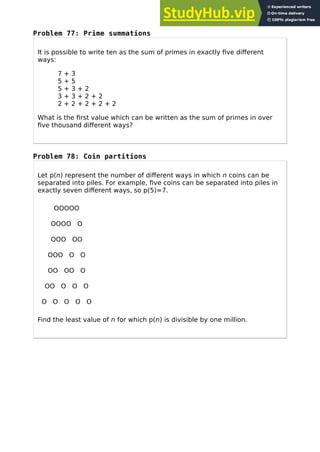




![before exiting?
Some positive integers n have the property that the sum [ n + reverse(n) ]
consists entirely of odd (decimal) digits. For instance, 36 + 63 = 99 and
409 + 904 = 1313. We will call such numbers reversible; so 36, 63, 409,
and 904 are reversible. Leading zeroes are not allowed in either n or
reverse(n).
There are 120 reversible numbers below one-thousand.
How many reversible numbers are there below one-billion (109)?
The smallest positive integer n for which the numbers n2+1, n2+3, n2+7,
n2+9, n2+13, and n2+27 are consecutive primes is 10. The sum of all such
integers n below one-million is 1242490.
What is the sum of all such integers n below 150 million?
Problem 145: How many reversible numbers are there below
one-billion?
Problem 146: Investigating a Prime Pattern](https://image.slidesharecdn.com/allproblems-230807163807-9cbfa2f5/85/All-Problems-pdf-89-320.jpg)


![Looking at the table below, it is easy to verify that the maximum possible
sum of adjacent numbers in any direction (horizontal, vertical, diagonal or
anti-diagonal) is 16 (= 8 + 7 + 1).
−2 5 3 2
9 −6 5 1
3 2 7 3
−1 8 −4 8
Now, let us repeat the search, but on a much larger scale:
First, generate four million pseudo-random numbers using a specific form
of what is known as a "Lagged Fibonacci Generator":
For 1 ≤ k ≤ 55, sk = [100003 − 200003k + 300007k3] (modulo 1000000)
− 500000.
For 56 ≤ k ≤ 4000000, sk = [sk−24 + sk−55 + 1000000] (modulo 1000000)
− 500000.
Thus, s10 = −393027 and s100 = 86613.
The terms of s are then arranged in a 2000×2000 table, using the first
2000 numbers to fill the first row (sequentially), the next 2000 numbers to
fill the second row, and so on.
Finally, find the greatest sum of (any number of) adjacent entries in any
direction (horizontal, vertical, diagonal or anti-diagonal).
Problem 149: Searching for a maximum-sum subsequence](https://image.slidesharecdn.com/allproblems-230807163807-9cbfa2f5/85/All-Problems-pdf-92-320.jpg)


![The RSA encryption is based on the following procedure:
Generate two distinct primes p and q.
Compute n=pq and φ=(p-1)(q-1).
Find an integer e, 1<e<φ, such that gcd(e,φ)=1.
A message in this system is a number in the interval [0,n-1].
A text to be encrypted is then somehow converted to messages (numbers
in the interval [0,n-1]).
To encrypt the text, for each message, m, c=me mod n is calculated.
To decrypt the text, the following procedure is needed: calculate d such
that ed=1 mod φ, then for each encrypted message, c, calculate m=cd
mod n.
There exist values of e and m such that me mod n=m.
We call messages m for which me mod n=m unconcealed messages.
An issue when choosing e is that there should not be too many
unconcealed messages.
For instance, let p=19 and q=37.
Then n=19*37=703 and φ=18*36=648.
If we choose e=181, then, although gcd(181,648)=1 it turns out that all
possible messages
m (0≤m≤n-1) are unconcealed when calculating me mod n.
For any valid choice of e there exist some unconcealed messages.
It's important that the number of unconcealed messages is at a minimum.
Choose p=1009 and q=3643.
Find the sum of all values of e, 1<e<φ(1009,3643) and gcd(e,φ)=1, so
that the number of unconcealed messages for this value of e is at a
minimum.
Problem 182: RSA encryption](https://image.slidesharecdn.com/allproblems-230807163807-9cbfa2f5/85/All-Problems-pdf-119-320.jpg)


![Here are the records from a busy telephone system with one million users:
RecNr Caller Called
1 200007 100053
2 600183 500439
3 600863 701497
... ... ...
The telephone number of the caller and the called number in record n are
Caller(n) = S2n-1 and Called(n) = S2n where S1,2,3,... come from the
"Lagged Fibonacci Generator":
For 1 ≤ k ≤ 55, Sk = [100003 - 200003k + 300007k3] (modulo 1000000)
For 56 ≤ k, Sk = [Sk-24 + Sk-55] (modulo 1000000)
If Caller(n) = Called(n) then the user is assumed to have misdialled and
the call fails; otherwise the call is successful.
From the start of the records, we say that any pair of users X and Y are
friends if X calls Y or vice-versa. Similarly, X is a friend of a friend of Z if X
is a friend of Y and Y is a friend of Z; and so on for longer chains.
The Prime Minister's phone number is 524287. After how many successful
calls, not counting misdials, will 99% of the users (including the PM) be a
friend, or a friend of a friend etc., of the Prime Minister?
A composite is a number containing at least two prime factors. For
example, 15 = 3 × 5; 9 = 3 × 3; 12 = 2 × 2 × 3.
There are ten composites below thirty containing precisely two, not
necessarily distinct, prime factors: 4, 6, 9, 10, 14, 15, 21, 22, 25, 26.
How many composite integers, n < 108, have precisely two, not
necessarily distinct, prime factors?
Problem 186: Connectedness of a network
Problem 187: Semiprimes](https://image.slidesharecdn.com/allproblems-230807163807-9cbfa2f5/85/All-Problems-pdf-123-320.jpg)


![Let Sm = (x1, x2, ... , xm) be the m-tuple of positive real numbers with x1 +
x2 + ... + xm = m for which Pm = x1 * x2
2 * ... * xm
m is maximised.
For example, it can be verified that [P10] = 4112 ([ ] is the integer part
function).
Find Σ[Pm] for 2 ≤ m ≤ 15.
A particular school offers cash rewards to children with good attendance
and punctuality. If they are absent for three consecutive days or late on
more than one occasion then they forfeit their prize.
During an n-day period a trinary string is formed for each child consisting
of L's (late), O's (on time), and A's (absent).
Although there are eighty-one trinary strings for a 4-day period that can be
formed, exactly forty-three strings would lead to a prize:
OOOO OOOA OOOL OOAO OOAA OOAL OOLO OOLA OAOO OAOA
OAOL OAAO OAAL OALO OALA OLOO OLOA OLAO OLAA AOOO
AOOA AOOL AOAO AOAA AOAL AOLO AOLA AAOO AAOA AAOL
AALO AALA ALOO ALOA ALAO ALAA LOOO LOOA LOAO LOAA
LAOO LAOA LAAO
How many "prize" strings exist over a 30-day period?
Problem 190: Maximising a weighted product
Problem 191: Prize Strings](https://image.slidesharecdn.com/allproblems-230807163807-9cbfa2f5/85/All-Problems-pdf-127-320.jpg)


![x y x AND y
0 0 0
0 1 0
1 0 0
1 1 1
x y x XOR y
0 0 0
0 1 1
1 0 1
1 1 0
A k-input binary truth table is a map from k input bits (binary digits, 0
[false] or 1 [true]) to 1 output bit. For example, the 2-input binary truth
tables for the logical AND and XOR functions are:
How many 6-input binary truth tables, τ, satisfy the formula
τ(a, b, c, d, e, f) AND τ(b, c, d, e, f, a XOR (b AND c)) = 0
for all 6-bit inputs (a, b, c, d, e, f)?
Consider the set S(r) of points (x,y) with integer coordinates satisfying |x|
+ |y| ≤ r.
Let O be the point (0,0) and C the point (r/4,r/4).
Let N(r) be the number of points B in S(r), so that the triangle OBC has an
obtuse angle, i.e. the largest angle α satisfies 90°<α<180°.
So, for example, N(4)=24 and N(8)=100.
What is N(1,000,000,000)?
For a positive integer n, let σ2(n) be the sum of the squares of its divisors.
For example,
σ2(10) = 1 + 4 + 25 + 100 = 130.
Find the sum of all n, 0 < n < 64,000,000 such that σ2(n) is a perfect
square.
Problem 209: Circular Logic
Problem 210: Obtuse Angled Triangles
Problem 211: Divisor Square Sum](https://image.slidesharecdn.com/allproblems-230807163807-9cbfa2f5/85/All-Problems-pdf-140-320.jpg)
![An axis-aligned cuboid, specified by parameters { (x0,y0,z0), (dx,dy,dz) },
consists of all points (X,Y,Z) such that x0 ≤ X ≤ x0+dx, y0 ≤ Y ≤ y0+dy and
z0 ≤ Z ≤ z0+dz. The volume of the cuboid is the product, dx × dy × dz.
The combined volume of a collection of cuboids is the volume of their
union and will be less than the sum of the individual volumes if any
cuboids overlap.
Let C1,...,C50000 be a collection of 50000 axis-aligned cuboids such that Cn
has parameters
x0 = S6n-5 modulo 10000
y0 = S6n-4 modulo 10000
z0 = S6n-3 modulo 10000
dx = 1 + (S6n-2 modulo 399)
dy = 1 + (S6n-1 modulo 399)
dz = 1 + (S6n modulo 399)
where S1,...,S300000 come from the "Lagged Fibonacci Generator":
For 1 ≤ k ≤ 55, Sk = [100003 - 200003k + 300007k3] (modulo
1000000)
For 56 ≤ k, Sk = [Sk-24 + Sk-55] (modulo 1000000)
Thus, C1 has parameters {(7,53,183),(94,369,56)}, C2 has parameters
{(2383,3563,5079),(42,212,344)}, and so on.
The combined volume of the first 100 cuboids, C1,...,C100, is 723581599.
What is the combined volume of all 50000 cuboids, C1,...,C50000 ?
A 30×30 grid of squares contains 900 fleas, initially one flea per square.
When a bell is rung, each flea jumps to an adjacent square at random
(usually 4 possibilities, except for fleas on the edge of the grid or at the
corners).
What is the expected number of unoccupied squares after 50 rings of the
bell? Give your answer rounded to six decimal places.
Problem 212: Combined Volume of Cuboids
Problem 213: Flea Circus](https://image.slidesharecdn.com/allproblems-230807163807-9cbfa2f5/85/All-Problems-pdf-141-320.jpg)


![Given the set {1,2,...,n}, we define f(n,k) as the number of its k-element
subsets with an odd sum of elements. For example, f(5,3) = 4, since the set
{1,2,3,4,5} has four 3-element subsets having an odd sum of elements,
i.e.: {1,2,4}, {1,3,5}, {2,3,4} and {2,4,5}.
When all three values n, k and f(n,k) are odd, we say that they make
an odd-triplet [n,k,f(n,k)].
There are exactly five odd-triplets with n ≤ 10, namely:
[1,1,f(1,1) = 1], [5,1,f(5,1) = 3], [5,5,f(5,5) = 1], [9,1,f(9,1) = 5] and
[9,9,f(9,9) = 1].
How many odd-triplets are there with n ≤ 1012 ?
A positive fraction whose numerator is less than its denominator is called a
proper fraction.
For any denominator, d, there will be d−1 proper fractions; for example,
with d = 12:
1/12 , 2/12 , 3/12 , 4/12 , 5/12 , 6/12 , 7/12 , 8/12 , 9/12 , 10/12 , 11/12 .
We shall call a fraction that cannot be cancelled down a resilient fraction.
Furthermore we shall define the resilience of a denominator, R(d), to be
the ratio of its proper fractions that are resilient; for example, R(12) = 4/11
.
In fact, d = 12 is the smallest denominator having a resilience R(d) < 4/10 .
Find the smallest denominator d, having a resilience R(d) < 15499/94744 .
Problem 242: Odd Triplets
Problem 243: Resilience](https://image.slidesharecdn.com/allproblems-230807163807-9cbfa2f5/85/All-Problems-pdf-158-320.jpg)


![Albert chooses a positive integer k, then two real numbers a, b are
randomly chosen in the interval [0,1] with uniform distribution.
The square root of the sum (k·a+1)2 + (k·b+1)2 is then computed and
rounded to the nearest integer. If the result is equal to k, he scores k
points; otherwise he scores nothing.
For example, if k = 6, a = 0.2 and b = 0.85, then (k·a+1)2 + (k·b+1)2 =
42.05.
The square root of 42.05 is 6.484... and when rounded to the nearest
integer, it becomes 6.
This is equal to k, so he scores 6 points.
It can be shown that if he plays 10 turns with k = 1, k = 2, ..., k = 10, the
expected value of his total score, rounded to five decimal places, is
10.20914.
If he plays 105 turns with k = 1, k = 2, k = 3, ..., k = 105, what is the
expected value of his total score, rounded to five decimal places?
Barbara is a mathematician and a basketball player. She has found that
the probability of scoring a point when shooting from a distance x is
exactly (1 - x/q), where q is a real constant greater than 50.
During each practice run, she takes shots from distances x = 1, x = 2, ..., x
= 50 and, according to her records, she has precisely a 2 % chance to
score a total of exactly 20 points.
Find q and give your answer rounded to 10 decimal places.
Problem 285: Pythagorean odds
Problem 286: Scoring probabilities](https://image.slidesharecdn.com/allproblems-230807163807-9cbfa2f5/85/All-Problems-pdf-188-320.jpg)


![Susan has a prime frog.
Her frog is jumping around over 500 squares numbered 1 to 500. He can
only jump one square to the left or to the right, with equal probability, and
he cannot jump outside the range [1;500].
(if it lands at either end, it automatically jumps to the only available square
on the next move.)
When he is on a square with a prime number on it, he croaks 'P' (PRIME)
with probability 2/3 or 'N' (NOT PRIME) with probability 1/3 just before
jumping to the next square.
When he is on a square with a number on it that is not a prime he croaks
'P' with probability 1/3 or 'N' with probability 2/3 just before jumping to the
next square.
Given that the frog's starting position is random with the same probability
for every square, and given that she listens to his first 15 croaks, what is
the probability that she hears the sequence PPPPNNPPPNPPNPN?
Give your answer as a fraction p/q in reduced form.
Problem 329: Prime Frog](https://image.slidesharecdn.com/allproblems-230807163807-9cbfa2f5/85/All-Problems-pdf-224-320.jpg)


![A cubic Bézier curve is defined by four points: P0, P1, P2 and P3.
The curve is constructed as follows:
On the segments P0P1, P1P2 and
P2P3 the points Q0,Q1 and Q2 are
drawn such that
P0Q0 / P0P1 = P1Q1 / P1P2 = P2Q2 /
P2P3 = t (t in [0,1]).
On the segments Q0Q1 and Q1Q2
the points R0 and R1 are drawn
such that
Q0R0 / Q0Q1 = Q1R1 / Q1Q2 = t for
the same value of t.
On the segment R0R1 the point B is
drawn such that R0B / R0R1 = t for the same value of t.
The Bézier curve defined by the points P0, P1, P2, P3 is the locus of B as Q0
takes all possible positions on the segment P0P1.
(Please note that for all points the value of t is the same.)
At this (external) web address you will find an applet that allows you to
drag the points P0, P1, P2 and P3 to see what the Bézier curve (green
curve) defined by those points looks like. You can also drag the point Q0
along the segment P0P1.
From the construction it is clear that the Bézier curve will be tangent to the
segments P0P1 in P0 and P2P3 in P3.
A cubic Bézier curve with P0=(1,0), P1=(1,v), P2=(v,1) and P3=(0,1) is
used to approximate a quarter circle.
The value v > 0 is chosen such that the area enclosed by the lines OP0,
OP3 and the curve is equal to π/4 (the area of the quarter circle).
By how many percent does the length of the curve differ from the length of
the quarter circle?
That is, if L is the length of the curve, calculate 100 ×
L − π/2
π/2
Give your answer rounded to 10 digits behind the decimal point.
Problem 363: Bézier Curves](https://image.slidesharecdn.com/allproblems-230807163807-9cbfa2f5/85/All-Problems-pdf-253-320.jpg)


![Let us define a geometric triangle as an integer sided triangle with sides a
≤ b ≤ c so that its sides form a geometric progression, i.e. b2 = a · c .
An example of such a geometric triangle is the triangle with sides a = 144,
b = 156 and c = 169.
There are 861805 geometric triangles with perimeter ≤ 106 .
How many geometric triangles exist with perimeter ≤ 2.5·1013 ?
Oregon licence plates consist of three letters followed by a three digit
number (each digit can be from [0..9]).
While driving to work Seth plays the following game:
Whenever the numbers of two licence plates seen on his trip add to 1000
that's a win.
E.g. MIC-012 and HAN-988 is a win and RYU-500 and SET-500 too. (as long
as he sees them in the same trip).
Find the expected number of plates he needs to see for a win.
Give your answer rounded to 8 decimal places behind the decimal point.
Note: We assume that each licence plate seen is equally likely to have any three digit
number on it.
Let R(M, N) be the number of lattice points (x, y) which satisfy M<x≤N,
M<y≤N and is odd.
We can verify that R(0, 100) = 3019 and R(100, 10000) = 29750422.
Find R(2·106, 109).
Note: represents the floor function.
Problem 370: Geometric triangles
Problem 371: Licence plates
Problem 372: Pencils of rays](https://image.slidesharecdn.com/allproblems-230807163807-9cbfa2f5/85/All-Problems-pdf-258-320.jpg)


![Consider an infinite row of boxes. Some of the boxes contain a ball. For
example, an initial configuration of 2 consecutive occupied boxes followed
by 2 empty boxes, 2 occupied boxes, 1 empty box, and 2 occupied boxes
can be denoted by the sequence (2, 2, 2, 1, 2), in which the number of
consecutive occupied and empty boxes appear alternately.
A turn consists of moving each ball exactly once according to the following
rule: Transfer the leftmost ball which has not been moved to the nearest
empty box to its right.
After one turn the sequence (2, 2, 2, 1, 2) becomes (2, 2, 1, 2, 3) as can be
seen below; note that we begin the new sequence starting at the first
occupied box.
A system like this is called a Box-Ball System or BBS for short.
It can be shown that after a sufficient number of turns, the system evolves
to a state where the consecutive numbers of occupied boxes is invariant.
In the example below, the consecutive numbers of occupied boxes
evolves to [1, 2, 3]; we shall call this the final state.
We define the sequence {ti}:
s0 = 290797
sk+1 = sk
2 mod 50515093
tk = (sk mod 64) + 1
Starting from the initial configuration (t0, t1, …, t10), the final state
becomes [1, 3, 10, 24, 51, 75].
Starting from the initial configuration (t0, t1, …, t10 000 000), find the final
state.
Give as your answer the sum of the squares of the elements of the final
state. For example, if the final state is [1, 2, 3] then 14 ( = 12 + 22 + 32) is
Problem 426: Box-ball system](https://image.slidesharecdn.com/allproblems-230807163807-9cbfa2f5/85/All-Problems-pdf-296-320.jpg)


![Define S(N) as ∑R(i,j) for 1 ≤ i, j ≤ N.
E.g. S(5) = 25021721.
Find S(100), give your answer modulo 1000000033
The Fibonacci numbers {fn, n ≥ 0} are defined recursively as fn = fn-1 +
fn-2 with base cases f0 = 0 and f1 = 1.
Define the polynomials {Fn, n ≥ 0} as Fn(x) = ∑fixi for 0 ≤ i ≤ n.
For example, F7(x) = x + x2 + 2x3 + 3x4 + 5x5 + 8x6 + 13x7, and F7(11) =
268357683.
Let n = 1015. Find the sum [∑0≤x≤100 Fn(x)] mod 1307674368000 (= 15!).
Problem 435: Polynomials of Fibonacci numbers](https://image.slidesharecdn.com/allproblems-230807163807-9cbfa2f5/85/All-Problems-pdf-303-320.jpg)


![The function is defined for all positive integers as follows:
The function is defined as .
and .
Find . Give the last 9 digits of your answer.
The Möbius function, denoted μ(n), is defined as:
μ(n) = (-1)ω(n) if n is squarefree (where ω(n) is the number of
distinct prime factors of n)
μ(n) = 0 if n is not squarefree.
Let P(a,b) be the number of integers n in the interval [a,b] such that μ(n)
= 1.
Let N(a,b) be the number of integers n in the interval [a,b] such that μ(n)
= -1.
For example, P(2,10) = 2 and N(2,10) = 4.
Let C(n) be the number of integer pairs (a,b) such that:
1 ≤ a ≤ b ≤ n,
99·N(a,b) ≤ 100·P(a,b), and
99·P(a,b) ≤ 100·N(a,b).
For example, C(10) = 13, C(500) = 16676 and C(10 000) = 20155319.
Find C(20 000 000).
Problem 463: A weird recurrence relation
f
f(1) = 1
f(3) = 3
f(2n) = f(n)
f(4n + 1) = 2f(2n + 1) − f(n)
f(4n + 3) = 3f(2n + 1) − 2f(n)
S(n) f(i)
∑n
i=1
S(8) = 22 S(100) = 3604
S( )
337
Problem 464: Möbius function and intervals](https://image.slidesharecdn.com/allproblems-230807163807-9cbfa2f5/85/All-Problems-pdf-324-320.jpg)
![The kernel of a polygon is defined by the set of points from which the
entire polygon's boundary is visible. We define a polar polygon as a
polygon for which the origin is strictly contained inside its kernel.
For this problem, a polygon can have collinear consecutive vertices.
However, a polygon still cannot have self-intersection and cannot have
zero area.
For example, only the first of the following is a polar polygon (the kernels
of the second, third, and fourth do not strictly contain the origin, and the
fifth does not have a kernel at all):
Notice that the first polygon has three consecutive collinear vertices.
Let P(n) be the number of polar polygons such that the vertices (x, y) have
integer coordinates whose absolute values are not greater than n.
Note that polygons should be counted as different if they have different set
of edges, even if they enclose the same area. For example, the polygon
with vertices [(0,0),(0,3),(1,1),(3,0)] is distinct from the polygon with
vertices [(0,0),(0,3),(1,1),(3,0),(1,0)].
For example, P(1) = 131, P(2) = 1648531, P(3) = 1099461296175 and
P(343) mod 1 000 000 007 = 937293740.
Find P(713) mod 1 000 000 007.
Problem 465: Polar polygons](https://image.slidesharecdn.com/allproblems-230807163807-9cbfa2f5/85/All-Problems-pdf-325-320.jpg)


