PRIME FACTORIZATION
Being able to factor a number into its prime number components is often required in order to
reduce fractions, simplify radicals, etc. [A prime number can be divided only by itself and one –
it can't be reduced any further.] It also helps to be able to do it quickly (like on tests). A few
rules and adopting a consistent method will help the process.

Divisibility Criteria

There are several rules that tell you what a number can be divided by, but only a few are really
needed to get down to prime components.

        If the number ends in:                      It can be divided by:

        an even number or 0                                   2

        0 or 5                                                5

Also, if the sum of the digits is divisible by 3, the number is divisible by 3. For example, the
number 537 is divisible by 3 because 5 + 3 + 7 = 15, which is divisible by 3. If you're not sure if
the number is divisible by 3, add the digits again: 1 + 5 = 6, which is divisible by 3.

If none of these rules applies, then try dividing by 7, 11, 13, or some other prime.

It also helps to be able to recognize some of the primes (so you know you can stop):

                     2           3            5            7             11
                    13          17           19           23             29
                    31          37           41           43             47
                    53          59           61           67             71
                    73          79           83           89             97
(There's lots more of these!)

Methods of dividing

There's a couple of common dividing methods to quickly step through the process.

1. Downward division: This looks like long division upside down. You start with whatever
prime you can start with, then divide the result by whatever prime you can, and continue. If the
number is divisible by more than one prime, it doesn't matter which one you start with!

Example: Factor 90 into its primes.

    2 | 90 (even)                 3 | 90 (9+0=9)                  5 | 90 (ends in 0)
     5 | 45 (ends in 5)   or       2 | 30 (ends in 0)    or        3 | 18 (1+8=9)
      3|9                           5 | 15 (ends in 5)              3|6
          3                              3                              2


                    Department of Mathematics, Sinclair Community College, Dayton, OH              1
The factors are 2 • 5 • 3 • 3 or 2 • 5 • 32.


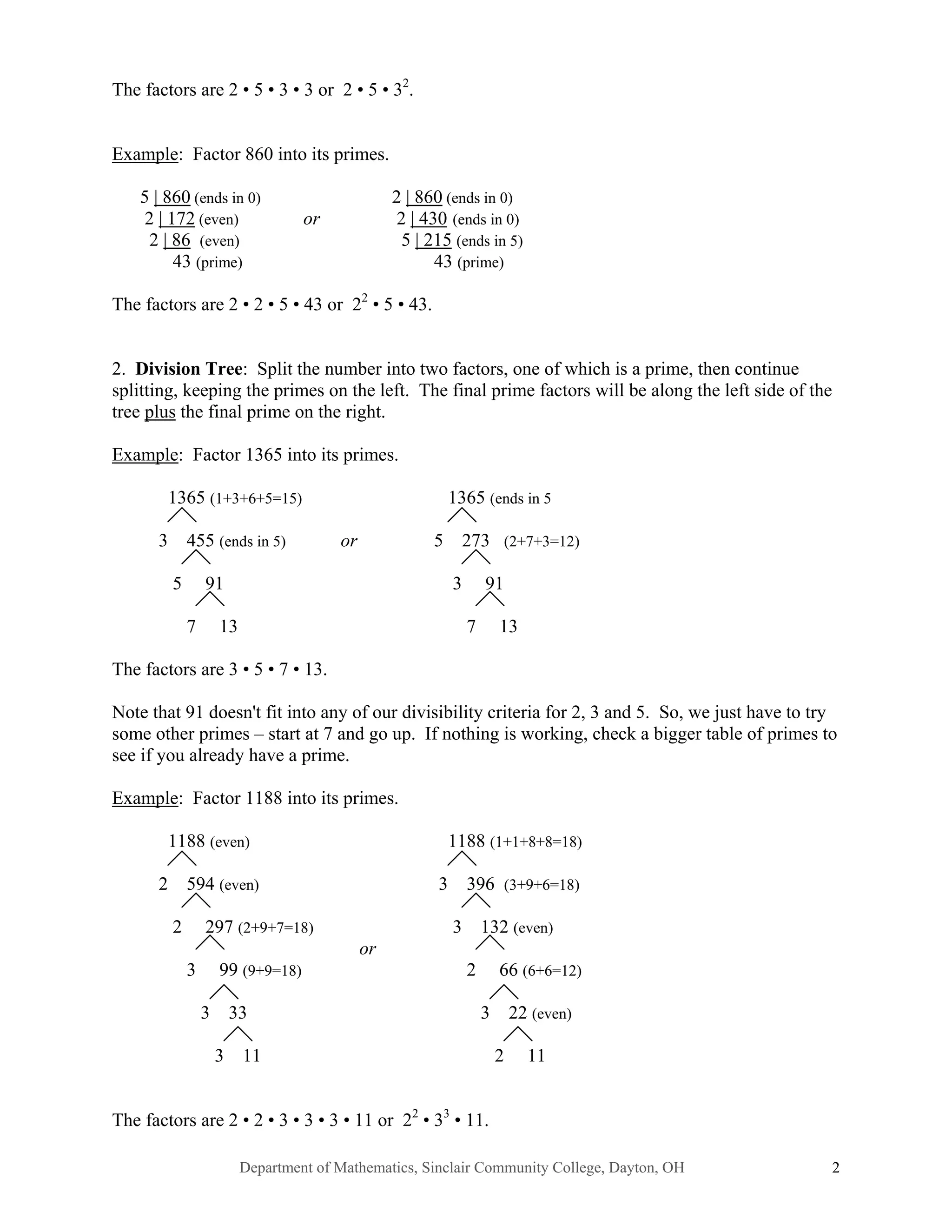
Example: Factor 860 into its primes.

    5 | 860 (ends in 0)                            2 | 860 (ends in 0)
     2 | 172 (even)                 or              2 | 430 (ends in 0)
      2 | 86 (even)                                  5 | 215 (ends in 5)
          43 (prime)                                      43 (prime)

The factors are 2 • 2 • 5 • 43 or 22 • 5 • 43.


2. Division Tree: Split the number into two factors, one of which is a prime, then continue
splitting, keeping the primes on the left. The final prime factors will be along the left side of the
tree plus the final prime on the right.

Example: Factor 1365 into its primes.

        1365 (1+3+6+5=15)                                    1365 (ends in 5

      3       455 (ends in 5)            or              5     273 (2+7+3=12)

          5       91                                          3       91

              7       13                                          7       13

The factors are 3 • 5 • 7 • 13.

Note that 91 doesn't fit into any of our divisibility criteria for 2, 3 and 5. So, we just have to try
some other primes – start at 7 and go up. If nothing is working, check a bigger table of primes to
see if you already have a prime.

Example: Factor 1188 into its primes.

        1188 (even)                                          1188 (1+1+8+8=18)

      2       594 (even)                                  3       396 (3+9+6=18)

          2       297 (2+9+7=18)                              3       132 (even)
                                              or
              3       99 (9+9=18)                                 2       66 (6+6=12)

                  3       33                                          3       22 (even)

                      3    11                                             2     11


The factors are 2 • 2 • 3 • 3 • 3 • 11 or 22 • 33 • 11.

                           Department of Mathematics, Sinclair Community College, Dayton, OH            2

Prime factorization

  • 1.
    PRIME FACTORIZATION Being ableto factor a number into its prime number components is often required in order to reduce fractions, simplify radicals, etc. [A prime number can be divided only by itself and one – it can't be reduced any further.] It also helps to be able to do it quickly (like on tests). A few rules and adopting a consistent method will help the process. Divisibility Criteria There are several rules that tell you what a number can be divided by, but only a few are really needed to get down to prime components. If the number ends in: It can be divided by: an even number or 0 2 0 or 5 5 Also, if the sum of the digits is divisible by 3, the number is divisible by 3. For example, the number 537 is divisible by 3 because 5 + 3 + 7 = 15, which is divisible by 3. If you're not sure if the number is divisible by 3, add the digits again: 1 + 5 = 6, which is divisible by 3. If none of these rules applies, then try dividing by 7, 11, 13, or some other prime. It also helps to be able to recognize some of the primes (so you know you can stop): 2 3 5 7 11 13 17 19 23 29 31 37 41 43 47 53 59 61 67 71 73 79 83 89 97 (There's lots more of these!) Methods of dividing There's a couple of common dividing methods to quickly step through the process. 1. Downward division: This looks like long division upside down. You start with whatever prime you can start with, then divide the result by whatever prime you can, and continue. If the number is divisible by more than one prime, it doesn't matter which one you start with! Example: Factor 90 into its primes. 2 | 90 (even) 3 | 90 (9+0=9) 5 | 90 (ends in 0) 5 | 45 (ends in 5) or 2 | 30 (ends in 0) or 3 | 18 (1+8=9) 3|9 5 | 15 (ends in 5) 3|6 3 3 2 Department of Mathematics, Sinclair Community College, Dayton, OH 1
  • 2.
    The factors are2 • 5 • 3 • 3 or 2 • 5 • 32. Example: Factor 860 into its primes. 5 | 860 (ends in 0) 2 | 860 (ends in 0) 2 | 172 (even) or 2 | 430 (ends in 0) 2 | 86 (even) 5 | 215 (ends in 5) 43 (prime) 43 (prime) The factors are 2 • 2 • 5 • 43 or 22 • 5 • 43. 2. Division Tree: Split the number into two factors, one of which is a prime, then continue splitting, keeping the primes on the left. The final prime factors will be along the left side of the tree plus the final prime on the right. Example: Factor 1365 into its primes. 1365 (1+3+6+5=15) 1365 (ends in 5 3 455 (ends in 5) or 5 273 (2+7+3=12) 5 91 3 91 7 13 7 13 The factors are 3 • 5 • 7 • 13. Note that 91 doesn't fit into any of our divisibility criteria for 2, 3 and 5. So, we just have to try some other primes – start at 7 and go up. If nothing is working, check a bigger table of primes to see if you already have a prime. Example: Factor 1188 into its primes. 1188 (even) 1188 (1+1+8+8=18) 2 594 (even) 3 396 (3+9+6=18) 2 297 (2+9+7=18) 3 132 (even) or 3 99 (9+9=18) 2 66 (6+6=12) 3 33 3 22 (even) 3 11 2 11 The factors are 2 • 2 • 3 • 3 • 3 • 11 or 22 • 33 • 11. Department of Mathematics, Sinclair Community College, Dayton, OH 2