Factors and Multiples

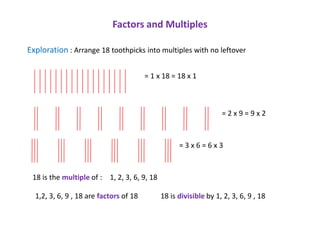
Exploration : Arrange 18 toothpicks into multiples with no leftover

                                        = 1 x 18 = 18 x 1


                                                                  =2x9=9x2


                                                   =3x6=6x3


 18 is the multiple of : 1, 2, 3, 6, 9, 18

  1,2, 3, 6, 9 , 18 are factors of 18        18 is divisible by 1, 2, 3, 6, 9 , 18
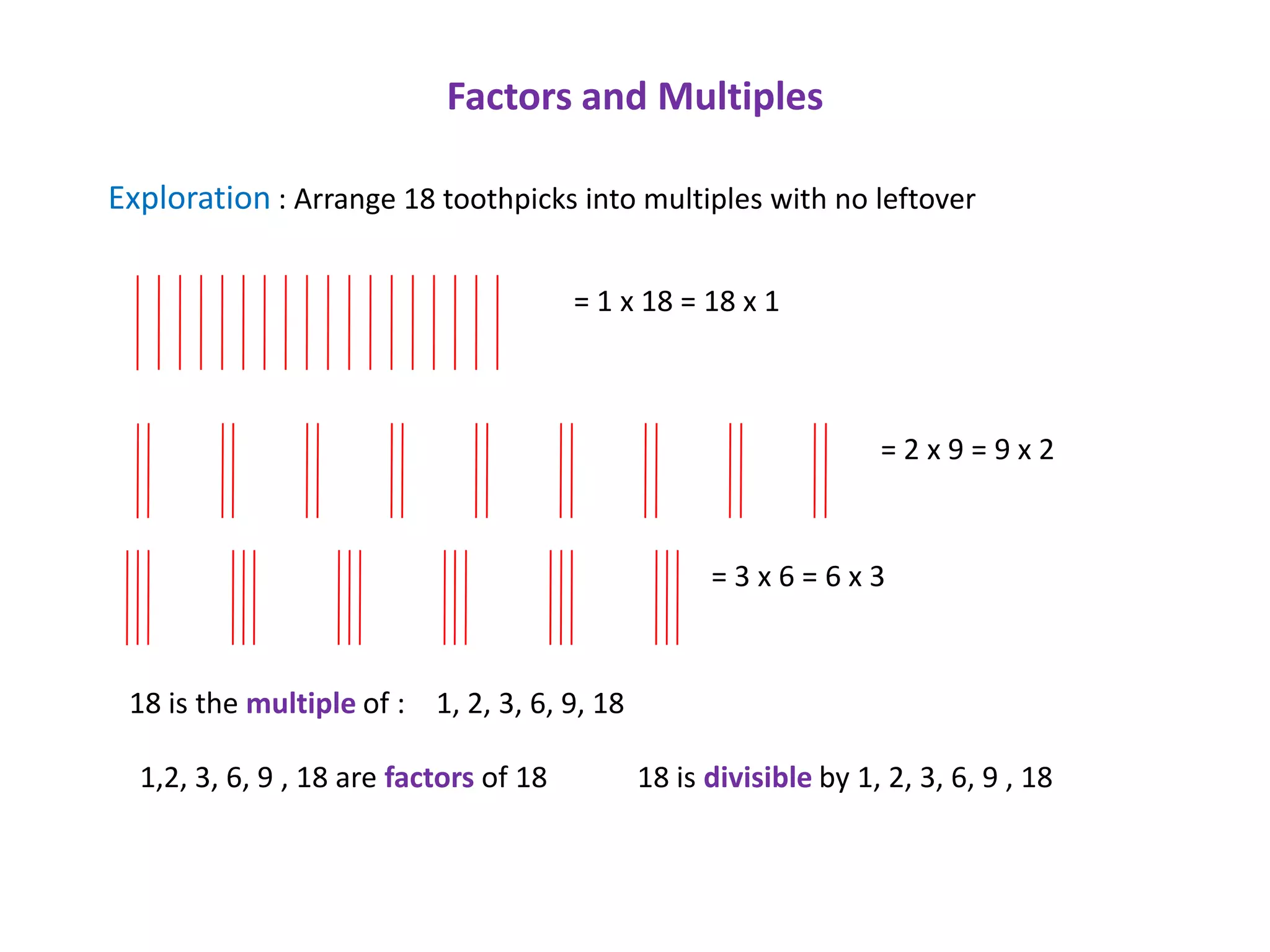
Example 1

a. List the factors of 60                   b. List the multiples of 5


60 = 1 x 60 = 2 x 30 = 3 x 20               5, 10, 15, 20, ….
   = 4 x 15 = 5x 12 = 6 x 10

The factors of 60 are : 1, 2, 3, 4, 5, 6,
10 , 12, 15, 20 , 30, 60
Prime and Composite Numbers

Prime number is a number which has only 2 different factors , 1 and the
   number itself

 Example : 2, 3, 5, 7, 11, ….

Composite number is a number which has more than 2 different factors

Example : 4, 6, 8, 9, 10, ….

The number 1 is neither a prime number nor a composite number . Why ?

Because 1 has only 1 factor which is itself
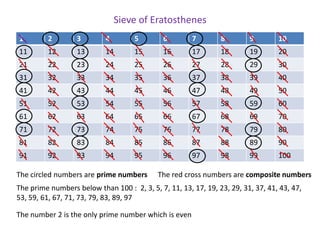
Sieve of Eratosthenes
1        2         3        4        5        6        7        8        9        10
11       12        13       14       15       16       17       18       19       20
21       22        23       24       25       26       27       28       29       30
31       32        33       34       35       36       37       38       39       40
41       42        43       44       45       46       47       48       49       50
51       52        53       54       55       56       57       58       59       60
61       62        63       64       65       66       67       68       69       70
71       72        73       74       75       76       77       78       79       80
81       82        83       84       85       86       87       88       89       90
91       92        93       94       95       96       97       98       99       100

The circled numbers are prime numbers       The red cross numbers are composite numbers
The prime numbers below than 100 : 2, 3, 5, 7, 11, 13, 17, 19, 23, 29, 31, 37, 41, 43, 47,
53, 59, 61, 67, 71, 73, 79, 83, 89, 97

The number 2 is the only prime number which is even
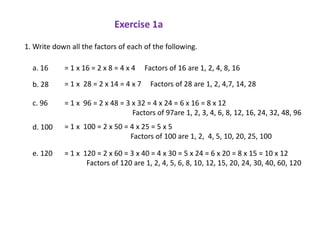
Exercise 1a

1. Write down all the factors of each of the following.

  a. 16     = 1 x 16 = 2 x 8 = 4 x 4    Factors of 16 are 1, 2, 4, 8, 16

  b. 28     = 1 x 28 = 2 x 14 = 4 x 7    Factors of 28 are 1, 2, 4,7, 14, 28

  c. 96     = 1 x 96 = 2 x 48 = 3 x 32 = 4 x 24 = 6 x 16 = 8 x 12
                                  Factors of 97are 1, 2, 3, 4, 6, 8, 12, 16, 24, 32, 48, 96
  d. 100    = 1 x 100 = 2 x 50 = 4 x 25 = 5 x 5
                                 Factors of 100 are 1, 2, 4, 5, 10, 20, 25, 100

  e. 120    = 1 x 120 = 2 x 60 = 3 x 40 = 4 x 30 = 5 x 24 = 6 x 20 = 8 x 15 = 10 x 12
                   Factors of 120 are 1, 2, 4, 5, 6, 8, 10, 12, 15, 20, 24, 30, 40, 60, 120
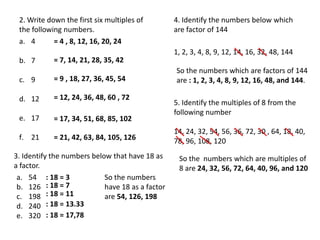
2. Write down the first six multiples of         4. Identify the numbers below which
 the following numbers.                           are factor of 144
 a. 4       = 4 , 8, 12, 16, 20, 24
                                                  1, 2, 3, 4, 8, 9, 12, 14, 16, 32, 48, 144
 b. 7       = 7, 14, 21, 28, 35, 42
                                                  So the numbers which are factors of 144
 c. 9       = 9 , 18, 27, 36, 45, 54              are : 1, 2, 3, 4, 8, 9, 12, 16, 48, and 144.

 d. 12      = 12, 24, 36, 48, 60 , 72
                                                  5. Identify the multiples of 8 from the
                                                  following number
 e. 17      = 17, 34, 51, 68, 85, 102
                                                  14, 24, 32, 54, 56, 36, 72, 30 , 64, 18, 40,
 f. 21      = 21, 42, 63, 84, 105, 126            78, 96, 108, 120
3. Identify the numbers below that have 18 as      So the numbers which are multiples of
a factor.                                          8 are 24, 32, 56, 72, 64, 40, 96, and 120
 a. 54 : 18 = 3             So the numbers
 b. 126 : 18 = 7            have 18 as a factor
 c. 198 : 18 = 11           are 54, 126, 198
 d. 240 : 18 = 13.33
 e. 320 : 18 = 17,78
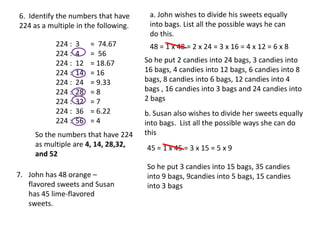
6. Identify the numbers that have      a. John wishes to divide his sweets equally
224 as a multiple in the following.    into bags. List all the possible ways he can
                                       do this.
           224 :   3    = 74.67        48 = 1 x 48 = 2 x 24 = 3 x 16 = 4 x 12 = 6 x 8
           224 :   4    = 56
           224 :   12   = 18.67       So he put 2 candies into 24 bags, 3 candies into
           224 :   14   = 16          16 bags, 4 candies into 12 bags, 6 candies into 8
           224 :   24   = 9.33        bags, 8 candies into 6 bags, 12 candies into 4
           224 :   28   =8            bags , 16 candies into 3 bags and 24 candies into
           224 :   32   =7            2 bags
           224 :   36   = 6.22        b. Susan also wishes to divide her sweets equally
           224 :   56   =4            into bags. List all the possible ways she can do
     So the numbers that have 224     this
     as multiple are 4, 14, 28,32,    45 = 1 x 45 = 3 x 15 = 5 x 9
     and 52
                                      So he put 3 candies into 15 bags, 35 candies
7. John has 48 orange –               into 9 bags, 9candies into 5 bags, 15 candies
   flavored sweets and Susan          into 3 bags
   has 45 lime-flavored
   sweets.
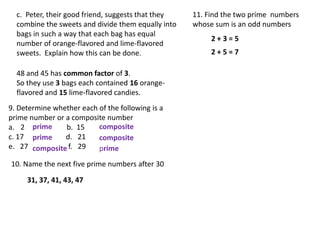
c. Peter, their good friend, suggests that they   11. Find the two prime numbers
  combine the sweets and divide them equally into   whose sum is an odd numbers
  bags in such a way that each bag has equal
                                                         2+3=5
  number of orange-flavored and lime-flavored
  sweets. Explain how this can be done.                  2+5=7

  48 and 45 has common factor of 3.
  So they use 3 bags each contained 16 orange-
  flavored and 15 lime-flavored candies.
9. Determine whether each of the following is a
prime number or a composite number
a. 2 prime      b. 15     composite
c. 17 prime     d. 21     composite
e. 27 composite f. 29     prime
10. Name the next five prime numbers after 30

     31, 37, 41, 43, 47

Fpb1

  • 1.
    Factors and Multiples Exploration: Arrange 18 toothpicks into multiples with no leftover = 1 x 18 = 18 x 1 =2x9=9x2 =3x6=6x3 18 is the multiple of : 1, 2, 3, 6, 9, 18 1,2, 3, 6, 9 , 18 are factors of 18 18 is divisible by 1, 2, 3, 6, 9 , 18
  • 2.
    Example 1 a. Listthe factors of 60 b. List the multiples of 5 60 = 1 x 60 = 2 x 30 = 3 x 20 5, 10, 15, 20, …. = 4 x 15 = 5x 12 = 6 x 10 The factors of 60 are : 1, 2, 3, 4, 5, 6, 10 , 12, 15, 20 , 30, 60
  • 3.
    Prime and CompositeNumbers Prime number is a number which has only 2 different factors , 1 and the number itself Example : 2, 3, 5, 7, 11, …. Composite number is a number which has more than 2 different factors Example : 4, 6, 8, 9, 10, …. The number 1 is neither a prime number nor a composite number . Why ? Because 1 has only 1 factor which is itself
  • 4.
    Sieve of Eratosthenes 1 2 3 4 5 6 7 8 9 10 11 12 13 14 15 16 17 18 19 20 21 22 23 24 25 26 27 28 29 30 31 32 33 34 35 36 37 38 39 40 41 42 43 44 45 46 47 48 49 50 51 52 53 54 55 56 57 58 59 60 61 62 63 64 65 66 67 68 69 70 71 72 73 74 75 76 77 78 79 80 81 82 83 84 85 86 87 88 89 90 91 92 93 94 95 96 97 98 99 100 The circled numbers are prime numbers The red cross numbers are composite numbers The prime numbers below than 100 : 2, 3, 5, 7, 11, 13, 17, 19, 23, 29, 31, 37, 41, 43, 47, 53, 59, 61, 67, 71, 73, 79, 83, 89, 97 The number 2 is the only prime number which is even
  • 5.
    Exercise 1a 1. Writedown all the factors of each of the following. a. 16 = 1 x 16 = 2 x 8 = 4 x 4 Factors of 16 are 1, 2, 4, 8, 16 b. 28 = 1 x 28 = 2 x 14 = 4 x 7 Factors of 28 are 1, 2, 4,7, 14, 28 c. 96 = 1 x 96 = 2 x 48 = 3 x 32 = 4 x 24 = 6 x 16 = 8 x 12 Factors of 97are 1, 2, 3, 4, 6, 8, 12, 16, 24, 32, 48, 96 d. 100 = 1 x 100 = 2 x 50 = 4 x 25 = 5 x 5 Factors of 100 are 1, 2, 4, 5, 10, 20, 25, 100 e. 120 = 1 x 120 = 2 x 60 = 3 x 40 = 4 x 30 = 5 x 24 = 6 x 20 = 8 x 15 = 10 x 12 Factors of 120 are 1, 2, 4, 5, 6, 8, 10, 12, 15, 20, 24, 30, 40, 60, 120
  • 6.
    2. Write downthe first six multiples of 4. Identify the numbers below which the following numbers. are factor of 144 a. 4 = 4 , 8, 12, 16, 20, 24 1, 2, 3, 4, 8, 9, 12, 14, 16, 32, 48, 144 b. 7 = 7, 14, 21, 28, 35, 42 So the numbers which are factors of 144 c. 9 = 9 , 18, 27, 36, 45, 54 are : 1, 2, 3, 4, 8, 9, 12, 16, 48, and 144. d. 12 = 12, 24, 36, 48, 60 , 72 5. Identify the multiples of 8 from the following number e. 17 = 17, 34, 51, 68, 85, 102 14, 24, 32, 54, 56, 36, 72, 30 , 64, 18, 40, f. 21 = 21, 42, 63, 84, 105, 126 78, 96, 108, 120 3. Identify the numbers below that have 18 as So the numbers which are multiples of a factor. 8 are 24, 32, 56, 72, 64, 40, 96, and 120 a. 54 : 18 = 3 So the numbers b. 126 : 18 = 7 have 18 as a factor c. 198 : 18 = 11 are 54, 126, 198 d. 240 : 18 = 13.33 e. 320 : 18 = 17,78
  • 7.
    6. Identify thenumbers that have a. John wishes to divide his sweets equally 224 as a multiple in the following. into bags. List all the possible ways he can do this. 224 : 3 = 74.67 48 = 1 x 48 = 2 x 24 = 3 x 16 = 4 x 12 = 6 x 8 224 : 4 = 56 224 : 12 = 18.67 So he put 2 candies into 24 bags, 3 candies into 224 : 14 = 16 16 bags, 4 candies into 12 bags, 6 candies into 8 224 : 24 = 9.33 bags, 8 candies into 6 bags, 12 candies into 4 224 : 28 =8 bags , 16 candies into 3 bags and 24 candies into 224 : 32 =7 2 bags 224 : 36 = 6.22 b. Susan also wishes to divide her sweets equally 224 : 56 =4 into bags. List all the possible ways she can do So the numbers that have 224 this as multiple are 4, 14, 28,32, 45 = 1 x 45 = 3 x 15 = 5 x 9 and 52 So he put 3 candies into 15 bags, 35 candies 7. John has 48 orange – into 9 bags, 9candies into 5 bags, 15 candies flavored sweets and Susan into 3 bags has 45 lime-flavored sweets.
  • 8.
    c. Peter, theirgood friend, suggests that they 11. Find the two prime numbers combine the sweets and divide them equally into whose sum is an odd numbers bags in such a way that each bag has equal 2+3=5 number of orange-flavored and lime-flavored sweets. Explain how this can be done. 2+5=7 48 and 45 has common factor of 3. So they use 3 bags each contained 16 orange- flavored and 15 lime-flavored candies. 9. Determine whether each of the following is a prime number or a composite number a. 2 prime b. 15 composite c. 17 prime d. 21 composite e. 27 composite f. 29 prime 10. Name the next five prime numbers after 30 31, 37, 41, 43, 47