ALKALOIDS
PRESENTATION
PRESENTED BY:
ALKALOIDS
CONTENTS
 Introduction
 Occurrence, Distribution & Location of Alkaloids
 Properties Of Alkaloids
 Why alkaloids are basic?
 Classification of Alkaloids
 Test for Alkaloids
 Extraction of Alkaloids
 Medical Uses of some Alkaloids
INTRODUCTION
 The term “alkaloid” (alkali-like) is commonly used to designate basic heterocyclic
nitrogenous compounds of plant origin that are physiologically active.
 The name “alkaloid” comes from the Arabic word for ash “al- qali”
 Alkaloids are a group of naturally occurring chemical compounds that contain
mostly basic nitrogen atoms. This group also includes some related compounds with
neutral and even weakly acidic properties. Some synthetic compounds of similar
structure are also termed alkaloids. In addition to carbon, hydrogen and nitrogen,
alkaloids may also contain oxygen, sulfur and, more rarely, other elements such as
chlorine, bromine, and phosphorus.
 So basically Alkaloids are naturally occurring nitrogenous substance which is
isolated from plants and reacts like bases”
Deviation From Definition
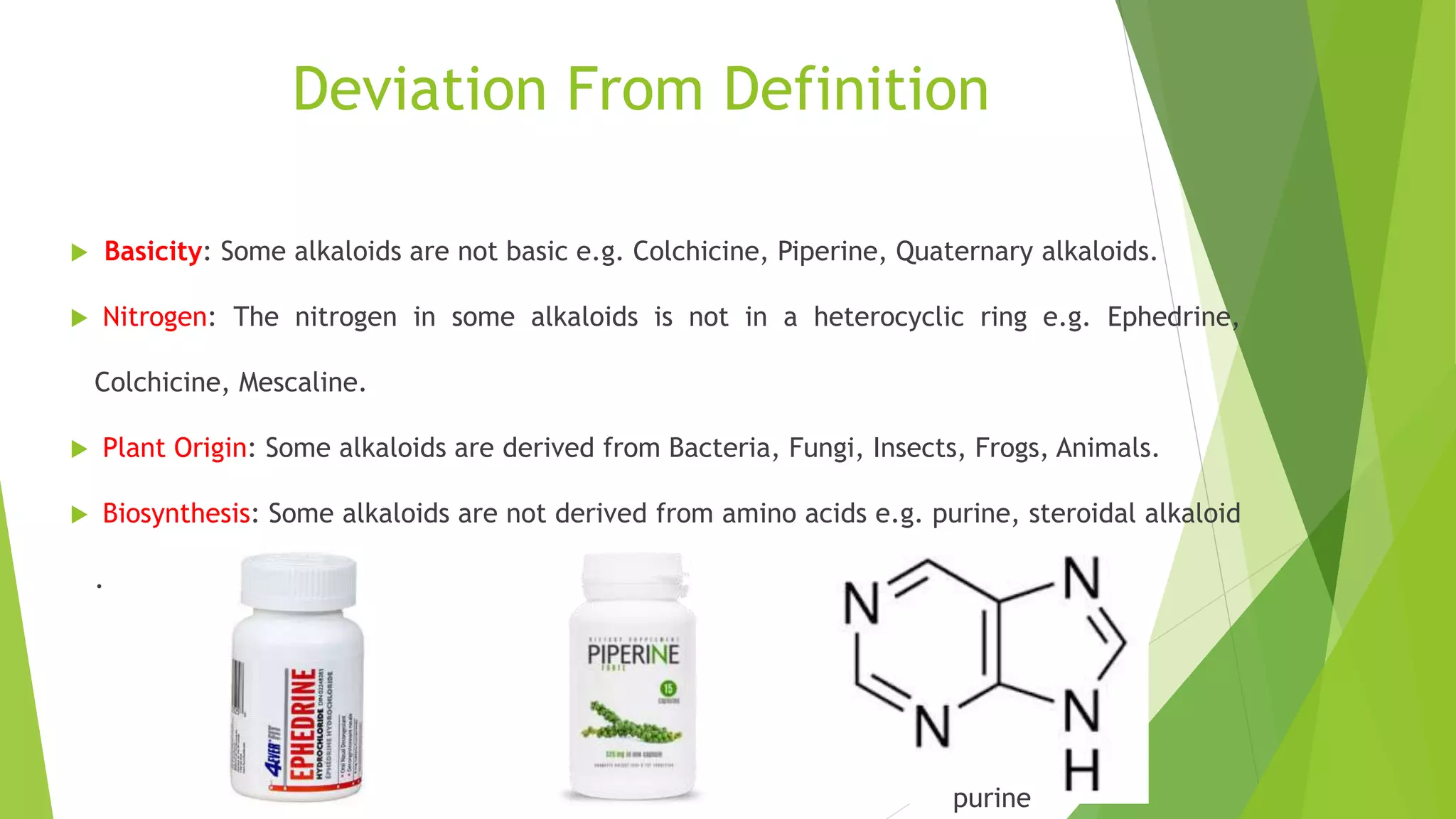
 Basicity: Some alkaloids are not basic e.g. Colchicine, Piperine, Quaternary alkaloids.
 Nitrogen: The nitrogen in some alkaloids is not in a heterocyclic ring e.g. Ephedrine,
Colchicine, Mescaline.
 Plant Origin: Some alkaloids are derived from Bacteria, Fungi, Insects, Frogs, Animals.
 Biosynthesis: Some alkaloids are not derived from amino acids e.g. purine, steroidal alkaloid
.
purine
Alkaloid Description
 Contains nitrogen -usually derived from an amino acid.
 Bitter tasting, generally white solids (exception -nicotine is a brown liquid).
 They give a precipitate with heavy metal iodides.
 Caffeine, a purine derivative, does not precipitate like most alkaloids.
 Alkaloids are basic -they form water soluble salts. Most alkaloids are well-defined crystalline
substances which unite with acids to form salts. In plants, they may exist as-
1. in the free state
2. as salts or
3. as N-Oxides
 Occur in a limited number of plants. Nucleic acid exists in all plants, whereas, morphine exists in
only one plant species .
Occurrence, Distribution & Location of
Alkaloids
 Occur in bacteria(Pseudomonas aeruginosa) and rarely in fungi (pscilocin from
hallucinogenic mushrooms).
 Some occur in certain families (hyoscyamine), while others occur only in a
specific species (morphine).
 All alkaloids of one plant will have a common biogenetic origin
 Alkaloids occur in all plant parts, but are usually localized in one organ (e.g.
the bark or seeds).
 Within the plant, [alkaloid] can vary widely from part to part –some parts may
contain no alkaloids.
 Occasionally, different alkaloids also form in different parts of the plant.
 Alkaloid concentrations occur in wide ranges –e.g. Madagascar periwinkle
contains 3g per (anti cancer) alkaloids per ton of leaves.
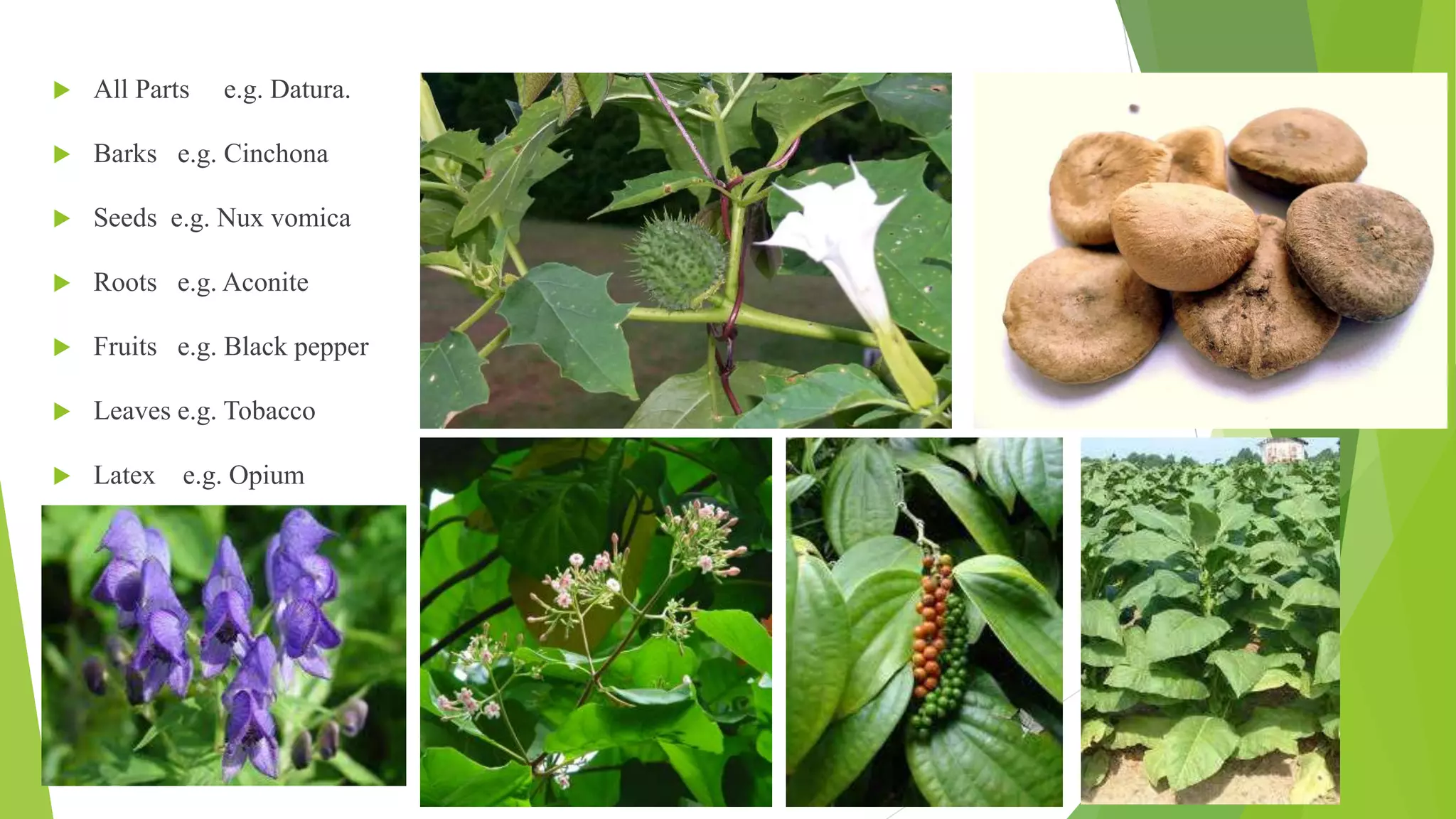
 All Parts e.g. Datura.
 Barks e.g. Cinchona
 Seeds e.g. Nux vomica
 Roots e.g. Aconite
 Fruits e.g. Black pepper
 Leaves e.g. Tobacco
 Latex e.g. Opium
 Molecular weight varies from: 100-900
 Basic in Nature.
 Most bases which do not contain O2 are liquid at room temperature (nicotine), while those that
do are solids. In rare cases they are colored.
 Insoluble or sparingly soluble in water, but the salts formed on reaction with acids are usually
freely soluble
 Soluble in a polar or slightly polar organic solvents. Soluble in concentrated hydro alcoholic
solutions
 Some alkaloids are liquid because of lacking of oxygen in their molecules. (e.g. coniine,
nicotine, spartenine)
 The degree of basicity varies greatly, depending on the structure of the molecule and the
presence and location of other functional groups.
 Have high melting points
Physical Properties
 STATE:
• Most alkaloids are crystalline solids.
• Few alkaloids are amorphous solids e.g. emetine.
• Some are liquids that are either:
Volatile e.g. nicotine and coniine, or
Non-volatile e.g. pilocarpine and hyoscine.
 COLOR:
The majority of alkaloids are colorless but some are colored e.g.:
• Colchicine and berberine are yellow.
• betanidine is orange.
• The salts of sanguinarine are copper-red
 SOLUBILITY:
• Both alkaloidal bases and their salts are soluble in alcohol.
• Generally, the bases are soluble in organic solvents and insoluble in water
Exceptions:
• Bases soluble in water: caffeine, ephedrine, codeine, colchicine, pilocarpine and
quaternary ammonium bases.
• Bases insoluble or sparingly soluble in certain organic solvents: morphine in
ether, theobromine and theophylline in benzene.
• Salts are usually soluble in water and, insoluble or sparingly soluble in organic solvents.
Chemical Properties
 Most of the alkaloids are basic in nature, due to the availability of lone pair of electrons
on nitrogen.
 The basic character of the alkaloid compound is enhanced if the adjacent functional
groups are electron releasing.
 The alkaloid turns to be neutral or acidic when the adjacent functional groups are
electron withdrawing like amide group which reduces the availability of the lone pair of
electron.
 Their salt formation with an inorganic acid prevents many a time their decomposition.
 In the natural form, the alkaloids exist either in Free State, as amine or as salt with acid
or alkaloid N-oxides.
 The alkaloid may contain one or more nitrogen and exist in the form of
• Primary amines R-NH2 e.g. Norephedrine
• Secondary amines R2-NH e.g. Ephedrine
• Tertiary amines R3-N e.g. Atropine
• Quaternary ammonium salts R4-N e.g. d-Tubocurarine
Alkaloids usually contain one nitrogen atom, Although some, like
ergotamine may contain up to 5. The nitrogen may exist as primary
amine, secondary amine or tertiary amine. Because the nitrogen atom
contains unshared pair of electron so alkaloids are basic and resemble
ammonia’s chemical properties. The degree of basicity varies greatly,
depending on the structure of the molecule and the presence and
location of other functional group.
No. Heterocycle Example
1.
Pyrrole and
Pyrrolidine
Hygrine, Stachydrine
2.
Pyrrolizidine
Senecionine, Symphitine, Echimidine,
Seneciphylline
3.
Pyridine and Piperidine
Lobeline, Nicotine, Piperine, Conine,
Trigonelline
4.
Tropane (piperidine/N-methyl-
pyrrolidine)
Cocaine, Atropine, Hyoscyamine, Hyoscine
5.
Quinoline
Quinine, Quinidine, Cinchonine,
Cinchonidine
6.
Isoquinoline
Morphine, Emetine, Papaverine, Narcotine,
Tubocurarine, Codeine
7.
Aporphine (reduced
isoquinoline/naphthalene)
Boldine
8.
Quinolizidine
Lupanine, Cytisine, Laburnine, Sparteine
9.
Indole or
Benzopyrole
Ergometrine, Vinblastine, Vincristine, Strychnine, Brucine,
Ergotamine, Yohimbine, Reserpine, Serpentine,
Physostigmine
10.
Indolizidine
Castanospermine, Swainsonine
11.
Imidazole or
glyoxaline
Pilocarpine, Pilosine
12.
Purine (pyrimidine/imidazole)
13.
Steroidal (some combined as
glycosides)*
Conessine, Solanidine
14. Terpenoid*
Aconitine, lycaconitine, Aconine
TEST FOR
ALKALOIDS
Tests
 Most alkaloids are precipitated from neutral or slightly acidic solution by
 Dragendorff's reagent -- (solution of potassium bismuth iodide) orange colored
precipitate.
 Mayer's reagent -- (potassium mercuric iodide solution): Cream colored precipitate.
 Wagner’s reagent -- (iodine in potassium iodide) red-brown precipitate
 Hagers reagent -- (picric acid) yellow precipitate
 Caffeine does precipitate
• Potassium
bismuth iodide
solution.
• Observation :
orange coloured
precipitate
• Iodine in
potassium iodide
• Observation :
red-brown
precipitate
• Mercuric
potassium iodide
solution
• Observation:
white
precipitate
• Saturated
solution of picric
acid.
• Observation:
yellow
precipitate
Extraction Of Alkaloids
MORPHINE
 Has chemical formula: C17H19NO3
 Most powerful analgesic used in cases
of severe pain as post operative pain,
bone fractures, cancer patients & in
cases of angina.
 Use as a pain relief before, during or
after surgery.
 As a general anesthesia to sedate the
pain.
 To relieve in severe diarrhea.
 Relief of pain caused by heart attack
or myocardial infarction.
 Dose: Morphine Sulphate Parentally is
10mg 6/day.
NICOTINE
 Molecular formula: C10H14N2
 It is a naturally occurring liquid alkaloid found in
many plants of the nightshade family.
 Tomatoes, potatoes, eggplant and tobacco all
contain nicotine, although for humans, tobacco is
the only plant containing significant enough
quantities to have an effect.
 Nicotine has a lot of therapeutic uses.
 it may be useful in treating Parkinson's disease.
 Amazing for cognitive enhancement and is relaxing
and stimulating at the same time.
 Nicotine Increases Wakefulness, Motivation,
Alertness and Creativity
 Used for alertness.
 Nicotine Helps Repair Tissue
 Nicotine Helps in Weight and Insulin Control
CONS:
 if you have or had cancer, it might not be
smart to use nicotine.
 It’s Addictive, and Quitting is Difficult.
 Nicotine Can Increase Tumor Growth
 Nicotine Increases Risk of H.Pylori
 An oral dose of 50 to 60 mg of nicotine
is enough to kill a 160 lb person
QUININE
 Molecular formula: C20H24N2O2
 Bark of various species of Cinchona
Plant contains quinine, cinchonidine.
 Quinine has been used for the
treatment of malaria and associated
febrile states, leg cramps .
 Quinine has been widely studied as an
antimalarial.
 It is used to treat malaria and
babesiosis.
 The medical uses of quinine is
currently limited to the treatment of
malaria.

Alkaloids

  • 1.
  • 2.
  • 3.
    CONTENTS  Introduction  Occurrence,Distribution & Location of Alkaloids  Properties Of Alkaloids  Why alkaloids are basic?  Classification of Alkaloids  Test for Alkaloids  Extraction of Alkaloids  Medical Uses of some Alkaloids
  • 4.
    INTRODUCTION  The term“alkaloid” (alkali-like) is commonly used to designate basic heterocyclic nitrogenous compounds of plant origin that are physiologically active.  The name “alkaloid” comes from the Arabic word for ash “al- qali”  Alkaloids are a group of naturally occurring chemical compounds that contain mostly basic nitrogen atoms. This group also includes some related compounds with neutral and even weakly acidic properties. Some synthetic compounds of similar structure are also termed alkaloids. In addition to carbon, hydrogen and nitrogen, alkaloids may also contain oxygen, sulfur and, more rarely, other elements such as chlorine, bromine, and phosphorus.  So basically Alkaloids are naturally occurring nitrogenous substance which is isolated from plants and reacts like bases”
  • 5.
    Deviation From Definition Basicity: Some alkaloids are not basic e.g. Colchicine, Piperine, Quaternary alkaloids.  Nitrogen: The nitrogen in some alkaloids is not in a heterocyclic ring e.g. Ephedrine, Colchicine, Mescaline.  Plant Origin: Some alkaloids are derived from Bacteria, Fungi, Insects, Frogs, Animals.  Biosynthesis: Some alkaloids are not derived from amino acids e.g. purine, steroidal alkaloid . purine
  • 6.
    Alkaloid Description  Containsnitrogen -usually derived from an amino acid.  Bitter tasting, generally white solids (exception -nicotine is a brown liquid).  They give a precipitate with heavy metal iodides.  Caffeine, a purine derivative, does not precipitate like most alkaloids.  Alkaloids are basic -they form water soluble salts. Most alkaloids are well-defined crystalline substances which unite with acids to form salts. In plants, they may exist as- 1. in the free state 2. as salts or 3. as N-Oxides  Occur in a limited number of plants. Nucleic acid exists in all plants, whereas, morphine exists in only one plant species .
  • 7.
    Occurrence, Distribution &Location of Alkaloids  Occur in bacteria(Pseudomonas aeruginosa) and rarely in fungi (pscilocin from hallucinogenic mushrooms).  Some occur in certain families (hyoscyamine), while others occur only in a specific species (morphine).  All alkaloids of one plant will have a common biogenetic origin  Alkaloids occur in all plant parts, but are usually localized in one organ (e.g. the bark or seeds).  Within the plant, [alkaloid] can vary widely from part to part –some parts may contain no alkaloids.  Occasionally, different alkaloids also form in different parts of the plant.  Alkaloid concentrations occur in wide ranges –e.g. Madagascar periwinkle contains 3g per (anti cancer) alkaloids per ton of leaves.
  • 8.
     All Partse.g. Datura.  Barks e.g. Cinchona  Seeds e.g. Nux vomica  Roots e.g. Aconite  Fruits e.g. Black pepper  Leaves e.g. Tobacco  Latex e.g. Opium
  • 11.
     Molecular weightvaries from: 100-900  Basic in Nature.  Most bases which do not contain O2 are liquid at room temperature (nicotine), while those that do are solids. In rare cases they are colored.  Insoluble or sparingly soluble in water, but the salts formed on reaction with acids are usually freely soluble  Soluble in a polar or slightly polar organic solvents. Soluble in concentrated hydro alcoholic solutions  Some alkaloids are liquid because of lacking of oxygen in their molecules. (e.g. coniine, nicotine, spartenine)  The degree of basicity varies greatly, depending on the structure of the molecule and the presence and location of other functional groups.  Have high melting points
  • 12.
    Physical Properties  STATE: •Most alkaloids are crystalline solids. • Few alkaloids are amorphous solids e.g. emetine. • Some are liquids that are either: Volatile e.g. nicotine and coniine, or Non-volatile e.g. pilocarpine and hyoscine.  COLOR: The majority of alkaloids are colorless but some are colored e.g.: • Colchicine and berberine are yellow. • betanidine is orange. • The salts of sanguinarine are copper-red
  • 13.
     SOLUBILITY: • Bothalkaloidal bases and their salts are soluble in alcohol. • Generally, the bases are soluble in organic solvents and insoluble in water Exceptions: • Bases soluble in water: caffeine, ephedrine, codeine, colchicine, pilocarpine and quaternary ammonium bases. • Bases insoluble or sparingly soluble in certain organic solvents: morphine in ether, theobromine and theophylline in benzene. • Salts are usually soluble in water and, insoluble or sparingly soluble in organic solvents.
  • 14.
    Chemical Properties  Mostof the alkaloids are basic in nature, due to the availability of lone pair of electrons on nitrogen.  The basic character of the alkaloid compound is enhanced if the adjacent functional groups are electron releasing.  The alkaloid turns to be neutral or acidic when the adjacent functional groups are electron withdrawing like amide group which reduces the availability of the lone pair of electron.  Their salt formation with an inorganic acid prevents many a time their decomposition.  In the natural form, the alkaloids exist either in Free State, as amine or as salt with acid or alkaloid N-oxides.  The alkaloid may contain one or more nitrogen and exist in the form of • Primary amines R-NH2 e.g. Norephedrine • Secondary amines R2-NH e.g. Ephedrine • Tertiary amines R3-N e.g. Atropine • Quaternary ammonium salts R4-N e.g. d-Tubocurarine
  • 16.
    Alkaloids usually containone nitrogen atom, Although some, like ergotamine may contain up to 5. The nitrogen may exist as primary amine, secondary amine or tertiary amine. Because the nitrogen atom contains unshared pair of electron so alkaloids are basic and resemble ammonia’s chemical properties. The degree of basicity varies greatly, depending on the structure of the molecule and the presence and location of other functional group.
  • 22.
    No. Heterocycle Example 1. Pyrroleand Pyrrolidine Hygrine, Stachydrine 2. Pyrrolizidine Senecionine, Symphitine, Echimidine, Seneciphylline 3. Pyridine and Piperidine Lobeline, Nicotine, Piperine, Conine, Trigonelline 4. Tropane (piperidine/N-methyl- pyrrolidine) Cocaine, Atropine, Hyoscyamine, Hyoscine 5. Quinoline Quinine, Quinidine, Cinchonine, Cinchonidine
  • 23.
    6. Isoquinoline Morphine, Emetine, Papaverine,Narcotine, Tubocurarine, Codeine 7. Aporphine (reduced isoquinoline/naphthalene) Boldine 8. Quinolizidine Lupanine, Cytisine, Laburnine, Sparteine 9. Indole or Benzopyrole Ergometrine, Vinblastine, Vincristine, Strychnine, Brucine, Ergotamine, Yohimbine, Reserpine, Serpentine, Physostigmine 10. Indolizidine Castanospermine, Swainsonine 11. Imidazole or glyoxaline Pilocarpine, Pilosine
  • 24.
    12. Purine (pyrimidine/imidazole) 13. Steroidal (somecombined as glycosides)* Conessine, Solanidine 14. Terpenoid* Aconitine, lycaconitine, Aconine
  • 25.
  • 26.
    Tests  Most alkaloidsare precipitated from neutral or slightly acidic solution by  Dragendorff's reagent -- (solution of potassium bismuth iodide) orange colored precipitate.  Mayer's reagent -- (potassium mercuric iodide solution): Cream colored precipitate.  Wagner’s reagent -- (iodine in potassium iodide) red-brown precipitate  Hagers reagent -- (picric acid) yellow precipitate  Caffeine does precipitate
  • 27.
    • Potassium bismuth iodide solution. •Observation : orange coloured precipitate • Iodine in potassium iodide • Observation : red-brown precipitate • Mercuric potassium iodide solution • Observation: white precipitate • Saturated solution of picric acid. • Observation: yellow precipitate
  • 29.
  • 36.
    MORPHINE  Has chemicalformula: C17H19NO3  Most powerful analgesic used in cases of severe pain as post operative pain, bone fractures, cancer patients & in cases of angina.  Use as a pain relief before, during or after surgery.  As a general anesthesia to sedate the pain.  To relieve in severe diarrhea.  Relief of pain caused by heart attack or myocardial infarction.  Dose: Morphine Sulphate Parentally is 10mg 6/day.
  • 37.
    NICOTINE  Molecular formula:C10H14N2  It is a naturally occurring liquid alkaloid found in many plants of the nightshade family.  Tomatoes, potatoes, eggplant and tobacco all contain nicotine, although for humans, tobacco is the only plant containing significant enough quantities to have an effect.  Nicotine has a lot of therapeutic uses.  it may be useful in treating Parkinson's disease.  Amazing for cognitive enhancement and is relaxing and stimulating at the same time.  Nicotine Increases Wakefulness, Motivation, Alertness and Creativity  Used for alertness.  Nicotine Helps Repair Tissue  Nicotine Helps in Weight and Insulin Control CONS:  if you have or had cancer, it might not be smart to use nicotine.  It’s Addictive, and Quitting is Difficult.  Nicotine Can Increase Tumor Growth  Nicotine Increases Risk of H.Pylori  An oral dose of 50 to 60 mg of nicotine is enough to kill a 160 lb person
  • 39.
    QUININE  Molecular formula:C20H24N2O2  Bark of various species of Cinchona Plant contains quinine, cinchonidine.  Quinine has been used for the treatment of malaria and associated febrile states, leg cramps .  Quinine has been widely studied as an antimalarial.  It is used to treat malaria and babesiosis.  The medical uses of quinine is currently limited to the treatment of malaria.