Goal:
Evaluation of tools and method establishment for DTM from stereo
data
Sub goal-1: Evaluation of tools for DTM from stereo data
• All the available tools (10-15 in number)are to be analyzed and generate DTM for a
given cartosat-1 stereo data
• Literature Study report on “Evaluation of tools for DTM from stereo data”
Sub goal-2: Evaluation of method establishment for DTM from stereo data
• A method is to established up to generation of camera calibration for a given
cartosat-1 stereo data
• A method is to be established to generate DTM on a sample point cloud data.
• Literature Study report on “Evaluation of method establishment for DTM from stereo
data in different stages of implementation”
Tools used for generating Point Cloud through investigation
1. VisualSFM
2. Pix4D
3. IMAGINE Photogrammetry (LPS)
4. ContexCapture CENTER
5. Photomodeler
6. Agisoft Photoscan
7. Point Cloud Library
8. SURE
9. Bundler package, a Structure from Motion system with two stereo packages CMVS
and PMVS
10. OSM Bundler
11. Python Photogrammetry Toolbox (PPT
12. MeshLab
13. Cloud Compare
14. The Digital Imaging and Remote Sensing Image Generation (DIRSIG) – simulation
to point cloud
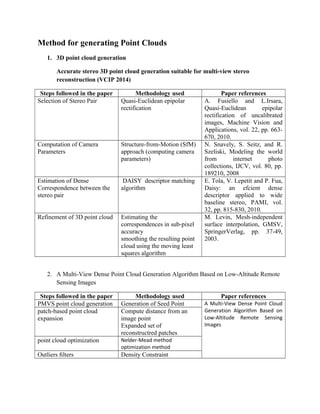
Method for generating Point Clouds
1. 3D point cloud generation
Accurate stereo 3D point cloud generation suitable for multi-view stereo
reconstruction (VCIP 2014)
Steps followed in the paper Methodology used Paper references
Selection of Stereo Pair Quasi-Euclidean epipolar
rectification
A. Fusiello and L.Irsara,
Quasi-Euclidean epipolar
rectification of uncalibrated
images, Machine Vision and
Applications, vol. 22, pp. 663-
670, 2010.
Computation of Camera
Parameters
Structure-from-Motion (SfM)
approach (computing camera
parameters)
N. Snavely, S. Seitz, and R.
Szeliski, Modeling the world
from internet photo
collections, IJCV, vol. 80, pp.
189210, 2008
Estimation of Dense
Correspondence between the
stereo pair
DAISY descriptor matching
algorithm
E. Tola, V. Lepetit and P. Fua,
Daisy: an efcient dense
descriptor applied to wide
baseline stereo, PAMI, vol.
32, pp. 815-830, 2010.
Refinement of 3D point cloud Estimating the
correspondences in sub-pixel
accuracy
smoothing the resulting point
cloud using the moving least
squares algorithm
M. Levin, Mesh-independent
surface interpolation, GMSV,
SpringerVerlag, pp. 37-49,
2003.
2. A Multi-View Dense Point Cloud Generation Algorithm Based on Low-Altitude Remote
Sensing Images
Steps followed in the paper Methodology used Paper references
PMVS point cloud generation Generation of Seed Point A Multi-View Dense Point Cloud
Generation Algorithm Based on
Low-Altitude Remote Sensing
Images
patch-based point cloud
expansion
Compute distance from an
image point
Expanded set of
reconstructred patches
point cloud optimization Nelder-Mead method
optimization method
Outliers filters Density Constraint
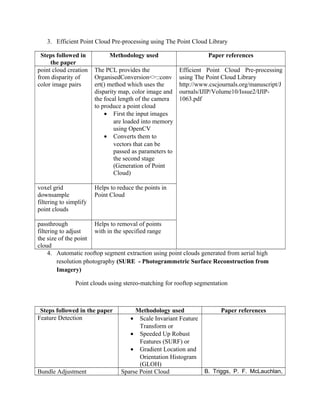
3. Efficient Point Cloud Pre-processing using The Point Cloud Library
Steps followed in
the paper
Methodology used Paper references
point cloud creation
from disparity of
color image pairs
The PCL provides the
OrganisedConversion<>::conv
ert() method which uses the
disparity map, color image and
the focal length of the camera
to produce a point cloud
• First the input images
are loaded into memory
using OpenCV
• Converts them to
vectors that can be
passed as parameters to
the second stage
(Generation of Point
Cloud)
Efficient Point Cloud Pre-processing
using The Point Cloud Library
http://www.cscjournals.org/manuscript/J
ournals/IJIP/Volume10/Issue2/IJIP-
1063.pdf
voxel grid
downsample
filtering to simplify
point clouds
Helps to reduce the points in
Point Cloud
passthrough
filtering to adjust
the size of the point
cloud
Helps to removal of points
with in the specified range
4. Automatic rooftop segment extraction using point clouds generated from aerial high
resolution photography (SURE - Photogrammetric Surface Reconstruction from
Imagery)
Point clouds using stereo-matching for rooftop segmentation
Steps followed in the paper Methodology used Paper references
Feature Detection • Scale Invariant Feature
Transform or
• Speeded Up Robust
Features (SURF) or
• Gradient Location and
Orientation Histogram
(GLOH)
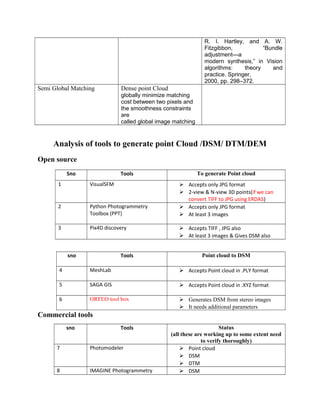
Bundle Adjustment Sparse Point Cloud B. Triggs, P. F. McLauchlan,
R. I. Hartley, and A. W.
Fitzgibbon, “Bundle
adjustment—a
modern synthesis,” in Vision
algorithms: theory and
practice. Springer,
2000, pp. 298–372.
Semi Global Matching Dense point Cloud
globally minimize matching
cost between two pixels and
the smoothness constraints
are
called global image matching
Analysis of tools to generate point Cloud /DSM/ DTM/DEM
Open source
Sno Tools To generate Point cloud
1 VisualSFM  Accepts only JPG format
 2-view & N-view 3D points(if we can
convert TIFF to JPG using ERDAS)
2 Python Photogrammetry
Toolbox (PPT)
 Accepts only JPG format
 At least 3 images
3 Pix4D discovery  Accepts TIFF , JPG also
 At least 3 images & Gives DSM also
sno Tools Point cloud to DSM
4 MeshLab  Accepts Point cloud in .PLY format
5 SAGA GIS  Accepts Point cloud in .XYZ format
6 ORFEO tool box  Generates DSM from stereo images
 It needs additional parameters
Commercial tools
sno Tools Status
(all these are working up to some extent need
to verify thoroughly)
7 Photomodeler  Point cloud
 DSM
 DTM
8 IMAGINE Photogrammetry  DSM
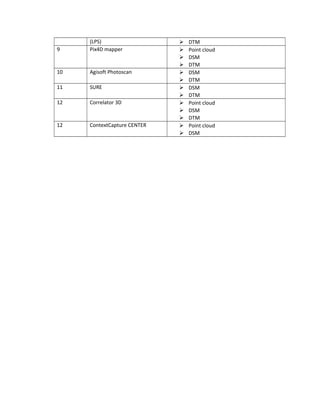
(LPS)  DTM
9 Pix4D mapper  Point cloud
 DSM
 DTM
10 Agisoft Photoscan  DSM
 DTM
11 SURE  DSM
 DTM
12 Correlator 3D  Point cloud
 DSM
 DTM
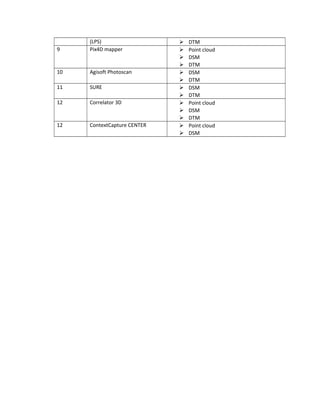
12 ContextCapture CENTER  Point cloud
 DSM
(LPS)  DTM
9 Pix4D mapper  Point cloud
 DSM
 DTM
10 Agisoft Photoscan  DSM
 DTM
11 SURE  DSM
 DTM
12 Correlator 3D  Point cloud
 DSM
 DTM
12 ContextCapture CENTER  Point cloud
 DSM

Algorithms and tools for point cloud generation

  • 1.
    Goal: Evaluation of toolsand method establishment for DTM from stereo data Sub goal-1: Evaluation of tools for DTM from stereo data • All the available tools (10-15 in number)are to be analyzed and generate DTM for a given cartosat-1 stereo data • Literature Study report on “Evaluation of tools for DTM from stereo data” Sub goal-2: Evaluation of method establishment for DTM from stereo data • A method is to established up to generation of camera calibration for a given cartosat-1 stereo data • A method is to be established to generate DTM on a sample point cloud data. • Literature Study report on “Evaluation of method establishment for DTM from stereo data in different stages of implementation” Tools used for generating Point Cloud through investigation 1. VisualSFM 2. Pix4D 3. IMAGINE Photogrammetry (LPS) 4. ContexCapture CENTER 5. Photomodeler 6. Agisoft Photoscan 7. Point Cloud Library 8. SURE 9. Bundler package, a Structure from Motion system with two stereo packages CMVS and PMVS 10. OSM Bundler 11. Python Photogrammetry Toolbox (PPT 12. MeshLab 13. Cloud Compare 14. The Digital Imaging and Remote Sensing Image Generation (DIRSIG) – simulation to point cloud
  • 2.
    Method for generatingPoint Clouds 1. 3D point cloud generation Accurate stereo 3D point cloud generation suitable for multi-view stereo reconstruction (VCIP 2014) Steps followed in the paper Methodology used Paper references Selection of Stereo Pair Quasi-Euclidean epipolar rectification A. Fusiello and L.Irsara, Quasi-Euclidean epipolar rectification of uncalibrated images, Machine Vision and Applications, vol. 22, pp. 663- 670, 2010. Computation of Camera Parameters Structure-from-Motion (SfM) approach (computing camera parameters) N. Snavely, S. Seitz, and R. Szeliski, Modeling the world from internet photo collections, IJCV, vol. 80, pp. 189210, 2008 Estimation of Dense Correspondence between the stereo pair DAISY descriptor matching algorithm E. Tola, V. Lepetit and P. Fua, Daisy: an efcient dense descriptor applied to wide baseline stereo, PAMI, vol. 32, pp. 815-830, 2010. Refinement of 3D point cloud Estimating the correspondences in sub-pixel accuracy smoothing the resulting point cloud using the moving least squares algorithm M. Levin, Mesh-independent surface interpolation, GMSV, SpringerVerlag, pp. 37-49, 2003. 2. A Multi-View Dense Point Cloud Generation Algorithm Based on Low-Altitude Remote Sensing Images Steps followed in the paper Methodology used Paper references PMVS point cloud generation Generation of Seed Point A Multi-View Dense Point Cloud Generation Algorithm Based on Low-Altitude Remote Sensing Images patch-based point cloud expansion Compute distance from an image point Expanded set of reconstructred patches point cloud optimization Nelder-Mead method optimization method Outliers filters Density Constraint
  • 3.
    3. Efficient PointCloud Pre-processing using The Point Cloud Library Steps followed in the paper Methodology used Paper references point cloud creation from disparity of color image pairs The PCL provides the OrganisedConversion<>::conv ert() method which uses the disparity map, color image and the focal length of the camera to produce a point cloud • First the input images are loaded into memory using OpenCV • Converts them to vectors that can be passed as parameters to the second stage (Generation of Point Cloud) Efficient Point Cloud Pre-processing using The Point Cloud Library http://www.cscjournals.org/manuscript/J ournals/IJIP/Volume10/Issue2/IJIP- 1063.pdf voxel grid downsample filtering to simplify point clouds Helps to reduce the points in Point Cloud passthrough filtering to adjust the size of the point cloud Helps to removal of points with in the specified range 4. Automatic rooftop segment extraction using point clouds generated from aerial high resolution photography (SURE - Photogrammetric Surface Reconstruction from Imagery) Point clouds using stereo-matching for rooftop segmentation Steps followed in the paper Methodology used Paper references Feature Detection • Scale Invariant Feature Transform or • Speeded Up Robust Features (SURF) or • Gradient Location and Orientation Histogram (GLOH) Bundle Adjustment Sparse Point Cloud B. Triggs, P. F. McLauchlan,
  • 4.
    R. I. Hartley,and A. W. Fitzgibbon, “Bundle adjustment—a modern synthesis,” in Vision algorithms: theory and practice. Springer, 2000, pp. 298–372. Semi Global Matching Dense point Cloud globally minimize matching cost between two pixels and the smoothness constraints are called global image matching Analysis of tools to generate point Cloud /DSM/ DTM/DEM Open source Sno Tools To generate Point cloud 1 VisualSFM  Accepts only JPG format  2-view & N-view 3D points(if we can convert TIFF to JPG using ERDAS) 2 Python Photogrammetry Toolbox (PPT)  Accepts only JPG format  At least 3 images 3 Pix4D discovery  Accepts TIFF , JPG also  At least 3 images & Gives DSM also sno Tools Point cloud to DSM 4 MeshLab  Accepts Point cloud in .PLY format 5 SAGA GIS  Accepts Point cloud in .XYZ format 6 ORFEO tool box  Generates DSM from stereo images  It needs additional parameters Commercial tools sno Tools Status (all these are working up to some extent need to verify thoroughly) 7 Photomodeler  Point cloud  DSM  DTM 8 IMAGINE Photogrammetry  DSM
  • 5.
    (LPS)  DTM 9Pix4D mapper  Point cloud  DSM  DTM 10 Agisoft Photoscan  DSM  DTM 11 SURE  DSM  DTM 12 Correlator 3D  Point cloud  DSM  DTM 12 ContextCapture CENTER  Point cloud  DSM
  • 6.
    (LPS)  DTM 9Pix4D mapper  Point cloud  DSM  DTM 10 Agisoft Photoscan  DSM  DTM 11 SURE  DSM  DTM 12 Correlator 3D  Point cloud  DSM  DTM 12 ContextCapture CENTER  Point cloud  DSM