ALFRED ADLER
Angelo State University
Thelma Sanchez-Lira
FOUNDER OF ADLERIAN THERAPY
HISTORY OF THEORY
 Adler believed that personality difficulties are rooted in a feeling of
inferiority from restrictions on the individual’s need for self-
assertion.
 Adler had a tendency to change his theory on personality
throughout his life but he ultimately believed that people are
focused on maintaining desire we have to fulfill our potentials
becomes closer and closer to our ideals (Fisher, 2001)
 Called his theory Individual Psychology because he felt each
person was unique and no previous therapy applied to all people.
 Theory includes four aspects:
 The development of personality
 Striving towards superiority
 Psychological health
 The unity of personality
MAJOR TENETS OF THEORY
 The one dynamic force behind people’s
behavior is the striving for success or superiority
 People’s subjective perceptions shape their
behavior and personality
 Personality is unified and self-consistent
 The value of all human activity must be seen
from the viewpoint of social interest
 The self-consistent personality structure
develops into a person’s style of life
 Style of life is molded by people’s creative
power
THEORY TECHNIQUES
An Adlerian therapist assist individuals in
comprehending the thoughts, drives, and
productive way of life by developing new insights,
skills, and behaviors (Adlerian Psychology, 2016)
These are the four stages of Adlerian therapy:
 Establishing the relationship
 Exploring the psychological dynamics operating
in the client-assessment
 Encouraging development of self-
understanding-insight into purpose
 Helping client make new choices-
re-orientation & re-education
ESTABLISHING RELATIONSHIP
 A trusting therapeutic relationship is built
between the therapist and the person in
therapy and they agree to work together to
effectively address the problem
ASSESSMENT
 The therapist invites the client to speak about
his of her personal history, family history,
early recollections, beliefs, feelings, and
motives.
 Helps reveal the person’s overall lifestyle
patterns, and factors that the client may not
pay much regard to
INSIGHT
 The client is helped to develop new ways of
thinking about his or her situation
REORIENTATION
 The therapist encourages the client to
engage in satisfying and effective actions
that reinforce the new insight
THEORY APPLICATIONS
 Application to Education
 Application to Parent Education
 Application to Couples Counseling
 Application to Family Counseling
 Application to Group Counseling
APPLICATION TO EDUCATION
 Adler was an advocate for training both
teachers and parents in effective practices
that foster the child’s social interests and
result in a sense of competence and self-
worth (Corey, 2009).
 By providing teachers with ways to prevent
and correct basic mistakes of
children, he sought out to
promote social interest and
mental health
APPLICATION TO PARENT EDUCATION
 Parent education seeks to improve the relationship
between parent and child by promoting greater
understanding and acceptance (Corey, 2009)
 Alderian parent education stresses listening to
children, helping children accept the consequences
of their behavior, applying emotional coaching,
holding family meetings, and using encouragement
(Corey, 2009)
APPLICATION TO COUPLES COUNSELING
 Adlerian therapy with couples is designed to
assess a couple’s beliefs and behaviors
while educating them in more effective ways
of meeting their relationship goals (Corey,
2009)
APPLICATION TO FAMILY COUNSELING
 With its emphasis on the family constellation,
holism, and the freedom of the therapist to
improvise, Adler’s approach contributed to
the foundation of the family therapy
perspective (Corey, 2009).
 Adlerian family therapy strives to understand
the goals, beliefs, and behaviors of each
family member.
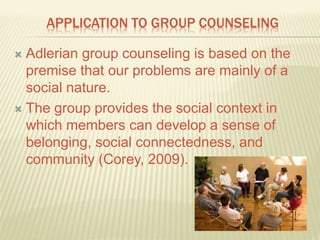
APPLICATION TO GROUP COUNSELING
 Adlerian group counseling is based on the
premise that our problems are mainly of a
social nature.
 The group provides the social context in
which members can develop a sense of
belonging, social connectedness, and
community (Corey, 2009).
REFERENCES
Adlerian Psychology (2016). The four stages of
adlerian therapy. Retrieved from
http://www.goodtherapy.org/learn-about-
therapy/types/adlerian-psychology
Corey, G. (2009). Theory and practice of
counseling and psychotherapy. Belmont,
CA: Thomson Higher Education.
Fisher, M. (2001). Alfred adler. Psychology
history. Retrieved from
http://www.muskingum.edu/~psych/psycw
eb/history/adler.html

Alfred adler

  • 1.
    ALFRED ADLER Angelo StateUniversity Thelma Sanchez-Lira
  • 2.
  • 3.
    HISTORY OF THEORY Adler believed that personality difficulties are rooted in a feeling of inferiority from restrictions on the individual’s need for self- assertion.  Adler had a tendency to change his theory on personality throughout his life but he ultimately believed that people are focused on maintaining desire we have to fulfill our potentials becomes closer and closer to our ideals (Fisher, 2001)  Called his theory Individual Psychology because he felt each person was unique and no previous therapy applied to all people.  Theory includes four aspects:  The development of personality  Striving towards superiority  Psychological health  The unity of personality
  • 4.
    MAJOR TENETS OFTHEORY  The one dynamic force behind people’s behavior is the striving for success or superiority  People’s subjective perceptions shape their behavior and personality  Personality is unified and self-consistent  The value of all human activity must be seen from the viewpoint of social interest  The self-consistent personality structure develops into a person’s style of life  Style of life is molded by people’s creative power
  • 5.
    THEORY TECHNIQUES An Adleriantherapist assist individuals in comprehending the thoughts, drives, and productive way of life by developing new insights, skills, and behaviors (Adlerian Psychology, 2016) These are the four stages of Adlerian therapy:  Establishing the relationship  Exploring the psychological dynamics operating in the client-assessment  Encouraging development of self- understanding-insight into purpose  Helping client make new choices- re-orientation & re-education
  • 6.
    ESTABLISHING RELATIONSHIP  Atrusting therapeutic relationship is built between the therapist and the person in therapy and they agree to work together to effectively address the problem
  • 7.
    ASSESSMENT  The therapistinvites the client to speak about his of her personal history, family history, early recollections, beliefs, feelings, and motives.  Helps reveal the person’s overall lifestyle patterns, and factors that the client may not pay much regard to
  • 8.
    INSIGHT  The clientis helped to develop new ways of thinking about his or her situation
  • 9.
    REORIENTATION  The therapistencourages the client to engage in satisfying and effective actions that reinforce the new insight
  • 10.
    THEORY APPLICATIONS  Applicationto Education  Application to Parent Education  Application to Couples Counseling  Application to Family Counseling  Application to Group Counseling
  • 11.
    APPLICATION TO EDUCATION Adler was an advocate for training both teachers and parents in effective practices that foster the child’s social interests and result in a sense of competence and self- worth (Corey, 2009).  By providing teachers with ways to prevent and correct basic mistakes of children, he sought out to promote social interest and mental health
  • 12.
    APPLICATION TO PARENTEDUCATION  Parent education seeks to improve the relationship between parent and child by promoting greater understanding and acceptance (Corey, 2009)  Alderian parent education stresses listening to children, helping children accept the consequences of their behavior, applying emotional coaching, holding family meetings, and using encouragement (Corey, 2009)
  • 13.
    APPLICATION TO COUPLESCOUNSELING  Adlerian therapy with couples is designed to assess a couple’s beliefs and behaviors while educating them in more effective ways of meeting their relationship goals (Corey, 2009)
  • 14.
    APPLICATION TO FAMILYCOUNSELING  With its emphasis on the family constellation, holism, and the freedom of the therapist to improvise, Adler’s approach contributed to the foundation of the family therapy perspective (Corey, 2009).  Adlerian family therapy strives to understand the goals, beliefs, and behaviors of each family member.
  • 15.
    APPLICATION TO GROUPCOUNSELING  Adlerian group counseling is based on the premise that our problems are mainly of a social nature.  The group provides the social context in which members can develop a sense of belonging, social connectedness, and community (Corey, 2009).
  • 16.
    REFERENCES Adlerian Psychology (2016).The four stages of adlerian therapy. Retrieved from http://www.goodtherapy.org/learn-about- therapy/types/adlerian-psychology Corey, G. (2009). Theory and practice of counseling and psychotherapy. Belmont, CA: Thomson Higher Education. Fisher, M. (2001). Alfred adler. Psychology history. Retrieved from http://www.muskingum.edu/~psych/psycw eb/history/adler.html