






FROM GREEN SCREENS TO LONE GENIUS:
COMMON INNOVATION MYTHS
World Usability Day
NOVEMBER 12, 2015
Steve Fors and Art Chinda
Art Chinda
Lead Experience Architect

art.chinda@effectiveui.com
Steve Fors
Design Principal

steve.fors@effectiveui.com
ALITTLEABOUTOURSELVES
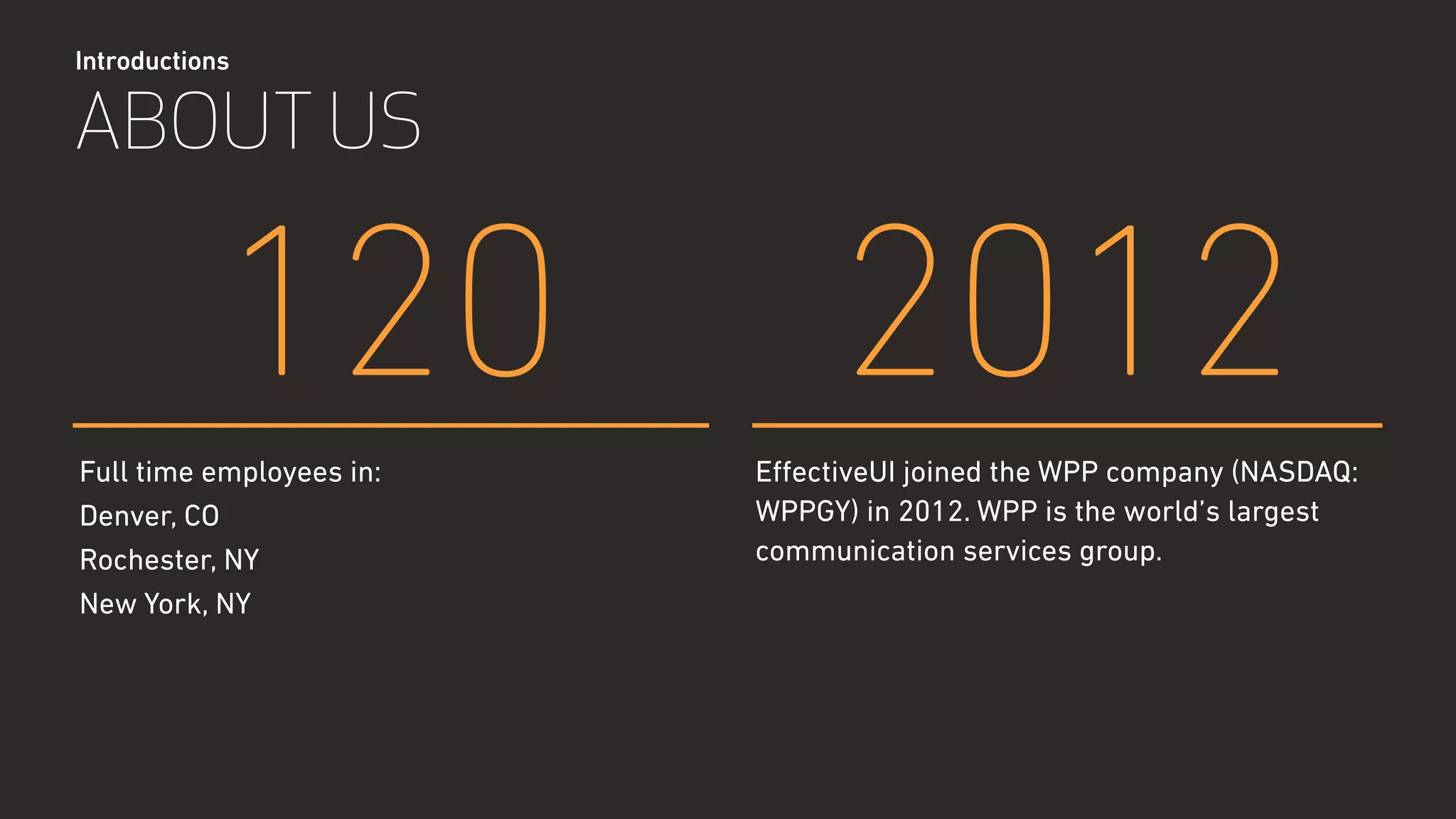
120 2012
Introductions
EffectiveUI joined the WPP company (NASDAQ:
WPPGY) in 2012. WPP is the world’s largest
communication services group.
ABOUT US
Full time employees in:
Denver, CO
Rochester, NY
New York, NY
Introductions
WHERE WE’RE LOCATED
Rochester
NYC
Denver
“There is no formula
for innovation.”
Shane Parrish, Farnam Street
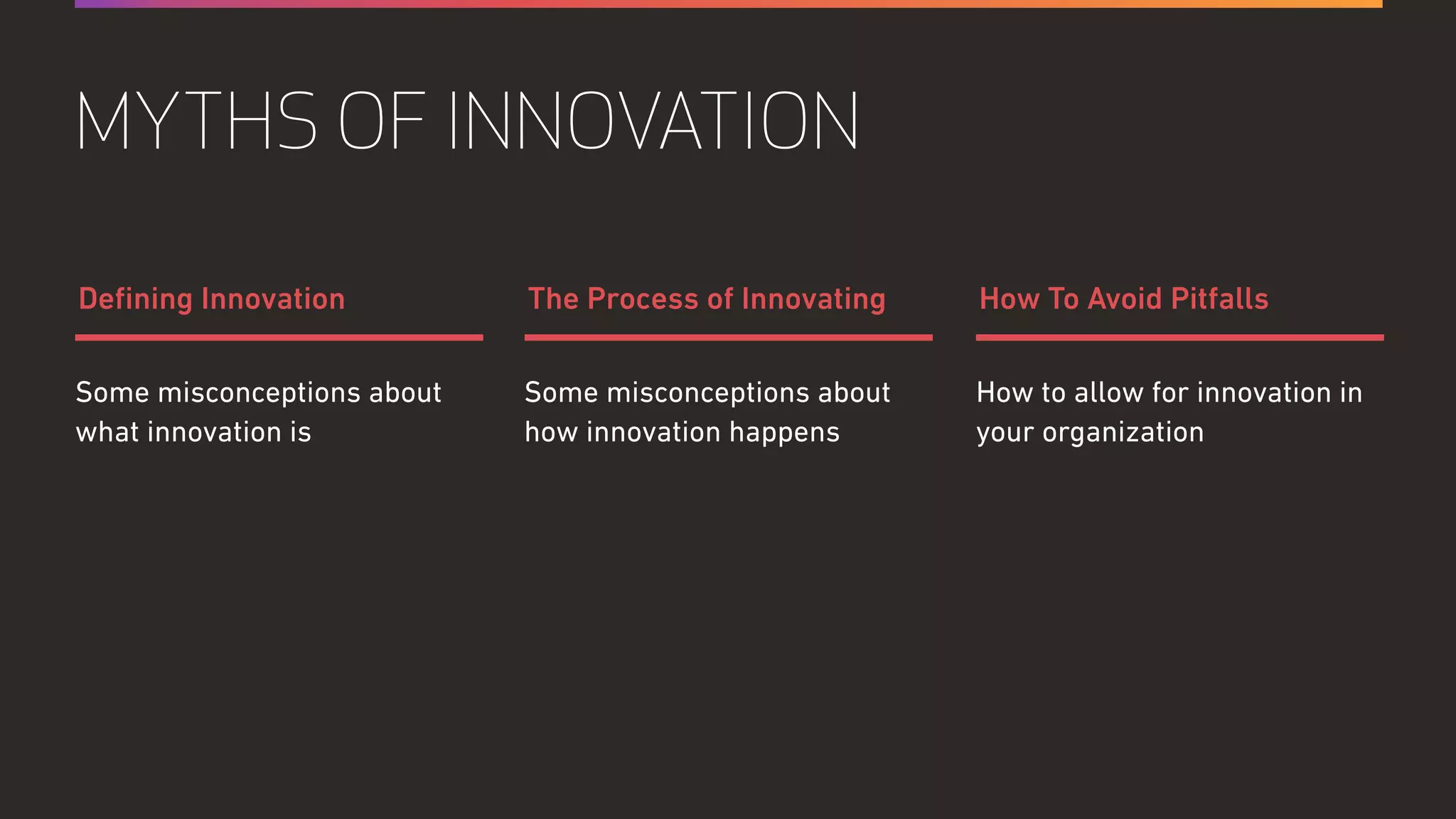
Some misconceptions about
how innovation happens
How to allow for innovation in
your organization
Some misconceptions about
what innovation is
The Process of Innovating How To Avoid PitfallsDefining Innovation
MYTHS OF INNOVATION
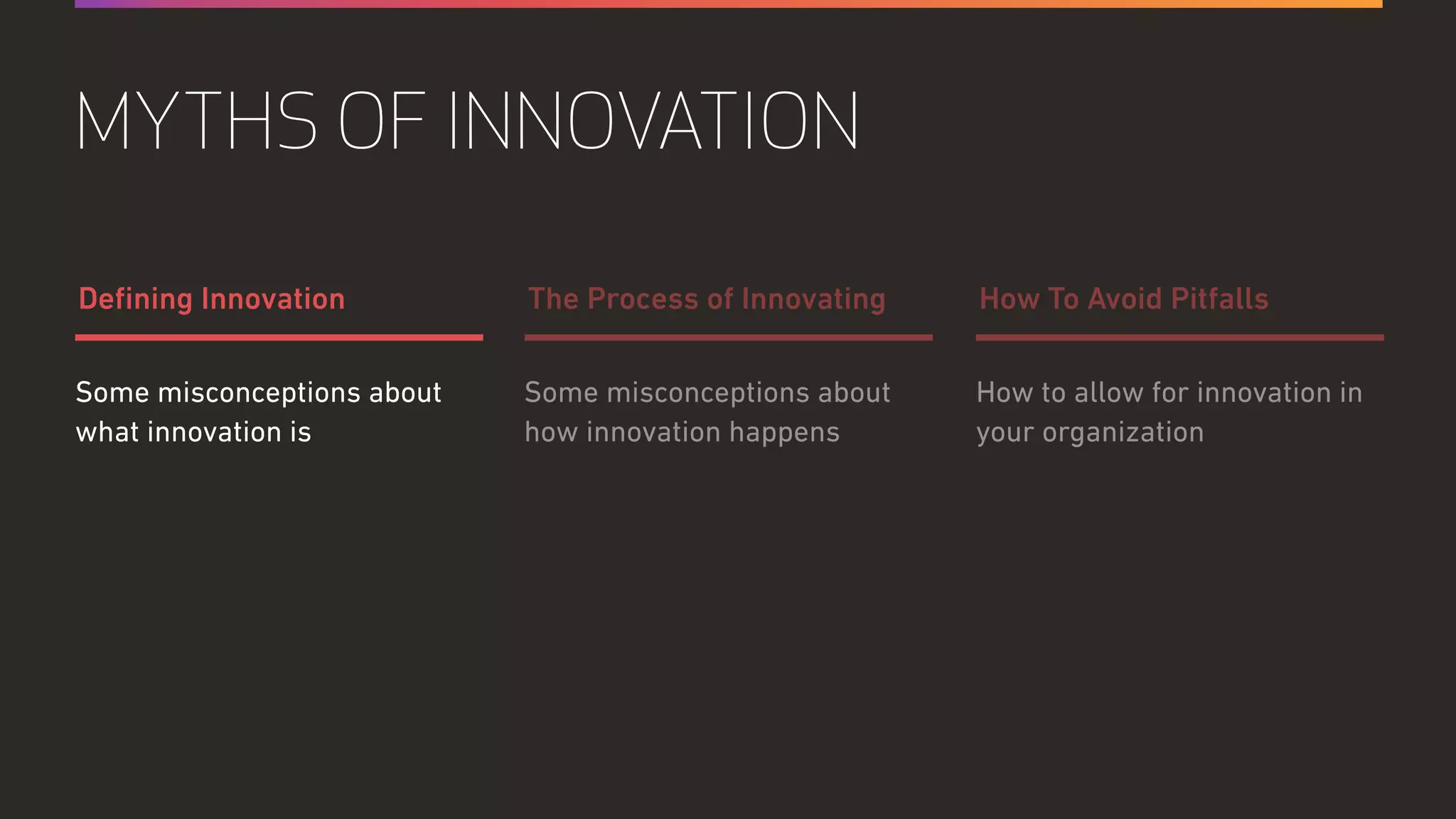
Some misconceptions about
how innovation happens
How to allow for innovation in
your organization
Some misconceptions about
what innovation is
The Process of Innovating How To Avoid PitfallsDefining Innovation
MYTHS OF INNOVATION
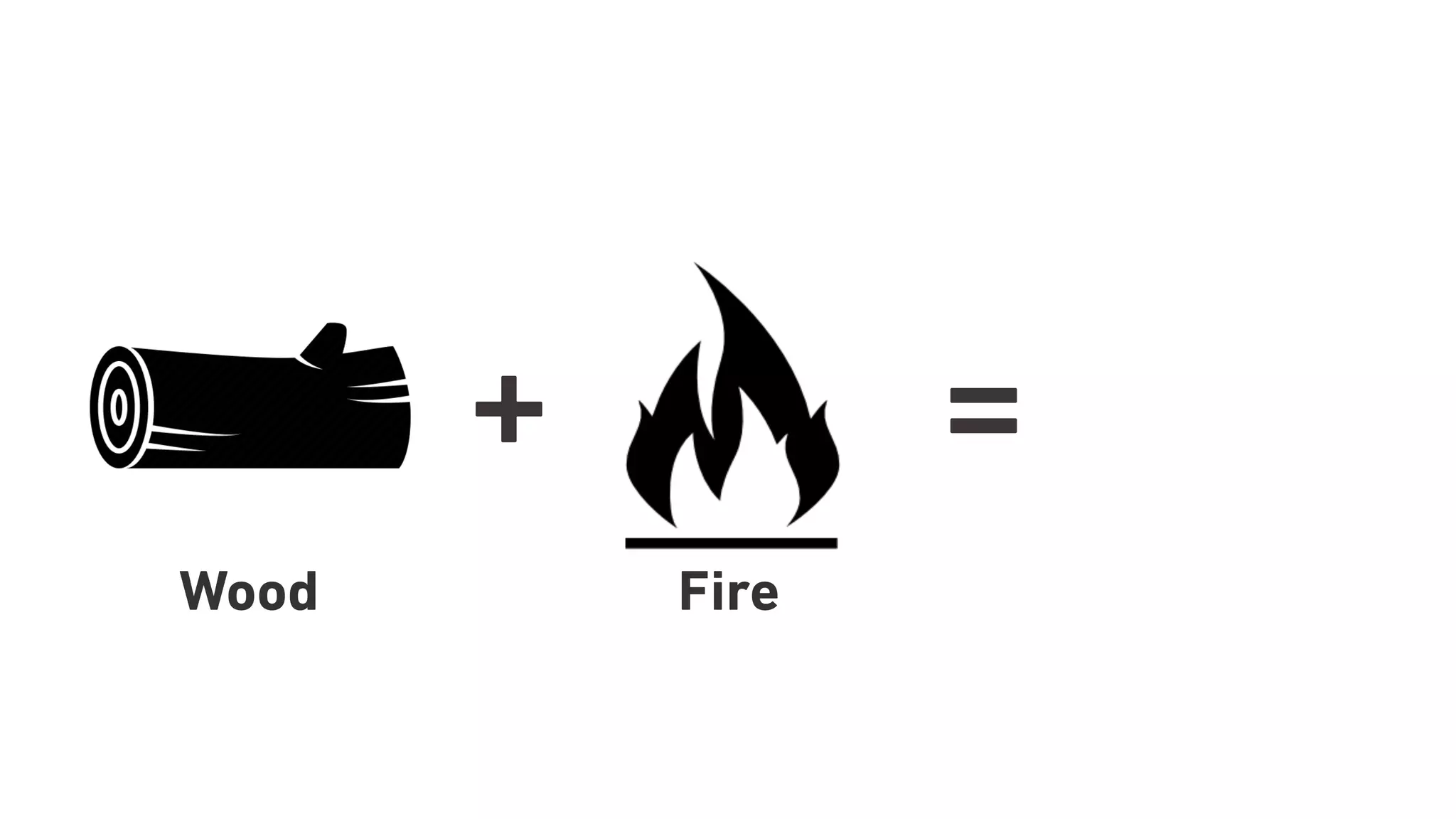
+ =
Wood Fire
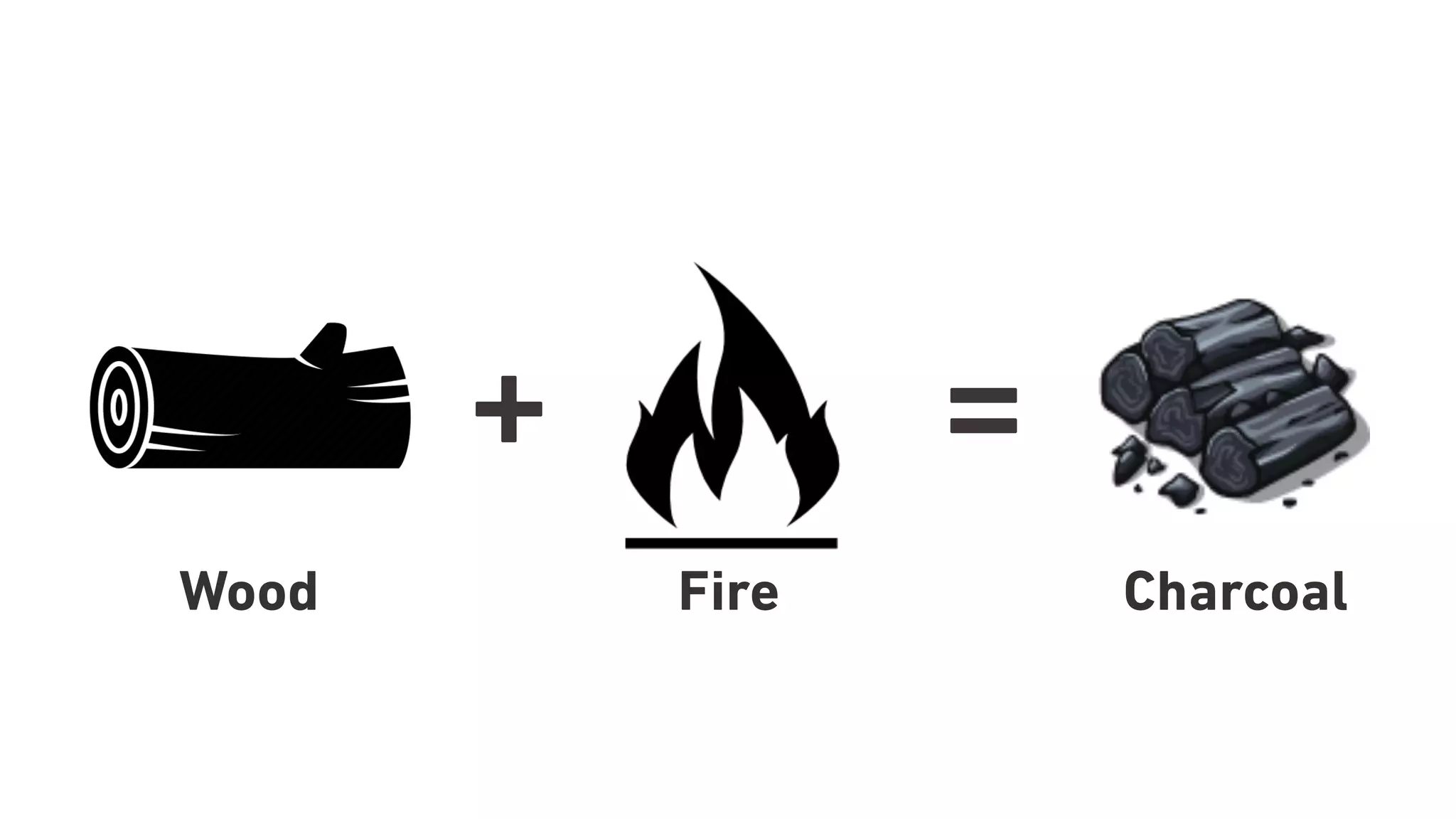
+ =
Wood Fire Charcoal
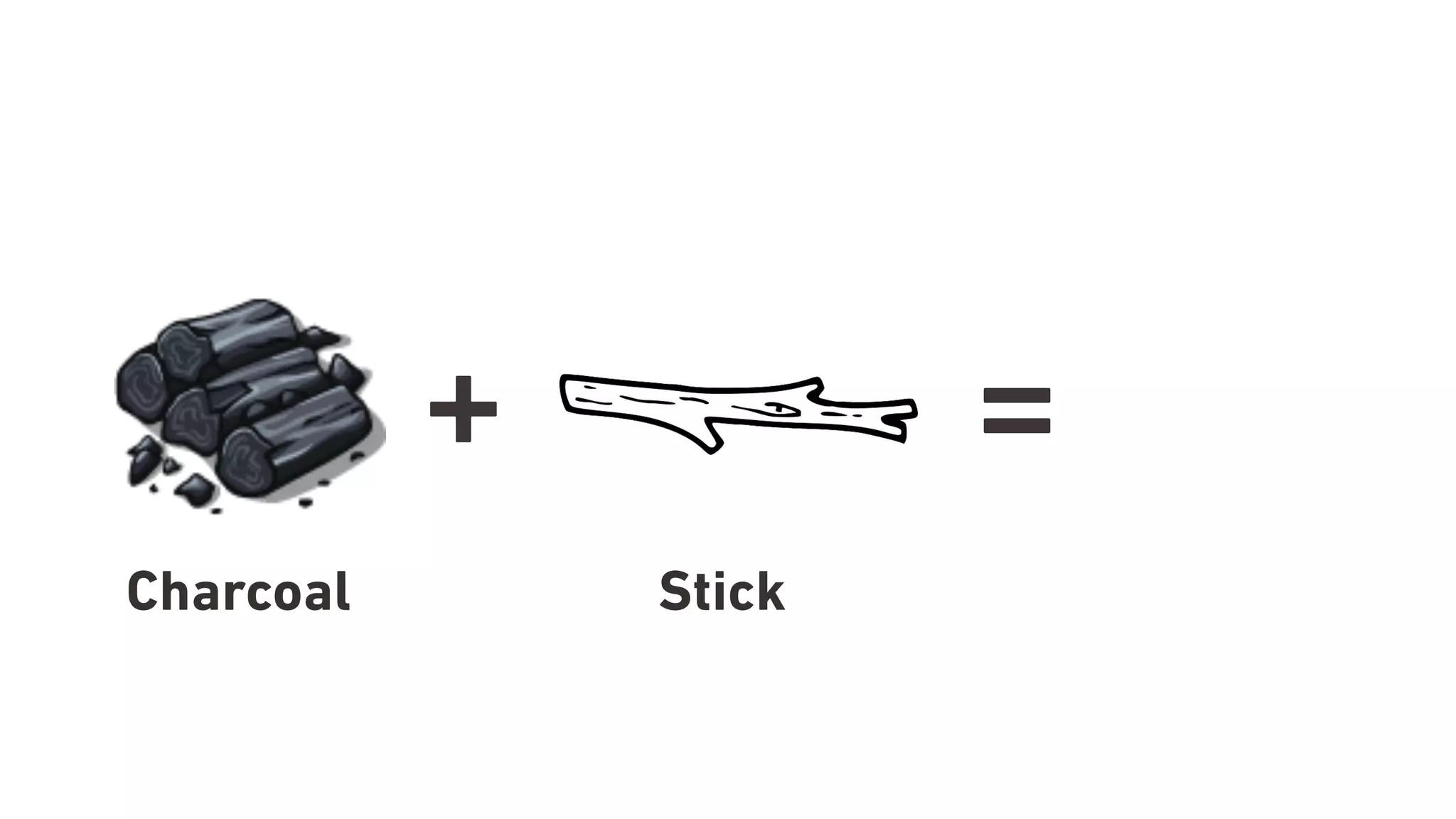
+ =
Charcoal Stick
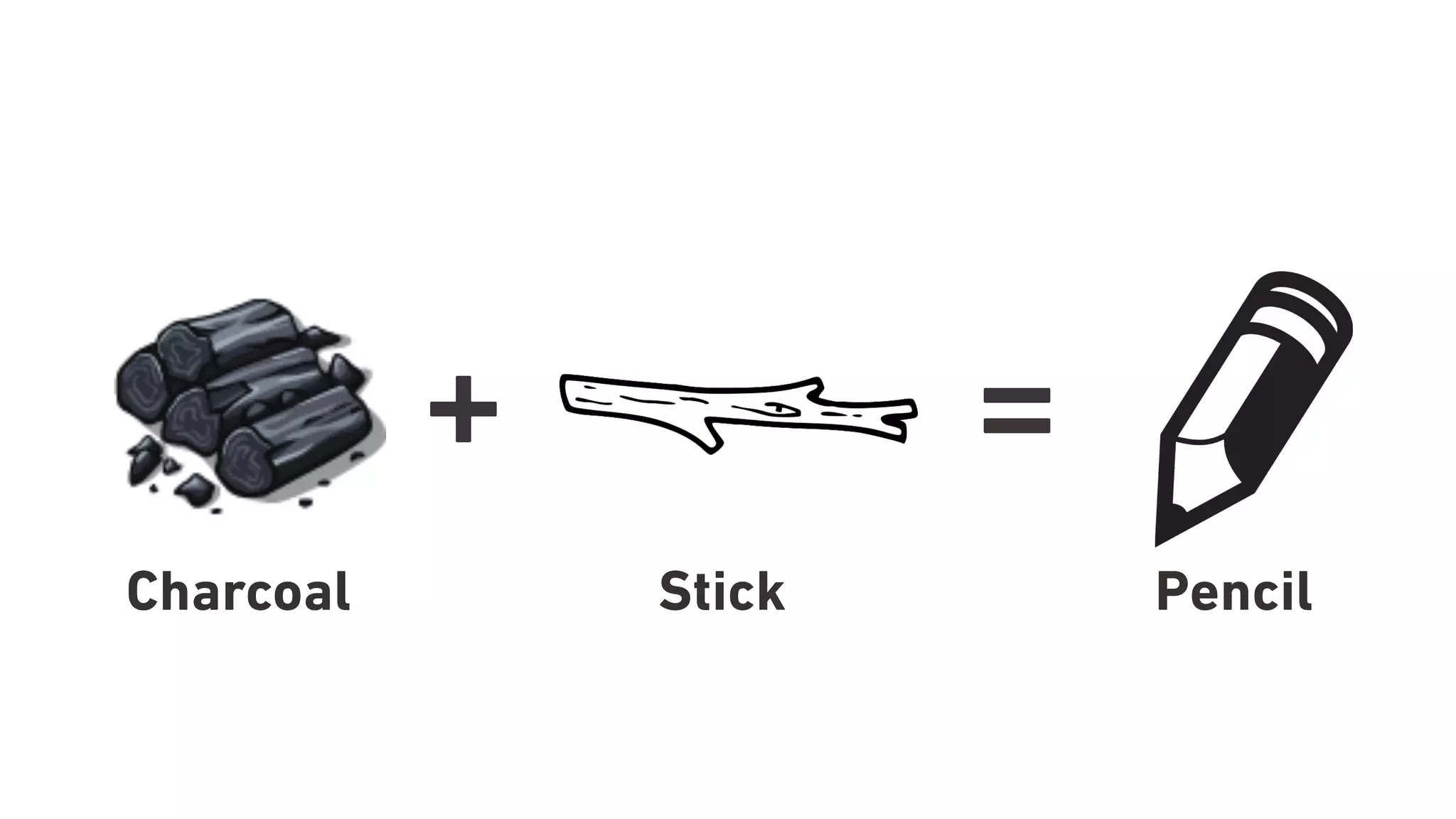
+ =
Charcoal Stick Pencil
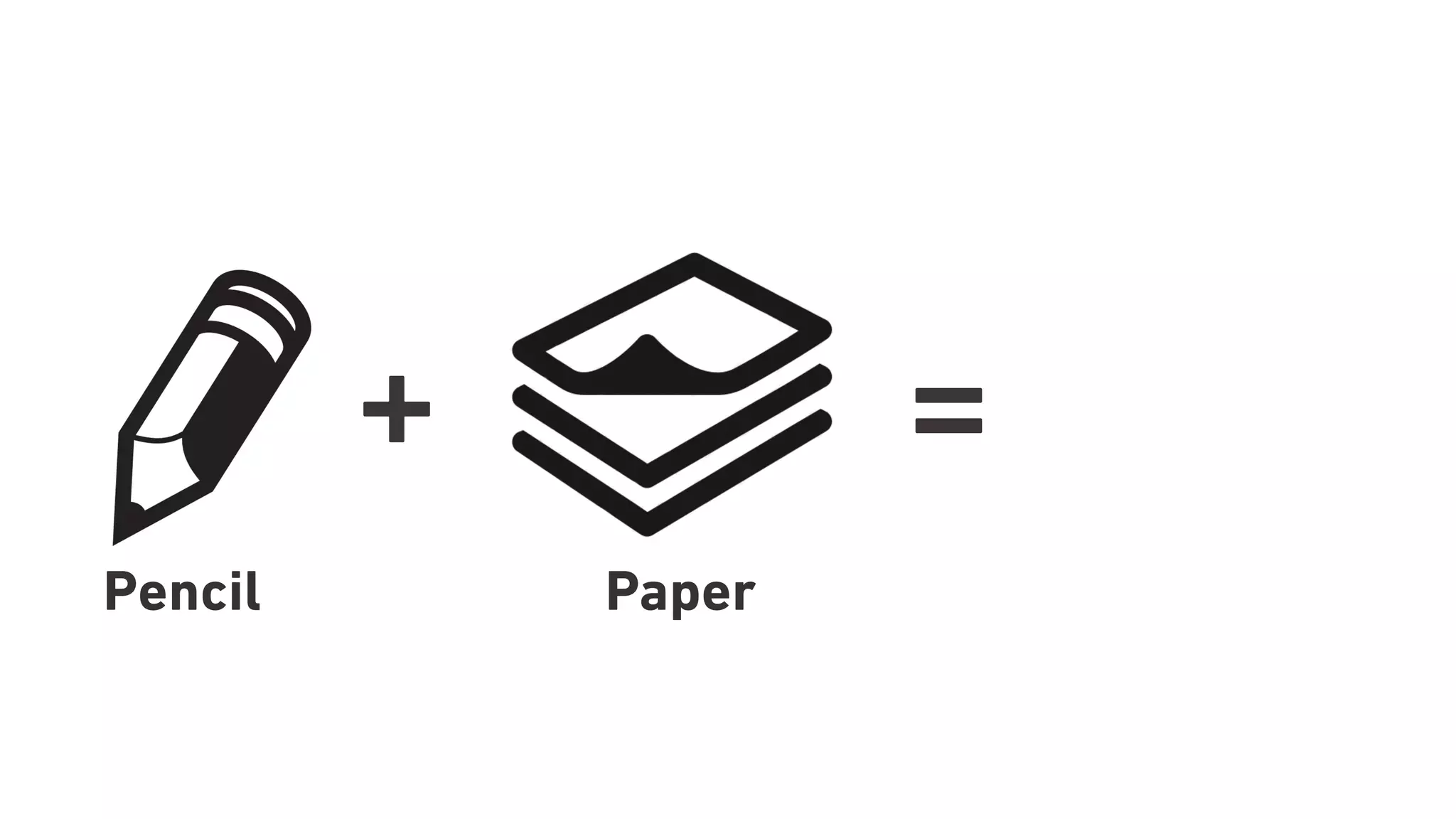
+ =
Pencil Paper
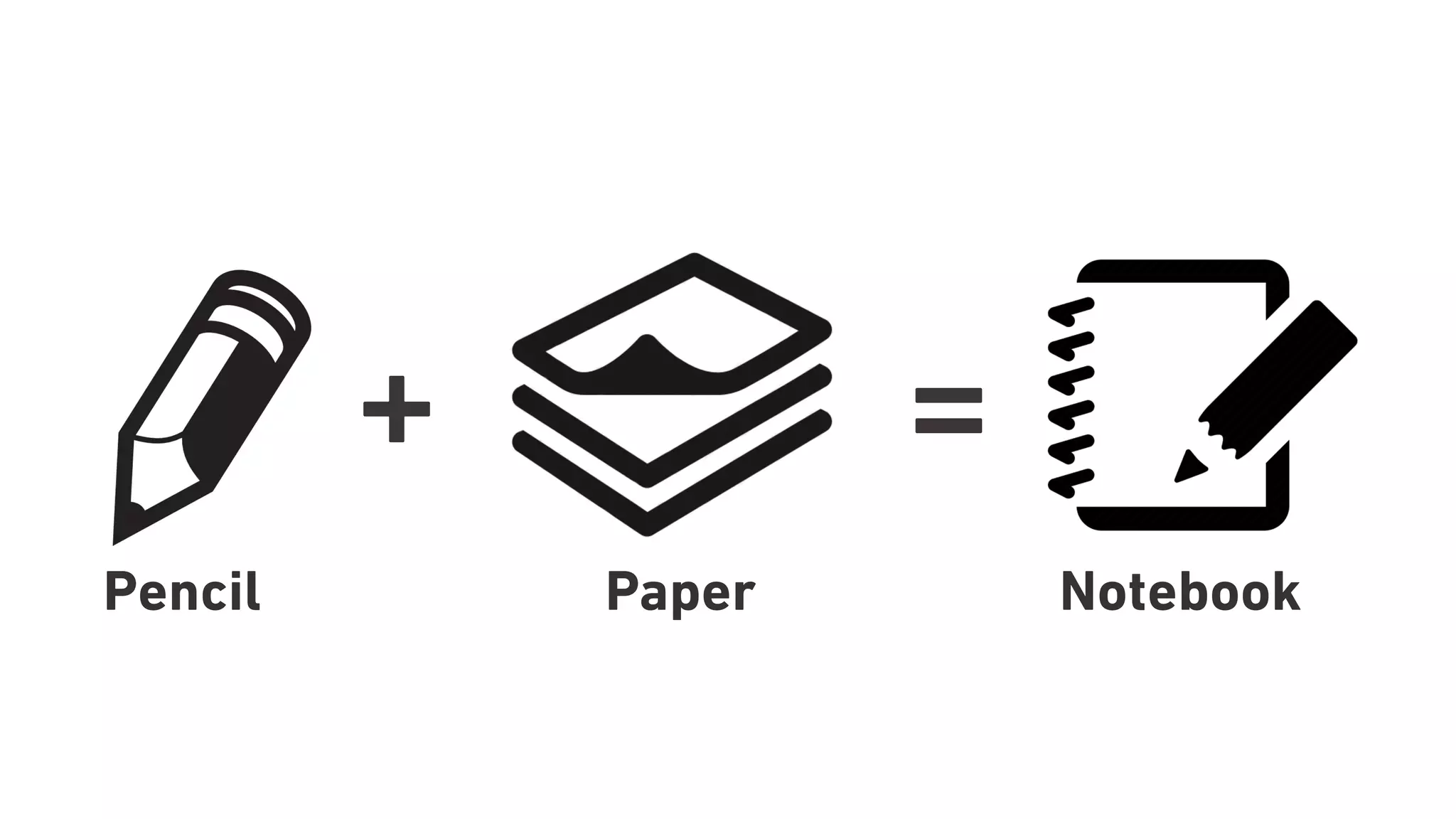
+ =
Pencil Paper Notebook
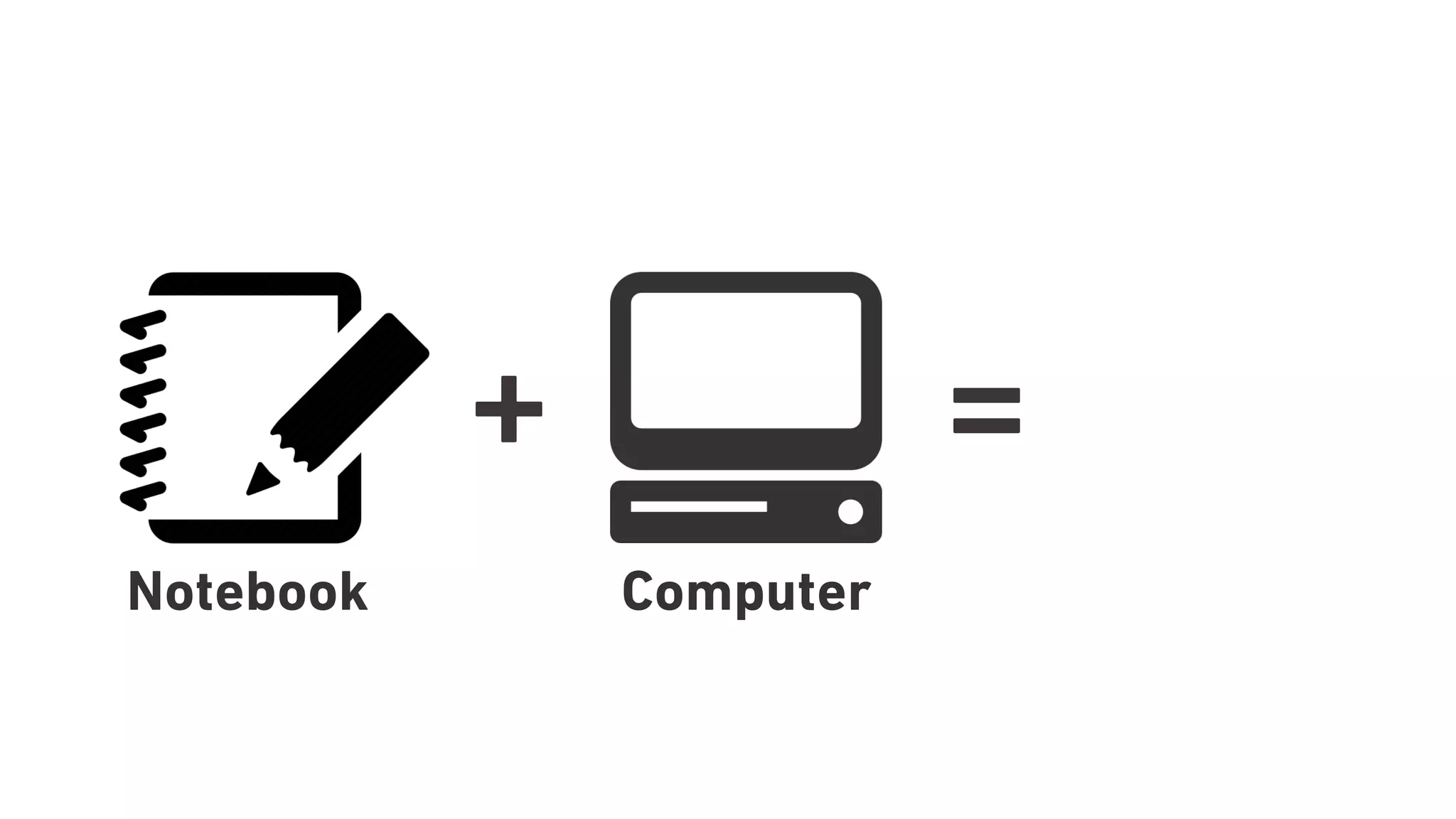
+ =
Notebook Computer
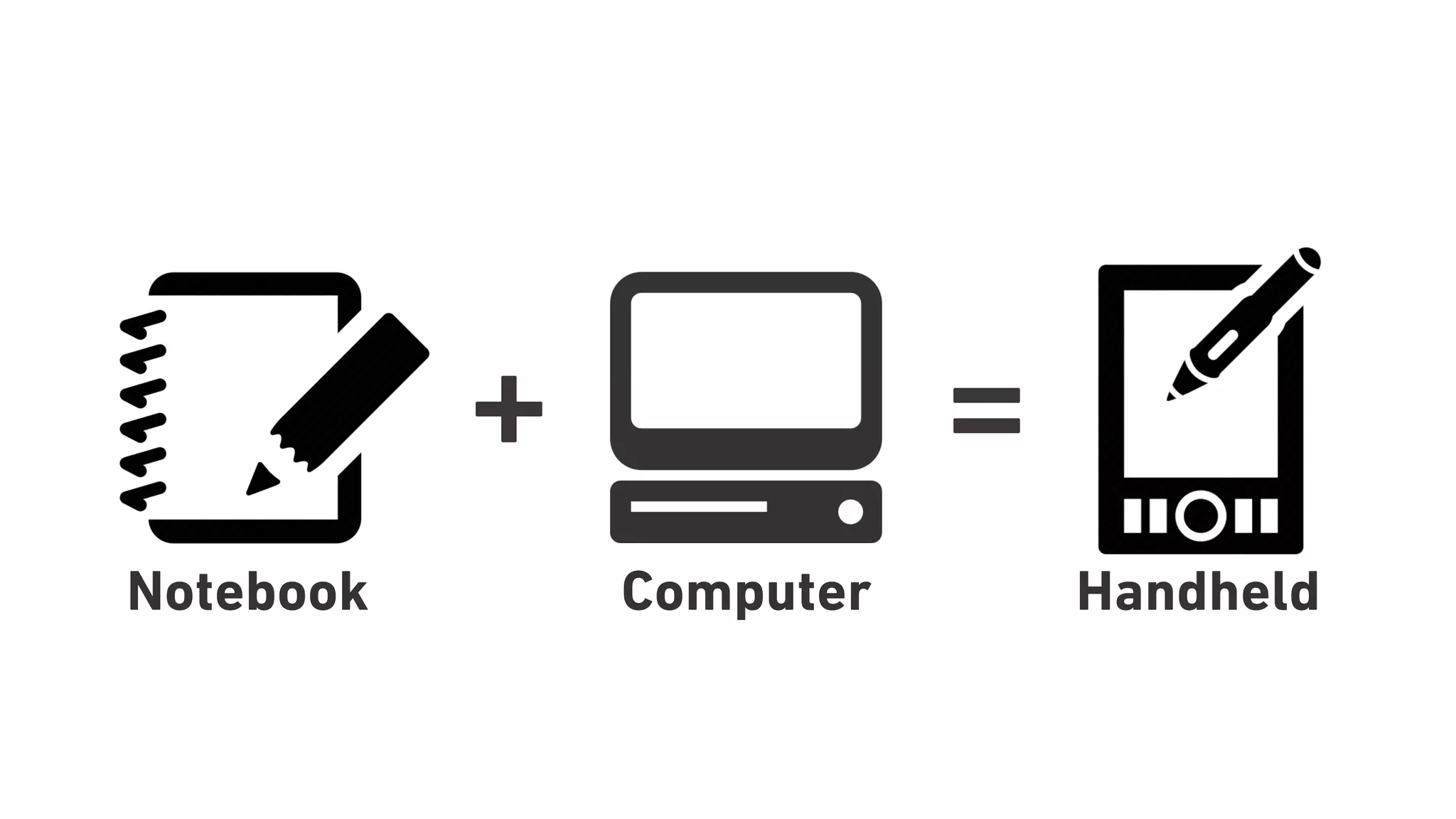
+ =
Notebook Computer Handheld
+ =
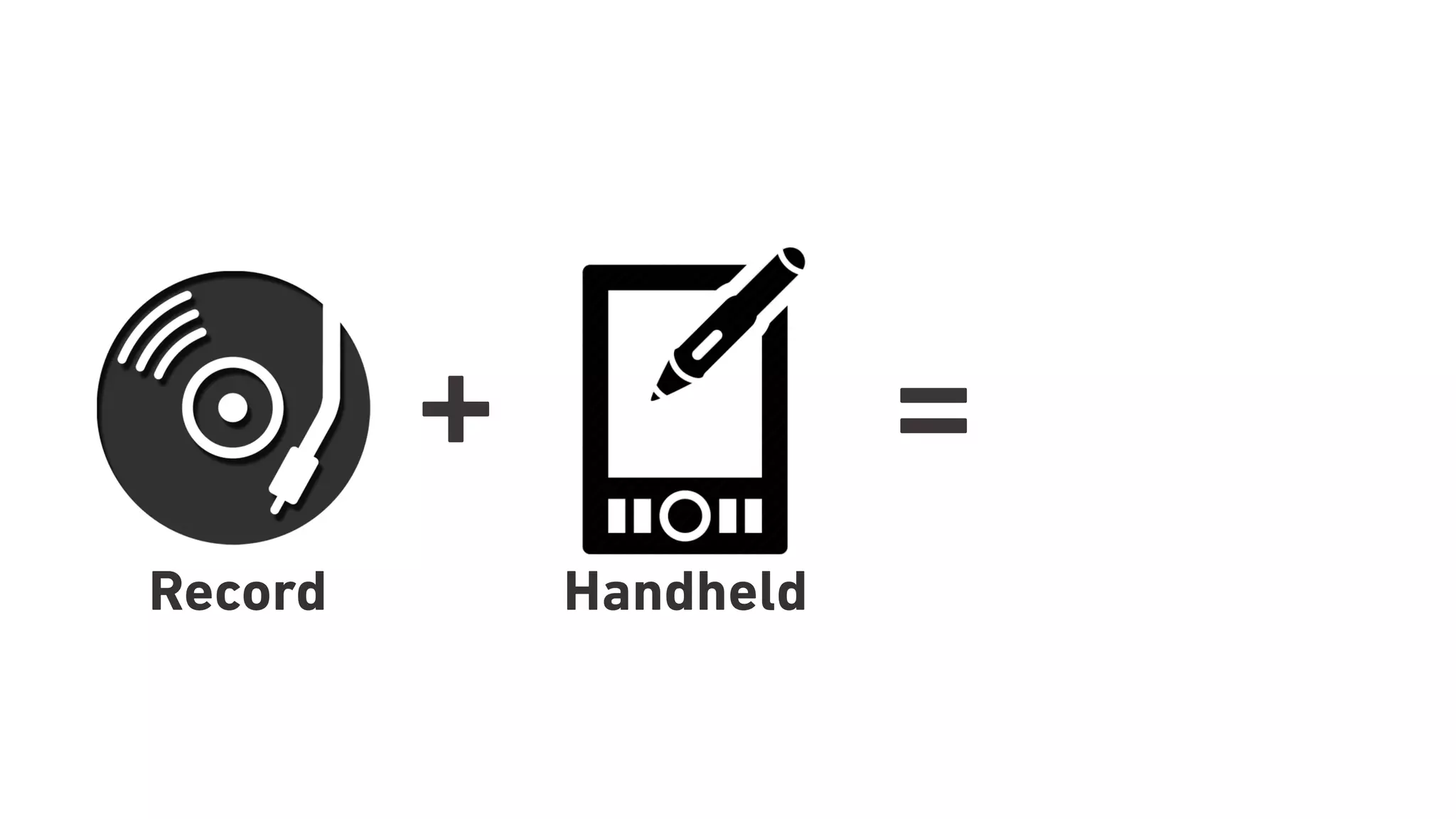
Record Handheld
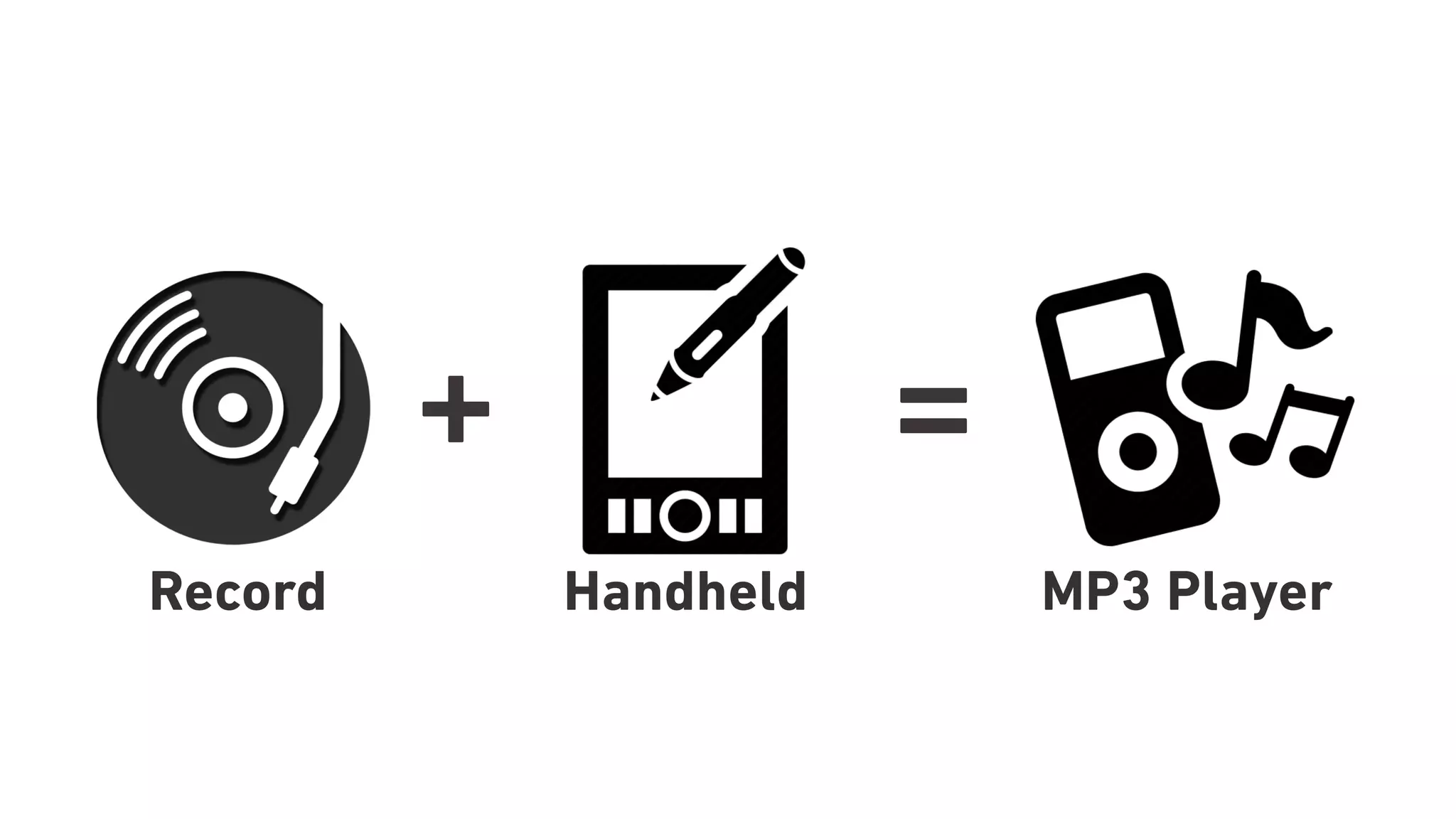
+ =
Record Handheld MP3 Player
+ =
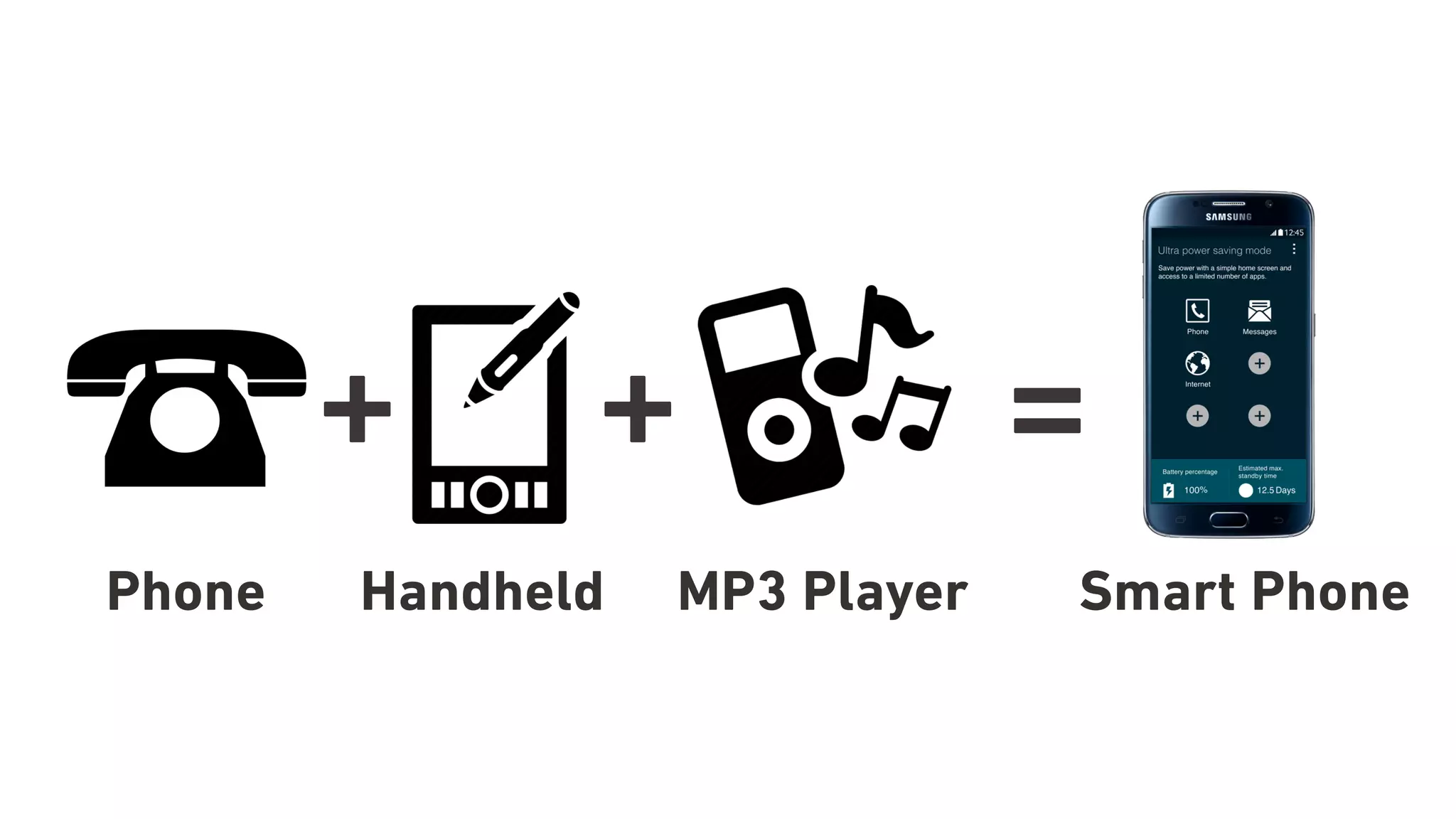
Phone Handheld
+
MP3 Player
+ =
Phone Handheld
+
MP3 Player Smart Phone
#1 Innovation is
new.
MYTH
Myth #1: Innovation Is…
NEW
Often, we think that to innovate is to come
up with something completely new. Most
innovation happens by process of
associating.
Associating, or the ability to successfully
connect seemingly unrelated questions,
problems, or ideas from different fields, is
central to the innovator’s DNA.
+
Innovation is
good.#2
MYTH
Myth #2: Innovation Is…
GOOD
When I lead a UX team at GE Healthcare, 

a large hospital network tapped us to
innovate on a medical coding and billing
application.
The problem: it was green screen.
Our job was, according to the CEO and product group, to bring the
coding and billing practice into the 21st century.
To the CEO this meant: make it look new.
To the product group this meant: make it best in class.
To the end-users this meant: ???
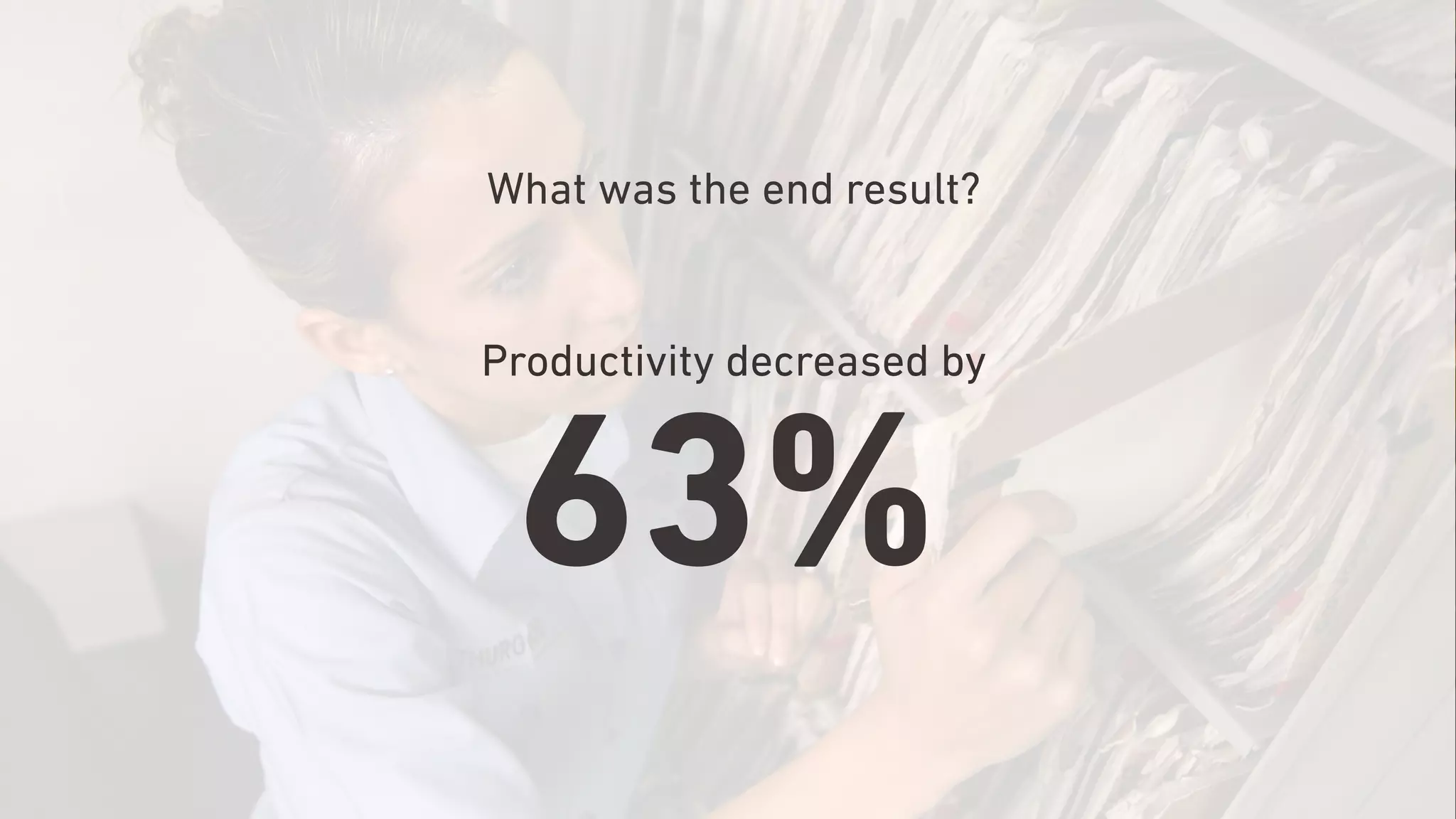
What was the end result?
63%
Productivity decreased by
Myth #2: Innovation Is…
GOOD
The whole story:
The green screen app had been honed by
end-users & the IT department for years to
deliver efficiency and optimal productivity.
End-users were not involved in “innovation”
effort (they we too busy working!), and the
results showed their lack of involvement.
For many reasons, this innovation project
failed miserably. The product—although it
looked old—worked well, and didn’t need
wholesale innovation.
#3
MYTH
Innovation is
product.
Myth #3: Innovation Is…
PRODUCT
When people think of innovation today, they
usually think of big technology companies.
Innovation has become synonymous with
their new hardware and software
technologies.
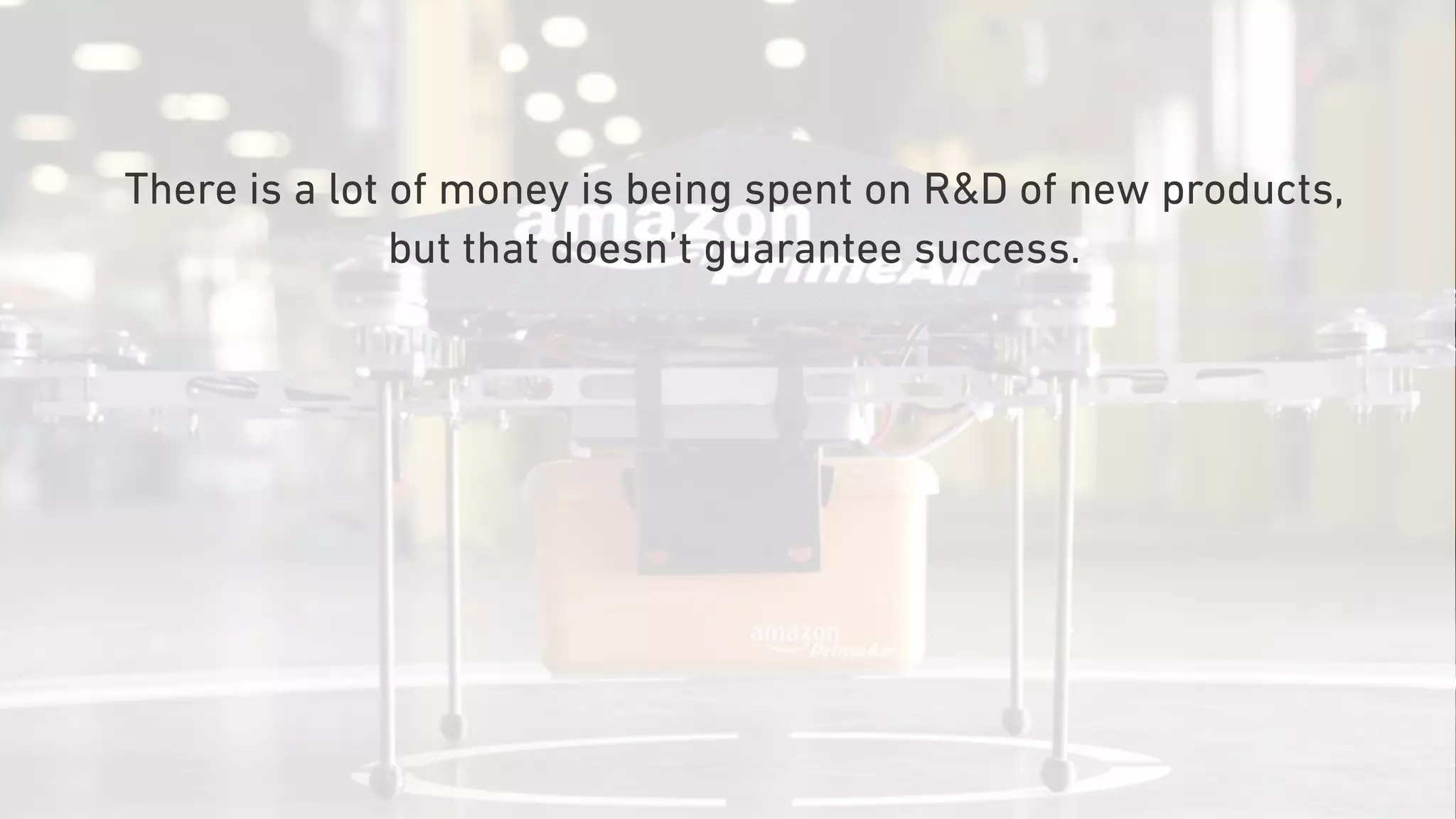
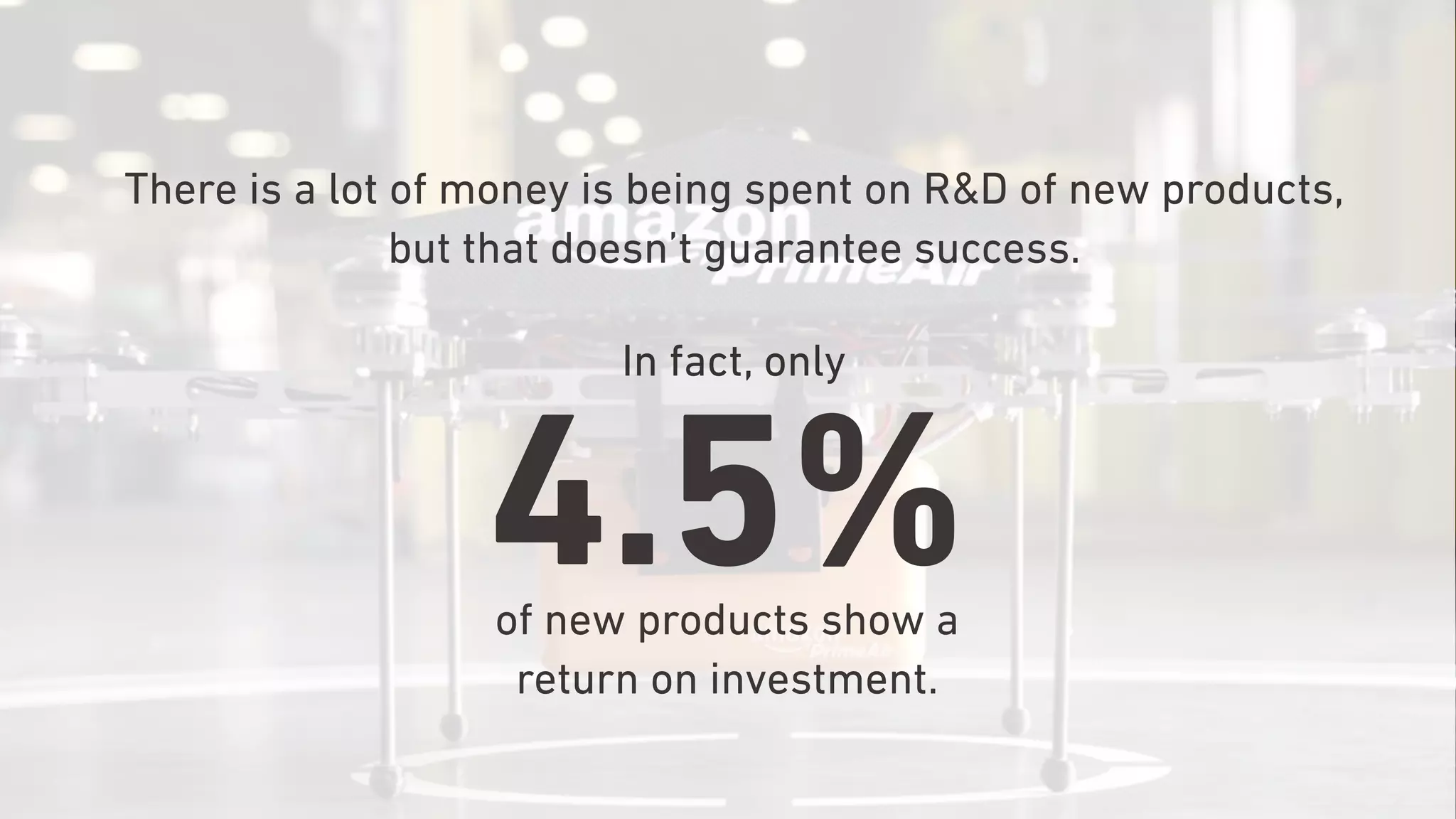
There is a lot of money is being spent on R&D of new products,
but that doesn’t guarantee success.
There is a lot of money is being spent on R&D of new products,
but that doesn’t guarantee success.
4.5%of new products show a
return on investment.
In fact, only
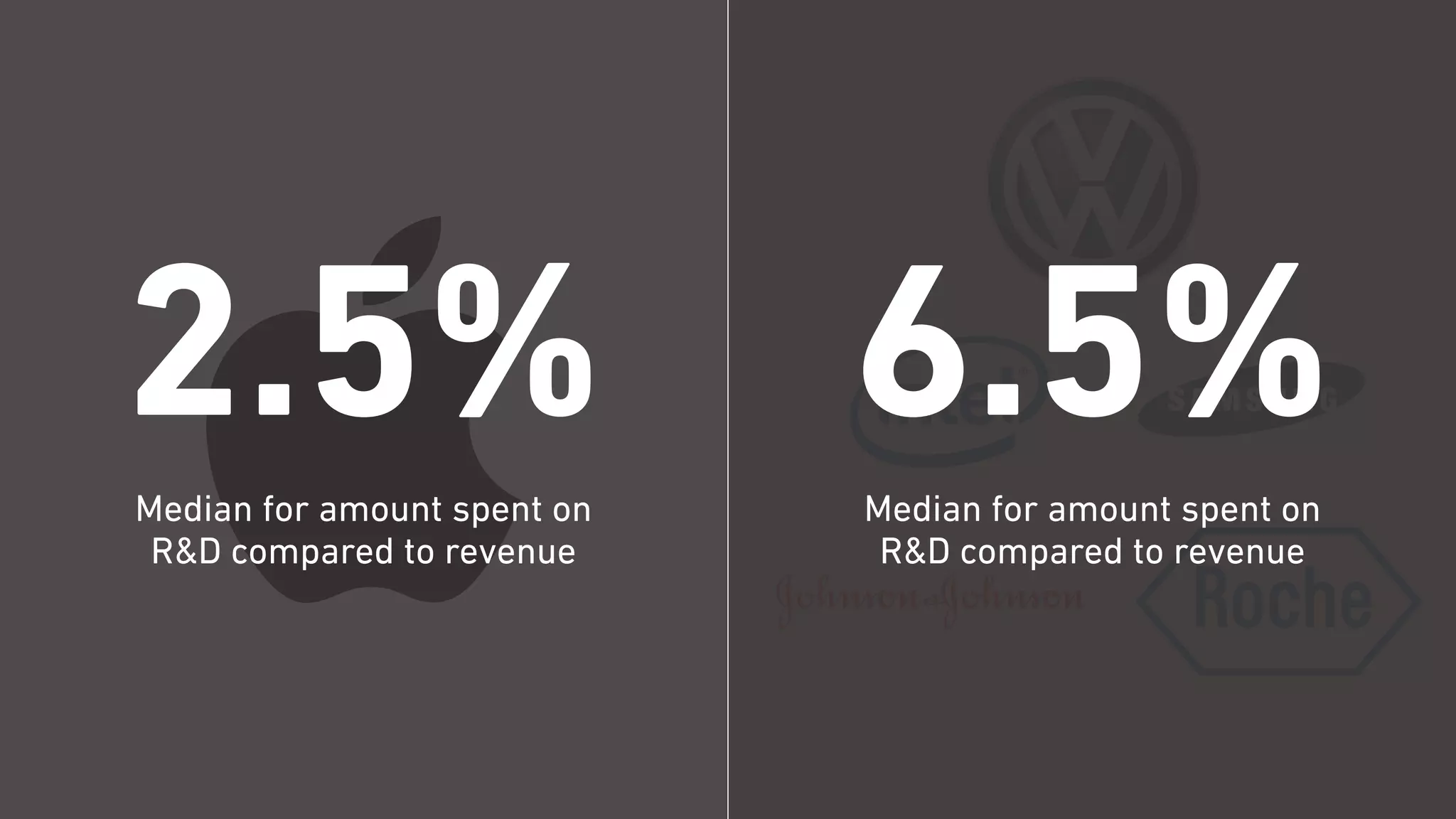
2.5%Median for amount spent on
R&D compared to revenue
6.5%Median for amount spent on
R&D compared to revenue
Myth #3: Innovation Is…
PRODUCT
Developing products is often not the most
effective way to innovate.
Some companies choose to focus their
innovative efforts on process and culture.
A great example of this is Zappos.
5Weeks of Customer
Service training for
EVERY employee
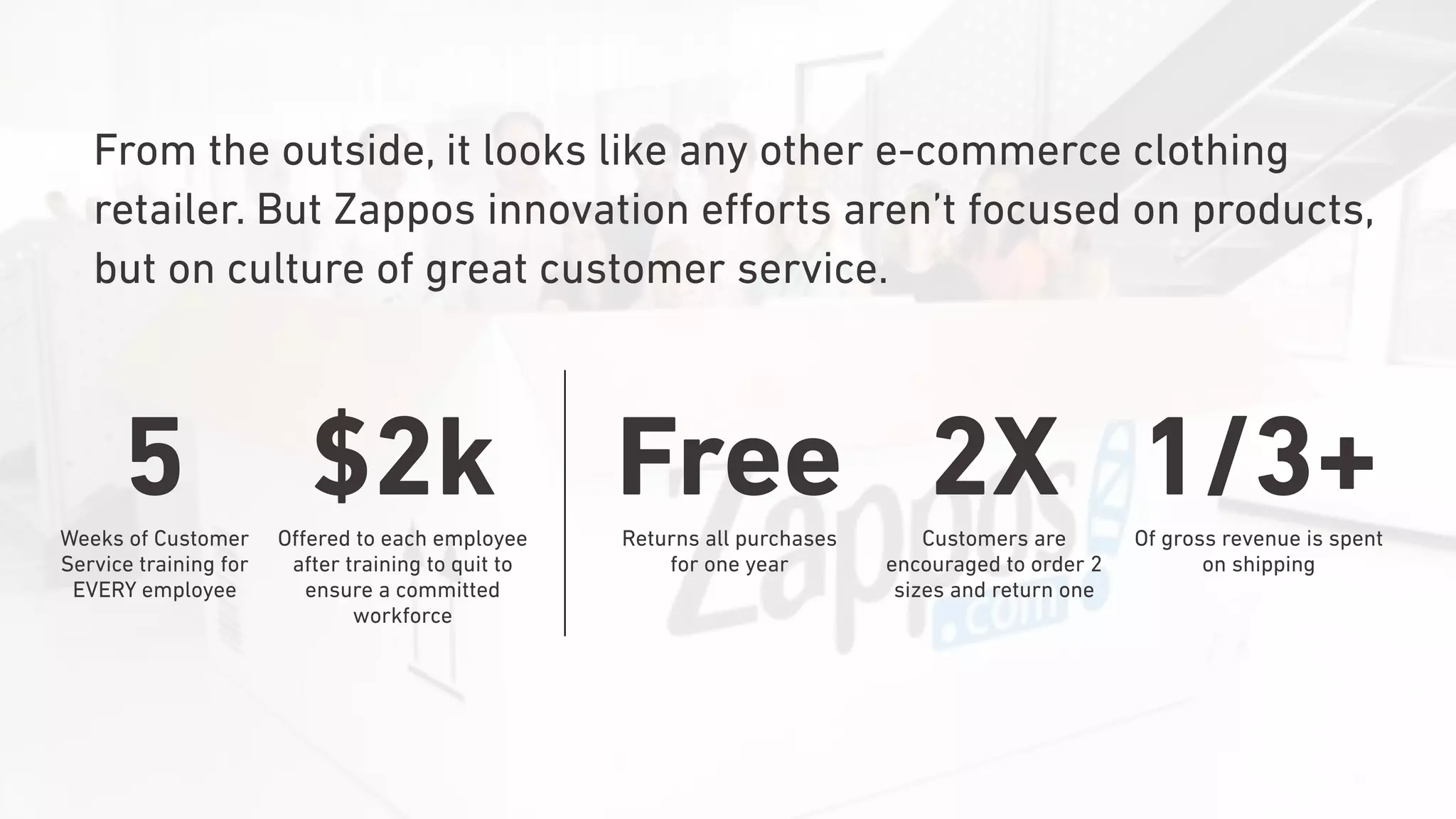
From the outside, it looks like any other e-commerce clothing
retailer. But Zappos innovation efforts aren’t focused on products,
but on culture of great customer service.
$2kOffered to each employee
after training to quit to
ensure a committed
workforce
FreeReturns all purchases 

for one year
2XCustomers are
encouraged to order 2
sizes and return one
1/3+Of gross revenue is spent
on shipping
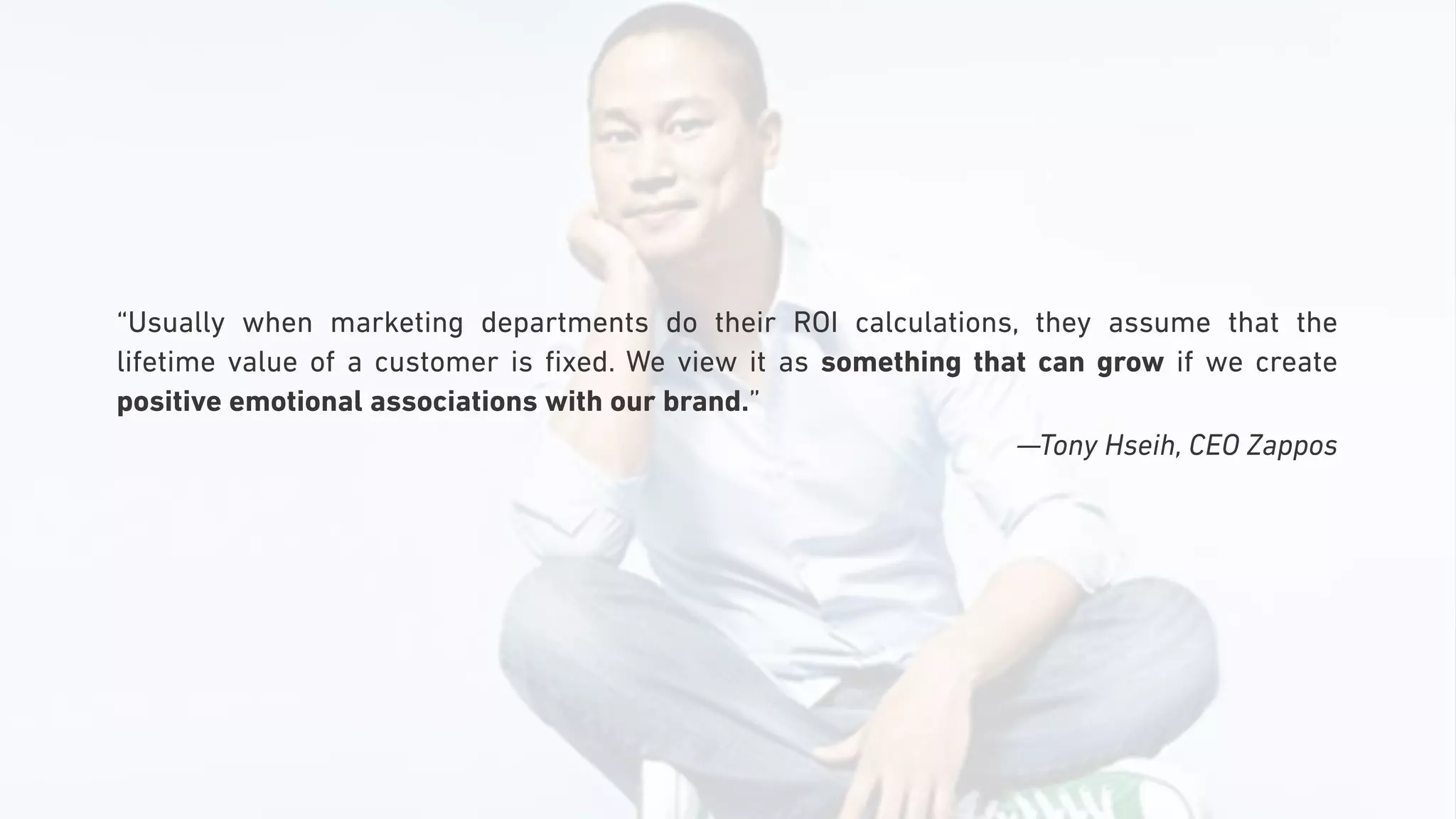
“Usually when marketing departments do their ROI calculations, they assume that the
lifetime value of a customer is fixed. We view it as something that can grow if we create
positive emotional associations with our brand.”
—Tony Hseih, CEO Zappos
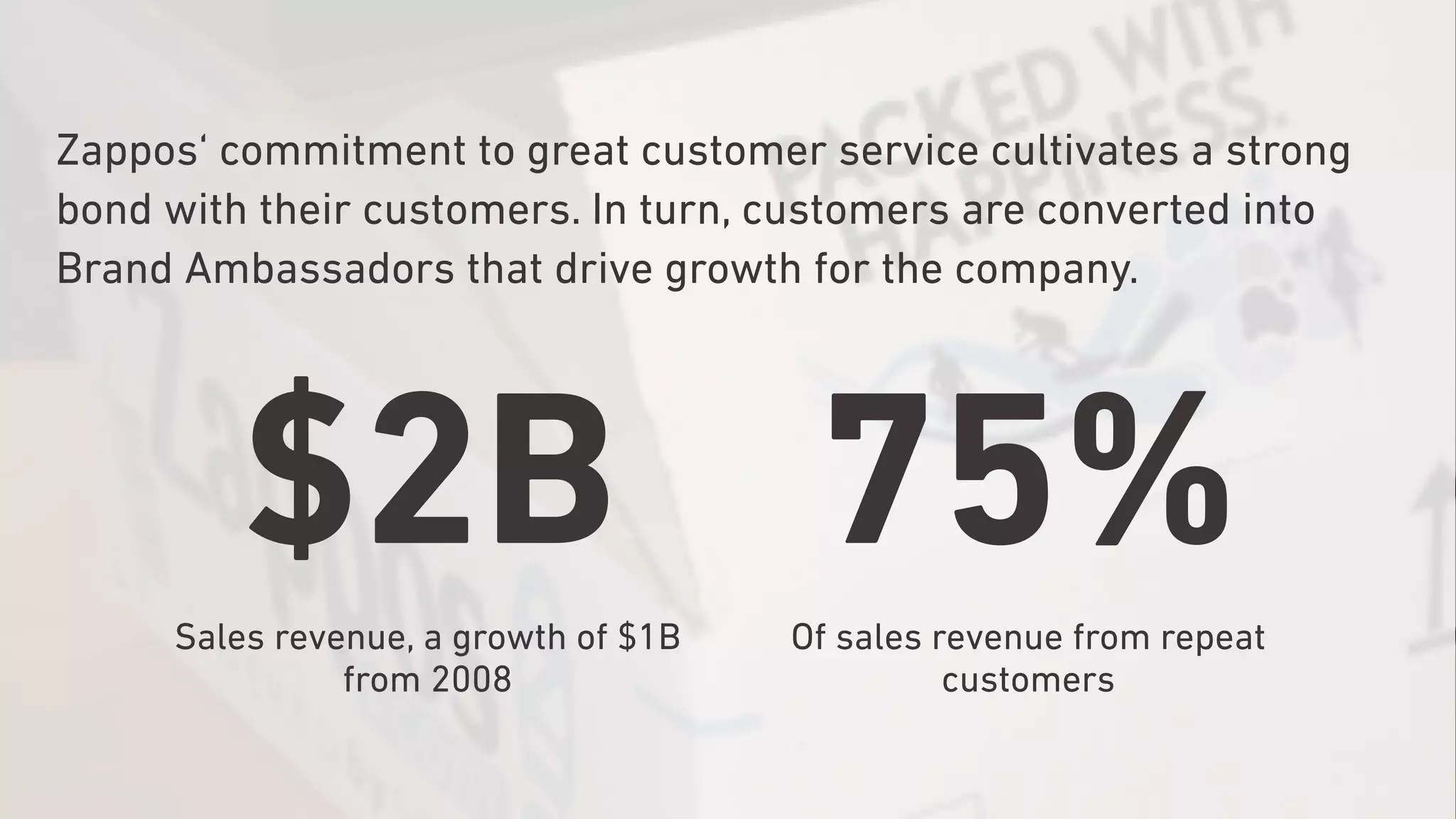
Zappos‘ commitment to great customer service cultivates a strong
bond with their customers. In turn, customers are converted into
Brand Ambassadors that drive growth for the company.
$2BSales revenue, a growth of $1B
from 2008
75%Of sales revenue from repeat
customers
Myth #3: Innovation Is…
PRODUCT
Its a common pitfall to measure successful
innovation only in regards to new products
and technologies. Innovation more often
means:
— Creating better customer experiences
— Improving internal processes
— Creating a culture driven organization
— Establishing a values-driven brand
— Experimenting with new business
models
Some misconceptions about
how innovation happens
How to allow for innovation in
your organization
Some misconceptions about
what innovation is
The Process of Innovating How To Avoid PitfallsDefining Innovation
MYTHS OF INNOVATION
#4
MYTH
The “Lone

Genius.”
Myth #4: The “Lone Genius”
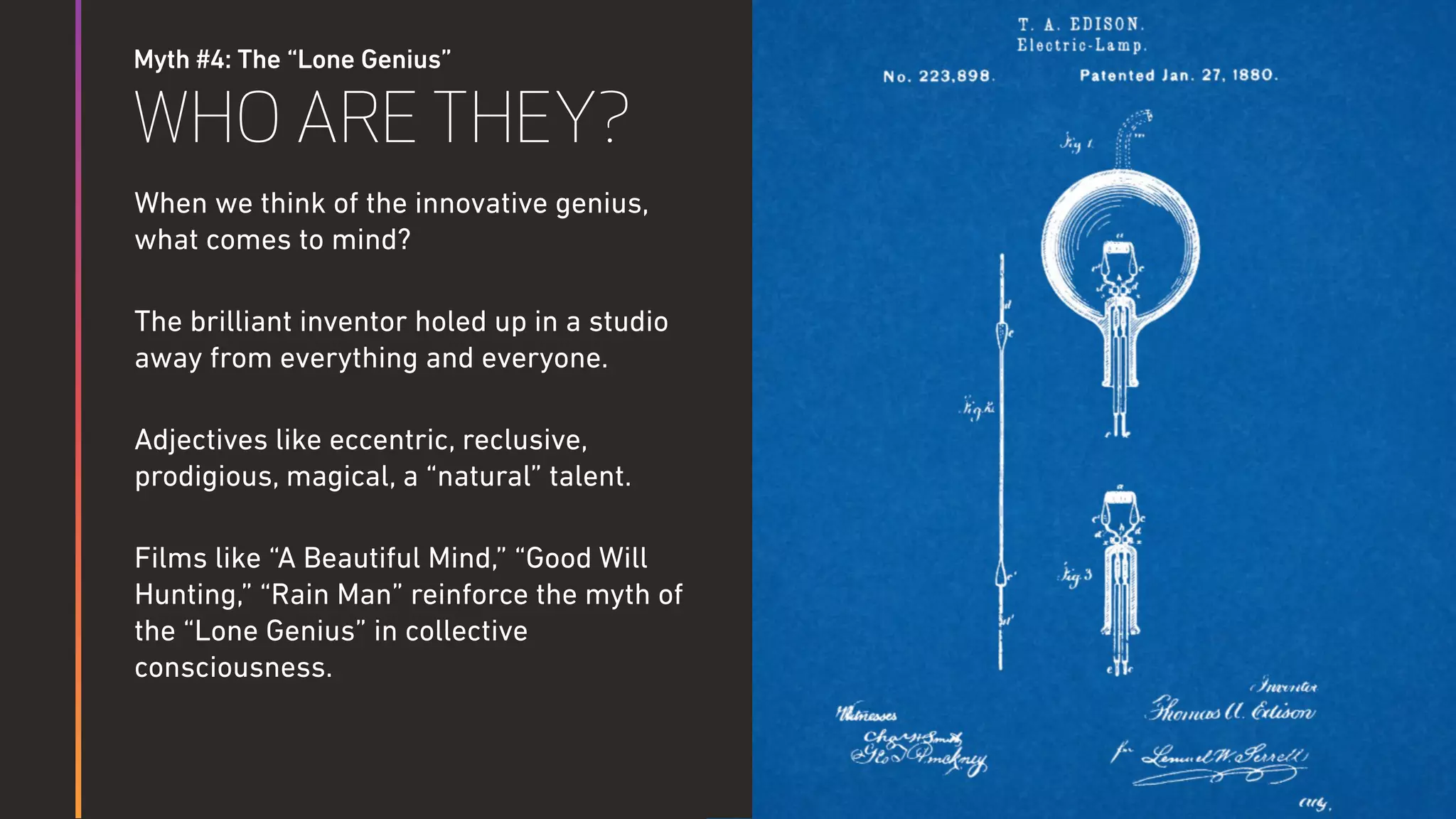
WHO ARE THEY?
When we think of the innovative genius,
what comes to mind?
The brilliant inventor holed up in a studio
away from everything and everyone.
Adjectives like eccentric, reclusive,
prodigious, magical, a “natural” talent.
Films like “A Beautiful Mind,” “Good Will
Hunting,” “Rain Man” reinforce the myth of
the “Lone Genius” in collective
consciousness.
Myth #4: The “Lone Genius”
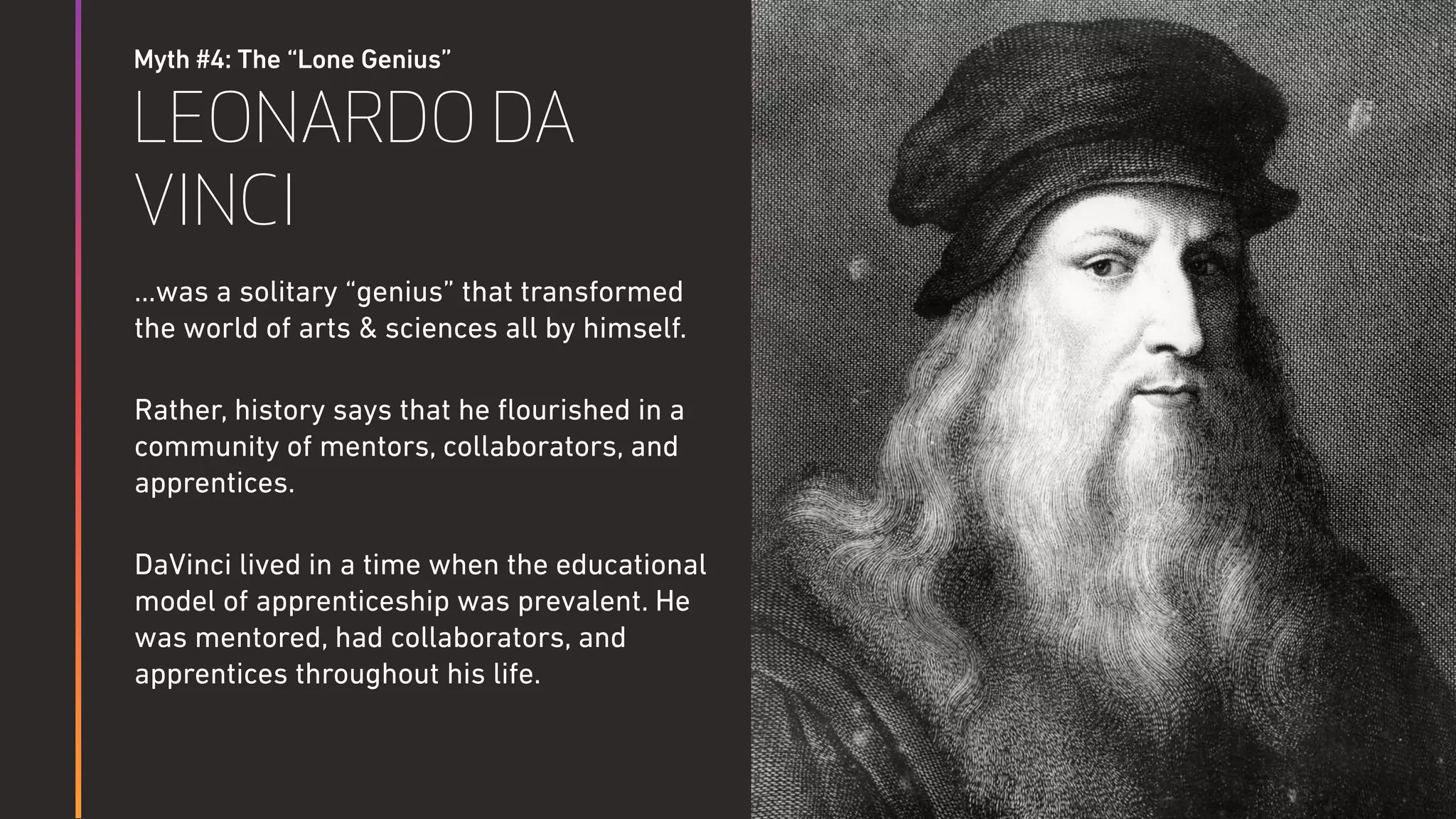
LEONARDO DA
VINCI
…was a solitary “genius” that transformed
the world of arts & sciences all by himself.
Rather, history says that he flourished in a
community of mentors, collaborators, and
apprentices.
DaVinci lived in a time when the educational
model of apprenticeship was prevalent. He
was mentored, had collaborators, and
apprentices throughout his life.
Entrepreneur Frans Johansson described [the birth of the Renaissance] as the Medici effect, referring
to the creative explosion in Florence when the Medici family brought together people from a wide
range of disciplines—sculptors, scientists, poets, philosophers, painters, and architects. As these
individuals connected, new ideas blossomed at the intersections of their respective fields, thereby
spawning the Renaissance, one of the most inventive eras in history.
—The Innovator’s DNA, Harvard Business Review
DaVinci’s Vitruvian Man
Myth #4: The “Lone Genius”
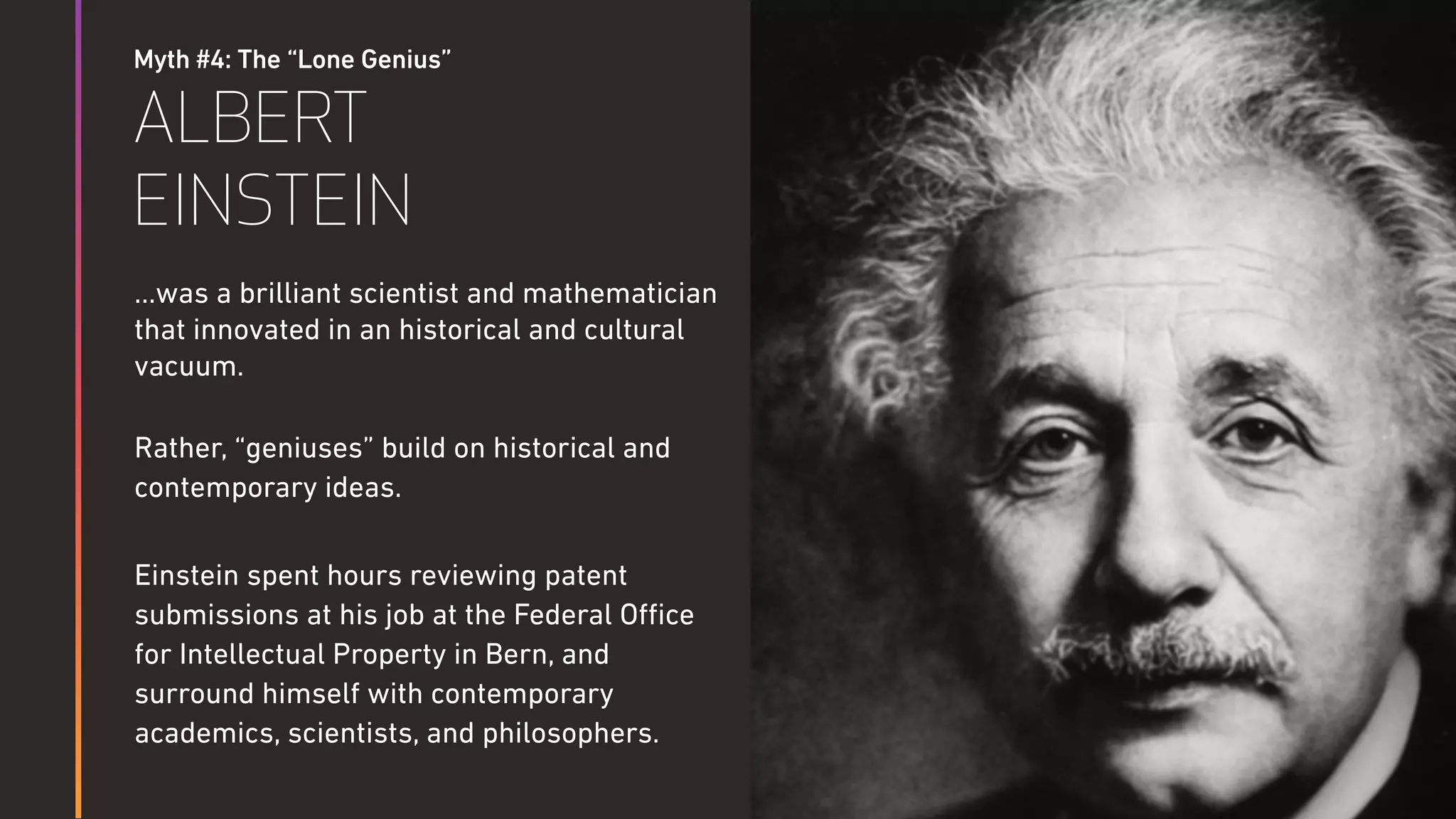
ALBERT
EINSTEIN
…was a brilliant scientist and mathematician
that innovated in an historical and cultural
vacuum.
Rather, “geniuses” build on historical and
contemporary ideas.
Einstein spent hours reviewing patent
submissions at his job at the Federal Office
for Intellectual Property in Bern, and
surround himself with contemporary
academics, scientists, and philosophers.
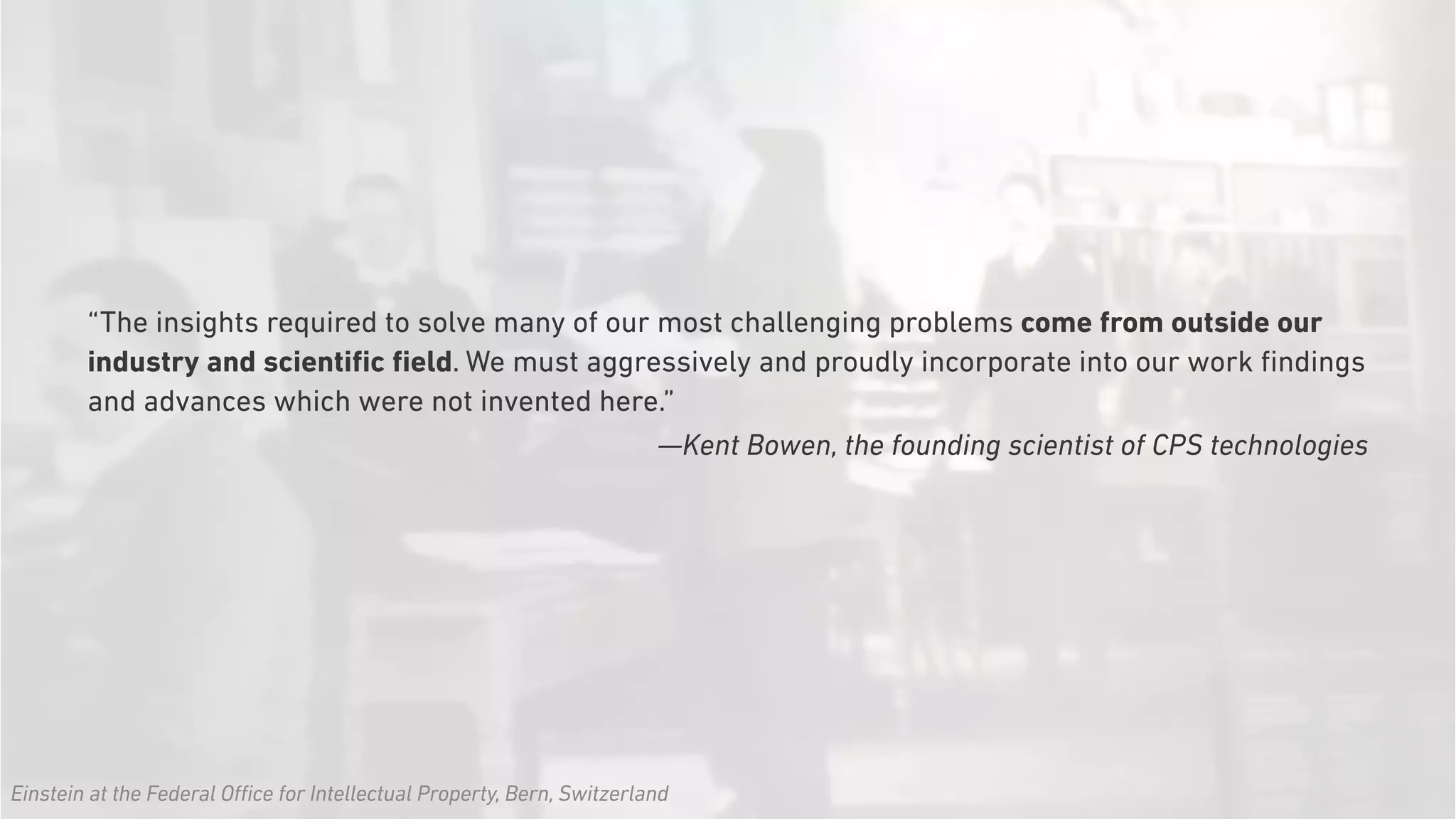
“The insights required to solve many of our most challenging problems come from outside our
industry and scientific field. We must aggressively and proudly incorporate into our work findings
and advances which were not invented here.”
—Kent Bowen, the founding scientist of CPS technologies
Einstein at the Federal Office for Intellectual Property, Bern, Switzerland
Myth #4: The “Lone Genius”
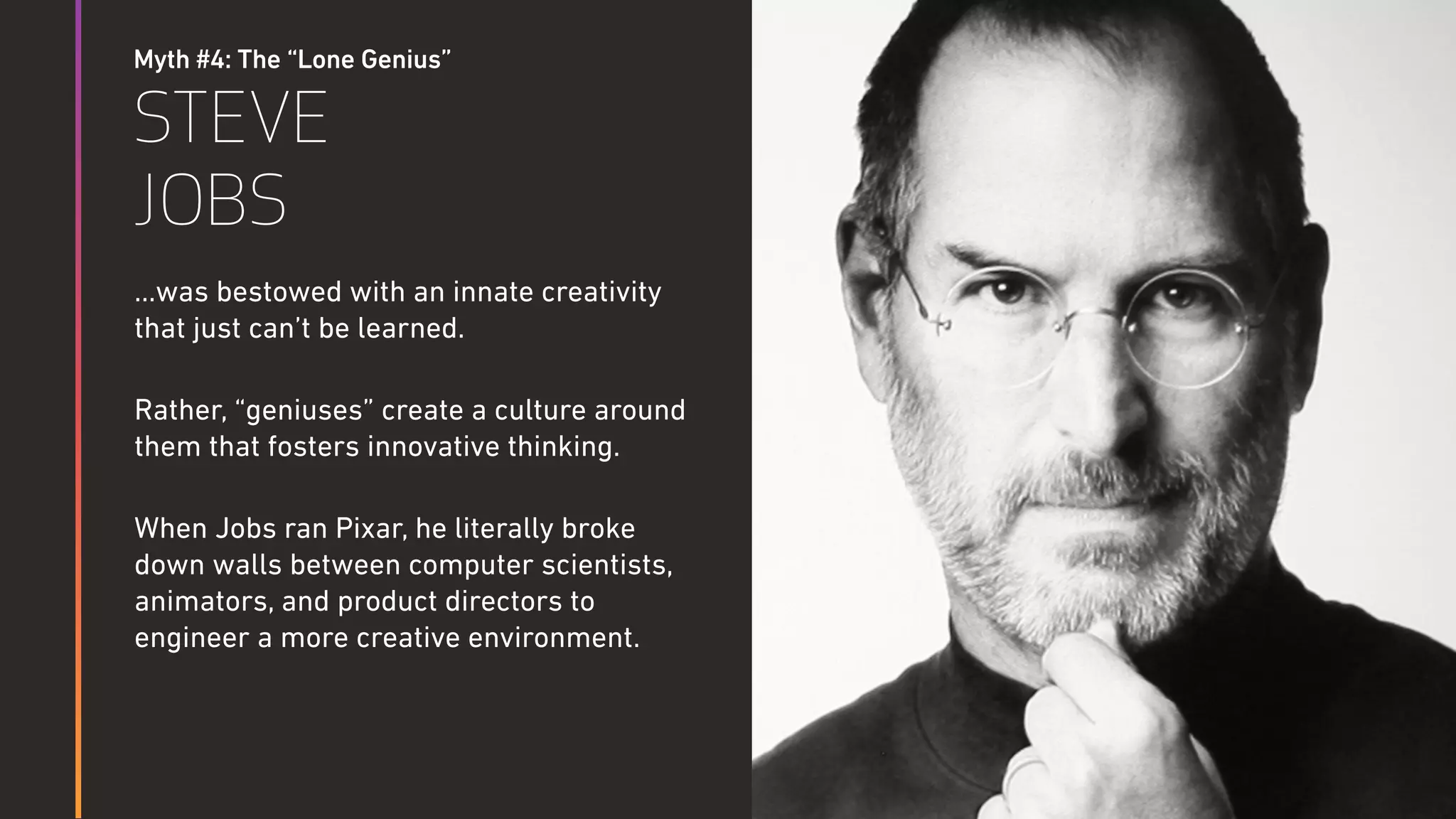
STEVE
JOBS
…was bestowed with an innate creativity
that just can’t be learned.
Rather, “geniuses” create a culture around
them that fosters innovative thinking.
When Jobs ran Pixar, he literally broke
down walls between computer scientists,
animators, and product directors to
engineer a more creative environment.
Steven Hawking
[Jobs] wanted there to be mixing. He knew that the human friction makes the sparks, and that
when you're talking about a creative endeavor that requires people from different cultures to
come together, you have to force them to mix; that our natural tendency is to stay isolated, to talk
to people who are just like us, who speak our private languages, who understand our problems.
But that's a big mistake.
—Jonah Lehrer, Author of Imagine: How Creativity Works
Apple Headquarters, Cupertino, CA
Myth #4: The “Lone Genius”
WHO ARE THEY,
REALLY?
While we may believe in the myth on the
“Lone Genius,” history tells us that:
“Geniuses” have a community of
mentors, collaborators, and apprentices.
“Geniuses” build on prior innovative
ideas.
“Geniuses” create a culture around them
that fosters innovative thinking.
If you build it,
they will come.#5
MYTH
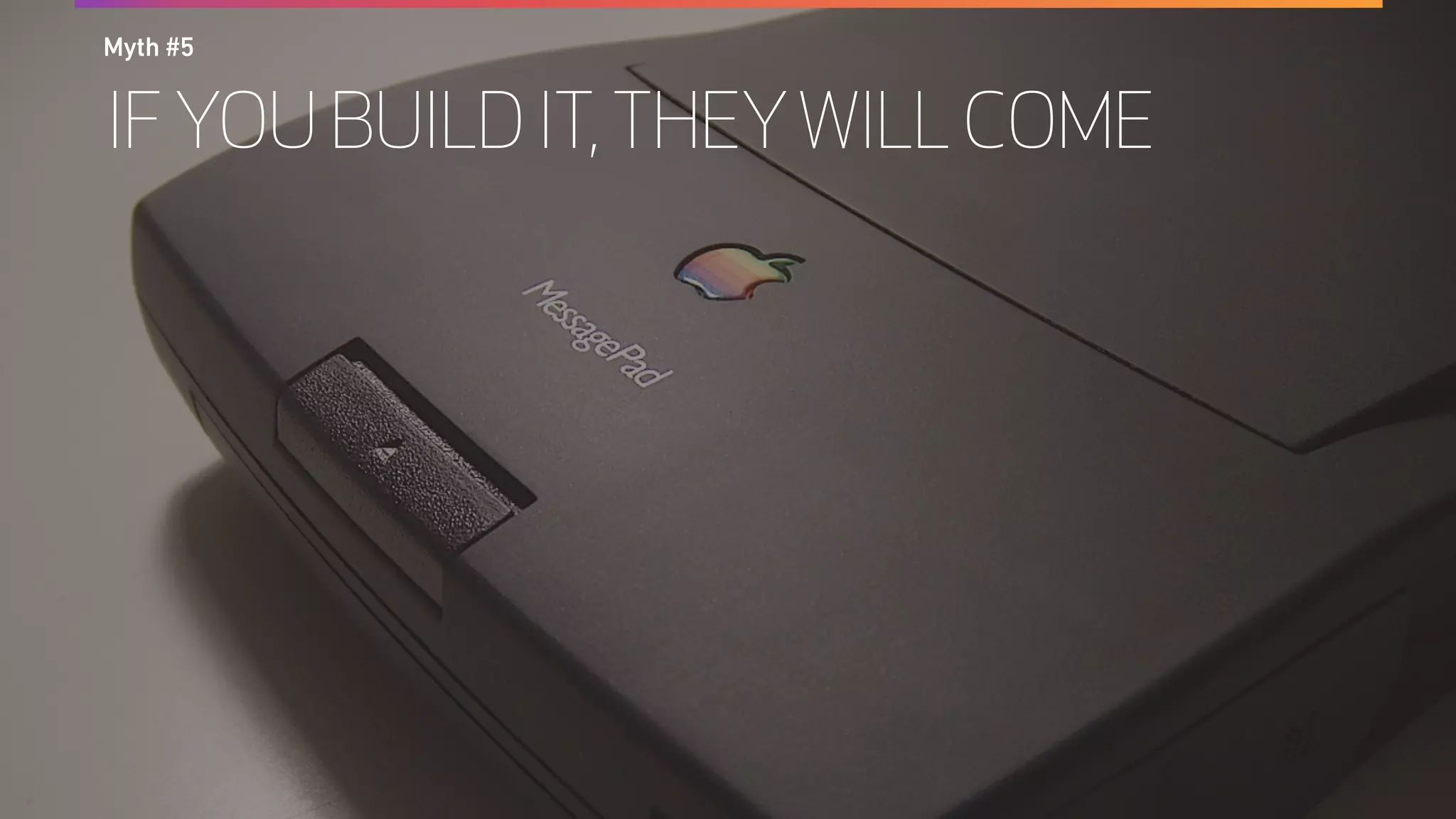
IF YOU BUILD IT,THEYWILL COME
Myth #5
Myth #5: If You Build It, They Will Come
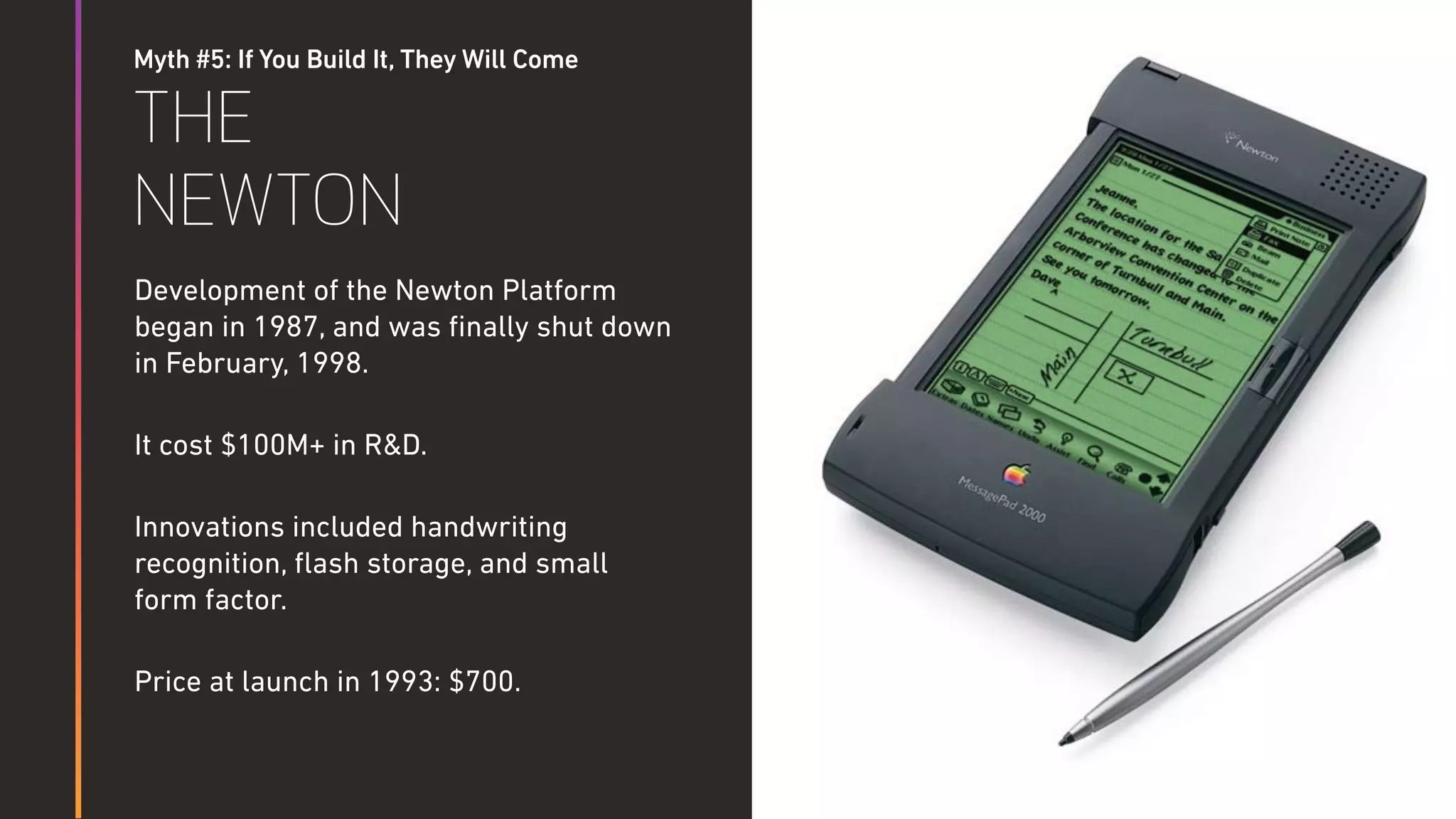
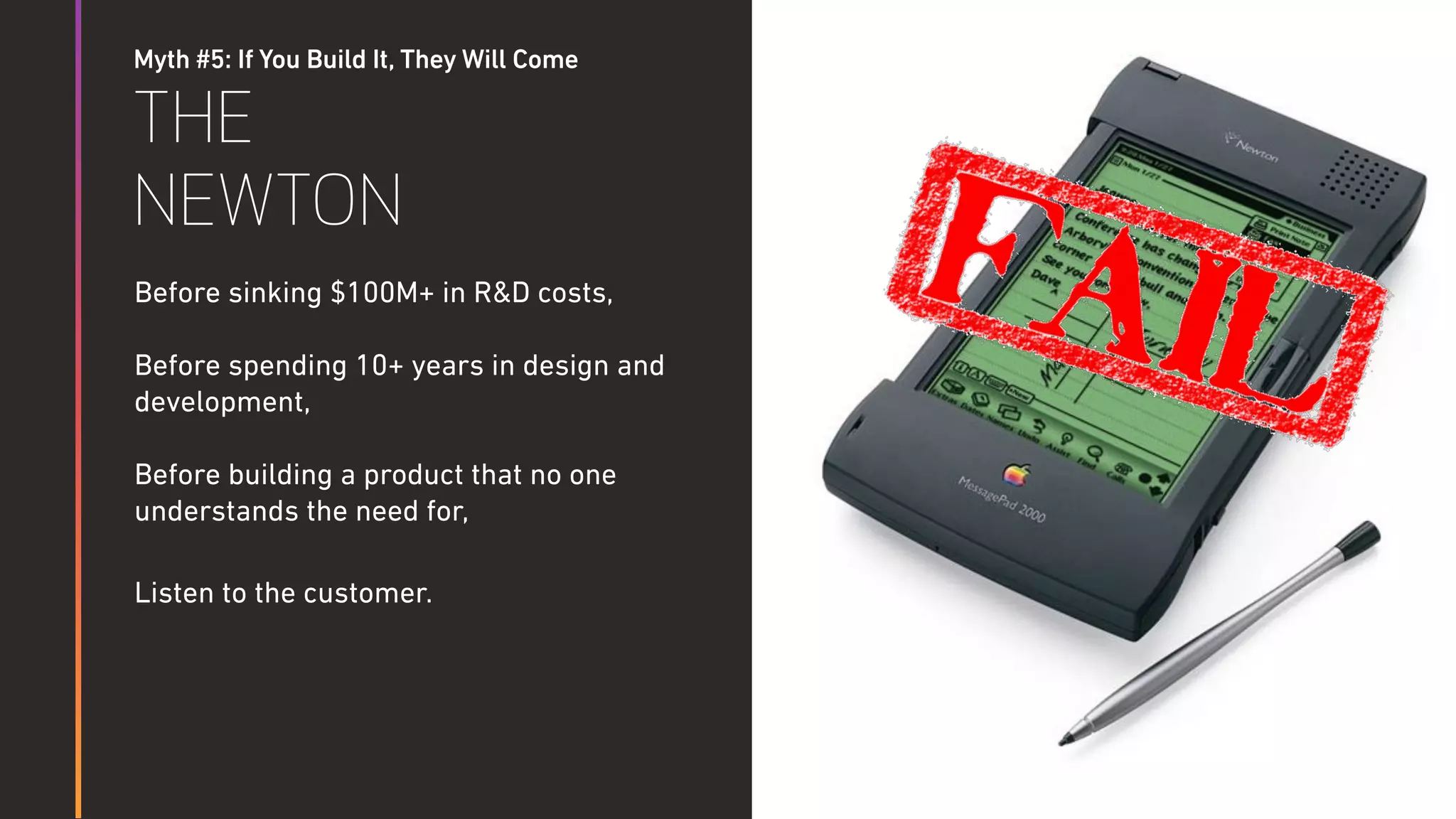
THE
NEWTON
Development of the Newton Platform
began in 1987, and was finally shut down
in February, 1998.
It cost $100M+ in R&D.
Innovations included handwriting
recognition, flash storage, and small
form factor.
Price at launch in 1993: $700.
Myth #5: If You Build It, They Will Come
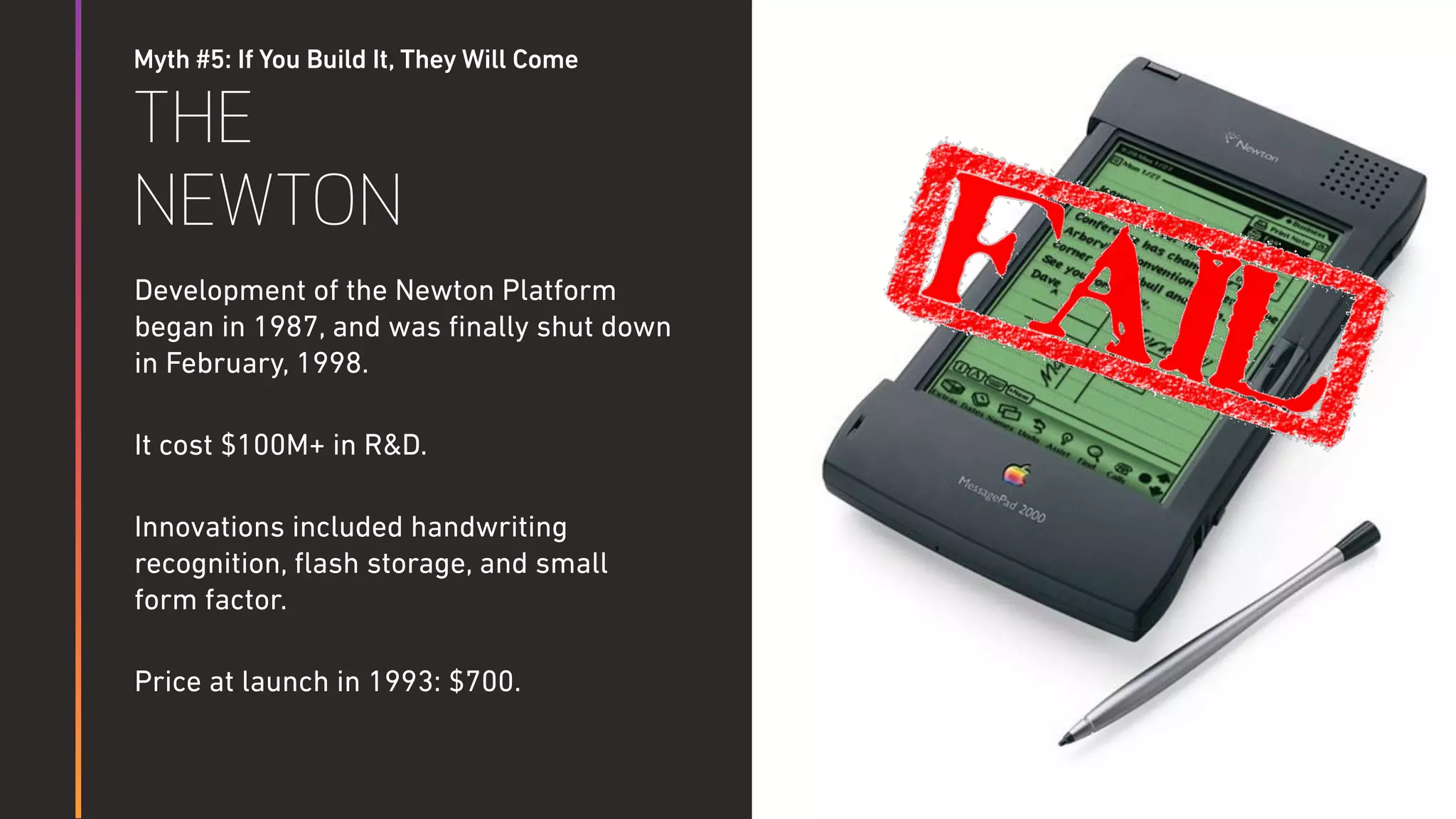
THE
NEWTON
Development of the Newton Platform
began in 1987, and was finally shut down
in February, 1998.
It cost $100M+ in R&D.
Innovations included handwriting
recognition, flash storage, and small
form factor.
Price at launch in 1993: $700.
The problem with the Newton wasn’t any physical or technical problem. Those are easy to
surmount. The problem that broke the Newton was that nobody was prepared for it. There was no
mental slot in people’s heads that the Newton could glide into.
—Amy Chow, The iPad, and the Staggering Work of Obviousness
cheerfulsw blog
Myth #5: If You Build It, They Will Come
THE
NEWTON
Before sinking $100M+ in R&D costs,


Before spending 10+ years in design and
development,


Before building a product that no one
understands the need for,
Listen to the customer.
PEOPLE DON’T KNOW WHAT THEY WANT
UNTIL YOU SHOW IT TO THEM.
PEOPLE DON’T KNOW WHAT THEY WANT
UNTIL YOU SHOW IT TO THEM.
IT'S REALLY HARD TO DESIGN PRODUCTS
BY FOCUS GROUPS.
A LOT OF TIMES,
Customers
inhibit innovation.#6
MYTH
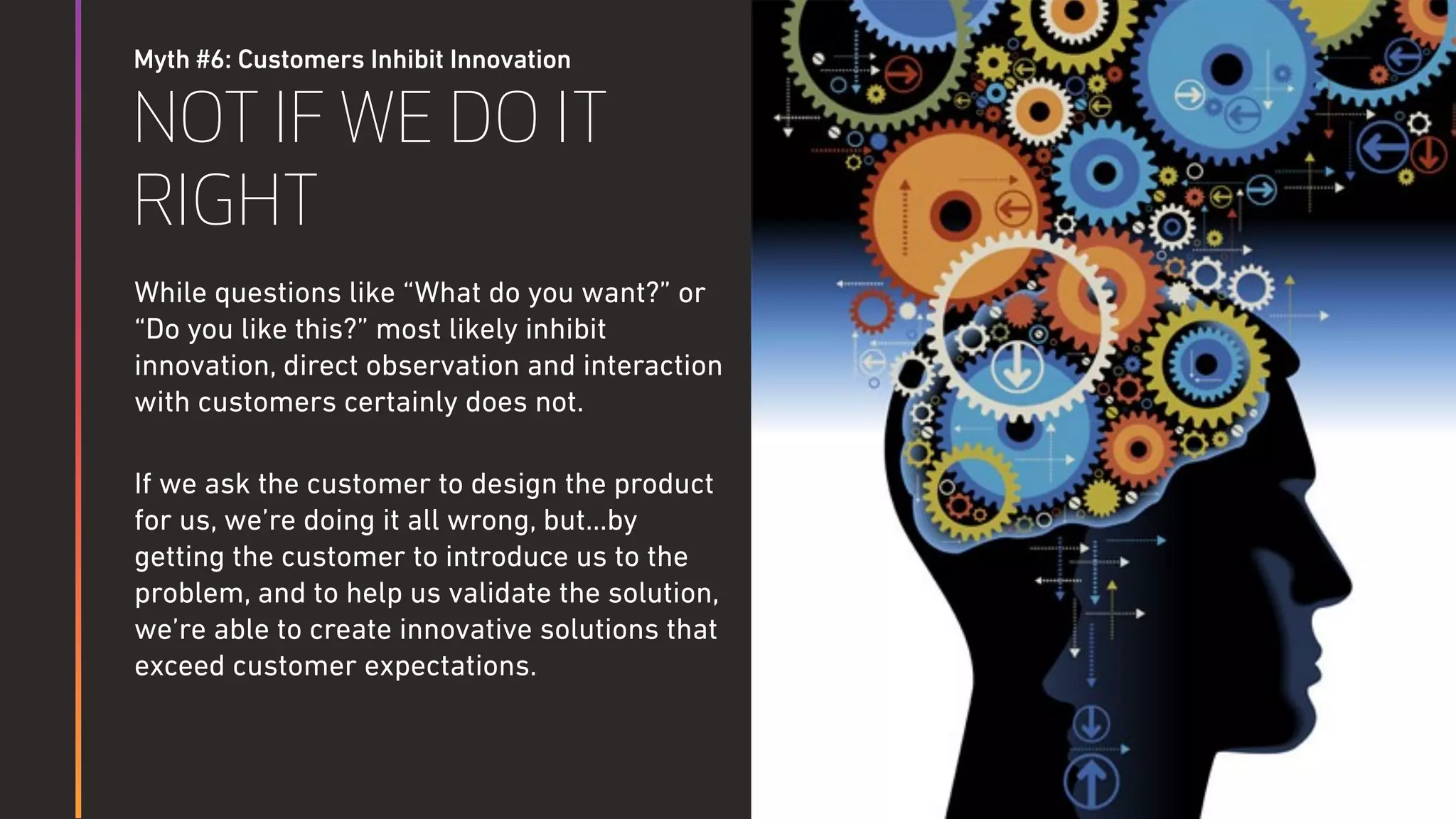
Myth #6: Customers Inhibit Innovation
NOT IF WE DO IT
RIGHT
While questions like “What do you want?” or
“Do you like this?” most likely inhibit
innovation, direct observation and interaction
with customers certainly does not.
If we ask the customer to design the product
for us, we’re doing it all wrong, but…by
getting the customer to introduce us to the
problem, and to help us validate the solution,
we’re able to create innovative solutions that
exceed customer expectations.
Some misconceptions about
how innovation happens
How to allow for innovation in
your organization
Some misconceptions about
what innovation is
The Process of Innovating How To Avoid PitfallsDefining Innovation
MYTHS OF INNOVATION
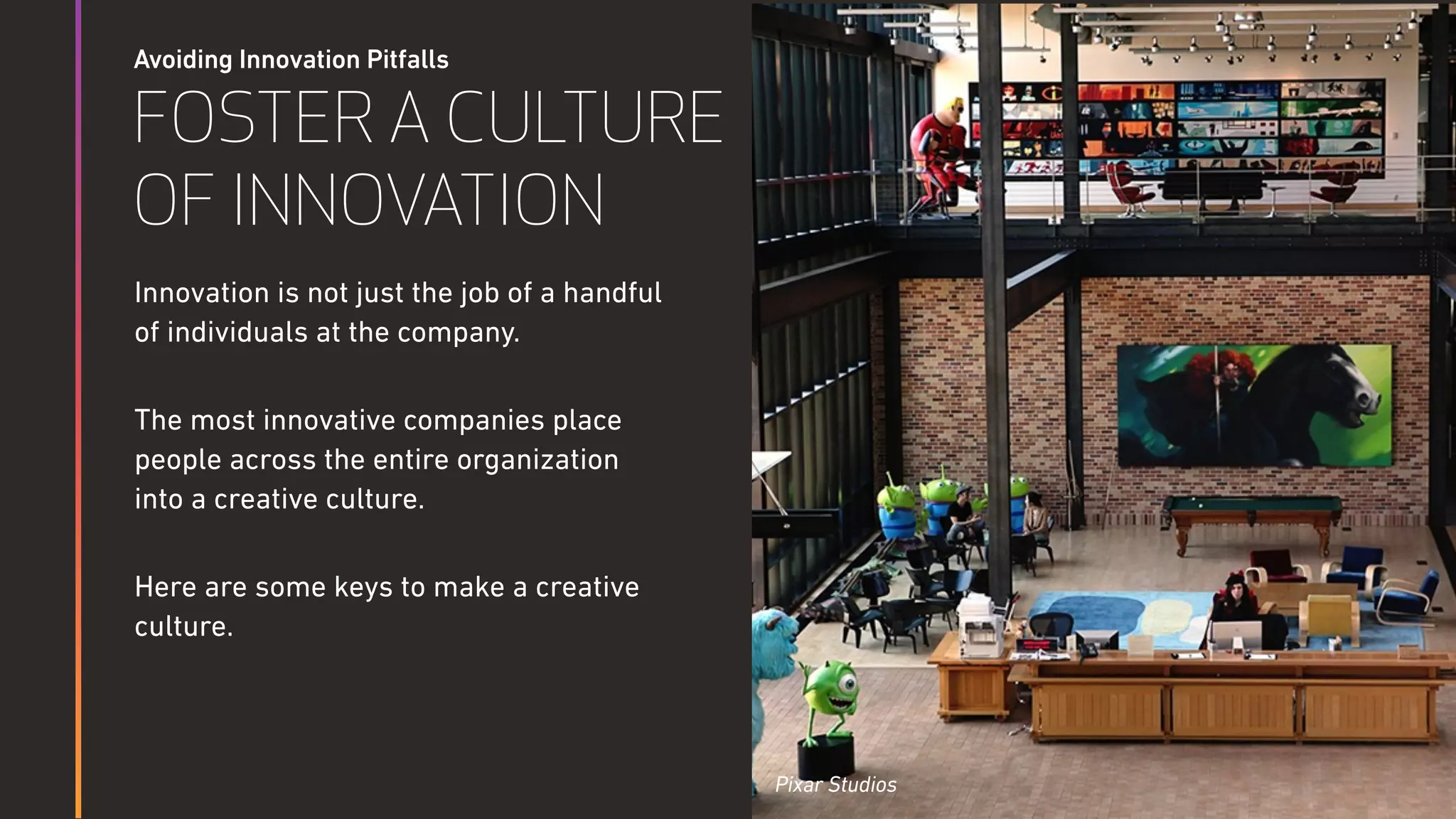
Avoiding Innovation Pitfalls
FOSTER A CULTURE
OF INNOVATION
Innovation is not just the job of a handful
of individuals at the company.
The most innovative companies place
people across the entire organization
into a creative culture.
Here are some keys to make a creative
culture.
Pixar Studios
Make work a collaborative environment
Take advantage of the new devices and technologies that support collaboration 

and knowledge sharing.
Make innovation an important part of leadership
Hire leaders who value creativity and are creative themselves. Leaders need
to be brave in supporting a culture of innovation.
Elon Musk of SpaceX and Tesla
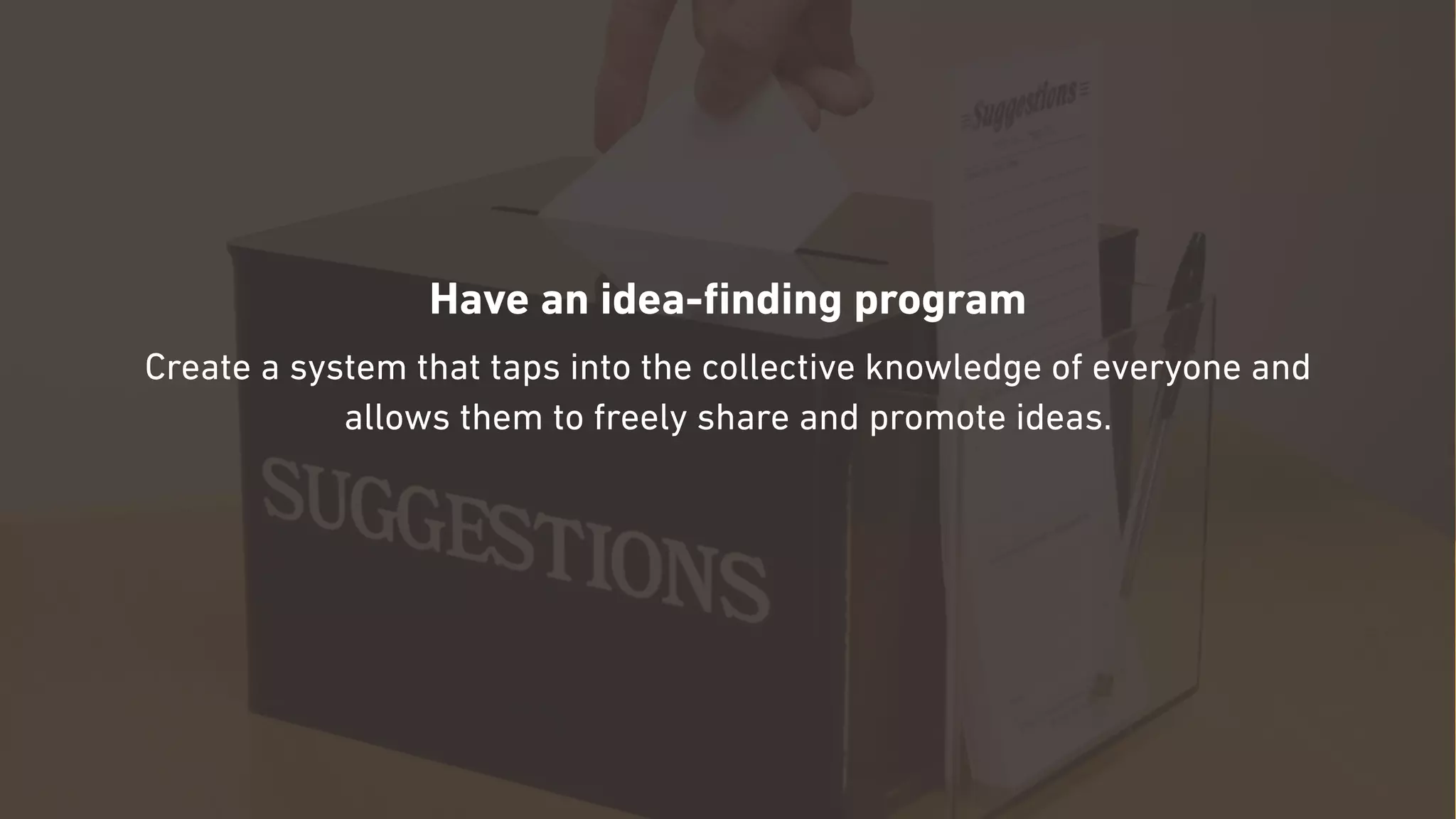
Have an idea-finding program
Create a system that taps into the collective knowledge of everyone and
allows them to freely share and promote ideas.
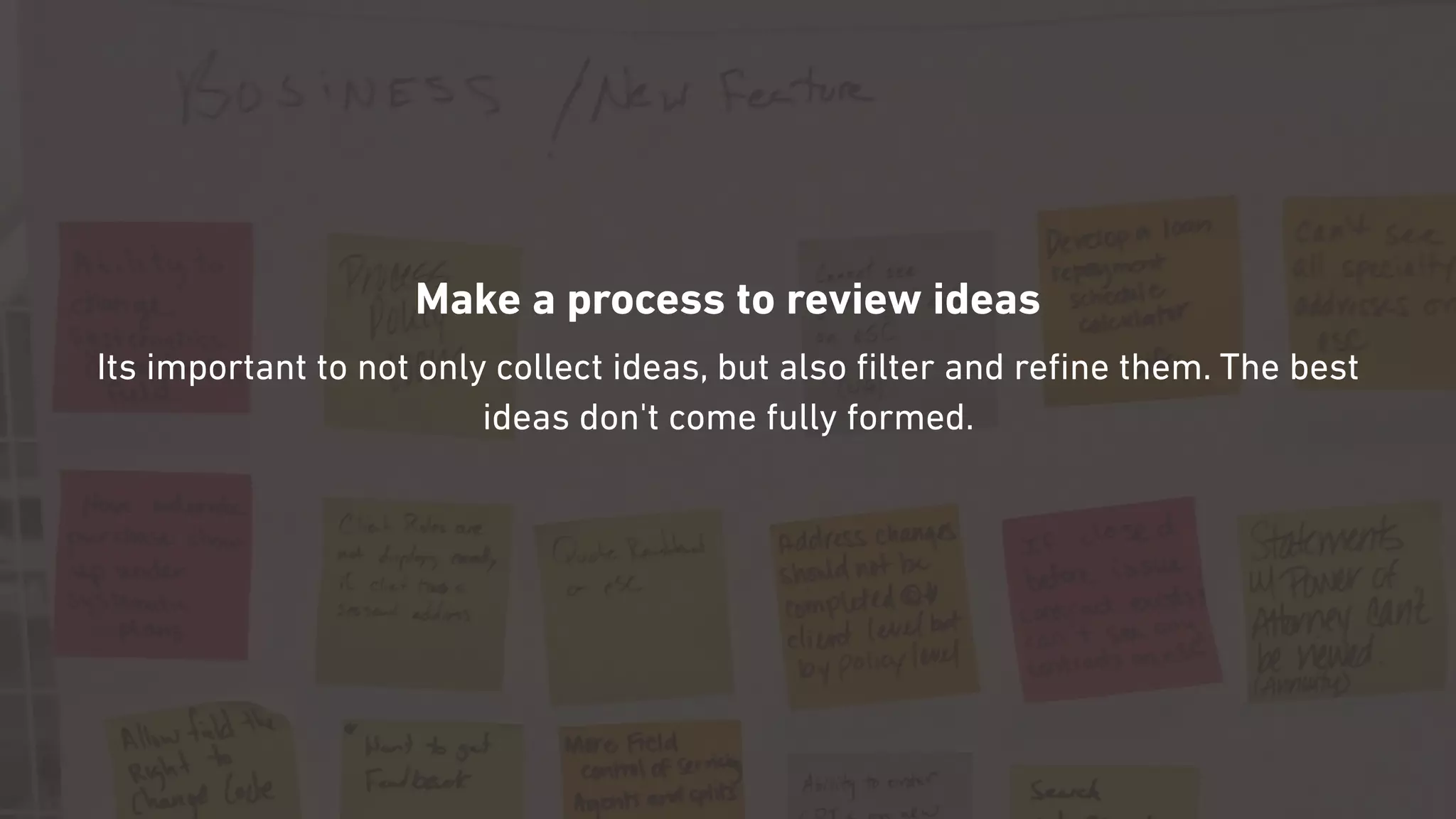
Make a process to review ideas
Its important to not only collect ideas, but also filter and refine them. The best
ideas don't come fully formed.
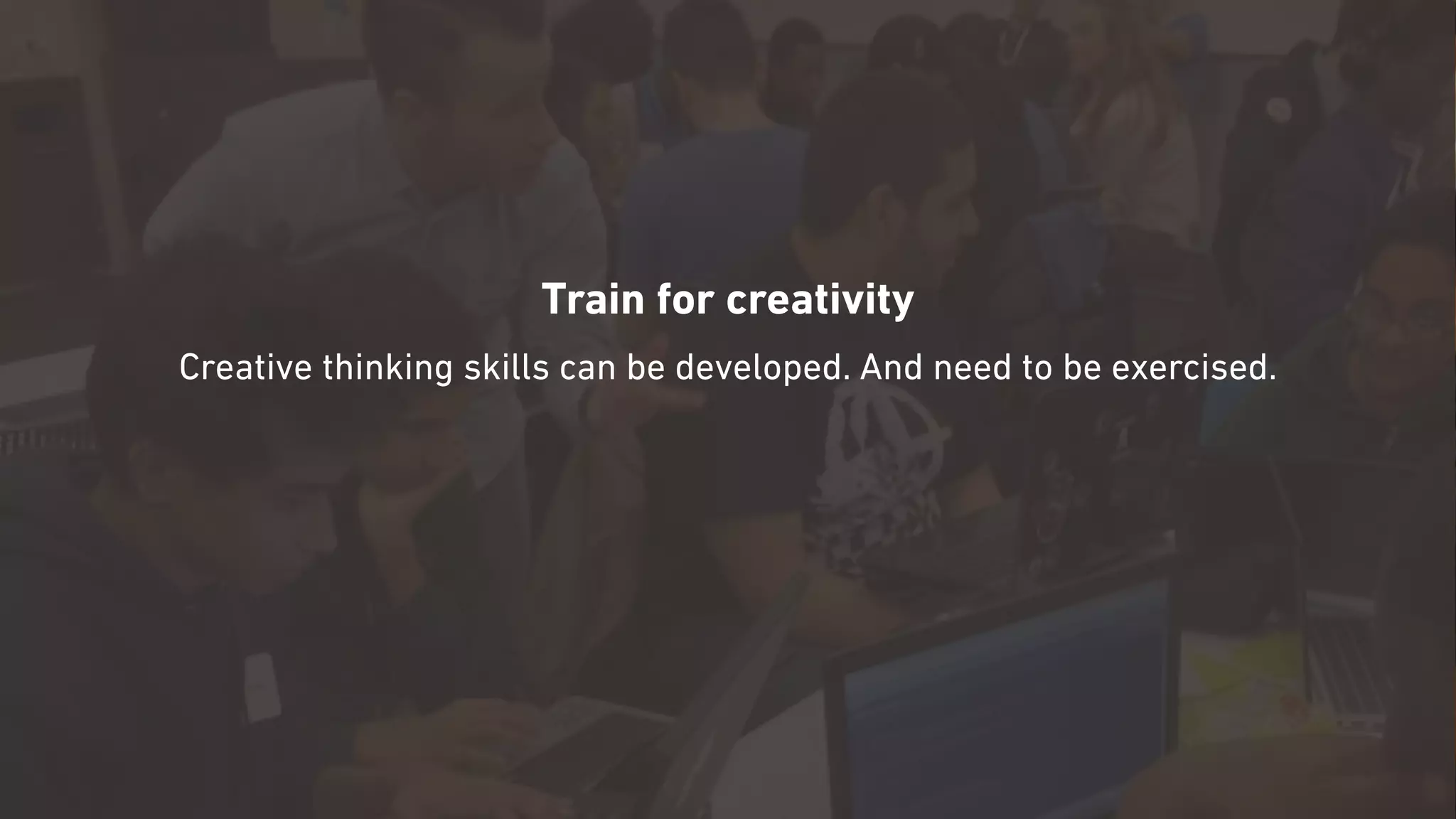
Train for creativity
Creative thinking skills can be developed. And need to be exercised.
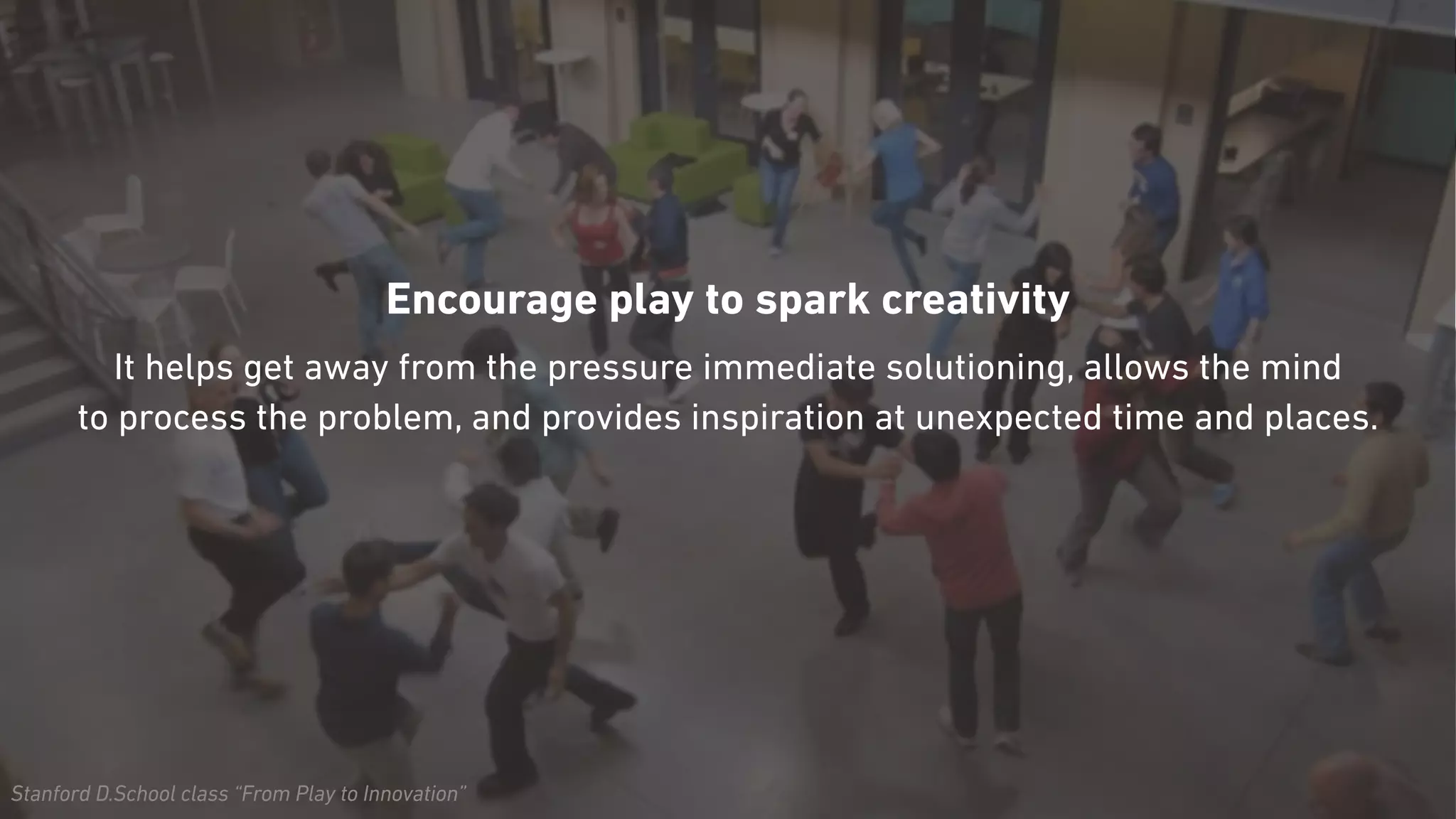
Stanford D.School class “From Play to Innovation”
Encourage play to spark creativity
It helps get away from the pressure immediate solutioning, allows the mind 

to process the problem, and provides inspiration at unexpected time and places.
THANK YOU.
From Lone Genius to Group Think: Common Innovation Pitfalls
FURTHER READING
'How Creativity Works': It's All In Your Imagination

http://www.npr.org/2012/03/19/148777350/how-creativity-works-its-all-in-your-imagination
How Pixar Fosters Collective Creativity

https://hbr.org/2008/09/how-pixar-fosters-collective-creativity
The Innovator’s DNA

https://hbr.org/2009/12/the-innovators-dna
The 7 Innovative Secrets of Steve Jobs

http://www.forbes.com/sites/carminegallo/2014/05/02/the-7-innovation-secrets-of-steve-jobs/
Ten Practices from the Most Innovative Organizations

http://www.creativitypost.com/business/10_practices_from_the_most_innovative_organizations
Remembering the Apple Newton’s Prophetic Failure and Lasting Impact

http://www.wired.com/2013/08/remembering-the-apple-newtons-prophetic-failure-and-lasting-ideals/
The iPad, and the Staggering Work of Obviousness

http://cheerfulsw.com/2010/ipad-a-staggering-work-of-obvious/
From Lone Genius to Group Think: Common Innovation Pitfalls
ADDITIONAL REFERENCES
Innovation is Meaning(Less)

http://www.agosto.com/blog/innovation-is-meaningless-and-why-companies-dont-do-it
Debunking the Myth of Innovation

http://www.inc.com/magazine/201309/less-innovation-is-better.html
Global Innovation 1000 Study

http://www.strategyand.pwc.com/innovation1000
How I Did It: Zappos’s CEO on Going to Extremes for Customers 

https://hbr.org/2010/07/how-i-did-it-zapposs-ceo-on-going-to-extremes-for-customers
Zappos and the Connection Between Structure and Strategy 

https://hbr.org/2015/06/zappos-and-the-connection-between-structure-and-strategy

Common Innovation Myths (World Usability Day)

  • 1.
    FROM GREEN SCREENSTO LONE GENIUS: COMMON INNOVATION MYTHS World Usability Day NOVEMBER 12, 2015 Steve Fors and Art Chinda
  • 2.
    Art Chinda Lead ExperienceArchitect
 art.chinda@effectiveui.com Steve Fors Design Principal
 steve.fors@effectiveui.com ALITTLEABOUTOURSELVES
  • 3.
    120 2012 Introductions EffectiveUI joinedthe WPP company (NASDAQ: WPPGY) in 2012. WPP is the world’s largest communication services group. ABOUT US Full time employees in: Denver, CO Rochester, NY New York, NY
  • 4.
  • 5.
    “There is noformula for innovation.” Shane Parrish, Farnam Street
  • 6.
    Some misconceptions about howinnovation happens How to allow for innovation in your organization Some misconceptions about what innovation is The Process of Innovating How To Avoid PitfallsDefining Innovation MYTHS OF INNOVATION
  • 7.
    Some misconceptions about howinnovation happens How to allow for innovation in your organization Some misconceptions about what innovation is The Process of Innovating How To Avoid PitfallsDefining Innovation MYTHS OF INNOVATION
  • 8.
  • 9.
    + = Wood FireCharcoal
  • 10.
  • 11.
  • 12.
  • 13.
  • 14.
  • 15.
  • 16.
  • 17.
  • 18.
  • 19.
    + = Phone Handheld + MP3Player Smart Phone
  • 20.
  • 21.
    Myth #1: InnovationIs… NEW Often, we think that to innovate is to come up with something completely new. Most innovation happens by process of associating. Associating, or the ability to successfully connect seemingly unrelated questions, problems, or ideas from different fields, is central to the innovator’s DNA. +
  • 22.
  • 23.
    Myth #2: InnovationIs… GOOD When I lead a UX team at GE Healthcare, 
 a large hospital network tapped us to innovate on a medical coding and billing application. The problem: it was green screen.
  • 25.
    Our job was,according to the CEO and product group, to bring the coding and billing practice into the 21st century. To the CEO this meant: make it look new. To the product group this meant: make it best in class. To the end-users this meant: ???
  • 27.
    What was theend result?
  • 28.
    What was theend result? 63% Productivity decreased by
  • 29.
    Myth #2: InnovationIs… GOOD The whole story: The green screen app had been honed by end-users & the IT department for years to deliver efficiency and optimal productivity. End-users were not involved in “innovation” effort (they we too busy working!), and the results showed their lack of involvement. For many reasons, this innovation project failed miserably. The product—although it looked old—worked well, and didn’t need wholesale innovation.
  • 30.
  • 31.
    Myth #3: InnovationIs… PRODUCT When people think of innovation today, they usually think of big technology companies. Innovation has become synonymous with their new hardware and software technologies.
  • 32.
    There is alot of money is being spent on R&D of new products, but that doesn’t guarantee success.
  • 33.
    There is alot of money is being spent on R&D of new products, but that doesn’t guarantee success. 4.5%of new products show a return on investment. In fact, only
  • 35.
    2.5%Median for amountspent on R&D compared to revenue 6.5%Median for amount spent on R&D compared to revenue
  • 36.
    Myth #3: InnovationIs… PRODUCT Developing products is often not the most effective way to innovate. Some companies choose to focus their innovative efforts on process and culture. A great example of this is Zappos.
  • 37.
    5Weeks of Customer Servicetraining for EVERY employee From the outside, it looks like any other e-commerce clothing retailer. But Zappos innovation efforts aren’t focused on products, but on culture of great customer service. $2kOffered to each employee after training to quit to ensure a committed workforce FreeReturns all purchases 
 for one year 2XCustomers are encouraged to order 2 sizes and return one 1/3+Of gross revenue is spent on shipping
  • 38.
    “Usually when marketingdepartments do their ROI calculations, they assume that the lifetime value of a customer is fixed. We view it as something that can grow if we create positive emotional associations with our brand.” —Tony Hseih, CEO Zappos
  • 39.
    Zappos‘ commitment togreat customer service cultivates a strong bond with their customers. In turn, customers are converted into Brand Ambassadors that drive growth for the company. $2BSales revenue, a growth of $1B from 2008 75%Of sales revenue from repeat customers
  • 40.
    Myth #3: InnovationIs… PRODUCT Its a common pitfall to measure successful innovation only in regards to new products and technologies. Innovation more often means: — Creating better customer experiences — Improving internal processes — Creating a culture driven organization — Establishing a values-driven brand — Experimenting with new business models
  • 41.
    Some misconceptions about howinnovation happens How to allow for innovation in your organization Some misconceptions about what innovation is The Process of Innovating How To Avoid PitfallsDefining Innovation MYTHS OF INNOVATION
  • 42.
  • 43.
    Myth #4: The“Lone Genius” WHO ARE THEY? When we think of the innovative genius, what comes to mind? The brilliant inventor holed up in a studio away from everything and everyone. Adjectives like eccentric, reclusive, prodigious, magical, a “natural” talent. Films like “A Beautiful Mind,” “Good Will Hunting,” “Rain Man” reinforce the myth of the “Lone Genius” in collective consciousness.
  • 44.
    Myth #4: The“Lone Genius” LEONARDO DA VINCI …was a solitary “genius” that transformed the world of arts & sciences all by himself. Rather, history says that he flourished in a community of mentors, collaborators, and apprentices. DaVinci lived in a time when the educational model of apprenticeship was prevalent. He was mentored, had collaborators, and apprentices throughout his life.
  • 45.
    Entrepreneur Frans Johanssondescribed [the birth of the Renaissance] as the Medici effect, referring to the creative explosion in Florence when the Medici family brought together people from a wide range of disciplines—sculptors, scientists, poets, philosophers, painters, and architects. As these individuals connected, new ideas blossomed at the intersections of their respective fields, thereby spawning the Renaissance, one of the most inventive eras in history. —The Innovator’s DNA, Harvard Business Review DaVinci’s Vitruvian Man
  • 46.
    Myth #4: The“Lone Genius” ALBERT EINSTEIN …was a brilliant scientist and mathematician that innovated in an historical and cultural vacuum. Rather, “geniuses” build on historical and contemporary ideas. Einstein spent hours reviewing patent submissions at his job at the Federal Office for Intellectual Property in Bern, and surround himself with contemporary academics, scientists, and philosophers.
  • 47.
    “The insights requiredto solve many of our most challenging problems come from outside our industry and scientific field. We must aggressively and proudly incorporate into our work findings and advances which were not invented here.” —Kent Bowen, the founding scientist of CPS technologies Einstein at the Federal Office for Intellectual Property, Bern, Switzerland
  • 48.
    Myth #4: The“Lone Genius” STEVE JOBS …was bestowed with an innate creativity that just can’t be learned. Rather, “geniuses” create a culture around them that fosters innovative thinking. When Jobs ran Pixar, he literally broke down walls between computer scientists, animators, and product directors to engineer a more creative environment. Steven Hawking
  • 49.
    [Jobs] wanted thereto be mixing. He knew that the human friction makes the sparks, and that when you're talking about a creative endeavor that requires people from different cultures to come together, you have to force them to mix; that our natural tendency is to stay isolated, to talk to people who are just like us, who speak our private languages, who understand our problems. But that's a big mistake. —Jonah Lehrer, Author of Imagine: How Creativity Works Apple Headquarters, Cupertino, CA
  • 50.
    Myth #4: The“Lone Genius” WHO ARE THEY, REALLY? While we may believe in the myth on the “Lone Genius,” history tells us that: “Geniuses” have a community of mentors, collaborators, and apprentices. “Geniuses” build on prior innovative ideas. “Geniuses” create a culture around them that fosters innovative thinking.
  • 51.
    If you buildit, they will come.#5 MYTH
  • 52.
    IF YOU BUILDIT,THEYWILL COME Myth #5
  • 53.
    Myth #5: IfYou Build It, They Will Come THE NEWTON Development of the Newton Platform began in 1987, and was finally shut down in February, 1998. It cost $100M+ in R&D. Innovations included handwriting recognition, flash storage, and small form factor. Price at launch in 1993: $700.
  • 54.
    Myth #5: IfYou Build It, They Will Come THE NEWTON Development of the Newton Platform began in 1987, and was finally shut down in February, 1998. It cost $100M+ in R&D. Innovations included handwriting recognition, flash storage, and small form factor. Price at launch in 1993: $700.
  • 55.
    The problem withthe Newton wasn’t any physical or technical problem. Those are easy to surmount. The problem that broke the Newton was that nobody was prepared for it. There was no mental slot in people’s heads that the Newton could glide into. —Amy Chow, The iPad, and the Staggering Work of Obviousness cheerfulsw blog
  • 56.
    Myth #5: IfYou Build It, They Will Come THE NEWTON Before sinking $100M+ in R&D costs,
 
 Before spending 10+ years in design and development,
 
 Before building a product that no one understands the need for, Listen to the customer.
  • 57.
    PEOPLE DON’T KNOWWHAT THEY WANT UNTIL YOU SHOW IT TO THEM.
  • 58.
    PEOPLE DON’T KNOWWHAT THEY WANT UNTIL YOU SHOW IT TO THEM. IT'S REALLY HARD TO DESIGN PRODUCTS BY FOCUS GROUPS. A LOT OF TIMES,
  • 59.
  • 60.
    Myth #6: CustomersInhibit Innovation NOT IF WE DO IT RIGHT While questions like “What do you want?” or “Do you like this?” most likely inhibit innovation, direct observation and interaction with customers certainly does not. If we ask the customer to design the product for us, we’re doing it all wrong, but…by getting the customer to introduce us to the problem, and to help us validate the solution, we’re able to create innovative solutions that exceed customer expectations.
  • 61.
    Some misconceptions about howinnovation happens How to allow for innovation in your organization Some misconceptions about what innovation is The Process of Innovating How To Avoid PitfallsDefining Innovation MYTHS OF INNOVATION
  • 62.
    Avoiding Innovation Pitfalls FOSTERA CULTURE OF INNOVATION Innovation is not just the job of a handful of individuals at the company. The most innovative companies place people across the entire organization into a creative culture. Here are some keys to make a creative culture. Pixar Studios
  • 63.
    Make work acollaborative environment Take advantage of the new devices and technologies that support collaboration 
 and knowledge sharing.
  • 64.
    Make innovation animportant part of leadership Hire leaders who value creativity and are creative themselves. Leaders need to be brave in supporting a culture of innovation. Elon Musk of SpaceX and Tesla
  • 65.
    Have an idea-findingprogram Create a system that taps into the collective knowledge of everyone and allows them to freely share and promote ideas.
  • 66.
    Make a processto review ideas Its important to not only collect ideas, but also filter and refine them. The best ideas don't come fully formed.
  • 67.
    Train for creativity Creativethinking skills can be developed. And need to be exercised.
  • 68.
    Stanford D.School class“From Play to Innovation” Encourage play to spark creativity It helps get away from the pressure immediate solutioning, allows the mind 
 to process the problem, and provides inspiration at unexpected time and places.
  • 69.
  • 70.
    From Lone Geniusto Group Think: Common Innovation Pitfalls FURTHER READING 'How Creativity Works': It's All In Your Imagination
 http://www.npr.org/2012/03/19/148777350/how-creativity-works-its-all-in-your-imagination How Pixar Fosters Collective Creativity
 https://hbr.org/2008/09/how-pixar-fosters-collective-creativity The Innovator’s DNA
 https://hbr.org/2009/12/the-innovators-dna The 7 Innovative Secrets of Steve Jobs
 http://www.forbes.com/sites/carminegallo/2014/05/02/the-7-innovation-secrets-of-steve-jobs/ Ten Practices from the Most Innovative Organizations
 http://www.creativitypost.com/business/10_practices_from_the_most_innovative_organizations Remembering the Apple Newton’s Prophetic Failure and Lasting Impact
 http://www.wired.com/2013/08/remembering-the-apple-newtons-prophetic-failure-and-lasting-ideals/ The iPad, and the Staggering Work of Obviousness
 http://cheerfulsw.com/2010/ipad-a-staggering-work-of-obvious/
  • 71.
    From Lone Geniusto Group Think: Common Innovation Pitfalls ADDITIONAL REFERENCES Innovation is Meaning(Less)
 http://www.agosto.com/blog/innovation-is-meaningless-and-why-companies-dont-do-it Debunking the Myth of Innovation
 http://www.inc.com/magazine/201309/less-innovation-is-better.html Global Innovation 1000 Study
 http://www.strategyand.pwc.com/innovation1000 How I Did It: Zappos’s CEO on Going to Extremes for Customers 
 https://hbr.org/2010/07/how-i-did-it-zapposs-ceo-on-going-to-extremes-for-customers Zappos and the Connection Between Structure and Strategy 
 https://hbr.org/2015/06/zappos-and-the-connection-between-structure-and-strategy