This work shop is to
guide teachers to a
better writing for
their students.
It is divided into six
steps to be given in
six periods.
Step one
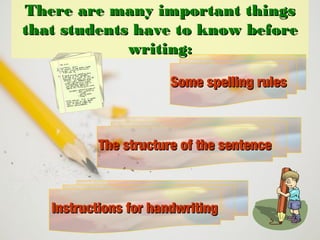
There are many important things
that students have to know before
writing:
Some spelling rules

The structure of the sentence

Instructions for handwriting
Step Two
The first step in writing a
composition is to choose the title.
Think about the type of paper
you are expected to produce.
Should it be a general overview,
or a specific analysis.
If it is a specific analysis, make
sure your topic is fairly specific.
If it is too general, you must
choose a narrower subtopic to
discuss.
(min )5

Choose a title
Be sure to make
it specific
The purpose of using a
graphic organizer is to
organize your ideas and
put them on paper, in an
organized format
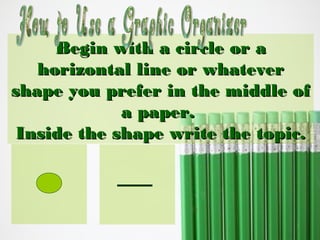
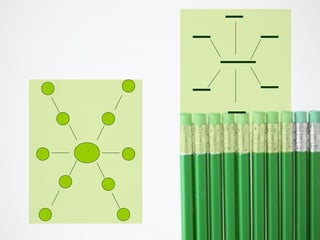
Begin with a circle or a
horizontal line or whatever
shape you prefer in the middle of
a paper.
Inside the shape write the topic.
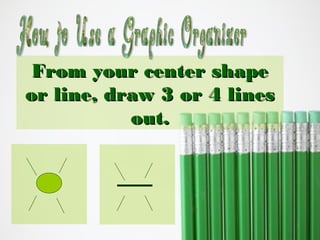
From your center shape
or line, draw 3 or 4 lines
out.
At the end of each line, draw
another horizontal or circle.
In each shape or each line,
write the main ideas that you
have about your topic, or the
main points that you want to
.make
(min )20

Using a graphic
organizer arrange
your ideas about
the topic you chose
Step Three
It should give your reader an idea
about the essay's intent, including a
basic statement of what the essay
will discuss
.
(min )20

Write an
introduction for
the title you chose
It presents the evidence that
supports the ideas.
Use concrete examples and avoid
generalities.
(min )20

Write a body
for your essay
Step Four
The conclusion should
summarize and make
sense of the evidence
you presented in the
body
(min )20

Write a
conclusion
for your essay
Step Five
Editing
While editing isn't always a
student's favorite task, it's an
important task nonetheless.
During this stage, students
will check spelling,
grammar, punctuation,
capitalization, and subject/
verb agreement.
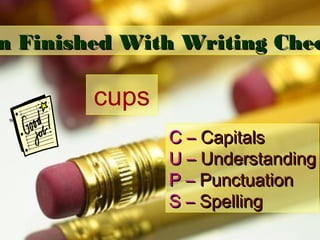
n Finished With Writing Chec

cups
C – Capitals
U – Understanding
P – Punctuation
S – Spelling
Capitalization
Each sentence starts with a capital letter.
All names of people and places begin
with a capital letter.
Titles in a person's name begin with a
capital letter.
Each important word in a title (that
doesn't refer to people) begins with a
capital letter.
Understanding
Story starts at the beginning, or with
. the most exciting event
Beginning and ending make sense.
Order of events is easy to follow.
All sentences are complete and
include a subject and a verb
Punctuation
Quotation marks surround all words
that are part of a direct quote.
Commas separate items in a list,
appear within sentences that have
direct quotes.
All sentences end with a period or
other appropriate ending punctuation.
Spelling
Make sure that words are spelled
correctly. If you are using a computer,
remember to use the spell check
function.
All sentences are complete and include a
subject and a verb. All subjects and verbs
agree.
Fix What Needs Fixing
 
(min )5

Use the
checklist to
evaluate your
essay
Peer Review
This cycle allows students one
more look before showing their
work publicly. It can be done
through peer review.
(min )7

Use the checklist
to evaluate your
friend’s essay
Step six
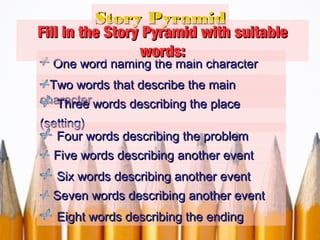
Story Pyramid

Fill in the Story Pyramid with suitable
words:
One word naming the main character

Two words that describe the main
character words describing the place
Three
(setting)
Four words describing the problem
Five words describing another event
Six words describing another event
Seven words describing another event
Eight words describing the ending
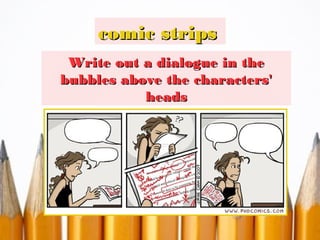
comic strips
Write out a dialogue in the
bubbles above the characters'
heads
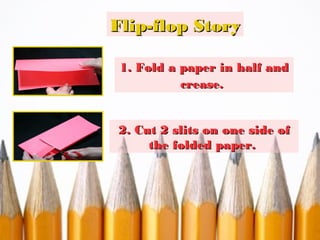
Flip-flop Story
1. Fold a paper in half and
crease.
2. Cut 2 slits on one side of
the folded paper.
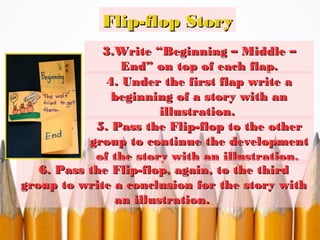
Flip-flop Story
3.Write “Beginning – Middle –
End” on top of each flap.
4. Under the first flap write a
beginning of a story with an
illustration.
5. Pass the Flip-flop to the other
group to continue the development
of the story with an illustration.
6. Pass the Flip-flop, again, to the third
group to write a conclusion for the story with
an illustration.
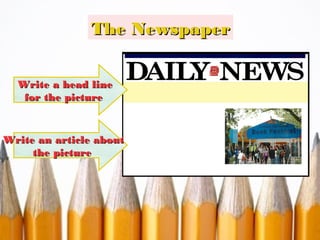
The Newspaper
Write a head line
for the picture

Write an article about
the picture
Write it briefly so they will read,
clearly so they will appreciate it,
picturesquely so they will remember
it,
and above all accurately so they will
be guided by its light.

American journalist and p
If you want your students to
change

be creative
Because , if you
always do what
you’ve always
done, you’ll
always get what
you’ve always
6 steps writing

6 steps writing

  • 4.
    This work shopis to guide teachers to a better writing for their students. It is divided into six steps to be given in six periods.
  • 12.
  • 13.
    There are manyimportant things that students have to know before writing: Some spelling rules The structure of the sentence Instructions for handwriting
  • 15.
  • 16.
    The first stepin writing a composition is to choose the title. Think about the type of paper you are expected to produce. Should it be a general overview, or a specific analysis.
  • 17.
    If it isa specific analysis, make sure your topic is fairly specific. If it is too general, you must choose a narrower subtopic to discuss.
  • 18.
    (min )5 Choose atitle Be sure to make it specific
  • 19.
    The purpose ofusing a graphic organizer is to organize your ideas and put them on paper, in an organized format
  • 20.
    Begin with acircle or a horizontal line or whatever shape you prefer in the middle of a paper. Inside the shape write the topic.
  • 21.
    From your centershape or line, draw 3 or 4 lines out.
  • 22.
    At the endof each line, draw another horizontal or circle. In each shape or each line, write the main ideas that you have about your topic, or the main points that you want to .make
  • 24.
    (min )20 Using agraphic organizer arrange your ideas about the topic you chose
  • 25.
  • 26.
    It should giveyour reader an idea about the essay's intent, including a basic statement of what the essay will discuss .
  • 27.
    (min )20 Write an introductionfor the title you chose
  • 28.
    It presents theevidence that supports the ideas. Use concrete examples and avoid generalities.
  • 29.
    (min )20 Write abody for your essay
  • 30.
  • 31.
    The conclusion should summarizeand make sense of the evidence you presented in the body
  • 32.
  • 33.
  • 34.
    Editing While editing isn'talways a student's favorite task, it's an important task nonetheless. During this stage, students will check spelling, grammar, punctuation, capitalization, and subject/ verb agreement.
  • 35.
    n Finished WithWriting Chec cups C – Capitals U – Understanding P – Punctuation S – Spelling
  • 36.
    Capitalization Each sentence startswith a capital letter. All names of people and places begin with a capital letter. Titles in a person's name begin with a capital letter. Each important word in a title (that doesn't refer to people) begins with a capital letter.
  • 37.
    Understanding Story starts atthe beginning, or with . the most exciting event Beginning and ending make sense. Order of events is easy to follow. All sentences are complete and include a subject and a verb
  • 38.
    Punctuation Quotation marks surroundall words that are part of a direct quote. Commas separate items in a list, appear within sentences that have direct quotes. All sentences end with a period or other appropriate ending punctuation.
  • 39.
    Spelling Make sure thatwords are spelled correctly. If you are using a computer, remember to use the spell check function. All sentences are complete and include a subject and a verb. All subjects and verbs agree.
  • 40.
    Fix What NeedsFixing  
  • 41.
    (min )5 Use the checklistto evaluate your essay
  • 42.
    Peer Review This cycleallows students one more look before showing their work publicly. It can be done through peer review.
  • 43.
    (min )7 Use thechecklist to evaluate your friend’s essay
  • 45.
  • 46.
    Story Pyramid Fill inthe Story Pyramid with suitable words: One word naming the main character Two words that describe the main character words describing the place Three (setting) Four words describing the problem Five words describing another event Six words describing another event Seven words describing another event Eight words describing the ending
  • 47.
    comic strips Write outa dialogue in the bubbles above the characters' heads
  • 48.
    Flip-flop Story 1. Folda paper in half and crease. 2. Cut 2 slits on one side of the folded paper.
  • 49.
    Flip-flop Story 3.Write “Beginning– Middle – End” on top of each flap. 4. Under the first flap write a beginning of a story with an illustration. 5. Pass the Flip-flop to the other group to continue the development of the story with an illustration. 6. Pass the Flip-flop, again, to the third group to write a conclusion for the story with an illustration.
  • 50.
    The Newspaper Write ahead line for the picture Write an article about the picture
  • 51.
    Write it brieflyso they will read, clearly so they will appreciate it, picturesquely so they will remember it, and above all accurately so they will be guided by its light. American journalist and p
  • 52.
    If you wantyour students to change be creative Because , if you always do what you’ve always done, you’ll always get what you’ve always