This role play description is licensed under a Creative Commons Attribution-Noncommercial-Share Alike 2.5 Australia License


Abstract: ‘Save Wallaby Forest’ casts students                         Keywords: Public Relations, Community
into a local planning debate as public                                 Action Groups, Public communication, Activism
communicators. It aims to give them an insight into
the complex process of text production and its                         Contact: Kristin Demetrious, Deakin University
relationship ethics. This is facilitated through their
                                                                       kristin.demetrious@deakin.edu.au
active engagement with a complex, volatile and
dynamic issue – as players, not just spectators.


                       Save Wallaby Forest
                                        Online role-play
Description:

Save Wallaby Forest is an online role-play that aims to give depth of understanding to different theoretical
perspectives and relationships between groups in society. In the role-play, students, as either ‘developers’ or
‘activists’, must prepare a submission and attend a public meeting to convince the Council to either reject or
accept a planning application that will facilitate the construction of 600 houses in a 40-hectare tract of land
called Wallaby Forest. Several interruption events demand additional work from groups. In the reflective part of
the exercise, students are asked to consider the theoretical perspectives that shaped the social and political views
as well as the discursive production of texts and their distribution.

The role play requires students to:
     Join a group: either Developers or Activists
     Research the theoretical perspectives of pluralism and Marxism
     Work as a team to develop and present a 500-word submission at a Public Meeting
     Reflect and respond to an essay question that applies theory to their experience

Audience/group-size:                                                Timeframe & Setting:

Designed for about 40-50 students. Individual group                 The role-play takes place over three to four weeks in
sizes of 8-10 students.                                             the students’ own time.

Learning Opportunities:

The role-play helps students to develop deeper understandings of:
     New approaches to PR and journalism and their major cultural, political and ethical implications, as
         well as their links with citizenship, responsibility and accountability
     Activism, including cyber activism, NGOs and not for profit areas
     Consultation with local and regional communities and how organisations use formal and informal
         communication to achieve social, cultural and political change in a climate of increasing globalisation
         and corporate responsibility and accountability and citizenshi.
     How traditional and ‘new’ media ‘frame’ society and construct ‘knowledge’
     The major theories of citizenship, risk society and communication within a local Australian context.

Resources:

The role-play is facilitated through the integration of an online learning management system (WebCT till 2007),
a four-minute video to set the role-play scene, hyperlinks to external theory resources and mock websites.
Role Play Organisation:

      The role-play uses a four-step
      structure to move students logically
      through the complex task of
      understanding the debate, forming a
      group, completing a shared task,
      evaluating the experience, and linking
      it to the theory.

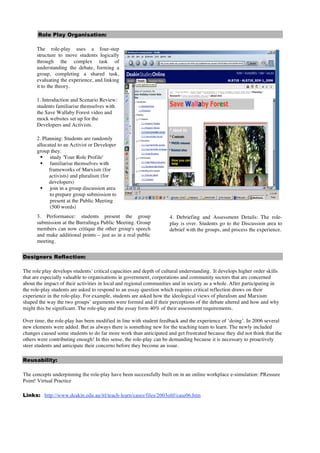
      1. Introduction and Scenario Review:
      students familiarise themselves with
      the Save Wallaby Forest video and
      mock websites set up for the
      Developers and Activists.

      2. Planning: Students are randomly
      allocated to an Activist or Developer
      group they:
         study 'Your Role Profile'
         familiarise themselves with
            frameworks of Marxism (for
            activists) and pluralism (for
            developers)
         join in a group discussion area
            to prepare group submission to
            present at the Public Meeting
            (500 words)
      3. Performance: students present the group                     4. Debriefing and Assessment Details: The role-
      submission at the Burralinga Public Meeting. Group             play is over. Students go to the Discussion area to
      members can now critique the other group's speech              debrief with the groups, and process the experience.
      and make additional points – just as in a real public
      meeting.

Designers Reflection:

The role play develops students’ critical capacities and depth of cultural understanding. It develops higher order skills
that are especially valuable to organisations in government, corporations and community sectors that are concerned
about the impact of their activities in local and regional communities and in society as a whole. After participating in
the role-play students are asked to respond to an essay question which requires critical reflection draws on their
experience in the role-play. For example, students are asked how the ideological views of pluralism and Marxism
shaped the way the two groups’ arguments were formed and if their perceptions of the debate altered and how and why
might this be significant. The role-play and the essay form 40% of their assessment requirements.

Over time, the role-play has been modified in line with student feedback and the experience of ‘doing’. In 2006 several
new elements were added. But as always there is something new for the teaching team to learn. The newly included
changes caused some students to do far more work than anticipated and get frustrated because they did not think that the
others were contributing enough! In this sense, the role-play can be demanding because it is necessary to proactively
steer students and anticipate their concerns before they become an issue.

Reusability:

The concepts underpinning the role-play have been successfully built on in an online workplace e-simulation: PRessure
Point! Virtual Practice

Links: http://www.deakin.edu.au/itl/teach-learn/cases/files/2003oltf/case06.htm

Save Wallaby Forest Role Play

  • 1.
    This role playdescription is licensed under a Creative Commons Attribution-Noncommercial-Share Alike 2.5 Australia License Abstract: ‘Save Wallaby Forest’ casts students Keywords: Public Relations, Community into a local planning debate as public Action Groups, Public communication, Activism communicators. It aims to give them an insight into the complex process of text production and its Contact: Kristin Demetrious, Deakin University relationship ethics. This is facilitated through their kristin.demetrious@deakin.edu.au active engagement with a complex, volatile and dynamic issue – as players, not just spectators. Save Wallaby Forest Online role-play Description: Save Wallaby Forest is an online role-play that aims to give depth of understanding to different theoretical perspectives and relationships between groups in society. In the role-play, students, as either ‘developers’ or ‘activists’, must prepare a submission and attend a public meeting to convince the Council to either reject or accept a planning application that will facilitate the construction of 600 houses in a 40-hectare tract of land called Wallaby Forest. Several interruption events demand additional work from groups. In the reflective part of the exercise, students are asked to consider the theoretical perspectives that shaped the social and political views as well as the discursive production of texts and their distribution. The role play requires students to:  Join a group: either Developers or Activists  Research the theoretical perspectives of pluralism and Marxism  Work as a team to develop and present a 500-word submission at a Public Meeting  Reflect and respond to an essay question that applies theory to their experience Audience/group-size: Timeframe & Setting: Designed for about 40-50 students. Individual group The role-play takes place over three to four weeks in sizes of 8-10 students. the students’ own time. Learning Opportunities: The role-play helps students to develop deeper understandings of:  New approaches to PR and journalism and their major cultural, political and ethical implications, as well as their links with citizenship, responsibility and accountability  Activism, including cyber activism, NGOs and not for profit areas  Consultation with local and regional communities and how organisations use formal and informal communication to achieve social, cultural and political change in a climate of increasing globalisation and corporate responsibility and accountability and citizenshi.  How traditional and ‘new’ media ‘frame’ society and construct ‘knowledge’  The major theories of citizenship, risk society and communication within a local Australian context. Resources: The role-play is facilitated through the integration of an online learning management system (WebCT till 2007), a four-minute video to set the role-play scene, hyperlinks to external theory resources and mock websites.
  • 2.
    Role Play Organisation: The role-play uses a four-step structure to move students logically through the complex task of understanding the debate, forming a group, completing a shared task, evaluating the experience, and linking it to the theory. 1. Introduction and Scenario Review: students familiarise themselves with the Save Wallaby Forest video and mock websites set up for the Developers and Activists. 2. Planning: Students are randomly allocated to an Activist or Developer group they:  study 'Your Role Profile'  familiarise themselves with frameworks of Marxism (for activists) and pluralism (for developers)  join in a group discussion area to prepare group submission to present at the Public Meeting (500 words) 3. Performance: students present the group 4. Debriefing and Assessment Details: The role- submission at the Burralinga Public Meeting. Group play is over. Students go to the Discussion area to members can now critique the other group's speech debrief with the groups, and process the experience. and make additional points – just as in a real public meeting. Designers Reflection: The role play develops students’ critical capacities and depth of cultural understanding. It develops higher order skills that are especially valuable to organisations in government, corporations and community sectors that are concerned about the impact of their activities in local and regional communities and in society as a whole. After participating in the role-play students are asked to respond to an essay question which requires critical reflection draws on their experience in the role-play. For example, students are asked how the ideological views of pluralism and Marxism shaped the way the two groups’ arguments were formed and if their perceptions of the debate altered and how and why might this be significant. The role-play and the essay form 40% of their assessment requirements. Over time, the role-play has been modified in line with student feedback and the experience of ‘doing’. In 2006 several new elements were added. But as always there is something new for the teaching team to learn. The newly included changes caused some students to do far more work than anticipated and get frustrated because they did not think that the others were contributing enough! In this sense, the role-play can be demanding because it is necessary to proactively steer students and anticipate their concerns before they become an issue. Reusability: The concepts underpinning the role-play have been successfully built on in an online workplace e-simulation: PRessure Point! Virtual Practice Links: http://www.deakin.edu.au/itl/teach-learn/cases/files/2003oltf/case06.htm