This document provides information about A Level Art and Design courses offered at STAC. It outlines the course aims, which include developing students' intellectual, creative, analytical and technical skills. Students choose from options like Fine Art, Graphic Communication, Textile Design, and more. The course involves coursework portfolio units and externally set assignments. It prepares students for further education in fields like design, art history, and more. Sample activities are provided to help students complete the portfolio unit over several weeks, developing ideas through research, experimentation, and refining work.
Welcome to
A Level
Art& Design
at STAC
AQA- Specification code: 7241 - 7246, 7201 - 7206
2.
• An understandingof the
interrelationships between art, craft
and design processes and an
awareness of the contexts in which
they operate
• Knowledge and experience of real-
world contexts and, where
appropriate, links to the creative
industries
• Knowledge and understanding of
art, craft, design and media and
technologies in contemporary and
past societies and cultures
• An awareness of different roles,
functions, audiences and consumers
Course aims to develop:
• Intellectual, imaginative, creative and
intuitive capabilities.
• Investigative, analytical, experimental,
practical, technical and expressive
skills, aesthetic understanding and
critical judgement.
• Independence of mind in developing,
refining and communicating their
own ideas, their own intentions and
their own personal outcomes
• An interest in, enthusiasm for and
enjoyment of art, craft and design
• The experience of working with a
broad range of media
3.
Why choose
Art andDesign?
Further study and
career opportunities:
Possible degree options design,
Film/video production, Fine art, Graphic
design, Illustration, Architecture, Art
conservation, Art history, Art therapy,
Fashion Interior design, Jewellery design,
Photography, Product design, Textile
design, Theatre design, Three-
dimensional, Design, Web design
Exciting career
options, include:
Animator, Architect, Art therapist,
Art restoration, Cartoonist,
Computer game, designer
Community arts worker, Exhibition
designer, Fashion designer,
Film/video maker, Fine artist
Furniture designer, Graphic
designer, Illustrator, Interior
designer, Jeweller,
Museum/gallery
Conservator, Medical illustrator,
Printmaker, Product designer,
4.
• This specificationsdirectly
support progression to further
and higher education.
• Provides students with a rich
platform to inspire a lifelong
interest in Art and Design.
• Students can focus on an area of
personal interest.
• Enables progression from AS to
the full A-level.
Background
Students choose one of the titles below
for study. They can choose the same or
different titles for AS and A-level.
1 Art, craft and design
2 Fine art
3 Graphic communication
4 Textile design
5 Three-dimensional design
6 Photography
Content
5.
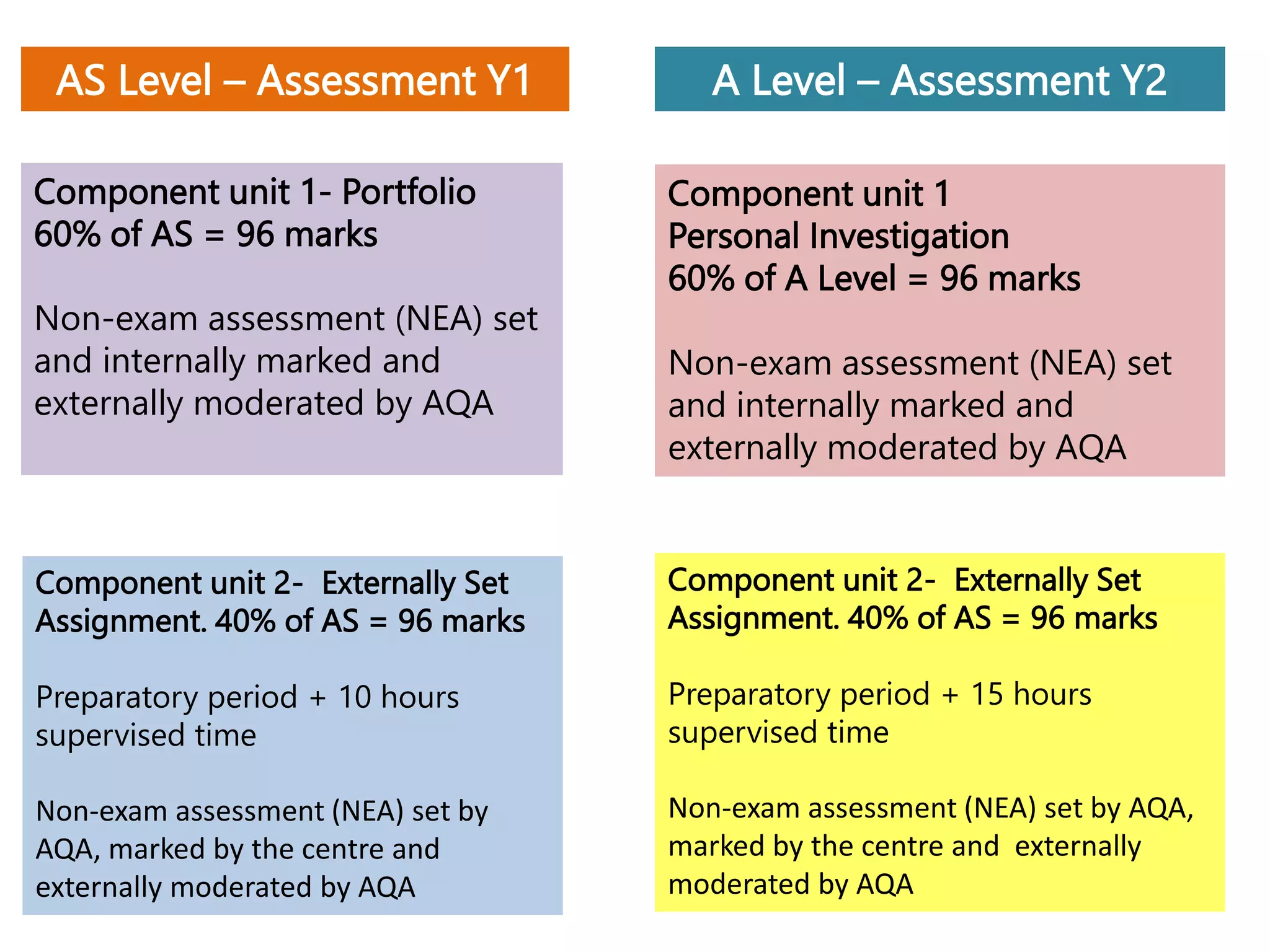
Component unit 1-Portfolio
60% of AS = 96 marks
Non-exam assessment (NEA) set
and internally marked and
externally moderated by AQA
AS Level – Assessment Y1
Component unit 2- Externally Set
Assignment. 40% of AS = 96 marks
Preparatory period + 10 hours
supervised time
Non-exam assessment (NEA) set by
AQA, marked by the centre and
externally moderated by AQA
A Level – Assessment Y2
Component unit 1
Personal Investigation
60% of A Level = 96 marks
Non-exam assessment (NEA) set
and internally marked and
externally moderated by AQA
Component unit 2- Externally Set
Assignment. 40% of AS = 96 marks
Preparatory period + 15 hours
supervised time
Non-exam assessment (NEA) set by AQA,
marked by the centre and externally
moderated by AQA
6.
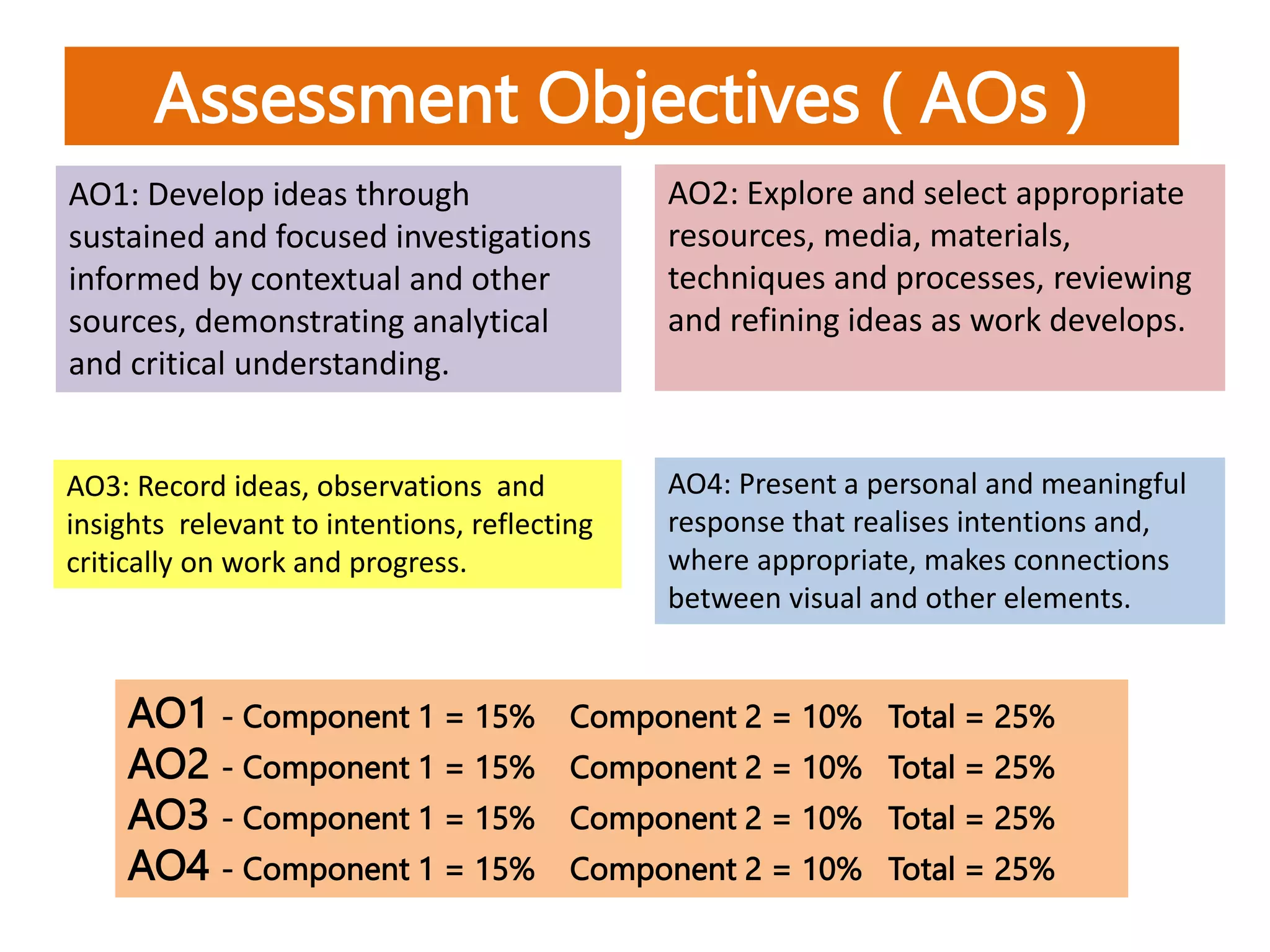
AO1: Develop ideasthrough
sustained and focused investigations
informed by contextual and other
sources, demonstrating analytical
and critical understanding.
Assessment Objectives ( AOs )
AO4: Present a personal and meaningful
response that realises intentions and,
where appropriate, makes connections
between visual and other elements.
AO2: Explore and select appropriate
resources, media, materials,
techniques and processes, reviewing
and refining ideas as work develops.
AO3: Record ideas, observations and
insights relevant to intentions, reflecting
critically on work and progress.
AO1 - Component 1 = 15% Component 2 = 10% Total = 25%
AO2 - Component 1 = 15% Component 2 = 10% Total = 25%
AO3 - Component 1 = 15% Component 2 = 10% Total = 25%
AO4 - Component 1 = 15% Component 2 = 10% Total = 25%
7.
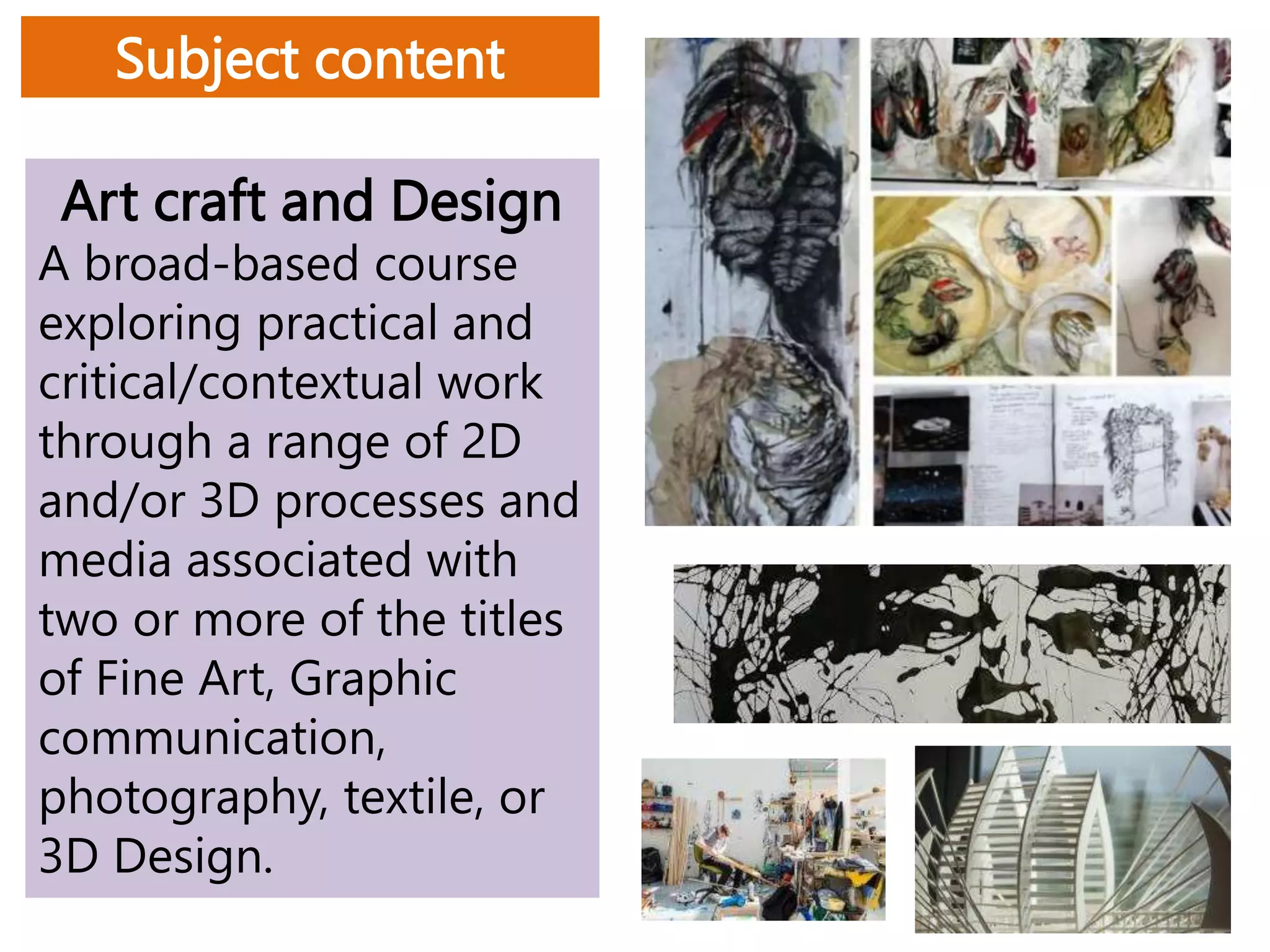
Art craft andDesign
A broad-based course
exploring practical and
critical/contextual work
through a range of 2D
and/or 3D processes and
media associated with
two or more of the titles
of Fine Art, Graphic
communication,
photography, textile, or
3D Design.
Subject content
8.
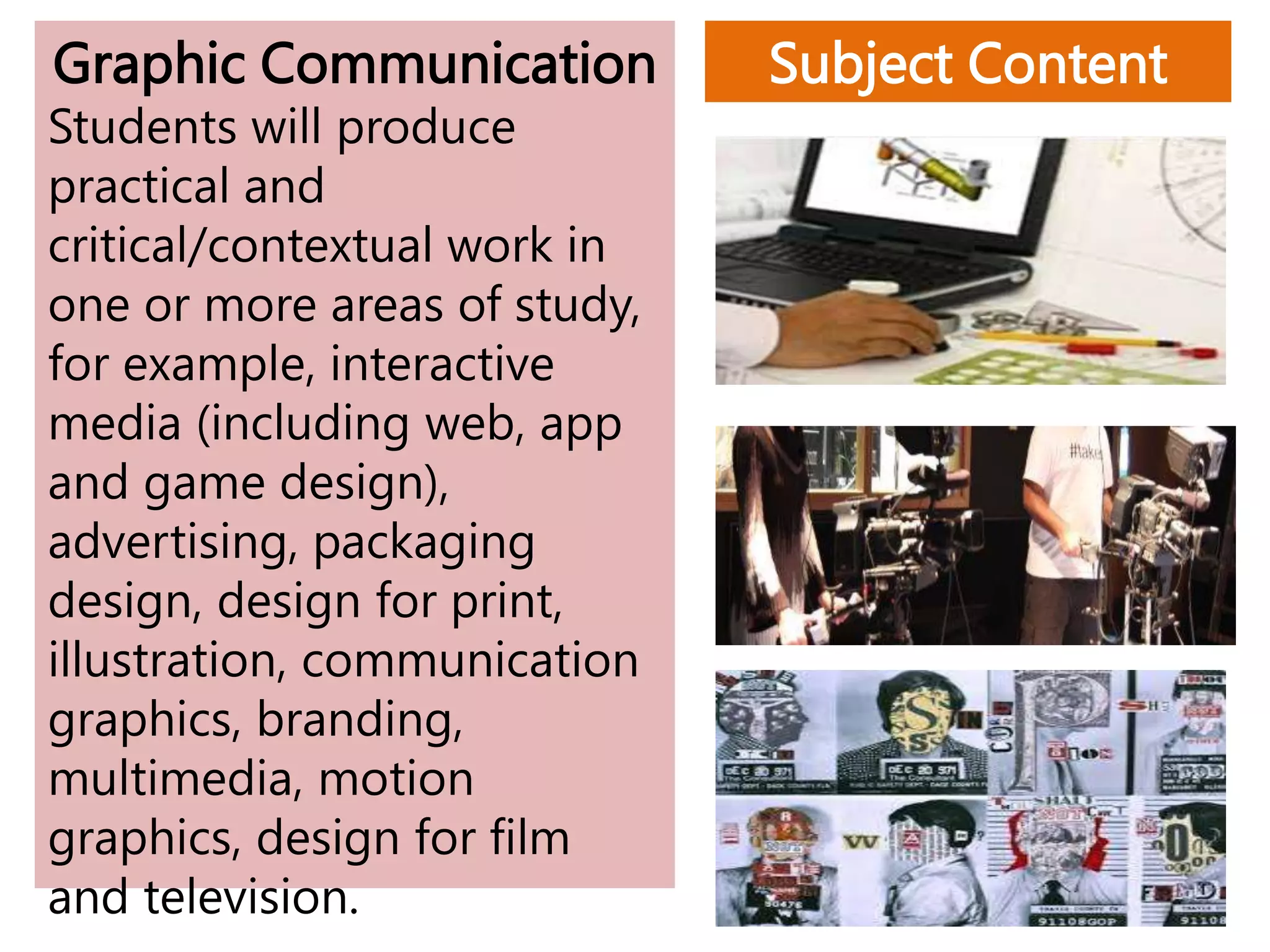
Subject Content
Graphic Communication
Studentswill produce
practical and
critical/contextual work in
one or more areas of study,
for example, interactive
media (including web, app
and game design),
advertising, packaging
design, design for print,
illustration, communication
graphics, branding,
multimedia, motion
graphics, design for film
and television.
9.
Subject content
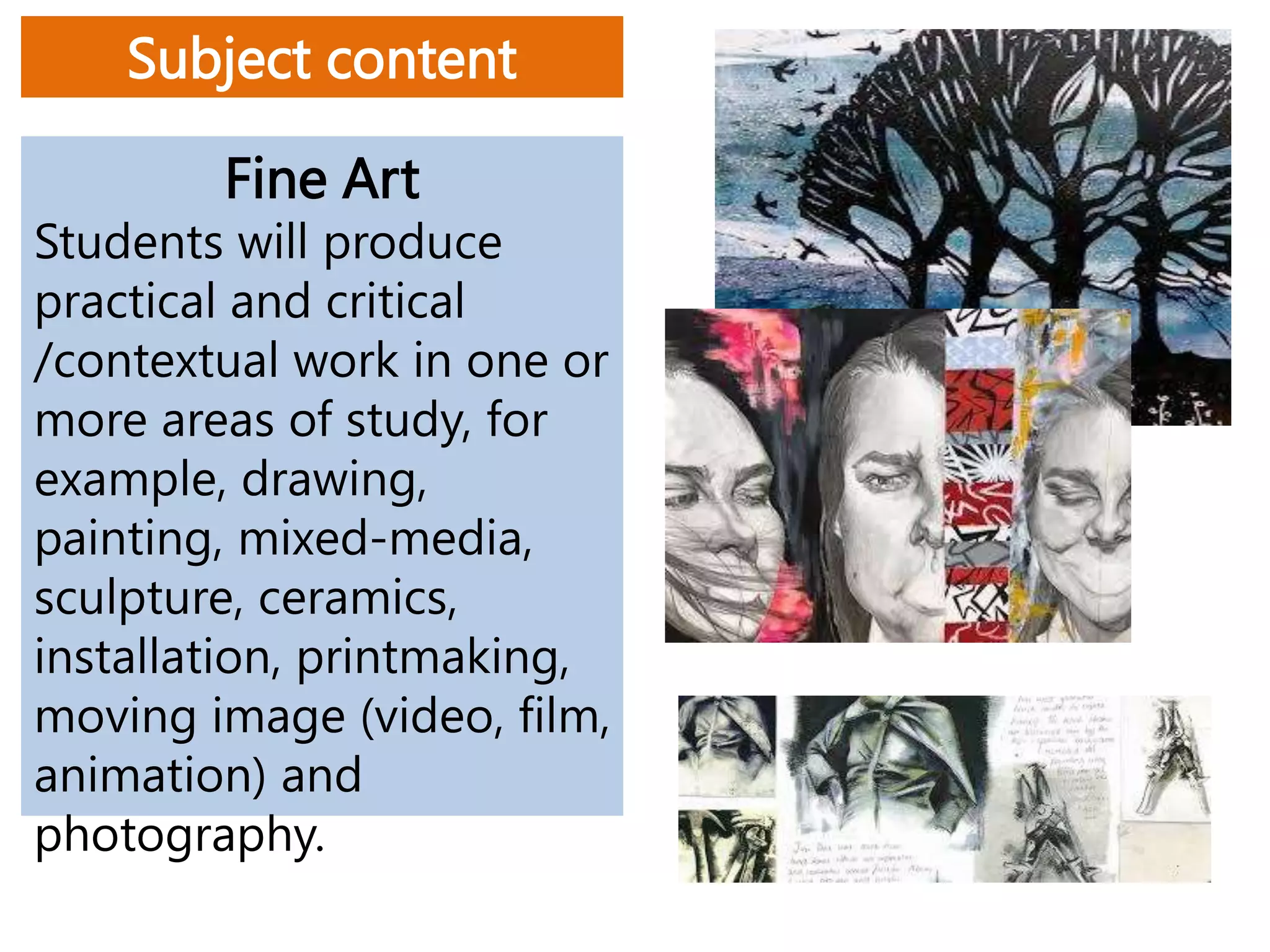
Fine Art
Studentswill produce
practical and critical
/contextual work in one or
more areas of study, for
example, drawing,
painting, mixed-media,
sculpture, ceramics,
installation, printmaking,
moving image (video, film,
animation) and
photography.
10.
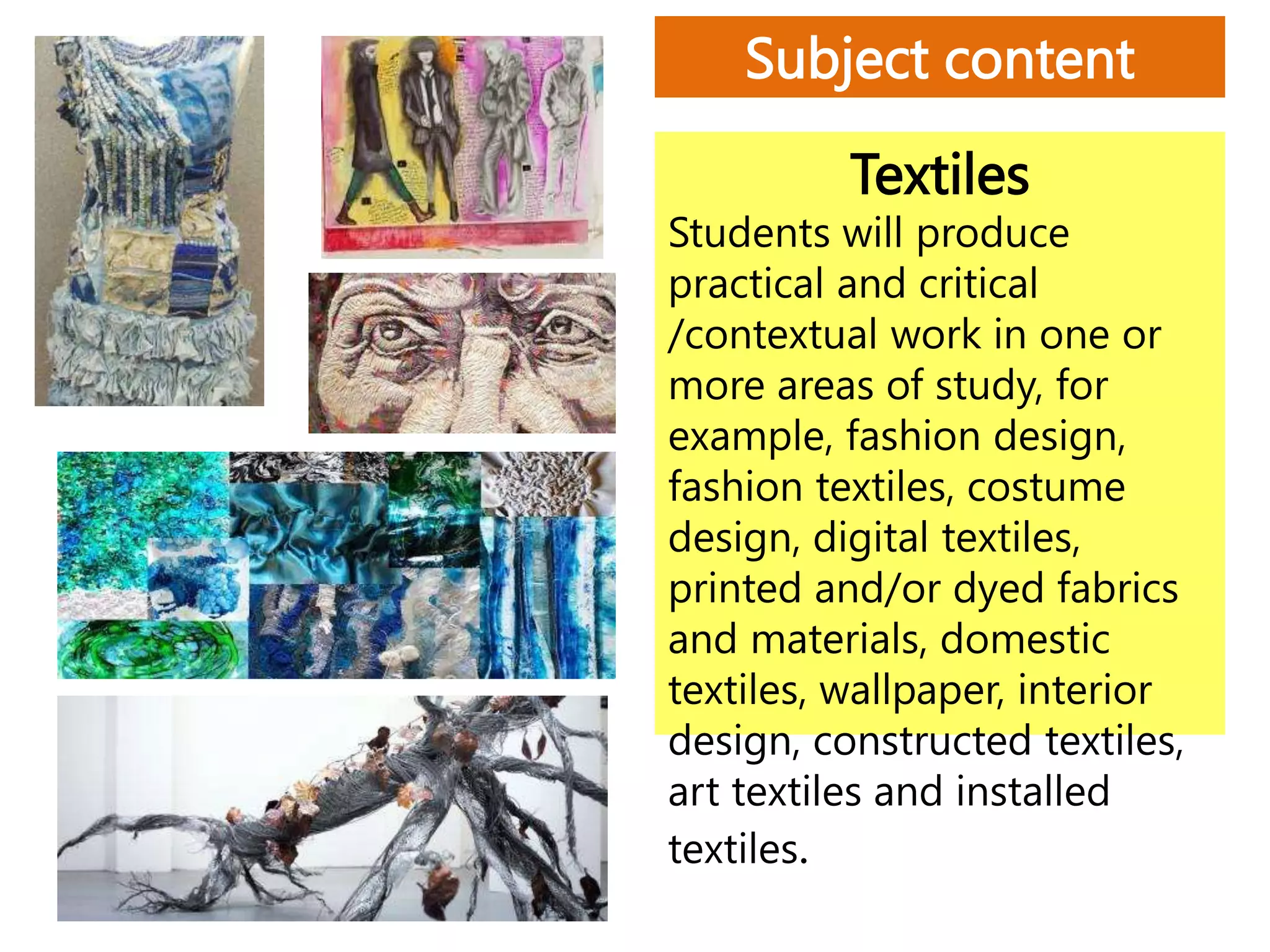
Textiles
Students will produce
practicaland critical
/contextual work in one or
more areas of study, for
example, fashion design,
fashion textiles, costume
design, digital textiles,
printed and/or dyed fabrics
and materials, domestic
textiles, wallpaper, interior
design, constructed textiles,
art textiles and installed
textiles.
Subject content
11.
Subject content
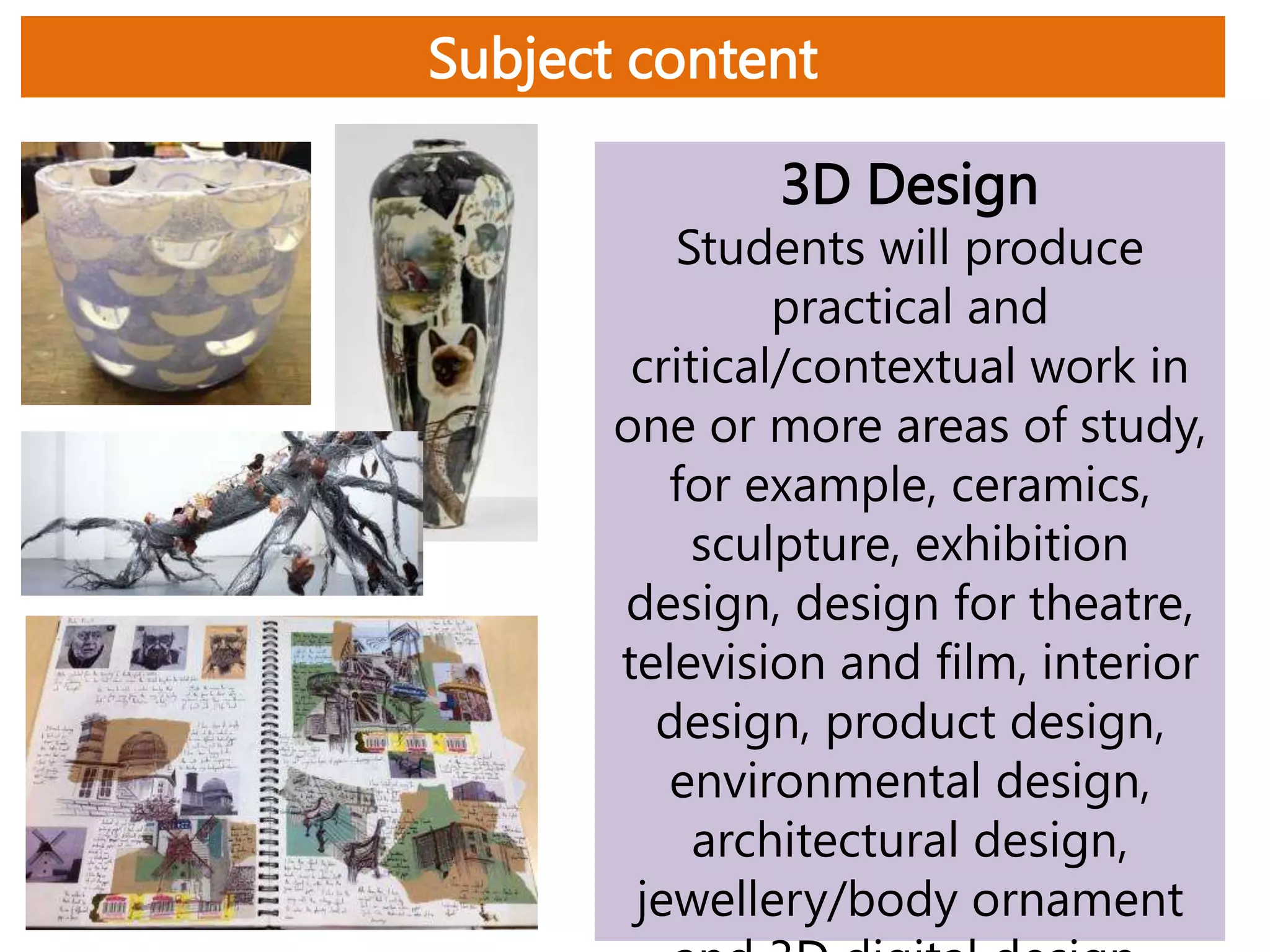
3D Design
Studentswill produce
practical and
critical/contextual work in
one or more areas of study,
for example, ceramics,
sculpture, exhibition
design, design for theatre,
television and film, interior
design, product design,
environmental design,
architectural design,
jewellery/body ornament
12.
Subject content
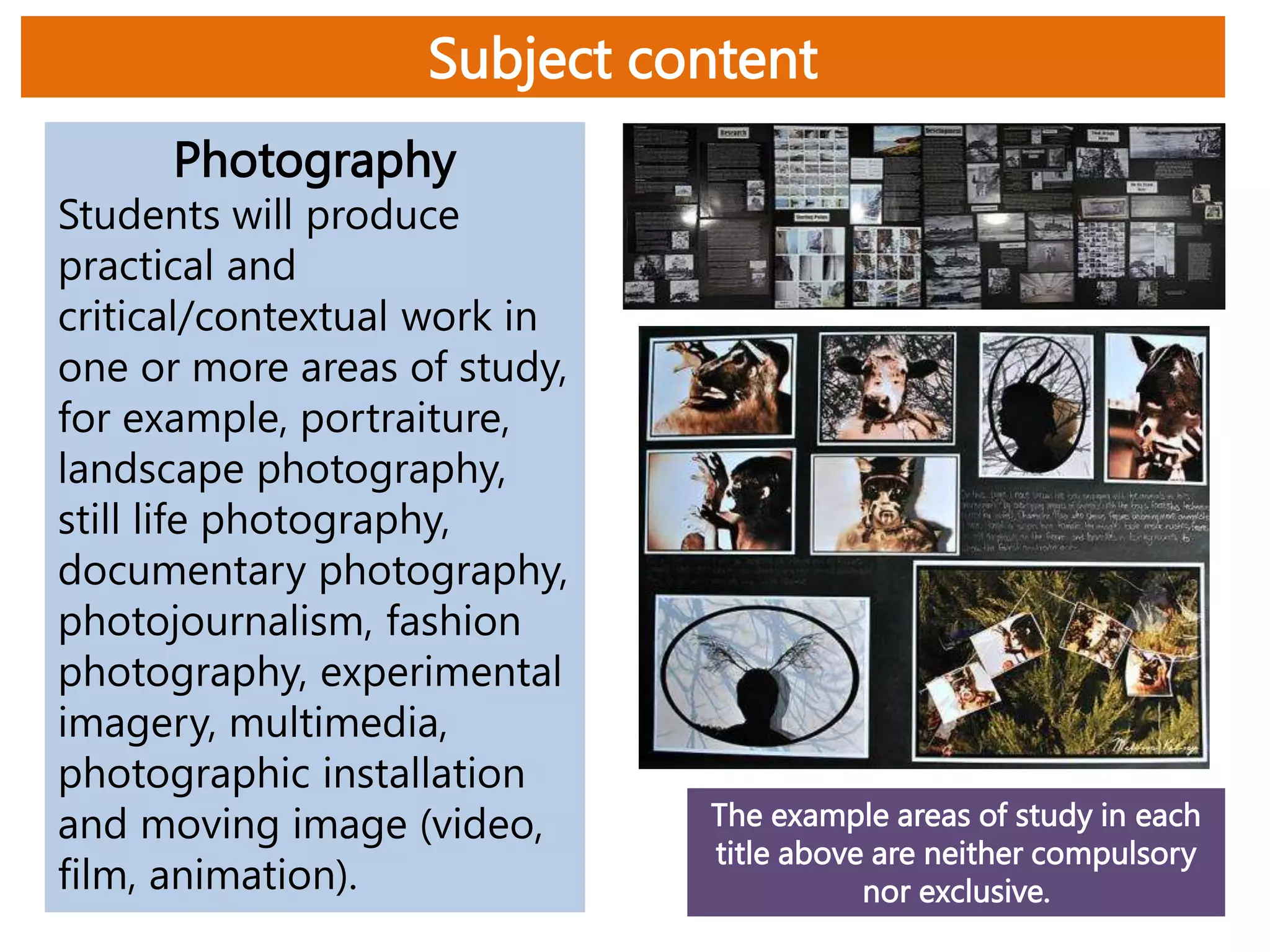
Photography
Students willproduce
practical and
critical/contextual work in
one or more areas of study,
for example, portraiture,
landscape photography,
still life photography,
documentary photography,
photojournalism, fashion
photography, experimental
imagery, multimedia,
photographic installation
and moving image (video,
film, animation).
The example areas of study in each
title above are neither compulsory
nor exclusive.
13.
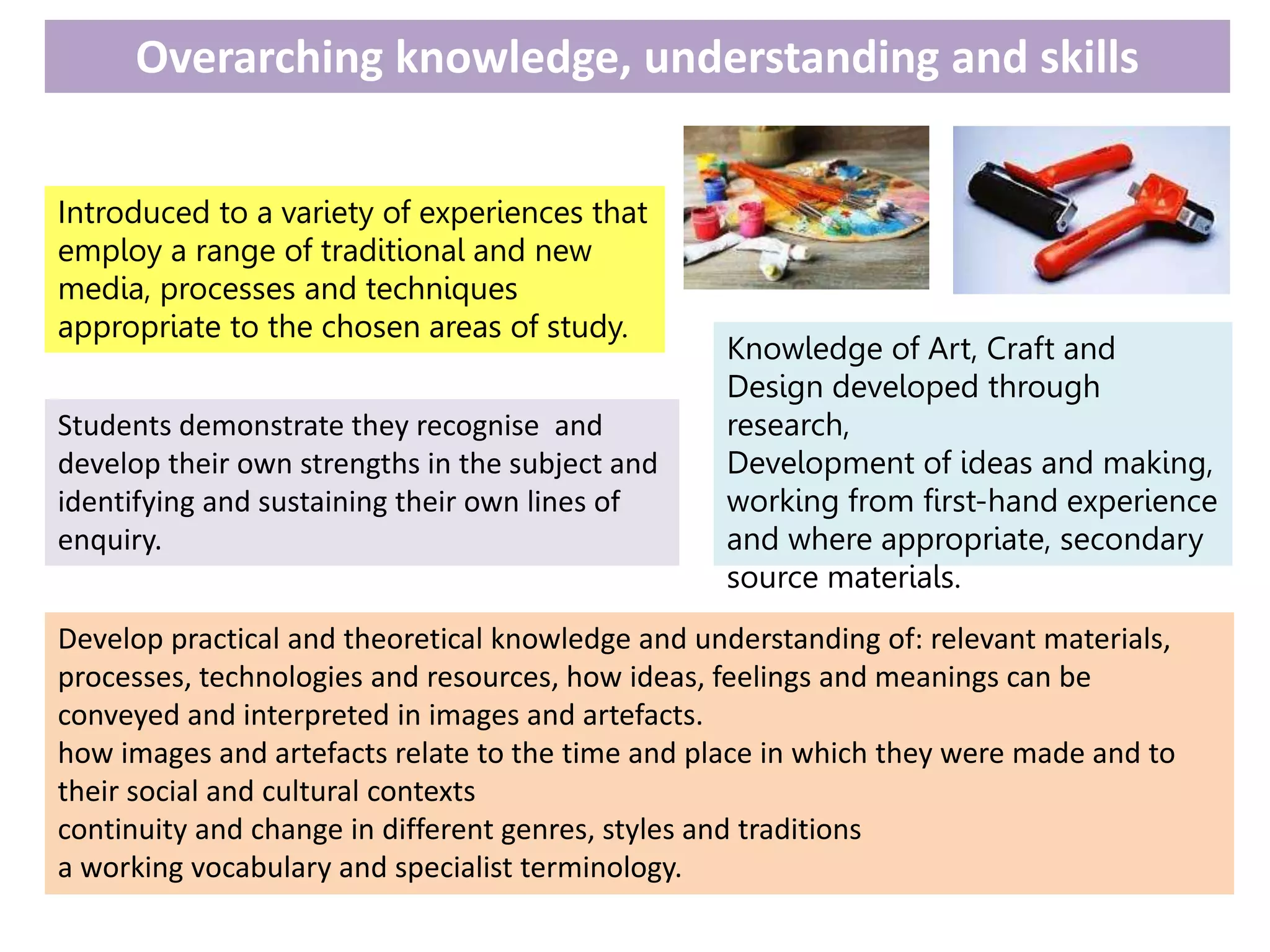
Overarching knowledge, understandingand skills
Introduced to a variety of experiences that
employ a range of traditional and new
media, processes and techniques
appropriate to the chosen areas of study.
Knowledge of Art, Craft and
Design developed through
research,
Development of ideas and making,
working from first-hand experience
and where appropriate, secondary
source materials.
Students demonstrate they recognise and
develop their own strengths in the subject and
identifying and sustaining their own lines of
enquiry.
Develop practical and theoretical knowledge and understanding of: relevant materials,
processes, technologies and resources, how ideas, feelings and meanings can be
conveyed and interpreted in images and artefacts.
how images and artefacts relate to the time and place in which they were made and to
their social and cultural contexts
continuity and change in different genres, styles and traditions
a working vocabulary and specialist terminology.
14.
Overarching knowledge, understandingand skills
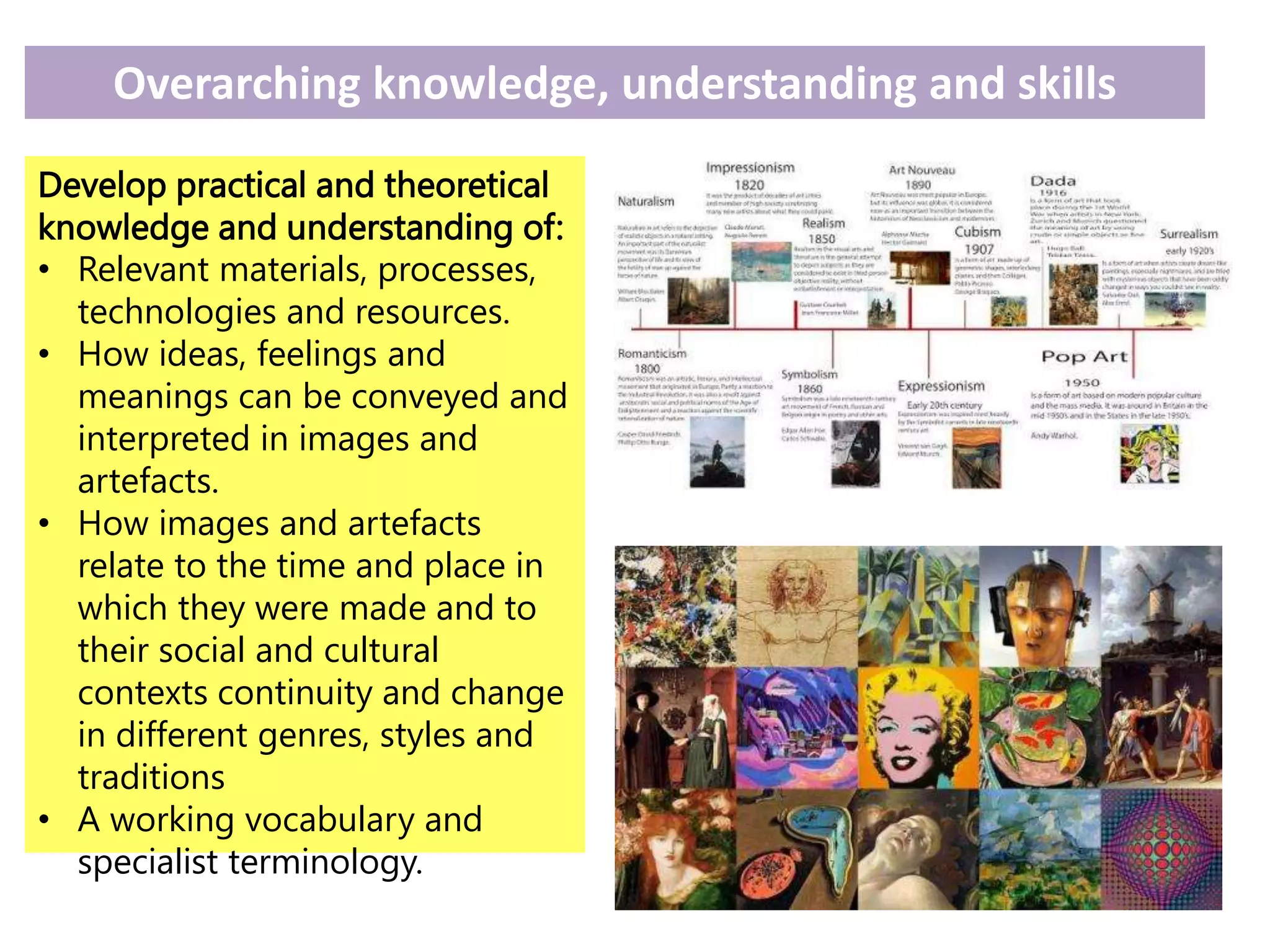
Develop practical and theoretical
knowledge and understanding of:
• Relevant materials, processes,
technologies and resources.
• How ideas, feelings and
meanings can be conveyed and
interpreted in images and
artefacts.
• How images and artefacts
relate to the time and place in
which they were made and to
their social and cultural
contexts continuity and change
in different genres, styles and
traditions
• A working vocabulary and
specialist terminology.
15.
Overarching knowledge, understandingand skills
Record experiences and observations, in a variety of ways using drawing or other
appropriate visual forms;
Undertake research; and gather, select and organise visual and other appropriate
information.
Explore relevant resources; analyse, discuss and evaluate images, objects and
artefacts; and make and record independent judgements.
Use knowledge and understanding of the work of others to develop and extend
thinking and inform own work.
Generate and explore potential lines of enquiry using appropriate media and
techniques
Apply knowledge and understanding in making images and artefacts; review and
modify work; and plan and develop ideas in the light of their own and others’
evaluations.
Organise, select and communicate ideas, solutions and responses, and present
them in a range of visual, tactile and/or sensory forms.
Students can work entirely in digital media or entirely in non-digital
media, or in a mixture of both, provided the aims and assessment
objectives are met.
16.
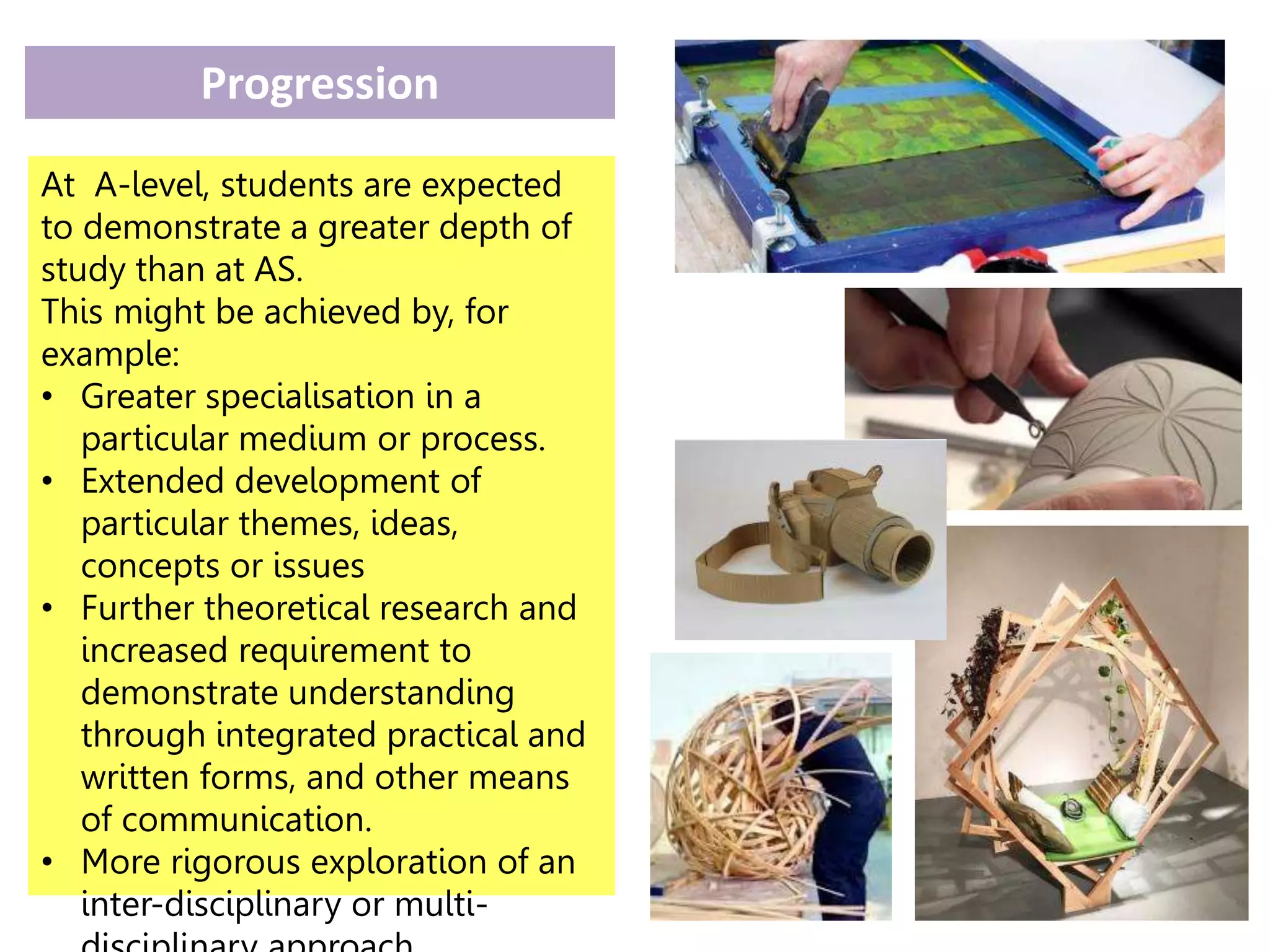
At A-level, studentsare expected
to demonstrate a greater depth of
study than at AS.
This might be achieved by, for
example:
• Greater specialisation in a
particular medium or process.
• Extended development of
particular themes, ideas,
concepts or issues
• Further theoretical research and
increased requirement to
demonstrate understanding
through integrated practical and
written forms, and other means
of communication.
• More rigorous exploration of an
inter-disciplinary or multi-
Progression
17.
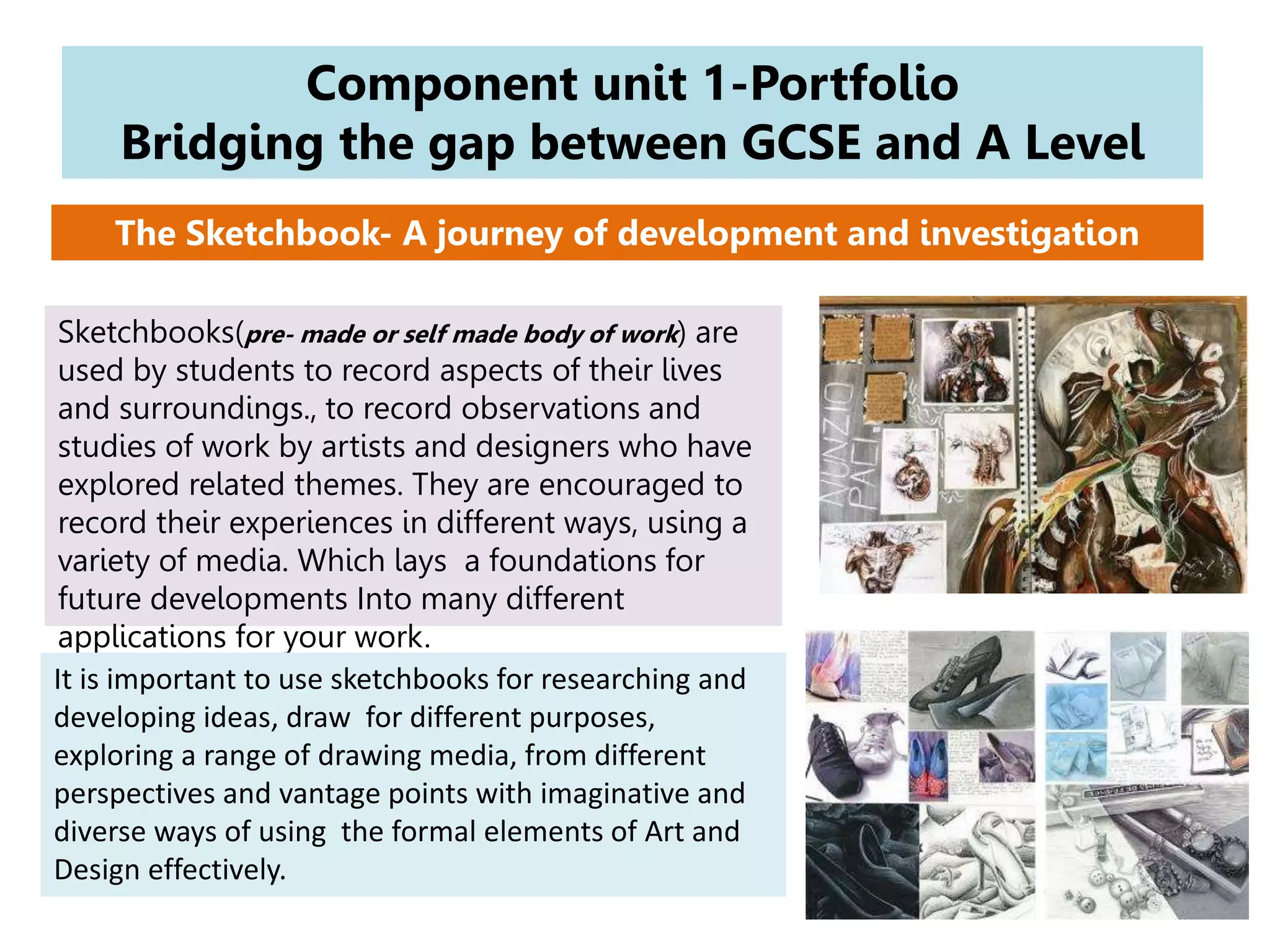
Sketchbooks(pre- made orself made body of work) are
used by students to record aspects of their lives
and surroundings., to record observations and
studies of work by artists and designers who have
explored related themes. They are encouraged to
record their experiences in different ways, using a
variety of media. Which lays a foundations for
future developments Into many different
applications for your work.
It is important to use sketchbooks for researching and
developing ideas, draw for different purposes,
exploring a range of drawing media, from different
perspectives and vantage points with imaginative and
diverse ways of using the formal elements of Art and
Design effectively.
Component unit 1-Portfolio
Bridging the gap between GCSE and A Level
The Sketchbook- A journey of development and investigation
18.
Component unit 1portfolio- Bridge the gap
Activity 1:
a) Choose one theme from the 6 below.
• The Urban Journey
• Microscopic inspection
• Encounters, Experiences and Meetings
• Combinations and Alliances
• Fossils
• Inside / Outside
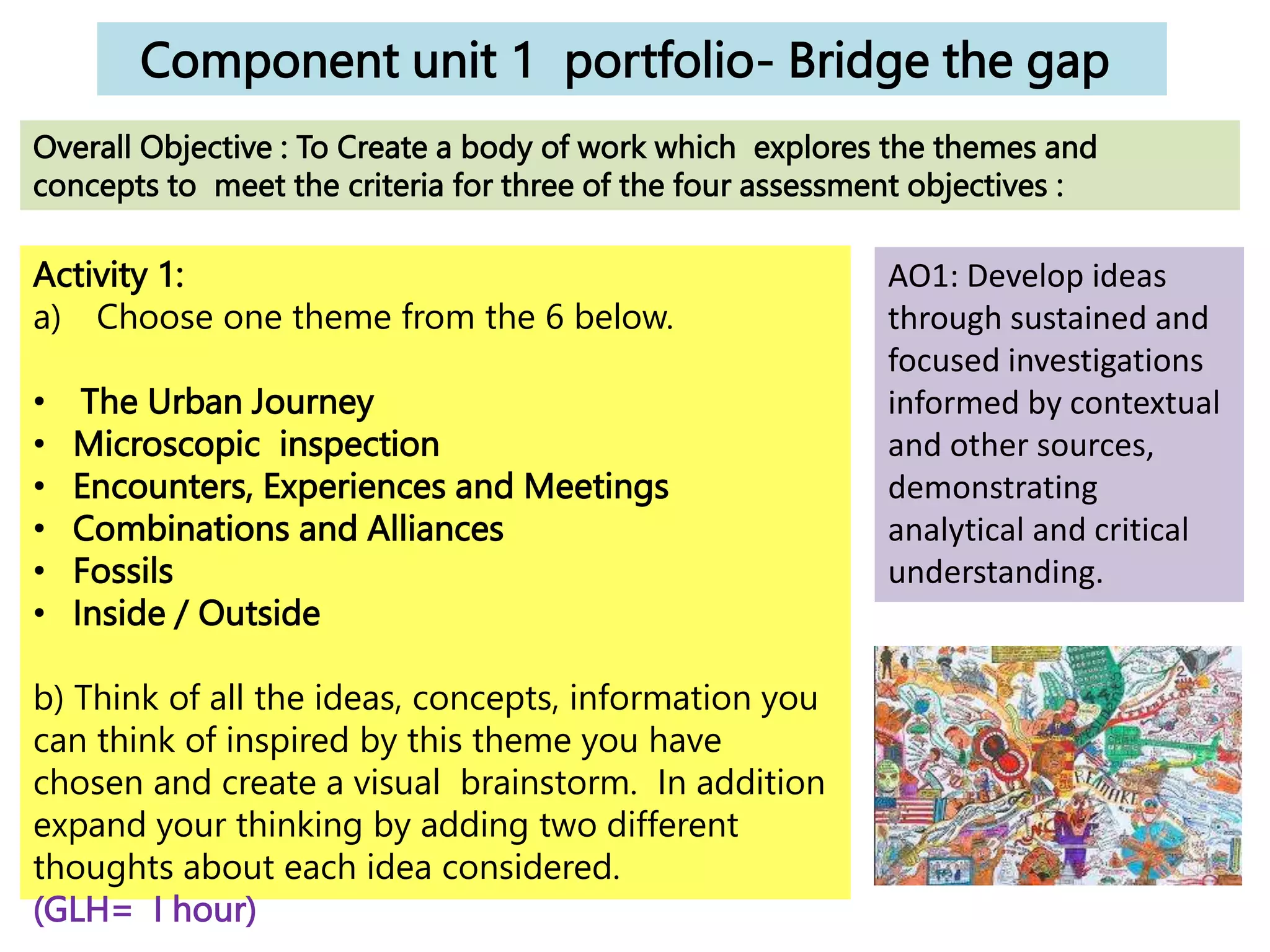
b) Think of all the ideas, concepts, information you
can think of inspired by this theme you have
chosen and create a visual brainstorm. In addition
expand your thinking by adding two different
thoughts about each idea considered.
(GLH= I hour)
Overall Objective : To Create a body of work which explores the themes and
concepts to meet the criteria for three of the four assessment objectives :
AO1: Develop ideas
through sustained and
focused investigations
informed by contextual
and other sources,
demonstrating
analytical and critical
understanding.
19.
Component unit 1portfolio- Bridge the gap
Activity 2:
a) Research, gather collect and select a range
(15 ) of your ideas and concepts from your
brainstorm. Inspired by your chosen theme .
Each idea should be supported by explaining
how each links to the theme. (PEEL) (GLH= I
hour)
b) Record(draw in different ways) these ideas
effectively using the appropriate materials, as
responses to the research collected. ( 5 plus)
(GLH= I hour each )
(Consider using your own photographs as part of your recording)
C) After each recorded idea, create, explain how
you may develop them further.
(GLH= 20 minutes )
Overall Objective : To Create a body of work which explores the themes and
concepts to meet the criteria for three of the four assessment objectives :
AO1: Develop ideas
through sustained and
focused investigations
informed by contextual
and other sources,
demonstrating
analytical and critical
understanding.
AO3: Record ideas,
observations and insights
relevant to intentions,
reflecting critically on work
and progress.
20.
Component unit 1portfolio- Bridge the gap
Activity 3:
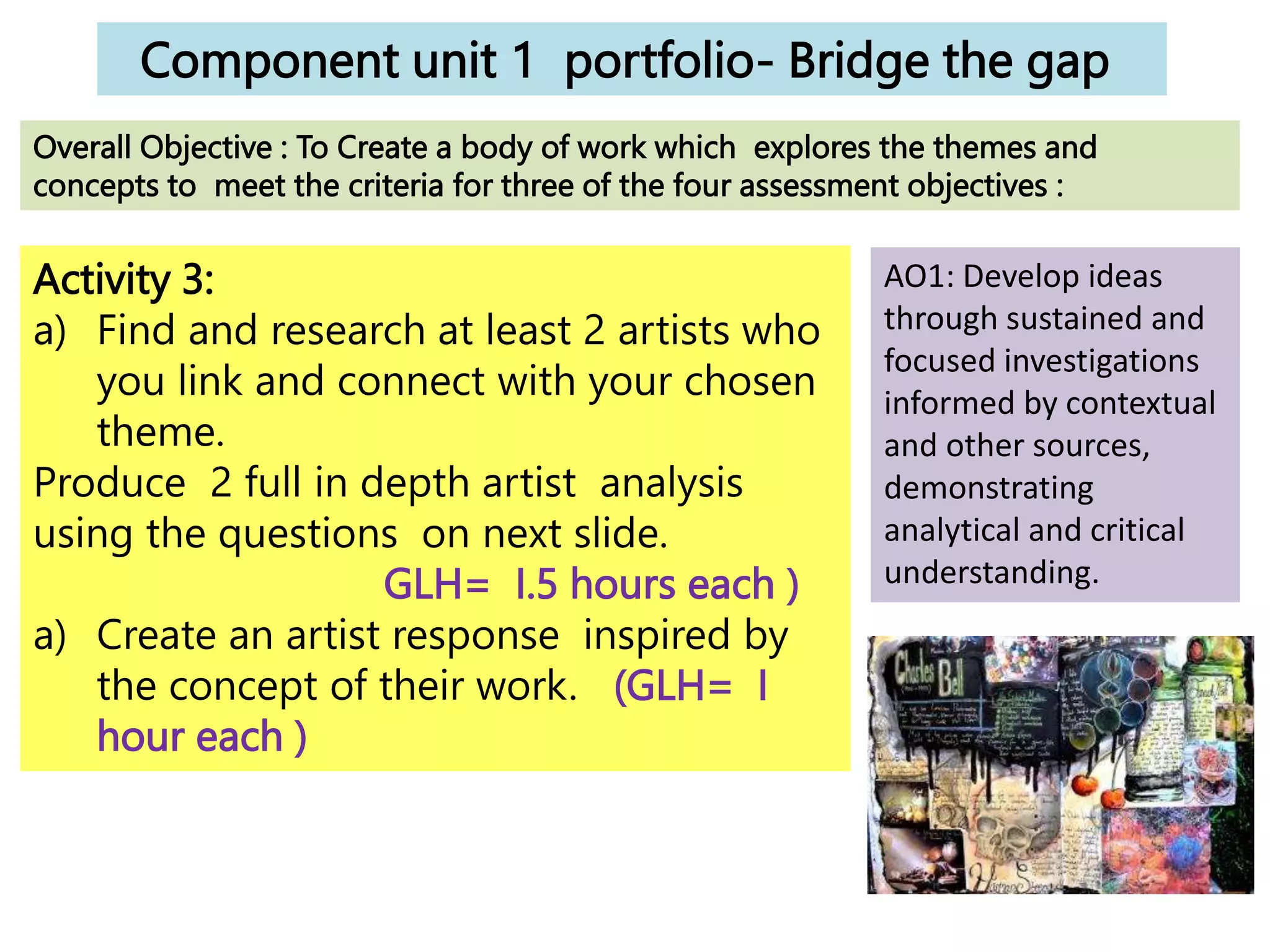
a) Find and research at least 2 artists who
you link and connect with your chosen
theme.
Produce 2 full in depth artist analysis
using the questions on next slide.
GLH= I.5 hours each )
a) Create an artist response inspired by
the concept of their work. (GLH= I
hour each )
Overall Objective : To Create a body of work which explores the themes and
concepts to meet the criteria for three of the four assessment objectives :
AO1: Develop ideas
through sustained and
focused investigations
informed by contextual
and other sources,
demonstrating
analytical and critical
understanding.
21.
Component unit 1portfolio- Bridge the gap
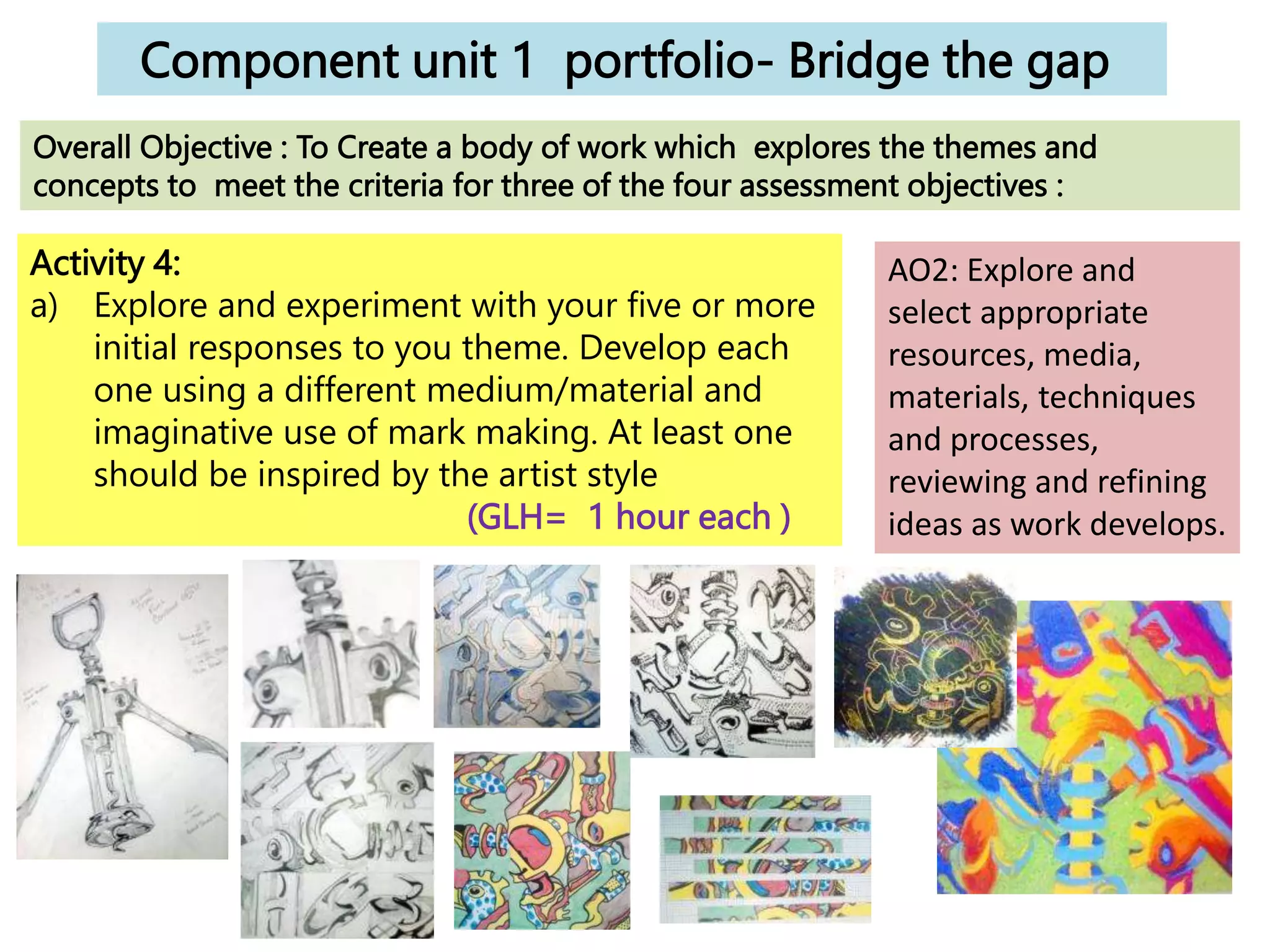
Activity 4:
a) Explore and experiment with your five or more
initial responses to you theme. Develop each
one using a different medium/material and
imaginative use of mark making. At least one
should be inspired by the artist style
(GLH= 1 hour each )
Overall Objective : To Create a body of work which explores the themes and
concepts to meet the criteria for three of the four assessment objectives :
AO2: Explore and
select appropriate
resources, media,
materials, techniques
and processes,
reviewing and refining
ideas as work develops.
22.
Component unit 1portfolio- Bridge the gap
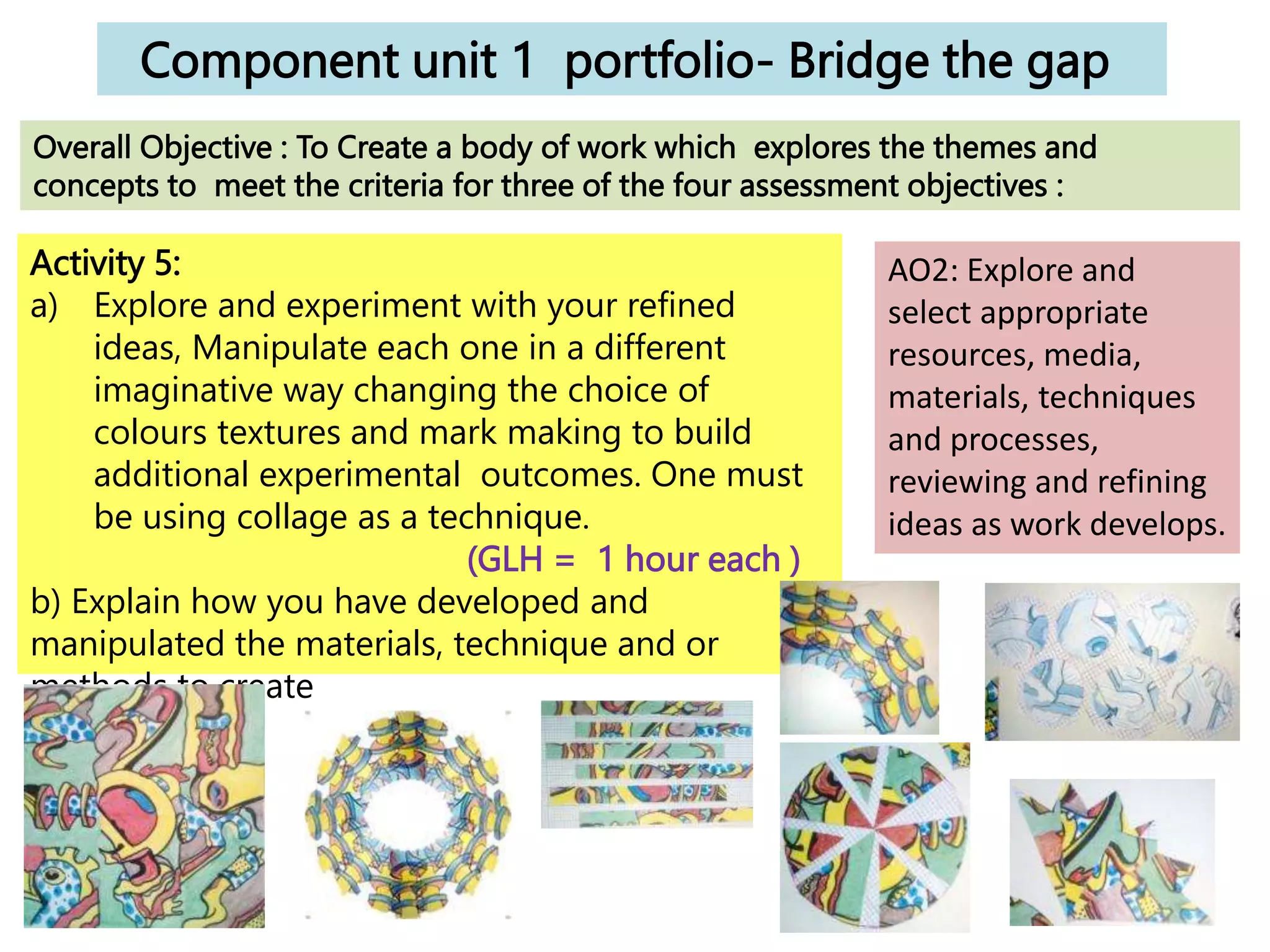
Activity 5:
a) Explore and experiment with your refined
ideas, Manipulate each one in a different
imaginative way changing the choice of
colours textures and mark making to build
additional experimental outcomes. One must
be using collage as a technique.
(GLH = 1 hour each )
b) Explain how you have developed and
manipulated the materials, technique and or
methods to create
each idea.
Overall Objective : To Create a body of work which explores the themes and
concepts to meet the criteria for three of the four assessment objectives :
AO2: Explore and
select appropriate
resources, media,
materials, techniques
and processes,
reviewing and refining
ideas as work develops.
23.
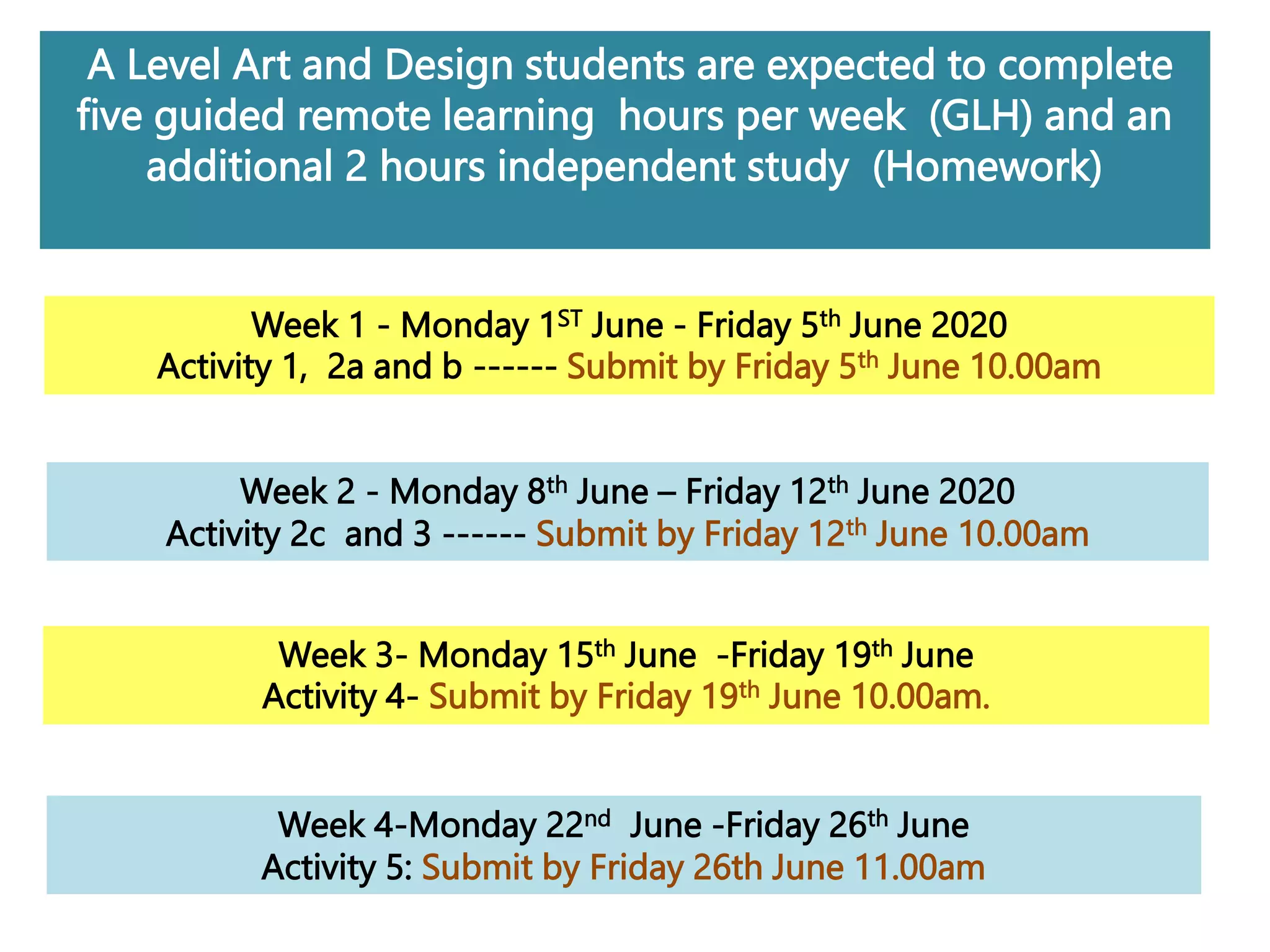
Week 1 -Monday 1ST June - Friday 5th June 2020
Activity 1, 2a and b ------ Submit by Friday 5th June 10.00am
Week 2 - Monday 8th June – Friday 12th June 2020
Activity 2c and 3 ------ Submit by Friday 12th June 10.00am
Week 3- Monday 15th June -Friday 19th June
Activity 4- Submit by Friday 19th June 10.00am.
Week 4-Monday 22nd June -Friday 26th June
Activity 5: Submit by Friday 26th June 11.00am
A Level Art and Design students are expected to complete
five guided remote learning hours per week (GLH) and an
additional 2 hours independent study (Homework)


![Stage2 specialist areas_2011[1]](https://cdn.slidesharecdn.com/ss_thumbnails/stage2specialistareas20111-111204182545-phpapp01-thumbnail.jpg?width=640&height=640&fit=bounds)


