“Creativity is contagious, pass it
on” - Albert Einstein

Gallery Websites

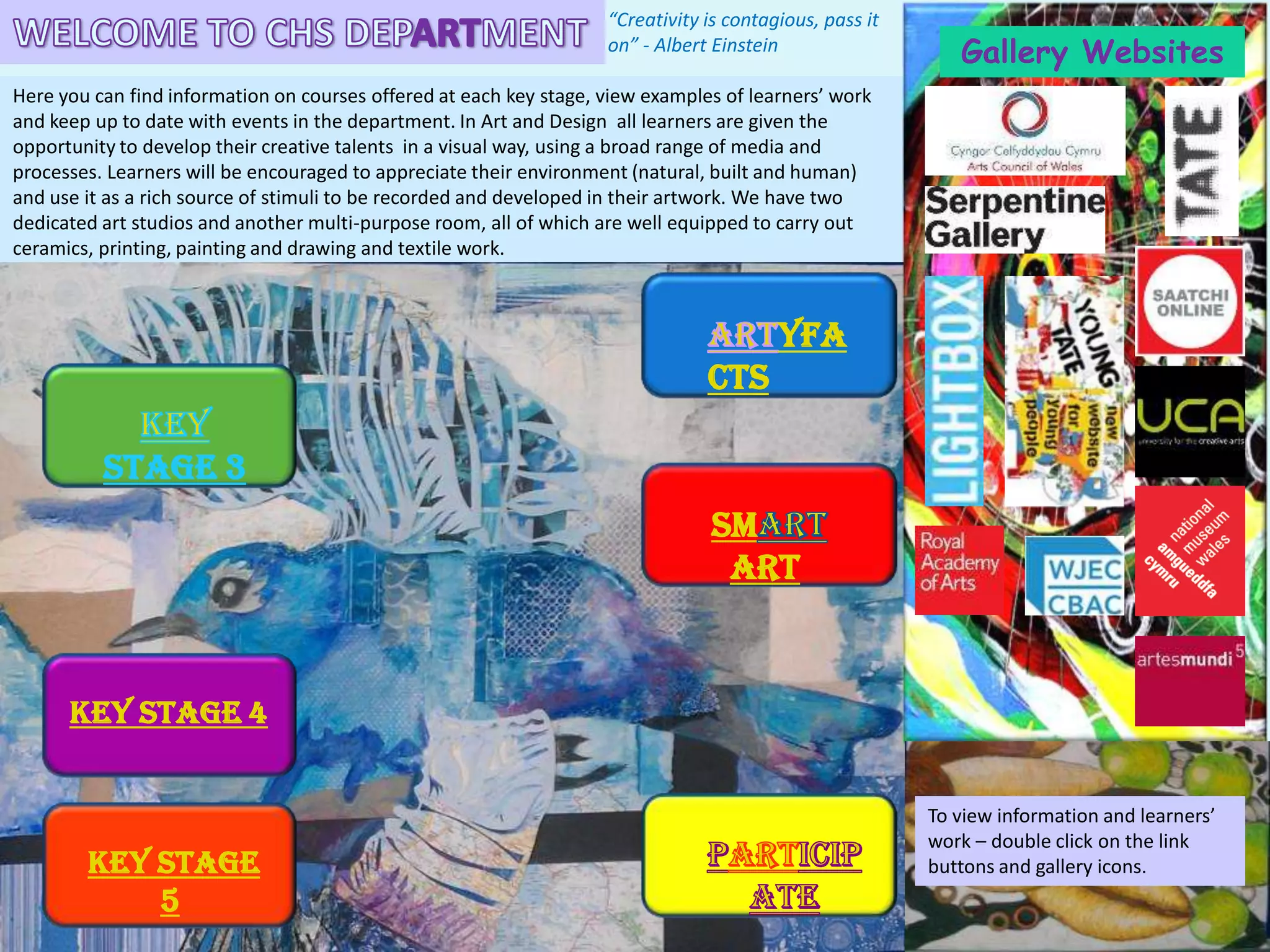
Here you can find information on courses offered at each key stage, view examples of learners’ work
and keep up to date with events in the department. In Art and Design all learners are given the
opportunity to develop their creative talents in a visual way, using a broad range of media and
processes. Learners will be encouraged to appreciate their environment (natural, built and human)
and use it as a rich source of stimuli to be recorded and developed in their artwork. We have two
dedicated art studios and another multi-purpose room, all of which are well equipped to carry out
ceramics, printing, painting and drawing and textile work.

yfa

cts
Stage 3
Sm
Art

Key Stage 4

Key Stage
5

To view information and learners’
work – double click on the link
buttons and gallery icons.
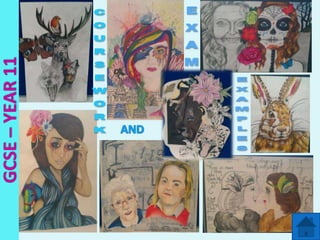
WJEC GCSE Art & Design has been designed for a wide range of candidates. It is particularly suitable for
those who enjoy painting, drawing, print-making, constructing, modelling, fabricating, making, investigating,
handling traditional and/or contemporary media, materials, techniques and tools, inventing, improvising,
planning and designing and using historical and contemporary influences and references.
However, learners’ work ethic and attitude will determine their success as they will be expected to work to
strict deadlines and to take responsibility for researching, planning, organising, experimenting, making and
completing their work to the best of their ability.
Parents should expect to see quality homework/coursework being completed on a weekly basis.
Below is an outline of the assessment for the two year course.
Assessment 1 (Candidate Portfolio) (60%) Begins in Year 10 120 marks
• Internally set and developed from personal and/or given starting
points
• Selected and presented by the candidate from work undertaken
within the course
• Requires evidence of how the candidate has met each of the
assessment objectives
Assessment 2 Exam (Externally set task or starting point) [research &
preparation plus 10 hours] (40%) Spring term Year 11 80 marks
• Requires a sustained period of focussed study of no longer than
10 hours
• Presented to the candidates no earlier than the start of January
in the year of the examination
• Requires evidence of how the candidate has met each of the
assessment objective
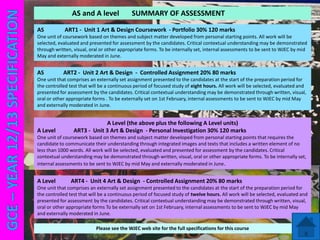
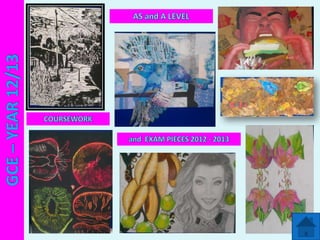
AS and A level
AS

SUMMARY OF ASSESSMENT

ART1 - Unit 1 Art & Design Coursework - Portfolio 30% 120 marks

One unit of coursework based on themes and subject matter developed from personal starting points. All work will be
selected, evaluated and presented for assessment by the candidates. Critical contextual understanding may be demonstrated
through written, visual, oral or other appropriate forms. To be internally set, internal assessments to be sent to WJEC by mid
May and externally moderated in June.

AS

ART2 - Unit 2 Art & Design - Controlled Assignment 20% 80 marks

One unit that comprises an externally set assignment presented to the candidates at the start of the preparation period for
the controlled test that will be a continuous period of focused study of eight hours. All work will be selected, evaluated and
presented for assessment by the candidates. Critical contextual understanding may be demonstrated through written, visual,
oral or other appropriate forms . To be externally set on 1st February, internal assessments to be sent to WJEC by mid May
and externally moderated in June.

A Level

A Level (the above plus the following A Level units)
ART3 - Unit 3 Art & Design - Personal Investigation 30% 120 marks

One unit of coursework based on themes and subject matter developed from personal starting points that requires the
candidate to communicate their understanding through integrated images and texts that includes a written element of no
less than 1000 words. All work will be selected, evaluated and presented for assessment by the candidates. Critical
contextual understanding may be demonstrated through written, visual, oral or other appropriate forms. To be internally set,
internal assessments to be sent to WJEC by mid May and externally moderated in June.

A Level

ART4 - Unit 4 Art & Design - Controlled Assignment 20% 80 marks

One unit that comprises an externally set assignment presented to the candidates at the start of the preparation period for
the controlled test that will be a continuous period of focused study of twelve hours. All work will be selected, evaluated and
presented for assessment by the candidates. Critical contextual understanding may be demonstrated through written, visual,
oral or other appropriate forms To be externally set on 1st February, internal assessments to be sent to WJEC by mid May
and externally moderated in June.
Please see the WJEC web site for the full specifications for this course
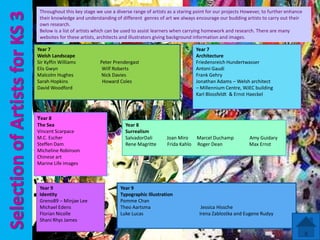
Throughout this key stage we use a diverse range of artists as a staring point for our projects However, to further enhance
their knowledge and understanding of different genres of art we always encourage our budding artists to carry out their
own research.
Below is a list of artists which can be used to assist learners when carrying homework and research. There are many
websites for these artists, architects and illustrators giving background information and images.

Year 7
Welsh Landscape
Sir Kyffin Williams
Elis Gwyn
Malcolm Hughes
Sarah Hopkins
David Woodford

Year 7
Architecture
Friedensreich Hundertwasser
Antoni Gaudi
Frank Gehry
Jonathan Adams – Welsh architect
– Millennium Centre, WJEC building
Karl Blossfeldt & Ernst Haeckel

Peter Prendergast
Wilf Roberts
Nick Davies
Howard Coles

Year 8
The Sea
Vincent Scarpace
M.C. Escher
Steffen Dam
Micheline Robinson
Chinese art
Marine Life images

Year 9
Identity
Greno89 – Minjae Lee
Michael Edens
Florian Nicolle
Shani Rhys James

Year 8
Surrealism
SalvadorDali
Rene Magritte

Joan Miro
Frida Kahlo

Year 9
Typographic Illustration
Pomme Chan
Theo Aartsma
Luke Lucas

Marcel Duchamp
Roger Dean

Amy Guidary
Max Ernst

Jessica Hissche
Irena Zablostka and Eugene Rudyy
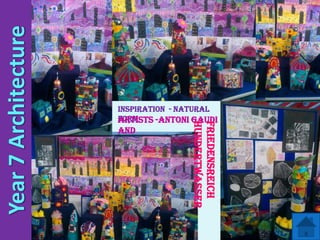
and

Friedensreich
Hundertwasser

INSPIRATION - Natural
Form
Artists -Antoni Gaudi
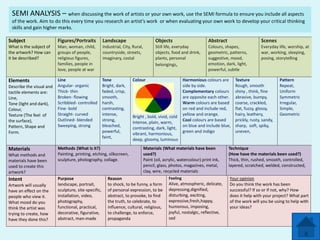
SEMI ANALYSIS – when discussing the work of artists or your own work, use the SEMI formula to ensure you include all aspects
of the work. Aim to do this every time you research an artist’s work or when evaluating your own work to develop your critical thinking
skills and gain higher marks.
ART- SEMI Analysis – Use this to write talk and write about artwork.
Subject
Figures/Portraits Landscape
Objects
Abstract
Scenes
What is the subject of
the artwork? How can
it be described?

Man, woman, child,
groups of people,
religious figures,
families, people in
love, people at war

Industrial, City, Rural,
countryside, streets,
imaginary, costal

Elements

Line
Angular- organic
Thick- thin
Broken- flowing
Scribbled- controlled
Fine- bold
Straight- curved
Outlined- blended
Sweeping, strong

Tone
Bright, dark,
faded, crisp,
smooth,
harsh,
contrasting,
intense,
strong,
bleached,
powerful,
faint,

Describe the visual and
tactile elements are:
Line,
Tone (light and dark),
Colour,
Texture (The feel of
the surface),
Pattern, Shape and
Form.

Materials
What methods and
materials have been
used to create this
artwork?

Intent
Artwork will usually
have an effect on the
people who view it.
What mood do you
think the artist was
trying to create, how
have they done this?

Methods (What is it?)
Painting, printing, etching, silkscreen,
sculpture, photography, collage.

Purpose
landscape, portrait,
sculpture, site-specific,
installation, video,
photography,
functional, practical,
decorative, figurative,
abstract, man-made

Still life, everyday
objects, food and drink,
plants, personal
belongings,

Colour

Bright , bold, vivid, cold
intense, plain, warm,
contrasting, dark, light,
vibrant, harmonious,
deep, gloomy, luminous

Colours, shapes,
geometric, patterns,
suggestive, mood,
emotion, dark, light,
powerful, subtle

Harmonious colours are
side by side.
Complementary colours
are opposite each other.
Warm colours are based
on red and include red,
yellow and orange.
Cool colours are based
on blue and include blue,
green and indigo

Materials (What materials have been
used?)
Paint (oil, acrylic, watercolour) print ink,
pencil, glass, photos, magazines, metal,
clay, wire, recycled materials

Reason
to shock, to be funny, a form
of personal expression, to be
abstract, to provoke, to find
the truth, to celebrate, to
influence, cultural, religious,
to challenge, to enforce,
propaganda

Feeling

Alive, atmospheric, delicate,
depressing,dignified,
disturbing, exciting,
expressive,fresh,happy,
humorous, imposing,
joyful, nostalgic, reflective,
sad

Everyday life, worship, at
war, working, sleeping,
posing, storytelling

Texture
Rough, smooth
shiny , think, fine
abrasive, bumpy,
coarse, crackled,
flat, fuzzy, glossy,
hairy, leathery,
prickly, rusty, sandy,
sharp, soft, spiky,
uneven,

Pattern
Repeat,
Uniform
Symmetric
Irregular,
Simple,
Geometric

Technique
(How have the materials been used?)
Thick, thin, rushed, smooth, controlled,
layered, scratched, welded, constructed,
Your opinion
Do you think the work has been
successful? If so or if not, why? How
does it help with your project? What part
of the work will you be using to help with
your ideas?
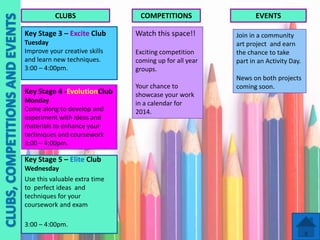
CLUBS

COMPETITIONS

EVENTS

Key Stage 3 – Excite Club

Watch this space!!

Tuesday
Improve your creative skills
and learn new techniques.
3:00 – 4:00pm.

Exciting competition
coming up for all year
groups.

Join in a community
art project and earn
the chance to take
part in an Activity Day.

Key Stage 4 -EvolutionClub
Monday
Come along to develop and
experiment with ideas and
materials to enhance your
techniques and coursework
3:00 – 4:00pm.

Key Stage 5 – Elite Club
Wednesday
Use this valuable extra time
to perfect ideas and
techniques for your
coursework and exam
3:00 – 4:00pm.

Your chance to
showcase your work
in a calendar for
2014.

News on both projects
coming soon.

Cwmcarn High School Art Department

  • 1.
    “Creativity is contagious,pass it on” - Albert Einstein Gallery Websites Here you can find information on courses offered at each key stage, view examples of learners’ work and keep up to date with events in the department. In Art and Design all learners are given the opportunity to develop their creative talents in a visual way, using a broad range of media and processes. Learners will be encouraged to appreciate their environment (natural, built and human) and use it as a rich source of stimuli to be recorded and developed in their artwork. We have two dedicated art studios and another multi-purpose room, all of which are well equipped to carry out ceramics, printing, painting and drawing and textile work. yfa cts Stage 3 Sm Art Key Stage 4 Key Stage 5 To view information and learners’ work – double click on the link buttons and gallery icons.
  • 2.
    WJEC GCSE Art& Design has been designed for a wide range of candidates. It is particularly suitable for those who enjoy painting, drawing, print-making, constructing, modelling, fabricating, making, investigating, handling traditional and/or contemporary media, materials, techniques and tools, inventing, improvising, planning and designing and using historical and contemporary influences and references. However, learners’ work ethic and attitude will determine their success as they will be expected to work to strict deadlines and to take responsibility for researching, planning, organising, experimenting, making and completing their work to the best of their ability. Parents should expect to see quality homework/coursework being completed on a weekly basis. Below is an outline of the assessment for the two year course. Assessment 1 (Candidate Portfolio) (60%) Begins in Year 10 120 marks • Internally set and developed from personal and/or given starting points • Selected and presented by the candidate from work undertaken within the course • Requires evidence of how the candidate has met each of the assessment objectives Assessment 2 Exam (Externally set task or starting point) [research & preparation plus 10 hours] (40%) Spring term Year 11 80 marks • Requires a sustained period of focussed study of no longer than 10 hours • Presented to the candidates no earlier than the start of January in the year of the examination • Requires evidence of how the candidate has met each of the assessment objective
  • 3.
    AS and Alevel AS SUMMARY OF ASSESSMENT ART1 - Unit 1 Art & Design Coursework - Portfolio 30% 120 marks One unit of coursework based on themes and subject matter developed from personal starting points. All work will be selected, evaluated and presented for assessment by the candidates. Critical contextual understanding may be demonstrated through written, visual, oral or other appropriate forms. To be internally set, internal assessments to be sent to WJEC by mid May and externally moderated in June. AS ART2 - Unit 2 Art & Design - Controlled Assignment 20% 80 marks One unit that comprises an externally set assignment presented to the candidates at the start of the preparation period for the controlled test that will be a continuous period of focused study of eight hours. All work will be selected, evaluated and presented for assessment by the candidates. Critical contextual understanding may be demonstrated through written, visual, oral or other appropriate forms . To be externally set on 1st February, internal assessments to be sent to WJEC by mid May and externally moderated in June. A Level A Level (the above plus the following A Level units) ART3 - Unit 3 Art & Design - Personal Investigation 30% 120 marks One unit of coursework based on themes and subject matter developed from personal starting points that requires the candidate to communicate their understanding through integrated images and texts that includes a written element of no less than 1000 words. All work will be selected, evaluated and presented for assessment by the candidates. Critical contextual understanding may be demonstrated through written, visual, oral or other appropriate forms. To be internally set, internal assessments to be sent to WJEC by mid May and externally moderated in June. A Level ART4 - Unit 4 Art & Design - Controlled Assignment 20% 80 marks One unit that comprises an externally set assignment presented to the candidates at the start of the preparation period for the controlled test that will be a continuous period of focused study of twelve hours. All work will be selected, evaluated and presented for assessment by the candidates. Critical contextual understanding may be demonstrated through written, visual, oral or other appropriate forms To be externally set on 1st February, internal assessments to be sent to WJEC by mid May and externally moderated in June. Please see the WJEC web site for the full specifications for this course
  • 4.
    Throughout this keystage we use a diverse range of artists as a staring point for our projects However, to further enhance their knowledge and understanding of different genres of art we always encourage our budding artists to carry out their own research. Below is a list of artists which can be used to assist learners when carrying homework and research. There are many websites for these artists, architects and illustrators giving background information and images. Year 7 Welsh Landscape Sir Kyffin Williams Elis Gwyn Malcolm Hughes Sarah Hopkins David Woodford Year 7 Architecture Friedensreich Hundertwasser Antoni Gaudi Frank Gehry Jonathan Adams – Welsh architect – Millennium Centre, WJEC building Karl Blossfeldt & Ernst Haeckel Peter Prendergast Wilf Roberts Nick Davies Howard Coles Year 8 The Sea Vincent Scarpace M.C. Escher Steffen Dam Micheline Robinson Chinese art Marine Life images Year 9 Identity Greno89 – Minjae Lee Michael Edens Florian Nicolle Shani Rhys James Year 8 Surrealism SalvadorDali Rene Magritte Joan Miro Frida Kahlo Year 9 Typographic Illustration Pomme Chan Theo Aartsma Luke Lucas Marcel Duchamp Roger Dean Amy Guidary Max Ernst Jessica Hissche Irena Zablostka and Eugene Rudyy
  • 5.
  • 8.
    SEMI ANALYSIS –when discussing the work of artists or your own work, use the SEMI formula to ensure you include all aspects of the work. Aim to do this every time you research an artist’s work or when evaluating your own work to develop your critical thinking skills and gain higher marks. ART- SEMI Analysis – Use this to write talk and write about artwork. Subject Figures/Portraits Landscape Objects Abstract Scenes What is the subject of the artwork? How can it be described? Man, woman, child, groups of people, religious figures, families, people in love, people at war Industrial, City, Rural, countryside, streets, imaginary, costal Elements Line Angular- organic Thick- thin Broken- flowing Scribbled- controlled Fine- bold Straight- curved Outlined- blended Sweeping, strong Tone Bright, dark, faded, crisp, smooth, harsh, contrasting, intense, strong, bleached, powerful, faint, Describe the visual and tactile elements are: Line, Tone (light and dark), Colour, Texture (The feel of the surface), Pattern, Shape and Form. Materials What methods and materials have been used to create this artwork? Intent Artwork will usually have an effect on the people who view it. What mood do you think the artist was trying to create, how have they done this? Methods (What is it?) Painting, printing, etching, silkscreen, sculpture, photography, collage. Purpose landscape, portrait, sculpture, site-specific, installation, video, photography, functional, practical, decorative, figurative, abstract, man-made Still life, everyday objects, food and drink, plants, personal belongings, Colour Bright , bold, vivid, cold intense, plain, warm, contrasting, dark, light, vibrant, harmonious, deep, gloomy, luminous Colours, shapes, geometric, patterns, suggestive, mood, emotion, dark, light, powerful, subtle Harmonious colours are side by side. Complementary colours are opposite each other. Warm colours are based on red and include red, yellow and orange. Cool colours are based on blue and include blue, green and indigo Materials (What materials have been used?) Paint (oil, acrylic, watercolour) print ink, pencil, glass, photos, magazines, metal, clay, wire, recycled materials Reason to shock, to be funny, a form of personal expression, to be abstract, to provoke, to find the truth, to celebrate, to influence, cultural, religious, to challenge, to enforce, propaganda Feeling Alive, atmospheric, delicate, depressing,dignified, disturbing, exciting, expressive,fresh,happy, humorous, imposing, joyful, nostalgic, reflective, sad Everyday life, worship, at war, working, sleeping, posing, storytelling Texture Rough, smooth shiny , think, fine abrasive, bumpy, coarse, crackled, flat, fuzzy, glossy, hairy, leathery, prickly, rusty, sandy, sharp, soft, spiky, uneven, Pattern Repeat, Uniform Symmetric Irregular, Simple, Geometric Technique (How have the materials been used?) Thick, thin, rushed, smooth, controlled, layered, scratched, welded, constructed, Your opinion Do you think the work has been successful? If so or if not, why? How does it help with your project? What part of the work will you be using to help with your ideas?
  • 9.
    CLUBS COMPETITIONS EVENTS Key Stage 3– Excite Club Watch this space!! Tuesday Improve your creative skills and learn new techniques. 3:00 – 4:00pm. Exciting competition coming up for all year groups. Join in a community art project and earn the chance to take part in an Activity Day. Key Stage 4 -EvolutionClub Monday Come along to develop and experiment with ideas and materials to enhance your techniques and coursework 3:00 – 4:00pm. Key Stage 5 – Elite Club Wednesday Use this valuable extra time to perfect ideas and techniques for your coursework and exam 3:00 – 4:00pm. Your chance to showcase your work in a calendar for 2014. News on both projects coming soon.