ALCOHOL
Students names
1. Bilan Ibrahim Abib
2. Abdifatax Farxan Abdi
3. Gudon Deeq Muxumed
4. Cumar Maxamed Cumar
5. Ilyas Ismacil Abdi
6. Samsam Xusen Dahir
CONTENT
Introduction to alcohol
Functional group
Types of alcohol
Nomenclature
Physical properties
Chemical properties
Introduction to alcohol
Alcohol is both a beverage providing some sustenance and a drug. For thousands
of years, alcohol has been consumed in a medicinal, celebratory, and ritualistic
manner. It is drunk in just about every country and often in excessive amounts.
Alcohol can be made from a variety of different starch foods through the processes
called fermentation
The alcohols form a homologous series. Like all homologous series, the alcohols.
cont..
Alcohol is a psychoactive drug. A psychoactive drug is any
substance that crosses the blood-brain barrier primarily affecting the
functioning of the brain, be it altering mood, thinking, memory, motor
control, or behavior.
Functional group of alcohol
• Alcohol molecules all contain the hydroxyl (-OH) functional group.
They are a homologous series and have the general formula
CnH2n+1OH. Their names all end in -ol.
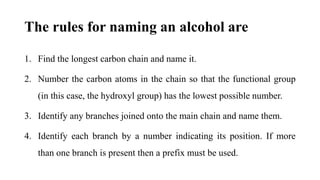
The rules for naming an alcohol are
1. Find the longest carbon chain and name it.
2. Number the carbon atoms in the chain so that the functional group
(in this case, the hydroxyl group) has the lowest possible number.
3. Identify any branches joined onto the main chain and name them.
4. Identify each branch by a number indicating its position. If more
than one branch is present then a prefix must be used.
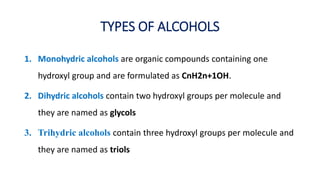
TYPES OF ALCOHOLS
1. Monohydric alcohols are organic compounds containing one
hydroxyl group and are formulated as CnH2n+1OH.
2. Dihydric alcohols contain two hydroxyl groups per molecule and
they are named as glycols
3. Trihydric alcohols contain three hydroxyl groups per molecule and
they are named as triols
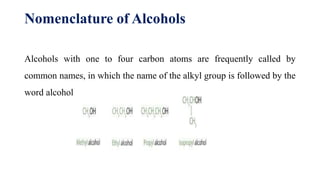
Nomenclature of Alcohols
Alcohols with one to four carbon atoms are frequently called by
common names, in which the name of the alkyl group is followed by the
word alcohol.
Rules for naming the alcohols
1.Find the longest chain containing the hydroxy group (OH). If there is
a chain with more carbons than the one containing the OH group it will
be named as a subsitutent.
2.Place the OH on the lowest possible number for the chain. With the
exception of carbonyl groups such as ketones and aldehydes, the alcohol
or hydroxy groups have first priority for naming.
Cont..
3.When naming a cyclic structure, the -OH is assumed to be on the first
carbon unless the carbonyl group is present, in which case the later will
get priority at the first carbon.
4.When multiple -OH groups are on the cyclic structure, number the
carbons on which the -OH groups reside.
Physical properties
• The physical properties of alcohol can be explained by the following
points –
• Alcohols are colourless.
• They generally give a sweet smell except for glycerol and a few lower
alcohols.
• They are flammable and produce a blue flame.
• They don’t produce any smoke while burning.
• They are generally liquid at room temperature. Although glycerol is a
viscous liquid.
cont:
1. Boiling of alcohol : Alcohols generally have higher points in
comparison to other hydrocarbons having equal molecular masses.
2. Solubility of alcohol : The solubility of alcohol in watter is governed
by the hydroxyl group present.
3. Acidity of alcohol : alcahol react with active metals such as
Sodium,potassium etc. To form the corresponding alkoxide, these
reactions of alcohols indicate their acidic nature.
The acidic nature of alcohol is due to the polarity of –OH bond.
Chemical properties
The chemical properties of alcohol can be explained by the following
points .
1. Oxidation Reaction of Alcohol – Alcohols produce aldehydes and
ketones on oxidation. The reaction is given below .
C₂H₅OH + 2O 🡪 CH₃COOH + H₂O
Ethanol Methanoic acid
2. Combustion of Alcohol – On heating ethanol gives carbon dioxide
and water and burns with a blue flame. The reaction is given below .
C₂H₅OH + 3O₂ 🡪 2CO₂ + 3H₂O
Cont..
3. Dehydration of Alcohol – Alcohol can be dehydrated in an acidic
medium. The removal of water molecules from a compound is called
dehydration. Upon dehydration of alcohol alkenes are produced. The
reaction is given below .
C2H5OH (conc. H₂SO₄,▵)→C₂H₄ + H₂O
ALCOHOL.pptx
ALCOHOL.pptx

ALCOHOL.pptx

  • 1.
  • 3.
    Students names 1. BilanIbrahim Abib 2. Abdifatax Farxan Abdi 3. Gudon Deeq Muxumed 4. Cumar Maxamed Cumar 5. Ilyas Ismacil Abdi 6. Samsam Xusen Dahir
  • 4.
    CONTENT Introduction to alcohol Functionalgroup Types of alcohol Nomenclature Physical properties Chemical properties
  • 5.
    Introduction to alcohol Alcoholis both a beverage providing some sustenance and a drug. For thousands of years, alcohol has been consumed in a medicinal, celebratory, and ritualistic manner. It is drunk in just about every country and often in excessive amounts. Alcohol can be made from a variety of different starch foods through the processes called fermentation The alcohols form a homologous series. Like all homologous series, the alcohols.
  • 6.
    cont.. Alcohol is apsychoactive drug. A psychoactive drug is any substance that crosses the blood-brain barrier primarily affecting the functioning of the brain, be it altering mood, thinking, memory, motor control, or behavior.
  • 7.
    Functional group ofalcohol • Alcohol molecules all contain the hydroxyl (-OH) functional group. They are a homologous series and have the general formula CnH2n+1OH. Their names all end in -ol.
  • 8.
    The rules fornaming an alcohol are 1. Find the longest carbon chain and name it. 2. Number the carbon atoms in the chain so that the functional group (in this case, the hydroxyl group) has the lowest possible number. 3. Identify any branches joined onto the main chain and name them. 4. Identify each branch by a number indicating its position. If more than one branch is present then a prefix must be used.
  • 10.
    TYPES OF ALCOHOLS 1.Monohydric alcohols are organic compounds containing one hydroxyl group and are formulated as CnH2n+1OH. 2. Dihydric alcohols contain two hydroxyl groups per molecule and they are named as glycols 3. Trihydric alcohols contain three hydroxyl groups per molecule and they are named as triols
  • 11.
    Nomenclature of Alcohols Alcoholswith one to four carbon atoms are frequently called by common names, in which the name of the alkyl group is followed by the word alcohol.
  • 13.
    Rules for namingthe alcohols 1.Find the longest chain containing the hydroxy group (OH). If there is a chain with more carbons than the one containing the OH group it will be named as a subsitutent. 2.Place the OH on the lowest possible number for the chain. With the exception of carbonyl groups such as ketones and aldehydes, the alcohol or hydroxy groups have first priority for naming.
  • 14.
    Cont.. 3.When naming acyclic structure, the -OH is assumed to be on the first carbon unless the carbonyl group is present, in which case the later will get priority at the first carbon. 4.When multiple -OH groups are on the cyclic structure, number the carbons on which the -OH groups reside.
  • 15.
    Physical properties • Thephysical properties of alcohol can be explained by the following points – • Alcohols are colourless. • They generally give a sweet smell except for glycerol and a few lower alcohols. • They are flammable and produce a blue flame. • They don’t produce any smoke while burning. • They are generally liquid at room temperature. Although glycerol is a viscous liquid.
  • 16.
    cont: 1. Boiling ofalcohol : Alcohols generally have higher points in comparison to other hydrocarbons having equal molecular masses. 2. Solubility of alcohol : The solubility of alcohol in watter is governed by the hydroxyl group present. 3. Acidity of alcohol : alcahol react with active metals such as Sodium,potassium etc. To form the corresponding alkoxide, these reactions of alcohols indicate their acidic nature. The acidic nature of alcohol is due to the polarity of –OH bond.
  • 18.
    Chemical properties The chemicalproperties of alcohol can be explained by the following points . 1. Oxidation Reaction of Alcohol – Alcohols produce aldehydes and ketones on oxidation. The reaction is given below . C₂H₅OH + 2O 🡪 CH₃COOH + H₂O Ethanol Methanoic acid 2. Combustion of Alcohol – On heating ethanol gives carbon dioxide and water and burns with a blue flame. The reaction is given below . C₂H₅OH + 3O₂ 🡪 2CO₂ + 3H₂O
  • 19.
    Cont.. 3. Dehydration ofAlcohol – Alcohol can be dehydrated in an acidic medium. The removal of water molecules from a compound is called dehydration. Upon dehydration of alcohol alkenes are produced. The reaction is given below . C2H5OH (conc. H₂SO₄,▵)→C₂H₄ + H₂O