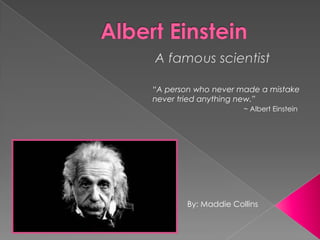
“A person who never made a mistake
never tried anything new.”
~ Albert Einstein

By: Maddie Collins
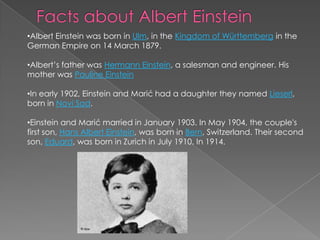
•Albert Einstein was born in Ulm, in the Kingdom of Württemberg in the
German Empire on 14 March 1879.
•Albert’s father was Hermann Einstein, a salesman and engineer. His
mother was Pauline Einstein
•In early 1902, Einstein and Marić had a daughter they named Lieserl,
born in Novi Sad.
•Einstein and Marić married in January 1903. In May 1904, the couple's
first son, Hans Albert Einstein, was born in Bern, Switzerland. Their second
son, Eduard, was born in Zurich in July 1910. In 1914.
• Einstein and Marić divorced on 14 February 1919, having lived apart
for five years.
•Einstein married Elsa Löwenthal on 2 June 1919.
These were the facts about Albert!
Throughout his life, Einstein published hundreds of books and articles. In
addition to the work he did by himself he also collaborated with other
scientists on additional projects including the Bose–Einstein statistics,
the Einstein refrigerator and others.
In 1905, while working as a patent clerk in Bern, Switzerland, Einstein had
what came to be known as his ―Annus Mirabilis‖ — or ―miracle year‖. It was
during this time that the young physicist obtained his Doctorate degree and
published four of his most influential research papers, including the Special
Theory of Relativity. In that, the now world famous equation "e = mc2"
unlocked mysteries of the Universe theretofore unknown.
Ten years later, in 1915, Einstein completed his General Theory of Relativity
and in 1921 he was awarded the Nobel Prize in Physics (iconic status
cemented in 1919 when Arthur Eddington’s expedition confirmed Albert
Einstein’s prediction). It also launched him to international superstardom
and his name became a household word synonymous with genius all over
the world.
Einstein emigrated to the United States in the autumn of 1933 and took up
residence in Princeton, New Jersey and a professorship at the prestigious
Institute for Advanced Study.
Today, the practical applications of Einstein’s theories include the
development of the television, remote control devices, automatic door
openers, lasers, and DVD-players. Recognized as TIME magazine’s ―Person
of the Century‖ in 1999, Einstein’s intellect, coupled his strong passion for
social justice and dedication to pacifism, left the world with infinite
knowledge and pioneering moral leadership
On 17 April 1955, Albert Einstein experienced internal bleeding caused by
the rupture of an abdominal aortic aneurysm, which had previously been
reinforced surgically by Dr. Rudolph Nissen in 1948.[76] He took the draft of
a speech he was preparing for a television appearance commemorating
the State of Israel's seventh anniversary with him to the hospital, but he
did not live long enough to complete it.[77] Einstein refused surgery, saying:
"I want to go when I want. It is tasteless to prolong life artificially. I have
done my share, it is time to go. I will do it elegantly."[78] He died
in Princeton Hospital early the next morning at the age of 76, having
continued to work until near the end.
During the autopsy, the pathologist of Princeton Hospital, Thomas Stoltz
Harvey, removed Einstein's brain for preservation without the permission of his
family, in the hope that the neuroscience of the future would be able to
discover what made Einstein so intelligent.[79] Einstein's remains were
cremated and his ashes were scattered at an undisclosed location.[80][81]
In his lecture at Einstein's memorial, nuclear physicist Robert
Oppenheimer summarized his impression of him as a person: "He was almost
wholly without sophistication and wholly without worldliness . . . There was
always with him a wonderful purity at once childlike and profoundly stubborn

Albert Einstein School Project

  • 1.
    “A person whonever made a mistake never tried anything new.” ~ Albert Einstein By: Maddie Collins
  • 2.
    •Albert Einstein wasborn in Ulm, in the Kingdom of Württemberg in the German Empire on 14 March 1879. •Albert’s father was Hermann Einstein, a salesman and engineer. His mother was Pauline Einstein •In early 1902, Einstein and Marić had a daughter they named Lieserl, born in Novi Sad. •Einstein and Marić married in January 1903. In May 1904, the couple's first son, Hans Albert Einstein, was born in Bern, Switzerland. Their second son, Eduard, was born in Zurich in July 1910. In 1914.
  • 3.
    • Einstein andMarić divorced on 14 February 1919, having lived apart for five years. •Einstein married Elsa Löwenthal on 2 June 1919. These were the facts about Albert!
  • 4.
    Throughout his life,Einstein published hundreds of books and articles. In addition to the work he did by himself he also collaborated with other scientists on additional projects including the Bose–Einstein statistics, the Einstein refrigerator and others. In 1905, while working as a patent clerk in Bern, Switzerland, Einstein had what came to be known as his ―Annus Mirabilis‖ — or ―miracle year‖. It was during this time that the young physicist obtained his Doctorate degree and published four of his most influential research papers, including the Special Theory of Relativity. In that, the now world famous equation "e = mc2" unlocked mysteries of the Universe theretofore unknown. Ten years later, in 1915, Einstein completed his General Theory of Relativity and in 1921 he was awarded the Nobel Prize in Physics (iconic status cemented in 1919 when Arthur Eddington’s expedition confirmed Albert Einstein’s prediction). It also launched him to international superstardom and his name became a household word synonymous with genius all over the world.
  • 5.
    Einstein emigrated tothe United States in the autumn of 1933 and took up residence in Princeton, New Jersey and a professorship at the prestigious Institute for Advanced Study. Today, the practical applications of Einstein’s theories include the development of the television, remote control devices, automatic door openers, lasers, and DVD-players. Recognized as TIME magazine’s ―Person of the Century‖ in 1999, Einstein’s intellect, coupled his strong passion for social justice and dedication to pacifism, left the world with infinite knowledge and pioneering moral leadership
  • 6.
    On 17 April1955, Albert Einstein experienced internal bleeding caused by the rupture of an abdominal aortic aneurysm, which had previously been reinforced surgically by Dr. Rudolph Nissen in 1948.[76] He took the draft of a speech he was preparing for a television appearance commemorating the State of Israel's seventh anniversary with him to the hospital, but he did not live long enough to complete it.[77] Einstein refused surgery, saying: "I want to go when I want. It is tasteless to prolong life artificially. I have done my share, it is time to go. I will do it elegantly."[78] He died in Princeton Hospital early the next morning at the age of 76, having continued to work until near the end.
  • 7.
    During the autopsy,the pathologist of Princeton Hospital, Thomas Stoltz Harvey, removed Einstein's brain for preservation without the permission of his family, in the hope that the neuroscience of the future would be able to discover what made Einstein so intelligent.[79] Einstein's remains were cremated and his ashes were scattered at an undisclosed location.[80][81] In his lecture at Einstein's memorial, nuclear physicist Robert Oppenheimer summarized his impression of him as a person: "He was almost wholly without sophistication and wholly without worldliness . . . There was always with him a wonderful purity at once childlike and profoundly stubborn