ESSAY IN ENGLISH 
«THE MYSTERY PERSON» 
NICK MORAITIS 
1ο ΓΥΜΝΑΣΙΟ ΑΡΤΕΜΙΔΑΣ 
Σχολικό Έτος: 2013-2014 
Τμήμα: Α2
Who is the Mystery Person? 
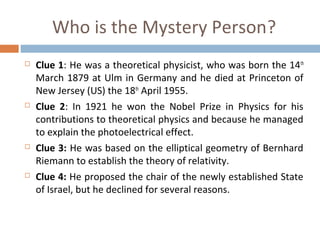
 Clue 1: He was a theoretical physicist, who was born the 14th 
March 1879 at Ulm in Germany and he died at Princeton of 
New Jersey (US) the 18th April 1955. 
 Clue 2: In 1921 he won the Nobel Prize in Physics for his 
contributions to theoretical physics and because he managed 
to explain the photoelectrical effect. 
 Clue 3: He was based on the elliptical geometry of Bernhard 
Riemann to establish the theory of relativity. 
 Clue 4: He proposed the chair of the newly established State 
of Israel, but he declined for several reasons.
Who is the Mystery Person? 
Any Idea?
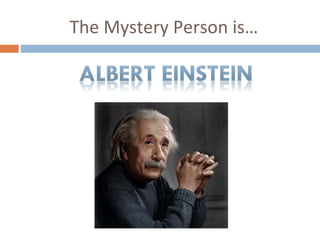
The Mystery Person is…
1. Biography of Albert Einstein 
 Date of Birth: March 14, 1879. 
 Place of Birth: Ulm, Wurttemberg, Germany. 
 As a child, Einstein revealed an extraordinary 
curiosity for understanding the mysteries of 
science. 
 A typical child (only to his socio-economic class — 
educated middle class), Einstein took music 
lessons, playing both the violin and piano — a 
passion that followed him into adulthood. 
 He graduated from high-school in 1896. 
 Einstein called the book Euclid’s Elements the "holy 
little geometry book". 
 He was right-handed. There appears to be no 
evidence for the widespread popular belief that he 
was left-handed. 
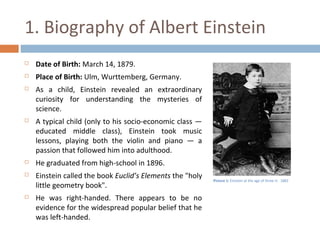
Picture 1: Einstein at the age of three in 1882
1. Biography of Albert Einstein 
 His father intended for him to pursue 
electrical engineering, but Einstein 
clashed with authorities and resented 
the school's regimen and teaching 
method. 
 In 1895, at the age of sixteen, Einstein 
sat the entrance examinations for the 
Swiss Federal Polytechnic in Zurich. 
 He failed to reach the required standard 
in the general part of the examination, 
but obtained exceptional grades in 
physics and mathematics. 
 In 1896 he completed his secondary 
schooling at the Aargau Cantonal School 
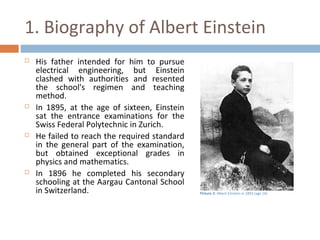
in Switzerland. Picture 2: Albert Einstein in 1893 (age 14)
1. Biography of Albert Einstein 
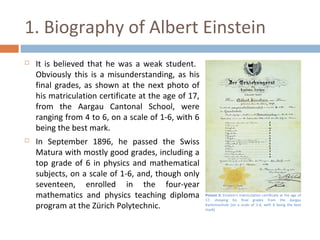
 It is believed that he was a weak student. 
Obviously this is a misunderstanding, as his 
final grades, as shown at the next photo of 
his matriculation certificate at the age of 17, 
from the Aargau Cantonal School, were 
ranging from 4 to 6, on a scale of 1-6, with 6 
being the best mark. 
 In September 1896, he passed the Swiss 
Matura with mostly good grades, including a 
top grade of 6 in physics and mathematical 
subjects, on a scale of 1-6, and, though only 
seventeen, enrolled in the four-year 
mathematics and physics teaching diploma 
program at the Zürich Polytechnic. 
Picture 3: Einstein's matriculation certificate at the age of 
17, showing his final grades from the Aargau 
Kantonsschule (on a scale of 1-6, with 6 being the best 
mark)
1. Biography of Albert Einstein 
 After graduating, in 1900, took Swiss nationality, worked for two months 
as a mathematics teacher and in 1902 was hired as an examiner in the 
Swiss patent office in Bern. 
 Much of his work at the patent office related to questions about 
transmission of electric signals and electrical-mechanical synchronization 
of time, two technical problems that show up conspicuously in the 
thought experiments that eventually led Einstein to his radical 
conclusions about the nature of light and the fundamental connection 
between space and time. 
 With a few friends he had met in Bern, Einstein started a small discussion 
group, self-mockingly named “The Olympia Academy”, which met 
regularly to discuss science and philosophy. Their readings included the 
works of Henry Poincare, Ernst Mach and David Hume, which influenced 
his scientific and philosophical outlook.
1. Biography of Albert Einstein 
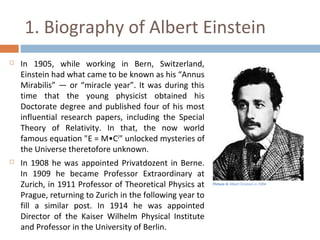
 In 1905, while working in Bern, Switzerland, 
Einstein had what came to be known as his “Annus 
Mirabilis” — or “miracle year”. It was during this 
time that the young physicist obtained his 
Doctorate degree and published four of his most 
influential research papers, including the Special 
Theory of Relativity. In that, the now world 
famous equation "Ε = Μ•C2" unlocked mysteries of 
the Universe theretofore unknown. 
 In 1908 he was appointed Privatdozent in Berne. 
In 1909 he became Professor Extraordinary at 
Zurich, in 1911 Professor of Theoretical Physics at 
Prague, returning to Zurich in the following year to 
fill a similar post. In 1914 he was appointed 
Director of the Kaiser Wilhelm Physical Institute 
and Professor in the University of Berlin. 
Picture 4: Albert Einstein in 1904
1. Biography of Albert Einstein 
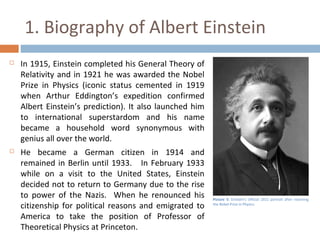
 In 1915, Einstein completed his General Theory of 
Relativity and in 1921 he was awarded the Nobel 
Prize in Physics (iconic status cemented in 1919 
when Arthur Eddington’s expedition confirmed 
Albert Einstein’s prediction). It also launched him 
to international superstardom and his name 
became a household word synonymous with 
genius all over the world. 
 He became a German citizen in 1914 and 
remained in Berlin until 1933. In February 1933 
while on a visit to the United States, Einstein 
decided not to return to Germany due to the rise 
to power of the Nazis. When he renounced his 
citizenship for political reasons and emigrated to 
America to take the position of Professor of 
Theoretical Physics at Princeton. 
Picture 5: Einstein's official 1921 portrait after receiving 
the Nobel Prize in Physics
1. Biography of Albert Einstein 
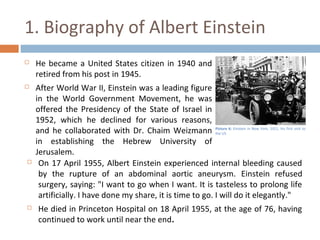
 He became a United States citizen in 1940 and 
retired from his post in 1945. 
 After World War II, Einstein was a leading figure 
in the World Government Movement, he was 
offered the Presidency of the State of Israel in 
1952, which he declined for various reasons, 
and he collaborated with Dr. Chaim Weizmann 
in establishing the Hebrew University of 
Jerusalem. 
 On 17 April 1955, Albert Einstein experienced internal bleeding caused 
by the rupture of an abdominal aortic aneurysm. Einstein refused 
surgery, saying: "I want to go when I want. It is tasteless to prolong life 
artificially. I have done my share, it is time to go. I will do it elegantly." 
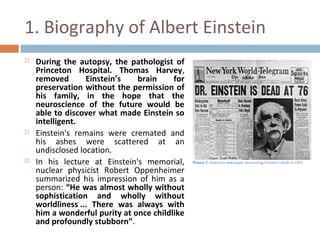
 He died in Princeton Hospital on 18 April 1955, at the age of 76, having 
continued to work until near the end. 
Picture 6: Einstein in New York, 1921, his first visit to 
the US
1. Biography of Albert Einstein 
 During the autopsy, the pathologist of 
Princeton Hospital. Thomas Harvey, 
removed Einstein’s brain for 
preservation without the permission of 
his family, in the hope that the 
neuroscience of the future would be 
able to discover what made Einstein so 
intelligent. 
 Einstein's remains were cremated and 
his ashes were scattered at an 
undisclosed location. 
 In his lecture at Einstein's memorial, 
nuclear physicist Robert Oppenheimer 
summarized his impression of him as a 
person: “He was almost wholly without 
sophistication and wholly without 
worldliness ... There was always with 
him a wonderful purity at once childlike 
and profoundly stubborn”. 
Picture 7: American newspaper announcing Einstein's death in 1955
2. Personal Life 
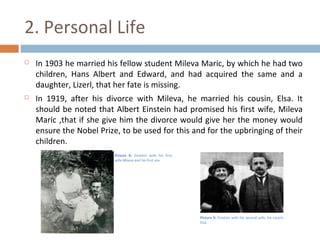
 In 1903 he married his fellow student Mileva Maric, by which he had two 
children, Hans Albert and Edward, and had acquired the same and a 
daughter, Lizerl, that her fate is missing. 
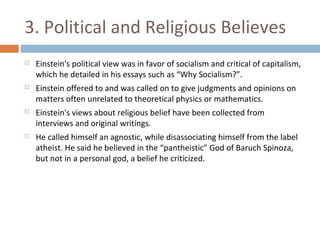
 In 1919, after his divorce with Mileva, he married his cousin, Elsa. It 
should be noted that Albert Einstein had promised his first wife, Mileva 
Maric ,that if she give him the divorce would give her the money would 
ensure the Nobel Prize, to be used for this and for the upbringing of their 
children. 
Picture 8: Einstein with his first 
wife Mileva and his first son 
Picture 9: Einstein with his second wife, his cousin 
Elsa
3. Political and Religious Believes 
 Einstein's political view was in favor of socialism and critical of capitalism, 
which he detailed in his essays such as “Why Socialism?”. 
 Einstein offered to and was called on to give judgments and opinions on 
matters often unrelated to theoretical physics or mathematics. 
 Einstein's views about religious belief have been collected from 
interviews and original writings. 
 He called himself an agnostic, while disassociating himself from the label 
atheist. He said he believed in the “pantheistic” God of Baruch Spinoza, 
but not in a personal god, a belief he criticized.
4. Scientific Career 
 Einstein always appeared to have a clear view of the problems of physics 
and the determination to solve them. He had a strategy of his own and 
was able to visualize the main stages on the way to his goal. He regarded 
his major achievements as mere stepping-stones for the next advance. 
 At the start of his scientific work, Einstein realized the inadequacies of 
Newtonian mechanics and his special theory of relativity stemmed from 
an attempt to reconcile the laws of mechanics with the laws of the 
electromagnetic field. He dealt with classical problems of statistical 
mechanics and problems in which they were merged with quantum 
theory: this led to an explanation of the Brownian movement of 
molecules. He investigated the thermal properties of light with a low 
radiation density and his observations laid the foundation of the photon 
theory of light.
4. Scientific Career 
 In his early days in Berlin, Einstein postulated that 
the correct interpretation of the special theory of 
relativity must also furnish a theory of gravitation 
and in 1916 he published his paper on the general 
theory of relativity. During this time he also 
contributed to the problems of the theory of 
radiation and statistical mechanics. 
 In the 1920's, Einstein embarked on the 
construction of unified field theories, although he 
continued to work on the probabilistic 
interpretation of quantum theory, and he 
persevered with this work in America. 
 He contributed to statistical mechanics by his 
development of the quantum theory of a 
monatomic gas and he has also accomplished 
valuable work in connection with atomic transition 
probabilities and relativistic cosmology. 
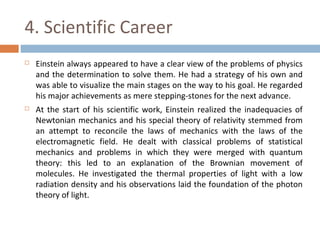
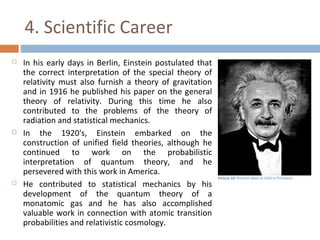
Picture 10: Portrait taken in 1935 in Princeton
4. Scientific Career 
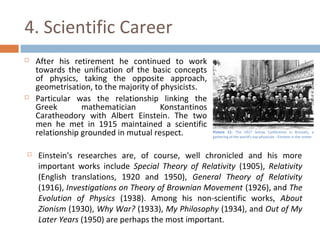
 After his retirement he continued to work 
towards the unification of the basic concepts 
of physics, taking the opposite approach, 
geometrisation, to the majority of physicists. 
 Particular was the relationship linking the 
Greek mathematician Konstantinos 
Caratheodory with Albert Einstein. The two 
men he met in 1915 maintained a scientific 
relationship grounded in mutual respect. 
Picture 11: The 1927 Solvay Conference in Brussels, a 
gathering of the world's top physicists - Einstein in the center 
 Einstein's researches are, of course, well chronicled and his more 
important works include Special Theory of Relativity (1905), Relativity 
(English translations, 1920 and 1950), General Theory of Relativity 
(1916), Investigations on Theory of Brownian Movement (1926), and The 
Evolution of Physics (1938). Among his non-scientific works, About 
Zionism (1930), Why War? (1933), My Philosophy (1934), and Out of My 
Later Years (1950) are perhaps the most important.
5. Notable Awards 
 Albert Einstein received honorary doctorate degrees in science, medicine and 
philosophy from many European and American universities. During the 1920's 
he lectured in Europe, America and the Far East, and he was awarded 
Fellowships or Memberships of all the leading scientific academies throughout 
the world. He gained numerous awards in recognition of his work, such as: 
 Nobel Prize in Physics (1921) 
 Matteucci Medal (1921) 
 Copley Medal (1925) 
 Max Planck Medal (1929) 
 Franklin Medal (1935) 
 Time Person of the Century (1999)
6. General Information 
Birth Name : Albert Einstein 
Born : March 14, 1879 
Ulm, Wurttemberg, Germany 
Died : April 18, 1955 (aged 76) 
Princeton, New Jersey, U.S.A. 
Spouses : Mileva Maric (1903-1919) 
Elsa Einstein (1919-1936) 
Children : Lieserl (1902-1903?) 
Hans Albert Einstein (1904-1973) 
Eduard Einstein (1910-1965) 
Residence : Germany, Italy, Switzerland, Austria, Belgium, 
United States
6. General Information 
Citizenship : Kingdom of Württemberg (1879–1896) 
Stateless (1896–1901) 
Switzerland (1901–1955) 
Austria–Hungary (1911–1912) 
German Empire (1914–1918) 
Weimar Republic (1919–1933) 
United States (1940–1955)
6. General Information 
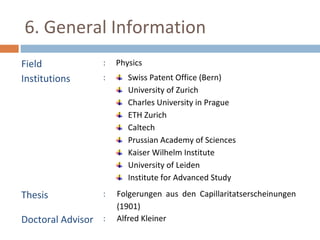
Field : Physics 
Institutions : Swiss Patent Office (Bern) 
University of Zurich 
Charles University in Prague 
ETH Zurich 
Caltech 
Prussian Academy of Sciences 
Kaiser Wilhelm Institute 
University of Leiden 
Institute for Advanced Study 
Thesis : Folgerungen aus den Capillaritatserscheinungen 
(1901) 
Doctoral Advisor : Alfred Kleiner
6. General Information 
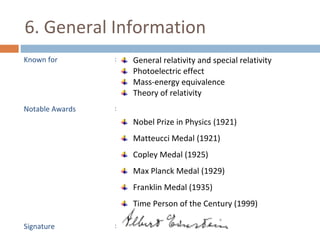
Known for : General relativity and special relativity 
Photoelectric effect 
Mass-energy equivalence 
Theory of relativity 
Notable Awards : 
Nobel Prize in Physics (1921) 
Matteucci Medal (1921) 
Copley Medal (1925) 
Max Planck Medal (1929) 
Franklin Medal (1935) 
Time Person of the Century (1999) 
Signature :
7. Albert Einstein’s Quotes 
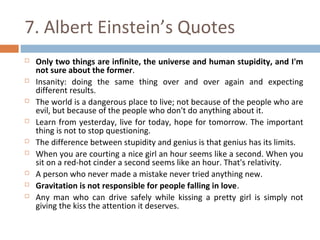
 Only two things are infinite, the universe and human stupidity, and I'm 
not sure about the former. 
 Insanity: doing the same thing over and over again and expecting 
different results. 
 The world is a dangerous place to live; not because of the people who are 
evil, but because of the people who don't do anything about it. 
 Learn from yesterday, live for today, hope for tomorrow. The important 
thing is not to stop questioning. 
 The difference between stupidity and genius is that genius has its limits. 
 When you are courting a nice girl an hour seems like a second. When you 
sit on a red-hot cinder a second seems like an hour. That's relativity. 
 A person who never made a mistake never tried anything new. 
 Gravitation is not responsible for people falling in love. 
 Any man who can drive safely while kissing a pretty girl is simply not 
giving the kiss the attention it deserves.
7. Albert Einstein’s Quotes 
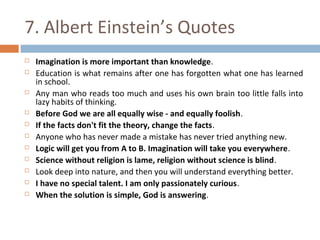
 Imagination is more important than knowledge. 
 Education is what remains after one has forgotten what one has learned 
in school. 
 Any man who reads too much and uses his own brain too little falls into 
lazy habits of thinking. 
 Before God we are all equally wise - and equally foolish. 
 If the facts don't fit the theory, change the facts. 
 Anyone who has never made a mistake has never tried anything new. 
 Logic will get you from A to B. Imagination will take you everywhere. 
 Science without religion is lame, religion without science is blind. 
 Look deep into nature, and then you will understand everything better. 
 I have no special talent. I am only passionately curious. 
 When the solution is simple, God is answering.
7. Albert Einstein’s Quotes 
 Peace cannot be kept by force; it can only be achieved by 
understanding. 
 It is the supreme art of the teacher to awaken joy in creative expression 
and knowledge. 
 The only source of knowledge is experience. 
 All religions, arts and sciences are branches of the same tree. 
 A table, a chair, a bowl of fruit and a violin; what else does a man need 
to be happy? 
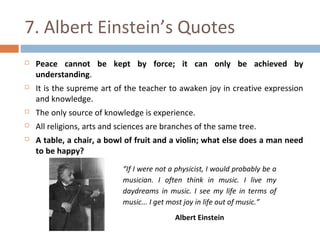
“If I were not a physicist, I would probably be a 
musician. I often think in music. I live my 
daydreams in music. I see my life in terms of 
music... I get most joy in life out of music.” 
Albert Einstein
SOURCES 
•http://einstein.biz/index.php 
•http://www.nobelprize.org/nobel_prizes/physics/laureates/1921/einstein-bio. 
html 
•http://en.wikipedia.org/wiki/Albert_Einstein 
•http://www.brainyquote.com/quotes/authors/a/albert_einstein.html 
•http://physiclessons.blogspot.gr/2011/10/blog-post_2009.html 
THANK YOU FOR YOUR ATTENTION 
NICK MORAITIS 
28/04/2014

Eργασία Aγγλικών Einstein-01

  • 1.
    ESSAY IN ENGLISH «THE MYSTERY PERSON» NICK MORAITIS 1ο ΓΥΜΝΑΣΙΟ ΑΡΤΕΜΙΔΑΣ Σχολικό Έτος: 2013-2014 Τμήμα: Α2
  • 2.
    Who is theMystery Person?  Clue 1: He was a theoretical physicist, who was born the 14th March 1879 at Ulm in Germany and he died at Princeton of New Jersey (US) the 18th April 1955.  Clue 2: In 1921 he won the Nobel Prize in Physics for his contributions to theoretical physics and because he managed to explain the photoelectrical effect.  Clue 3: He was based on the elliptical geometry of Bernhard Riemann to establish the theory of relativity.  Clue 4: He proposed the chair of the newly established State of Israel, but he declined for several reasons.
  • 3.
    Who is theMystery Person? Any Idea?
  • 4.
  • 5.
    1. Biography ofAlbert Einstein  Date of Birth: March 14, 1879.  Place of Birth: Ulm, Wurttemberg, Germany.  As a child, Einstein revealed an extraordinary curiosity for understanding the mysteries of science.  A typical child (only to his socio-economic class — educated middle class), Einstein took music lessons, playing both the violin and piano — a passion that followed him into adulthood.  He graduated from high-school in 1896.  Einstein called the book Euclid’s Elements the "holy little geometry book".  He was right-handed. There appears to be no evidence for the widespread popular belief that he was left-handed. Picture 1: Einstein at the age of three in 1882
  • 6.
    1. Biography ofAlbert Einstein  His father intended for him to pursue electrical engineering, but Einstein clashed with authorities and resented the school's regimen and teaching method.  In 1895, at the age of sixteen, Einstein sat the entrance examinations for the Swiss Federal Polytechnic in Zurich.  He failed to reach the required standard in the general part of the examination, but obtained exceptional grades in physics and mathematics.  In 1896 he completed his secondary schooling at the Aargau Cantonal School in Switzerland. Picture 2: Albert Einstein in 1893 (age 14)
  • 7.
    1. Biography ofAlbert Einstein  It is believed that he was a weak student. Obviously this is a misunderstanding, as his final grades, as shown at the next photo of his matriculation certificate at the age of 17, from the Aargau Cantonal School, were ranging from 4 to 6, on a scale of 1-6, with 6 being the best mark.  In September 1896, he passed the Swiss Matura with mostly good grades, including a top grade of 6 in physics and mathematical subjects, on a scale of 1-6, and, though only seventeen, enrolled in the four-year mathematics and physics teaching diploma program at the Zürich Polytechnic. Picture 3: Einstein's matriculation certificate at the age of 17, showing his final grades from the Aargau Kantonsschule (on a scale of 1-6, with 6 being the best mark)
  • 8.
    1. Biography ofAlbert Einstein  After graduating, in 1900, took Swiss nationality, worked for two months as a mathematics teacher and in 1902 was hired as an examiner in the Swiss patent office in Bern.  Much of his work at the patent office related to questions about transmission of electric signals and electrical-mechanical synchronization of time, two technical problems that show up conspicuously in the thought experiments that eventually led Einstein to his radical conclusions about the nature of light and the fundamental connection between space and time.  With a few friends he had met in Bern, Einstein started a small discussion group, self-mockingly named “The Olympia Academy”, which met regularly to discuss science and philosophy. Their readings included the works of Henry Poincare, Ernst Mach and David Hume, which influenced his scientific and philosophical outlook.
  • 9.
    1. Biography ofAlbert Einstein  In 1905, while working in Bern, Switzerland, Einstein had what came to be known as his “Annus Mirabilis” — or “miracle year”. It was during this time that the young physicist obtained his Doctorate degree and published four of his most influential research papers, including the Special Theory of Relativity. In that, the now world famous equation "Ε = Μ•C2" unlocked mysteries of the Universe theretofore unknown.  In 1908 he was appointed Privatdozent in Berne. In 1909 he became Professor Extraordinary at Zurich, in 1911 Professor of Theoretical Physics at Prague, returning to Zurich in the following year to fill a similar post. In 1914 he was appointed Director of the Kaiser Wilhelm Physical Institute and Professor in the University of Berlin. Picture 4: Albert Einstein in 1904
  • 10.
    1. Biography ofAlbert Einstein  In 1915, Einstein completed his General Theory of Relativity and in 1921 he was awarded the Nobel Prize in Physics (iconic status cemented in 1919 when Arthur Eddington’s expedition confirmed Albert Einstein’s prediction). It also launched him to international superstardom and his name became a household word synonymous with genius all over the world.  He became a German citizen in 1914 and remained in Berlin until 1933. In February 1933 while on a visit to the United States, Einstein decided not to return to Germany due to the rise to power of the Nazis. When he renounced his citizenship for political reasons and emigrated to America to take the position of Professor of Theoretical Physics at Princeton. Picture 5: Einstein's official 1921 portrait after receiving the Nobel Prize in Physics
  • 11.
    1. Biography ofAlbert Einstein  He became a United States citizen in 1940 and retired from his post in 1945.  After World War II, Einstein was a leading figure in the World Government Movement, he was offered the Presidency of the State of Israel in 1952, which he declined for various reasons, and he collaborated with Dr. Chaim Weizmann in establishing the Hebrew University of Jerusalem.  On 17 April 1955, Albert Einstein experienced internal bleeding caused by the rupture of an abdominal aortic aneurysm. Einstein refused surgery, saying: "I want to go when I want. It is tasteless to prolong life artificially. I have done my share, it is time to go. I will do it elegantly."  He died in Princeton Hospital on 18 April 1955, at the age of 76, having continued to work until near the end. Picture 6: Einstein in New York, 1921, his first visit to the US
  • 12.
    1. Biography ofAlbert Einstein  During the autopsy, the pathologist of Princeton Hospital. Thomas Harvey, removed Einstein’s brain for preservation without the permission of his family, in the hope that the neuroscience of the future would be able to discover what made Einstein so intelligent.  Einstein's remains were cremated and his ashes were scattered at an undisclosed location.  In his lecture at Einstein's memorial, nuclear physicist Robert Oppenheimer summarized his impression of him as a person: “He was almost wholly without sophistication and wholly without worldliness ... There was always with him a wonderful purity at once childlike and profoundly stubborn”. Picture 7: American newspaper announcing Einstein's death in 1955
  • 13.
    2. Personal Life  In 1903 he married his fellow student Mileva Maric, by which he had two children, Hans Albert and Edward, and had acquired the same and a daughter, Lizerl, that her fate is missing.  In 1919, after his divorce with Mileva, he married his cousin, Elsa. It should be noted that Albert Einstein had promised his first wife, Mileva Maric ,that if she give him the divorce would give her the money would ensure the Nobel Prize, to be used for this and for the upbringing of their children. Picture 8: Einstein with his first wife Mileva and his first son Picture 9: Einstein with his second wife, his cousin Elsa
  • 14.
    3. Political andReligious Believes  Einstein's political view was in favor of socialism and critical of capitalism, which he detailed in his essays such as “Why Socialism?”.  Einstein offered to and was called on to give judgments and opinions on matters often unrelated to theoretical physics or mathematics.  Einstein's views about religious belief have been collected from interviews and original writings.  He called himself an agnostic, while disassociating himself from the label atheist. He said he believed in the “pantheistic” God of Baruch Spinoza, but not in a personal god, a belief he criticized.
  • 15.
    4. Scientific Career  Einstein always appeared to have a clear view of the problems of physics and the determination to solve them. He had a strategy of his own and was able to visualize the main stages on the way to his goal. He regarded his major achievements as mere stepping-stones for the next advance.  At the start of his scientific work, Einstein realized the inadequacies of Newtonian mechanics and his special theory of relativity stemmed from an attempt to reconcile the laws of mechanics with the laws of the electromagnetic field. He dealt with classical problems of statistical mechanics and problems in which they were merged with quantum theory: this led to an explanation of the Brownian movement of molecules. He investigated the thermal properties of light with a low radiation density and his observations laid the foundation of the photon theory of light.
  • 16.
    4. Scientific Career  In his early days in Berlin, Einstein postulated that the correct interpretation of the special theory of relativity must also furnish a theory of gravitation and in 1916 he published his paper on the general theory of relativity. During this time he also contributed to the problems of the theory of radiation and statistical mechanics.  In the 1920's, Einstein embarked on the construction of unified field theories, although he continued to work on the probabilistic interpretation of quantum theory, and he persevered with this work in America.  He contributed to statistical mechanics by his development of the quantum theory of a monatomic gas and he has also accomplished valuable work in connection with atomic transition probabilities and relativistic cosmology. Picture 10: Portrait taken in 1935 in Princeton
  • 17.
    4. Scientific Career  After his retirement he continued to work towards the unification of the basic concepts of physics, taking the opposite approach, geometrisation, to the majority of physicists.  Particular was the relationship linking the Greek mathematician Konstantinos Caratheodory with Albert Einstein. The two men he met in 1915 maintained a scientific relationship grounded in mutual respect. Picture 11: The 1927 Solvay Conference in Brussels, a gathering of the world's top physicists - Einstein in the center  Einstein's researches are, of course, well chronicled and his more important works include Special Theory of Relativity (1905), Relativity (English translations, 1920 and 1950), General Theory of Relativity (1916), Investigations on Theory of Brownian Movement (1926), and The Evolution of Physics (1938). Among his non-scientific works, About Zionism (1930), Why War? (1933), My Philosophy (1934), and Out of My Later Years (1950) are perhaps the most important.
  • 18.
    5. Notable Awards  Albert Einstein received honorary doctorate degrees in science, medicine and philosophy from many European and American universities. During the 1920's he lectured in Europe, America and the Far East, and he was awarded Fellowships or Memberships of all the leading scientific academies throughout the world. He gained numerous awards in recognition of his work, such as:  Nobel Prize in Physics (1921)  Matteucci Medal (1921)  Copley Medal (1925)  Max Planck Medal (1929)  Franklin Medal (1935)  Time Person of the Century (1999)
  • 19.
    6. General Information Birth Name : Albert Einstein Born : March 14, 1879 Ulm, Wurttemberg, Germany Died : April 18, 1955 (aged 76) Princeton, New Jersey, U.S.A. Spouses : Mileva Maric (1903-1919) Elsa Einstein (1919-1936) Children : Lieserl (1902-1903?) Hans Albert Einstein (1904-1973) Eduard Einstein (1910-1965) Residence : Germany, Italy, Switzerland, Austria, Belgium, United States
  • 20.
    6. General Information Citizenship : Kingdom of Württemberg (1879–1896) Stateless (1896–1901) Switzerland (1901–1955) Austria–Hungary (1911–1912) German Empire (1914–1918) Weimar Republic (1919–1933) United States (1940–1955)
  • 21.
    6. General Information Field : Physics Institutions : Swiss Patent Office (Bern) University of Zurich Charles University in Prague ETH Zurich Caltech Prussian Academy of Sciences Kaiser Wilhelm Institute University of Leiden Institute for Advanced Study Thesis : Folgerungen aus den Capillaritatserscheinungen (1901) Doctoral Advisor : Alfred Kleiner
  • 22.
    6. General Information Known for : General relativity and special relativity Photoelectric effect Mass-energy equivalence Theory of relativity Notable Awards : Nobel Prize in Physics (1921) Matteucci Medal (1921) Copley Medal (1925) Max Planck Medal (1929) Franklin Medal (1935) Time Person of the Century (1999) Signature :
  • 23.
    7. Albert Einstein’sQuotes  Only two things are infinite, the universe and human stupidity, and I'm not sure about the former.  Insanity: doing the same thing over and over again and expecting different results.  The world is a dangerous place to live; not because of the people who are evil, but because of the people who don't do anything about it.  Learn from yesterday, live for today, hope for tomorrow. The important thing is not to stop questioning.  The difference between stupidity and genius is that genius has its limits.  When you are courting a nice girl an hour seems like a second. When you sit on a red-hot cinder a second seems like an hour. That's relativity.  A person who never made a mistake never tried anything new.  Gravitation is not responsible for people falling in love.  Any man who can drive safely while kissing a pretty girl is simply not giving the kiss the attention it deserves.
  • 24.
    7. Albert Einstein’sQuotes  Imagination is more important than knowledge.  Education is what remains after one has forgotten what one has learned in school.  Any man who reads too much and uses his own brain too little falls into lazy habits of thinking.  Before God we are all equally wise - and equally foolish.  If the facts don't fit the theory, change the facts.  Anyone who has never made a mistake has never tried anything new.  Logic will get you from A to B. Imagination will take you everywhere.  Science without religion is lame, religion without science is blind.  Look deep into nature, and then you will understand everything better.  I have no special talent. I am only passionately curious.  When the solution is simple, God is answering.
  • 25.
    7. Albert Einstein’sQuotes  Peace cannot be kept by force; it can only be achieved by understanding.  It is the supreme art of the teacher to awaken joy in creative expression and knowledge.  The only source of knowledge is experience.  All religions, arts and sciences are branches of the same tree.  A table, a chair, a bowl of fruit and a violin; what else does a man need to be happy? “If I were not a physicist, I would probably be a musician. I often think in music. I live my daydreams in music. I see my life in terms of music... I get most joy in life out of music.” Albert Einstein
  • 26.
    SOURCES •http://einstein.biz/index.php •http://www.nobelprize.org/nobel_prizes/physics/laureates/1921/einstein-bio. html •http://en.wikipedia.org/wiki/Albert_Einstein •http://www.brainyquote.com/quotes/authors/a/albert_einstein.html •http://physiclessons.blogspot.gr/2011/10/blog-post_2009.html THANK YOU FOR YOUR ATTENTION NICK MORAITIS 28/04/2014