

Alfio Albasini
           PT, PostGradManipTherap
Adjunct Fellow, Università Svizzera Italiana (USI)
     Member of CEC, Otto Bock Healthcare
   International Presenter, McConnell & NDS
            alfioalbasini@ticino.com
                   Switzerland
Jenny McConnell
              McConnell J,
              The management of
              chondromalacia patellae: a
              long term solution.
               Aust J Physiother
              1986, 32:215-23.
Original Hypothesis


   shifting mechanically the patella medially with the
 tape (medial glide) would correct the patella position,
stretch the tight lateral structures, increase the activity
  of the VMO muscle, decrease pain thus allowing the
 patient to start strengthening the 4-ceps with specific
                        exercises.
Assessment of patella malalignment


Herrington LC, Man Ther, 2002;7:163-167
Medial Glide of the Patella
Effect of taping the patella on
patellofemoral pain sufferers
 reduces   pain (Bockrath et al 1991, Conway et al
 1992, Cushnagen et al 1994, Cerny 1995, Powers et al
 1997, Gilleard et al 1998, Crossley et al 2000, Hinmann
 et al 2003 Whittingham et al 2004, ).
Efficacy on Knee Tape in the management of
osteoarthritis of the knee: blinded randomised
controlled trial
  Hypothesis: taping decrease P in OA pat also after
   treatment ???
  87 patients with symptoms of knee osteoarthritis
  Therapeutic Tape: medial glide, lat. Tilt , AP Tilt and
   Hoffa Fat pad
   Control Tape and No Tape
  Three weeks duration and follow up after three weeks
   of stop of treatment


  Rana S Hinman, Kay M Crossley, Jenny McConnell, Kim L Bennell, BJM
  2003;327:135
Efficacy on Knee Tape in the management of
osteoarthritis of the knee: blinded randomised
controlled trial
Change in P after 3 weeks:
 Therapeutic Tape 73% of improvement
 Control Tape 49 %
 No Tape 10%
 Benefit of therapeutic tape was maintained also after
  three weeks follow up


Rana S Hinman, Kay M Crossley, Jenny McConnell, Kim L
Bennell, BJM 2003;327:135
Acute effects of patella taping on
patella position
 12 asymptomatic subjects
    6 male, 6 female
    Age 20.4(+/- 1.2) years
 Pre-post ultrasound
  measurements
 Intervention: patella
  medial tilt tape


Herrington, L. (2009) The effect of patella taping on patella position measured
using ultrasound scanning The Knee (under review)
No tape                                   With tape in-situ
                             Deep lateral retinaculum

Patella                                   Patella


                  Lateral femoral                               Lateral femoral
                  condyle                                       condyle


Note
Distance between patella & lateral femoral condyle (red line) increases with
tape; patella is tilted medially
Orientation of deep lateral retinaculum changes (solid line)

 Herrington, L. (2009) The effect of patella taping on patella position measured
 using ultrasound scanning The Knee (under review)
Results
 Patella taping
 P=0.0032
                         12


                         10


                         8
 Patella position (mm)


                         6


                         4


                         2


                         0
                              Pre                             Post
Herrington, L. (2009) The effect of patella taping on patella position measured
using ultrasound scanning The Knee (under review)
1. Patellofemoral pain syndrome:
     clinical features

2. Pathomecanical hypotheses:
   local-, proximal-, distal factors

3. Predicting success with
   multimodal treatment approach


4. Clinical efficacy
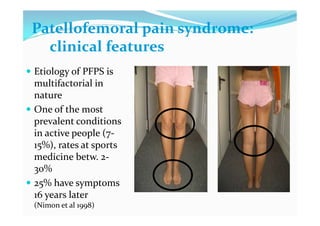
Patellofemoral pain syndrome:
   clinical features
 Etiology of PFPS is
  multifactorial in
  nature
 One of the most
  prevalent conditions
  in active people (7-
  15%), rates at sports
  medicine betw. 2-
  30%
 25% have symptoms
  16 years later
 (Nimon et al 1998)
Pathomecanical hypotheses:
local factors
 Maltracking of the patella
Pathomecanical hypotheses:
local factors: VMO
Vastus Medialis Oblique (VMO)
  insufficiency, important
  stabilizer (Elias et al 2009)
 Timing
 Endurance
 Magnitude
                                  25 ms
VMO

 VL
Pathomecanical hypotheses
proximal factors 1: hip
 Evidence suggests that patients with PFPS
 demonstrate altered hip kinematic in the frontal
 and traverse plane during various taks (Souza et al 2009)

 Females with PFPS demonstrate hip abduction &
 external rotation weakness    (Bolgla et al 2008)


 Some individual with PFPS have delayed gluteus
 medius activity during steping tasks (Cowan et al 2009)
Pathomecanical hypotheses
proximal factors 1: hip


      (Powers et al., J Orthop Sports Phys Ther, 2003;
      Doucette & Child; J Orthop Sports Phys Ther, 1996)
Altered hip and trunk muscle
function in individuals with PFP
Altered hip and trunk muscle
function in individuals with PFP
Pathomecanical hypotheses
proximal factors 2 : trunk
Pathomecanical hypotheses distal factors:
foot
Pronated Foot on Limb Alignment
Interventions: Taping of the Foot
Interventions: Foot orthoses


  Vicenzino, Collins, Crossley et al (2008), BMC Musculoskelet Disord, 9:27
Taping the foot or using orthoses,
 effectiveness ?

     Bill Vicenzino’s work
     179 participants (100 women) 18-40 y.o.
      with PFPS > 6/52 without Tretament preceeding the
      test 12/12
     6/52 PT, flat inserts, foot orthoses, combination of foot
      orth. & PT
     Foot orthoses improvement in short term; no
      difference if added to PT


Foot orthoses and physiotherapy in the treatment of patellofemoral pain
Syndrome: randomised clinical trial, Colling et al BMJ 2008; 337: a1735
Take home message

 PFPS does not have a homogenous presentations
 PFPS is only one part of the problem
 Not every patient with PFPS has the same
  “abnormalities”
 Standard treatment for PFPS does not exist
 Clinician should incorporate the information
  gained from their clinical assessment of each
  patient &
 Use clinical reasoning to ensure that the
  treatment is patient specific
What about the shoulder ?
 The effect of tape on glenohumeral rotation
  range of motion in elite junior tennis players
 11 male (mean age 16.8±1.3 years) and 10 female (mean age 14.9±0.8 years)
  elite junior tennis players
 Two measurements of passive external rotation and internal rotation
  ROM were made using a universal goniometer with an attached spirit-
  level under three randomly ordered conditions
     Control
     Tape
     Sham Tape
THANK YOU


alfioalbasini@ticino.com

Albasini jfk2011

  • 1.
    Alfio Albasini PT, PostGradManipTherap Adjunct Fellow, Università Svizzera Italiana (USI) Member of CEC, Otto Bock Healthcare International Presenter, McConnell & NDS alfioalbasini@ticino.com Switzerland
  • 2.
    Jenny McConnell  McConnell J, The management of chondromalacia patellae: a long term solution. Aust J Physiother 1986, 32:215-23.
  • 3.
    Original Hypothesis shifting mechanically the patella medially with the tape (medial glide) would correct the patella position, stretch the tight lateral structures, increase the activity of the VMO muscle, decrease pain thus allowing the patient to start strengthening the 4-ceps with specific exercises.
  • 4.
    Assessment of patellamalalignment Herrington LC, Man Ther, 2002;7:163-167
  • 5.
    Medial Glide ofthe Patella
  • 6.
    Effect of tapingthe patella on patellofemoral pain sufferers  reduces pain (Bockrath et al 1991, Conway et al 1992, Cushnagen et al 1994, Cerny 1995, Powers et al 1997, Gilleard et al 1998, Crossley et al 2000, Hinmann et al 2003 Whittingham et al 2004, ).
  • 7.
    Efficacy on KneeTape in the management of osteoarthritis of the knee: blinded randomised controlled trial  Hypothesis: taping decrease P in OA pat also after treatment ???  87 patients with symptoms of knee osteoarthritis  Therapeutic Tape: medial glide, lat. Tilt , AP Tilt and Hoffa Fat pad Control Tape and No Tape  Three weeks duration and follow up after three weeks of stop of treatment Rana S Hinman, Kay M Crossley, Jenny McConnell, Kim L Bennell, BJM 2003;327:135
  • 8.
    Efficacy on KneeTape in the management of osteoarthritis of the knee: blinded randomised controlled trial Change in P after 3 weeks:  Therapeutic Tape 73% of improvement  Control Tape 49 %  No Tape 10%  Benefit of therapeutic tape was maintained also after three weeks follow up Rana S Hinman, Kay M Crossley, Jenny McConnell, Kim L Bennell, BJM 2003;327:135
  • 9.
    Acute effects ofpatella taping on patella position  12 asymptomatic subjects  6 male, 6 female  Age 20.4(+/- 1.2) years  Pre-post ultrasound measurements  Intervention: patella medial tilt tape Herrington, L. (2009) The effect of patella taping on patella position measured using ultrasound scanning The Knee (under review)
  • 10.
    No tape With tape in-situ Deep lateral retinaculum Patella Patella Lateral femoral Lateral femoral condyle condyle Note Distance between patella & lateral femoral condyle (red line) increases with tape; patella is tilted medially Orientation of deep lateral retinaculum changes (solid line) Herrington, L. (2009) The effect of patella taping on patella position measured using ultrasound scanning The Knee (under review)
  • 11.
    Results  Patella taping P=0.0032 12 10 8 Patella position (mm) 6 4 2 0 Pre Post Herrington, L. (2009) The effect of patella taping on patella position measured using ultrasound scanning The Knee (under review)
  • 12.
    1. Patellofemoral painsyndrome: clinical features 2. Pathomecanical hypotheses: local-, proximal-, distal factors 3. Predicting success with multimodal treatment approach 4. Clinical efficacy
  • 13.
    Patellofemoral pain syndrome: clinical features  Etiology of PFPS is multifactorial in nature  One of the most prevalent conditions in active people (7- 15%), rates at sports medicine betw. 2- 30%  25% have symptoms 16 years later (Nimon et al 1998)
  • 14.
  • 15.
  • 16.
    Pathomecanical hypotheses: local factors:VMO Vastus Medialis Oblique (VMO) insufficiency, important stabilizer (Elias et al 2009)  Timing  Endurance  Magnitude 25 ms VMO VL
  • 17.
    Pathomecanical hypotheses proximal factors1: hip  Evidence suggests that patients with PFPS demonstrate altered hip kinematic in the frontal and traverse plane during various taks (Souza et al 2009)  Females with PFPS demonstrate hip abduction & external rotation weakness (Bolgla et al 2008)  Some individual with PFPS have delayed gluteus medius activity during steping tasks (Cowan et al 2009)
  • 18.
    Pathomecanical hypotheses proximal factors1: hip (Powers et al., J Orthop Sports Phys Ther, 2003; Doucette & Child; J Orthop Sports Phys Ther, 1996)
  • 19.
    Altered hip andtrunk muscle function in individuals with PFP
  • 20.
    Altered hip andtrunk muscle function in individuals with PFP
  • 21.
  • 22.
    Pathomecanical hypotheses distalfactors: foot Pronated Foot on Limb Alignment
  • 23.
  • 24.
    Interventions: Foot orthoses Vicenzino, Collins, Crossley et al (2008), BMC Musculoskelet Disord, 9:27
  • 25.
    Taping the footor using orthoses, effectiveness ?  Bill Vicenzino’s work  179 participants (100 women) 18-40 y.o. with PFPS > 6/52 without Tretament preceeding the test 12/12  6/52 PT, flat inserts, foot orthoses, combination of foot orth. & PT  Foot orthoses improvement in short term; no difference if added to PT Foot orthoses and physiotherapy in the treatment of patellofemoral pain Syndrome: randomised clinical trial, Colling et al BMJ 2008; 337: a1735
  • 26.
    Take home message PFPS does not have a homogenous presentations  PFPS is only one part of the problem  Not every patient with PFPS has the same “abnormalities”  Standard treatment for PFPS does not exist  Clinician should incorporate the information gained from their clinical assessment of each patient &  Use clinical reasoning to ensure that the treatment is patient specific
  • 27.
    What about theshoulder ?  The effect of tape on glenohumeral rotation range of motion in elite junior tennis players  11 male (mean age 16.8±1.3 years) and 10 female (mean age 14.9±0.8 years) elite junior tennis players  Two measurements of passive external rotation and internal rotation ROM were made using a universal goniometer with an attached spirit- level under three randomly ordered conditions  Control  Tape  Sham Tape
  • 28.