Arun C Mohan
MBA IFM
ALANDUR IN CONTEXT
Located 14 km south of Chennai, Alandur is part of the Kanchipuram district of Tamil
Nadu and forms a part of the Chennai Metropolitan Development Area (CMDA). The
town has developed as a residential suburb of Chennai with a population of 160,000
(Census 2004) of which approximately one-fourth lives in slums.
Rapid urbanization during 1980s and „90s at the peripheral vicinity of Chennai resulted in
the creation of this satellite town. It is given the status of Selection Grade
Municipality.
Prior to the project, Alandur had no sewerage system and wastewater from the majority of
its residents was collected either in septic tanks or holding tanks. The sewerage was
collected periodically in tankers and disposed of in low-lying areas outside the
municipal limits. The clearance of septic tanks was irregular due to lack of sufficient
vehicles and staff in the public health department.
In 1997, the Government of Tamil Nadu decided to provide a sewerage system in 12
selected major urban centers, including Alandur, in the context of a World Bank
funded project. The Chairperson of the Municipality, Mr. R. S. Bharati took up the task
of implementing the project in Alandur.
OBJECTIVES OF ALANDUR SEWERAGE PROJECT
To improve the standard of living of the residents of Alandur on par with that of
Chennai
To provide the most essential basic facility to all the residents of the town
To eradicate the mosquito menace
To avoid the recurring expenditure on septic tank cleaning
To avoid ground water contamination
The proposed sewerage system was to be designed for the estimated population of
about 300,000 by 2027
It was planned to be completed within a five-year period from its inception date.
ASP COMPONENTS
A sewerage network consisting of the main sewer line, branch sewer line and
manholes
Construction of a sewage pumping station
A sewage treatment plant
Low cost sanitation
PROJECT IMPLEMENTATION PROCESS
Tamil Nadu Urban Infrastructure Finance Services Ltd. (TNUIFSL) was nominated as
the agency to coordinate, supervise and structure the finances for the project,
was also responsible for detailed studies on the feasibility of the project.
Lack of resources in Municipal level resulted in TNUIFSL & the Municipal
Administration of Alandur to construct the underground sewerage system on
BOQ basis, and the sewerage treatment plant (STP) on a BOT basis.
Besides the construction responsibility, the contractor was also required to
undertake the O&M of the sewerage system for a period of 5yrs from the date of
completion of the construction, on a fixed fee basis. Collection of tariff and
provision of new connections during the O&M phase was to be undertaken by
the municipality directly.
PROJECT PROCUREMENT
The project was structured such that an EPC contractor, selected through
competitive bidding process, would design and implement the sewerage system,
on turnkey works contract, and would also finance, design, build, and operate
the STP on BOT (Annuity) basis.
The procurement of private contractor for the execution of the project was carried
out as per the standards prescribed by the World Bank. A two stage bid process
was adopted - a technical proposal followed by a financial proposal.
The technical capabilities of the contractors and their experience in similar works
were given importance. Of the 13 entities who submitted the bids, three were
short-listed, and the financial proposals were received from such technically
qualified firms.
As per the financial evaluation criteria, the bidder quoting the lowest cost for the
sewerage system and lowest lease period for the STP was selected as the final,
successful contractor.
PPP STRUCTURE OF THE PROJECT
A Works Contract for construction of the sewage network, using the World Bank‟s
contract for National Competitive Bidding (NCB-W2) as the template
An O&M Contract, also using NCB-W2. The selected contractor would operate and
maintain the underground sewerage system for a period of 5yrs on a fixed fee
basis
A Lease Contract (in the nature of a BOT Agreement) for the STP, using guidelines
from FIDIC. Through this Agreement, the contractor would finance, build and
operate the STP for a period as proposed in the contractor‟s successful bid. The
contractor would be require to recover the investment o the STP on the basis of
a per unit rate payment from the municipality for treatment of sewage delivered.
The municipality agreed to provide a minimum payment level per annum
regardless of the volume of sewage actually delivered. It was designed to cover
the company‟s minimum fixed operating cost and capital investment.
FOLLOWING THE BID
Project awarded to IVRCL Infrastructures and Projects Ltd in technical collaboration
with “Va Tech Wabag Technologies Ltd.” A SPV called „First Sewerage Treatment
Plant Pvt. Ltd‟ (First STP) was incorporated and was the concessionaire company
with whom the BOT Agreement was signed 2 March 2000.
IVRCL was to carry out the civil works for the project
Va Tech Wabag, through the electro mechanical contract, was to design the process,
supply, install and commission the equipment.
Va Tech Wabag was also to carry out a contract for O&M the facility for 14 years.
The land on which the plant was set up was leased by the municipality to First STP.
IMPLEMENTATION
As per the Agreement, the expected date of completion was 31st March, 2005.
In order to ensure timely implementation of the project and adherence to quality
specifications, Consulting Engineering Services Limited (CESL) was appointed as
Project Management Consultants for the detailed supervision and quality
control.
Along with the consultants, the Chairman, Commissioner and Engineer of the AM
reviewed the progress of the project on a weekly basis.
The Commissioner of Municipal Administration, GoTN, the Secretary of the
Municipal Administration & Water Supply and the Chief Executive of TNUIFSL
also reviewed the progress of the project every month, and provided
administrative support for acquiring the necessary clearances from agencies
such as the railways, highway authority, PWD, etc.
DELIVERY
The project work was carried out in two phases.
In the first phase (the first two and a half years), 50% of the branch sewers, main
sewers, pump house including installation of machinery, pumping main and one
12 MLD capacity sewage treatment plant, were completed and commissioned.
The remaining work relating to the project was to be carried out in the next phase.
By end 2001, the laying of the sewer pipes and main sewers was completed, as also
the construction of the Pumping Station, Pumping Mains and Sewerage
Treatment Plant.
The overall date of completion was October 2003.
FINANCING INFORMATION
Initially, the cost of the project was estimated to be INR 45.31 crore, which was later
revised to INR 40.86 crore.
A unique aspect of the project funding was the initiative of bringing in people‟s
money to fund public infrastructure by generating public awareness and interest
right from inception.
PUBLIC CONTRIBUTION
To reduce the repayment burden on the local body, it was decided to collect deposits
from at least 10000 residents before calling tenders to ensure effective public
participation in the project
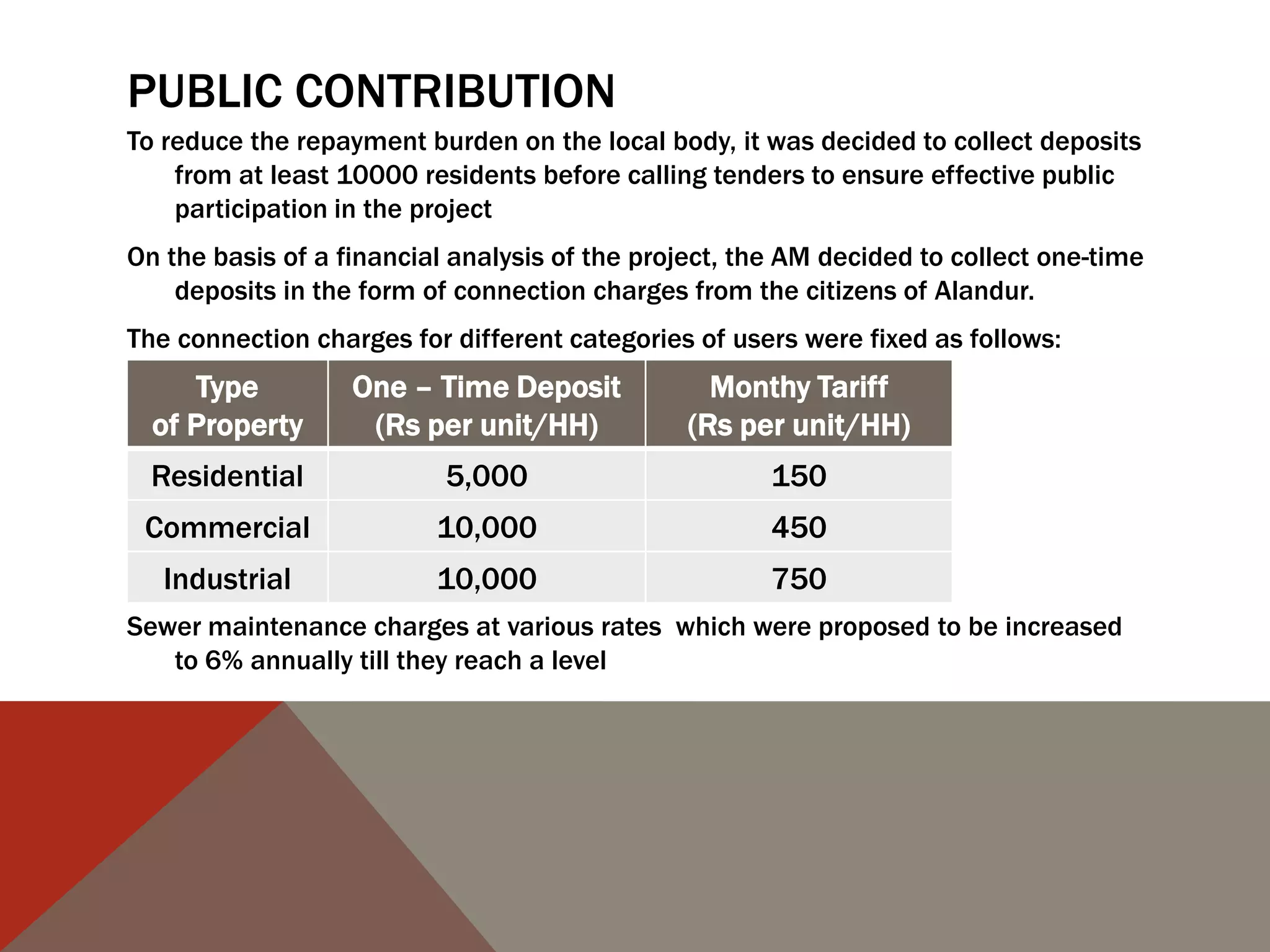
On the basis of a financial analysis of the project, the AM decided to collect one-time
deposits in the form of connection charges from the citizens of Alandur.
The connection charges for different categories of users were fixed as follows:
Sewer maintenance charges at various rates which were proposed to be increased
to 6% annually till they reach a level
Type
of Property
One – Time Deposit
(Rs per unit/HH)
Monthy Tariff
(Rs per unit/HH)
Residential 5,000 150
Commercial 10,000 450
Industrial 10,000 750
ASP FEATURES
The greatest challenge (as well as accomplishment) of the ASP, was that both the
municipality and the public recognized and accepted the „value‟ of bringing in
private participation.
This project truly demonstrates the benefits of bringing in PPP in the municipal
sector in terms of drawing private sector expertise while addressing important
risk related aspect that would make the project attractive for the private sector.
KEY LEARNING AND OBSERVATIONS FROM ASP
Beneficiary participatory approach
Stakeholder involvement and interdepartmental coordination
Political will and strong decision making, especially at the grass-root level
Acceptance of fiscal discipline
Commitment towards project prior to implementation
Implementing an effective fee system
Technical and financial assistance
Transparency in bidding and contracting procedures
IMPACTS OF THE PROJECT
Nearly 500 slum dwellers of the 7,000 had a sewerage connection and 43 percent
of slum dwellers have opted and paid for individual sewerage connections.
In 2005, 14 community toilets were constructed to serve poor clusters.
By end of March 2008 – all households have received sewerage connections
Alandur sewerage project is an innovative attempt for sustainable delivery of urban
services in the country and many municipalities (Trichy, Tanjavur, Tirunelveli,
Ambattur, etc.) had started adopting similar efforts for underground drainage
The initiative was awarded the National Urban Water Award in 2008.
Alandur sewerage proj   arun

Alandur sewerage proj arun

  • 1.
  • 2.
    ALANDUR IN CONTEXT Located14 km south of Chennai, Alandur is part of the Kanchipuram district of Tamil Nadu and forms a part of the Chennai Metropolitan Development Area (CMDA). The town has developed as a residential suburb of Chennai with a population of 160,000 (Census 2004) of which approximately one-fourth lives in slums. Rapid urbanization during 1980s and „90s at the peripheral vicinity of Chennai resulted in the creation of this satellite town. It is given the status of Selection Grade Municipality. Prior to the project, Alandur had no sewerage system and wastewater from the majority of its residents was collected either in septic tanks or holding tanks. The sewerage was collected periodically in tankers and disposed of in low-lying areas outside the municipal limits. The clearance of septic tanks was irregular due to lack of sufficient vehicles and staff in the public health department. In 1997, the Government of Tamil Nadu decided to provide a sewerage system in 12 selected major urban centers, including Alandur, in the context of a World Bank funded project. The Chairperson of the Municipality, Mr. R. S. Bharati took up the task of implementing the project in Alandur.
  • 3.
    OBJECTIVES OF ALANDURSEWERAGE PROJECT To improve the standard of living of the residents of Alandur on par with that of Chennai To provide the most essential basic facility to all the residents of the town To eradicate the mosquito menace To avoid the recurring expenditure on septic tank cleaning To avoid ground water contamination The proposed sewerage system was to be designed for the estimated population of about 300,000 by 2027 It was planned to be completed within a five-year period from its inception date.
  • 4.
    ASP COMPONENTS A seweragenetwork consisting of the main sewer line, branch sewer line and manholes Construction of a sewage pumping station A sewage treatment plant Low cost sanitation
  • 5.
    PROJECT IMPLEMENTATION PROCESS TamilNadu Urban Infrastructure Finance Services Ltd. (TNUIFSL) was nominated as the agency to coordinate, supervise and structure the finances for the project, was also responsible for detailed studies on the feasibility of the project. Lack of resources in Municipal level resulted in TNUIFSL & the Municipal Administration of Alandur to construct the underground sewerage system on BOQ basis, and the sewerage treatment plant (STP) on a BOT basis. Besides the construction responsibility, the contractor was also required to undertake the O&M of the sewerage system for a period of 5yrs from the date of completion of the construction, on a fixed fee basis. Collection of tariff and provision of new connections during the O&M phase was to be undertaken by the municipality directly.
  • 6.
    PROJECT PROCUREMENT The projectwas structured such that an EPC contractor, selected through competitive bidding process, would design and implement the sewerage system, on turnkey works contract, and would also finance, design, build, and operate the STP on BOT (Annuity) basis. The procurement of private contractor for the execution of the project was carried out as per the standards prescribed by the World Bank. A two stage bid process was adopted - a technical proposal followed by a financial proposal. The technical capabilities of the contractors and their experience in similar works were given importance. Of the 13 entities who submitted the bids, three were short-listed, and the financial proposals were received from such technically qualified firms. As per the financial evaluation criteria, the bidder quoting the lowest cost for the sewerage system and lowest lease period for the STP was selected as the final, successful contractor.
  • 7.
    PPP STRUCTURE OFTHE PROJECT A Works Contract for construction of the sewage network, using the World Bank‟s contract for National Competitive Bidding (NCB-W2) as the template An O&M Contract, also using NCB-W2. The selected contractor would operate and maintain the underground sewerage system for a period of 5yrs on a fixed fee basis A Lease Contract (in the nature of a BOT Agreement) for the STP, using guidelines from FIDIC. Through this Agreement, the contractor would finance, build and operate the STP for a period as proposed in the contractor‟s successful bid. The contractor would be require to recover the investment o the STP on the basis of a per unit rate payment from the municipality for treatment of sewage delivered. The municipality agreed to provide a minimum payment level per annum regardless of the volume of sewage actually delivered. It was designed to cover the company‟s minimum fixed operating cost and capital investment.
  • 8.
    FOLLOWING THE BID Projectawarded to IVRCL Infrastructures and Projects Ltd in technical collaboration with “Va Tech Wabag Technologies Ltd.” A SPV called „First Sewerage Treatment Plant Pvt. Ltd‟ (First STP) was incorporated and was the concessionaire company with whom the BOT Agreement was signed 2 March 2000. IVRCL was to carry out the civil works for the project Va Tech Wabag, through the electro mechanical contract, was to design the process, supply, install and commission the equipment. Va Tech Wabag was also to carry out a contract for O&M the facility for 14 years. The land on which the plant was set up was leased by the municipality to First STP.
  • 9.
    IMPLEMENTATION As per theAgreement, the expected date of completion was 31st March, 2005. In order to ensure timely implementation of the project and adherence to quality specifications, Consulting Engineering Services Limited (CESL) was appointed as Project Management Consultants for the detailed supervision and quality control. Along with the consultants, the Chairman, Commissioner and Engineer of the AM reviewed the progress of the project on a weekly basis. The Commissioner of Municipal Administration, GoTN, the Secretary of the Municipal Administration & Water Supply and the Chief Executive of TNUIFSL also reviewed the progress of the project every month, and provided administrative support for acquiring the necessary clearances from agencies such as the railways, highway authority, PWD, etc.
  • 10.
    DELIVERY The project workwas carried out in two phases. In the first phase (the first two and a half years), 50% of the branch sewers, main sewers, pump house including installation of machinery, pumping main and one 12 MLD capacity sewage treatment plant, were completed and commissioned. The remaining work relating to the project was to be carried out in the next phase. By end 2001, the laying of the sewer pipes and main sewers was completed, as also the construction of the Pumping Station, Pumping Mains and Sewerage Treatment Plant. The overall date of completion was October 2003.
  • 11.
    FINANCING INFORMATION Initially, thecost of the project was estimated to be INR 45.31 crore, which was later revised to INR 40.86 crore. A unique aspect of the project funding was the initiative of bringing in people‟s money to fund public infrastructure by generating public awareness and interest right from inception.
  • 13.
    PUBLIC CONTRIBUTION To reducethe repayment burden on the local body, it was decided to collect deposits from at least 10000 residents before calling tenders to ensure effective public participation in the project On the basis of a financial analysis of the project, the AM decided to collect one-time deposits in the form of connection charges from the citizens of Alandur. The connection charges for different categories of users were fixed as follows: Sewer maintenance charges at various rates which were proposed to be increased to 6% annually till they reach a level Type of Property One – Time Deposit (Rs per unit/HH) Monthy Tariff (Rs per unit/HH) Residential 5,000 150 Commercial 10,000 450 Industrial 10,000 750
  • 14.
    ASP FEATURES The greatestchallenge (as well as accomplishment) of the ASP, was that both the municipality and the public recognized and accepted the „value‟ of bringing in private participation. This project truly demonstrates the benefits of bringing in PPP in the municipal sector in terms of drawing private sector expertise while addressing important risk related aspect that would make the project attractive for the private sector.
  • 15.
    KEY LEARNING ANDOBSERVATIONS FROM ASP Beneficiary participatory approach Stakeholder involvement and interdepartmental coordination Political will and strong decision making, especially at the grass-root level Acceptance of fiscal discipline Commitment towards project prior to implementation Implementing an effective fee system Technical and financial assistance Transparency in bidding and contracting procedures
  • 16.
    IMPACTS OF THEPROJECT Nearly 500 slum dwellers of the 7,000 had a sewerage connection and 43 percent of slum dwellers have opted and paid for individual sewerage connections. In 2005, 14 community toilets were constructed to serve poor clusters. By end of March 2008 – all households have received sewerage connections Alandur sewerage project is an innovative attempt for sustainable delivery of urban services in the country and many municipalities (Trichy, Tanjavur, Tirunelveli, Ambattur, etc.) had started adopting similar efforts for underground drainage The initiative was awarded the National Urban Water Award in 2008.

Editor's Notes

  • #6 (TNUIFSL), the state asset management company
  • #16 1. 29% of the project cost was garnered from public 2. citizen’s committee was formed and it met frequently to review the status of the project, monitor performance of the BOT contractor and provide a forum in which citizens could air their concerns.4. TNUIFSL and TUFIDCO, placed strict lending conditions on the municipality, requiring the municipality to accept and implement strong fiscal discipline measures