Water supply and  sanitation  in Africa Optimism  or  pessimism? Some reflections Alan Nicol RiPPLE / ODI
Two views It’s bad, and getting worse Supply is barely matching population-driven demand   Urbanisation is causing new problems (rural-urban) Sustainability is still a problem—for coverage figures It’s getting better, slowly   Government is managing the sector more effectively and new aid instruments are assisting in this A private sector is emerging alongside a stronger civil society, and able to ‘fill the gaps’ Coverage is increasing, but incrementally only—no ‘great leap forward’
Comparative view…
sanitation
…and water?
Which, in global terms could mean… “ If the average one hour per day saved by each household member through the convenience of nearby safe drinking water and sanitation facilities could be used to earn the daily minimum wage, that time would be worth $63.5 bn a year”…globally
At present the situation suggests a pessimistic perspective in SSA
So, it is useful to look a little more in-depth at a ‘meso level’
Where, in rural, areas… It’s a long walk to water…and time is money One person-day lost a week = ~ $1? Which is enough to purchase 100 litres? Water is  very  expensive and often poor quality
…and in towns Rich people pay the same amount for ~ 5,000 litres with a connection Water is  cheap or expensive ?
Ethiopia’s complex policy and institutional environment Federal state, increasing decentralisation of delivery Fragmented decision making and poor coordination Complex aid environment: many actors Shifting to a sectoral programme, but problems in progress
Some brief findings of the  research to date… Financing Budget utilisation is a problem—you can’t simply throw money at local levels and expect progress Matching funds are difficult—there are complexities in the way programmes are understood, delivered and managed Governance and planning Sustainability is a major issue Communicating new plans and approaches needs improving Yet strong political championing can work (but too much politics can skew results?)
…Case studies looking at: Economic impacts of access to water and sanitation in Ethiopia—Evidence from the Welfare Monitoring Surveys Poverty impacts of improved access to water and sanitation in Ethiopia: Evidence from a household survey The costs and benefits of multiple uses of water in East Hararghe Zone Linkages between water supply and sanitation and food security: A case study in four villages of East Hararghe Zone
Evidence from the Welfare Monitoring Surveys Statistically significant relationship between HH improvements in sources of drinking water and improvements in self-reported food situations But not a statistically significant relationship to changes in (self-reported) overall welfare situation No statistically significant relationship between changes in sources of sanitation and self-reported food or overall welfare
Evidence from a household survey Investments more likely where kebeles are well-connected Complex relationship of proximity and health impacts Significant links between off-non-farm employment and improved WS access Significant poverty-access to improved water supply relationship Potential poverty impact of improved WS access also depends on the availability of other livelihood assets Roads are important: enabling access to WS and enhancing poverty impacts
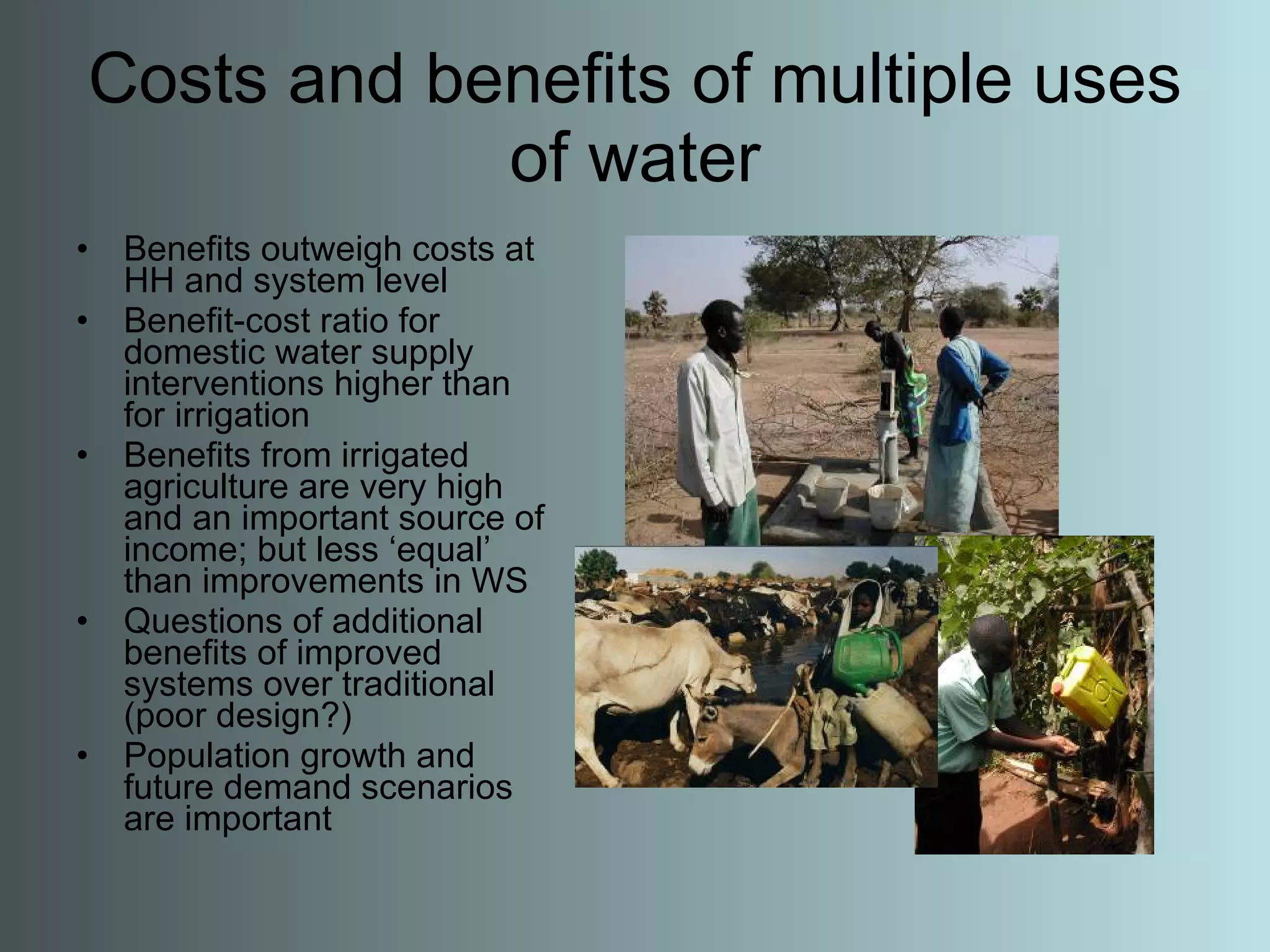
Costs and benefits of multiple uses of water Benefits outweigh costs at HH and system level Benefit-cost ratio for domestic water supply interventions higher than for irrigation Benefits from irrigated agriculture are very high and an important source of income; but less ‘equal’ than improvements in WS Questions of additional benefits of improved systems over traditional (poor design?) Population growth and future demand scenarios are important
Tentative conclusions… Water-growth relationships are neither simple nor linear: Health linkages are complex (many intervening factors) (water brings problems too) Access is a two-way issue: to water (use), from use to markets (productivity)—growth corridors Income diversity-water relationships are significant, but assets crucial (who has?) Water into money: yes, in combination with other interventions Equity: what about benefits distribution?
Taking forward thinking at a micro level…in relation to adaptation Conceptualising household water economies Water as an economic and social good Thinking about maximizing poverty impacts through greater sectoral linkage Thinking more about the resource, as well as delivering it effectively
Back to the challenge  World SSA
So, addressing the issue optimistically…
How about some ‘pessoptimism’? Population is rising fast and outstripping improvements…maybe As food (and fuel) prices rise, users bearing some proportion of service cost becomes increasingly problematic (and politically unpalatable)…likely, so safety nets are key as are realistic expectations Capacity to deliver, manage and monitor remains low…so do we really know about progress? But  there is no option other than improving on the current situation So downward accountability should increase…not simple Other models exist that may work and are being explored elsewhere (e.g. Kenya)—the community as private sector company? Can or should people do it for themselves? If water and sanitation are basic rights, then where and how should responsibility be shouldered across the state-society continuum?
Thank you! Finally, it’s both half full and half empty… You can stare into a well for as long as you like, but you may have to jump in to find out how deep it is (a call for more research)

Alan Nicol Keynote Speech

  • 1.
    Water supply and sanitation in Africa Optimism or pessimism? Some reflections Alan Nicol RiPPLE / ODI
  • 2.
    Two views It’sbad, and getting worse Supply is barely matching population-driven demand  Urbanisation is causing new problems (rural-urban) Sustainability is still a problem—for coverage figures It’s getting better, slowly  Government is managing the sector more effectively and new aid instruments are assisting in this A private sector is emerging alongside a stronger civil society, and able to ‘fill the gaps’ Coverage is increasing, but incrementally only—no ‘great leap forward’
  • 3.
  • 4.
  • 5.
  • 6.
    Which, in globalterms could mean… “ If the average one hour per day saved by each household member through the convenience of nearby safe drinking water and sanitation facilities could be used to earn the daily minimum wage, that time would be worth $63.5 bn a year”…globally
  • 7.
    At present thesituation suggests a pessimistic perspective in SSA
  • 8.
    So, it isuseful to look a little more in-depth at a ‘meso level’
  • 9.
    Where, in rural,areas… It’s a long walk to water…and time is money One person-day lost a week = ~ $1? Which is enough to purchase 100 litres? Water is very expensive and often poor quality
  • 10.
    …and in townsRich people pay the same amount for ~ 5,000 litres with a connection Water is cheap or expensive ?
  • 11.
    Ethiopia’s complex policyand institutional environment Federal state, increasing decentralisation of delivery Fragmented decision making and poor coordination Complex aid environment: many actors Shifting to a sectoral programme, but problems in progress
  • 12.
    Some brief findingsof the research to date… Financing Budget utilisation is a problem—you can’t simply throw money at local levels and expect progress Matching funds are difficult—there are complexities in the way programmes are understood, delivered and managed Governance and planning Sustainability is a major issue Communicating new plans and approaches needs improving Yet strong political championing can work (but too much politics can skew results?)
  • 13.
    …Case studies lookingat: Economic impacts of access to water and sanitation in Ethiopia—Evidence from the Welfare Monitoring Surveys Poverty impacts of improved access to water and sanitation in Ethiopia: Evidence from a household survey The costs and benefits of multiple uses of water in East Hararghe Zone Linkages between water supply and sanitation and food security: A case study in four villages of East Hararghe Zone
  • 14.
    Evidence from theWelfare Monitoring Surveys Statistically significant relationship between HH improvements in sources of drinking water and improvements in self-reported food situations But not a statistically significant relationship to changes in (self-reported) overall welfare situation No statistically significant relationship between changes in sources of sanitation and self-reported food or overall welfare
  • 15.
    Evidence from ahousehold survey Investments more likely where kebeles are well-connected Complex relationship of proximity and health impacts Significant links between off-non-farm employment and improved WS access Significant poverty-access to improved water supply relationship Potential poverty impact of improved WS access also depends on the availability of other livelihood assets Roads are important: enabling access to WS and enhancing poverty impacts
  • 16.
    Costs and benefitsof multiple uses of water Benefits outweigh costs at HH and system level Benefit-cost ratio for domestic water supply interventions higher than for irrigation Benefits from irrigated agriculture are very high and an important source of income; but less ‘equal’ than improvements in WS Questions of additional benefits of improved systems over traditional (poor design?) Population growth and future demand scenarios are important
  • 17.
    Tentative conclusions… Water-growthrelationships are neither simple nor linear: Health linkages are complex (many intervening factors) (water brings problems too) Access is a two-way issue: to water (use), from use to markets (productivity)—growth corridors Income diversity-water relationships are significant, but assets crucial (who has?) Water into money: yes, in combination with other interventions Equity: what about benefits distribution?
  • 18.
    Taking forward thinkingat a micro level…in relation to adaptation Conceptualising household water economies Water as an economic and social good Thinking about maximizing poverty impacts through greater sectoral linkage Thinking more about the resource, as well as delivering it effectively
  • 19.
    Back to thechallenge World SSA
  • 20.
    So, addressing theissue optimistically…
  • 21.
    How about some‘pessoptimism’? Population is rising fast and outstripping improvements…maybe As food (and fuel) prices rise, users bearing some proportion of service cost becomes increasingly problematic (and politically unpalatable)…likely, so safety nets are key as are realistic expectations Capacity to deliver, manage and monitor remains low…so do we really know about progress? But there is no option other than improving on the current situation So downward accountability should increase…not simple Other models exist that may work and are being explored elsewhere (e.g. Kenya)—the community as private sector company? Can or should people do it for themselves? If water and sanitation are basic rights, then where and how should responsibility be shouldered across the state-society continuum?
  • 22.
    Thank you! Finally,it’s both half full and half empty… You can stare into a well for as long as you like, but you may have to jump in to find out how deep it is (a call for more research)

Editor's Notes

  • #2 Morning, ladies and gentleman I have been given the unenviable task of taking an Africa-wide perspective on a highly complex issue. I shall do so, by starting broadly, then narrowing down on the experience in once country It is not representative – as no single country can be – but it does serve to illustrate some of the major challenges facing water supply and sanitation in sub-Saharan Africa, in particular As well as some of the critical water and development links that exist