AJM Sheet: Talar Fractures
Talus =
Anomalous
Bone
Job = Torque conversion  Hyaline cartilage
everywhere  Limited areas of vascular
supply
• Second in frequency of all tarsal bone injures
• Talus fractures reportedly comprise 3-5% of
foot fractures
• 50% of fractures of the talus involve the talar
neck.
• Mechanism of fracture varies, impact and
forced twisting play major role.
• Injury may result in arterial compromise
• Prognosis is usually good with early
recognition and proper treatment.
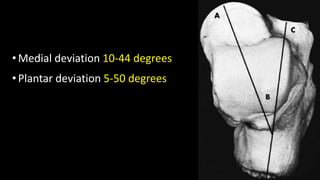
•Medial deviation 10-44 degrees
•Plantar deviation 5-50 degrees
AJM Sheet
Talar fractures are generally associated with high
energy trauma, and a standard evaluation with
primary and secondary surveys should precede any
specific talar evaluation.
Subjective
History of trauma with a high incidence of MVC. The
classic description of a talar neck fracture comes from
a forced dorsiflexion of the foot on the ankle
(“Aviator’s Astragulus”). Talar fractures account for
approximately 1% of all foot and ankle fractures.
Objective
Important to verify neurovascular status, and rule out
dislocations and compartment syndromes.
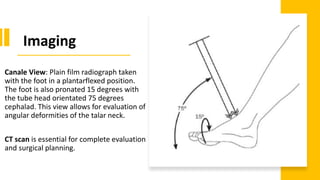
Canale View: Plain film radiograph taken
with the foot in a plantarflexed position.
The foot is also pronated 15 degrees with
the tube head orientated 75 degrees
cephalad. This view allows for evaluation of
angular deformities of the talar neck.
CT scan is essential for complete evaluation
and surgical planning.
Imaging
Relevant
Anatomy
An intimate knowledge of the vascular supply
to the talus is essential with regard to
avascular necrosis (AVN):
[Aquino’s. Talar neck fractures: a review of
vascular supply and classification. J Foot Surg.
1986; 25(3): 188-93.]
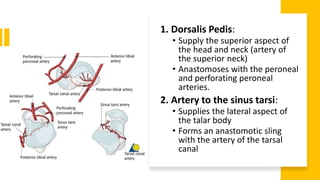
1. Dorsalis Pedis:
• Supply the superior aspect of
the head and neck (artery of
the superior neck)
• Anastomoses with the peroneal
and perforating peroneal
arteries.
2. Artery to the sinus tarsi:
• Supplies the lateral aspect of
the talar body
• Forms an anastomotic sling
with the artery of the tarsal
canal
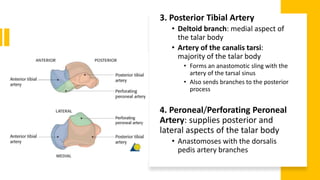
3. Posterior Tibial Artery
• Deltoid branch: medial aspect of
the talar body
• Artery of the canalis tarsi:
majority of the talar body
• Forms an anastomotic sling with the
artery of the tarsal sinus
• Also sends branches to the posterior
process
4. Peroneal/Perforating Peroneal
Artery: supplies posterior and
lateral aspects of the talar body
• Anastomoses with the dorsalis
pedis artery branches
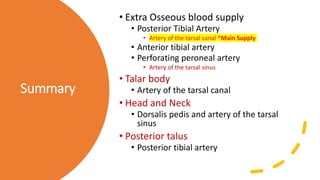
Summary
• Extra Osseous blood supply
• Posterior Tibial Artery
• Artery of the tarsal canal *Main Supply
• Anterior tibial artery
• Perforating peroneal artery
• Artery of the tarsal sinus
• Talar body
• Artery of the tarsal canal
• Head and Neck
• Dorsalis pedis and artery of the tarsal
sinus
• Posterior talus
• Posterior tibial artery
Talus Trauma
Classifications
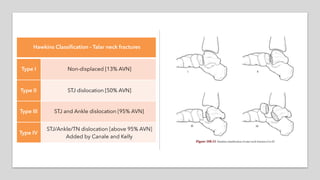
1. Hawkin’s Classification- Talar neck Fractures
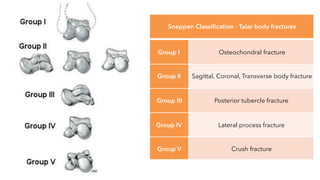
2. Sneppen Classification- Talar body Fractures
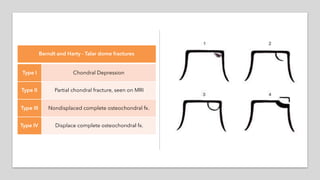
3. Berndt and Harty- Talar dome fractures
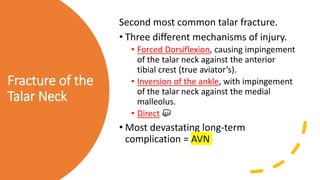
Fracture of the
Talar Neck
Second most common talar fracture.
• Three different mechanisms of injury.
• Forced Dorsiflexion, causing impingement
of the talar neck against the anterior
tibial crest (true aviator’s).
• Inversion of the ankle, with impingement
of the talar neck against the medial
malleolus.
• Direct 👊
• Most devastating long-term
complication = AVN
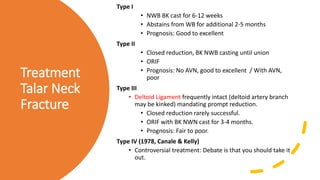
Treatment
Talar Neck
Fracture
Type I
• NWB BK cast for 6-12 weeks
• Abstains from WB for additional 2-5 months
• Prognosis: Good to excellent
Type II
• Closed reduction, BK NWB casting until union
• ORIF
• Prognosis: No AVN, good to excellent / With AVN,
poor
Type III
• Deltoid Ligament frequently intact (deltoid artery branch
may be kinked) mandating prompt reduction.
• Closed reduction rarely successful.
• ORIF with BK NWN cast for 3-4 months.
• Prognosis: Fair to poor.
Type IV (1978, Canale & Kelly)
• Controversial treatment: Debate is that you should take it
out.
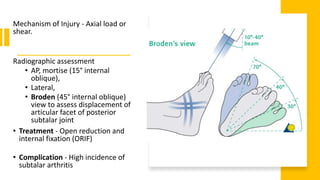
Mechanism of Injury - Axial load or
shear.
Radiographic assessment
• AP, mortise (15° internal
oblique),
• Lateral,
• Broden (45° internal oblique)
view to assess displacement of
articular facet of posterior
subtalar joint
• Treatment - Open reduction and
internal fixation (ORIF)
• Complication - High incidence of
subtalar arthritis
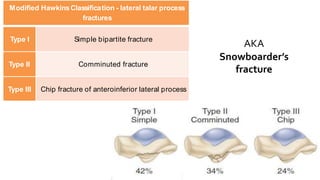
Modified HawkinsClassification - lateral talar process
fractures
Type I Simple bipartite fracture
Type II Comminuted fracture
Type III Chip fracture of anteroinferior lateral process- lateral talar process
tite fracture
ed fracture
AKA
Snowboarder’s
fracture
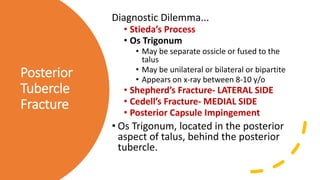
Posterior
Tubercle
Fracture
Diagnostic Dilemma...
• Stieda’s Process
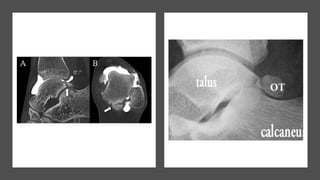
• Os Trigonum
• May be separate ossicle or fused to the
talus
• May be unilateral or bilateral or bipartite
• Appears on x-ray between 8-10 y/o
• Shepherd’s Fracture- LATERAL SIDE
• Cedell’s Fracture- MEDIAL SIDE
• Posterior Capsule Impingement
• Os Trigonum, located in the posterior
aspect of talus, behind the posterior
tubercle.
Type I Simple bipartite fracture
Type II Comminuted fracture
Type III Chip fracture of anteroinferior lateral process
Other Named Fractures:
- Shepherd’sfracture: Acute fracture of posterolateral talar
process
- Cedell’sfracture: Acute fracture of the posteromedial talar
process Other Named Fractures:
- Snowboarder’sfracture: lateral process
fractures
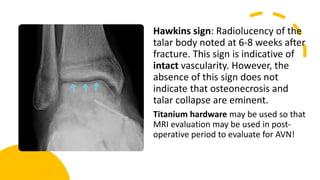
Hawkins sign: Radiolucency of the
talar body noted at 6-8 weeks after
fracture. This sign is indicative of
intact vascularity. However, the
absence of this sign does not
indicate that osteonecrosis and
talar collapse are eminent.
Titanium hardware may be used so that
MRI evaluation may be used in post-
operative period to evaluate for AVN!
Additional
Readings
Talar fractures are relatively uncommon in the
medical literature. Most studies are case
reports or small retrospective reviews leading
only to Level IV or V evidence.
[Ahmad J, Raikin SM. Current concepts review: talar fractures.
Foot Ankle Int. 2006 Jun; 27(6): 475-82.]
[Golano P, et al. The anatomy of the navicular and periarticular
structures. Foot Ankle Clin. 2004 Mar; 9(1): 1-23.]
[Berndt A, Harty M. Transchondral fractures of the talus. JBJS-
Am. 1959; 41: 988-1020.]
[Canale ST, Kelly FB. Fractures of the neck of the talus. Long-term
evaluation of seventy-one cases. JBJS-Am. 1978 Mar; 60(2): 143-
56.]

AJM Sheet: Talar fracture

  • 1.
  • 2.
    Talus = Anomalous Bone Job =Torque conversion  Hyaline cartilage everywhere  Limited areas of vascular supply • Second in frequency of all tarsal bone injures • Talus fractures reportedly comprise 3-5% of foot fractures • 50% of fractures of the talus involve the talar neck. • Mechanism of fracture varies, impact and forced twisting play major role. • Injury may result in arterial compromise • Prognosis is usually good with early recognition and proper treatment.
  • 3.
    •Medial deviation 10-44degrees •Plantar deviation 5-50 degrees
  • 4.
    AJM Sheet Talar fracturesare generally associated with high energy trauma, and a standard evaluation with primary and secondary surveys should precede any specific talar evaluation. Subjective History of trauma with a high incidence of MVC. The classic description of a talar neck fracture comes from a forced dorsiflexion of the foot on the ankle (“Aviator’s Astragulus”). Talar fractures account for approximately 1% of all foot and ankle fractures. Objective Important to verify neurovascular status, and rule out dislocations and compartment syndromes.
  • 5.
    Canale View: Plainfilm radiograph taken with the foot in a plantarflexed position. The foot is also pronated 15 degrees with the tube head orientated 75 degrees cephalad. This view allows for evaluation of angular deformities of the talar neck. CT scan is essential for complete evaluation and surgical planning. Imaging
  • 6.
    Relevant Anatomy An intimate knowledgeof the vascular supply to the talus is essential with regard to avascular necrosis (AVN): [Aquino’s. Talar neck fractures: a review of vascular supply and classification. J Foot Surg. 1986; 25(3): 188-93.]
  • 7.
    1. Dorsalis Pedis: •Supply the superior aspect of the head and neck (artery of the superior neck) • Anastomoses with the peroneal and perforating peroneal arteries. 2. Artery to the sinus tarsi: • Supplies the lateral aspect of the talar body • Forms an anastomotic sling with the artery of the tarsal canal
  • 8.
    3. Posterior TibialArtery • Deltoid branch: medial aspect of the talar body • Artery of the canalis tarsi: majority of the talar body • Forms an anastomotic sling with the artery of the tarsal sinus • Also sends branches to the posterior process 4. Peroneal/Perforating Peroneal Artery: supplies posterior and lateral aspects of the talar body • Anastomoses with the dorsalis pedis artery branches
  • 9.
    Summary • Extra Osseousblood supply • Posterior Tibial Artery • Artery of the tarsal canal *Main Supply • Anterior tibial artery • Perforating peroneal artery • Artery of the tarsal sinus • Talar body • Artery of the tarsal canal • Head and Neck • Dorsalis pedis and artery of the tarsal sinus • Posterior talus • Posterior tibial artery
  • 10.
    Talus Trauma Classifications 1. Hawkin’sClassification- Talar neck Fractures 2. Sneppen Classification- Talar body Fractures 3. Berndt and Harty- Talar dome fractures
  • 12.
    Fracture of the TalarNeck Second most common talar fracture. • Three different mechanisms of injury. • Forced Dorsiflexion, causing impingement of the talar neck against the anterior tibial crest (true aviator’s). • Inversion of the ankle, with impingement of the talar neck against the medial malleolus. • Direct 👊 • Most devastating long-term complication = AVN
  • 13.
    Treatment Talar Neck Fracture Type I •NWB BK cast for 6-12 weeks • Abstains from WB for additional 2-5 months • Prognosis: Good to excellent Type II • Closed reduction, BK NWB casting until union • ORIF • Prognosis: No AVN, good to excellent / With AVN, poor Type III • Deltoid Ligament frequently intact (deltoid artery branch may be kinked) mandating prompt reduction. • Closed reduction rarely successful. • ORIF with BK NWN cast for 3-4 months. • Prognosis: Fair to poor. Type IV (1978, Canale & Kelly) • Controversial treatment: Debate is that you should take it out.
  • 15.
    Mechanism of Injury- Axial load or shear. Radiographic assessment • AP, mortise (15° internal oblique), • Lateral, • Broden (45° internal oblique) view to assess displacement of articular facet of posterior subtalar joint • Treatment - Open reduction and internal fixation (ORIF) • Complication - High incidence of subtalar arthritis
  • 17.
    Modified HawkinsClassification -lateral talar process fractures Type I Simple bipartite fracture Type II Comminuted fracture Type III Chip fracture of anteroinferior lateral process- lateral talar process tite fracture ed fracture AKA Snowboarder’s fracture
  • 18.
    Posterior Tubercle Fracture Diagnostic Dilemma... • Stieda’sProcess • Os Trigonum • May be separate ossicle or fused to the talus • May be unilateral or bilateral or bipartite • Appears on x-ray between 8-10 y/o • Shepherd’s Fracture- LATERAL SIDE • Cedell’s Fracture- MEDIAL SIDE • Posterior Capsule Impingement • Os Trigonum, located in the posterior aspect of talus, behind the posterior tubercle.
  • 19.
    Type I Simplebipartite fracture Type II Comminuted fracture Type III Chip fracture of anteroinferior lateral process Other Named Fractures: - Shepherd’sfracture: Acute fracture of posterolateral talar process - Cedell’sfracture: Acute fracture of the posteromedial talar process Other Named Fractures: - Snowboarder’sfracture: lateral process fractures
  • 20.
    Hawkins sign: Radiolucencyof the talar body noted at 6-8 weeks after fracture. This sign is indicative of intact vascularity. However, the absence of this sign does not indicate that osteonecrosis and talar collapse are eminent. Titanium hardware may be used so that MRI evaluation may be used in post- operative period to evaluate for AVN!
  • 21.
    Additional Readings Talar fractures arerelatively uncommon in the medical literature. Most studies are case reports or small retrospective reviews leading only to Level IV or V evidence. [Ahmad J, Raikin SM. Current concepts review: talar fractures. Foot Ankle Int. 2006 Jun; 27(6): 475-82.] [Golano P, et al. The anatomy of the navicular and periarticular structures. Foot Ankle Clin. 2004 Mar; 9(1): 1-23.] [Berndt A, Harty M. Transchondral fractures of the talus. JBJS- Am. 1959; 41: 988-1020.] [Canale ST, Kelly FB. Fractures of the neck of the talus. Long-term evaluation of seventy-one cases. JBJS-Am. 1978 Mar; 60(2): 143- 56.]