Brihdeshwar
Temple
Tanjore
Dr.Virag Sontakke
Assistant Professor
A.I.H.C. & Archaeology
Banaras Hindu University,Varanasi
Brihdeshwar
Temple
Introduction
• The great Cholas established a powerful monarchy in the
9th CE at Thanjavur and in its surroundings.
• Cholas, achievements in all fields such as military
conquest, efficient administration, cultural assimilation
and promotion of art.
• Shaivite in belive
• The Chola period is a very significant span of time in that
south Indian art and architecture.
• The Brihadishvara at Thanjavur, is the most significant
temple of their period.
• Temple was constructed Rajraj I (985-1014 CE)
Imperial Chola
Vijayalaya (850-871)
Aditya(871-907)Parantaka I
(907-953)Parantaka II/Sundar
Chola (973-973)Uttam Chola
(973-985)
RajrajaI (985-1014)RajendraI
(1014-1044)Rajadhiraj(1044-
1052)
Chola Architecture
•Early Temples
• (Vijayalaya c.850 CE to Uttama Chola 973-985 CE)
•Later Temples
• (Rajaraja I c.985-1014 CE to Kullotunga I (c.1072-
1122 CE)
Early Temples (850-985 CE)
a) Influence of Pallava Architecture
b) Innovations in plan and designs
c) Niches of walls are small as compare to Pallavas
d) “Kudu” of shikhara are different than the Pallavas temple
e) Pillars are different than Pallava
f) Dwarpalas are similar to Pallava (two handed)
g) Before the Rajaraja (c.985—1014 CE) Chola temples usually
consists Vimana, Ardhmandapa and group of eight Parivara
shrines surrounded by prakara.
h) Also has small gopuram at the entrance
i) Vimana are normally squares
j) Adhisthanans show variety of ornate forms including
narratives from Epics, Puranas and regional religious
traditions.
k) Pilasters of the wall are tetragonal, octagonal or circular
a. Panjara
b. Kuta
c. sala
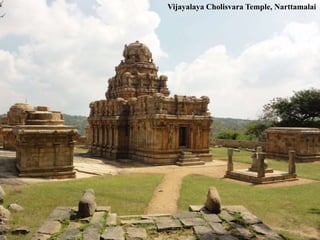
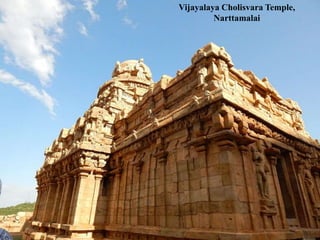
Vijayalaya Cholisvara Temple, Narttamalai
Vijayalaya Cholisvara Temple,
Narttamalai
Later Chola Temples
1.Brihadeshwar Temple
2. Gangaikonda Cholapuram
3. Eravateshwar
Later Temples (985-1122 CE)
1. Architecture style reached its apogee
2. Influence of Challukyan art and Architecture
3. These temples are huge, enclosed in wall and all
elements of temples are big in size.
4. Dwarpalas are big and four handed
5. Single storied vimana are extended to multi storied
6. The brackets of the pillar and pilasters get tenon-like
projections
7. Big temples show greater variety in sculptural
embellishment.
8. Big Gopuram
9. Temples reflecting glory of Imperial Chola.
Brihadisvara Temple, Tanjore
The
Brihdeswara
Temple
• The Brihdeswara Temple
is located in Tanjavur, lies
350 kilometres southwest
from Tamil Nadu.
• The temple is within a
spacious inner prakara of
240.9 m long (east-west)
and 122 m. broad (north-
south).
• A gopuram at the east.
• The temple with its
massive proportions and
simplicity of design.
• This temple provided
inspiration not only in
south India but also in
south-east Asia.
Brihdeswara Temple
•Rajaraja, who commissioned the temple,
called it Rajarajeshvaram literally “the
temple of the god of Rajaraja”.
•Brihdeswara: Brihd means Big,
and Ishvara means lord, “Shiva”, The name
means the “Great lord, big Shiva” temple.
•An exemplary example of a fully
realized Dravida style temple architecture.
Brihdeswara Temple, Tanjore
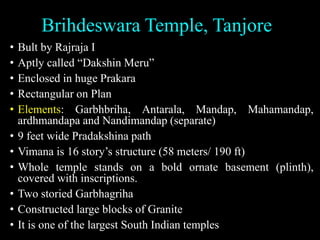
• Bult by Rajraja I
• Aptly called “Dakshin Meru”
• Enclosed in huge Prakara
• Rectangular on Plan
• Elements: Garbhbriha, Antarala, Mandap, Mahamandap,
ardhmandapa and Nandimandap (separate)
• 9 feet wide Pradakshina path
• Vimana is 16 story’s structure (58 meters/ 190 ft)
• Whole temple stands on a bold ornate basement (plinth),
covered with inscriptions.
• Two storied Garbhagriha
• Constructed large blocks of Granite
• It is one of the largest South Indian temples
Elements of temple
• Garbhagriha: Main component (two storied)
• Antarala: flight of steps on either side (North and
South)
• Mahamandapa: Bigger than mandapa
• Mukh-Mandapa: A rectangular entrance hall
• Ardhmandapa: the opening face of the temple
• Nandi mandapa: separate, monolithic bull on a
pedestal
• Prakara: Compound wall.
• Vimana: Shikhar of the temple.
Elements of temple
• Garbhagriha:
a) The garbhagriha is square on plan
b) Stand on on a plinth with up-pitha and
adhisthana
c) Colossal Shivlinga is 8.7 m high.
d) Each side of the Garbhagriha depict
image of Shiva,
e) Sarvotabhadra (opening from four
cardinal sides)
f) Sandhara: at two lowest talas
g) It is 8.7 m (29 ft) high, occupying two
storeys of the sanctum.
h) 16 storeys tower of which 13 are
tapering squares
i) 108 images of Shiva in dancing form
j) Sculpture of Rajraja I and Queen Lok
Mahadevi
Mandapa
• Two Mandapa
• Mukh-mandapa (front)
• Maha-mandapa (middle)
• Rectangular plan, axially
aligned between the sanctum
and the Nandi mandapa.
• Closed by walls
• Numerous pillars
• mandapa have big dwarapala
image at front
Viman
1. Base: square on plan, 82
x 82 feet, 50 feet Hight
2. Pyramidical: 16 storied,
1st is bigger, decorated
with vertical and
horizontal lines
3. Ovel stupica: huge
approx. 80 ton stupica,
has nandi on 4 corners,
4. 190 ft. Hight
5. Each story carries a hara
of kutas, sala and panjara
6. Whole shikhara is
decorated
7. Tallest shikra in India
Elevation of the Temple
The moulded plinth is extensively engraved with inscriptions by its royal builder who refers to
his many endowments, pious acts and organisational events connected to the temple.
Garbhagriha rest upon pitha
This is moulded and 0.5 metres (1 ft 8 in) thick.
It consists of upapitham 140 cm and adhishthanam 360 cm thick.
Decoration
Decoration
1. Moldings divides the lower part of vimana into two
storied.
2. Ground floor (aaditala) of the vimana portray various
form of Shiva: Lingodbhava, Bhikshatana, Natraja,
Gangadhara, Ardhnarishwara, Harihara and
Chandrasekhar etc.
3. Entire interior of the of the ground floor ambulatory,
has been covered with paintings
4. Second tala shows 108 panels (27 uncarved) shiva
demonstrating the 108 dance poses according to
Natyashashtra.
5. Door-guardians are colossal
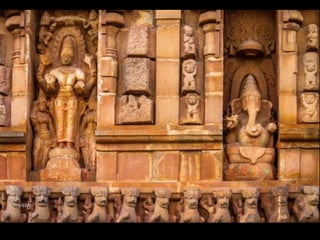
Sculptures on the Mahamandap walls
North side South side
Bhairava (Shiva) Ganesha
Mahishasuramardini
(Durga)
Vishnu
Saraswati Gajalakshmi
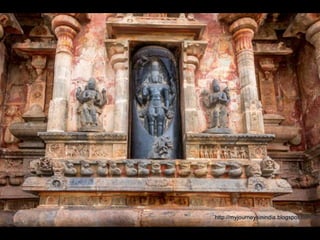
Sculptures on the Garbhagriha
GROUND FLOOR
East West
Lingodbhav Harihara
Pashupat Lingodbhav
2 dwarpala Chandrashekhar
Sculptures on the Garbhagriha
GROUND FLOOR
North South
Ardhnarishwar Virbhadra
Gangadhar Dakshinamurti
Pashupat Natraja
• The mural paintings on the
walls of the lower
ambulatory inside are
finest examples of Chola
and later periods.
• These frescoes on the
sanctum walls along the
circumambulatory
pathway.
• These frescoes discovered
in 1931.
• Painting depicts the
contemporaneous scenes
with legendary ones.
• Most frescoes are related
to Shiva
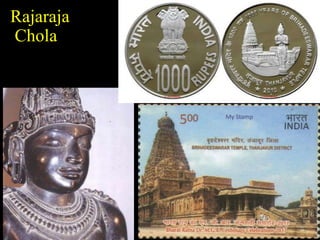
Rajaraja
Chola
Gangaikonda Cholpuram,
Brihadisvara temple
Thank You

Brihdeshwar Temple Tanjore.pptx

  • 1.
  • 2.
  • 3.
    Introduction • The greatCholas established a powerful monarchy in the 9th CE at Thanjavur and in its surroundings. • Cholas, achievements in all fields such as military conquest, efficient administration, cultural assimilation and promotion of art. • Shaivite in belive • The Chola period is a very significant span of time in that south Indian art and architecture. • The Brihadishvara at Thanjavur, is the most significant temple of their period. • Temple was constructed Rajraj I (985-1014 CE)
  • 4.
    Imperial Chola Vijayalaya (850-871) Aditya(871-907)ParantakaI (907-953)Parantaka II/Sundar Chola (973-973)Uttam Chola (973-985) RajrajaI (985-1014)RajendraI (1014-1044)Rajadhiraj(1044- 1052)
  • 5.
    Chola Architecture •Early Temples •(Vijayalaya c.850 CE to Uttama Chola 973-985 CE) •Later Temples • (Rajaraja I c.985-1014 CE to Kullotunga I (c.1072- 1122 CE)
  • 6.
    Early Temples (850-985CE) a) Influence of Pallava Architecture b) Innovations in plan and designs c) Niches of walls are small as compare to Pallavas d) “Kudu” of shikhara are different than the Pallavas temple e) Pillars are different than Pallava f) Dwarpalas are similar to Pallava (two handed) g) Before the Rajaraja (c.985—1014 CE) Chola temples usually consists Vimana, Ardhmandapa and group of eight Parivara shrines surrounded by prakara. h) Also has small gopuram at the entrance i) Vimana are normally squares j) Adhisthanans show variety of ornate forms including narratives from Epics, Puranas and regional religious traditions. k) Pilasters of the wall are tetragonal, octagonal or circular
  • 7.
  • 8.
  • 9.
  • 10.
    Later Chola Temples 1.BrihadeshwarTemple 2. Gangaikonda Cholapuram 3. Eravateshwar
  • 11.
    Later Temples (985-1122CE) 1. Architecture style reached its apogee 2. Influence of Challukyan art and Architecture 3. These temples are huge, enclosed in wall and all elements of temples are big in size. 4. Dwarpalas are big and four handed 5. Single storied vimana are extended to multi storied 6. The brackets of the pillar and pilasters get tenon-like projections 7. Big temples show greater variety in sculptural embellishment. 8. Big Gopuram 9. Temples reflecting glory of Imperial Chola.
  • 12.
  • 13.
    The Brihdeswara Temple • The BrihdeswaraTemple is located in Tanjavur, lies 350 kilometres southwest from Tamil Nadu. • The temple is within a spacious inner prakara of 240.9 m long (east-west) and 122 m. broad (north- south). • A gopuram at the east. • The temple with its massive proportions and simplicity of design. • This temple provided inspiration not only in south India but also in south-east Asia.
  • 14.
    Brihdeswara Temple •Rajaraja, whocommissioned the temple, called it Rajarajeshvaram literally “the temple of the god of Rajaraja”. •Brihdeswara: Brihd means Big, and Ishvara means lord, “Shiva”, The name means the “Great lord, big Shiva” temple. •An exemplary example of a fully realized Dravida style temple architecture.
  • 15.
    Brihdeswara Temple, Tanjore •Bult by Rajraja I • Aptly called “Dakshin Meru” • Enclosed in huge Prakara • Rectangular on Plan • Elements: Garbhbriha, Antarala, Mandap, Mahamandap, ardhmandapa and Nandimandap (separate) • 9 feet wide Pradakshina path • Vimana is 16 story’s structure (58 meters/ 190 ft) • Whole temple stands on a bold ornate basement (plinth), covered with inscriptions. • Two storied Garbhagriha • Constructed large blocks of Granite • It is one of the largest South Indian temples
  • 17.
    Elements of temple •Garbhagriha: Main component (two storied) • Antarala: flight of steps on either side (North and South) • Mahamandapa: Bigger than mandapa • Mukh-Mandapa: A rectangular entrance hall • Ardhmandapa: the opening face of the temple • Nandi mandapa: separate, monolithic bull on a pedestal • Prakara: Compound wall. • Vimana: Shikhar of the temple.
  • 20.
    Elements of temple •Garbhagriha: a) The garbhagriha is square on plan b) Stand on on a plinth with up-pitha and adhisthana c) Colossal Shivlinga is 8.7 m high. d) Each side of the Garbhagriha depict image of Shiva, e) Sarvotabhadra (opening from four cardinal sides) f) Sandhara: at two lowest talas g) It is 8.7 m (29 ft) high, occupying two storeys of the sanctum. h) 16 storeys tower of which 13 are tapering squares i) 108 images of Shiva in dancing form j) Sculpture of Rajraja I and Queen Lok Mahadevi
  • 21.
    Mandapa • Two Mandapa •Mukh-mandapa (front) • Maha-mandapa (middle) • Rectangular plan, axially aligned between the sanctum and the Nandi mandapa. • Closed by walls • Numerous pillars • mandapa have big dwarapala image at front
  • 22.
    Viman 1. Base: squareon plan, 82 x 82 feet, 50 feet Hight 2. Pyramidical: 16 storied, 1st is bigger, decorated with vertical and horizontal lines 3. Ovel stupica: huge approx. 80 ton stupica, has nandi on 4 corners, 4. 190 ft. Hight 5. Each story carries a hara of kutas, sala and panjara 6. Whole shikhara is decorated 7. Tallest shikra in India
  • 23.
  • 29.
    The moulded plinthis extensively engraved with inscriptions by its royal builder who refers to his many endowments, pious acts and organisational events connected to the temple.
  • 30.
    Garbhagriha rest uponpitha This is moulded and 0.5 metres (1 ft 8 in) thick. It consists of upapitham 140 cm and adhishthanam 360 cm thick.
  • 32.
  • 33.
    Decoration 1. Moldings dividesthe lower part of vimana into two storied. 2. Ground floor (aaditala) of the vimana portray various form of Shiva: Lingodbhava, Bhikshatana, Natraja, Gangadhara, Ardhnarishwara, Harihara and Chandrasekhar etc. 3. Entire interior of the of the ground floor ambulatory, has been covered with paintings 4. Second tala shows 108 panels (27 uncarved) shiva demonstrating the 108 dance poses according to Natyashashtra. 5. Door-guardians are colossal
  • 34.
    Sculptures on theMahamandap walls North side South side Bhairava (Shiva) Ganesha Mahishasuramardini (Durga) Vishnu Saraswati Gajalakshmi Sculptures on the Garbhagriha GROUND FLOOR East West Lingodbhav Harihara Pashupat Lingodbhav 2 dwarpala Chandrashekhar Sculptures on the Garbhagriha GROUND FLOOR North South Ardhnarishwar Virbhadra Gangadhar Dakshinamurti Pashupat Natraja
  • 35.
    • The muralpaintings on the walls of the lower ambulatory inside are finest examples of Chola and later periods. • These frescoes on the sanctum walls along the circumambulatory pathway. • These frescoes discovered in 1931. • Painting depicts the contemporaneous scenes with legendary ones. • Most frescoes are related to Shiva
  • 37.
  • 39.
  • 50.