
AFFILIATED WITH
Of all the marketing variables that influence the potential sales 
of airline seats and cargo capacity, price has received the most 
attention since deregulation. 
Economists have emphasized the price variable in describing 
the level of demand. Pricing remains a very complex issue in 
many industries. In the case of air transportation, it is even 
more complex because of the transition in recent years 
from a highly regulated industry to a deregulated environment.
Demand is defined as the various amounts of a product 
or service that consumers are willing and able to 
purchase at various prices over a particular time period. 
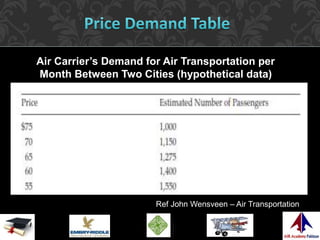
A demand schedule is simply a representation of a series of 
possibilities that can be set down in tabular form. 
There is an inverse relationship between price and quantity 
demanded. Economists have labeled this inverse relationship 
the law of demand.
Air Carrier’s Demand for Air Transportation per 
Month Between Two Cities (hypothetical data) 
Ref John Wensveen – Air Transportation
Assumption --- Price is the key variable and all others factors 
are insignificant – however, non-price determinants exist. 
The major non-price determinants of demand in the air travel 
market are: 
(1) the preferences of passengers, 
(2) the number of passengers in a particular market, 
(3) the financial status and income levels of the passengers, 
(4) the prices of competitors and related travel expenses, and 
(5) passenger expectations with respect to future prices.
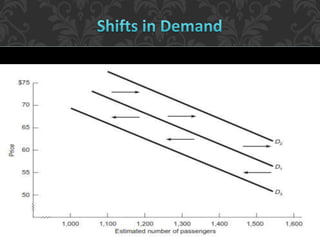
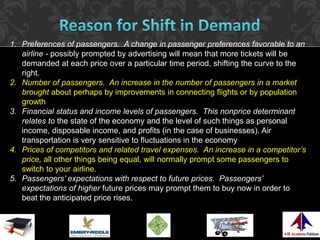
1. Preferences of passengers. A change in passenger preferences favorable to an 
airline - possibly prompted by advertising will mean that more tickets will be 
demanded at each price over a particular time period, shifting the curve to the 
right. 
2. Number of passengers. An increase in the number of passengers in a market 
brought about perhaps by improvements in connecting flights or by population 
growth 
3. Financial status and income levels of passengers. This nonprice determinant 
relates to the state of the economy and the level of such things as personal 
income, disposable income, and profits (in the case of businesses). Air 
transportation is very sensitive to fluctuations in the economy 
4. Prices of competitors and related travel expenses. An increase in a competitor’s 
price, all other things being equal, will normally prompt some passengers to 
switch to your airline. 
5. Passengers’ expectations with respect to future prices. Passengers’ 
expectations of higher future prices may prompt them to buy now in order to 
beat the anticipated price rises.
Elasticity of Demand 
Coefficient of Elasticity 
Determinants of Elasticity 
Types of Passenger Fares 
Pricing Process 
Intro to Airline Costs 
Output Determination
Airline pricing & demand

Airline pricing & demand

  • 1.
  • 3.
    Of all themarketing variables that influence the potential sales of airline seats and cargo capacity, price has received the most attention since deregulation. Economists have emphasized the price variable in describing the level of demand. Pricing remains a very complex issue in many industries. In the case of air transportation, it is even more complex because of the transition in recent years from a highly regulated industry to a deregulated environment.
  • 5.
    Demand is definedas the various amounts of a product or service that consumers are willing and able to purchase at various prices over a particular time period. A demand schedule is simply a representation of a series of possibilities that can be set down in tabular form. There is an inverse relationship between price and quantity demanded. Economists have labeled this inverse relationship the law of demand.
  • 6.
    Air Carrier’s Demandfor Air Transportation per Month Between Two Cities (hypothetical data) Ref John Wensveen – Air Transportation
  • 8.
    Assumption --- Priceis the key variable and all others factors are insignificant – however, non-price determinants exist. The major non-price determinants of demand in the air travel market are: (1) the preferences of passengers, (2) the number of passengers in a particular market, (3) the financial status and income levels of the passengers, (4) the prices of competitors and related travel expenses, and (5) passenger expectations with respect to future prices.
  • 10.
    1. Preferences ofpassengers. A change in passenger preferences favorable to an airline - possibly prompted by advertising will mean that more tickets will be demanded at each price over a particular time period, shifting the curve to the right. 2. Number of passengers. An increase in the number of passengers in a market brought about perhaps by improvements in connecting flights or by population growth 3. Financial status and income levels of passengers. This nonprice determinant relates to the state of the economy and the level of such things as personal income, disposable income, and profits (in the case of businesses). Air transportation is very sensitive to fluctuations in the economy 4. Prices of competitors and related travel expenses. An increase in a competitor’s price, all other things being equal, will normally prompt some passengers to switch to your airline. 5. Passengers’ expectations with respect to future prices. Passengers’ expectations of higher future prices may prompt them to buy now in order to beat the anticipated price rises.
  • 11.
    Elasticity of Demand Coefficient of Elasticity Determinants of Elasticity Types of Passenger Fares Pricing Process Intro to Airline Costs Output Determination