Airline Marketing 6:
Airline Marketing Product
Analysis
Dr Narudh Cheramakara
1/2017
Bangkok University
1. What are airlines’ products?
• Airline industry product’s is intangible unlike
manufacturing industry
• Instantly perishable and can not be stored
• Intangible and multifaceted
-
1. What are airlines’ products?
Route as product
- The rise and fall of TPE : and potential rise again
- Connectivity through hubs: DXB v traditional
kangaroo route
- Nok with the highest domestic destinations
1. What are airlines’ products?
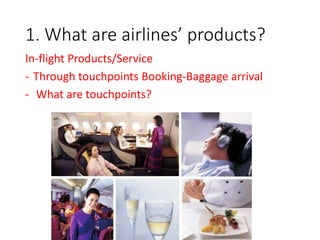
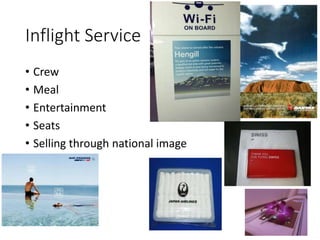
In-flight Products/Service
- Through touchpoints Booking-Baggage arrival
- What are touchpoints?
1. What are airlines’ products?
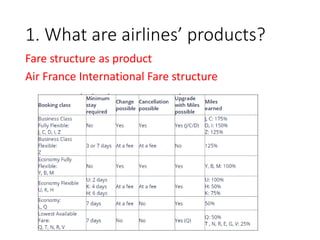
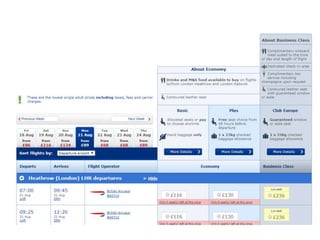
Fare structure as product
Air France International Fare structure
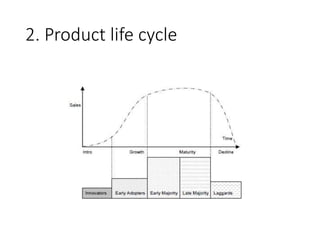
2. Product life cycle
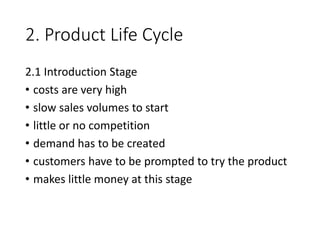
2. Product Life Cycle
2.1 Introduction Stage
• costs are very high
• slow sales volumes to start
• little or no competition
• demand has to be created
• customers have to be prompted to try the product
• makes little money at this stage
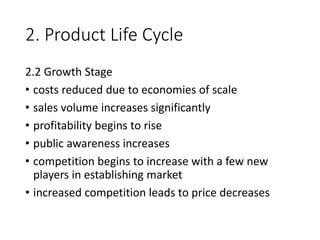
2. Product Life Cycle
2.2 Growth Stage
• costs reduced due to economies of scale
• sales volume increases significantly
• profitability begins to rise
• public awareness increases
• competition begins to increase with a few new
players in establishing market
• increased competition leads to price decreases
2. Product Life Cycle
2.3 Maturity Stage
• costs are decreased as a result of production volumes
increasing and experience curve effects
• sales volume peaks and market saturation is reached
• increase in competitors entering the market
• prices tend to drop due to the proliferation of
competing products
• brand differentiation and feature diversification is
emphasized to maintain or increase market share
• industrial profits go down
2. Product Life Cycle
2.4 Decline stage
• costs become counter-optimal
• sales volume decline
• prices, profitability diminish
• profit becomes more a challenge of
production/distribution efficiency than increased
sales
3. Product Innovation
For a successful product innovation E.M. Rogers
suggests the following points of consideration
3.1 Relative Advantage
• new products must be substantially better value-
for-money thanthose they are replacing, in order
for consumers to accept the risks of using them
3. Product Innovation
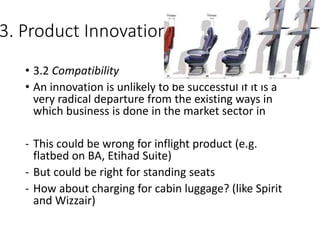
• 3.2 Compatibility
• An innovation is unlikely to be successful if it is a
very radical departure from the existing ways in
which business is done in the market sector in
- This could be wrong for inflight product (e.g.
flatbed on BA, Etihad Suite)
- But could be right for standing seats
- How about charging for cabin luggage? (like Spirit
and Wizzair)
3. Product Innovation
• 3.3 Complexity
• Some innovations fail because they are perceived
as being extremelydifficult to use, requiring
purchasers to invest a great deal of time and effort
• This is why LCCs make booking and payment very
easy.
• Nok Air has a policy of not collecting irrelevant
passengers’ data (DOB, passport no, etc.)  This is
a double-edged sword for CRM Analysis.
3. Product Innovation
• 3.4 4. Divisibility
• It is often easier to persuade consumers to take a
series of short steps, rather than one very large and
risky one.
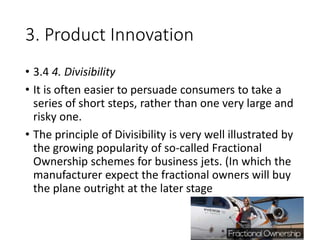
• The principle of Divisibility is very well illustrated by
the growing popularity of so-called Fractional
Ownership schemes for business jets. (In which the
manufacturer expect the fractional owners will buy
the plane outright at the later stage
3. Product Innovation
• 3.5 Communicability
• Customers are unlikely to be persuaded to buy a
product if the benefits this product will bring
cannot be communicated to them persuasively.
• Miscommunication and the socalled ‘internet
drama’ is very difficult to handle by airlines
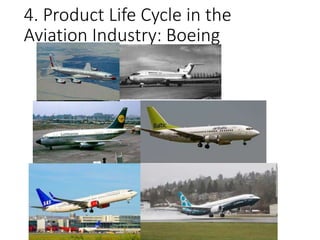
4. Product Life Cycle in the
Aviation Industry: Boeing
4. Product Life Cycle in the
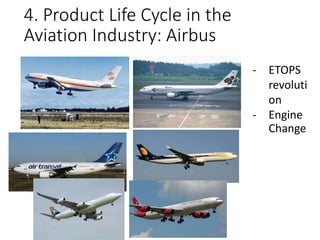
Aviation Industry: Airbus
- ETOPS
revoluti
on
- Engine
Change
4. Product Life Cycle in the
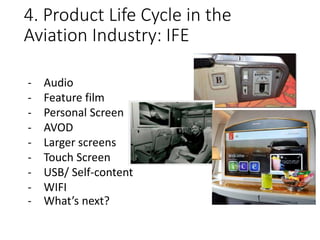
Aviation Industry: IFE
- Audio
- Feature film
- Personal Screen
- AVOD
- Larger screens
- Touch Screen
- USB/ Self-content
- WIFI
- What’s next?
4. Product Life Cycle in the
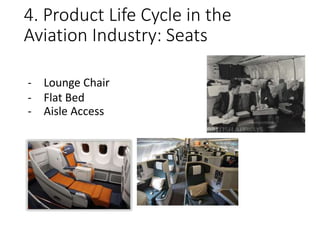
Aviation Industry: Seats
- Lounge Chair
- Flat Bed
- Aisle Access
5. Managing Product Portfolio
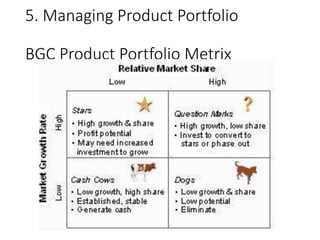
BGC Product Portfolio Metrix
BGC Portfolio Metrix: Airlines
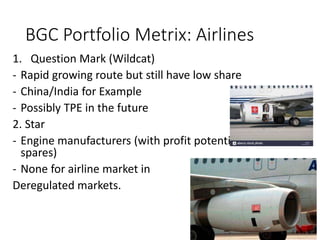
1. Question Mark (Wildcat)
- Rapid growing route but still have low share
- China/India for Example
- Possibly TPE in the future
2. Star
- Engine manufacturers (with profit potential from
spares)
- None for airline market in
Deregulated markets.
BGC Portfolio Metrix: Airlines
3. Cashcow
This is the one where the product in question still has a good
share of the market, but where the total market is no longer
growing strongly.
The fundamental difference between Stars and Cash Cows is
that the Cash Cow market will no longer be an attractive one
for new entrants.
Established firms will have invested to gain their place in the
market, and should be able to continue to exploit it
successfully.
- CFM56 for 737NGs
4. Dog
- KBV for Nok Air
6. ANSOFF Metrix
• The Ansoff Matrix is a strategic planning tool that
provides a framework to help executives, senior
managers, and marketers devise strategies for
future growth. It is named after Russian
American Igor Ansoff, who came up with the
concept.
6. ANSOFF Metrix
6. ANSOFF Metrix
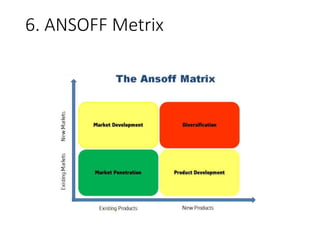
• Market penetration
• In market penetration strategy, the organization tries to
grow using its existing offerings (products and services) in
existing markets.
• In other words, it tries to increase its market sharein current
market scenario. This involves increasing market share
within existing market segments. This can be achieved by
selling more products or services to established customers
or by finding new customers within existing markets. Here,
the company seeks increased sales for its present products
in its present markets through more aggressive promotion
and distribution.
• This can be accomplished by: (i) Price decrease; (ii) Increase
in promotion and distribution support; (iii) Acquisition of a
rival in the same market; (iv) Modest product refinements
6. ANSOFF Metrix
• Market development[edit]
• In market development strategy, a firm tries to expand into
new markets (geographies, countries etc.) using its existing
offerings.
• This can be accomplished by (i) Different customer
segments (ii) Industrial buyers for a good that was
previously sold only to the households; (iii) New areas or
regions about of the country (iv) Foreign markets. This
strategy is more likely to be successful where:- (i) The firm
has a unique product technology it can leverage in the new
market; (ii) It benefits from economies of scale if it increases
output; (iii) The new market is not too different from the
one it has experience of; (iv) The buyers in the market are
intrinsically profitable.
6. ANSOFF Metrix
• Product development
• In product development strategy, a company tries to
create new products and services targeted at its
existing markets to achieve growth.
• This involves extending the product range available to
the firm's existing markets. These products may be
obtained by: (i) Investment in research and
development of additional products; (ii) Acquisition of
rights to produce someone else's product; (iii) Buying in
the product and "branding" it; (iv) Joint development
with ownership of another company who need access
to the firm's distribution channels or brands.
6. ANSOFF Metrix
• Diversification
• In diversification an organization tries to grow its market
share by introducing new offerings in new markets. It is the
most risky strategy because both product and market
development is required. (i) Related Diversification - Here
there is relationship and, therefore, potential synergy,
between the firms in existing business and the new
product/market space. (a) Concentric diversification, and (b)
Vertical integration. (ii) Unrelated Diversification: This is
otherwise termed conglomerate growth because the
resulting corporation is a conglomerate, i.e. a collection of
businesses without any relationship to one another.A
strategy for company growth through starting up or
acquiring businesses outside the company’s current
products and markets
Key Take Away from ANSOFF
Matrix
• The overall message of the Ansoff Matrix is a clear one.
To achieve the correct balance between risk and
opportunity, firms must have products which fit into
each of the four boxes of the Matrix. There must be
established products and markets which provide for
profits in the short term. The business must grow and
develop using examples drawn from Boxes Two and
Three. If it can do so, there may be room for some
much riskier products drawn from the Fourth Box. It
must be accepted that some of these products will fail.
Others may cause large early losses before becoming
long-term winners. The business must be certain that
current profits are sufficient to cover these possible
losses.
7. Airline Product
7.1 Cabin and Class
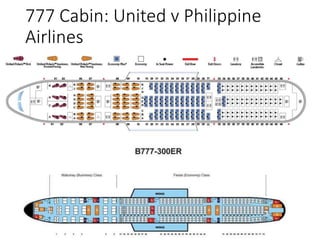
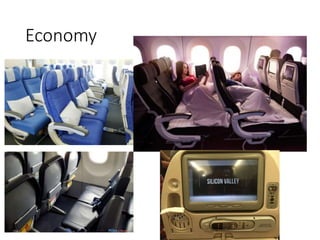
- Declining Seat Pitch for Economy (min 28)
- Seat Abreast on 777, 330
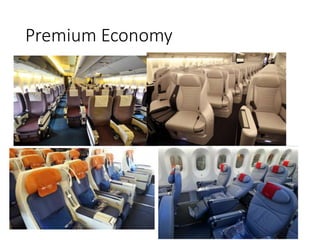
- Premium Economy Class Development
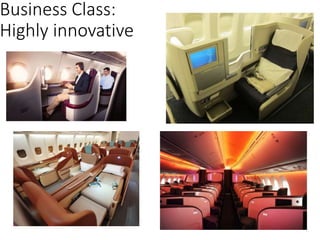
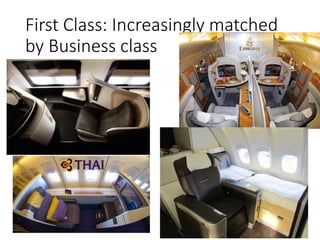
- The Flatbed in Business Class and Decline of First
Class
777 Cabin: United v Philippine
Airlines
Economy
Premium Economy
Business Class:
Highly innovative
First Class: Increasingly matched
by Business class
7. Airline Product
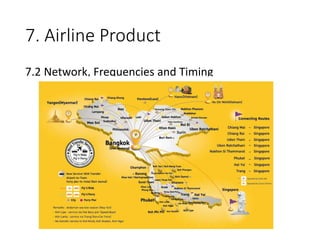
7.2 Network, Frequencies and Timing
A. Network:
- Hub or Direct? Pros and Cons (BA v Easyjet)
- Problem of Constraint (Slot, operating hours – noise
banned at night at LHR, traffic rights)
7. Airline Product
7.2 Network, Frequencies and Timing
7. Airline Product
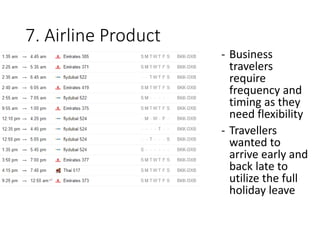
- Business
travelers
require
frequency and
timing as they
need flexibility
- Travellers
wanted to
arrive early and
back late to
utilize the full
holiday leave
7. Airline Product
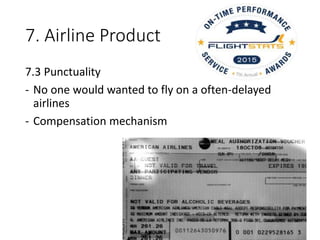
7.3 Punctuality
- No one would wanted to fly on a often-delayed
airlines
- Compensation mechanism
7. Airline Product
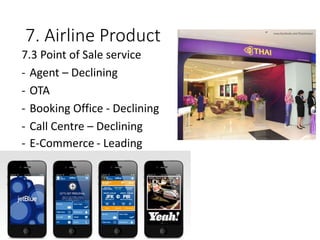
7.3 Point of Sale service
- Agent – Declining
- OTA
- Booking Office - Declining
- Call Centre – Declining
- E-Commerce - Leading
7. Airline Product
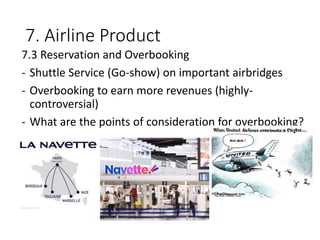
7.3 Reservation and Overbooking
- Shuttle Service (Go-show) on important airbridges
- Overbooking to earn more revenues (highly-
controversial)
- What are the points of consideration for overbooking?
7. Airline Product
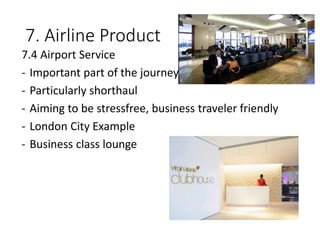
7.4 Airport Service
- Important part of the journey
- Particularly shorthaul
- Aiming to be stressfree, business traveler friendly
- London City Example
- Business class lounge
Inflight Service
• Crew
• Meal
• Entertainment
• Seats
• Selling through national image
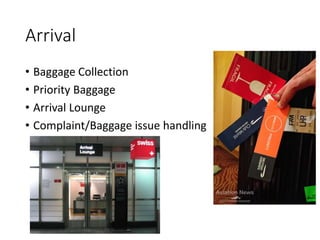
Arrival
• Baggage Collection
• Priority Baggage
• Arrival Lounge
• Complaint/Baggage issue handling