Aircraft Analysis
Contents
● Project Objective
● Project Methodology
● Aircraft
● B-2 Bomber
● An-225
● Concorde Airliner
● Su-47 Fighter
● Focke-Wulf Triebflügel Interceptor
Project Objective
Airplane Development and their Aerodynamics
● 5 aircraft of different design and for different
purposes
○ B2 Bomber
○ Concorde
○ Antonov An-225
○ Su-47 Fighter
○ Focke-Wulf Triebflügel Interceptor
● How the design has impacted the aerodynamics
and the intended purpose of the aircraft?
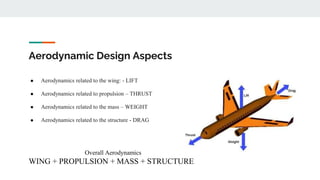
Aerodynamic Design Aspects
● Aerodynamics related to the wing: - LIFT
● Aerodynamics related to propulsion – THRUST
● Aerodynamics related to the mass – WEIGHT
● Aerodynamics related to the structure - DRAG
Overall Aerodynamics
WING + PROPULSION + MASS + STRUCTURE
B-2 Stealth Bomber
● B-2 is a flying wing/--high lift efficiency--higher payloads.
● 4 electric (77 kN)-thrust non-afterburning turbofan.
● Subsonic (Mach 0.95 at sea level)
● Range of 6000 nautical miles without refueling.
● Maximum takeoff weight: 376,000 lb (170,600 kg).
B-2 Bomber
● The entire body of B-2 is generating lift/ its flying-wing design.
● No rudder needed/with one side of the speedbrake extended, drag will be created on one side of the
aircraft but the other side does not generate additional drag. Therefore, a torque would be created
and the plane will rotate/yaw to the side where the speedbrake is extended--this acts as the rudder of
the B-2.
● Relatively low maneuverability due to its long wingspan/high aspect ratio--low angular roll
acceleration.
Concorde Airliner
● Delta (triangular) Wing/incorporates ailerons and horizontal stabilizers (6
trailing edge “elevons”).
● Large wing area--provides sufficient lift at low speeds with high angles of
attack/generates “air cushion”, which makes the landing smoother even at
higher landing speeds.
● Wing shape similar to fighter jets--low drag at high speeds.
● Aspect ratio 1.7 (low)
● Maximum takeoff weight: 408,000 lbs (185,000 kg)
Concorde Airliner
The overall design is focused on bringing concorde to supersonic speeds. Its delta wing is similar to fighter jets;
with ailerons and elevators incorporated, it requires the wing to stretch from nose to tail, which creates this large wing
area and provides additional lift at high angles of attack. The fuselage is much flatter and slimmer compared to other
airliners like the Boeing 777. The nose has a much sharper tip, which accommodates supersonic flight as well, but
requires the droop nose design as pilots cannot get sufficient visuals during landing with such a long nose.
Su-47 Fighter
Forward-swept wing:
● Higher lift to drag ratio
● increase in maneuverability/decrease in yaw stability
● Ailerons are effective at high angles of attack
● 2 × Soloviev D-30F6 afterburning turbofan engines
● 93.1 kN for each engine, 153kN with afterburner
● Maximum speed at altitude: 2200 km/h (2.21 Mach)
● Gross weight: 25670 kg
● Maximum takeoff weight: 34000 kg
Su-47 Fighter
The most noticeable feature of Su-47 is its forward-swept wing design. As a military fighter jet, this wing design enhances
one of the most important aspects for fighter jets during dog fight--maneuverability. Although it has certain drawbacks
compared to normal backward-swept wings such as instability and may jeopardize the aircraft under certain maneuvers by
causing a spiral dive, which is not recoverable. Moreover, the wing structure could be stressed to the point of failure.
Antonov An-225
● Aspect ratio: 8.6
● 6 Turbofans engine
● 230 kN each
● Speed 850 km/h
● Empty weight: 350000 kg
● Max. takeoff weight: 600000 kg
Antonov An-225
Super-heavy cargo freighter
An-225 has a twin tail vertical stabilizer as large external
payloads (e.g. space shuttle) would disturb the airflow
around a conventional vertical stabilizer. It is not designed to
land on short runways and for military services.
Focke-Wulf Triebflügel Interceptor
● There are no wings; a three-blade propeller with a jet engine on the end
of each blade.
● Four tailplanes, combining rudders and elevators.
● The pitch of the blades is adjustable in order to change the amount of
lift generated.
● Empty weight: 2,500 kg (5,200 lb)
● VTOL (vertical takeoff/landing)
● Designed to intercept heavy bombers.
● 3 × Walter liquid fuel rockets
● 3 × Pabst ramjets, 8.9 kN (2,000 lbf) thrust each
● Rockets for starting the propeller; when the rotation
speed is high enough, the rockets will expire and the
airflow will be sufficient for the ramjets to function.
● Rotors 220 rpm at max level speed
● Max speed: 1000 km/h
Focke-Wulf Triebflügel Interceptor
The rotor blades are similar to the ones on helicopters and during
level flight, it is used for thrust. Since it mainly provides forward thrust,
the fuselage has to pitch up in order to generate sufficient lift for the
aircraft to stay in the air. Also, to counteract the torque provided by the
rotor, the tailplanes are also responsible for preventing the fuselage from
rotating with the rotor.

Aircraft Analysis Project

  • 1.
  • 2.
    Contents ● Project Objective ●Project Methodology ● Aircraft ● B-2 Bomber ● An-225 ● Concorde Airliner ● Su-47 Fighter ● Focke-Wulf Triebflügel Interceptor
  • 3.
    Project Objective Airplane Developmentand their Aerodynamics ● 5 aircraft of different design and for different purposes ○ B2 Bomber ○ Concorde ○ Antonov An-225 ○ Su-47 Fighter ○ Focke-Wulf Triebflügel Interceptor ● How the design has impacted the aerodynamics and the intended purpose of the aircraft?
  • 4.
    Aerodynamic Design Aspects ●Aerodynamics related to the wing: - LIFT ● Aerodynamics related to propulsion – THRUST ● Aerodynamics related to the mass – WEIGHT ● Aerodynamics related to the structure - DRAG Overall Aerodynamics WING + PROPULSION + MASS + STRUCTURE
  • 5.
    B-2 Stealth Bomber ●B-2 is a flying wing/--high lift efficiency--higher payloads. ● 4 electric (77 kN)-thrust non-afterburning turbofan. ● Subsonic (Mach 0.95 at sea level) ● Range of 6000 nautical miles without refueling. ● Maximum takeoff weight: 376,000 lb (170,600 kg).
  • 6.
    B-2 Bomber ● Theentire body of B-2 is generating lift/ its flying-wing design. ● No rudder needed/with one side of the speedbrake extended, drag will be created on one side of the aircraft but the other side does not generate additional drag. Therefore, a torque would be created and the plane will rotate/yaw to the side where the speedbrake is extended--this acts as the rudder of the B-2. ● Relatively low maneuverability due to its long wingspan/high aspect ratio--low angular roll acceleration.
  • 7.
    Concorde Airliner ● Delta(triangular) Wing/incorporates ailerons and horizontal stabilizers (6 trailing edge “elevons”). ● Large wing area--provides sufficient lift at low speeds with high angles of attack/generates “air cushion”, which makes the landing smoother even at higher landing speeds. ● Wing shape similar to fighter jets--low drag at high speeds. ● Aspect ratio 1.7 (low) ● Maximum takeoff weight: 408,000 lbs (185,000 kg)
  • 8.
    Concorde Airliner The overalldesign is focused on bringing concorde to supersonic speeds. Its delta wing is similar to fighter jets; with ailerons and elevators incorporated, it requires the wing to stretch from nose to tail, which creates this large wing area and provides additional lift at high angles of attack. The fuselage is much flatter and slimmer compared to other airliners like the Boeing 777. The nose has a much sharper tip, which accommodates supersonic flight as well, but requires the droop nose design as pilots cannot get sufficient visuals during landing with such a long nose.
  • 9.
    Su-47 Fighter Forward-swept wing: ●Higher lift to drag ratio ● increase in maneuverability/decrease in yaw stability ● Ailerons are effective at high angles of attack ● 2 × Soloviev D-30F6 afterburning turbofan engines ● 93.1 kN for each engine, 153kN with afterburner ● Maximum speed at altitude: 2200 km/h (2.21 Mach) ● Gross weight: 25670 kg ● Maximum takeoff weight: 34000 kg
  • 10.
    Su-47 Fighter The mostnoticeable feature of Su-47 is its forward-swept wing design. As a military fighter jet, this wing design enhances one of the most important aspects for fighter jets during dog fight--maneuverability. Although it has certain drawbacks compared to normal backward-swept wings such as instability and may jeopardize the aircraft under certain maneuvers by causing a spiral dive, which is not recoverable. Moreover, the wing structure could be stressed to the point of failure.
  • 11.
    Antonov An-225 ● Aspectratio: 8.6 ● 6 Turbofans engine ● 230 kN each ● Speed 850 km/h ● Empty weight: 350000 kg ● Max. takeoff weight: 600000 kg
  • 12.
    Antonov An-225 Super-heavy cargofreighter An-225 has a twin tail vertical stabilizer as large external payloads (e.g. space shuttle) would disturb the airflow around a conventional vertical stabilizer. It is not designed to land on short runways and for military services.
  • 13.
    Focke-Wulf Triebflügel Interceptor ●There are no wings; a three-blade propeller with a jet engine on the end of each blade. ● Four tailplanes, combining rudders and elevators. ● The pitch of the blades is adjustable in order to change the amount of lift generated. ● Empty weight: 2,500 kg (5,200 lb) ● VTOL (vertical takeoff/landing) ● Designed to intercept heavy bombers. ● 3 × Walter liquid fuel rockets ● 3 × Pabst ramjets, 8.9 kN (2,000 lbf) thrust each ● Rockets for starting the propeller; when the rotation speed is high enough, the rockets will expire and the airflow will be sufficient for the ramjets to function. ● Rotors 220 rpm at max level speed ● Max speed: 1000 km/h
  • 14.
    Focke-Wulf Triebflügel Interceptor Therotor blades are similar to the ones on helicopters and during level flight, it is used for thrust. Since it mainly provides forward thrust, the fuselage has to pitch up in order to generate sufficient lift for the aircraft to stay in the air. Also, to counteract the torque provided by the rotor, the tailplanes are also responsible for preventing the fuselage from rotating with the rotor.