Shaping
efficiency
A350 flight deck
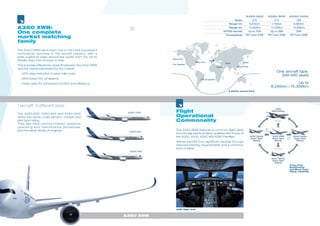
The A350 XWB features a common flight deck
and virtually identical flying qualities with those of
the A320, A330, A340 and A380 Families.
Airlines benefit from significant savings through
reduced training requirements and a common
pool of pilots.
Flight
Operational
Commonality 5 days
10
days
10
days
11 days
One aircraft type,
200-400 seats
Up to
8,250nm / 15,300km
A350 XWB
Cross Crew
Qualification
and Mixed Fleet
Flying capability
A350-800
276
8,250nm
15,300km
Up to 259t
RR Trent XWB
A350-900
315
7,750nm
14,350km
Up to 268t
RR Trent XWB
A350-1000
369
8,000nm
14,800km
308t
RR Trent XWB
Seats
Range nm
Range km
MTOW-tonnes
Powerplants
A350 XWB:
One complete
market matching
family
The A350 XWB has known one of the most successful
commercial launches in the aircraft industry, with a
wide customer base around the world: from the US to
Middle-East, from Europe to Asia.
This success reflects the close fit between the A350 XWB
and the needs expressed by the market:
• 25% step reduction in seat-mile costs
• 25% lower CO2
emissions
• Wide cabin for enhanced comfort and efficiency
A350-1000
1 aircraft, 3 different sizes
The A350-800, A350-900 and A350-1000
share the same cross section, cockpit and
pilot type rating.
They also have common interior, systems,
operating and maintenance procedures,
and the same family of engines. A350-900
A350-800
A350 XWB
8,250nm around Paris
Paris
Dubai
Delhi Tokyo
Hong Kong
Rio de Janeiro
New York
Vancouver
Los Angeles
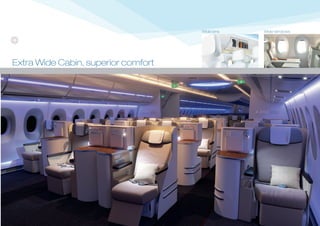
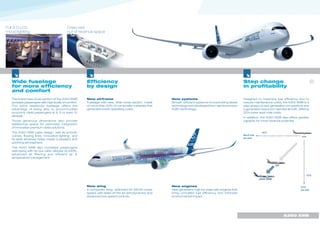
Wide bins
Extra Wide Cabin, superior comfort
Wide windows
Full 3-D LED
mood lighting
New airframe
Fuselage with new, wide cross section, made
of more than 50% of composite materials that
generates lower operating costs.
Crew rest
out of revenue space
Efficiency
by design
Wide fuselage
for more efficiency
and comfort
The brand new cross section of the A350 XWB
provides passengers with high levels of comfort.
The extra widebody fuselage offers the
advantage of being able to accommodate
economy class passengers at 8, 9 or even 10
abreast.
Those generous dimensions also provide
additionnal space for optimized integration
of innovative premium class solutions.
The A350 XWB cabin design, with its smooth
curves, flowing lines, innovative lighting and
its wide windows helps create a pleasant and
soothing atmosphere.
The A350 XWB also increases passengers
well-being with its low cabin altitude (6,000ft),
advanced air filtering and efficient air &
temperature management.
New wing
A composite wing, optimized for M0.85 cruise
speed, with state-of-the art aerodynamics and
advanced low-speed controls.
Step change
in profitability
Designed to maximize fuel efficiency and to
reduce maintenance costs, the A350 XWB is a
step ahead of new generation competitors and
a generation beyond in-service aircraft, offering
25% lower seat-mile costs.
In addition, the A350 XWB also offers greater
capacity for more revenue potential.
COC
per seat
New systems
Simple, efficient systems incorporating latest
technology and developed from service proven
A380 technology.
New engines
Next generation high by-pass ratio engines that
bring unrivalled fuel efficiency and minimize
environmental impact.
Block Fuel
per seat
A350 XWB
787
777
-25%
-25%
A350 XWB
Shaping
eco-efficiency
Recognizing the need for a sustainable development
of air travel, the environment will benefit from the
efficiency inherent in the A350 XWB Family.
Next generation engines and state of the art
aerodynamics help reduce emissions well below
current and future regulations.
NOx emissions will be up to 40% lower than CAEP/6
requirements and exterior noise levels will be up to
16dB lower than ICAO chapter 4 regulations.
The A350 XWB will have some of the lowest CO2
emissions in the industry which also means that, at
equal emissions levels, it is capable of carrying more
passengers than its competitors.
Market
adaptability
The A350 XWB is designed to be efficient on very
long-haul missions but also for regional operations.
To reduce costs on shorter range missions, it
combines reduced operating weight options with up
to 40% engine derate capability.
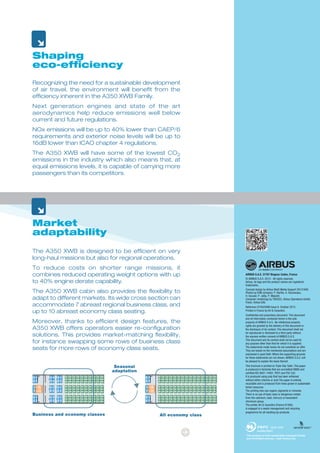
The A350 XWB cabin also provides the flexibility to
adapt to different markets. Its wide cross section can
accommodate 7 abreast regional business class, and
up to 10 abreast economy class seating.
Moreover, thanks to efficient design features, the
A350 XWB offers operators easier re-configuration
solutions. This provides market-matching flexibility,
for instance swapping some rows of business class
seats for more rows of economy class seats.
Business and economy classes All economy class
Seasonal
adaptation
AIRBUS S.A.S. 31707 Blagnac Cedex, France
© AIRBUS S.A.S. 2013 - All rights reserved,
Airbus, its logo and the product names are registered
trademarks.
Concept design by Airbus Multi Media Support 20131908.
Photos by EXM company: P. Barthe, A. Doumenjou,
H. Goussé, P. Jalby, P. Masclet.
Computer renderings by TBCEI22, Airbus Operations GmbH,
Fixion, Airbus EIAI.
Reference D10025986 Issue 6. October 2013.
Printed in France by Art & Caractère.
Confidential and proprietary document. This document
and all information contained herein is the sole
property of AIRBUS S.A.S.. No intellectual property
rights are granted by the delivery of this document or
the disclosure of its content. This document shall not
be reproduced or disclosed to a third party without
the express written consent of AIRBUS S.A.S.
This document and its content shall not be used for
any purpose other than that for which it is supplied.
The statements made herein do not constitute an offer.
They are based on the mentioned assumptions and are
expressed in good faith. Where the supporting grounds
for these statements are not shown, AIRBUS S.A.S. will
be pleased to explain the basis thereof.
This brochure is printed on Triple Star Satin. This paper
is produced in factories that are accredited EMAS and
certified ISO 9001-14001, PEFC and FSC CoC.
It is produced using pulp that has been whitened
without either chlorine or acid.The paper is entirely
recyclable and is produced from trees grown in sustainable
forest resources.
The printing inks use organic pigments or minerals.
There is no use of basic dyes or dangerous metals
from the cadmium, lead, mercury or hexavalent
chromium group.
The printer, Art & Caractère (France 81500),
is engaged in a waste management and recycling
programme for all resulting by-products.

Airbus A350

  • 1.
  • 2.
    A350 flight deck TheA350 XWB features a common flight deck and virtually identical flying qualities with those of the A320, A330, A340 and A380 Families. Airlines benefit from significant savings through reduced training requirements and a common pool of pilots. Flight Operational Commonality 5 days 10 days 10 days 11 days One aircraft type, 200-400 seats Up to 8,250nm / 15,300km A350 XWB Cross Crew Qualification and Mixed Fleet Flying capability A350-800 276 8,250nm 15,300km Up to 259t RR Trent XWB A350-900 315 7,750nm 14,350km Up to 268t RR Trent XWB A350-1000 369 8,000nm 14,800km 308t RR Trent XWB Seats Range nm Range km MTOW-tonnes Powerplants A350 XWB: One complete market matching family The A350 XWB has known one of the most successful commercial launches in the aircraft industry, with a wide customer base around the world: from the US to Middle-East, from Europe to Asia. This success reflects the close fit between the A350 XWB and the needs expressed by the market: • 25% step reduction in seat-mile costs • 25% lower CO2 emissions • Wide cabin for enhanced comfort and efficiency A350-1000 1 aircraft, 3 different sizes The A350-800, A350-900 and A350-1000 share the same cross section, cockpit and pilot type rating. They also have common interior, systems, operating and maintenance procedures, and the same family of engines. A350-900 A350-800 A350 XWB 8,250nm around Paris Paris Dubai Delhi Tokyo Hong Kong Rio de Janeiro New York Vancouver Los Angeles
  • 3.
    Wide bins Extra WideCabin, superior comfort Wide windows
  • 4.
    Full 3-D LED moodlighting New airframe Fuselage with new, wide cross section, made of more than 50% of composite materials that generates lower operating costs. Crew rest out of revenue space Efficiency by design Wide fuselage for more efficiency and comfort The brand new cross section of the A350 XWB provides passengers with high levels of comfort. The extra widebody fuselage offers the advantage of being able to accommodate economy class passengers at 8, 9 or even 10 abreast. Those generous dimensions also provide additionnal space for optimized integration of innovative premium class solutions. The A350 XWB cabin design, with its smooth curves, flowing lines, innovative lighting and its wide windows helps create a pleasant and soothing atmosphere. The A350 XWB also increases passengers well-being with its low cabin altitude (6,000ft), advanced air filtering and efficient air & temperature management. New wing A composite wing, optimized for M0.85 cruise speed, with state-of-the art aerodynamics and advanced low-speed controls. Step change in profitability Designed to maximize fuel efficiency and to reduce maintenance costs, the A350 XWB is a step ahead of new generation competitors and a generation beyond in-service aircraft, offering 25% lower seat-mile costs. In addition, the A350 XWB also offers greater capacity for more revenue potential. COC per seat New systems Simple, efficient systems incorporating latest technology and developed from service proven A380 technology. New engines Next generation high by-pass ratio engines that bring unrivalled fuel efficiency and minimize environmental impact. Block Fuel per seat A350 XWB 787 777 -25% -25% A350 XWB
  • 5.
    Shaping eco-efficiency Recognizing the needfor a sustainable development of air travel, the environment will benefit from the efficiency inherent in the A350 XWB Family. Next generation engines and state of the art aerodynamics help reduce emissions well below current and future regulations. NOx emissions will be up to 40% lower than CAEP/6 requirements and exterior noise levels will be up to 16dB lower than ICAO chapter 4 regulations. The A350 XWB will have some of the lowest CO2 emissions in the industry which also means that, at equal emissions levels, it is capable of carrying more passengers than its competitors. Market adaptability The A350 XWB is designed to be efficient on very long-haul missions but also for regional operations. To reduce costs on shorter range missions, it combines reduced operating weight options with up to 40% engine derate capability. The A350 XWB cabin also provides the flexibility to adapt to different markets. Its wide cross section can accommodate 7 abreast regional business class, and up to 10 abreast economy class seating. Moreover, thanks to efficient design features, the A350 XWB offers operators easier re-configuration solutions. This provides market-matching flexibility, for instance swapping some rows of business class seats for more rows of economy class seats. Business and economy classes All economy class Seasonal adaptation AIRBUS S.A.S. 31707 Blagnac Cedex, France © AIRBUS S.A.S. 2013 - All rights reserved, Airbus, its logo and the product names are registered trademarks. Concept design by Airbus Multi Media Support 20131908. Photos by EXM company: P. Barthe, A. Doumenjou, H. Goussé, P. Jalby, P. Masclet. Computer renderings by TBCEI22, Airbus Operations GmbH, Fixion, Airbus EIAI. Reference D10025986 Issue 6. October 2013. Printed in France by Art & Caractère. Confidential and proprietary document. This document and all information contained herein is the sole property of AIRBUS S.A.S.. No intellectual property rights are granted by the delivery of this document or the disclosure of its content. This document shall not be reproduced or disclosed to a third party without the express written consent of AIRBUS S.A.S. This document and its content shall not be used for any purpose other than that for which it is supplied. The statements made herein do not constitute an offer. They are based on the mentioned assumptions and are expressed in good faith. Where the supporting grounds for these statements are not shown, AIRBUS S.A.S. will be pleased to explain the basis thereof. This brochure is printed on Triple Star Satin. This paper is produced in factories that are accredited EMAS and certified ISO 9001-14001, PEFC and FSC CoC. It is produced using pulp that has been whitened without either chlorine or acid.The paper is entirely recyclable and is produced from trees grown in sustainable forest resources. The printing inks use organic pigments or minerals. There is no use of basic dyes or dangerous metals from the cadmium, lead, mercury or hexavalent chromium group. The printer, Art & Caractère (France 81500), is engaged in a waste management and recycling programme for all resulting by-products.